

Agricultural Micronutrients Market Size and Forecast – 2026 to 2033
The Agricultural Micronutrients Market is anticipated to grow at a CAGR of 8.9% with USD 6.1 Bn share in 2026 and is expected to reach USD 10.2 Bn in 2033. Declining soil fertility, increasing demand for higher crop yields, and greater awareness of micronutrient deficiencies are driving the Agricultural Micronutrients Market. India and global agriculture face worsening soil degradation and nutrient depletion, with over 90% of India’s cultivated soils severely deficient in nitrogen and phosphorus.
Key Takeaways
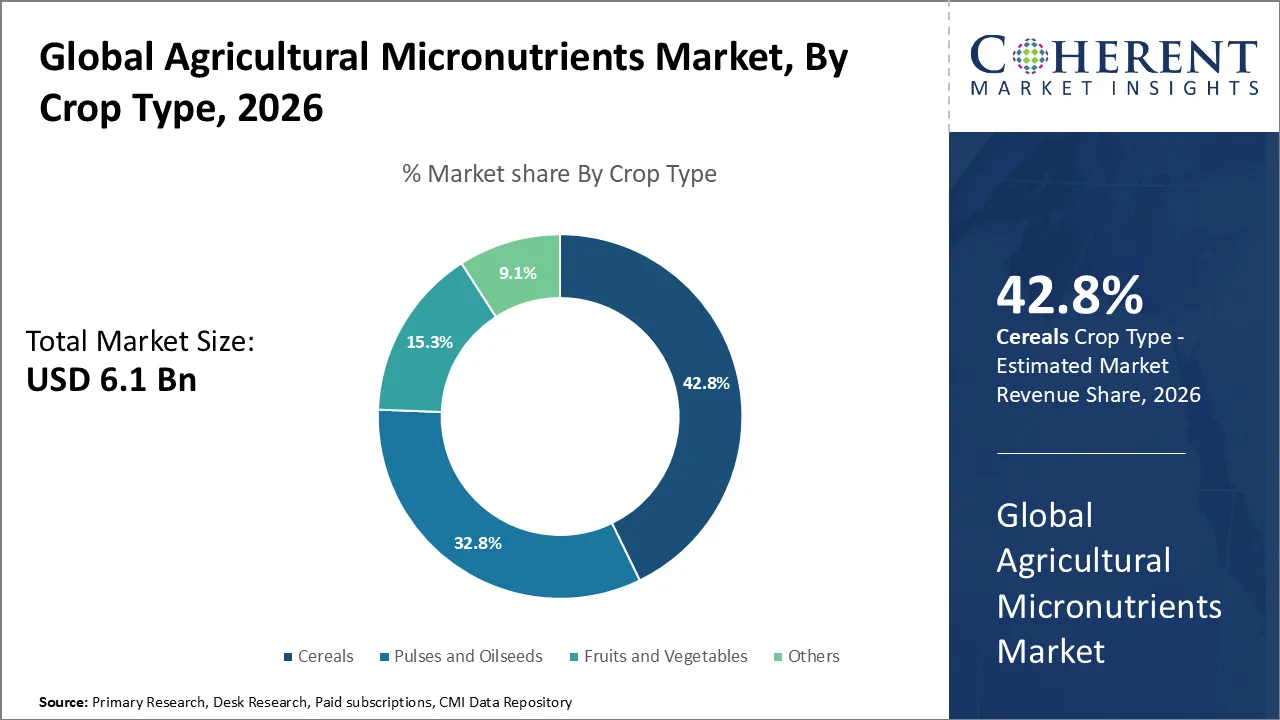
- Cereals hold the largest market share of 42.8% in 2026 owing to the growing cereal production. Global cereal production reached a record 2.9 Bn tonnes in 2025.
- Copper expected to hold largest market share of 36.7% in 2026 owing to its increasing soil copper deficiency. Soil copper concentrations typically range from 2 to 100 ppm, with an average of approximately 30 ppm.
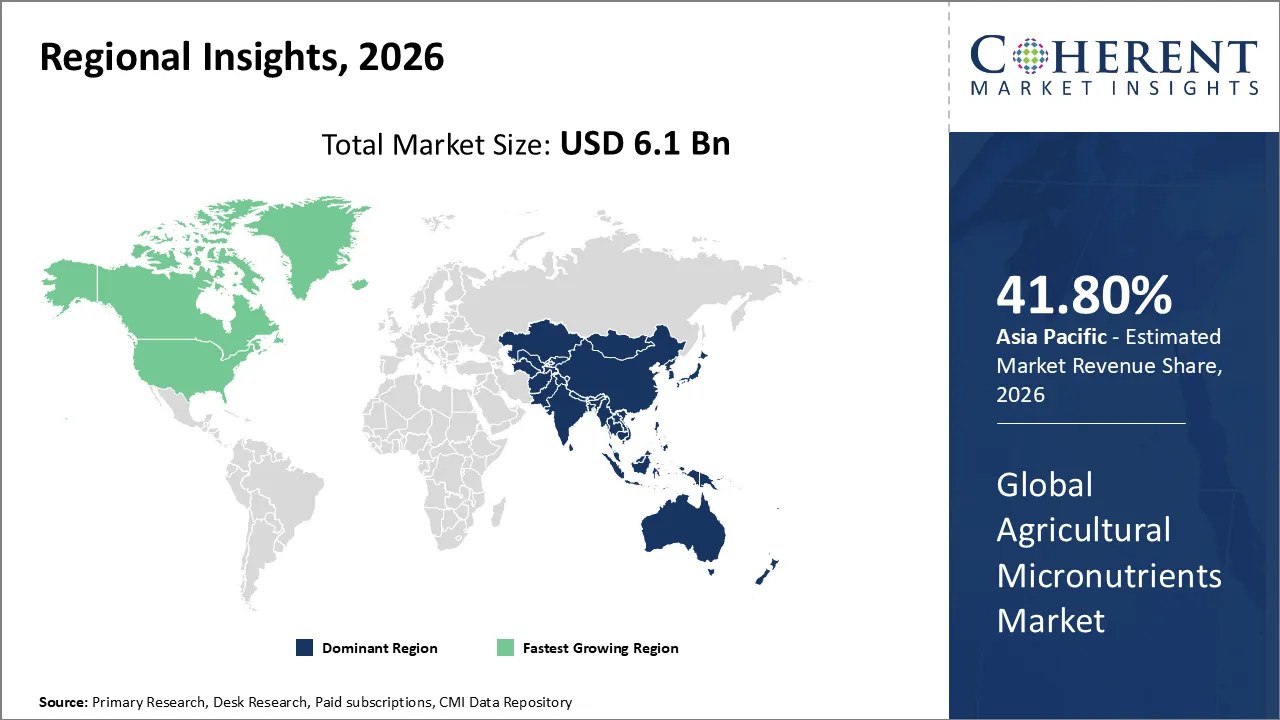
- Asia Pacific is expected to acquire the dominant share of 41.8% in 2026 owing to the soil micronutrient deficiencies. Approximately 48% of India’s agricultural soils are deficient in available zinc, making zinc deficiency the most widespread micronutrient constraint in the country.
Current Events and Their Impact on the Agricultural Micronutrients Market
Current Event | Description and its Impact |
India’s PM-PRANAM Scheme Promotes Balanced Fertilizer Use |
|
Expansion of Soil Testing Under India’s Soil Health Card Programme |
|
Segmental Insights
- Current Industry Events of 2026
- Market Size Estimation
- Regional Breakdown
- Competitive Landscape
- Customer Intelligence
- Segmental Analysis
- Pricing Analysis
- Key Market Drivers, Challenges & Future Trends
- Customized Insights Section
Why is Cereals Acquiring the Largest Market Share?
Cereals hold the largest market share of 42.8% in 2026. Rising cereal production and growing food demand are driving the cereals segment in the Agricultural Micronutrients Market, while farmers seek to increase yields from limited farmland. Intensive cultivation and repeated cropping deplete essential micronutrients, including zinc, iron, boron, and manganese, prompting farmers to replenish these nutrients. Farmers are also adopting balanced fertilization, soil testing, foliar applications, and precision agriculture to target nutrient deficiencies in wheat, rice, maize, and other cereals. Increasing awareness of micronutrient benefits further strengthens market demand. Coromandel International launched Paramfos Plus, a magnesium-fortified complex fertilizer in Bengaluru. The product contains 16% nitrogen, 20% phosphorus, 13% sulphur, and 0.6% magnesium, supporting photosynthesis, chlorophyll production, vegetative growth, and crop yield.
Which Product Type segment dominates the market?
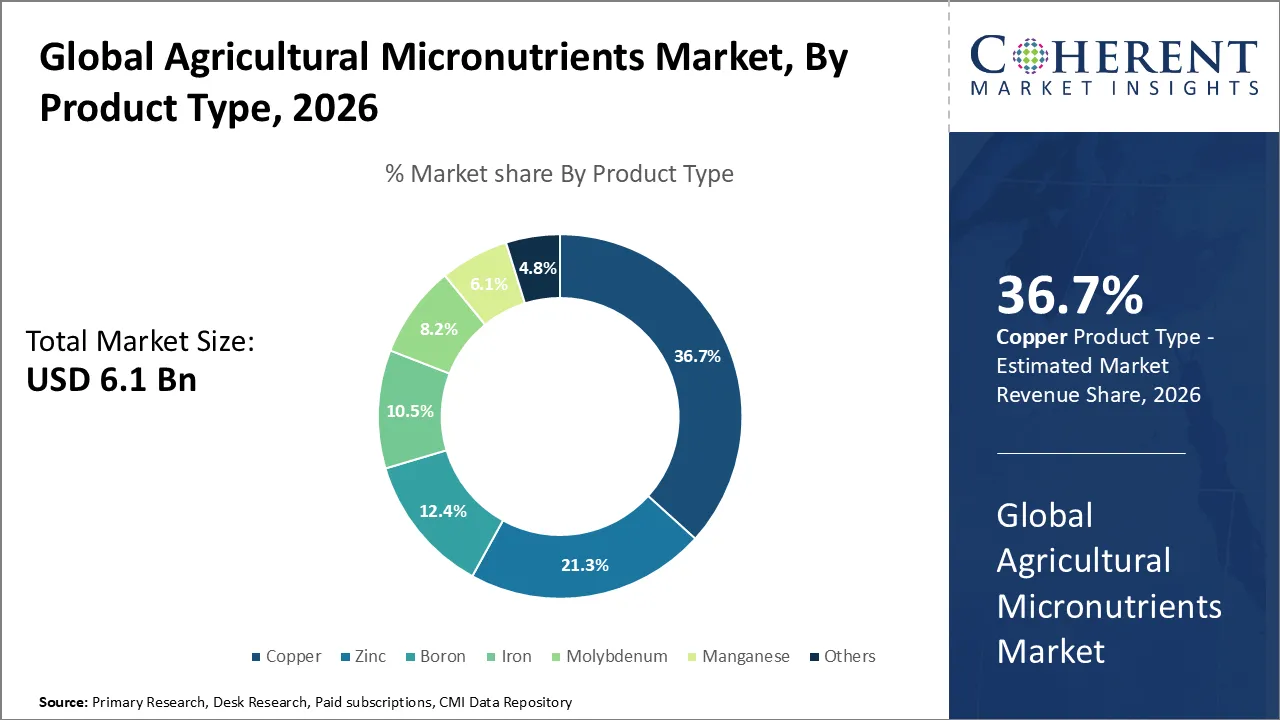
Copper expected to hold largest market share of 36.7% in 2026. Intensive farming and ongoing soil nutrient depletion are increasing demand for copper in the Agricultural Micronutrients Market. Farmers apply copper fertilizers to correct soil deficiencies and promote photosynthesis, enzyme activity, and reproductive development in crops. For instance, IFFCO received central government approval for its nano liquid zinc and nano liquid copper products under the Fertiliser Control Order for three years. The expansion of high-value crop cultivation and the need to improve agricultural productivity are further encouraging micronutrient use. Farmers increasingly employ soil testing, foliar spraying, fertigation, and precision agriculture to detect and correct copper deficiencies. Greater awareness of balanced crop nutrition and soil health also drives copper fertilizer adoption.
Agricultural Micronutrients Market Trends
- Growing adoption of precision agriculture and soil testing enables farmers to identify micronutrient deficiencies more accurately and apply nutrients such as zinc, boron, iron, manganese, and copper more efficiently. In India, ICAR reports that analysis of 242,827 surface-soil samples collected across 600 districts during 2014–2020 found 36.5% of samples deficient in plant-available zinc and 23.4% deficient in boron, highlighting the substantial need for targeted micronutrient management.
- Increasing demand for balanced crop nutrition encourages farmers to complement conventional NPK fertilizers with micronutrients, supporting nutrient-use efficiency, crop development, yield, and soil fertility. Globally, agricultural use of inorganic fertilizers reached 197 million tonnes of nutrients in 2024, according to the latest FAOSTAT data. Nitrogen accounted for 115 million tonnes, phosphorus for 44 million tonnes, and potassium for 38 million tonnes, demonstrating the scale of the broader fertilizer market in which micronutrient products are increasingly used alongside primary nutrients.
Regional Insights
Asia Pacific dominates owing to government support for soil health
Asia Pacific is expected to acquire the dominant share of 41.80% in 2026. Asia Pacific’s large agricultural sector, rising food demand, and the need to increase crop productivity drive the Agricultural Micronutrients Market. Farmers intensively cultivate land, which gradually depletes essential soil nutrients and encourages them to apply micronutrient fertilizers. Growing awareness of zinc, boron, iron, manganese, and copper deficiencies further increases adoption. Governments promote soil health, balanced fertilization, and soil testing, supporting market growth. Farmers also increasingly use precision agriculture, fertigation, and high-value crop cultivation, creating demand for targeted micronutrient solutions across the region. Yara India upgraded its FarmCare app on World Soil Day, highlighting the growing impact of secondary and micronutrient depletion on crop yields and nutritional quality.
North America Agricultural Micronutrients Market Trends
Farmers across North America increasingly recognize soil deficiencies in essential micronutrients such as zinc, boron, iron, and manganese, driving demand for effective crop nutrition. Commercial and intensive farming practices further encourage producers to improve nutrient management and crop productivity. Farmers also adopt precision agriculture, soil testing, variable-rate application, and targeted fertilization to optimize nutrient use. Growing specialty-crop cultivation, improved irrigation systems, and the need for higher-quality produce additionally support the adoption of chelated and specialized micronutrient formulations throughout the region. For instance, ICL launched its Nova line of advanced water-soluble micronutrient and N-P-K fertilizers in North America, featuring FINISH, PULSE, ELEVATE, and FLOW for foliar and fertigation applications.
China Agricultural Micronutrients Market Trends
China’s agricultural micronutrients market grows as farmers seek to increase crop yields, improve soil health, and enhance nutrient-use efficiency. Intensive farming practices create micronutrient deficiencies in soils, driving demand for zinc, boron, iron, and manganese products. Government programs that promote scientific fertilization, soil testing, and sustainable farming further encourage adoption. In July 2026, China announced six major environmental projects, including initiatives to prevent soil pollution at its source and improve the treatment of small rural water bodies. Farmers also increasingly use precision agriculture and fertigation to apply micronutrients efficiently. Limited arable land and food-security priorities encourage producers to adopt technologies that improve agricultural productivity and crop quality.
United States Agricultural Micronutrients Market Trends
The United States agricultural micronutrients market grows as farmers increasingly recognize soil nutrient deficiencies, especially those involving zinc, boron, manganese, and iron, that can limit crop productivity. Farmers are adopting precision agriculture, tissue analysis, variable-rate application, and remote sensing to improve nutrient management. Demand for higher crop yields and quality, specialty crop cultivation, and stronger focus on soil health and sustainable farming further supports market growth. Manufacturers also advance chelated, liquid, foliar, and fertigation-compatible formulations to meet evolving agricultural needs.
Who are the Major Companies in Agricultural Micronutrients Industry
Some of the major key players in Agricultural Micronutrients are The Dow Chemical Company, BASF SE, The Mosaic Company, Akzo Nobel N.V., Yara International ASA, The Potash Corporation, Land O'Lakes, Inc., Marubeni Corporation, and Nufarm Limited.
Key News
- In June 2026, ICAR-Central Potato Research Institute (ICAR-CPRI) joined the nationwide “Khet Bachao Abhiyan” to promote soil health, balanced fertilizer use, natural farming, and sustainable agricultural practices among farmers. Source: PIB
Market Report Scope
Agricultural Micronutrients Market Report Coverage
Report Coverage | Details | ||
Base Year: | 2025 | Market Size in 2026: | USD 6.1 Bn |
Historical Data for: | 2020 to 2024 | Forecast Period: | 2026 to 2033 |
Forecast Period 2026 to 2033 CAGR: | 8.9% | 2033 Value Projection: | USD 10.2 Bn |
Geographies covered: |
| ||
Segments covered: |
| ||
Companies covered: | The Dow Chemical Company, BASF SE, The Mosaic Company, Akzo Nobel N.V., Yara International ASA, The Potash Corporation, Land O'Lakes, Inc., Marubeni Corporation, and Nufarm Limited. | ||
Analyst Opinion
- The U.S. agricultural micronutrients market is being shaped less by broad fertilizer consumption and more by the industry’s shift toward nutrient-specific, evidence-based application. USDA data show that 775,055 U.S. farms used commercial fertilizer, lime, or soil conditioners across nearly 236.8 million treated acres in 2022, creating a substantial application infrastructure through which micronutrient products can penetrate. The strongest opportunity lies in products that integrate with soil testing, precision application, and crop-specific nutrient programs rather than generic micronutrient blends.
- Zinc and iron represent particularly compelling technical opportunities because micronutrient deficiencies can directly affect crop nutritional quality, not merely yield. USDA Agricultural Research Service research across six U.S. wheat sites found critically low available soil zinc at every site, while grain zinc at some locations reached only about half of the nutritional target of 25 mg/kg. The same research found that grain zinc declined by approximately 6 mg/kg across a 4,000 kg/ha difference in yield, highlighting the dilution challenge created by higher-yielding crops. This evidence supports greater interest in targeted zinc management and biofortification strategies, particularly across the Central Great Plains.
- U.S. field evidence shows that the economic case depends heavily on soil conditions and crop response. For example, University of Missouri Extension evaluated 69 farmer-field experiments on corn response to zinc and reported an average yield response of only 0.02 units, with researchers concluding that soil generally supplied sufficient zinc for full yield in those trials. This reinforces the view that future demand will increasingly favor diagnostic-led products and precision placement over blanket micronutrient applications.
- Precision agriculture is therefore becoming a critical commercial differentiator rather than simply a technology trend. USDA’s fertilizer-use program tracks nutrient application by crop and state, while its latest documentation notes that surveyed states represented 93% of planted corn acres, 96% of soybean acres, 89% of cotton acres, and 85% of winter wheat acres. Such extensive crop-specific data strengthen the case for manufacturers to develop formulations and application recommendations around specific crops, soil conditions, and nutrient requirements.
- U.S. market will increasingly reward micronutrient suppliers that can demonstrate measurable agronomic outcomes. The key competitive battleground is moving from simply supplying zinc, boron, manganese, or iron toward proving when, where, and how these nutrients generate value. Products supported by soil and tissue diagnostics, precision application, and crop-specific trials should have a stronger commercial proposition than undifferentiated micronutrient formulations, particularly as U.S. growers become more disciplined about input efficiency and return on every application.
Speak to the analyst
Want personalized insights?
Take the findings above to one of our principal consultants, or have the report rebuilt around the segments, geographies and competitors you actually track.
Market Segmentation
- By Crop Type (Revenue, USD Bn, 2021-2033)
- Cereals
- Pulses and Oilseeds
- Fruits and Vegetables
- Others (Plantation, Permanent Crops, and Floriculture.)
- By Product Type (Revenue, USD Bn, 2021-2033)
- Copper
- Zinc
- Boron
- Iron
- Molybdenum
- Manganese
- Others (Nickel and Chloride)
- By Region (Revenue, USD Bn, 2021-2033)
- North America
- U.S.
- Canada
- Latin America
- Brazil
- Mexico
- Argentina
- Rest of Latin America
- Europe
- Germany
- U.K.
- France
- Italy
- Spain
- Russia
- Rest of Europe
- Asia Pacific
- China
- India
- Japan
- Australia
- South Korea
- ASEAN
- Rest of Asia Pacific
- Middle East
- GCC
- Israel
- Rest of Middle East
- Africa
- South Africa
- Central Africa
- North Africa
- North America
Sources
Primary Research interviews
- Interviews with agricultural input manufacturers and micronutrient fertilizer producers
- Discussions with distributors, wholesalers, dealers, and retailers of agricultural fertilizers
- Interviews with farmers, large-scale growers, plantation owners, and agricultural cooperatives
- Discussions with agronomists, soil scientists, crop nutrition specialists, and agricultural consultants
- Interviews with representatives of government agricultural departments and fertilizer regulatory authorities
- Discussions with importers and exporters of micronutrient fertilizers
- Interviews with crop advisors and precision-agriculture specialists
- Discussions with representatives of agricultural universities, research institutes, and extension organizations
- Interviews with procurement and sourcing professionals across the agricultural input value chain
- Primary validation of market size, pricing, demand trends, application rates, product preferences, and distribution channels
Databases
- FAOSTAT – fertilizer production, agricultural use, trade, and nutrient statistics
- FAOSTAT Fertilizers by Nutrient database
- FAOSTAT Fertilizers by Product database
- FAOSTAT fertilizer trade matrix
- United Nations Comtrade Database
- World Bank agricultural and economic databases
- OECD agricultural statistics
- USDA National Agricultural Statistics Service (NASS) databases
- USDA Economic Research Service (ERS) fertilizer-use and price datasets
- USDA Foreign Agricultural Service (FAS) databases
- India Ministry of Agriculture & Farmers Welfare databases
- Directorate of Economics and Statistics (DES), Government of India
- Agricultural Census of India
- Soil Health Card database and related soil-fertility datasets
- ICAR and affiliated agricultural research institute databases
- State agricultural department databases and statistical reports
- National Horticulture Board databases
- International fertilizer production, consumption, trade, and crop-production datasets
Magazines
- Fertilizer International
- World Fertilizer
- Farm Chemicals International
- AgriBusiness Global
- CropLife
- Progressive Farmer
- Successful Farming
- The Hindu BusinessLine – Agriculture
- Agriculture Today
- AgroPages
- Indian Farming
- Agricultural industry and crop-production trade publications
Journals
- Journal of Plant Nutrition
- Plant and Soil
- Soil Science and Plant Nutrition
- Journal of Agricultural and Food Chemistry
- Agricultural Research
- Journal of Agriculture and Food Research
- Archives of Agronomy and Soil Science
- Communications in Soil Science and Plant Analysis
- Agronomy
- Plants
- Frontiers in Plant Science
- Frontiers in Sustainable Food Systems
- Indian Journal of Agricultural Sciences
- Indian Journal of Agronomy
- Journal of the Indian Society of Soil Science
- International Journal of Plant & Soil Science
- Peer-reviewed literature covering plant nutrition, soil micronutrients, fertilizer efficiency, crop productivity, and micronutrient deficiencies
Newspapers
- The Economic Times
- The Hindu
- Business Standard
- Financial Express
- Mint
- The Times of India
- The Indian Express
- Reuters
- Bloomberg
- Associated Press
- Regional and international agricultural business newspapers covering fertilizer, agriculture, commodity, and input markets
Associations
- International Fertilizer Association (IFA)
- The Fertilizer Institute (TFI)
- International Plant Nutrition Council (IPNC)
- International Union of Soil Sciences (IUSS)
- International Society for Horticultural Science (ISHS)
- Fertiliser Association of India (FAI)
- Indian Council of Agricultural Research (ICAR)
- National Fertilizers Association and relevant national fertilizer associations
- Crop-specific and agricultural producer associations
- National and regional associations representing fertilizer manufacturers, distributors, dealers, and agricultural input suppliers
Public Domain sources
- Food and Agriculture Organization of the United Nations (FAO)
- FAOSTAT
- United Nations Comtrade
- World Bank
- OECD
- United Nations Statistics Division
- USDA National Agricultural Statistics Service (NASS)
- USDA Economic Research Service (ERS)
- USDA Foreign Agricultural Service (FAS)
- U.S. Department of Commerce trade statistics
- Government of India – Ministry of Agriculture & Farmers Welfare
- Government of India – Department of Fertilizers
- Directorate General of Commercial Intelligence and Statistics (DGCI&S)
- Directorate of Economics and Statistics (DES)
- Indian Council of Agricultural Research (ICAR)
- National Sample Survey Office (NSSO/NSO)
- Agricultural Census of India
- Soil Health Card Programme
- National Horticulture Board
- State agriculture and horticulture departments
- Agricultural universities and government research institutions
- International agricultural research organizations and publicly available research repositories
- Peer-reviewed open-access research papers and institutional publications
- Government notifications, fertilizer policies, agricultural statistics, trade records, annual reports, and regulatory publications
Proprietary Elements
- CMI Data Analytics Tool
- Proprietary CMI Existing Repository of information for the last 10 years
Get access to 250+ pages report
Every segment, forecast, competitor profile and data table behind the analysis above — available for instant download.
- ESOMAR Member
- ISO 9001:2015 Certified
- D-U-N-S Registered
- GDPR & CCPA Compliant
Missing comfort of reading report in your local language? Find your preferred language:
Transform your Strategy with Exclusive Trending Reports
Frequently Asked Questions
Agricultural micronutrients are essential plant nutrients required in smaller quantities than primary nutrients such as nitrogen, phosphorus, and potassium.
The market is primarily driven by declining soil fertility, intensive cultivation, increasing demand for crop productivity, adoption of precision agriculture, and expanding use of soil testing and targeted nutrient application.
Cereals represent the leading crop segment in the provided market assessment.
Cereal production operates on a large agricultural acreage and requires consistent nutrient availability to sustain productivity.
Copper is expected to represent the leading product segment.