

Global Foldable Soil Testing Devices Market Size and Forecast – 2026- 2033
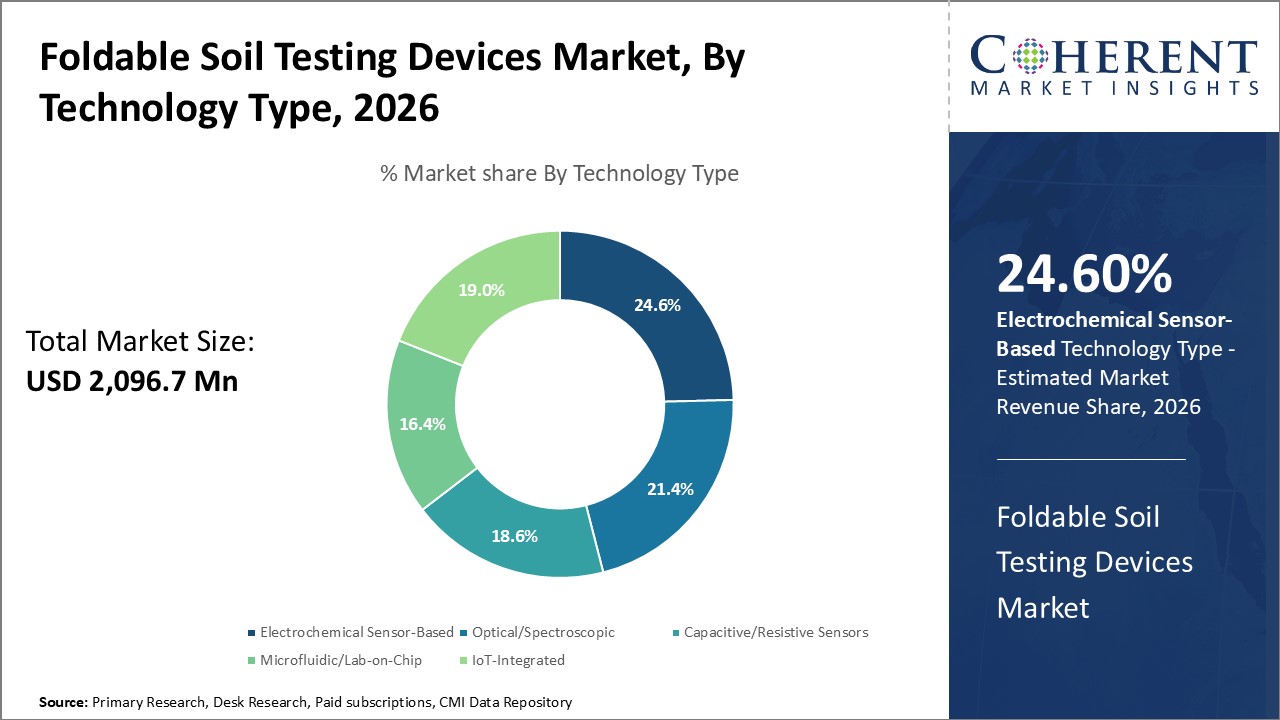
The Global Foldable Soil Testing Devices Market is estimated to be valued at USD 2,096.7 Mn in 2026 and is expected to reach USD 3,932.3 Mn by 2033, exhibiting a compound annual growth rate (CAGR) of 9.4% from 2026 to 2033.
Key Takeaways of the Foldable Soil Testing Devices Market
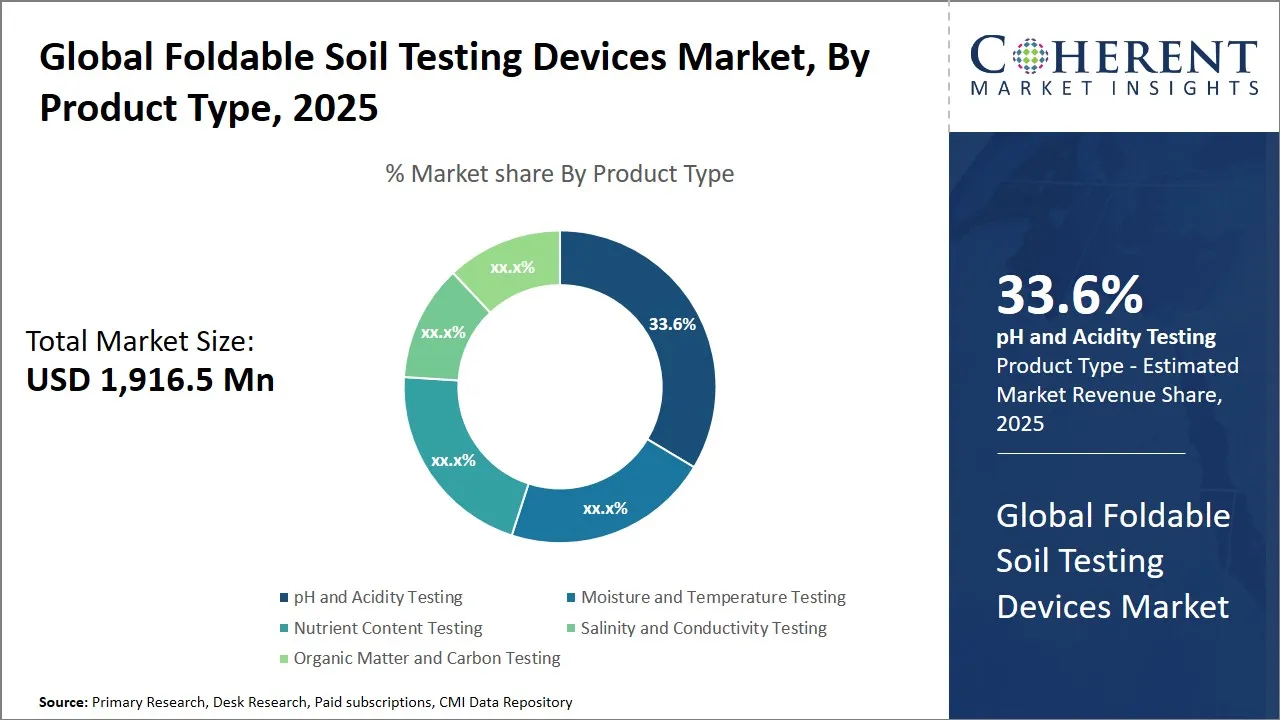
- The pH and acidity testing segment is expected to capture 34.6 % of the global foldable soil testing devices market in 2026.
- The electrochemical sensor-based segment is projected to hold a 24.6 % share of the market in 2026.
- The agriculture & farming segment is expected to account for 29.8 % of the foldable soil testing devices market in 2026.
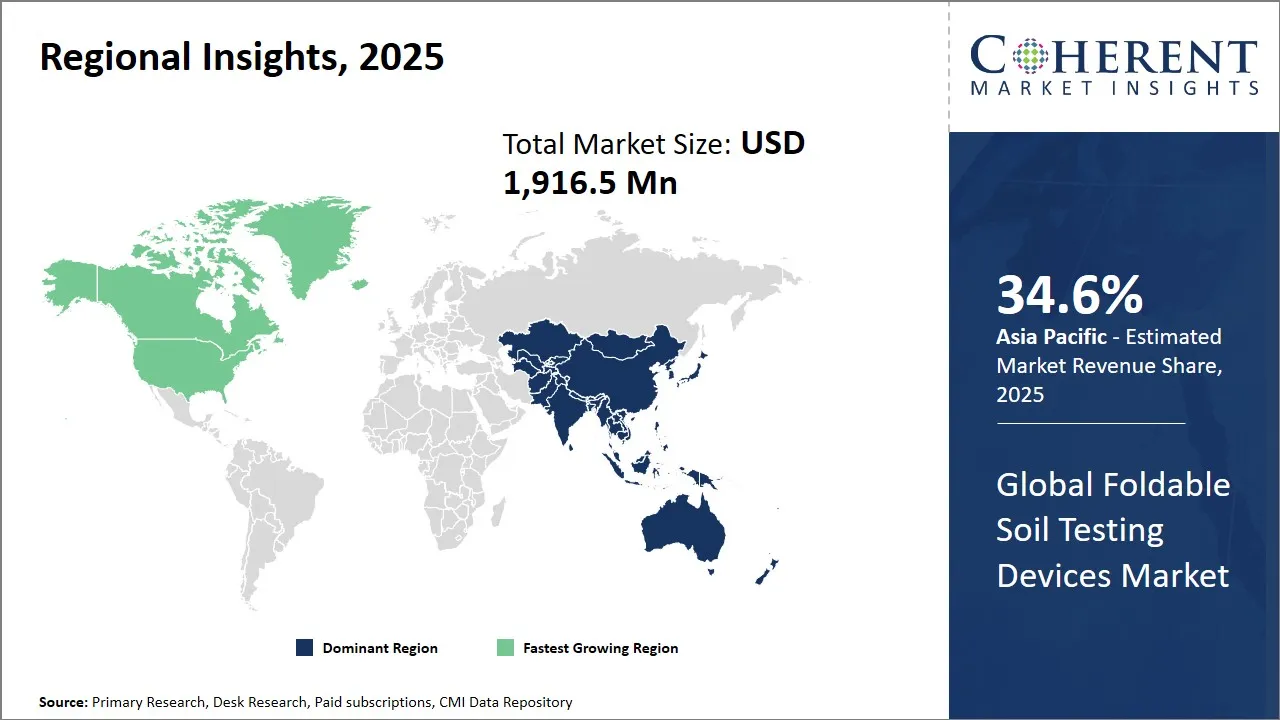
- Asia Pacific is set to lead the global foldable soil testing devices market in 2026 with a 34.6 % share. North America, with a 28.4% share, will be the fastest-growing regional market in 2026.
Market Overview
Current market trends highlight a shift towards portable, user-friendly, and foldable soil testing devices that offer real-time data and enhance field efficiency. Integration of IoT and smart sensors is transforming traditional soil testing methods, enabling remote monitoring and data analytics. Additionally, rising environmental concerns and government initiatives promoting precision farming are accelerating demand for foldable soil testing devices in both developed and emerging agricultural markets.
Currents Events and their Impact
Current Events | Description and its impact |
Regulatory Push for Sustainable Agriculture |
|
Advancements in Portable Soil Testing Kits |
|
Segmental Insights
- Current Industry Events of 2026
- Market Size Estimation
- Regional Breakdown
- Competitive Landscape
- Customer Intelligence
- Segmental Analysis
- Pricing Analysis
- Key Market Drivers, Challenges & Future Trends
- Customized Insights Section
Foldable Soil Testing Devices Market Insights, By Product Type - pH and Acidity Testing Segment due to Growing Precision Agriculture
The pH and acidity testing segment is expected to account for 34.6% of the global foldable soil testing devices market in 2026, as it plays the key role in deciding soil fertility and crop growth. Soil pH is among the most essential parameters that affect the availability of nutrients, microbial activity, and general soil chemistry. Farmers and agronomists are highly dependent on this reading to establish ideal growing conditions, which makes pH testing a crucial part of soil analysis. The portable design of these devices suits in-field quick assessment by providing immediate feedback on soil conditions without the need for time-wasting sample submissions to distant laboratories.
Foldable Soil Testing Devices Market Insights, By Technology Type - Electrochemical Sensor-Based Segment Dominates the Market due to their Cost-effectiveness, Portability, and Ability to Deliver Real-time, On-site Analysis
The electrochemical sensor-based segment is expected to dominate 24.6% of the market share in 2026. This is due to their natural advantages of precision, quick response, and flexibility. Electrochemical sensors work on the principle of detecting changes in electrical potential that take place in soil solution interactions, which allows for very precise measurements of a range of soil parameters such as pH, nutrient status, and moisture. The ability of these sensors to fit into small, foldable designs makes them well adapted for applications in the field where portability and convenience are a priority.
The increasing sophistication of contemporary agriculture, as it increasingly focuses on evidence-based decision-making, raises the stakes for trustworthy sensor technology. Electrochemical sensors have won the confidence of the industry because they offer real-time information critical to proactively managing soil health. Their capacity to measure fine differences in soil chemistry enables farmers and agronomists to apply precise interventions, enhancing the efficiency of use of resources as well as minimizing environmental footprint.
Foldable Soil Testing Devices Market Insights, By End-use Application - Agriculture & Farming Segment Dominates the Market due to the Increasing Demand for Sustainable Farming and Accurate, On-Site Soil Monitoring
The agriculture & farming segment is projected to account for 29.8% of the market share of the foldable soil testing instruments in 2026. This dominance is attributed to the industry's intrinsic dependence on soil health monitoring to increase crop yield and provide food security for the growing global population. Farmers are increasingly employing foldable soil testing devices to gain quick, on-site knowledge of soil parameters, facilitating adaptive management strategies that maximize water use efficiency, fertilization, and pest control.
The increasing adoption of precision agriculture technologies further accelerates the segment growth. With farm operations becoming data-driven, the ability to conduct regular soil testing in the field helps in conditioning interventions exactly to the needs of crops. The foldability feature adds convenience to farm workers who usually work in difficult, large-scale settings, with more regular and fine-grained soil monitoring than possible through routine lab testing.
Regional Insights
Asia Pacific Foldable Soil Testing Devices Market Analysis and Trends
The Asia Pacific region is anticipated to capture the majority share of 34.6% in 2026. This is due to its expansive agricultural base, increasing investment in precision farming, and government policy initiatives that promote better crop yields and soil health. Areas like China, India, and Australia have quickly adapted to technology as farmers and agribusinesses have become more aware of the benefits of various technologies.
The growth of domestic and international manufacturers and trade facilitation and subsidies for smart agriculture all promote the market growth. Some companies, like Hanna Instruments, Geosoft Technologies, and Emperical Lab, are seeing success through the introduction of more cost-effective and portable soil analysis tools that have been adapted to work in the local environment, thereby increasing market penetration.
North America Foldable Soil Testing Devices Market Analysis and Trends
The North America region is expected to grow the fastest, achieving a projected market share of 28.4% in 2026, which is largely due to an already established ecosystem for agricultural and environmental monitoring and the area's associated technological infrastructure. In addition to agricultural technology companies, the region benefits from noteworthy research and development capabilities and government initiatives for advanced and sustainable agriculture practices.
Stringent environmental regulations and soil quality monitoring mandates further boost the adoption of foldable soil testing devices. Key players such as Thermo Fisher Scientific, METER Group, and Extech Instruments have contributed significantly by innovating portable, accurate, and user-friendly foldable soil testing solutions tailored to diverse agricultural and landscaping needs.
Global Foldable Soil Testing Devices Market Outlook for Key Countries
U.S. Foldable Soil Testing Devices Market Trends
Rapid growth has been observed in the U.S. foldable soil testing devices segment due to the widespread adoption of advanced foldable soil testing devices catering to demand from commercial farming operations and environmental monitoring agencies. Several leading manufacturers include Thermo Fisher Scientific having recently developed ground-breaking products for comprehensive soil analysis to meet the demands of precision agriculture. In addition, government initiatives surrounding sustainable agriculture and precision farming support increased the use of foldable soil testing devices across a diverse range of agricultural practices.
China Foldable Soil Testing Devices Market Trends
Government initiatives surrounding the modernization of agriculture and soil pollution control are fueling rapid demand for foldable soil testing devices in China. There are around 50 local manufacturers including Geosoft Technologies and increasing cooperation with international firms that develop affordable and completely customized devices to target small and mid-sized farmers. China has emphasized soil health as a result of urbanization stresses and food security, which will increase soil testing generally and specifically foldable soil testing devices.
India Foldable Soil Testing Devices Market Trends
India’s foldable soil testing devices market growth is propelled by the increasing government focus on greater agricultural productivity and soil testing campaigns aimed at small-scale farmers. With rising awareness about soil nutrition and the benefits of precision farming, companies like Hanna Instruments and METER Group have launched portable, easy-to-use foldable soil testing devices tailored for diverse climatic and soil conditions. Trade policies encouraging technology imports and local manufacturing further facilitate the market growth.
Australia Foldable Soil Testing Devices Market Trends
Australia is still the front runner in embracing precision agriculture technology, driving the foldable soil testing devices market substantially. With the emphasis of the country on optimizing the management of resources in agriculture, along with beneficial trade policies and an active R&D presence, companies like Extech Instruments and Emperical Lab are bringing advanced soil testing solutions into the market. The extensive agricultural fields require robust and portable soil testing equipment to optimize inputs and improve crop yield.
Brazil Foldable Soil Testing Devices Market Trends
The foldable soil testing devices market in Brazil is changing at a fast pace with a growing emphasis on sustainable and precision agriculture to address international commodity demands. Incentives by the government coupled with the developing agritech industry push the adoption of foldable soil testing devices by large farming operations. Domestic and overseas companies collaborate to realign technologies to tropical soils as well as different crop varieties. The participation of firms such as Hanna Instruments guarantees the presence of handy devices that suit Brazil's varying agricultural needs.
End User Feedback and Unmet Needs in the Foldable Soil Testing Devices Market
- Precision agriculture is a well-recognized application area that foldable soil testing equipment has received extremely strong recommendation and endorsement from early users and purchasers. For example, one agricultural cooperative now uses foldable soil testing kits on remote farm sites. The effort on behalf of the cooperative underscored how portable the device is and that the agronomists can conduct actual soil testing in the field without having to take heavy mixing and non-portable equipment with them.
- One of the highest priority technology gaps that people are noticing area is the inability to sync data in real-time, especially in industrial and large-scale agriculture contexts. A number of users, including research and government users, need to relay data from more than one device at one time into one data base. The failure of the majority of foldable products for continuous data ingestion leads to users doing manual data logging, which decreased efficiency and increases errors.
Market Players, Company Insights, and Competitive Intelligence
Company Insights
NANBEI INSTRUMENT LIMITED provides portable, field-ready soil testing gear that fits the “foldable” use case: multi-parameter NPK nutrient analyzers supplied in carry cases with on-site reagents, data storage, and micro-printer output; handheld meters for soil moisture, salinity, and pH; and compact probes for soil compaction and hardness, with some models offering wireless data upload and cloud/app viewing plus OEM/ODM support.
Top Strategies Followed by Global Foldable Soil Testing Devices Market Players
- Well-established market leaders focus heavily on investment in research and development to innovate and offer high-performance products that address changing agricultural and environmental needs. They apply advanced technologies to improve device precision, longevity, and usability, securing leadership through innovation. This international expansion allows them to customize solutions to regional requirements, capitalizing on the growing need for effective soil testing tools fuelled by agrarian economies.
- For instance, HORIBA's LAQUAtwin series features space-saving sensors for real-time pH and nutrient measurement in the field, to suit precision agriculture requirements.
- Mid-tier players in the foldable soil testing devices market apply various strategies based on cost-effectiveness and value maximization. Mid-tier players seek to balance quality and price, responding to the requirements of price-sensitive consumer segments such as small to medium-sized farms, research centers, and local agricultural authorities. By providing stable yet affordable devices, mid-tier players gain market momentum where cost constraints are significant but the demand for precise soil analysis is high.
- For example, LaMotte Company Soil Test Kits are in widespread use with local agencies and agricultural extension programs in India and Africa for inexpensive, on-site testing.
- Small-scale market participants in the foldable soil testing devices industry differentiate themselves based on emphasizing specialized product attributes and niche innovations targeted at meeting certain geographic or industry segment-based demands.
Market Report Scope
Foldable Soil Testing Devices Market Report Coverage
| Report Coverage | Details | ||
|---|---|---|---|
| Base Year: | 2025 | Market Size in 2026: | USD 2,096.7 Mn |
| Historical Data for: | 2020 To 2024 | Forecast Period: | 2026 To 2033 |
| Forecast Period 2026 to 2033 CAGR: | 9.4% | 2033 Value Projection: | USD 3,932.3 Mn |
| Geographies covered: |
| ||
| Segments covered: |
| ||
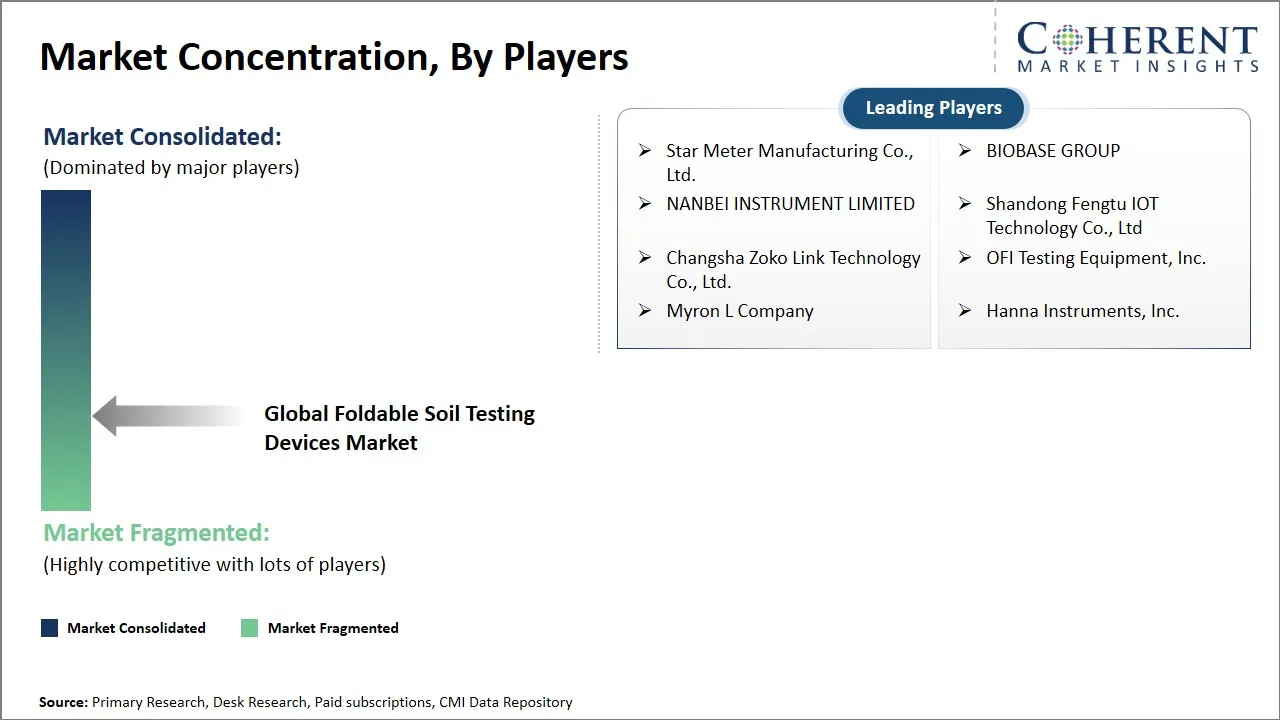
| Companies covered: | Star Meter Manufacturing Co., Ltd., BIOBASE GROUP, NANBEI INSTRUMENT LIMITED, Shandong Fengtu IOT Technology Co., Ltd, Changsha Zoko Link Technology Co., Ltd., OFI Testing Equipment, Inc., Myron L Company, and Hanna Instruments, Inc. | ||
| Growth Drivers: |
| ||
| Restraints & Challenges: |
| ||
Foldable Soil Testing Devices Market Dynamics
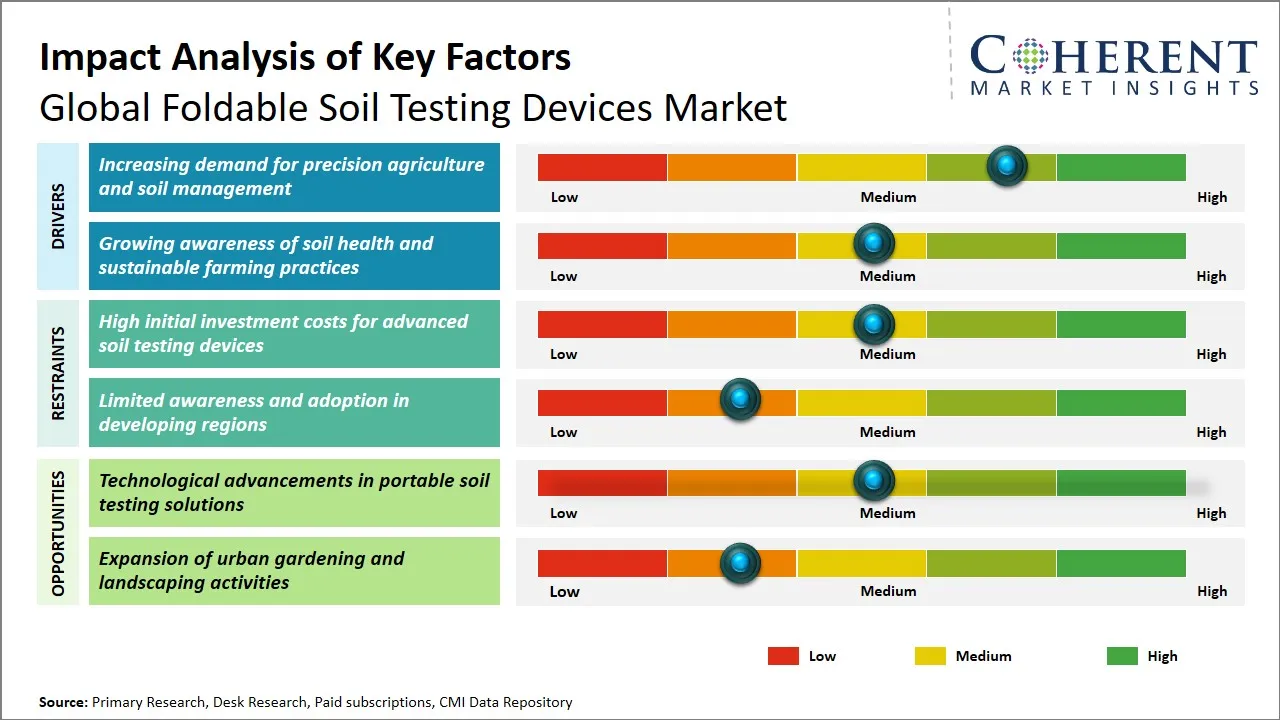
Foldable Soil Testing Devices Market Driver - Increasing Demand for Precision Agriculture and Soil Management
Growing focus on precision agriculture is heavily influencing the use of foldable soil testing devices across the world as farmers are increasingly looking for sophisticated ways to improve crop yield and efficiency of resources. Contemporary farming practices base their decisions on timely and accurate soil analysis to regulate nutrient management, irrigation scheduling, and pest control. Foldable soil testing equipment provides convenience and mobility, enabling farmers and agronomists to make on-site soil analysis rapidly and efficiently. This feature fosters data-driven methodologies that prevent wastage of fertilizers and water, in turn conserving the environment and saving input expenses.
For example, Yara International introduced its Atfarm digital solution combined with portable soil testing instruments in 2023 to assist precision nutrient management for farmers across Europe. The system permits on-farm soil analysis and feeds data directly into fertilizer recommendation models.
Foldable Soil Testing Devices Market Opportunity - Technological Advancements in Portable Soil Testing Solutions
Technologies like miniaturized sensor technology, Internet of Things (IoT) integration, and advancements in data analytics are influencing the creation of more precise, easy-to-use, and efficient foldable soil testing equipment. These technologies provide real-time soil analysis with increased accuracy, enabling prompt and informed decision-making by farmers, agronomists, and environmental scientists. Furthermore, the inclusion of wireless connectivity and smartphone app compatibility permits effortless data acquisition, storage, and remote monitoring, improving usability and accessibility in developed and emerging agricultural economies.
Analyst Opinion (Expert Opinion)
- The market for foldable soil testing instruments is on the verge of substantial expansion due to the growing focus on precision agriculture and eco-friendly farm practices. International Conference on Soil Science (2023) and Agri-Tech East Innovation Conference (2022) presented insights that spelled out revolutionizing trends, with Hanna Instruments and SoilTest at the forefront of creating handheld, easy-to-use test solutions.
- Hanna has just released a portable soil pH meter that takes innovation that works to bring agricultural products and services to farmers, and in particular, to farmers in rural areas. Presentations at these meetings discussed the urgent need for real time data on the ground, to manage soil to increase yield and limit environmental impacts. The only two barriers mentioned to mass adoption were high start-up costs and consumer education on how and when to test their soil.
- The firms who focus on cost and training of consumers will likely take more of the market share. Partnerships with extension efforts within agriculture will also increase reach. Ultimately, the existing market for global foldable soil testing devices will depend upon industry ability to use exciting technology within simple product designs capable of meeting the varied needs of farmers globally.
Speak to the analyst
Want personalized insights?
Take the findings above to one of our principal consultants, or have the report rebuilt around the segments, geographies and competitors you actually track.
Market Segmentation
- Product Type Insights (Revenue, USD Mn, 2021 - 2033)
- pH and Acidity Testing
- Moisture and Temperature Testing
- Nutrient Content Testing
- Salinity and Conductivity Testing
- Organic Matter and Carbon Testing
- Technology Type Insights (Revenue, USD Mn, 2021 - 2033)
- Electrochemical Sensor-Based
- Optical/Spectroscopic
- Capacitive/Resistive Sensors
- Microfluidic/Lab-on-Chip
- IoT-Integrated
- End-use Application Insights (Revenue, USD Mn, 2021 - 2033)
- Agriculture & Farming
- Horticulture & Greenhouse Operations
- Research & Educational Institutions
- Environmental Monitoring Agencies
- Construction & Land Development Firms
- Regional Insights (Revenue, USD Mn, 2021 - 2033)
- North America
- U.S.
- Canada
- Latin America
- Brazil
- Argentina
- Mexico
- Rest of Latin America
- Europe
- Germany
- U.K.
- Spain
- France
- Italy
- Russia
- Rest of Europe
- Asia Pacific
- China
- India
- Japan
- Australia
- South Korea
- ASEAN
- Rest of Asia Pacific
- Middle East
- GCC Countries
- Israel
- Rest of Middle East
- Africa
- South Africa
- North Africa
- Central Africa
- North America
- Key Players Insights
- Star Meter Manufacturing Co., Ltd.
- BIOBASE GROUP
- NANBEI INSTRUMENT LIMITED
- Shandong Fengtu IOT Technology Co., Ltd
- Changsha Zoko Link Technology Co., Ltd.
- OFI Testing Equipment, Inc.
- Myron L Company
- Hanna Instruments, Inc.
Sources
Primary Research Interviews
- R&D Director – Leading Soil Testing Device Manufacturer
- Procurement Manager – Major Agricultural Inputs Distributor
- Product Development Head – Well-Known Agricultural Technology Brand
- Sustainability Manager – Agri-Tech Certification Body
Stakeholders
- Manufacturers of soil testing devices (digital, foldable, portable)
- End-use Sectors:
- Agriculture (farmers, agribusinesses, cooperatives)
- Environmental Science Consulting Firms
- Hydroponics and Urban Farming Startups
- Government Agricultural Extension Services
- Regulatory & Certification Bodies
- E-commerce Platforms and Retailers specializing in agri-equipment
- Technology Integration Players: IoT, AI-based soil analytics, farm management system providers
Databases
- Food and Agriculture Organization (FAO) Stat Database
- UN Comtrade Database (export/import stats on soil testing devices)
Magazines
- Modern Farmer – Precision agriculture technology updates
- Agri-Tech Today – Innovations in agricultural instrumentation
- International Farming Systems – Trends in soil management tools
Journals
- Journal of Soil Science & Plant Nutrition – Device efficacy, accuracy studies
- Precision Agriculture Journal – Portable & digital soil analysis trends
- Computers and Electronics in Agriculture – Field device integration, IoT
- Journal of Agricultural Engineering – Foldable device design and utility research
Newspapers
- The Financial Times – Market growth for agri-tech devices
- The Guardian – Adoption of smart farming instrumentation
- Asia Agri Business Journal – Rise of portable soil testing in emerging markets
- European Farming News – Regulatory news for agricultural instrumentation
Associations
- International Society of Precision Agriculture (ISPA)
- American Society of Agricultural and Biological Engineers (ASABE)
- European Society for Agronomy
- Federation of Indian Chambers of Commerce and Industry (FICCI) – Agri-Tech Division
- Association of Agricultural Technologists
Public Domain Sources
- Food and Agriculture Organization (FAO) Guidelines – Use and safety of soil analysis equipment
- Bureau of Indian Standards (BIS) – Standards for soil/testing devices
- World Health Organization – Guidelines on safe agricultural input use
Proprietary Elements
- CMI Data Analytics Tool, Proprietary CMI Existing Repository of information for last 8 years.
Get access to 250+ pages report
Every segment, forecast, competitor profile and data table behind the analysis above — available for instant download.
- ESOMAR Member
- ISO 9001:2015 Certified
- D-U-N-S Registered
- GDPR & CCPA Compliant
Missing comfort of reading report in your local language? Find your preferred language:
Transform your Strategy with Exclusive Trending Reports
Frequently Asked Questions
The global foldable soil testing devices market is estimated to be valued at USD 2,096.7 Mn in 2026 and is expected to reach USD 3,932.3 Mn by 2033.
The CAGR of global foldable soil testing devices market is projected to be 9.4% from 2026 to 2033.
Increasing demand for precision agriculture and soil management and growing awareness of soil health and sustainable farming practices are the major factors driving the growth of the global foldable soil testing devices market.
High initial investment costs for advanced soil testing devices and limited awareness and adoption in developing regions are the major factors hampering the growth of the global foldable soil testing devices market.
In terms of product type, the pH and acidity testing segment is estimated to dominate the market revenue share in 2026.
Star Meter Manufacturing Co., Ltd., BIOBASE GROUP, NANBEI INSTRUMENT LIMITED, Shandong Fengtu IOT Technology Co., Ltd, Changsha Zoko Link Technology Co., Ltd., OFI Testing Equipment, Inc., Myron L Company, and Hanna Instruments, Inc. are the major players.
Asia Pacific is expected to lead the global foldable soil testing devices market in 2026.