

Global Safety Light Curtain Market Size and Forecast – 2026 To 2033
The Global Safety Light Curtain Market is estimated to be valued at USD 1,386.7 Mn in 2026 and is expected to reach USD 2,315.6 Mn by 2033, exhibiting a compound annual growth rate (CAGR) of 7.6% from 2026 to 2033. Growth is supported by increasing factory automation, wider deployment of robotic cells and material-handling systems, and stronger emphasis on preventing operator contact with hazardous machinery.
Manufacturers are also adopting connected safety devices that simplify diagnostics, commissioning, and integration with industrial control systems. In November 2024, Balluff introduced IO-Link Safety at the SPS trade show, enabling functional-safety components such as safety light curtains and safety-door devices to communicate securely with control systems. This development supports the transition toward digitally integrated and more easily maintainable machine-safety architectures.
Key Takeaways of the Global Safety Light Curtain Market
- Type 4 safety light curtains are expected to hold 62.8 % of the market share in 2026 because high-risk presses, robotic cells, assembly lines, and automated machinery require fail-safe protection up to PL e and SIL 3. In November 2025, SICK presented its DMM4 muting module for deTec4 Type 4 light curtains, enabling safe human-material differentiation in conveyor applications.
- The 5 to 15 meters segment is expected to account for 42.8 % of the market share in 2026, balancing broad machine coverage with reliable alignment and response performance. It suits automotive lines, palletizers, conveyors, and access points without the complexity of very-long-range systems. In March 2025, KEYENCE introduced its GL-V Type 4 series, offering detection distances of up to 12 meters.
- Finger protection is expected to account for 34.6 % of the global safety light curtain market in 2026, driven by the growing use of high-resolution, non-contact sensing systems around presses, robotic cells, assembly lines, and material-handling equipment. These systems detect fingers near hazardous machine zones while maintaining operator visibility, access, and production speed. In June 2025, OSHA renewed its National Emphasis Program on manufacturing amputations, prioritizing machine-guarding and hazardous-energy inspections and supporting compliance-led adoption of safety light curtains.
- Asia Pacific is expected to dominate with 34.1 % of the market share in 2026, supported by dense automotive, electronics, semiconductor, packaging, and machinery production networks. These industries require scalable operator-protection systems as robotics and automated lines expand. In September 2025, the International Federation of Robotics reported that Asia represented 74% of new industrial robot deployments in 2024, reinforcing the region’s addressable safety-sensor base.
- North America is expected to be the fastest-growing region and hold 30.8 % of the market share in 2026, supported by reshoring, labor constraints, robot adoption, and stricter safeguarding practices. In February 2026, the Association for Advancing Automation reported that North American companies ordered 36,766 robots during 2025, with broader adoption across food, electronics, life sciences, and other general industries.
- Networked Safety Diagnostics: Safety light curtains are evolving from standalone trip devices into connected field assets that provide alignment status, contamination alerts, interruption data, and predictive-maintenance information. Integration with IO-Link Safety and industrial networks reduces commissioning time, improves fault localization, and supports condition-based service, allowing suppliers to compete through software, diagnostics, and lifecycle support rather than hardware specifications alone.
- Flexible Human-Machine Collaboration: Manufacturers are adopting configurable muting, blanking, cascading, and reduced-resolution functions to protect operators without unnecessarily stopping material flow. This expands light-curtain use across robotic cells, palletizing, conveyor transfer, and flexible assembly. Vendors combining certified protection with rapid reconfiguration and compact installation will benefit as factories increase automation while retaining manual loading, inspection, and intervention tasks.
Segmental Insights
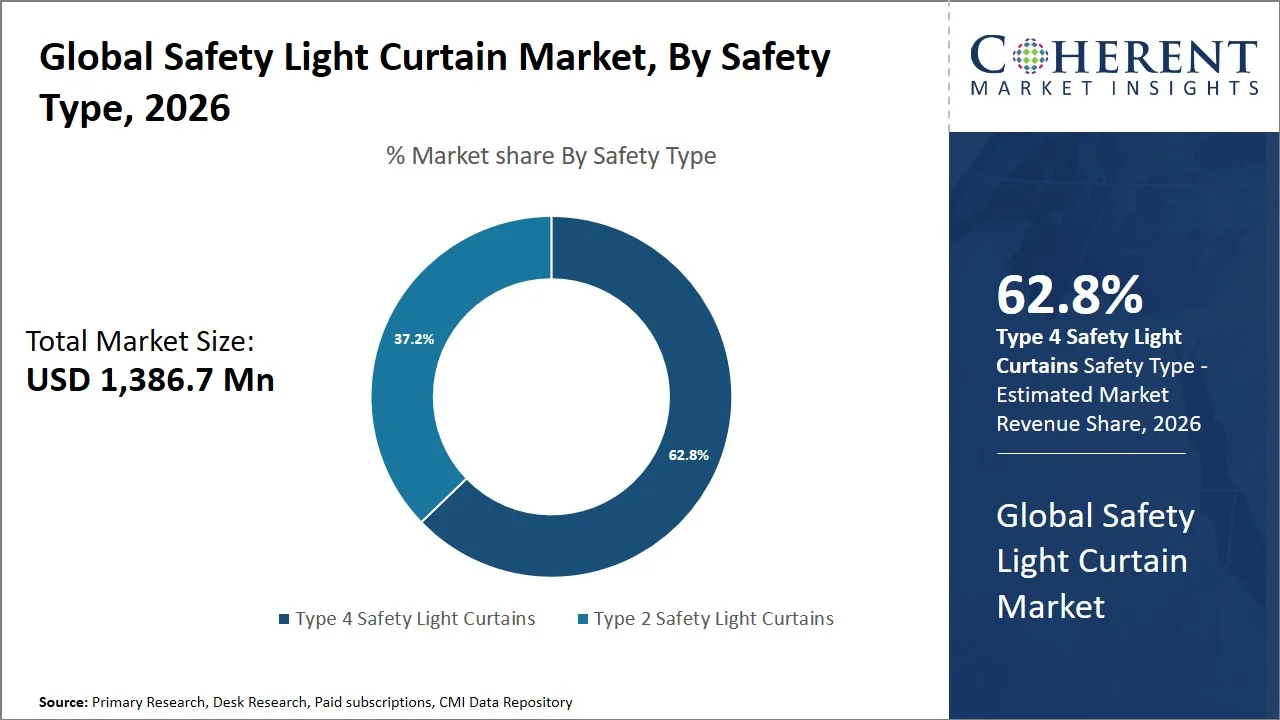
Why Do Type 4 Safety Light Curtains Dominate the Global Safety Light Curtain Market?
Type 4 safety light curtains are expected to dominate with 62.8% of the market share in 2026 because manufacturers increasingly require protective devices capable of maintaining safe operation even when internal component faults or external interference occur. Their dual-channel architecture, continuous self-testing, high diagnostic coverage, and compatibility with Performance Level e applications make them suitable for machinery where failure could cause severe injury. Demand is particularly strong in metal forming, robotic welding, automated assembly, semiconductor production, and high-speed packaging systems. Suppliers are strengthening these products with digital diagnostics, automated restart controls, configurable blanking, and simplified validation tools. In January 2025, Schmersal launched new SLC440COM-H safety light curtain versions with extended ranges and Bluetooth-enabled operating diagnostics. The SLC440COM series is classified as Type 4 under IEC 61496-1, supporting safety-critical industrial applications.
- Current Industry Events of 2026
- Market Size Estimation
- Regional Breakdown
- Competitive Landscape
- Customer Intelligence
- Segmental Analysis
- Pricing Analysis
- Key Market Drivers, Challenges & Future Trends
- Customized Insights Section
Why Does Finger Protection Represent the Largest Resolution Segment in the Global Safety Light Curtain Market?
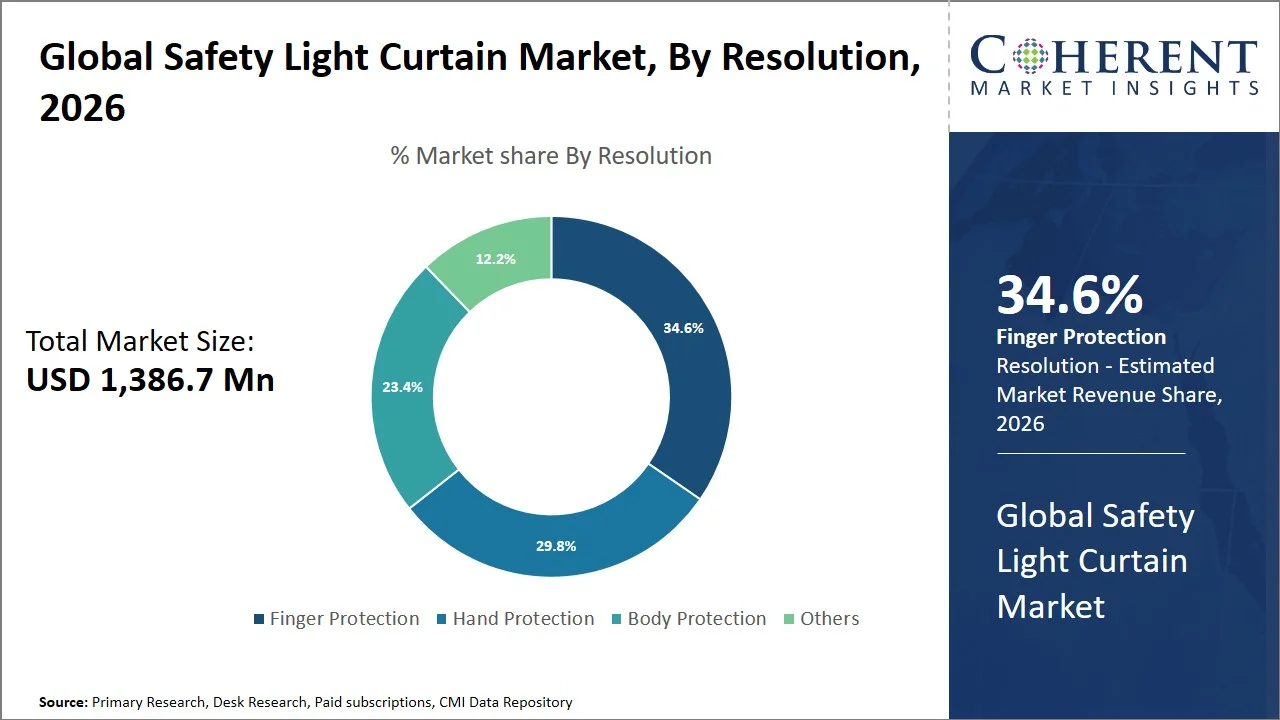
Finger protection is expected to account for the largest resolution share of 34.6% in 2026 because operators frequently work close to hazardous motion during component loading, positioning, inspection, and tool adjustment. Fine-resolution curtains can detect small intrusions before fingers reach cutting, pressing, stamping, or moving machine elements, allowing installation nearer to the hazard while preserving open access. This is commercially important in electronics assembly, compact machining centers, presses, and precision packaging equipment where fixed guards can slow repetitive workflows. Manufacturers are responding with slimmer profiles, shorter response times, dead-zone-free sensing, and certified 14 mm resolution models. In July 2025, Pilz listed an updated UL certification for its PSEN op4F range, which includes Type 4, Performance Level e safety light curtains designed specifically for 14 mm finger detection across multiple protective-field heights.
Why Does the 5 to 15 Meters Segment Dominate the Global Safety Light Curtain Market?
The 5 to 15 meters segment is expected to hold the largest sensing-range share of 42.8% in 2026 because it accommodates the dimensions of most industrial work cells without requiring specialized long-distance optics. This range supports installation across machine openings, transfer zones, multi-station production equipment, and wider access points while retaining dependable beam intensity and practical commissioning requirements. It also provides equipment builders with greater design flexibility, as one product family can address compact machines and broader production layouts. Supply-side adoption is supported by improved infrared transmitters, interference resistance, alignment indicators, and standardized M12 connectivity. In January 2026, Pepperl+Fuchs issued the technical specification for its SLCT30 safety light curtain with an operating range of 0.2 to 8 meters, IP67 protection, and protective-field heights extending to 2,400 mm.
Global Safety Light Curtain Market Dynamics
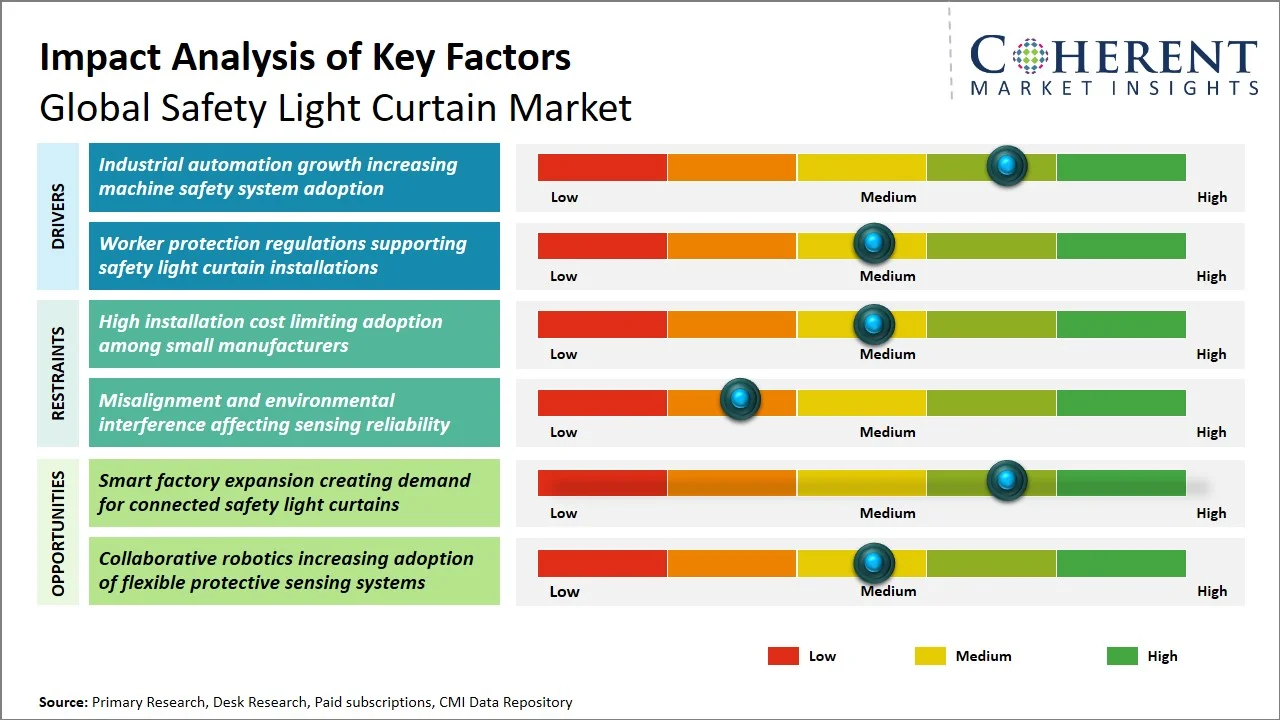
Key Market Drivers
- Industrial Automation Growth Increasing Machine Safety System Adoption: Industrial automation is increasing the number of robotic cells, transfer lines, presses, palletizers, and automated handling systems requiring non-contact operator protection. Safety light curtains allow frequent material loading, inspection, and intervention without the productivity constraints associated with fixed physical barriers. Demand is particularly strong where manufacturers combine high-speed machinery with manual tasks at defined access points. Integration with safety programmable logic controllers, drives, and robot controllers also makes light curtains part of complete functional-safety architectures rather than standalone sensors. In July 2025, ABB introduced three new robot families manufactured at its Shanghai robotics facility for material handling, pick-and-place, dispensing, polishing, electronics, and general manufacturing applications. Broader deployment of such flexible robotic systems expands the number of work cells requiring certified access protection, presence sensing, and safe-stop functionality.
- Worker Protection Regulations Supporting Safety Light Curtain Installations: Enforcement of machinery-safety obligations is encouraging manufacturers to replace unguarded access points, manually bypassed barriers, and outdated interlocks with validated electro-sensitive protective equipment. Safety light curtains are commercially attractive because they can protect operators while maintaining visibility and rapid access to production machinery. However, compliance requires correct resolution, separation distance, stopping-time calculation, restart prevention, and integration with safety-rated controls. This supports demand not only for sensors but also for risk assessment, installation, validation, and periodic inspection services. In April 2026, the K. Health and Safety Executive reported that a tissue manufacturer was fined after a worker sustained a serious hand injury while unblocking machinery. The enforcement action illustrates the financial and operational consequences of inadequate machine-safety controls and reinforces investment in engineered safeguarding solutions across manufacturing facilities.
Emerging Market Trends
- Connected Diagnostics and Safety-Network Integration: Safety light curtains are evolving from binary stop devices into digitally connected components within integrated machine-safety architectures. New systems provide beam-status information, alignment quality, contamination warnings, interruption history, device configuration, and fault-location data to controllers and maintenance platforms. This reduces commissioning time and helps technicians distinguish optical alignment problems from wiring, contamination, or control-system faults. Networked diagnostics can also support preventive cleaning and maintenance before nuisance trips disrupt production. The commercial effect is a gradual shift from hardware-only competition toward configurable safety platforms incorporating sensors, controllers, software, connectivity, and remote support. Adoption will be strongest in automotive, electronics, packaging, and semiconductor plants where unplanned line stoppages are costly. Suppliers must nevertheless maintain certified safety separation between diagnostic communication and the safety function, making cybersecurity, configuration control, and change documentation increasingly important product requirements.
- Dynamic Safeguarding for Flexible Human-Machine Workflows: Factories are moving from permanently separated automated areas toward production cells where operators regularly load parts, conduct quality checks, replace tools, or work beside automated equipment. This is increasing demand for configurable safeguarding functions such as muting, blanking, cascading, reduced resolution, partial-field protection, and safe restart control. These functions allow authorized materials to pass through a protected field while continuing to detect human entry, supporting higher throughput without eliminating operator access. The trend is especially relevant to palletizing, conveyors, robotic welding, press feeding, electronics assembly, and mixed-model production. Future differentiation will depend on how easily safety functions can be validated and reconfigured when layouts or products change. Manufacturers that combine fine-resolution detection with compact housings, short response times, clear visual diagnostics, and integration with safe-motion controls will be better positioned in flexible and space-constrained automation projects.
Current Events and their Impact
Current Events | Description and its Impact |
November 2024 – ISO 13855:2024 Published for Safeguard Positioning |
|
February 2025 – ISO 10218 Industrial Robot Safety Standards Updated |
|
Regional Insights
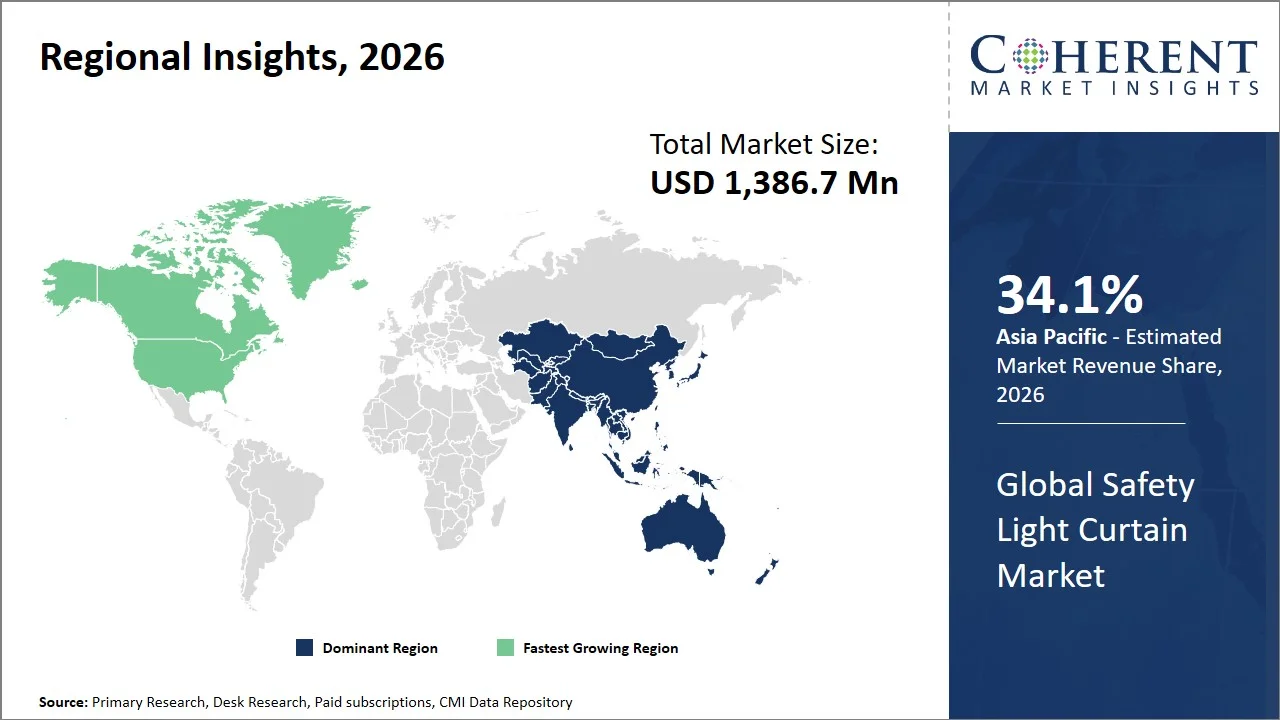
Why Does Asia Pacific Dominate the Global Safety Light Curtain Market?
Asia Pacific is expected to dominate the global safety light curtain market with 34.1% of the market share in 2026. The region combines large automotive, electronics, semiconductor, packaging, and machinery production bases with rapid adoption of robotic assembly and automated material handling. This creates recurring demand for Type 4 curtains, fine-resolution finger protection, and medium-range systems across machine-loading points and transfer zones. Regional equipment builders also benefit from established sensor, controller, and system-integration ecosystems, allowing safety functions to be embedded during machine design rather than added after installation. In October 2025, OMRON opened its Bengaluru Automation Center to advance smart manufacturing and industrial skill development in India. The initiative strengthens access to integrated automation expertise and supports broader implementation of certified machine-safety architectures across Asia Pacific production facilities.
Why is North America Emerging as the Fastest-Growing Region in the Global Safety Light Curtain Market?
North America is expected to emerge as the fastest-growing region and account for 30.8% of the global safety light curtain market in 2026. Growth is supported by reshoring of battery, semiconductor, automotive, food-processing, and packaging capacity, alongside modernization of older plants operating with fixed guards or fragmented safety circuits. Manufacturers increasingly require non-contact safeguarding that preserves production access while satisfying corporate safety standards, insurer expectations, and machine-validation requirements. Demand is therefore expanding for Type 4 devices, muting functions, safety-controller integration, and retrofit engineering. In November 2025, Toyota began production at its nearly USD 14 billion North Carolina battery plant, which is designed to house 14 battery production lines. Large, automated multi-line facilities of this type create extensive requirements for protected access points, conveyor crossings, maintenance zones, and machine-loading stations.
Global Safety Light Curtain Market Outlook for Key Countries
Why is the U.S. a Key Market for the Safety Light Curtain Market?
The U.S. is a key market for safety light curtains because it has a broad installed base of presses, robotic cells, conveyors, packaging machines, and semiconductor equipment requiring modernization. Demand is reinforced by high downtime costs, formal machine-risk assessments, and the need to safeguard workers without reducing access for loading, inspection, and maintenance. Semiconductor and battery investments are especially important because these facilities use automated material movement, precision equipment, and tightly controlled production areas where reliable presence detection is essential. In March 2025, TSMC announced plans to increase its U.S. advanced semiconductor manufacturing investment to USD 165 billion, including three additional fabrication plants, two advanced-packaging facilities, and an R&D center. This expansion enlarges the addressable base for safety sensors, controllers, interlocks, and validated machine-guarding systems within advanced manufacturing.
Why Does China Support Growth in the Global Safety Light Curtain Market?
China supports growth in the global safety light curtain market through its extensive automotive, electronics, battery, appliance, metalworking, packaging, and industrial-machinery clusters. Domestic machine builders deploy light curtains both for local installations and export equipment that must satisfy international safety specifications. The market increasingly requires faster response times, compact profiles, coded beams, muting, and connectivity with locally developed controllers and industrial networks. Strong competition also encourages suppliers to localize engineering, manufacturing, and service so products can be adapted quickly to customer requirements and machine configurations. In March 2025, Mitsubishi Electric announced a dedicated factory-automation business headquarters in Suzhou to oversee local product planning, development, manufacturing, and sales. The move reflects accelerating Chinese smart-factory demand and strengthens the ecosystem through which safety sensing and control technologies reach industrial customers.
Why is India Important in the Global Safety Light Curtain Market?
India is becoming an important safety light curtain market as automotive, electronics, pharmaceuticals, packaging, and general engineering companies add automated machinery while modernizing labor-intensive plants. Adoption is strongest where operators frequently load components or clear materials near presses, assembly machines, conveyors, and packaging equipment. Cost-sensitive buyers favor compact systems that combine certified protection with simple alignment, standard connectors, and local technical support. Growth of semiconductor manufacturing will create further demand for fine-resolution sensing and integrated safety controls around precision production and material-handling equipment. In May 2025, India’s Union Cabinet approved an HCL-Foxconn semiconductor unit in Uttar Pradesh, India designed for 20,000 wafers per month and 36 million display-driver units per month. The project illustrates the movement toward high-throughput electronics facilities requiring structured machine-safety design and reliable non-contact safeguarding.
Why is Germany a Strategic Country in the Safety Light Curtain Market?
Germany is a strategic safety light curtain market because its automotive, machinery, metalworking, logistics, and packaging industries operate highly automated equipment subject to rigorous risk assessment and conformity requirements. German machine builders also export complete production systems, making internationally recognized safety performance, documentation, and component availability important purchasing criteria. Demand is concentrated in Type 4 systems, fine-resolution protection, cascading, and integration with safety PLCs and safe drives. Retrofit activity is supported by digital factory programs and the need to retain operator access within flexible manufacturing cells. In April 2026, BMW Group reported that its new Munich body shop for the Neue Klasse uses 800 industrial robots and operates at approximately 98% automation. Such dense robotic environments require carefully engineered access protection, restart control, and sensing across joining, logistics, and inspection areas.
Why is Japan an Important Growth Market for the Safety Light Curtain Market?
Japan is an important growth market for safety light curtains because manufacturers are increasing robot use to address labor shortages while retaining human involvement in loading, quality inspection, tool changes, and maintenance. Compact factory layouts and high-value production favor slim, high-resolution devices that can be positioned close to machinery without creating large exclusion zones. Japan also has strong domestic capabilities in sensors, controllers, robotics, and machine tools, supporting sophisticated integration and lifecycle service. Demand is expanding beyond major automotive and electronics companies toward regional food, logistics, and general manufacturing businesses. In June 2025, Japan’s Ministry of Economy, Trade and Industry established the RING Project to accelerate robot adoption among regions and smaller companies. Wider SME automation directly increases the need for accessible, pre-engineered machine-safety systems, including light curtains and safety controllers.
Technology Adoption Landscape in the Global Safety Light Curtain Market
Technology | Adoption Level | Key Application Area | Business Impact |
Type 4 Dual-Channel AOPD Architecture | High | Presses, robotic cells, metalworking and high-risk machinery | Provides continuous self-monitoring and supports high functional-safety performance for severe machine hazards. |
Safety PLC and Safety Relay Integration | High | Automated production lines and multi-device safety circuits | Combines light curtains, emergency stops, interlocks, drives, and restart controls within one validated safety architecture. |
Muting and Blanking Functions | High | Conveyors, palletizers, material transfer and press feeding | Allows authorized products or fixtures to cross the sensing field without stopping production while retaining personnel protection. |
Cascaded Light Curtain Systems | Medium | Multi-sided cells and complex machine openings | Reduces wiring and controller inputs while extending protection across connected access points or adjoining machine sections. |
Industrial Safety Network Connectivity | Medium | Automotive, electronics and digitally integrated factories | Improves diagnostics, device-status visibility, commissioning efficiency, and integration with plant-level maintenance systems. |
Automatic Alignment and Contamination Monitoring | Medium | Long-range installations and dusty or vibration-prone environments | Reduces installation errors and nuisance shutdowns while supporting preventive cleaning and faster fault resolution. |
How are Flexible Automation and Brownfield Safety Retrofits Creating New Growth Opportunities in the Global Safety Light Curtain Market?
Flexible automation and brownfield machinery modernization represent major growth opportunities for safety light curtain suppliers. Many operating plants contain presses, conveyors, packaging machines, assembly systems, and robotic cells protected by outdated barriers or fragmented safety circuits. Replacing entire production assets is often economically impractical, creating demand for retrofit-ready light curtains, compact controllers, mounting systems, muting sensors, and validation services. Light curtains can improve access and production flow while helping older machinery achieve modern safeguarding performance when correctly integrated with stopping controls and restart prevention.
Additional opportunity is emerging from small and medium-sized manufacturers adopting robotics for the first time. These users require pre-engineered, easy-to-configure solutions that reduce dependence on specialist safety programmers. Suppliers can capture higher value through application assessment, stopping-time measurement, installation, certified logic, training, periodic inspection, and remote diagnostics. Products offering standard connectors, visual alignment guidance, flexible protective heights, and compatibility with multiple control platforms can accelerate adoption. The market opportunity therefore extends beyond sensor replacement toward complete, lifecycle-based machine-safety modernization.
Market Players, Key Development, and Competitive Landscape
Key Developments
- In September 2025, Rockwell Automation issued an updated declaration of conformity for its GuardShield Micro400 safety light curtains. The Type 4 devices cover finger- and hand-protection resolutions and support SIL 3 and Performance Level e applications. This is important because updated conformity documentation strengthens machine-builder confidence and supports deployment in internationally regulated, high-risk industrial applications.
- In May 2025, IDEC expanded the availability of its FS1B safety controller across several global regions. The controller combines inputs from light curtains, laser scanners, emergency-stop switches, and other safety devices using pre-certified logic. This is important for the safety light curtain market because it simplifies integration for machine builders lacking specialist safety-programming resources.
- In March 2025, Siemens updated its SIMATIC Press Safety Library with dedicated functional blocks for operating and supervising safety light curtains in safety and clock modes. The library includes cross-circuit monitoring, status indication, restart logic, and integration with press-safety functions. This is important because software-based safety integration can reduce engineering effort and standardize light-curtain deployment across press lines.
Competitive Landscape
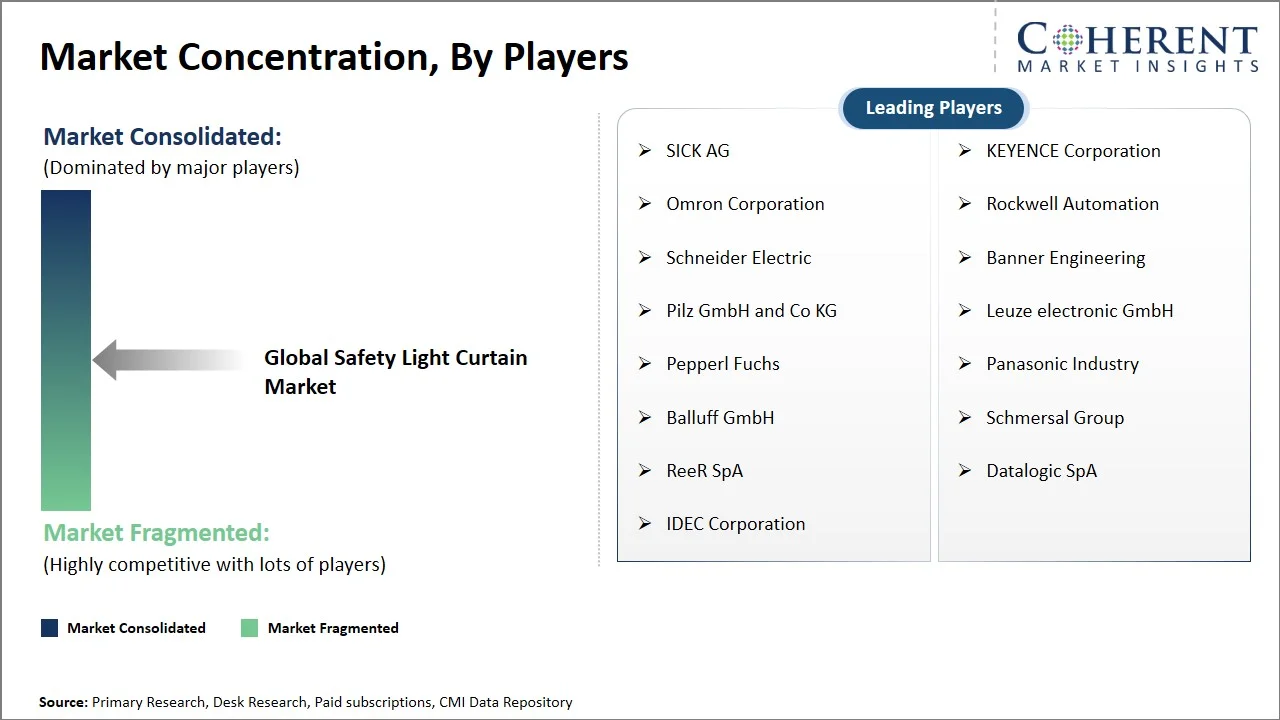
The global safety light curtain market is moderately consolidated among established industrial sensor and automation companies, alongside specialist machine-safety manufacturers and regional low-cost suppliers. Competition is shaped by functional-safety certification, sensing reliability, application engineering, product availability, and integration with broader automation portfolios. Large vendors benefit from controller, relay, drive, robotics, and service capabilities, while specialists compete through application-focused configurations and technical expertise.
Key focus areas include
- Product quality and detection reliability: Vendors compete through optical stability, response time, resolution accuracy, electromagnetic immunity, and resistance to dust, vibration, and ambient light.
- Safety-performance differentiation: Type classification, Performance Level, Safety Integrity Level, diagnostic coverage, and fault-tolerant architecture are major supplier-selection criteria.
- Configuration flexibility: Muting, blanking, cascading, reduced resolution, beam coding, and multiple protective-field heights support application-specific differentiation.
- Ease of installation: Compact profiles, standard connectors, alignment indicators, mounting brackets, mirrors, and configuration tools reduce engineering and commissioning time.
- Pricing and lifecycle cost: Suppliers must balance initial sensor pricing with lower wiring costs, reduced nuisance trips, faster troubleshooting, and long-term availability.
- Certification and compliance: IEC, ISO, CE, UL, TÜV, functional-safety, electromagnetic-compatibility, and environmental certifications influence OEM qualification and export access.
- Distribution and technical support: Local inventory, application engineers, system integrators, training, validation, and rapid replacement services strengthen customer reach.
- Automation ecosystem integration: Compatibility with safety PLCs, relays, drives, robot controllers, industrial networks, and diagnostic software supports broader supplier relationships
Market Report Scope
Safety Light Curtain Market Report Coverage
| Report Coverage | Details | ||
|---|---|---|---|
| Base Year: | 2025 | Market Size in 2026: | USD 1,386.7 Mn |
| Historical Data for: | 2020 To 2024 | Forecast Period: | 2026 To 2033 |
| Forecast Period 2026 to 2033 CAGR: | 7.6% | 2033 Value Projection: | USD 2,315.6 Mn |
| Geographies covered: |
| ||
| Segments covered: |
| ||
| Companies covered: | SICK AG, KEYENCE Corporation, Omron Corporation, Rockwell Automation, Schneider Electric, Banner Engineering, Pilz GmbH and Co KG, Leuze electronic GmbH, Pepperl Fuchs, Panasonic Industry, Balluff GmbH, Schmersal Group, ReeR SpA, Datalogic SpA, and IDEC Corporation | ||
| Growth Drivers: |
| ||
| Restraints & Challenges: |
| ||
Analyst Opinion (Expert Opinion)
- The next competitive phase will be shaped by software-defined safety architectures rather than additional sensing hardware alone. Light curtains that share actionable diagnostic information with safety controllers, drives, and maintenance platforms will create greater customer value. Suppliers should develop secure configuration tools, standardized data interfaces, and reusable certified logic that allow machinery to be modified without rebuilding the complete safety system.
- Dynamic safeguarding will have a transformative effect on flexible manufacturing. As plants move toward mixed-model production, robotic material handling, and frequent operator intervention, fixed protection strategies will become less commercially attractive. Configurable muting, blanking, cascading, and safe-motion integration can position light curtains as productivity-enabling devices rather than compliance-only components.
- The strongest opportunities will arise from Type 4 systems, fine-resolution protection, robotic-cell access, and retrofits of existing machinery. Key risks include incorrect separation distances, deliberate bypassing, poor validation, low-cost uncertified products, and cybersecurity weaknesses in connected safety systems. Vendors should prioritize application engineering, training, local service, certified ecosystem partnerships, and lifecycle validation to build defensible competitive advantage.
Speak to the analyst
Want personalized insights?
Take the findings above to one of our principal consultants, or have the report rebuilt around the segments, geographies and competitors you actually track.
Market Segmentation
- Safety Type Insights (Revenue, USD Mn, 2021 - 2033)
- Type 4 Safety Light Curtains
- Type 2 Safety Light Curtains
- Resolution Insights (Revenue, USD Mn, 2021 - 2033)
- Finger Protection
- Hand Protection
- Body Protection
- Others
- Sensing Range Insights (Revenue, USD Mn, 2021 - 2033)
- Below 5 Meters
- 5 to 15 Meters
- Above 15 Meters
- Application Insights (Revenue, USD Mn, 2021 - 2033)
- Machine Guarding
- Access Control
- Perimeter Protection
- Material Handling and Conveyors
- Others
- End-use Industry Insights (Revenue, USD Mn, 2021 - 2033)
- Automotive
- Electronics and Semiconductors
- Packaging
- Food and Beverages
- Pharmaceuticals
- Metal and Machinery
- Others
- Regional Insights (Revenue, USD Mn, 2021 - 2033)
- North America
- U.S.
- Canada
- Latin America
- Brazil
- Argentina
- Mexico
- Rest of Latin America
- Europe
- Germany
- U.K.
- Spain
- France
- Italy
- Russia
- Rest of Europe
- Asia Pacific
- China
- India
- Japan
- Australia
- South Korea
- ASEAN
- Rest of Asia Pacific
- Middle East
- GCC Countries
- Israel
- Rest of Middle East
- Africa
- South Africa
- North Africa
- Central Africa
- North America
- Key Players Insights
- SICK AG
- KEYENCE Corporation
- Omron Corporation
- Rockwell Automation
- Schneider Electric
- Banner Engineering
- Pilz GmbH and Co KG
- Leuze electronic GmbH
- Pepperl Fuchs
- Panasonic Industry
- Balluff GmbH
- Schmersal Group
- ReeR SpA
- Datalogic SpA
- IDEC CorporationO
Sources
Primary Research Interviews
- Safety light curtain manufacturers, product engineers, and functional-safety specialists
- Machine builders, robotic-cell integrators, and industrial automation providers
- Plant safety managers from automotive, electronics, packaging, food, pharmaceutical, and metalworking sectors
- Safety PLC, relay, sensor, control-system, testing, certification, and validation providers
- Distributors, installers, and maintenance service companies
Stakeholders
- Manufacturers: KEYENCE, SICK, OMRON, Banner Engineering, Rockwell Automation, Pilz, Pepperl+Fuchs, Schmersal, Leuze, IDEC, Datalogic, ReeR, and Contrinex
- Automation suppliers: Siemens, ABB, Mitsubishi Electric, Schneider Electric, Beckhoff, and Bosch Rexroth
- End users: automotive, electronics, semiconductors, packaging, food and beverages, pharmaceuticals, metalworking, machinery, logistics, and material handling
- Certification bodies: TÜV Rheinland, TÜV SÜD, UL Solutions, Intertek, DEKRA, and CSA Group
- Safety authorities: OSHA, NIOSH, EU-OSHA, U.K. HSE, and national labor ministries
Databases
- OSHA, BLS, Eurostat, ILOSTAT, UN Comtrade, ITC Trade Map, and USITC DataWeb
- EU NANDO and European Commission machinery conformity databases
- Company annual reports, technical datasheets, certifications, patents, and press releases
Industry Publications and Journals
- Control Engineering, Automation World, Plant Engineering, Machine Design, Packaging World, EHS Today, and Safety+Health
- Safety Science, Journal of Safety Research, Sensors, Robotics and Computer-Integrated Manufacturing, and IEEE industrial automation journals
- Associations and Standards Bodies
- ISO, IEC, ANSI, National Safety Council, International Labour Organization, Association for Advancing Automation, VDMA Robotics + Automation, Japan Robot Association, and ACMA India
- Public Domain Sources
- OSHA, NIOSH, U.S. BLS, European Commission, EU-OSHA, U.K. HSE, Japan METI, India Ministry of Labour and Employment, China Ministry of Emergency Management, ISO, and IEC
Proprietary Elements
- CMI Data Analytics Tool, Proprietary CMI Existing Repository of information for last 10 years.
Get access to 250+ pages report
Every segment, forecast, competitor profile and data table behind the analysis above — available for instant download.
- ESOMAR Member
- ISO 9001:2015 Certified
- D-U-N-S Registered
- GDPR & CCPA Compliant
Missing comfort of reading report in your local language? Find your preferred language:
Transform your Strategy with Exclusive Trending Reports
Frequently Asked Questions
The CAGR of the global safety light curtain market is projected to be 7.6% from 2026 to 2033.
Industrial automation growth increasing machine safety system adoption and worker protection regulations supporting safety light curtain installations are the major factors driving the growth of the global safety light curtain market.
The global safety light curtain market is estimated to be valued at USD 1,386.7 million in 2026 and is expected to reach USD 2,315.6 million by 2033.
Safety light curtains are widely used for machine guarding, robotic cells, assembly lines, conveyors, presses, packaging equipment, and automated material-handling systems.
Integration with Industry 4.0 platforms, real-time diagnostics, compact sensor designs, advanced connectivity, and growing adoption of smart safety systems are key market trends.
Automotive, electronics, food and beverages, pharmaceuticals, metal processing, packaging, logistics, and general manufacturing are the major end-use industries.
In terms of safety type, type 4 safety light curtains are estimated to dominate the market revenue share in 2026.