

Smart Elevators Market Size and Forecast – 2026 to 2033
The Smart Elevators Market is anticipated to grow at a CAGR of 7.8% with USD 13.3 Bn in 2026 and is expected to reach USD 21.6 Bn in 2033. Rapid urbanization and the construction of high-rise buildings are driving the smart elevators market, while growing demand for energy-efficient transportation solutions further strengthens adoption. Approximately 55% of the global population currently lives in urban areas, a share projected to reach 68% by 2050. Urban populations are expected to grow by 2.5 Bn, with nearly 90% of this increase occurring in Asia and Africa, driven by continued urbanization and population growth.
Key Takeaways
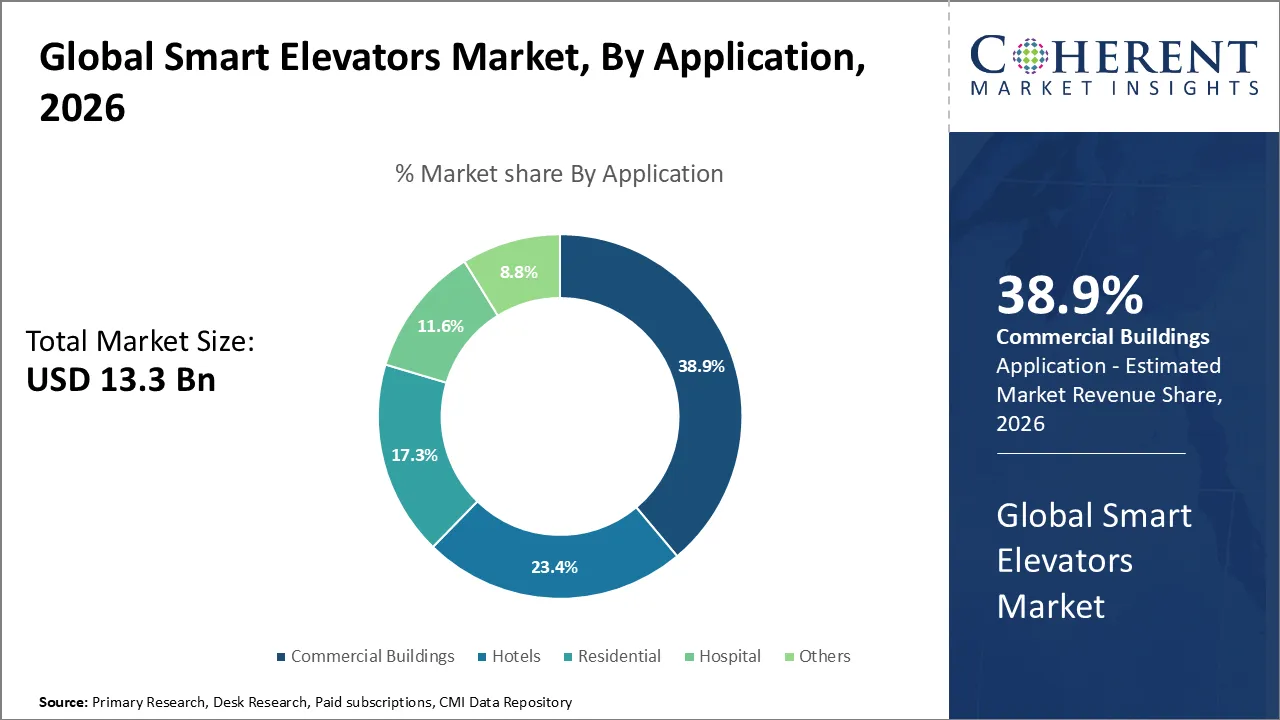
- Commercial Buildings hold the largest market share of 38.9% in 2026 owing to the rapid urbanization and high-rise construction. China leads globally with more than 680 buildings over 200 meters, followed by the United States with over 200 and the UAE with more than 100.
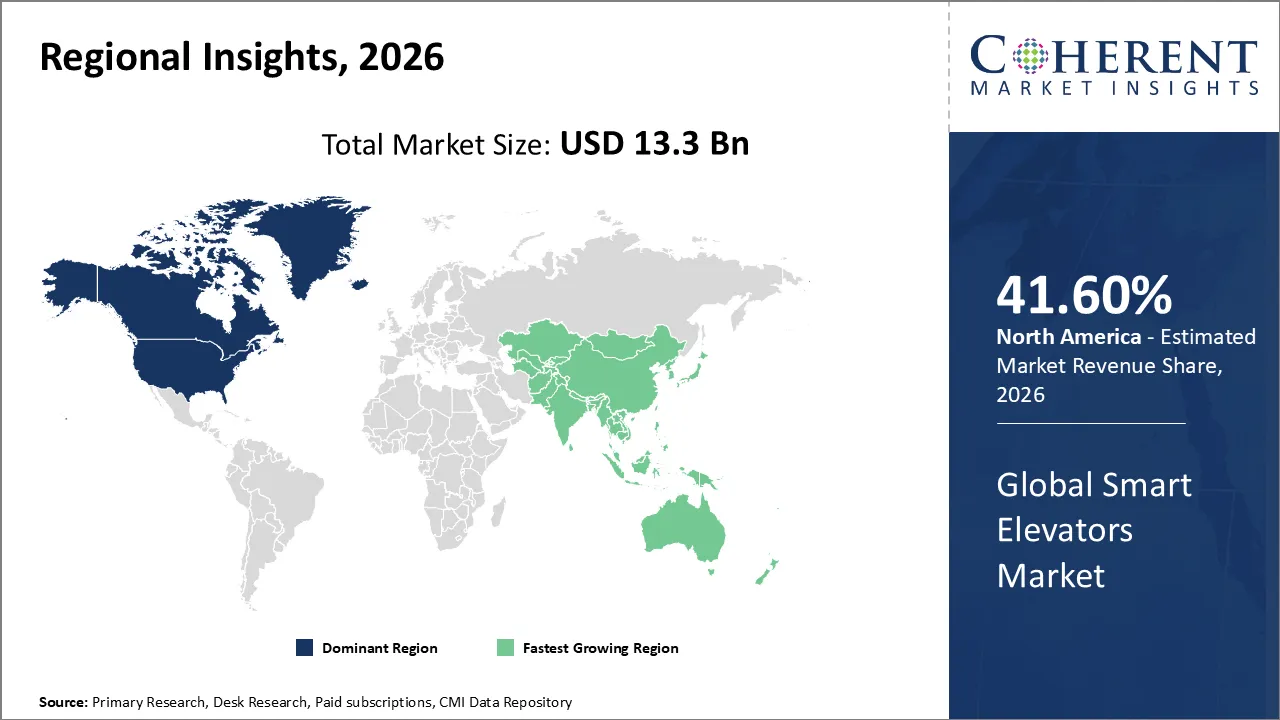
- North America is expected to acquire the dominant share of 41.6% in 2026 owing to its rapid adoption of smart buildings. A 2025 survey of 308 commercial building stakeholders in the U.S. and Canada found that 91% already use smart building systems, while average annual spending on smart technologies exceeded USD 550,000 per organization.
Current Events and Their Impact on the Smart Elevators Market
Current Event | Description and its Impact |
ITU-T Recommendation Y.4420 on IoT-based lift monitoring – 2026 |
|
EU Machinery Regulation (EU) 2023/1230 – effective January 2027 |
|
Segmental Insights
- Current Industry Events of 2026
- Market Size Estimation
- Regional Breakdown
- Competitive Landscape
- Customer Intelligence
- Segmental Analysis
- Pricing Analysis
- Key Market Drivers, Challenges & Future Trends
- Customized Insights Section
Why is Commercial Buildings Acquiring the Largest Market Share?
Commercial Buildings hold the largest market share of 38.9% in 2026. Commercial buildings drive the Smart Elevators Market as offices, hotels, shopping centers, hospitals, and mixed-use properties increasingly require efficient vertical transportation. There are about 700 to 1,200 malls in the United States. Building owners use smart elevators to manage passenger flow, shorten waiting times, improve energy efficiency, and enable predictive maintenance. They also integrate these systems with building management platforms, access-control solutions, IoT networks, and mobile technologies to enhance operational efficiency. Furthermore, investments in aging commercial infrastructure and the growing development of connected, sustainable buildings continue to accelerate the adoption of smart elevator solutions.
Smart Elevators Market Trends
- Growing emphasis on energy efficiency is supporting the development of more efficient lift systems and controls. The European Commission's 2025 evaluation of the Lifts Directive specifically identified energy efficiency as one of the areas requiring further examination, reinforcing the regulatory relevance of energy performance in the European lift market.
- Increasing adoption of predictive maintenance is creating a measurable value proposition for connected elevators. KONE reports that, within its connected elevator base, predictive-maintenance solutions have enabled 80% of issues to be resolved proactively and reduced downtime by 30%, although the company notes that results vary by site and equipment.
- Modernization of aging elevator infrastructure is a major opportunity for smart-elevator suppliers. The European Commission's data show that around 70% of EU lifts were installed before 1999, while the EU has more than 5.85 million lifts in service. This large installed base creates opportunities for upgrades involving connected sensors, digital controls, remote monitoring, and improved safety functions.
Regional Insights
North America dominates owing to increasing emphasis on safety and security
North America is expected to acquire the dominant share of 41.60% in 2026. North America’s Smart Elevators Market is expanding as building owners modernize aging elevator infrastructure and invest in smart commercial buildings. More than 80% of lifts in India are over 15 years old, highlighting significant demand for modernization and replacement. They increasingly deploy IoT-enabled elevators to enhance operational efficiency, enable predictive maintenance, optimize passenger flow, and manage energy consumption. Developers also drive demand by constructing high-rise offices, residential towers, healthcare facilities, and mixed-use properties. The region’s advanced digital infrastructure supports integration with building management systems, mobile applications, access-control technologies, and cloud platforms, while sustainability initiatives encourage energy-efficient elevator adoption. Otis has introduced flexible, phased elevator modernization packages to address Europe’s aging elevator infrastructure. More than six million elevators currently operate across Europe, and in many European countries, over half of these units have been in service for at least 25 years.
Asia Pacific Smart Elevators Market Trends
Rapid urbanization, rising high-rise residential and commercial construction, and expanding smart-city initiatives drive the Asia Pacific smart elevators market. China, India, Japan, South Korea, and Southeast Asian countries are investing heavily in infrastructure, increasing demand for advanced vertical mobility solutions. Building owners are also modernizing aging elevator systems, particularly in mature markets. In addition, demand for energy efficiency, passenger safety, predictive maintenance, touchless controls, and IoT-enabled monitoring encourages businesses to replace conventional elevators with smarter, connected systems. Elite Elevators Malaysia launched the X400 and X400 Plus, introducing its first smart, gearless residential lifts with advanced magnetic-drive technology and minimalist design.
United States Smart Elevators Market Trends
The United States smart elevators market continues to expand as building owners modernize aging elevator infrastructure and adopt smart building technologies. Companies are integrating IoT, artificial intelligence, cloud connectivity, predictive maintenance, and destination-control systems to improve safety, traffic management, and operational efficiency. The U.S. has approximately 900,000 elevators, increasing to around 1 million when additional elevator units are included; the U.S. and Canada together account for approximately 44,000 units in the referenced dataset. Urban development and high-rise construction further stimulate demand for advanced elevator solutions. Sustainability goals and evolving accessibility and safety standards also encourage upgrades, while investments in commercial real estate and infrastructure modernization accelerate the adoption of smart elevator technologies.
China Smart Elevators Market Trends
China’s Smart Elevators Market is expanding as rapid urbanization and high-rise construction increase the need for advanced elevator systems. Building owners are replacing and modernizing aging elevators with smarter, more efficient solutions. Government programs that promote energy efficiency, sustainable construction, and smart-city development also support market growth. Hangzhou is a leading example of smart-city innovation, with Alibaba’s City Brain platform using AI and data from traffic cameras and public transport systems to optimize urban operations and traffic management. Manufacturers are integrating IoT, AI, cloud connectivity, predictive maintenance, and advanced security technologies to enhance safety, efficiency, and passenger experience. Growing demand for energy-efficient buildings and connected property management further drives smart elevator adoption.
Who are the Major Companies in Smart Elevators Industry
Some of the major key players in Smart Elevators are Hitachi, KONE CORPORATION, Mitsubishi Electric, Otis Elevator Company (UNITED TECHNOLOGIES), Schindler, Thyssenkrupp, Hyundai Elevator Company Ltd., Toshiba Elevators and Building Systems Corporation, Fujitec Co. Ltd., and Motion Control Engineering, Inc.
Key News
- In August 2026, Taoping’s subsidiary, Skyladder Technology, launched an elevator maintenance insurance pilot program with PICC P&C’s Tianjin branch.
Market Report Scope
Smart Elevators Market Report Coverage
Report Coverage | Details | ||
Base Year: | 2025 | Market Size in 2026: | USD 13.3 Bn |
Historical Data for: | 2020 to 2024 | Forecast Period: | 2026 to 2033 |
Forecast Period 2026 to 2033 CAGR: | 7.8% | 2033 Value Projection: | USD 21.6 Bn |
Geographies covered: |
| ||
Segments covered: |
| ||
Companies covered: | Hitachi, KONE CORPORATION, Mitsubishi Electric, Otis Elevator Company (UNITED TECHNOLOGIES), Schindler, Thyssenkrupp, Hyundai Elevator Company Ltd., Toshiba Elevators and Building Systems Corporation, Fujitec Co. Ltd., and Motion Control Engineering, Inc. | ||
Analyst Opinion
- Smart elevators are moving from a “premium feature” to a practical asset-management tool because connected monitoring is demonstrating measurable reductions in downtime and maintenance inefficiency. In Weihai, China, integrating IoT monitoring with elevator maintenance reduced the average operating fault rate from 3% to 0.9%, while maintenance-worker productivity improved by more than 50%. In my view, results at this scale will make predictive and condition-based maintenance increasingly difficult for building owners to ignore, particularly for large residential portfolios.
- China’s elevator modernization opportunity is particularly compelling because regulators are increasingly pushing the industry toward data-driven maintenance rather than fixed, routine servicing. Chongqing had more than 69,000 IoT-connected elevators, with real-time fault data from 9,645 elevators integrated into its smart-elevator platform. The city also reported average emergency arrival times of about 9 minutes and average rescue completion times of 5 minutes. These outcomes strengthen the business case for connected elevators by linking digitalization directly to safety, response time, and maintenance performance rather than treating smart functionality as a convenience feature.
- The strongest near-term opportunity lies in retrofitting existing elevators with IoT sensors, remote monitoring, AI-based fault detection, and digital maintenance platforms rather than relying only on new elevator installations. Ningbo provides a strong example: smart monitoring across participating buildings reduced average elevator stoppages by about 70%, while its system collected 870,000 digital maintenance records and used AI-based fault prediction to identify potential failures earlier. This evidence shifts the competitive focus toward aftermarket intelligence, where manufacturers and service providers can generate recurring value from installed equipment throughout its operating life.
- China is also turning smart-elevator technology into a regulatory requirement rather than leaving adoption entirely to customer preference. Beijing’s elevator maintenance reforms encourage IoT-based remote monitoring, traceable operating and fault records, and maintenance decisions based on actual operating conditions. More recently, Yantai’s pilot framework requires IoT platforms to track operating data and maintain device connectivity, with participating elevator IoT equipment expected to maintain online stability of at least 98%. This regulatory direction will favor vendors that can combine hardware, connectivity, analytics, and maintenance services into one integrated platform.
Speak to the analyst
Want personalized insights?
Take the findings above to one of our principal consultants, or have the report rebuilt around the segments, geographies and competitors you actually track.
Market Segmentation
- By Application (Revenue, USD Bn, 2021-2033)
- Commercial Buildings
- Hotels
- Residential
- Hospital
- Others
- By Region (Revenue, USD Bn, 2021-2033)
- North America
- U.S.
- Canada
- Latin America
- Brazil
- Mexico
- Argentina
- Rest of Latin America
- Europe
- Germany
- U.K.
- France
- Italy
- Spain
- Russia
- Rest of Europe
- Asia Pacific
- China
- India
- Japan
- Australia
- South Korea
- ASEAN
- Rest of Asia Pacific
- Middle East
- GCC
- Israel
- Rest of Middle East
- Africa
- South Africa
- Central Africa
- North Africa
- North America
Sources
Primary Research interviews
- Elevator manufacturers and technology providers
- Elevator installation and modernization contractors
- Building owners and facility-management companies
- Smart-building solution providers
- Elevator maintenance and service professionals
- Architects, building-system integrators, and infrastructure developers
- Government officials and elevator safety regulators
- Commercial real-estate and high-rise building operators
Databases
- U.S. Census Bureau
- U.S. Bureau of Labor Statistics (BLS)
- U.S. Energy Information Administration (EIA)
- Eurostat
- World Bank Data
- OECD Data
- United Nations Data
- National Bureau of Statistics of China
- National Institute of Statistics and Economic Studies (INSEE)
- Japan Statistics Bureau
- Statistics Korea
- Government of India statistical databases
- International Energy Agency (IEA) databases
Magazines
- Elevator World
- ELEVATOR Magazine
- International Lift Industry Magazine (ILM)
- Buildings Magazine
- Facility Executive
- Engineering News-Record (ENR)
- Building Design + Construction
- Smart Buildings Magazine
Journals
- ASME Journal of Engineering for Sustainable Buildings and Cities
- ASME Journal of Dynamic Systems, Measurement, and Control
- IEEE Internet of Things Journal
- IEEE Transactions on Industrial Informatics
- Automation in Construction
- Building and Environment
- Energy and Buildings
- Journal of Building Engineering
- International Journal of Electrical Power & Energy Systems
- Sensors
- Applied Sciences
Newspapers
- The New York Times
- The Wall Street Journal
- Financial Times
- Reuters
- Bloomberg
- The Economic Times
- The Hindu BusinessLine
- South China Morning Post
- China Daily
- Nikkei Asia
Associations
- American Society of Mechanical Engineers (ASME)
- International Organization for Standardization (ISO)
- National Elevator Industry, Inc. (NEII)
- European Lift Association (ELA)
- China Elevator Association
- Japan Elevator Association
- Korea Elevator Safety Agency (KoELSA)
- Elevator and Escalator Safety Foundation (EESF)
- Canadian Elevator Contractors Association (CECA)
- National Association of Elevator Contractors (NAEC)
Public Domain sources
- U.S. Department of Energy (DOE)
- U.S. Department of Labor
- Occupational Safety and Health Administration (OSHA)
- U.S. Department of Housing and Urban Development (HUD)
- National Institute of Standards and Technology (NIST)
- European Commission
- Eurostat
- World Bank
- United Nations
- International Energy Agency (IEA)
- ISO standards and technical publications
- ASME codes and standards
- National Bureau of Statistics of China
- Government of India
- Bureau of Indian Standards (BIS)
- Ministry of Housing and Urban Affairs, Government of India
- Japan Ministry of Land, Infrastructure, Transport and Tourism (MLIT)
- U.S. state and local elevator safety authorities
- National and regional building-code authorities
Proprietary Elements
- CMI Data Analytics Tool
- Proprietary CMI Existing Repository of information for last 10 years
Get access to 250+ pages report
Every segment, forecast, competitor profile and data table behind the analysis above — available for instant download.
- ESOMAR Member
- ISO 9001:2015 Certified
- D-U-N-S Registered
- GDPR & CCPA Compliant
Missing comfort of reading report in your local language? Find your preferred language:
Transform your Strategy with Exclusive Trending Reports
Frequently Asked Questions
The Smart Elevators Market is anticipated to grow at a CAGR of 7.8% with USD 13.3 Bn in 2026 and is expected to reach USD 21.6 Bn in 2033.
The market is primarily driven by rapid urbanization, high-rise and mixed-use construction, and increasing demand for energy-efficient vertical transportation.
Commercial Buildings hold the largest share, accounting for 38.9% in 2026.
Commercial buildings generate heavy and variable passenger traffic, making elevator efficiency particularly important.
North America is expected to hold the dominant regional share, at 41.6% in 2026.
Asia Pacific benefits from rapid urbanization, extensive high-rise construction, smart-city programs, and infrastructure investment across China, India, Japan, South Korea, and Southeast Asia.