

Global Smart Language Model Market Size and Forecast – 2026-2033
Coherent Market Insights estimates that the global smart language model market is expected to reach USD 9 Bn in 2026 and will expand to USD 53 Bn by 2033, registering a CAGR of 24% between 2026 and 2033.
Key Takeaways of the Smart Language Model Market
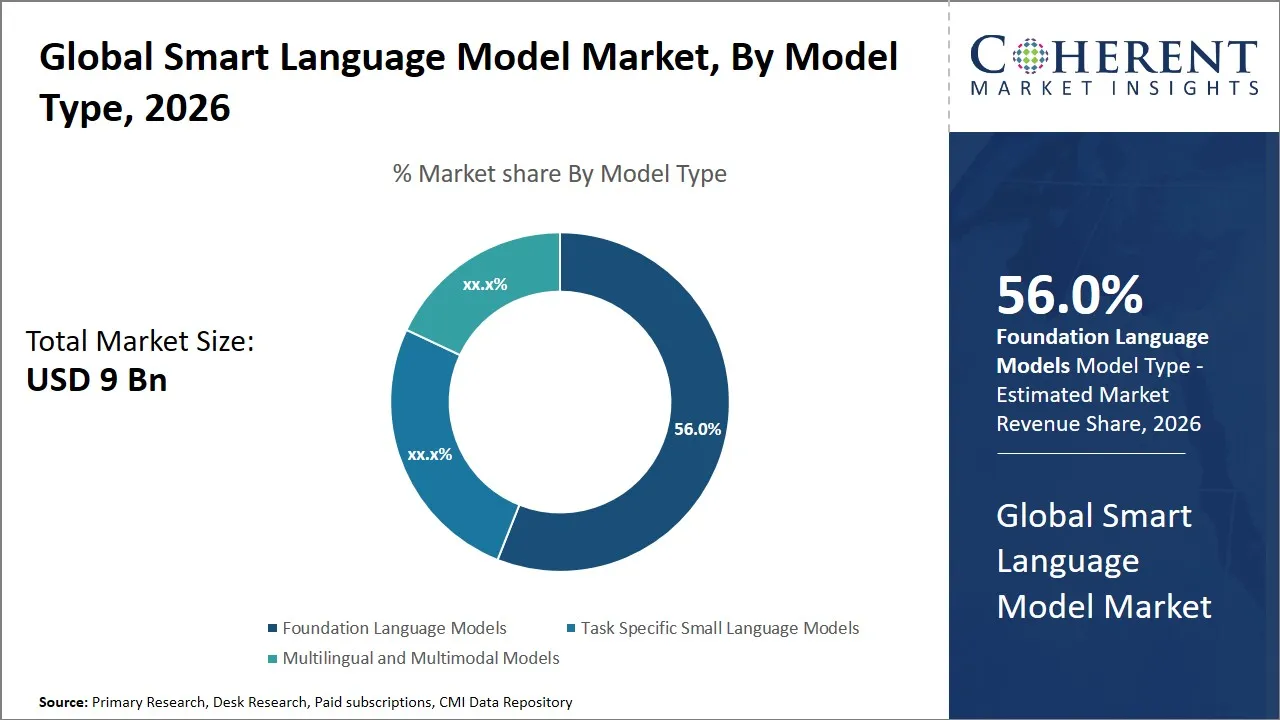
- The foundation language models segment is expected to account for 56% of the smart language model market share in 2026.
- The cloud-based APIs segment is estimated to hold 42% of the market share in 2026.
- The customer support and virtual assistants segment is projected to capture 33% of the global smart language model market share in 2026.
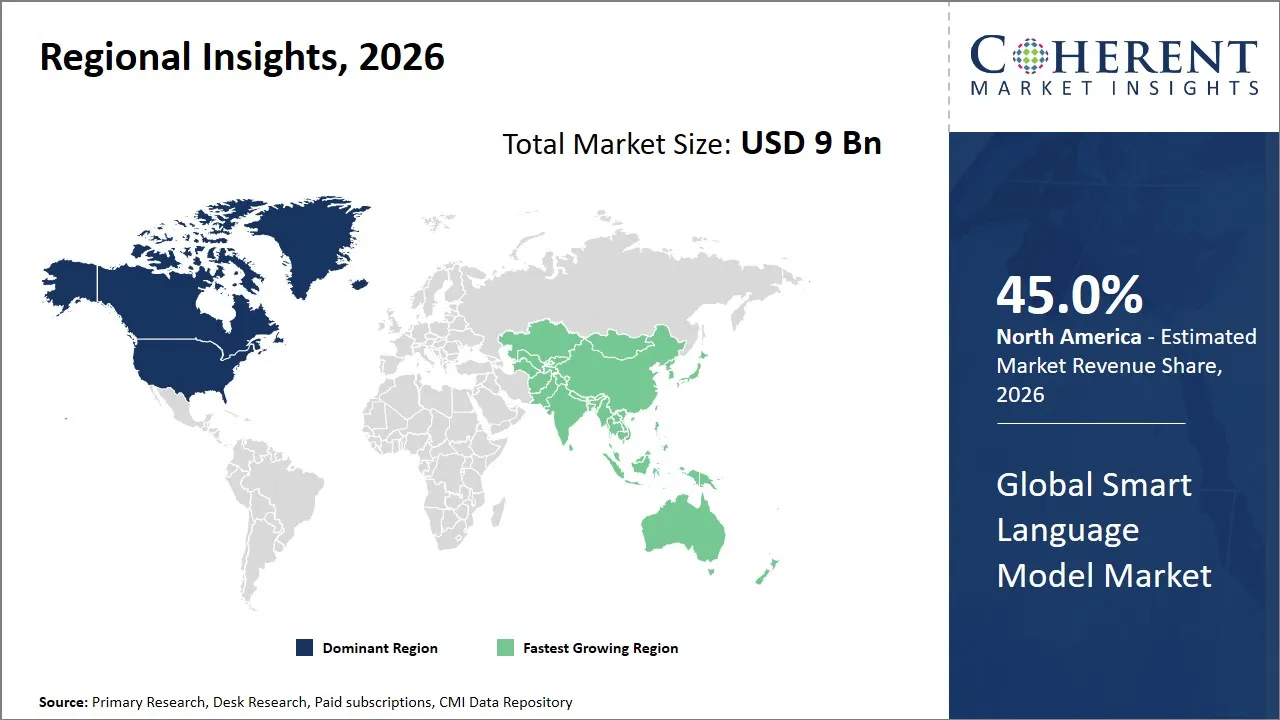
- North America will dominate the smart language model market in 2026 with an estimated 45% share.
- Asia Pacific will hold 23% share in 2026 and is expected to record the fastest growth over the forecast period.
Current Events and Its Impact
Current Events | Description and its Impact |
Large Language Model Launch Announcement |
|
Segmental Insights
- Current Industry Events of 2026
- Market Size Estimation
- Regional Breakdown
- Competitive Landscape
- Customer Intelligence
- Segmental Analysis
- Pricing Analysis
- Key Market Drivers, Challenges & Future Trends
- Customized Insights Section
Why Does Foundation Language Models Segment Dominate the Global Smart Language Model Market?
The foundation language models segment is expected to account for 56.0% of the global smart language model market share in 2026. The growth is mainly because of their ability to serve as a universal base for a wide range of downstream applications. Starting from broad data exposure, these systems learn patterns through prolonged training sequences instead of narrow examples. Because they adapt easily, firms apply them widely when handling diverse linguistic challenges. Their value appears most clearly where custom solutions would demand excessive effort otherwise.
For instance, on September 29, 2025, Apple introduced its Foundation Models framework to allow developers to build intelligent features into apps using Apple’s on‑device LLM technology.
(Source: apple.com)
Cloud-Based APIs Segment Dominates the Global Smart Language Model Market
The cloud-based APIs segment is projected to capture 42.0% of the global smart language model market share in 2026. Shifts in technology usage highlight a move toward remote data systems and subscription-style software solutions. Using this approach, companies gain entry to sophisticated language systems without needing extensive hardware or specialized personnel. From a distance, these solutions extend far beyond traditional limits - small groups included can integrate powerful messaging functions smoothly into routine tasks.
Why is Customer Support and Virtual Assistants the Most Widespread Application in the Smart Language Model Market?
The customer support and virtual assistants segment is expected to account for 33.0% of the market share in 2026. Due to rising demands for tailored, instant responses, expansion occurs. As firms adopt artificial intelligence for automated helpers, standard questions gain faster replies around the clock - this consistency lifts user approval even as expenses shrink. Powered by advanced language systems, such tools respond with fluidity, adjusting tone and meaning based on prior inputs; fewer users leave mid-conversation. Progress emerges not through novelty but steady refinement of interaction quality.
Data Privacy & Compliance Cost Avoidance Index
Category | Metric / Index | Approx. 2024–2026 Estimate / Insight |
Regulatory Costs - GDPR Baseline | Annual GDPR compliance cost (large enterprises) | USD 1 Mn – 70 Mn + |
Estimated Regional AI Compliance Spend | Global tech corporation annual AI compliance | USD 25 Mn – 40 Mn |
Breach / Risk Avoidance Costs | Average cost of a data breach | ~ USD 4.35 Mn |
Privacy & Governance Risk Level | % of organizations lacking GenAI governance | ~93% |
Privacy Engineering Premium | Cost uplift for privacy‑preserving AI | ~40 % higher |
Regional Insights
North America Smart Language Model Market Analysis and Trends
The North America region is projected to lead the market with a 45% share in 2026. Growth emerges from a stable network of technological resources, where respected AI research centers combine with consistent funding from venture sources. Innovation moves faster because major firms like Google, Microsoft, and IBM refine advanced language systems for varied fields - healthcare, finance, customer support included. Support comes not only from private enterprise but also from policy frameworks that favor artificial intelligence expansion, along with widespread upgrades to cloud-based platforms. A significant benefit emerges from North America's strong pool of experts dedicated to machine learning and natural language processing. Momentum builds where academic discoveries meet real-world implementation, allowing rapid deployment of smart linguistic systems. As collaboration spans industries, development moves forward without slowing. Growth persists through shared effort rather than isolated achievement.
For instance, on December 9, 2025, Block, Anthropic, OpenAI, and other leaders in AI announced the launch of Agentic AI Foundation (AAIF) to ensure agentic AI develops as an open, collaborative ecosystem.
(Source: block.xyz)
Asia Pacific Smart Language Model Market Analysis and Trends
The Asia Pacific region is expected to exhibit the fastest growth in the market contributing 23% share in 2026. Driven forward through rising digital shifts in developing nations, progress takes shape where national AI agendas align with broader tech integration. Investment flows strongly in places like China, Japan, South Korea, and India, where structured policy frameworks back advances in artificial intelligence exploration. Manufacturing intensity combines with vast, tech-engaged communities, fueling need for tailored language systems that reflect linguistic variety.
Firms such as Baidu, Tencent, and Naver push ahead, refining how machines interpret human speech at speed. Expansion gains strength as cross-border collaborations and open trade channels link local innovators with worldwide technological networks.
Global Smart Language Model Market Outlook for Key Countries
Is U.S. the Next Growth Engine for the Smart Language Model Market?
Despite global competition, dominance persists in the U.S. sector because major technology firms lead research into advanced language systems. Innovation moves quickly where entrepreneurial ventures receive substantial financial backing. Progress continues where national strategies support machine learning development. In healthcare, finance, and journalism, spoken and written interfaces become common features over time. Influence arises less from company size, more through linked capabilities that guide advanced systems forward.
Why is China Emerging as a Major Hub in the Smart Language Model Market?
Advancement in China appears through machines gaining speech comprehension across areas. Funding moves toward artificial intelligence through major technology firms located in Beijing, Hangzhou, and Shenzhen, directing energy toward language-processing systems. Backing arises from state-level strategies, placing smart technologies at the center of upcoming capacities. Because multiple speaking styles exist within everyday routines, applications adjust rapidly, appearing in workplaces and residences without delay. Growth occurs when information-dense settings support flexible models formed by practical needs.
Japan Smart Language Model Market Analysis and Trends
Progress moves forward in Japan, where focus lies on integrating smart language functions into robots, transportation, and enterprise solutions. Even with broad uses, companies like Sony and Fujitsu aim to improve interaction between humans and machines using sophisticated setups. Backed by academic research alongside unified government strategies, work moves forward in adapting language technologies to regional speech patterns. These steps help secure Japan’s role in shaping the way tech handles human language.
India Smart Language Model Market Analysis and Trends
Driven by strong local tech growth, India sees rising need for tools handling its many spoken forms. Solutions appearing now emphasize dialogue across tongues, interaction with users, language-specific material creation. With programs pushing artificial intelligence use, online skills, urban digitization, official efforts help shape opportunity. Because of lower expenses and large numbers of people using digital services, progress in speech-based systems gains ground here. Innovation in understanding regional expression finds space to grow.
Germany Smart Language Model Market Analysis and Trends
Smart language models see widespread use across German enterprises, especially within manufacturing, automotive, and financial industries. When firms such as SAP and Siemens integrate sophisticated language models into broader digital upgrades, progress in automation appears, altering service-user dynamics. Development advances through partnerships linking major corporations with academic institutions, addressing Europe’s diverse legal and language needs. Because personal data protection holds high priority, design decisions align closely with regional regulations on information handling.
Market Players, Key Development, and Competitive Intelligence
Key Developments
- On January 12, 2026, Apple announced a partnership with Google to power its artificial intelligence features, including a major Siri upgrade. The multiyear partnership will lean on Google’s Gemini and cloud technology for future Apple foundational models
- On December 31, 2025, SoftBank Group Corp. announced that it had completed an additional investment of USD 22.5 billion in OpenAI, at the second closing of The Company’s investment of up to USD 40.0 billion.
Top Strategies Followed by Global Smart Language Model Market Players
Player Type | Strategic Focus | Example |
Established Market Leaders | AWS at ReInvent 2025 | On December 4, 2025, AWS unveiled a wave of innovations at ReInvent 2025, including Graviton5, the company's most powerful and efficient CPU. AWS showcased a wave of innovations that indirectly impact computing, especially around AI, event-driven services, and infrastructure improvements. |
Mid-Level Players | NVIDIA Scale Up Announcement | On September 16, 2025, NVIDIA announced that it is accelerating the AI industrial revolution in the United Kingdom, working with partners including CoreWeave, Microsoft and Nscale to build the nation’s next generation of AI infrastructure. By the end of 2026, the companies will build and operate AI factories that will serve leading AI models, including those from OpenAI, to enable the U.K.’s sovereign AI goals for building a platform to power innovation, growth and opportunity across the economy. |
Small-Scale Players | Fund Raising Completion | On January 8, 2025, MiniMax Group announced that it raised USD 618.60 million in its Hong Kong initial public offering. |
Market Report Scope
Smart Language Model Market Report Coverage
| Report Coverage | Details | ||
|---|---|---|---|
| Base Year: | 2025 | Market Size in 2026: | USD 9 Bn |
| Historical Data for: | 2020 To 2024 | Forecast Period: | 2026 To 2033 |
| Forecast Period 2026 to 2033 CAGR: | 24% | 2033 Value Projection: | USD 53 Bn |
| Geographies covered: |
| ||
| Segments covered: |
| ||
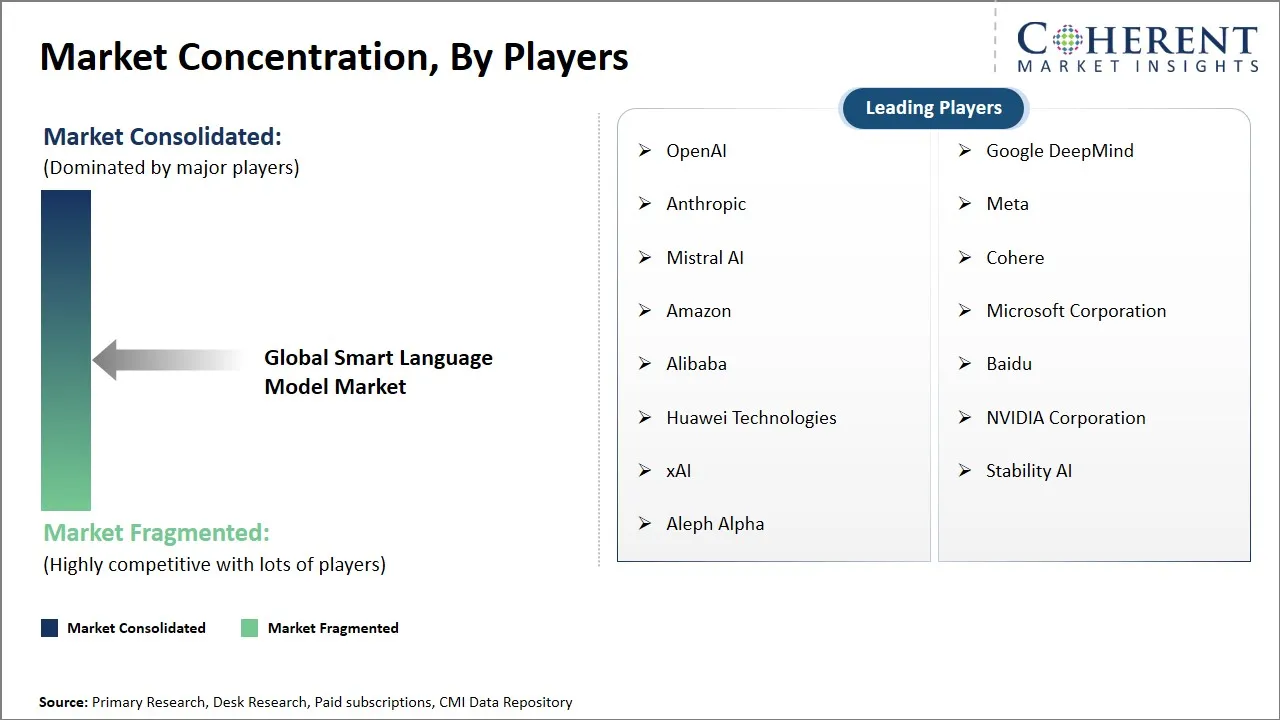
| Companies covered: | OpenAI, Google DeepMind, Anthropic, Meta, Mistral AI, Cohere, Amazon, Microsoft Corporation, Alibaba, Baidu, Huawei Technologies, NVIDIA Corporation, xAI, Stability AI, and Aleph Alpha | ||
| Growth Drivers: |
| ||
| Restraints & Challenges: |
| ||
Global Smart Language Model Market Dynamics
Global Smart Language Model Market Driver - Growing Evolution of Edge Computing
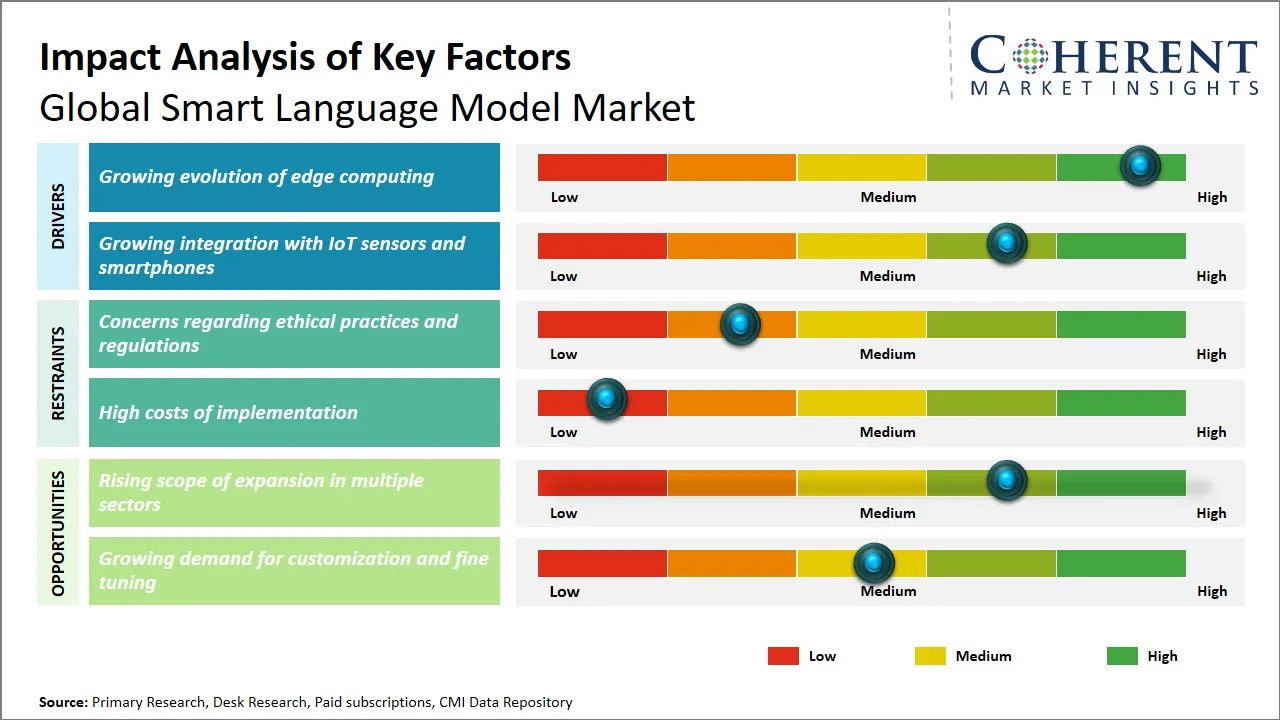
The accelerating advancement of edge computing is significantly propelling the adoption and development of smart language models across various industries. As edge computing enables data processing closer to the source of data generation, it addresses critical challenges related to latency, bandwidth constraints, and data privacy that traditional cloud-centric models often face. Operating across distributed networks makes advanced language systems faster on handheld gadgets, smartwatches, or connected machines. Where signals are weak or unstable, instant comprehension of speech still occurs. Efficiency improves when processing happens locally instead of relying solely on distant servers. Understanding context in everyday language remains possible without constant internet access. Performance gains emerge through reduced dependency on centralized hubs.
For instance, on May 19, 2025, Qualcomm Technologies, Inc announced a collaboration with Advantech to advance AI-driven IoT applications. Through this collaboration, Advantech is positioned as a partner in Qualcomm Technologies’ IoT ecosystem, enabling deeper integration of Qualcomm Technologies’ cutting-edge technologies into Advantech’s edge computing and edge AI platforms, accelerating the deployment of intelligent solutions across industries.
(Source: qualcomm.com)
Global Smart Language Model Market Opportunity - Rising Scope of Expansion Across Multiple Sectors
Growth in the global smart language model market stems from wider use across many industries. Because firms aim to automate tasks, engage users more effectively, one key solution gaining ground is intelligent language processing. Steady growth marks how widely these tools now operate - spanning healthcare, finance, retail, education, and assistance networks. In medical settings, they contribute by interpreting symptoms, managing conversations with patients, documenting visits, which sharpens accuracy while cutting time. Financial institutions use them differently: detecting irregular transactions, analyzing sentiment within messages, answering client questions - outcomes include tighter monitoring and more fluid exchanges.
Analyst Opinion (Expert Opinion)
- Still, advancements in machine learning continue, yet attention now leans more toward systems interpreting speech. Growth appears likely in coming years, supported by use in medical records and automated financial advice. Major tools emerge from adjustments by big tech firms; even so, many depend heavily on steady online access. Innovation persists, though actual operation hinges on connection quality and delay limits.
- Despite a positive outlook, few hurdles may slow expansion. Rising expenses in building and running systems create pressure, while questions about handling personal information safely linger. Rules governing these technologies continue shifting, creating hesitation among firms, more so for those with fewer resources. When machines misunderstand context or reflect bias, confidence tends to weaken. This leads some to ask for clearer oversight and stronger methods to manage potential harm.
Speak to the analyst
Want personalized insights?
Take the findings above to one of our principal consultants, or have the report rebuilt around the segments, geographies and competitors you actually track.
Market Segmentation
- Model Type Insights (Revenue, USD Billion, 2021 - 2033)
- Foundation Language Models
- Task Specific Small Language Models
- Multilingual and Multimodal Models
- Deployment Mode Insights (Revenue, USD Billion, 2021 - 2033)
- Cloud-Based API
- On-Premises Models
- Edge Deployment
- Hybrid
- Application Insights (Revenue, USD Billion, 2021 - 2033)
- Customer Support and Virtual Assistants
- Content Generation and Copywriting
- Code Generation and Software Development
- Language Translation and Localization
- Enterprise Knowledge Management
- Others
- Functionality Insights (Revenue, USD Billion, 2021 - 2033)
- Natural Language Understanding
- Natural Language Generation
- Sentiment Analysis
- Named Entity Recognition
- Contextual Memory and Tool Use
- End User Insights (Revenue, USD Billion, 2021 - 2033)
- IT and Telecom
- BFSI
- Healthcare and Life Sciences
- Retail and E-Commerce
- Legal and Government
- Education and EdTech
- Others
- Regional Insights (Revenue, USD Billion, 2021 - 2033)
- North America
- U.S.
- Canada
- Latin America
- Brazil
- Argentina
- Mexico
- Rest of Latin America
- Europe
- Germany
- U.K.
- Spain
- France
- Italy
- Russia
- Rest of Europe
- Asia Pacific
- China
- India
- Japan
- Australia
- South Korea
- ASEAN
- Rest of Asia Pacific
- Middle East
- GCC Countries
- Israel
- Rest of Middle East
- Africa
- South Africa
- North Africa
- Central Africa
- North America
- Key Players Insights
- OpenAI
- Google DeepMind
- Anthropic
- Meta
- Mistral AI
- Cohere
- Amazon
- Microsoft Corporation
- Alibaba
- Baidu
- Huawei Technologies
- NVIDIA Corporation
- xAI
- Stability AI
- Aleph Alpha
Sources
Primary Research Interviews
- Chief Technology Officers (CTOs) of AI/ML companies
- Product Managers at Natural Language Processing solution providers
- Data Scientists and ML Engineers from technology firms
- Business Intelligence Analysts from enterprise software companies
Databases
- IEEE Xplore Digital Library
Magazines
- AI Magazine
- MIT Technology Review
- Wired (Technology Section)
- VentureBeat AI
Journals
- Journal of Artificial Intelligence Research (JAIR)
- Nature Machine Intelligence
- ACM Computing Surveys
Newspapers
- The Wall Street Journal (Technology Section)
- Financial Times (Tech Sector Coverage)
- TechCrunch
- Reuters Technology News
Associations
- Association for the Advancement of Artificial Intelligence (AAAI)
- International Association for Machine Learning (IAML)
- Natural Language Processing Association
- IEEE Computer Society
Public Domain Sources
- U.S. Patent and Trademark Office (USPTO) AI patent filings
- European Patent Office (EPO) machine learning patents
- GitHub repositories and open-source NLP projects
- Government AI research publications and whitepapers
Proprietary Elements
- CMI Data Analytics Tool
- Proprietary CMI Existing Repository of information for last 8 years
Get access to 250+ pages report
Every segment, forecast, competitor profile and data table behind the analysis above — available for instant download.
- ESOMAR Member
- ISO 9001:2015 Certified
- D-U-N-S Registered
- GDPR & CCPA Compliant
Missing comfort of reading report in your local language? Find your preferred language:
Transform your Strategy with Exclusive Trending Reports
Frequently Asked Questions
The global smart language model market stood at USD 9 Bn in 2026 and is expected to reach USD 53 Bn by 2033.
The CAGR of global smart language model market is projected to be 24% from 2026 to 2033.
Growing evolution of edge computing and growing integration with IoT sensors and smartphones are the major factors driving the growth of the global smart language model market.
Concerns regarding ethical practices and regulations and high costs of implementation are the major factors hampering the growth of the global smart language model market.
In terms of model type, foundation language models are estimated to dominate the market revenue share in 2026.
Open‑source language models are boosting innovation and lowering barriers to entry for developers.
Yes, cross‑lingual embedding and multilingual capabilities expand global usability.