

Zigbee Market Size and Share Analysis- 2026 To 2033
The Zigbee Market size is anticipated to grow at a CAGR of 9.1%, with USD 3.54 Bn in 2026, and is expected to reach USD 6.51 Bn by 2033. The primary drivers are largely defined by the increasing adoption of smart home devices, rising demand for energy-efficient wireless communication technologies, growing deployment of Internet of Things (IoT) solutions, and wider use of Zigbee-enabled devices in industrial automation and smart building application. According to the Connectivity Standards Alliance (CSA), in November 2025, more than 1 Bn Zigbee devices had already been deployed worldwide.
Key Takeaways
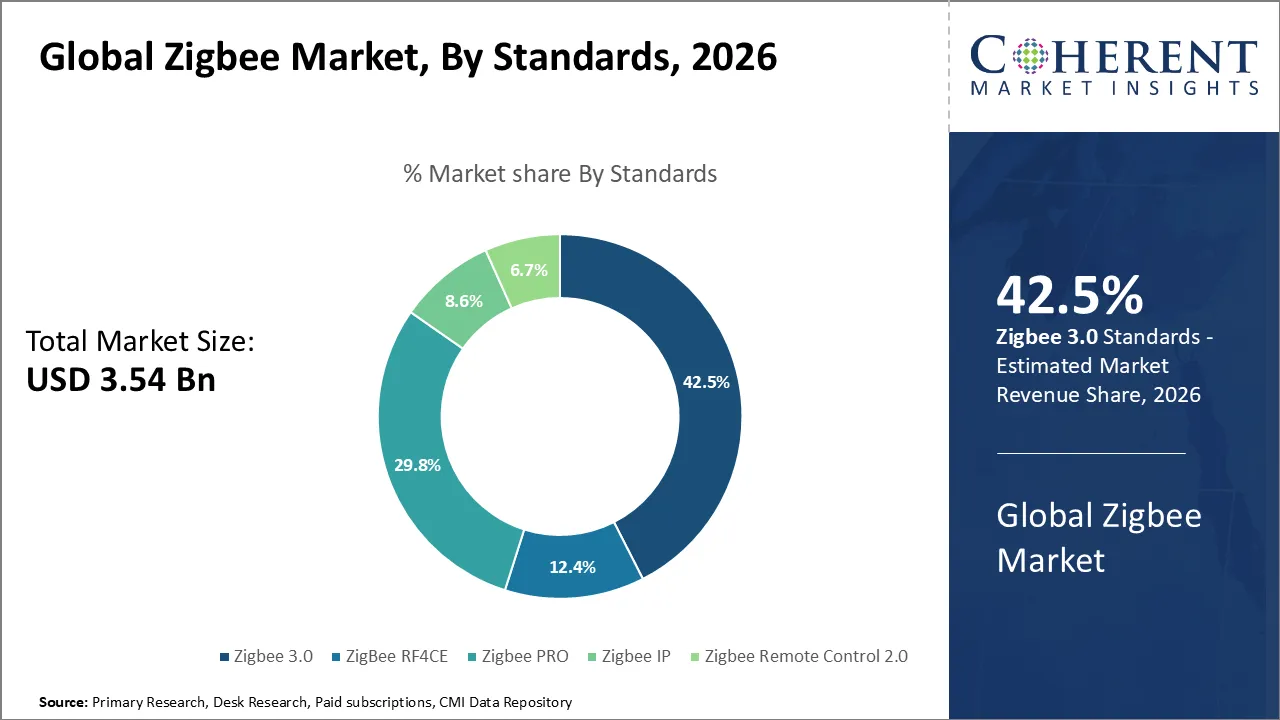
- The Zigbee 3.0 segment is expected to hold 42.5% of the market share in 2026. The segment growth is driven by increasing demand for interoperable smart devices, low power wireless connectivity, secure mesh networks, and growing adoption of connected lighting systems. According to the Connectivity Standards Alliance (CSA) in November 2025, there have been more than 1 Bn Zigbee devices deployed globally. The group also announced Zigbee 4.0, which is backward compatible with Zigbee 3.0 devices.
- The Zigbee Smart Energy segment is expected to hold the largest market share of 36.8% in 2026. Increasing smart meter installations, growing demand for automated energy monitoring, expanding smart grid infrastructure and adoption of connected energy management systems are key factors driving the segment growth. The U.S. Energy Information Administration (EIA) estimates that U.S. installations of advanced metering infrastructure increased to about 140.5 million in 2024 from 127.8 million in 2023, a reflection of increased deployment of smart electricity monitoring technologies.
- Home Automation is projected to account for the largest market share in 2026, at 38.5%. Growing adoption of smart lighting, connected security systems, automated thermostats and wireless home monitoring devices is driving the segment’s growth. The Philips Hue Bridge Pro, launched in September 2025, can support up to 150 lights and 50 accessories per hub, an upgrade over Zigbee-based smart home connectivity.
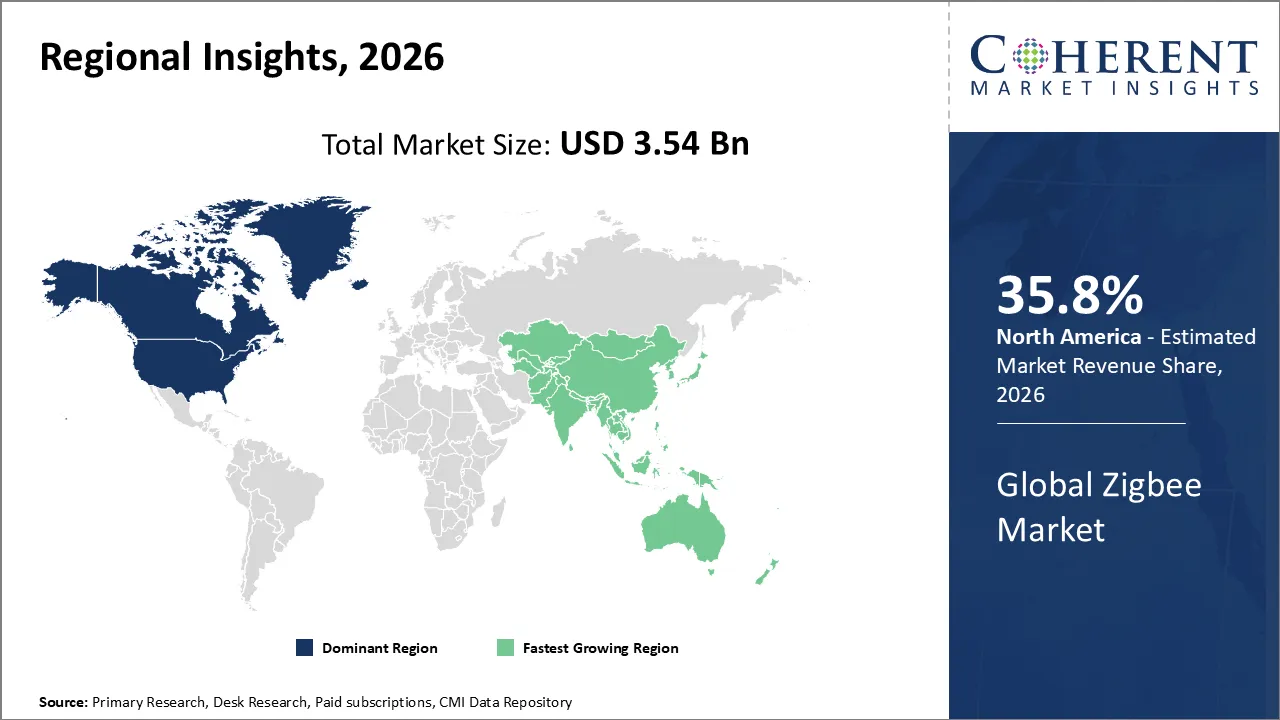
- North America is projected to emerge as the largest regional market with an approximately 35.8% share in 2026. The growth in the region is attributed to increasing smart home penetration, mature IoT infrastructure, energy-efficient building demand, and wireless automation technology adoption. Parks Associates reported smart home device ownership in U.S. internet households approached 50% in 2025, indicating the maturity of connected home devices for consumers in the country.
Market Drivers
Increasing Demand for Energy-Efficient Smart Buildings is Driving the Zigbee Market
The Zigbee Market is growing steadily due to the rising demand for energy-efficient buildings and automated energy management systems. Commercial and residential buildings are increasingly deploying wireless sensors, smart lighting controls and connected heating and cooling systems to monitor electricity consumption and boost energy efficiency. Zigbee technology allows these applications to communicate wirelessly and with low power using a mesh network so that many devices can share information without the need for a lot of wiring.
According to the International Energy Agency (IEA)’s Energy Efficiency 2025 report, buildings represented nearly 30% of global energy demand in 2024. Residential buildings used almost 70% of building energy demand and the rest 30% was divided between commercial and public buildings. These numbers underscore the importance of improving building energy efficiency and the potential for automated monitoring and control systems.
In June 2025, the U.S. Energy Information Administration (EIA) projected that commercial computing would account for 20% of U.S. commercial building electricity consumption by 2050, compared to an estimated 8% in 2024.
Growing Integration of Smart Home Devices and Connected Ecosystems is Accelerating the Zigbee Market
The increasing adoption of connected home technologies is another key factor contributing to the growth of the Zigbee market. Consumers are using smart lighting systems, motion sensors, security devices, smart plugs and automated appliances to improve convenience, safety and energy management. Zigbee allows such devices to talk to each other across low-power mesh networks and their interoperability with larger smart home platforms ensures they can work with products from multiple manufacturers.
According to the Consumer Technology Association (CTA) May 2026 U.S. Consumer Technology Ownership & Market Potential Study surveyed 73 technology products across 10 consumer technology categories including smart home devices. The study measured household ownership and intent to purchase, highlighting the growing importance of connected products in the consumer technology market.
In July 2026, IKEA released a software update for its DIRIGERA smart home hub, adding more Matter and Thread interoperability improvements and updating its Matter controller to version 1.4. 2. And IKEA assures that existing Zigbee devices connected through DIRIGERA will continue to work with Matter compatible smart home ecosystems.
Current Events and Their Impact on the Zigbee Market
Current Event | Description and its Impact |
European Union Implements Cyber Resilience Act Reporting Requirements for Connected Devices (September 2026) |
|
European Commission Updates Cybersecurity Regulations for Wireless Radio Equipment (April 2026) |
|
- Current Industry Events of 2026
- Market Size Estimation
- Regional Breakdown
- Competitive Landscape
- Customer Intelligence
- Segmental Analysis
- Pricing Analysis
- Key Market Drivers, Challenges & Future Trends
- Customized Insights Section
Segmental Insights
Why is Zigbee 3.0 Acquiring the Largest Market Share?
On the basis of standards, the Zigbee 3.0 segment is projected to account for the largest Zigbee Market share of 42.5% in 2026. The segment’s growth is driven by increasing adoption of interoperable wireless devices, low-power mesh networking, secure data communication, and integration of smart lighting, sensors, and connected home automation systems. Zigbee 3.0 supports communication between devices from different manufacturers, making it suitable for residential, commercial, and industrial IoT applications.
In January 2026, Silicon Labs’ SiMG301 wireless platform, which combines a 145 MHz Arm Cortex-M33 application core with dedicated processing for radio communication and security, was certified for Zigbee 3.0. The platform supports Zigbee, Bluetooth and Matter over Thread applications, a nod to the continued investment in multiprotocol wireless connectivity.
In March 2026, Texas Instruments received Zigbee 3.0 certification for its CC27xx family of wireless microcontrollers with the ZBOSS protocol stack. The news is a boon for continued semiconductor support for Zigbee-based IoT devices and could spur vendors to develop compatible wireless products.
Why is Zigbee Smart Energy Holding the Largest Market Share?
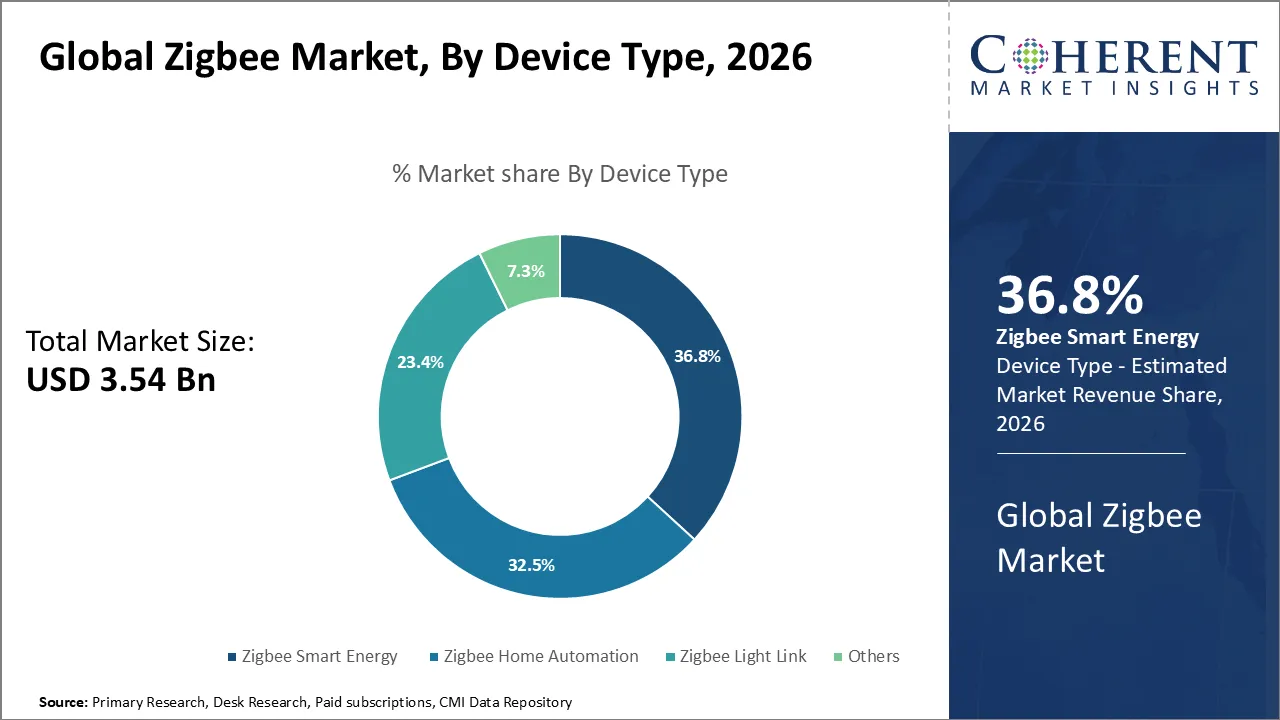
Zigbee Smart Energy segment is expected to be the leading device type segment with a share of 36.8% in 2026. The rise in smart electricity and gas meters adoption, increasing demand for real-time energy monitoring, growing smart grid infrastructure and increased focus on efficient energy consumption are attributed to the growth of the segment. Zigbee Smart Energy allows utility meters and in-home displays to communicate with each other and with energy management devices, giving consumers and utility providers the ability to monitor and manage energy usage.
According to the Connectivity Standards Alliance reports that Zigbee Smart Energy devices deployed globally exceed 250 million. This is evidence of the proven deployment of Zigbee technology in energy monitoring and management applications. Zigbee Smart Energy also supports certificate-based key establishment with 128 bits of security for improved safe communication between the meters and the devices they connect to.
In February 2026, Landis+Gyr’s 47:82 smart gas meter for the U.K. SMETS2 smart metering system achieved Zigbee Smart Energy certification. The certification recognizes the continuing development of Zigbee compatible metering products and reinforces the role of the technology within utility communication networks.
Why is Home Automation Leading the Zigbee Market?
On the basis of application, the Home Automation segment is anticipated to hold the largest Zigbee Market share of 38.5% in 2026. The segment’s growth is driven by increasing adoption of smart lighting, wireless security sensors, automated switches, connected appliances, and integrated home control systems. Zigbee technology enables low-power communication, reliable mesh connectivity and interoperability, and lets households control multiple connected devices through centralized hubs.
In August 2026, Shenzhen Sonoff Technologies has achieved Matter certification for its Zigbee 3.0 based smart home bridge ZBBridge-PR2, supporting up to 128 Zigbee sub-devices. The bridge allows Zigbee devices to be connected to smart home systems such as Apple Home, Google Home, Amazon Alexa and Samsung SmartThings.
Aqara’s smart home hub was Zigbee 3.0 certified by the Connectivity Standards Alliance in September 2026 with firmware version 4.0.4 and spec version 3.0. 1. The certification shows the ongoing development of Zigbee-compatible home automation products and helps in the growth of interoperable connected home systems.
Zigbee Market Trends
- The Zigbee Direct technology is growing in popularity, making it easier to install smart devices and manage wireless networks. The Connectivity Standards Alliance (CSA) said in March 2026 that Zigbee Direct technology could reduce device installation time by up to 60%, and could eliminate the need for dedicated commissioning hubs that typically cost USD 200-500 per project.
- The increasing demand for miniaturized and energy efficient wireless components is driving the development of compact Zigbee-enabled sensors, switches and monitoring devices. Texas Instruments says its pre-certified system-in-package wireless microcontrollers enable a 70% smaller board layout, helping to enable space-efficient designs, faster product development and lower power consumption in connected IoT applications.
- The growing adoption of advanced Zigbee software platforms is improving network reliability, device compatibility, and wireless communication performance. Silicon Labs released its Zigbee SDK version 9.1.1 in July 2026, which includes specific quality enhancements and bug fixes for Zigbee and multiprotocol wireless applications. These developments are enabling ongoing optimization of Zigbee-enabled products.
Regional Insights
North America Dominates Owing to Widespread Smart Home Adoption and Advanced IoT Infrastructure
The North America Zigbee Market is expected to hold the largest share of approximately 35.8% in 2026. Factors such as increasing adoption of smart home devices, strong wireless connectivity infrastructure, growing use of energy-efficient building automation systems and rising demand for connected security and lighting products are driving the growth of the region. The development of Zigbee-enabled devices is also benefitted by the presence of established semiconductor makers and wireless technology developers.
According to the Pew Research Center said 35% of U.S. adults had smart speakers, 18% had smart doorbells, 13% had robotic vacuum cleaners and 11% had smart thermostats with artificial-intelligence capabilities as of June 2026. Results from a survey completed in February 2026 show how prevalent connected home technologies are in the U.S. and the opportunities for interoperable wireless communication systems such as Zigbee.
In July 2026, California-based THIRDREALITY announced its ZW1 Zigbee Smart Wall Outlet for two electrical receptacles with independent control and energy monitoring. The product was introduced at a price of USD 29.99 and supports Zigbee mesh networking, enabling users to monitor electricity consumption and automate connected appliances.
Asia Pacific Zigbee Market Trends
Asia Pacific is expected to witness the fastest growth in the Zigbee Market during 2026–2033. The region’s growth is driven by increasing adoption of smart home devices, expansion of industrial IoT applications, rising investment in smart buildings, and government initiatives supporting digital connectivity. China, India, Japan, and South Korea are contributing to demand for energy-efficient wireless sensors, smart lighting systems, and connected automation technologies.
In January 2026, the Ministry of Commerce of China announced that in 2025, there were over 177,800 new home appliance product types in 12 categories introduced in China, up 28.89% year over year.
In April 2026, Aqara launched its FP310 AI-powered presence sensor, compatible with both Zigbee 3.0 and Thread wireless communication protocols. The battery-powered device combines four sensing capabilities, human presence detection, temperature, humidity and ambient light monitoring.
Increasing Smart Home Adoption and Demand for Secure Wireless Connectivity is Driving the Zigbee Market in the United States
The U.S. Zigbee Market is growing steadily due to rising adoption of smart home devices, increasing demand for low-power wireless communication, and growing integration of connected security systems, lighting controls, and automated sensors. The country’s matured IoT ecosystem and focus on device interoperability are opening up opportunities for Zigbee enabled residential and commercial automation solutions.
According to Horowitz Research says that in August 2026, 40% of U.S. consumers owned smart home devices. 55% of smart home device owners had connected doorbells, cameras or locks, 44% had smart TVs and 42% had sound systems. These findings point to a rising uptake of connected home technologies which in turn is driving demand for interoperable wireless communication solutions like Zigbee.
In December 2025, the U.S. National Institute of Standards and Technology (NIST) published research examining the security and privacy perceptions of 401 U.S. smart home users across five device categories, including lighting, security devices, sensors, thermostats, and voice assistants.
China Zigbee Market Trends
China is expected to witness strong growth in the Zigbee Market during 2026–2033. The country’s established electronics manufacturing industry, growing smart home ecosystem, increasing adoption of intelligent lighting and sensors, and continued development of low-power wireless communication technologies are driving the growth of the country. Chinese technology companies are introducing connected home platforms that incorporate Zigbee and other wireless protocols to allow interoperability across a range of devices.
According to the International Data Corporation (IDC), shipments of smart home devices in China are expected to reach about 300 million units in 2026, up 8.8% year-over-year. Smart cleaning robots and intelligent lighting devices are expected to be the growth categories.
In September 2026, China-based ZTE Corporation announced its AI Smart Display at IBC 2026 with Zigbee, Wi-Fi, Bluetooth, Matter connectivity. The device supports smart home control across more than 25 categories of connected products, including lighting, heating, and security systems.
Who are the Major Companies in Zigbee Industry
Some of the major key players in Zigbee Market are Intel Corporation, Qualcomm Incorporated, Atmel Corporation., Digi International, NXP Semiconductor N.V, STMicroelectronics N.V., Microchip Technology., Cypress Semiconductor Corporation, EnOcean GmbH, and NEXCOM International Co. Ltd.
Key News
- In March 2026, NXP Semiconductors announced the i.MX 93W applications processor, combining edge AI processing with integrated wireless connectivity supporting Wi-Fi 6, Bluetooth Low Energy, Thread, and Zigbee.
- In October 2025, Digi International announced that more than 25 million Digi XBee wireless modules had been shipped worldwide. The company highlighted its expanding wireless connectivity portfolio supporting Zigbee, DigiMesh, cellular, Bluetooth Low Energy, and other protocols.
Market Report Scope
Zigbee Market Report Coverage
Report Coverage | Details | ||
Base Year: | 2025 | Market Size in 2026: | USD 3.54 Bn |
Historical Data for: | 2020 to 2024 | Forecast Period: | 2026 to 2033 |
CAGR: | 9.1% | 2033 Value Projection: | USD 6.51 Bn |
Geographies covered: |
| ||
Segments covered: |
| ||
Companies covered: | Intel Corporation, Qualcomm Incorporated, Atmel Corporation., Digi International, NXP Semiconductor N.V, STMicroelectronics N.V., Microchip Technology., Cypress Semiconductor Corporation, EnOcean GmbH, and NEXCOM International Co. Ltd. | ||
Growth Drivers: |
| ||
Restraints & Challenges: |
| ||
Analyst Opinion
- The Zigbee Market growth is strongly supported by the increasing integration of wireless connectivity into smart home platforms and connected devices. According to Amazon’s 2026 developer docs say more than 20 Amazon Echo and eero device models support Zigbee connectivity, including smart home hubs, displays and routers. This shows how important Zigbee continues to be in current smart home ecosystems and drives demand for compatible sensors, switches, lighting products, and security devices.
- Multiprotocol semiconductor technologies are driving and accelerating Zigbee adoption in residential and industrial IoT applications. In March 2026, Synaptics announced the SYN765x wireless connectivity platform, which integrates Wi-Fi 7, Bluetooth LE 6.0 and Thread/Zigbee connectivity in a single-chip solution. The change is expected to make it easier to design devices, improve wireless interoperability and help increase the number of smart appliances and industrial automation systems that work with Zigbee.
- Growing emphasis on standardized wireless communication and product interoperability is driving long term opportunities for Zigbee Market. The Connectivity Standards Alliance has a certification ecosystem for various Zigbee applications including smart energy, home automation, lighting and connected sensors. Its Suzi certification program added support for sub-GHz communication in the 800 MHz band in Europe and 900 MHz band in North America in September 2026, possibly broadening Zigbee applications in commercial buildings, industrial monitoring and large-scale IoT networks.
Speak to the analyst
Want personalized insights?
Take the findings above to one of our principal consultants, or have the report rebuilt around the segments, geographies and competitors you actually track.
Market Segmentation
- By Standards (Revenue, USD Bn, 2021-2033)
- ZigBee RF4CE
- Zigbee PRO
- Zigbee IP
- Zigbee Remote Control 2.0
- Zigbee 3.0
- By Device Type (Revenue, USD Bn, 2021-2033)
- Zigbee Home Automation
- Zigbee Light Link
- Zigbee Smart Energy
- Others
- By Application (Revenue, USD Bn, 2021-2033)
- Home Automation
- Industrial Automation
- Telecommunication services
- Healthcare
- Retail Services
- Others
- By Region (Revenue, USD Bn, 2021-2033)
- North America
- U.S.
- Canada
- Latin America
- Brazil
- Mexico
- Argentina
- Rest of Latin America
- Europe
- Germany
- U.K.
- France
- Italy
- Spain
- Russia
- Rest of Europe
- Asia Pacific
- China
- India
- Japan
- Australia
- South Korea
- ASEAN
- Rest of Asia Pacific
- Middle East
- GCC
- Israel
- Rest of Middle East
- Africa
- South Africa
- Central Africa
- North Africa
- North America
Sources
Primary Research Interviews
- Zigbee wireless communication technology developers
- IoT chipset and semiconductor manufacturers
- Smart home and building automation solution providers
- R&D heads from wireless connectivity and IoT companies
- Smart meter and energy management system manufacturers
- Industrial automation and wireless sensor network experts
- Smart lighting and connected security device manufacturers
- Procurement managers from residential, commercial, and industrial IoT sectors
- Key opinion leaders (KOLs) in Zigbee technology, wireless networking, and IoT interoperability
Databases
- World Bank
- Organisation for Economic Co-operation and Development (OECD)
- International Telecommunication Union (ITU)
- U.S. Federal Communications Commission (FCC)
- International Energy Agency (IEA)
- U.S. Energy Information Administration (EIA)
- European Commission – Digital Strategy and Connectivity
- National Institute of Standards and Technology (NIST)
- United Nations International Trade Statistics Database (UN Comtrade)
Magazines
- Electronic Design
- EE Times
- IoT World Today
- Electronic Products
- Design World
- Embedded Computing Design
- Control Engineering
Journals
- IEEE Internet of Things Journal
- IEEE Communications Magazine
- IEEE Transactions on Industrial Informatics
- IEEE Transactions on Wireless Communications
- Sensors
- Wireless Networks
- Computer Networks
- International Journal of Communication Systems
Newspapers
- The New York Times
- The Guardian
- The Wall Street Journal
- Financial Times
- The Economic Times
- Nikkei Asia
Associations
- Connectivity Standards Alliance (CSA) – Zigbee Standards and Certification
- Institute of Electrical and Electronics Engineers (IEEE)
- IEEE Standards Association (IEEE SA)
- International Telecommunication Union (ITU)
- Telecommunications Industry Association (TIA)
- Internet of Things Community (IoT Community)
- Bluetooth Special Interest Group (Bluetooth SIG)
- Thread Group
- International Electrotechnical Commission (IEC)
Public Domain Sources
- Company Annual Reports and Investor Presentations
- Government Publications on IoT Infrastructure and Wireless Connectivity
- Connectivity Standards Alliance Zigbee Specifications and Certification Records
- IEEE 802.15.4 Wireless Communication Standards and Technical Publications
- Semiconductor Manufacturer Product Specifications and Technical Documentation
- Smart Home and Building Automation Industry Publications
- Publicly Available Smart Metering and Smart Grid Deployment Reports
- Patent Databases such as WIPO, USPTO, and Google Patents
- Regulatory Publications from FCC, ETSI, and the European Commission
- University Research Publications on Wireless Sensor Networks and IoT Technologies
Proprietary Elements
- CMI Data Analytics Tool
- Proprietary CMI Existing Repository of Information for the Last 10 Years
Get access to 250+ pages report
Every segment, forecast, competitor profile and data table behind the analysis above — available for instant download.
- ESOMAR Member
- ISO 9001:2015 Certified
- D-U-N-S Registered
- GDPR & CCPA Compliant
Missing comfort of reading report in your local language? Find your preferred language:
Transform your Strategy with Exclusive Trending Reports
Frequently Asked Questions
The Zigbee Market is expected to reach USD 6.51 Bn in 2033, compared to USD 3.54 Bn in 2026.
Major players operating in the global Zigbee Market include Intel Corporation, Qualcomm Incorporated, Atmel Corporation, Digi International, NXP Semiconductor N.V., STMicroelectronics N.V., Microchip Technology, Cypress Semiconductor Corporation, EnOcean GmbH, and NEXCOM International Co. Ltd.
Limited data transmission speed, bandwidth constraints, interference with Wi-Fi and other wireless technologies, and compatibility challenges are the key factors hampering growth of the Zigbee Market.
The increasing adoption of smart home devices, rising demand for energy-efficient wireless communication, growing deployment of IoT solutions, and expansion of industrial and building automation applications are driving growth of the Zigbee Market.
The Zigbee Market is anticipated to grow at a CAGR of approximately 9.1% between 2026 and 2033.
Among regions, North America is expected to account for the largest Zigbee Market share of approximately 35.8% in 2026, while Asia Pacific is anticipated to witness the fastest growth during the forecast period.
Zigbee is a low-power wireless communication technology designed to connect smart devices through mesh networking. It enables reliable data exchange between sensors, lighting systems, smart meters, and automation devices with minimal energy consumption.