

Electricians Market Size and Trends
The Global Electricians Market is estimated to be valued at USD 1 Tn in 2026 and is expected to reach USD 1.15 Tn by 2033, exhibiting a compound annual growth rate (CAGR) of 1.6% from 2026 to 2033.
Key Takeaways
- Based on Service Type, the electric power and systems installation and servicing segment is expected to lead the market with an estimated share of 64.4% in 2026, due to an increase in the demand for reliable and efficient power systems.
- Based on End User, the commercial segment is projected to dominate, holding 57.5% of the market share in 2026, owing to the rapid expansion and technological advancements in commercial spaces.
- Based on Region, Asia Pacific is expected to lead the market, holding a share of 35.8% in 2026, owing to the foreign direct investments.
Market Overview
The electricians market shows a positive trajectory, driven by urbanization, technological advancements, and the growing emphasis on energy efficiency. The rise in smart home installations, renewable energy projects, and infrastructure development fuels the demand for skilled electricians. Additionally, the aging electrical infrastructure in many countries necessitates upgrades and maintenance, further contributing to the market growth. As the industry evolves, electricians are adapting technologies and regulations, ensuring their continued relevance in the modern economy.
Current Events and Their Impacts
Current Events | Description and its impact |
Electric Vehicle Infrastructure Boom |
|
Energy Transition and Renewable Energy Expansion |
|
End-User Feedback And Unmet Needs
Feedback: 62–78% of customers have abandoned purchases or service requests because of poor or delayed communication; quick, transparent updates are a major expectation.
Unmet Need: End-users want 24/7 accessibility, rapid response (<4 hrs) on urgent issues, and proactive status updates (e.g., technician en route, parts delays).
Feedback: 40–49% of clients are frustrated by opaque pricing and billing; 75% expect upfront, detailed quotations.
Unmet Need: Clear scope-of-work breakdown, line-item pricing, and honest expectations are missing—customers demand trustworthy, jargon-free communication.
Feedback: 65% expect personalized service and tailored communication; 70% more likely to recommend providers who actively meet individual needs.
Unmet Need: One-size-fits-all solutions falter. Users want electricians knowledgeable in smart-home systems, renewable installations, energy efficiency, and to articulate options (e.g., whole-home inspections).
Feedback: 45% prefer online scheduling; 59% value self-service options; 58% report frustration with limited digital tools.
Unmet Need: From appointment booking to invoicing and status tracking, integrated digital platforms are lacking clients expect seamless interaction through mobile/web apps.
- Current Industry Events of 2026
- Market Size Estimation
- Regional Breakdown
- Competitive Landscape
- Customer Intelligence
- Segmental Analysis
- Pricing Analysis
- Key Market Drivers, Challenges & Future Trends
- Customized Insights Section
Segmental Insights
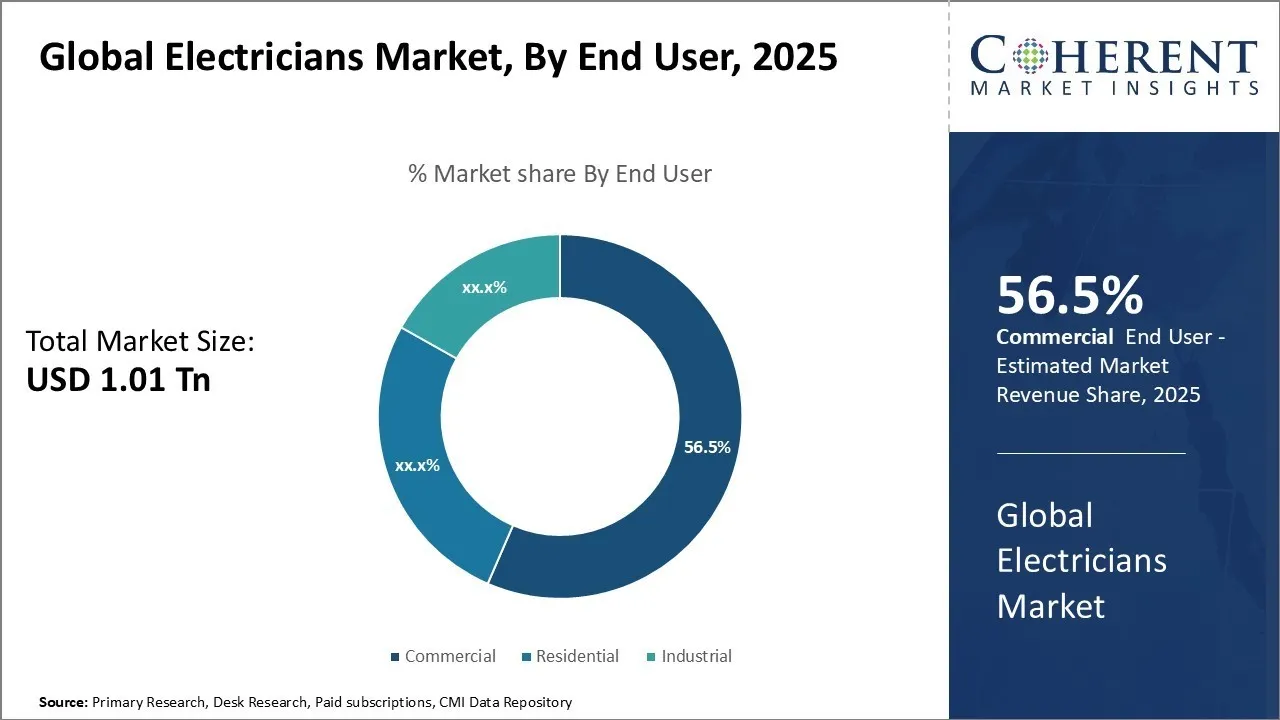
Electrical Market Insights, By End User
Commercial Segment Leads Due to Rapid Expansion and Technological Advancements in Commercial Spaces
The commercial segment is expected to emerge as the largest contributor to the global electricians market, holding a share of 57.5% in 2026, driven by a combination of factors that reflect the evolving needs of businesses and the increasing complexity of commercial spaces. This segment's dominance can be attributed to the rapid expansion of commercial infrastructure worldwide and the growing emphasis on advanced electrical systems in these environments.
One of the primary drivers for the commercial segment's growth is the continuous construction and renovation of office buildings, retail spaces, and hospitality establishments. As businesses expand and modernize their facilities, there is a constant need for electrical installations, upgrades, and maintenance. This trend is particularly pronounced in emerging economies where rapid urbanization is fueling the development of new commercial centers and business districts.
The increasing adoption of smart building technologies in commercial spaces has significantly contributed to the segment's growth. Modern office buildings and retail establishments are incorporating advanced lighting systems, Heating, Ventilation, and Air Conditioning (HVAC) controls, security systems, and energy management solutions, all of which require sophisticated electrical infrastructure. For instance, ABB and the Austria-based Zumtobel Group, a global leader in professional lighting solutions, have announced a strategic partnership focused on advancing smart building technologies and direct current (DC) applications for industrial products. This collaboration aims to deliver substantial value to customers across commercial, industrial, and institutional sectors by providing integrated, intelligent solutions for sustainable building development. This trend has created a sustained demand for electricians with expertise in installing and maintaining these complex, integrated systems.
Another factor driving the commercial segment's dominance is the growing emphasis on energy efficiency and sustainability in business operations.
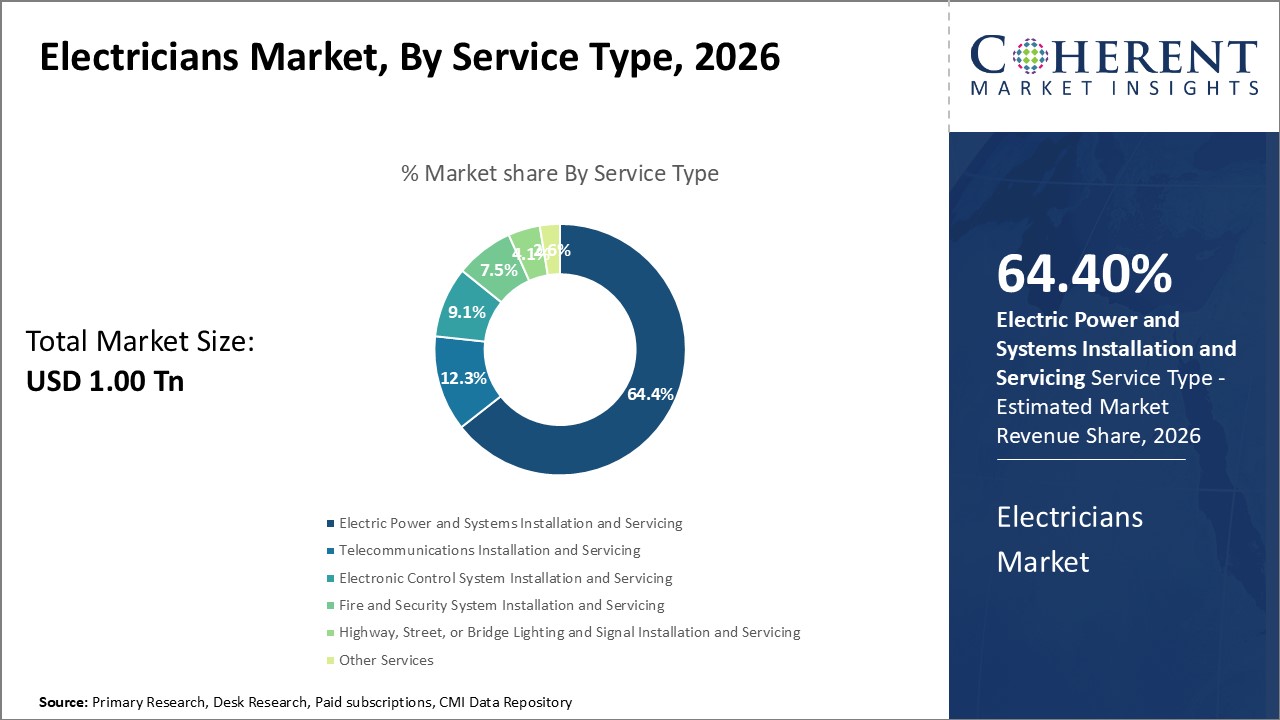
Electricians Market Insights, By Service Type
Electric Power and Systems Installation and Servicing Leads Due to Increasing Demand for Reliable and Efficient Power Systems
The electric power and systems installation and servicing segment is expected to emerge as the dominant segment in the global electricians market, holding a share of 64.4% in 2026, driven by several key factors that highlight its crucial role in modern infrastructure and energy management. The growing complexity of electrical systems in both residential and commercial settings has created a sustained demand for skilled electricians specializing in this area.
One of the primary drivers for this segment's growth is the increasing emphasis on energy efficiency and sustainability. As businesses and homeowners alike seek to reduce their carbon footprint and energy costs, there is a growing need for advanced electrical systems that can optimize power usage. This trend has led to a surge in the installation of smart meters, energy management systems, and renewable energy solutions, all of which require specialized expertise in electric power and systems.
Rapid urbanization and industrialization in developing countries have also contributed significantly to the segment's dominance. As new cities emerge and existing ones expand, there is an unprecedented demand for reliable electrical infrastructure. This includes not only the installation of new power systems but also the upgrading and maintenance of existing ones to meet growing energy needs and comply with evolving safety standards. For instance, in June 2025, Tata Power-DDL and Japan’s Nissin Electric Co Ltd commissioned India’s first micro substation with a power voltage transformer (PVT), enabling direct conversion of high-voltage transmission power to low voltage for residential use—offering a low-cost, reliable power supply. This is further propelling the electricians market demand.
Regional Insights
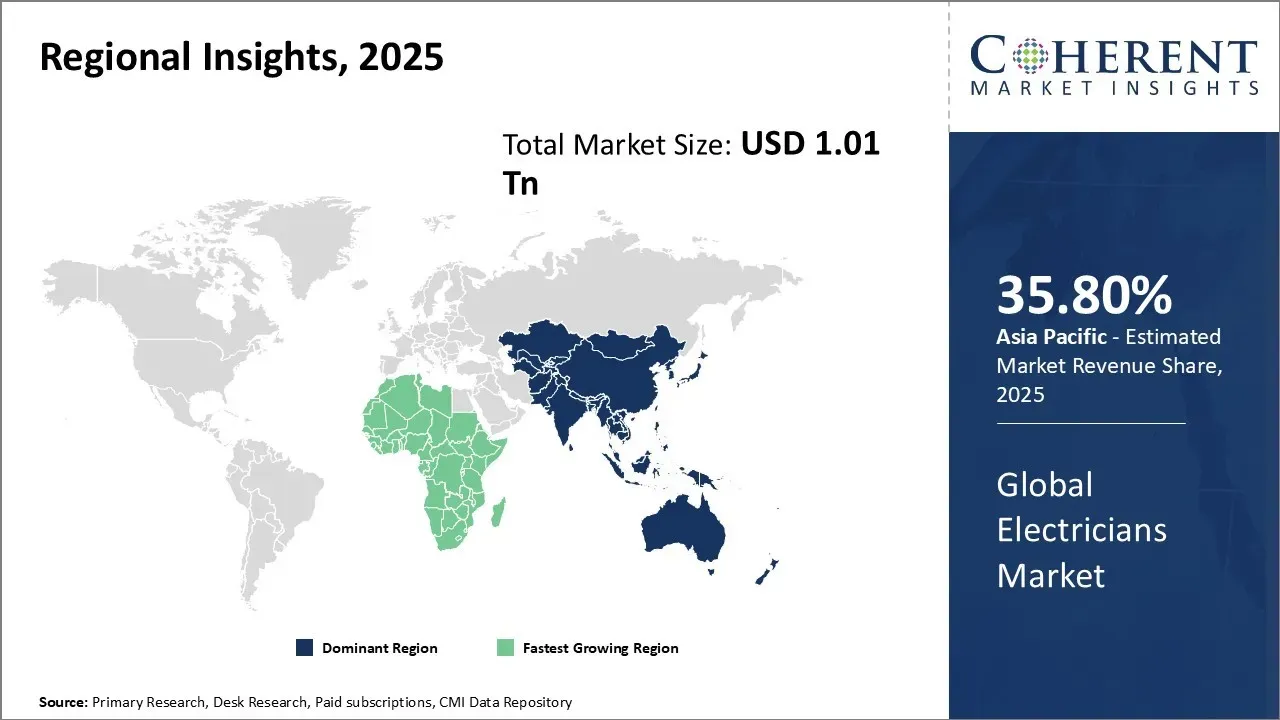
Asia Pacific Electricians Market Trends
Asia Pacific is expected to dominate the global electricians market, holding a market share of approximately 35.80% in 2026. The region is benefiting from increasing foreign direct investments in the manufacturing and industrial sectors, which require extensive electrical work. The rise of smart cities and the adoption of Internet of Things (IoT) technologies in countries like Japan, South Korea, and Singapore are further driving the demand for electricians with expertise in advanced electrical systems.
Local companies, such as Larsen & Toubro (India) and Panasonic Corporation (Japan), are playing significant roles in shaping the market landscape. These companies are not only providing employment opportunities but also contributing to the development of innovative electrical solutions tailored to the region's unique needs.
China's electrician market is experiencing rapid growth, fueled by the country's massive urbanization and infrastructure development initiatives. The government's push for renewable energy adoption and smart city projects is creating a surge in demand for specialized electrical services. Local companies such as TBEA Co., Ltd. and NARI Technology Co., Ltd. are playing crucial roles in shaping the market landscape. The ongoing expansion of China's manufacturing sector and the increasing focus on industrial automation are also driving the need for skilled electricians. As the country continues to invest in advanced technologies and sustainable development, the demand for electricians with expertise in these areas is expected to rise significantly.
Africa Electricians Market Trends
The Africa region, accounting for approximately 5.4% of the market in 2026, is projected to be the fastest-growing region, fueled by increasing urbanization, electrification programs, and infrastructure development across multiple countries. Nations such as Nigeria, South Africa, and Egypt are witnessing a surge in residential, commercial, and industrial construction, significantly increasing the demand for skilled electricians. The rising adoption of renewable energy sources, such as solar and wind power, is generating new opportunities for electricians specializing in green energy installations.
The African electricians market is also benefiting from foreign direct investments (FDI) in infrastructure, manufacturing, and industrial projects, which require extensive electrical work. The increasing focus on smart grids and energy-efficient electrical systems is further shaping the market landscape.
Local companies, such as Schneider Electric Africa (South Africa) and Elsewedy Electric (Egypt), are playing crucial roles in the region's electrical industry. These companies are not only creating employment opportunities but are also developing innovative electrical solutions tailored to Africa’s growing energy and construction needs.
Market Players, Key Development, and Competitive Intelligence
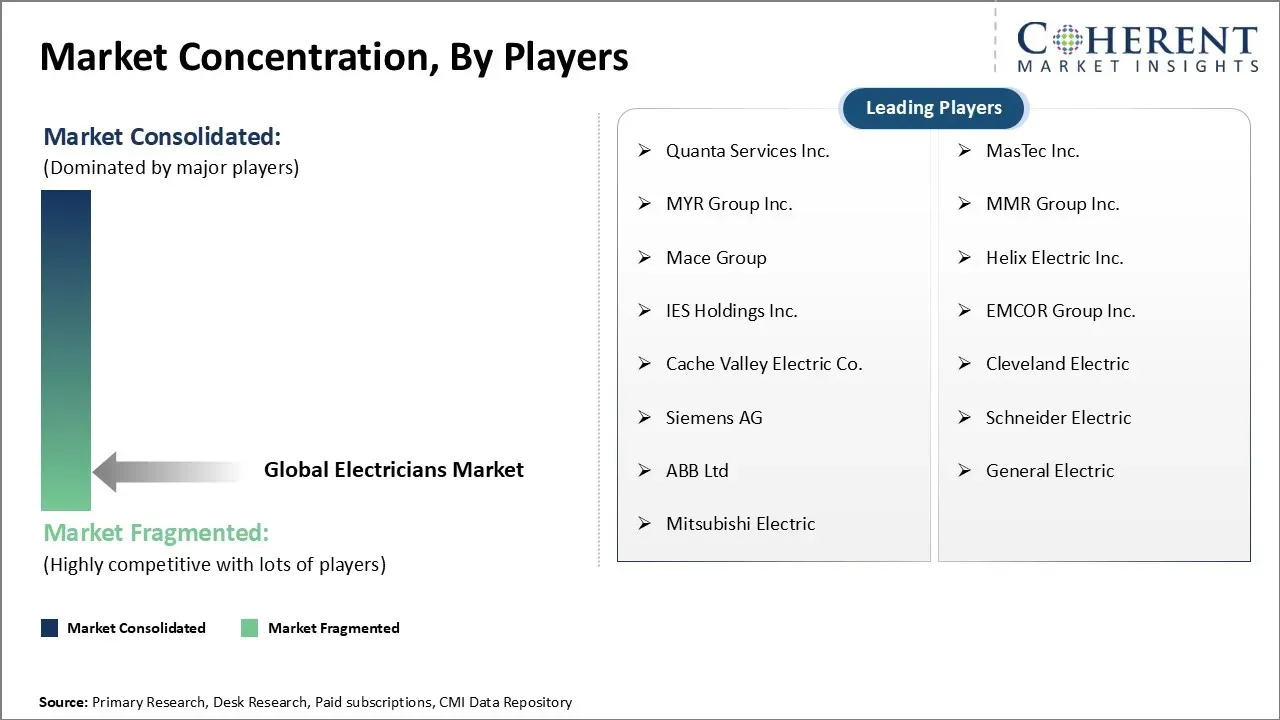
Key Developments
- In June 2025, Deputy Chief Minister Pawan Kalyan distributed safety kits to 325 private electricians in Pithapuram, India. He also emphasized on the need for safety gears.
- In April 2025, Google took the initiative to donate around USD 10 million to train electricians in the United States through organizations like the Electrical Training Alliance, National Electrical Contractors Association, etc. This initiative aims to train over 100,000 new workers.
- In May 2025, BIC Magazine highlighted the skills gap as several tech firms are preparing to train 130,000 electricians for the AI boom across the U.S. this upskilling initiative illustrates the key role electricians would play in supporting AI-powered infrastructure.
Market Report Scope
Electricians Market Report Coverage
| Report Coverage | Details | ||
|---|---|---|---|
| Base Year: | 2025 | Market Size in 2026: | USD 1 Tn |
| Historical Data for: | 2020 To 2024 | Forecast Period: | 2026 To 2033 |
| Forecast Period 2026 to 2033 CAGR: | 1.6% | 2033 Value Projection: | USD 1.15 Tn |
| Geographies covered: |
| ||
| Segments covered: |
| ||
| Companies covered: | Quanta Services Inc., MasTec Inc., MYR Group Inc.​, MMR Group Inc., Mace Group, Helix Electric Inc., IES Holdings Inc.​, EMCOR Group Inc., Cache Valley Electric Co.​, Cleveland Electric, Siemens AG​, Schneider Electric, ABB Ltd​, General Electric, and Mitsubishi Electric | ||
| Growth Drivers: |
| ||
| Restraints & Challenges: |
| ||
Electricians Market Driver-Rising Residential and Commercial Construction
The global electricians market is witnessing strong demand for energy-efficient heating and cooling solutions due to rising energy costs, stringent environmental regulations, and growing consumer awareness about sustainability. Governments worldwide are implementing energy efficiency standards and incentives to promote the adoption of high-Seasonal Energy Efficiency Ratio (SEER) rated HVAC systems, which has significantly boosted the market for electricians.
Unlike traditional central HVAC systems, electricians minimize energy loss by eliminating ductwork, allowing for precise temperature control and zoning capabilities that enhance overall efficiency. Additionally, the transition to eco-friendly refrigerants such as R-32 and R-410A, along with advancements in variable-speed inverter technology, has further strengthened the market’s appeal. As industries and residential consumers prioritize lower energy consumption and reduced carbon footprints, the demand for energy-efficient HVAC solutions, particularly electricians, is expected to grow exponentially.
Electricians Market Opportunity - Growth in Renewable Energy Projects
The global electricians market is poised to capitalize on a significant opportunity presented by the growing emphasis on renewable energy projects worldwide. As countries and corporations increasingly commit to reducing carbon emissions and transitioning to sustainable energy sources, there is a surge in demand for skilled electricians to install, maintain, and upgrade renewable energy systems. Solar PV panel installations, wind turbine projects, and energy storage solutions all require specialized electrical expertise, creating a new niche market for electricians. This shift towards green energy not only opens up new job opportunities but also encourages innovation and skill development within the industry.
Electricians who adapt to these emerging technologies position themselves at the forefront of a rapidly expanding sector. Furthermore, government incentives and subsidies for renewable energy projects in many countries are driving increased investment in this area, ensuring a steady stream of work for qualified professionals. The renewable energy sector also offers electricians the chance to contribute to environmental sustainability, potentially attracting a new generation of workers who are motivated by the opportunity to make a positive impact on the planet.
Analyst Viewpoint
- The shortage of electricians across global markets reflects a structural imbalance, not a temporary fluctuation. In Australia, industry groups report that over 42,000 additional electricians will be required to support current and future energy transition projects, while apprenticeship commencements have declined despite record completions. In the United States, the Bureau of Labor Statistics anticipates approximately 80,000 electrician openings annually through 2033, with growth significantly outpacing most other skilled trades.
- These data points confirm that the sector is contending not merely with labor scarcity but with systemic misalignment in training pipelines, regulatory frameworks, and the appeal of the profession itself.
- The role of electricians has fundamentally evolved. No longer limited to conventional electrical work, today's electricians are indispensable to large-scale infrastructure programs, particularly those tied to clean energy deployment, electric vehicle (EV) infrastructure, and artificial intelligence (AI) data centres.
- At the 2024 CERAWeek conference, multiple industry executives—including from BlackRock and Microsoft emphasized that the acute shortage of qualified electricians is delaying AI data centre projects and jeopardizing grid-scale renewable rollouts (Barron’s, 2024). Many renewable energy installations across North America and Oceania remain stalled due to the unavailability of certified professionals capable of integrating advanced systems, such as inverters, energy storage, and control automation.
- While digital transformation is underway in training ecosystems, the pace and scale are insufficient. Recent surveys show that over 78% of electrical services firms have increased training budgets, and 65% identify reskilling as a strategic priority. VR-based safety simulations and AI-assisted diagnostics are reducing average onboarding time by as much as 35%, yet these initiatives remain fragmented and heavily urban-centric.
- A central problem lies in the lack of coordination between industry stakeholders, vocational institutions, and government authorities. In many regions, particularly emerging markets, training quality remains inconsistent, and access to digital learning infrastructure is limited.
Market Segmentation
- Service Type Insights (Revenue, USD Trn, 2021 - 2033)
- Electric Power and Systems Installation and Servicing
- Telecommunications Installation and Servicing
- Electronic Control System Installation and Servicing
- Fire and Security System Installation and Servicing
- Highway, Street, or Bridge Lighting and Signal Installation and Servicing
- Other Services
- End User Insights (Revenue, USD Trn, 2021 - 2033)
- Commercial
- Residential
- Industrial
- Regional Insights (Revenue, USD Tn, 2021 - 2033)
- North America
- U.S.
- Canada
- Latin America
- Brazil
- Argentina
- Mexico
- Rest of Latin America
- Europe
- Germany
- U.K.
- Spain
- France
- Italy
- Russia
- Rest of Europe
- Asia Pacific
- China
- India
- Japan
- Australia
- South Korea
- ASEAN
- Rest of Asia Pacific
- Middle East
- GCC Countries
- Israel
- Rest of Middle East
- Africa
- South Africa
- North Africa
- Central Africa
- North America
- Key Players Insights
- Quanta Services Inc.
- MasTec Inc.
- MYR Group Inc.
- MMR Group Inc.
- Mace Group
- Helix Electric Inc.
- IES Holdings Inc.
- EMCOR Group Inc.
- Cache Valley Electric Co.
- Cleveland Electric
- Siemens AG
- Schneider Electric
- ABB Ltd.
- General Electric
- Mitsubishi Electric
Sources
Primary Research Interviews
- Direct interviews with licensed electricians, electrical contractors, and supervisors
- Discussions with equipment suppliers and electrical product distributors
- Insights from end-users in residential, commercial, and industrial segments
- Conversations with training institutions and certification bodies
Databases
- IBISWorld
- EMIS (Emerging Markets Information Service)
Magazines
- Electrical Contractor Magazine
- EC&M (Electrical Construction and Maintenance)
- T&D World
- Professional Electrician & Installer (UK)
- Construction Week (for MENA region updates)
Journals
- Journal of Electrical Engineering
- IEEE Transactions on Industry Applications
- Renewable and Sustainable Energy Reviews
- International Journal of Electrical Power & Energy Systems
Newspapers
- The Economic Times (India) – Industry updates, infrastructure news
- The Wall Street Journal – U.S. infrastructure and construction sector trends
- The Guardian (UK) – Skilled labor market and policy impacts
- Business Standard – Local tender notices and job market news
Associations
- National Electrical Contractors Association (NECA)
- Electrical Contractors’ Association (ECA, UK)
- Confederation of Indian Industry (CII) – Electrical and power sector vertical
- Independent Electrical Contractors (IEC)
- Institute of Electrical and Electronics Engineers (IEEE)
- National Skill Development Corporation (NSDC), India
Public Domain Sources
- Government labor and employment reports (e.g., U.S. Bureau of Labor Statistics, Ministry of Labour & Employment, India)
- World Bank and ILO reports on vocational and skilled trades
- Trade portals and tender websites
- Census and infrastructure investment data
- Open-access market insights and whitepapers from non-commercial sources
Get access to 250+ pages report
Every segment, forecast, competitor profile and data table behind the analysis above — available for instant download.
- ESOMAR Member
- ISO 9001:2015 Certified
- D-U-N-S Registered
- GDPR & CCPA Compliant
Missing comfort of reading report in your local language? Find your preferred language:
Transform your Strategy with Exclusive Trending Reports
Frequently Asked Questions
The global electricians market is estimated to be valued at USD 1.01 Trillion in 2025 and is expected to reach USD 1.11 trillion by 2032.
The CAGR of the global electricians market is projected to be 1.4% from 2025 to 2032.
Rising residential and commercial construction and increasing urbanization are the major factors driving the growth of the global electricians market.
Lack of skilled labor and rising material costs are the major factors hampering the growth of the global electricians market.
In terms of service type, the electric power and systems installation and servicing segment is estimated to dominate the market revenue share in 2025.
Quanta Services Inc., MasTec Inc., MYR Group Inc., MMR Group Inc., Mace Group, Helix Electric Inc., IES Holdings Inc., EMCOR Group Inc., Cache Valley Electric Co., Cleveland Electric, Siemens AG, Schneider Electric, ABB Ltd, General Electric, and Mitsubishi Electric are the major players.
Asia Pacific is expected to lead the global electricians market in 2025, holding a share of 35.8%.