

Global Software Defined Radio Market Size and Forecast – 2026 To 2033
The global software defined radio market is expected to grow from USD 17 Bn in 2026 to USD 29 Bn by 2033, registering a compound annual growth rate (CAGR) of 8.4% from 2026 to 2033. The global software defined radio market is driven by increasing deployment of secure military communication networks. On April 8, 2025, Rohde & Schwarz highlighted its pivotal role in being one of the first to implement the Second-Generation Anti-Jam Tactical UHF Radio for NATO (SATURN) standard. As NATO's standard UHF coalition waveform, SATURN is offering highly reliable transmission of voice and data. It is expected to replace the legacy HAVE QUICK waveform in operational use.
Key Takeaways of the Global Software Defined Radio Market
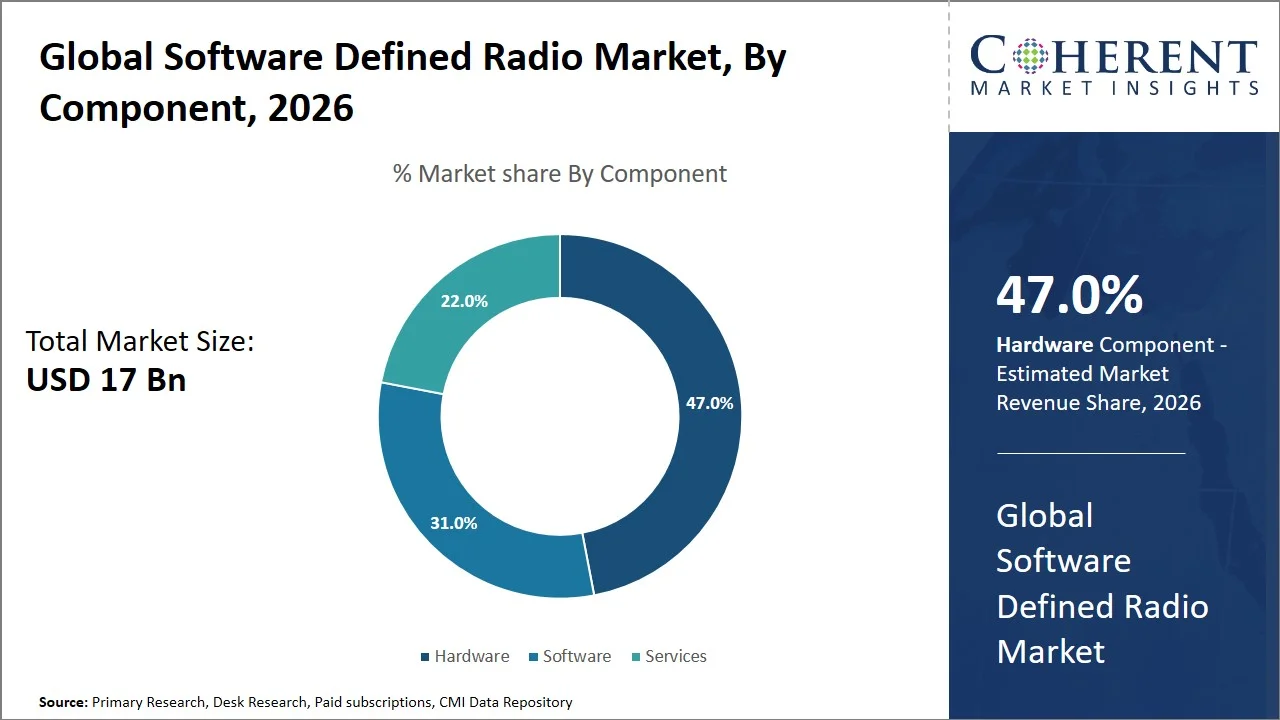
- The hardware segment is expected to account for 47.0 % of the global software defined radio market share in 2026. Expansion of public safety communication infrastructure is driving the growth of the segment. On April 21, 2025, Motorola Solutions launched SVX, a first-of-its-kind video remote speaker microphone that converges secure voice, video and AI, designed for the company’s flagship radio, APX NEXT.
- The land segment is estimated to capture 34.0 % of the market share in 2026. Increasing demand for multi band and multi-mode communication systems is majorly driving the growth of the segment. On October 7, 2025, Bharat Electronics Limited introduced the Indian Radio Software Architecture (IRSA) to standardize next-generation multi-band, multi-mode software-defined radios across the Indian Armed Forces, enabling interoperability between Army, Navy, and Air Force communication systems through common waveforms.
- The high frequency segment is estimated to capture 41.0 % of the market share in 2026. Growing use of software defined radio in satellite and aerospace applications is driving the growth of the segment. On May 20, 2025, Airbus Defence and Space continued the deployment of software-defined ground modem technology for the U.K.'s Skynet 6 programme, delivering multi-waveform software-defined radio capabilities designed to support military satellite communications across X-band and future protected waveforms.
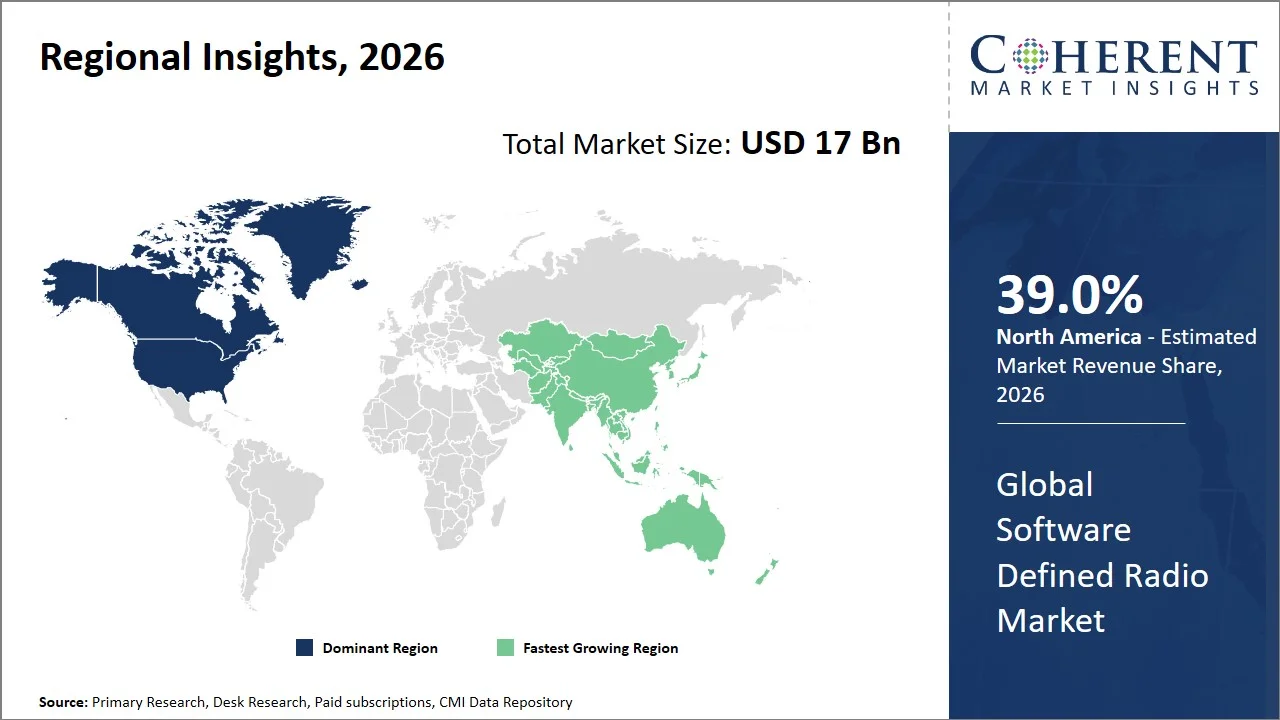
- North America is expected to dominate the software defined radio market in 2026 with a market share of 39.0 %. Increasing investments in tactical communication modernization in North America is driving the growth of the regional market. On August 3, 2026, Northrop Grumman signed two multi-year agreements valued at approximately USD 3 billion with the Pentagon and Lockheed Martin to expand production capacity for critical defense systems supporting U.S. military modernization.
- Asia Pacific is expected to account for 28.0 % of the market share in 2026 and is projected to record the fastest growth over the forecast period. Growing use in emergency response and disaster recovery networks across Asia Pacific is driving the growth of the regional market. On October 16, 2024, Leonardo was awarded the TETRA communication network contract for Singapore’s Cross Island Line (CRL), providing mission-critical radio infrastructure to serve emergency services.
Segmental Insights
Why Does Hardware Dominate the Global Software Defined Radio Market?
The hardware segment is expected to account for 47.0% of the global software defined radio market share in 2026. Hardware continues to dominate the global software defined radio market as high-performance radio frequency front ends, antennas, signal processors, field programmable gate arrays and analog-to-digital converters are still needed to provide reliable, low-latency and safe transmissions for defense, aerospace, public safety and commercial applications. The flexibility and waveform upgradeability of the software is still subject to the overall performance, frequency coverage, transmission power and signal integrity of the software defined radio systems, which depend on sophisticated hardware platforms that can support multiple bands and standards in demanding operating environments. On April 29, 2026, NI Ettus Research announced the introduction of USRP X420 software defined radio platform, featuring 1 GHz of instantaneous bandwidth, 10 MHz to 20 GHz of frequency coverage, built-in RF hardware and local oscillator sharing for high performance 6G, satellite communications, radar and aerospace research, reflecting the increasing demand for advanced RF front ends and high-speed hardware platforms.
- Current Industry Events of 2026
- Market Size Estimation
- Regional Breakdown
- Competitive Landscape
- Customer Intelligence
- Segmental Analysis
- Pricing Analysis
- Key Market Drivers, Challenges & Future Trends
- Customized Insights Section
Why is Land the Most Crucial Platform?
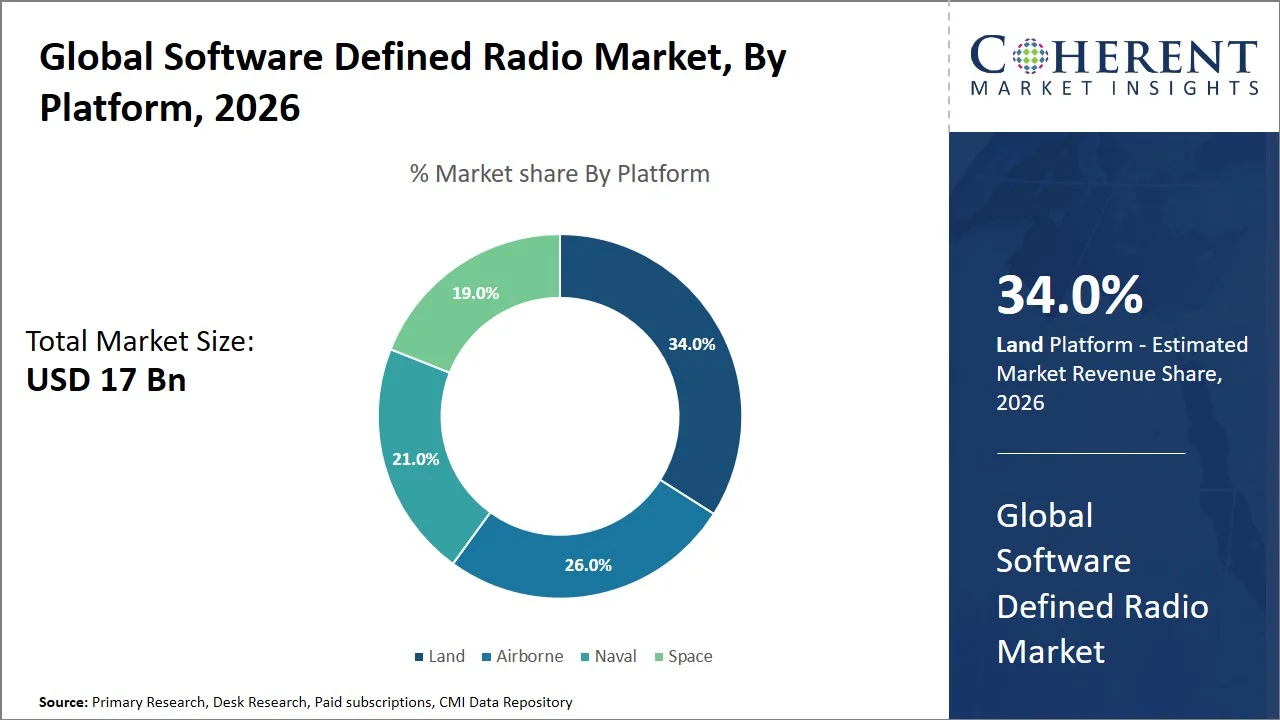
The land segment is expected to account for 34.0% of the global software defined radio market share in 2026. Modern military ground forces, border security agencies and emergency response organizations need secure and interoperable communications in highly dynamic operational contexts, and this is why land platforms represent the biggest proportion of software defined radio installations. Land-based deployments are the primary focus of procurement and modernization programs around the world, with software defined radio systems being critical for ground vehicles, portable soldier radios, command centers and tactical communication networks, providing multi-band support, encrypted communications and real-time network adaptability. On February 4, 2025, Rheinmetall announced that it has been awarded a contract in another important large-scale project for the Bundeswehr in the field of digitalization. As the prime contractor, Rheinmetall Electronics GmbH will be responsible for setting up an integrated communication network, the Tactical Wide Area Network for Land Based Operations.
High Frequency Dominates the Global Software Defined Radio Market
The high frequency segment is expected to account for 41.0% of the global software defined radio market share in 2026. High frequency is still widely used because it offers reliable long-range communication that can be achieved thru ionospheric propagation, going beyond the line of sight and thus proving extremely valuable for military operations, maritime communication, disaster response and remote area connectivity when satellite or terrestrial networks may be unavailable or disrupted. Software defined radios configured to operate at high frequencies provide flexible waveform support, secure voice and data transmission, and interoperability across multiple communications standards, enabling organizations to maintain resilient communications links under challenging operational conditions. On February 6, 2025, Bharat Electronics Limited entered into a contract with the Ministry of Defense to upgrade the Shakti Artillery Combat Command and Control System with secure HF, VHF and UHF software-defined communication capabilities for long-range battlefield connectivity and real-time command coordination.
Current Events and their Impact
Current Events | Description and its Impact |
European Union Radio Equipment Directive Delegated Regulation on Cybersecurity |
|
United States Federal Communications Commission Spectrum Rules and Open RAN Initiatives |
|
Global Software Defined Radio Market Dynamics
Market Drivers
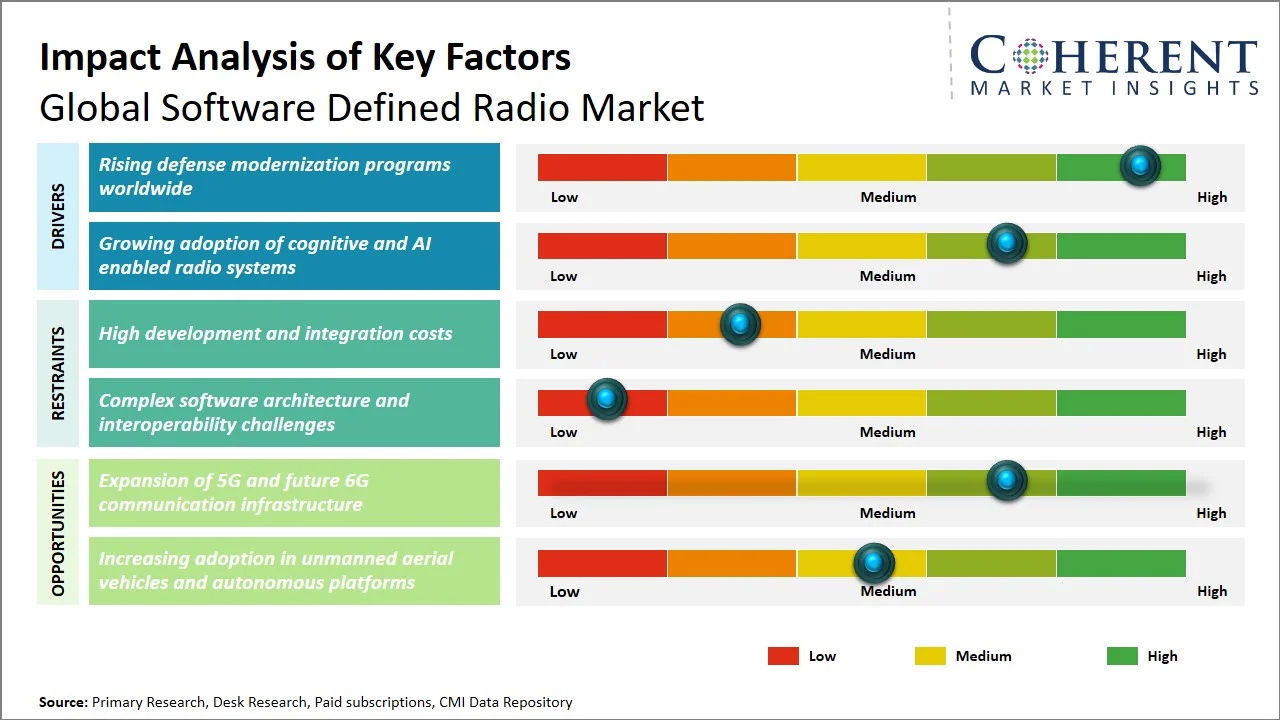
- Rising defense modernization programs worldwide: Defense modernization programs are growing fast in developed and emerging countries as governments emphasize safe, resilient and interoperable military communication networks. Investments in next generation command, control, communications, computers, intelligence, surveillance and reconnaissance (C4ISR) systems, network-centric warfare capabilities, electronic warfare platforms and software-defined tactical radios are driving the replacement of legacy analog communications equipment. Nations such as the United States, India, the United Kingdom, Japan, Australia, and a number of NATO members are increasing their defense budgets to improve battlefield connectivity, multi-domain operations, and coalition interoperability, which is creating steady demand for sophisticated software-defined radio technologies with improved encryption, spectrum agility, and real-time data sharing capabilities. On September 10, 2025, Thales and its local Malaysian partner Advanced Defense Systems signed a contract for the supply of HF XL TRC 3900 complete vehicle-mounted radio stations, including radios, amplifiers and antennas.
- Growing adoption of cognitive and AI enabled radio systems: Artificial intelligence and cognitive radio technologies are transforming wireless communication by enabling radios to independently analyze spectrum conditions, identify interference, and dynamically adjust operating frequencies without human intervention. AI-enabled software defined radios increase spectrum efficiency, maximize signal quality, improve electronic warfare resilience and allow autonomous decision making in highly contested communication contexts. Cognitive radio systems are increasingly being used in defense organizations, emergency response agencies, public safety networks and advanced commercial wireless infrastructure to improve reliability, reduce spectrum congestion and provide secure, adaptive communications across complex and rapidly changing operational scenarios. On October 14, 2025, Mavenir and e& UAE strengthened their strategic relationship with the deployment of AI-powered network security and intelligent network optimization, enabling cognitive radio capabilities thru automated traffic analysis, adaptive spectrum usage and AI-assisted network management.
Emerging Trends
- Integration of artificial intelligence and cognitive radio technologies: Software defined radio platforms are increasingly integrating artificial intelligence and machine learning algorithms that facilitate autonomous spectrum sensing, dynamic frequency allocation, interference mitigation, and adaptive waveform selection, which improve communication reliability in complex operational environments.
- Growing adoption of open architecture and modular radio platforms: Defense organizations and commercial operators are migrating to open standards and modular software defined radio architectures that facilitate interoperability, accelerate technology upgrades, and reduce lifecycle costs, while delivering support for multiple communication protocols on a single platform.
- Expansion of software defined radios in satellite and space communications: Rapid growth of low earth orbit satellite constellations and next generation space missions is driving the need for software defined radios that can be remotely reconfigured, and that can support multi-band communication and smooth integration with terrestrial and satellite internet
- Increasing deployment in unmanned and autonomous systems: Software defined radios are crucial in unmanned aerial vehicles, autonomous ground vehicles, and maritime platforms, offering secure, low-latency, and flexible communications that enable real-time command, control, surveillance, and data transfer across various mission environments.
Regional Insights
Why is North America a Strong Market for Software Defined Radios?
North America is expected to account for a market share of 39.0% in 2026. The U.S. and Canada are leading the way in military modernization and sophisticated aerospace programs, making North America the global epicenter for software defined radio innovation. The U.S. Department of Defense continues to employ secure tactical radios, within the framework of the Joint Tactical Networking Center certified waveform framework, with companies such as L3Harris Technologies, RTX, General Dynamics Mission Systems, Collins Aerospace and Northrop Grumman providing software defined radio systems for the U.S. Army, Navy, Air Force and Space Force. Software defined radios are also gaining wider usage in the region for satellite communications, border surveillance, emergency response networks and Open RAN deployments, with NASA increasingly turning to reconfigurable radios for deep-space and lunar communication missions.
Why Does the Asia Pacific Software Defined Radio Market Exhibit High Growth?
Asia Pacific is projected to account for 28.0% of the global software defined radio market in 2026 and expected to register the fastest growth. Rapid implementation of software defined radio is being witnessed in the Asia Pacific, spurred by defense modernization, local defense manufacturing and growing satellite communication capabilities. In addition to providing encrypted communications and EW platforms provided by BeiDou, China continues to integrate software defined radios into tactical communication systems in the People’s Liberation Army. India is rapidly developing its own SDRs via Bharat Electronics Limited, Defense Electronics Applications Laboratory and DRDO programs, while Japan is deploying advanced software defined radios across the Japan Self-Defense Forces and investing in next-generation tactical communication systems. South Korea is deploying SDR technology with the Korean Tactical Information Communication Network, while Australia is improving battlefield communications by LAND modernization efforts and secure interoperable radio procurements.
Global Software Defined Radio Market Outlook for Key Countries
Why is the U.S. Emerging as a Major Hub in the Software Defined Radio Market?
The U.S. leads global software defined radio adoption through continuous investment in Joint All-Domain Command and Control, Integrated Tactical Network, and next-generation battlefield communications. L3Harris Technologies has been ramping up deployment of its HMS Manpack and Leader radios sold to the U.S. Army. The U.S. Marine Corps and Special Operations Command are still developing upgrades to secure multi-channel communications equipment. RTX and Collins Aerospace are working on integrating SDRs into military aircraft, while the Naval Information Warfare Systems Command works to build secure marine communications. The Federal Communications Commission also encourages flexible use of spectrum thru programmable multi-band radio systems in both defense and commercial sectors.
Is China the Next Growth Engine for the Software Defined Radio Market?
China is developing software defined radio capabilities thru military modernization, local semiconductor development, and integrated satellite communications. The People’s Liberation Army has developed digital battlefield communications systems with multi-band programmable radios for land, marine and airborne operations. Chinese firms continue to integrate software defined radios into unmanned aerial vehicles, electronic warfare devices and BeiDou-enabled communication terminals. National investment in low Earth orbit satellite constellations, 5G infrastructure and intelligent spectrum management are enabling the use of reconfigurable radio technology across military and commercial applications.
Germany Software Defined Radio Market Analysis and Trends
Germany is one of the most advanced markets for software defined radio in Europe, driven by broad defense digitization and NATO interoperability efforts. The Bundeswehr continues to implement secure tactical communication systems that are compatible with multinational NATO operations and Rohde & Schwarz is developing innovative software defined radio solutions for military, aerospace and homeland security applications. Germany is also a key player in the European Future Combat Air System program that puts secure, software-upgradable communication networks at the heart of multi-domain operations. The country’s strong industrial electronics base and participation in European safe communication projects continue to stimulate creativity in programmable radio systems.
U.K. Software Defined Radio Market Analysis and Trends
Software defined radio deployment continues to increase in support of defense communication modernization and electronic warfare capabilities augmentation. Under the Morpheus program, the British Army is rolling out modern tactical communications systems that will replace antiquated Bowman infrastructure with software-centric and open-architecture communications. Companies providing secure software defined radio solutions for ground, marine and airborne platforms include BAE Systems, Spectra Group and Leonardo UK. The Ministry of Defense is also investing in robust multi-domain communications to give autonomous systems, cyber resilient networks and coalition interoperability throughout NATO missions.
India Software Defined Radio Market Analysis and Trends
With the government focus on self-reliance in military production and indigenous communication technology, India is fast emerging as a big market for software defined radio. Bharat Electronics Limited has created several generations of software defined radios for the Indian Army, Indian Navy and Indian Air Force while DRDO and the Defense Electronics Applications Laboratory continue to work on secure multi-band and network-centric radio systems. Software defined radios are being integrated into initiatives such as the Future Infantry Soldier as a System initiative, navy vessels, armored vehicles and battlefield management systems. Further, the progressive implementation of the Telecommunications Act and the growth of domestic defense production under the Atmanirbhar Bharat plan are supporting local development and deployment of secure programmable communication platforms.
Global Software Defined Radio Market - Cognitive Radio Adoption By Country (2025)
Country | Estimated Cognitive Radio Adoption |
U.S. | 76% |
China | 71% |
India | 63% |
Germany | 60% |
Japan | 58% |
South Korea | 56% |
U.K. | 54% |
France | 52% |
Canada | 49% |
Australia | 47% |
How is the Expansion of 5G and Future 6G Communication Infrastructure Creating New Growth Opportunities in the Global Software Defined Radio Market?
The growth of 5G and budding 6G communication infrastructure is fueling the demand for programmable radio platforms to support new frequency bands, network slicing, massive MIMO and evolving wireless standards without the need for hardware replacement, offering ample opportunities for the software defined radio market. Operators including Rakuten Mobile, Vodafone, NTT DOCOMO and AT&T are rolling out Open RAN which improves the use of software-driven radio units that can be remotely upgraded as network specifications change. 6G research initiatives include the European Union’s Smart Networks and Services Joint Undertaking, Japan’s Beyond 5G Promotion Consortium and the U.S. Next G Alliance is spearheading the development of software defined radios that enable sub-THz frequencies, AI-native radio resource management, integrated sensing and communication, and dynamic spectrum sharing, leading to long-term demand for flexible, multi-band, software-upgradable radio architectures across telecommunications, defense, and satellite communication networks.
On March 5, 2025, ZTE Corporation, a leading global provider of integrated information and communication technology solutions, and China Mobile co-hosted the 5G-A x AI Results Release Event, revealing two major innovations in Communication-Sensing-Computing-Intelligence and Ambient IoT at MWC Barcelona 2025.
Market Players, Key Development, and Competitive Landscape
Key Developments
- On June 9, 2026, L3Harris Technologies received a USD 170 million order from a Central European nation for its Falcon IV family of communication systems. The technology will support ongoing force modernization initiatives and will enhance secure, seamless interoperability with U.S. and NATO partners.
- On March 5, 2026, Rohde & Schwarz acquired Software Radio Systems, a specialist in 5G software defined radio systems. This acquisition further strengthens the position of Rohde & Schwarz in the cellular and wireless communications software market and accelerates development in AI based test solutions for satellite and next generation 6G wireless technologies.
Competitive Landscape
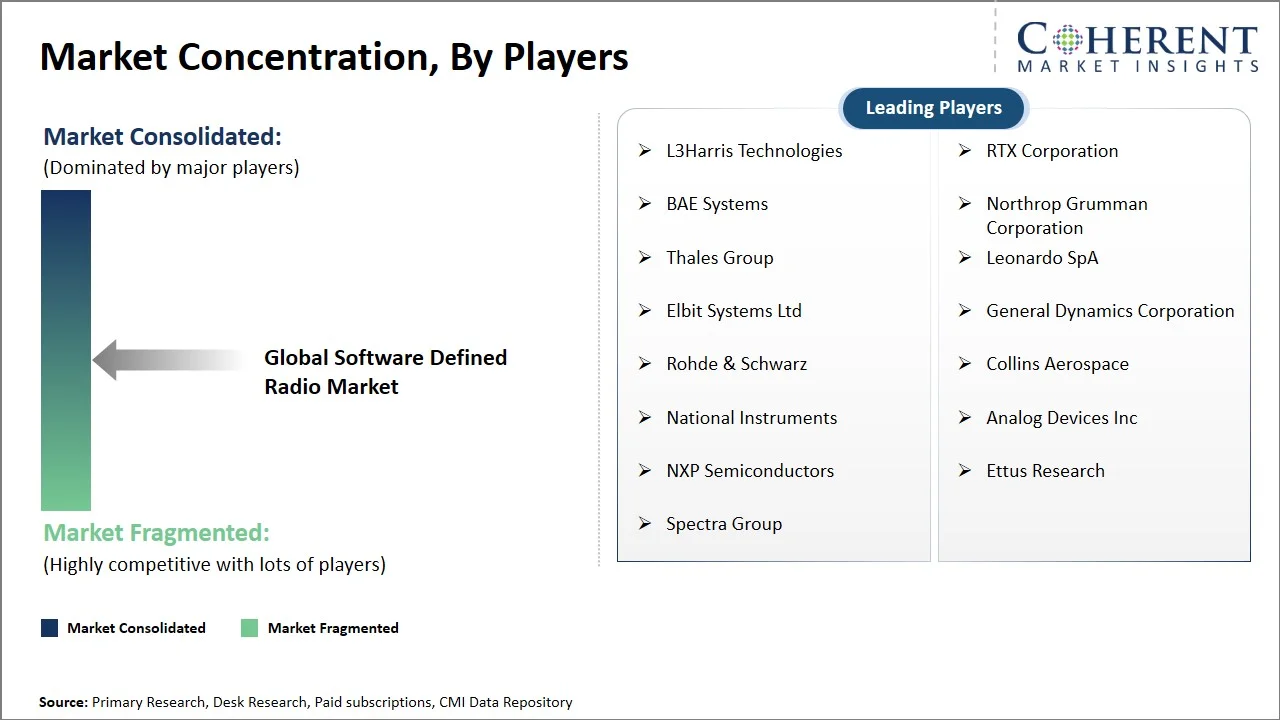
The global software defined radio market is led by companies including L3Harris Technologies, RTX Corporation, BAE Systems, Thales Group, Rohde & Schwarz, Leonardo, Northrop Grumman, and General Dynamics Mission Systems, all of which are competing through secure waveform development, open architecture platforms, AI-enabled spectrum management, and multi-domain interoperability. L3Harris develops Falcon IV tactical radio portfolio for U.S., working with the Department of Defense and allied nations. Thales has reinforced its SYNAPS family of software defined radios in NATO member states while Rohde & Schwarz continues to provide safe communication and electronic warfare solutions for European defense modernization programs. Leonardo is working on software upgradeable radios for integrated battlefield networks and naval systems, and BAE Systems is working on robust communications for Future Combat Air System and autonomous military platforms. Increasing collaboration with Open RAN ecosystem providers, satellite communication operators, and defense ministries is becoming the primary competitive strategy for maintaining technological leadership.
Market Report Scope
Software Defined Radio Market Report Coverage
| Report Coverage | Details | ||
|---|---|---|---|
| Base Year: | 2025 | Market Size in 2026: | USD 17 Bn |
| Historical Data for: | 2020 To 2024 | Forecast Period: | 2026 To 2033 |
| Forecast Period 2026 to 2033 CAGR: | 8.4% | 2033 Value Projection: | USD 29 Bn |
| Geographies covered: |
| ||
| Segments covered: |
| ||
| Companies covered: | L3Harris Technologies, RTX Corporation, BAE Systems, Northrop Grumman Corporation, Thales Group, Leonardo SpA, Elbit Systems Ltd, General Dynamics Corporation, Rohde & Schwarz, Collins Aerospace, National Instruments, Analog Devices Inc, NXP Semiconductors, Ettus Research, and Spectra Group | ||
| Growth Drivers: |
| ||
| Restraints & Challenges: |
| ||
Analyst Opinion (Expert Opinion)
- The future of the software defined radio industry is expected to be shaped by convergence between tactical communications, commercial 5G and future 6G infrastructure, low Earth orbit satellite networks, and artificial intelligence-based spectrum management. Software-defined, hardware-independent communication platforms will increasingly replace purpose-built radios as governments seek faster capability upgrades without extensive equipment replacement.
- The strongest growth opportunity is expected to emerge in land-based tactical communication systems for defense applications in the U.S. and India, where military modernization programs, indigenous manufacturing initiatives, and secure battlefield networking projects continue to accelerate procurement. Further high-potential opportunities are foreseen in Open RAN infrastructure deployments across Japan and Europe and in software defined satellite payloads supporting low Earth orbit constellations.
- To stay competitive, industry participants should focus on developing open-standard, NATO-compliant and AI-enabled software defined radio solutions that allow numerous waveforms via secure over-the-air upgrades. Over the next few years, the biggest deals will probably go to firms that forge long-term partnerships with defense ministries, chip makers, satellite operators and Open RAN ecosystem providers, and also strengthen their cybersecurity certification and software lifecycle management skills.
Speak to the analyst
Want personalized insights?
Take the findings above to one of our principal consultants, or have the report rebuilt around the segments, geographies and competitors you actually track.
Market Segmentation
- Component Insights (Revenue, USD Billion, 2021 - 2033)
- Hardware
- Software
- Services
- Platform Insights (Revenue, USD Billion, 2021 - 2033)
- Land
- Airborne
- Naval
- Space
- Frequency Band Insights (Revenue, USD Billion, 2021 - 2033)
- High Frequency
- Very High Frequency
- Ultra High Frequency
- Super High Frequency
- Application Insights (Revenue, USD Billion, 2021 - 2033)
- Defense
- Homeland Security
- Commercial Telecommunications
- Public Safety
- Transportation
- Aerospace
- Regional Insights (Revenue, USD Billion, 2021 - 2033)
- North America
- U.S.
- Canada
- Latin America
- Brazil
- Argentina
- Mexico
- Rest of Latin America
- Europe
- Germany
- U.K.
- Spain
- France
- Italy
- Russia
- Rest of Europe
- Asia Pacific
- China
- India
- Japan
- Australia
- South Korea
- ASEAN
- Rest of Asia Pacific
- Middle East
- GCC Countries
- Israel
- Rest of Middle East
- Africa
- South Africa
- North Africa
- Central Africa
- North America
- Key Players Insights
- L3Harris Technologies
- RTX Corporation
- BAE Systems
- Northrop Grumman Corporation
- Thales Group
- Leonardo SpA
- Elbit Systems Ltd
- General Dynamics Corporation
- Rohde & Schwarz
- Collins Aerospace
- National Instruments
- Analog Devices Inc
- NXP Semiconductors
- Ettus Research
- Spectra Group
Sources
Primary Research Interviews
- Aerospace and Satellite Communication Engineers
- Defense Procurement Officials
- Military Communication Program Managers
- Public Safety Communication Infrastructure Specialists
Magazines
- Military & Aerospace Electronics
- Microwave Journal
- IEEE Communications Magazine
- QST Magazine (ARRL)
Journals
- IEEE Transactions on Wireless Communications
- IEEE Transactions on Communications
- IEEE Journal on Selected Areas in Communications
- IEEE Open Journal of the Communications Society
Associations
- IEEE Communications Society (ComSoc)
- IEEE Aerospace and Electronic Systems Society (AESS)
- Wireless Innovation Forum
- National Defense Industrial Association (NDIA)
Public Domain Sources
- U.S. Department of Defense (DoD)
- Defense Advanced Research Projects Agency (DARPA)
- U.S. Federal Communications Commission (FCC)
- National Telecommunications and Information Administration (NTIA)
Proprietary Elements
- CMI Data Analytics Tool
- Proprietary CMI Existing Repository of Information for the Last 10 Years
Get access to 250+ pages report
Every segment, forecast, competitor profile and data table behind the analysis above — available for instant download.
- ESOMAR Member
- ISO 9001:2015 Certified
- D-U-N-S Registered
- GDPR & CCPA Compliant
Missing comfort of reading report in your local language? Find your preferred language:
Transform your Strategy with Exclusive Trending Reports
Frequently Asked Questions
The global software defined radio market is expected to stand at USD 17 Bn in 2026 and is expected to reach USD 29 Bn by 2033.
The CAGR of the global software defined radio market is projected to be 8.4% from 2026 to 2033.
Rising defense modernization programs worldwide and growing adoption of cognitive and AI enabled radio systems are the major factors driving the growth of the global software defined radio market.
High development and integration costs and complex software architecture and interoperability challenges are the major factors hampering the growth of the global software defined radio market.
Artificial intelligence improves spectrum sensing, interference mitigation, and autonomous radio configuration.
It enables programmable radio functions that can be upgraded through software without replacing hardware.
In terms of component, the hardware segment is estimated to dominate the market revenue share in 2026.