

Text Analytics Market Size and Share Analysis - 2026 To 2033
The Text Analytics Market is anticipated to grow at a CAGR of 17.7% with USD 15,467.6 Mn share in 2026 and is expected to reach USD 48,401.3 Mn in 2033. The increasing adoption of artificial intelligence and natural language processing, the growing need for customer sentiment analysis, the rise of unstructured data in businesses, and the increasing application of predictive analytics in industries such as healthcare, retail, BFSI, and media are driving the market.
Key Takeaways from the Text Analytics Market Report
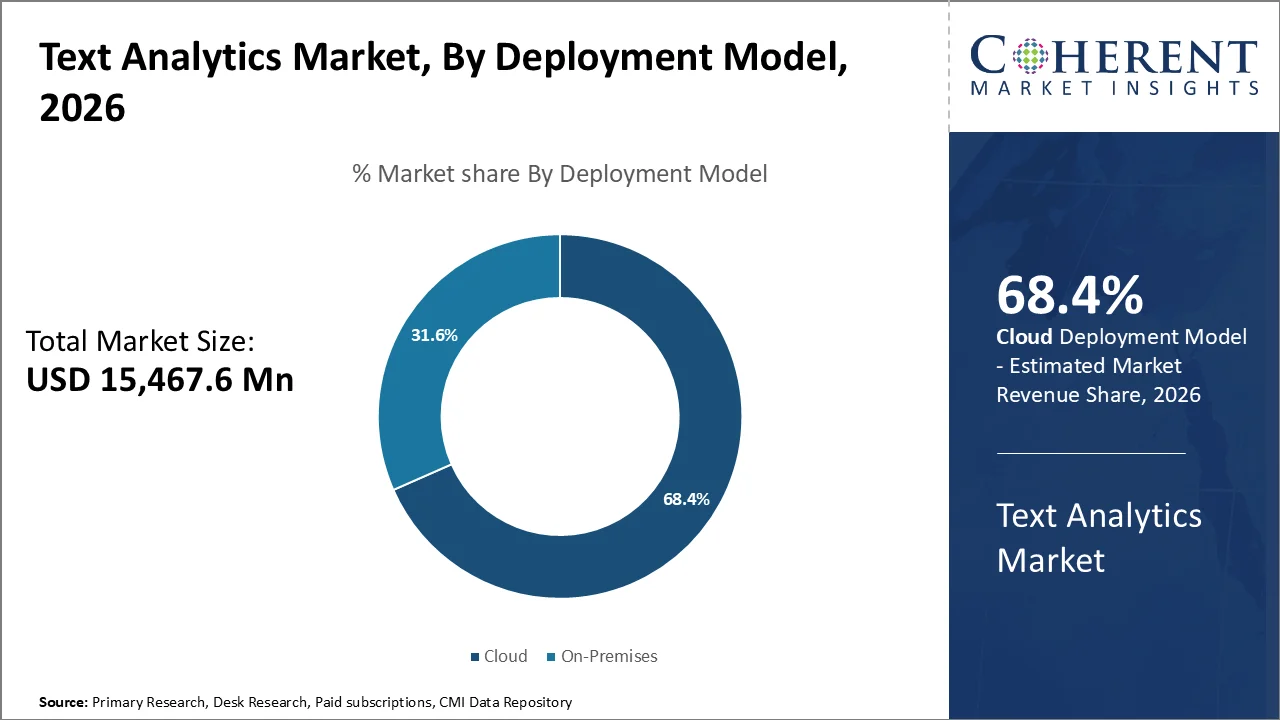
- The cloud segment is estimated to lead the market with a market share of 68.4% by 2026 owing to the increased adoption of cloud-based AI and analytics solutions, as well as cost efficiency. As per IBM, roughly 90% of the data generated by enterprises is unstructured, driving the need for cloud-based text analytics.
- The large enterprises segment is expected to occupy the largest market share of 64.7% in 2026 owing to high investment in artificial intelligence analytics, customer intelligence, and automation solutions. According to the results of the Deloitte India State of Artificial Intelligence Report, around 97% of companies are confident about productivity gains through artificial intelligence technology, while 68% have made investments in security and compliance areas.
- The Banking, Financial Services, and Insurance (BFSI) segment is anticipated to lead the market with a 24.8% market share in 2026 due to the increasing application of AI-based technologies for different purposes including fraud detection, compliance, customer sentiment analysis, and risk management. As per the report on AI Adoption by Deloitte, 40% of enterprises have adopted AI widely, which is 12% higher than the global average of 28%, reflecting the rapid adoption of analytics and AI solutions among data-intensive sectors such as BFSI.
- The customer relationship management (CRM) market segment is expected to capture the maximum market share of 31.5% by 2026 due to the rising requirement for sentiment analysis, engagement analysis, and social media analysis. According to IBM Data Analytics, it is noticed that unstructured data like emails, social media data, customer feedbacks, and multimedia engagements are increasingly analyzed using natural language processing and machine learning.
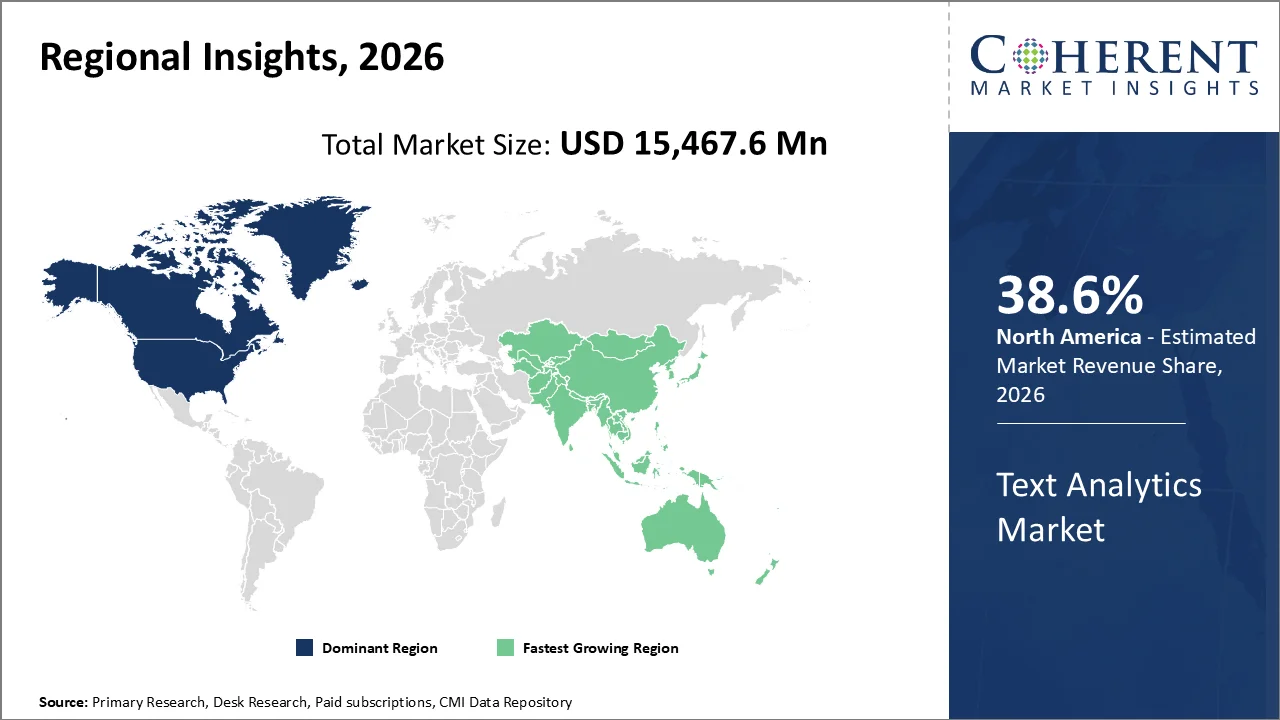
- North America is predicted to dominate the market with 38.6% market share in 2026 because of the extensive use of AI, big data analysis, and cloud computing by companies. As per the insights from Microsoft AI Research, companies are increasingly adopting AI-based analytical solutions for customer services, fraud prevention, and predictive analytics in BFSI, retail, and healthcare segments.
Growing Demand for Customer Experience Management and Sentiment Analysis is Driving Text Analytics Industry Growth
Organizations are increasingly prioritizing customer experience management and sentiment analysis to ensure that there are loyalty and retention of the clients to the brand. Through text mining techniques, the organizations can analyze the feedback gathered from the online reviews, phone calls at call centers, surveys, and social media interactions.
According to the Salesforce State of the Connected Customer Report, 88% of customers believe that the experience provided by companies is as important as the product itself.
Current Events and Their Impact on the Text Analytics Market
Current Event | Description and its Impact |
Growing Enterprise Adoption of Generative AI and NLP Technologies |
|
Rising Global Focus on Data Privacy and AI Regulations |
|
- Current Industry Events of 2026
- Market Size Estimation
- Regional Breakdown
- Competitive Landscape
- Customer Intelligence
- Segmental Analysis
- Pricing Analysis
- Key Market Drivers, Challenges & Future Trends
- Customized Insights Section
Segmental Insights
Why is the Cloud Segment Acquiring the Largest Market Share?
The cloud segment is expected to capture the highest market share within the text analytics market by 2026, constituting around 68.4% of the overall market value. The growing popularity of cloud-based artificial intelligence, machine learning, and big data analytics solutions among organizations globally is a major factor behind the dominance of the cloud-based segment.
In May 2025, Informatica announced new Agentic AI products on their AI-driven cloud data management platform. Some of the products released include CLAIRE Agents and AI Agent Engineering solutions for automating data discovery, data ingestion, analytics, and intelligence generation through AI.
Which Organisation Size Segment Dominates the Market?
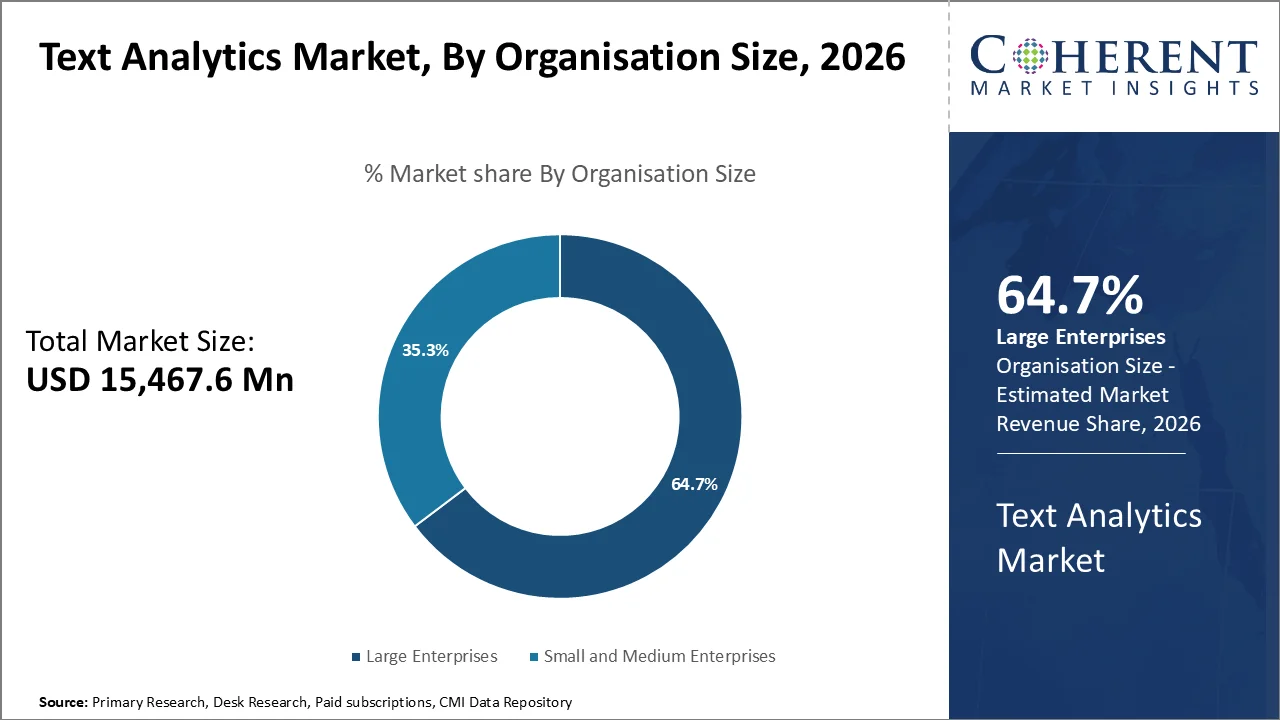
Large enterprises are anticipated to be the leading segment in the text analytics market, capturing about 64.7% of the market by 2026 on account of large capital investments in analytics based on artificial intelligence, automation solutions, and customer intelligence platforms. Large corporations have a significant amount of structured as well as unstructured business data, which drives the need for advanced analytics solutions.
In June 2025, Cube announced the launch of D3, described as the industry’s first agentic analytics platform built on a universal semantic layer. The solution enables enterprises to automate analytics tasks using AI-driven data agents, conversational querying, and governed semantic intelligence for large-scale business analytics environments.
Why Does the BFSI Segment Dominate the End User Market?
The Banking, Financial Services, and Insurance (BFSI) segment is estimated to have the largest share of around 24.8% by 2026 due to the rising adoption of fraud detection systems, compliance monitoring systems, risk analytics, and customer sentiment analysis software. The amount of transaction and customer interaction data generated by financial institutions is huge on a daily basis, thereby requiring efficient text analytics solutions.
As per the IBM Financial Services Insights, AI and analytics technologies are being used by banks and insurance companies for accurate fraud detection, automated compliance to regulations, and efficient customer service. Text analytics solutions allow BFSI firms to analyze customer communication, claim documents, e-mails, and transaction data instantly.
Why is Customer Relationship Management (CRM) the Leading Application Segment?
Customer Relationship Management (CRM) is expected to lead the text analytics market with a share of about 31.5% in 2026 owing to increasing demand for customer sentiment analysis, personalized engagement, and social media monitoring. The use of artificial intelligence-enabled text analytics software has increased considerably among businesses to analyze consumer behavior and enhance customer retention.
In June 2025, iQor launched Insights iQ, an AI-powered predictive analytics platform focused on customer experience intelligence. The solution analyzes 100% of voice, text, and chat interactions using large language models (LLMs) and advanced analytics engines to deliver real-time customer sentiment analysis, churn prediction, and behavioural insights.
Text Analytics Market Trends
- The increased use of generative AI and NLP systems has led to an increase in demand for text analytics systems. IBM states that around 80%-90% of the enterprise data is unstructured, hence the requirement for AI-enabled text analytics systems.
- Cloud-based text analytics systems have become popular because of their scalability and reduced costs.
- The increasing emphasis on customer experience and sentiment analysis is encouraging the use of CRM analytics. As per Salesforce, 88% of customers view customer experience as equally important as their offerings.
- The growing need for security and protection from cyber-attacks and frauds is pushing BFSI companies towards implementing text analytics solutions. The IBM Data Breach Report says that the worldwide average data breach cost amounted to US$ 4.88 million in 2024.
- The integration of AI copilots and conversational AI is gaining momentum as an important market trend. According to Microsoft AI, more and more companies are using AI assistants for automation and decision-making.
Regional Insights
North America Dominates the Text Analytics Market Owing to Strong AI and Cloud Technology Adoption
North America contributes to a market share of about 38.6% in 2026, due to the fast adoption of artificial intelligence (AI), big data analytics, cloud computing, and enterprise automation solutions. The North American region has the advantage of the presence of leading technology players, robust IT infrastructure, and significant enterprise expenditure on digital transformation.
Technological advancements continue to strengthen regional market growth. For instance, in October 2025, Microsoft expanded enterprise AI Copilot capabilities to enhance workflow automation, conversational analytics, and intelligent document processing across cloud environments.
Asia Pacific Text Analytics Market Trends
Asia Pacific region is anticipated to witness the fastest growth during the forecast period 2026-2033 owing to its rapid digitalization, increased usage of cloud technology, and increasing adoption of AI technology in nations like China, India, Japan, and South Korea.
Moreover, governments and enterprises across Asia Pacific are heavily investing in AI innovation ecosystems. In March 2025, Oracle launched its AI Centre of Excellence in Singapore to strengthen AI, cloud analytics, predictive analytics, and enterprise automation capabilities across Southeast Asia and Asia-Pacific markets.
Rising AI and Enterprise Digitalization are Accelerating the Text Analytics Market Demand in the United States
The United States text analytics market is experiencing rapid growth owing to the rising adoption of technologies such as artificial intelligence (AI), natural language processing (NLP), cloud computing, and enterprise automation. Some of the factors contributing to the growth include the prominent role of technology players in the country, high enterprise investments in AI-powered analytics, and rising demand for customer intelligence solutions.
In September 2025, Cisco launched Cisco Data Fabric, an AI-ready machine data intelligence architecture powered by Splunk.
China Text Analytics Market Trends
The China text analytics market is expected to witness substantial growth during the forecast period, attributable to the fast pace of digitalization, rising AI spending, and growing usage of cloud computing and big data analytics solutions. China continues to be one of the largest digital economies globally, producing large amounts of unstructured data through various digital channels such as e-commerce websites, digital payments, and social media.
China remains the leader in terms of digital adoption globally in e-commerce, fintech, and AI-driven business ecosystems, which increases the requirement for analytical and NLP solutions.
Who are the Major Companies in Text Analytics Industry
Some of the major key players in Text Analytics are SAP SE, International Business Machines Corporation, SAS Institute, Inc., Opentext Corporation, Clarabridge, Inc., Bitext Innovations S.L., Lexalytics, Inc., Megaputer Intelligence, Inc., Luminoso Technologies, Inc., and Knime.Com AG.
Industry News
- In February 2025, SAP launched SAP Business Data Cloud in partnership with Databricks to strengthen enterprise AI, business analytics, and intelligent data management capabilities.
- In June 2025, SAS introduced new SAS Viya innovations focused on AI agents, synthetic data generation, and intelligent analytics automation.
- In October 2025, OpenText launched Cloud Editions 25.4 featuring contextual AI and intelligent information management capabilities designed to enhance enterprise analytics, text processing, and AI-driven automation across cloud environments.
Market Report Scope
Text Analytics Market Report Coverage
| Report Coverage | Details | ||
|---|---|---|---|
| Base Year: | 2025 | Market Size in 2026: | USD 15,467.6 Mn |
| Historical Data for: | 2020 To 2024 | Forecast Period: | 2026 To 2033 |
| Forecast Period 2026 to 2033 CAGR: | 17.7% | 2033 Value Projection: | USD 48,401.3 Mn |
| Geographies covered: |
| ||
| Segments covered: |
| ||
| Companies covered: | SAP SE, International Business Machines Corporation, SAS Institute, Inc., Opentext Corporation, Clarabridge, Inc., Bitext Innovations S.L., Lexalytics, Inc., Megaputer Intelligence, Inc., Luminoso Technologies, Inc., and Knime.Com AG. | ||
| Growth Drivers: |
| ||
| Restraints & Challenges: |
| ||
Analyst Opinion (Expert Opinion)
- The text analytics market is no longer an analytics sub-vertical as it has emerged as an important tool for enterprise intelligence with more companies using advanced technologies like artificial intelligence (AI) and natural language processing (NLP) for handling large amounts of unstructured data.
- Analytics related to customer experience and sentiments has helped maintain a strong structural demand for the technology instead of making it vulnerable to economic cycles. This trend is witnessed in various industries such as BFSI, retail, healthcare, and telecom.
- Integration of generative AI, conversational AI, and AI co-pilots is transforming enterprise analytics demand patterns rather than displacing existing analytics solutions. Organizations are integrating AI-enabled assistants and intelligent automation into CRM solutions, customer support software, and business intelligence solutions, resulting in increased demand for real-time text analysis and predictive analytics solutions.
- Regulatory compliance, fraud detection, and cybersecurity surveillance are emerging as key long-term adoption factors for text analytics technology. Many organizations from the financial services and government industry segments are increasingly adopting NLP and machine learning capabilities to monitor communications and conduct surveillance as digital transactions and cybersecurity threats grow around the world.
Speak to the analyst
Want personalized insights?
Take the findings above to one of our principal consultants, or have the report rebuilt around the segments, geographies and competitors you actually track.
Market Segmentation
- By Deployment Model (Revenue, USD Mn, 2021-2033)
- Cloud
- On-Premises
- By Organisation Size (Revenue, USD Mn, 2021-2033)
- Small and Medium Enterprises
- Large Enterprises
- By End User (Revenue, USD Mn, 2021-2033)
- Banking, Financial Services, and Insurance
- Retail and Ecommerce
- Government and Defense
- Healthcare and Life Sciences
- Manufacturing
- Telecommunications and Information Technology
- Others
- By Application (Revenue, USD Mn, 2021-2033)
- Competitive Intelligence
- Customer Relationship management
- Predictive Analytics
- Fraud detection
- Brand Reputation
- By Region (Revenue, USD Mn, 2021-2033)
- North America
- U.S.
- Canada
- Latin America
- Brazil
- Mexico
- Argentina
- Rest of Latin America
- Europe
- Germany
- U.K.
- France
- Italy
- Spain
- Russia
- Rest of Europe
- Asia Pacific
- China
- India
- Japan
- Australia
- South Korea
- ASEAN
- Rest of Asia Pacific
- Middle East
- GCC
- Israel
- Rest of Middle East
- Africa
- South Africa
- Central Africa
- North Africa
- North America
Sources
Primary Research Interviews
- AI and machine learning solution providers
- Text analytics software vendors
- Cloud platform providers
- BFSI technology executives
- Customer experience and CRM managers
- Data scientists and NLP specialists
- IT infrastructure managers
- Key opinion leaders (KOLs) in artificial intelligence and analytics
Databases
- International Business Machines Corporation (IBM)
- Microsoft AI
- Salesforce Research Reports
- Organisation for Economic Co-operation and Development (OECD)
- World Economic Forum (WEF)
Magazines
- Analytics Insight
- AI Business
- CIO Review
- Enterprise AI
- Data Science Central
Journals
- Journal of Artificial Intelligence Research
- Journal of Big Data
- International Journal of Data Science and Analytics
- Expert Systems with Applications
- IEEE Transactions on Knowledge and Data Engineering
Newspapers
- The Wall Street Journal
- Financial Times
- The New York Times
- The Economic Times
- Bloomberg
Associations
- Association for Computing Machinery (ACM)
- Institute of Electrical and Electronics Engineers (IEEE)
- Association for the Advancement of Artificial Intelligence (AAAI)
- Data & Marketing Association (DMA)
- International Association for Analytics Professionals (IAAP)
Public Domain Sources
- Company Annual Reports and Investor Presentations
- Government Digital Transformation Publications
- AI and Cloud Technology Whitepapers
- Corporate Press Releases and Product Launch Announcements
- Regulatory and Data Privacy Framework Publications
Proprietary Elements
- CMI Data Analytics Tool
- Proprietary CMI Existing Repository of Information for Last 10 Years
Get access to 250+ pages report
Every segment, forecast, competitor profile and data table behind the analysis above — available for instant download.
- ESOMAR Member
- ISO 9001:2015 Certified
- D-U-N-S Registered
- GDPR & CCPA Compliant
Missing comfort of reading report in your local language? Find your preferred language:
Transform your Strategy with Exclusive Trending Reports
Frequently Asked Questions
The Text Analytics Market is expected to reach USD 48,401.3 Mn by 2033.
Major players operating in the global text analytics market include SAP SE, International Business Machines Corporation, SAS Institute, Inc., Opentext Corporation, Clarabridge, Inc., Bitext Innovations S.L., Lexalytics, Inc., Megaputer Intelligence, Inc., Luminoso Technologies, Inc., and Knime.Com AG.
Data privacy regulations, cybersecurity concerns, high implementation costs, and complexity in processing multilingual unstructured data are major factors restraining market growth.
Increasing adoption of artificial intelligence (AI), natural language processing (NLP), cloud-based analytics, customer sentiment analysis, and rising volumes of unstructured enterprise data are driving market growth.
The Text Analytics Market is anticipated to grow at a CAGR of 17.7% between 2026 and 2033.
Among regions, North America is expected to account for the largest market share in the global text analytics market during the forecast period.
Text analytics is the process of using artificial intelligence, machine learning, and natural language processing technologies to extract meaningful insights, patterns, and sentiments from unstructured text data such as emails, social media posts, customer reviews, and business documents.