

Global Space Infrastructure Market Size and Forecast – 2026 To 2033
The global space infrastructure market is expected to grow from USD 174.27 Bn in 2026 to USD 339.60 Bn by 2033, at a compound annual growth rate (CAGR) of 10.0% over 2026–2033. Defence budgets are a big reason. Governments now treat satellites as core security assets, and they are paying space companies to build low Earth orbit satellite constellations for missile warning, tracking and secure communication. On July 13, 2026, the US Space Development Agency awarded L3Harris and Sierra Space contracts worth about USD 1.75 billion to build 36 missile warning and tracking satellites, due for launch by the end of 2028.
Key Takeaways of the Global Space Infrastructure Market
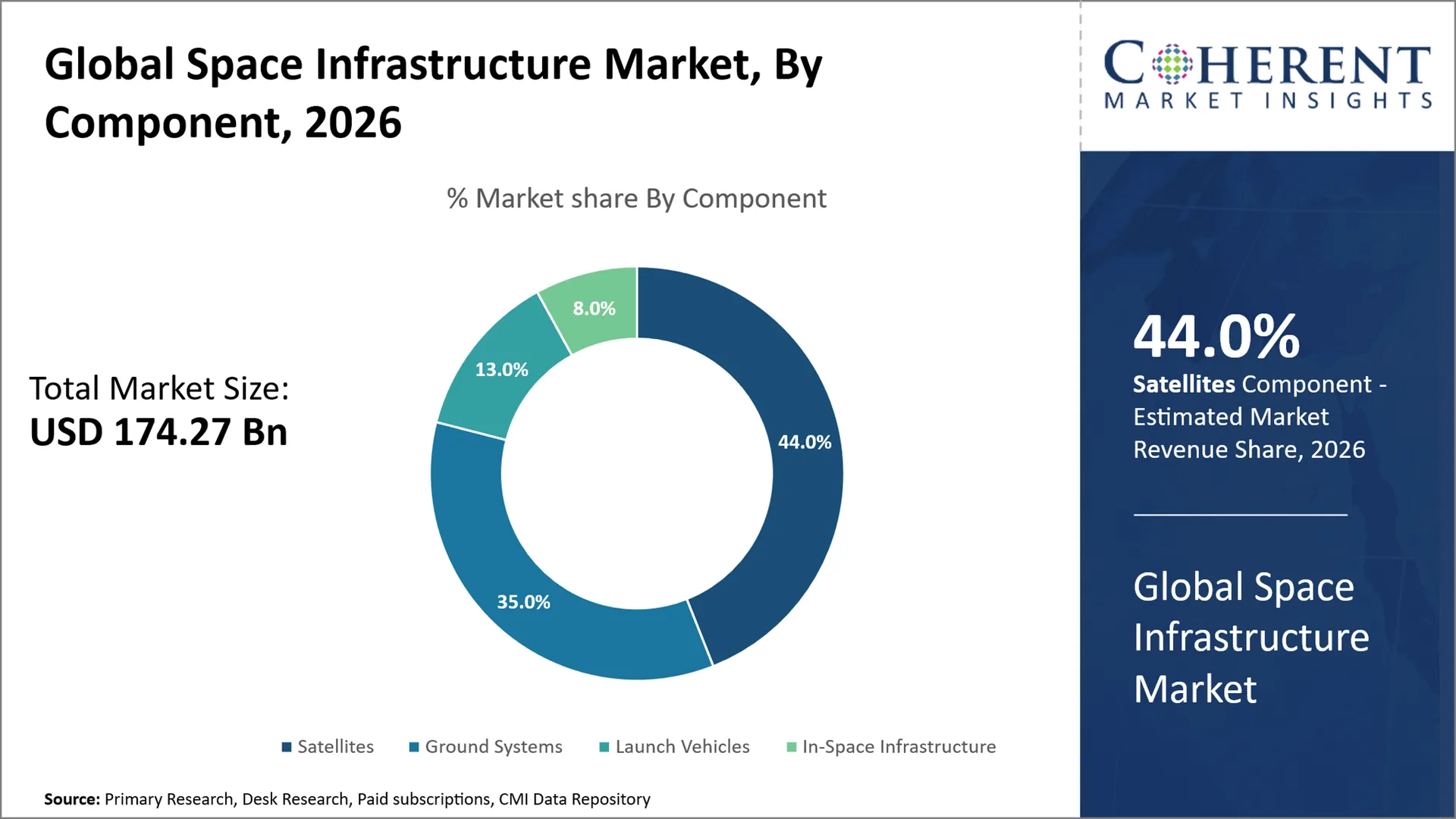
- The satellites segment is expected to account for 44.0% of the global space infrastructure market share in 2026. Satellites are the core of every space network, and governments keep ordering new ones to replace ageing fleets and add capacity. On June 24, 2026, MDA Space signed a USD 688 million contract with the Canadian Space Agency to build a radar satellite that will join and extend Canada’s RADARSAT Constellation.
- The communication segment is estimated to capture 42.0% of the market share in 2026. Satellite broadband is growing quickly, and operators need more satellites, ground stations and user terminals to keep up. On May 13, 2026, the Satellite Industry Association reported that global satellite broadband subscribers rose 62% in 2025 to more than 10 million.
- The commercial segment is expected to account for 54.0% of the global space infrastructure market share in 2026. Private companies now build and run a large part of the infrastructure that governments once owned, and many are buying up other firms to gain scale. On January 13, 2026, Intuitive Machines completed its USD 800 million acquisition of Lanteris Space Systems, formerly Maxar Space Systems.
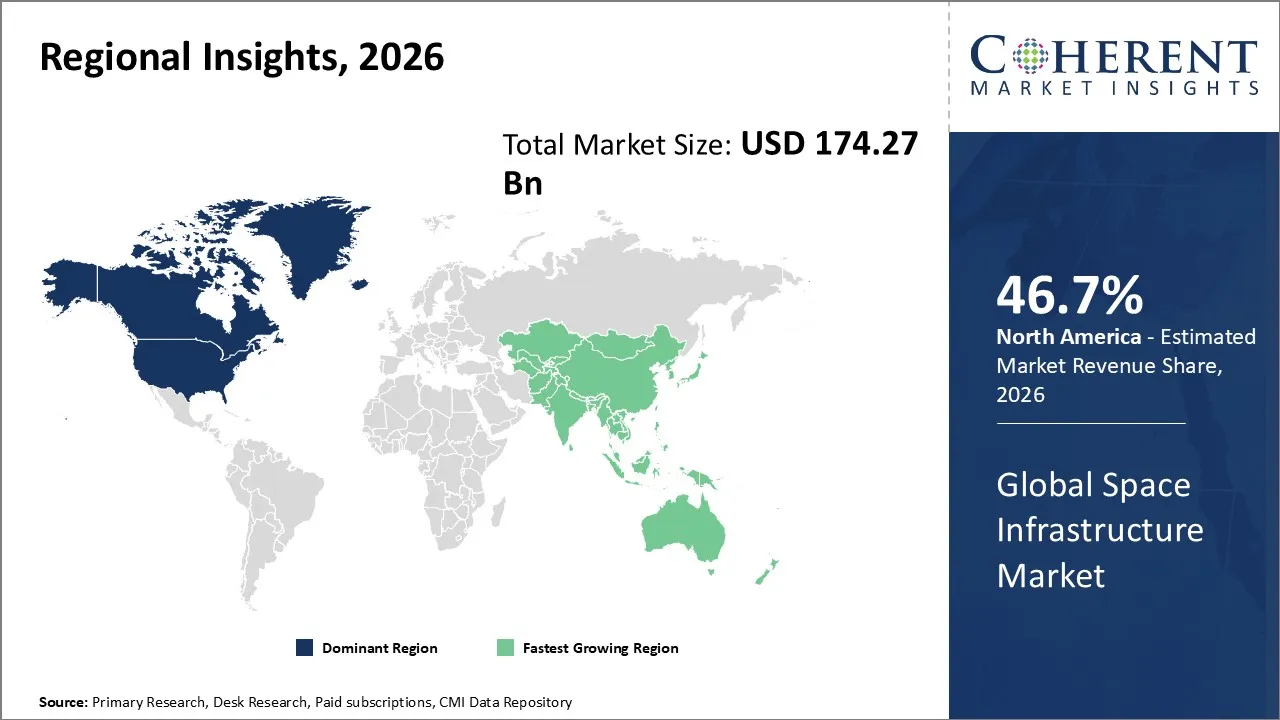
- North America is expected to dominate the space infrastructure market in 2026, with a share of 46.7%. The region has the largest space budgets, through NASA and the US Department of Defense, and most of the world’s leading launch and satellite companies. On May 1, 2026, Lockheed Martin was selected by the US Space Force’s Space Systems Command to develop space-based interceptors, with a demonstration planned for 2028.
- Asia Pacific is expected to account for 15.5% share in 2026 and is the fastest-growing region. China, India and Japan are expanding their space programmes and opening the sector to private companies. On July 24, 2025, India’s Department of Space told Parliament that IN-SPACe is working towards a target of a USD 44 billion space economy by 2033.
Segmental Insights
Why Do Satellites Dominate the Global Space Infrastructure Market?
In terms of component, satellites are expected to account for 44.0% of the global space infrastructure market share in 2026. Almost every space service depends on them. Broadband, navigation, weather data, Earth imaging and military surveillance all start with a satellite in orbit, and the rest of the infrastructure, from launch vehicles to ground stations, exists to put those satellites up and keep them working.
Demand comes from two directions. Commercial operators are building large constellations, which means ordering satellites in the thousands rather than one at a time. Governments, meanwhile, keep buying high-value satellites for Defence, Earth observation and secure communication. The volume growth is clear in the industry’s own numbers. A record 4,434 satellites were launched into Earth orbit in 2025, a 65% increase over the prior year. Satellites are also getting cheaper to build: over 4,400 commercially made satellites were launched in 2025, while satellite manufacturing revenue reached only USD 20.4 billion and barely moved. Lower unit costs make large networks affordable, which in turn keeps orders coming.
On September 21, 2026, the US Defense Innovation Unit and Space Systems Command selected Northrop Grumman and True Anomaly to build GHOST-R reconnaissance satellites, designed to monitor other spacecraft in geostationary orbit.
- Current Industry Events of 2026
- Market Size Estimation
- Regional Breakdown
- Competitive Landscape
- Customer Intelligence
- Segmental Analysis
- Pricing Analysis
- Key Market Drivers, Challenges & Future Trends
- Customized Insights Section
Why Is Communication the Biggest Source of Demand for Space Infrastructure?
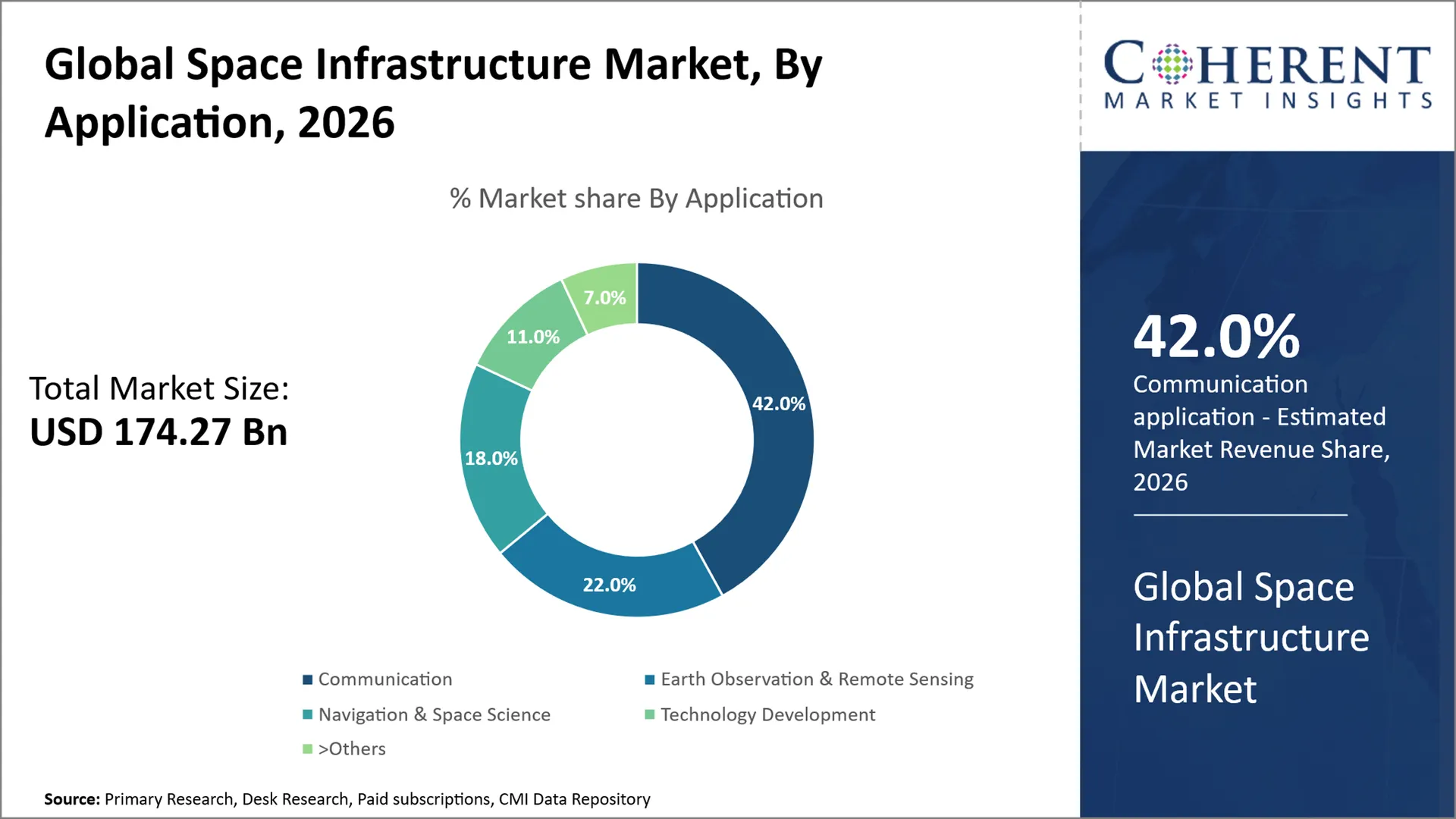
In terms of application, communication is expected to account for 42.0% of the global space infrastructure market share in 2026. No other use of space comes close. Satellite TV, broadband, maritime and aviation connectivity, and secure military links all depend on communication satellites. Each of these networks also needs ground stations, antennas and user terminals, so a single communication network creates demand across almost every part of the infrastructure.
Broadband is the main reason demand keeps growing. Low-orbit constellations have made satellite internet fast enough to compete with ground networks, especially in remote areas where cables don’t reach. People are signing up quickly. Global satellite broadband subscribers grew by 62% to over 10 million in 2025, and revenue increased by 16%. More users mean operators have to keep adding satellites and expanding their ground networks. Direct-to-device service, which lets an ordinary smartphone connect to a satellite, is adding another layer of demand.
On September 28, 2026, SpaceX’s Starship reached orbit for the first time and deployed Starlink V3 satellites, which are designed to add more broadband capacity per launch.
How Did Commercial Players Become the Largest End Users of Space Infrastructure?
In terms of end user, the commercial segment is expected to account for 54.0% of the global space infrastructure market share in 2026. Not long ago, governments built and ran most of what was in orbit. Today, private companies own the largest satellite constellations, run most commercial launches and operate a growing share of the ground networks that support them.
The shift comes down to money and speed. Commercial operators earn revenue from broadband, imaging and data services, so they reinvest in new satellites and ground systems far more often than most government programmes can. Their scale is now hard to ignore. The commercial satellite industry generated USD 303 billion in 2025, which was 71% of the world’s space business. Governments are also changing how they buy. Instead of owning every asset, many now pay private companies for launches, data and services, which sends more contracts to the commercial side.
On May 7, 2026, Rocket Lab signed a definitive agreement to acquire Motiv Space Systems, adding space robotics to its business and bringing the production of key spacecraft mechanisms in-house.
Current Events and their Impact
Current Events | Description and its Impact |
ISS Retirement and NASA’s Commercial Space Station Transition (US GAO, GAO-26-107805) |
|
Airbus, Leonardo and Thales Agreement to Combine Space Businesses (MoU, October 2025) |
|
Space Infrastructure Market Dynamics
Market Drivers
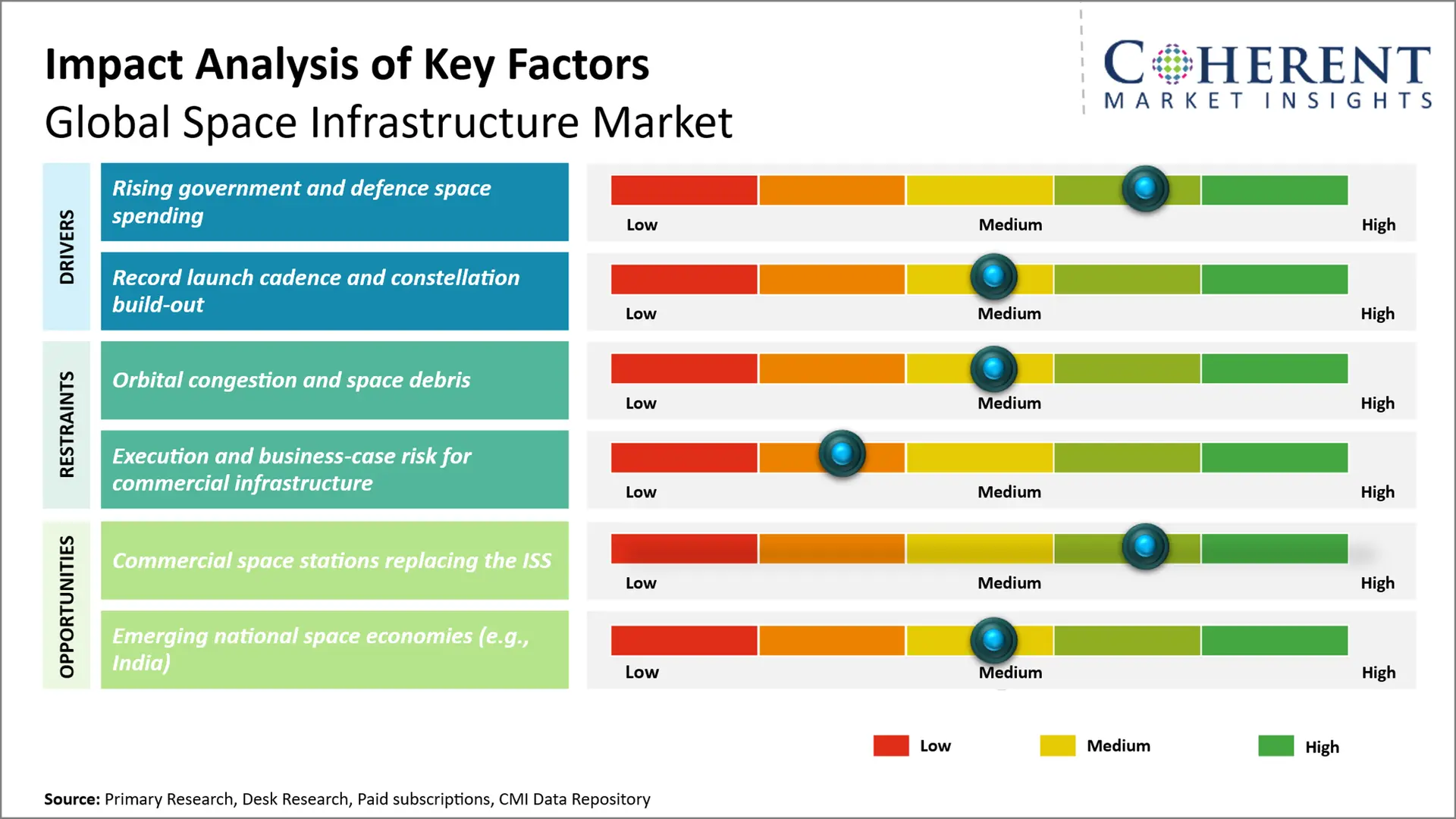
- Governments are spending more on space, and defence is leading the increase: Space is now treated as critical national infrastructure, and budgets are rising to match. OECD civil space budgets rose 15% between 2022 and 2025, from USD 40.5 billion to USD 46.4 billion. Defence spending is climbing even faster. In 2025, military programmes made up 46.3% of US government space spending, and Japan’s defence-space budget grew almost sevenfold over 2022–2025. Much of this money goes straight into infrastructure: new satellites, launch vehicles, ground control stations and tracking systems. Because these programmes run for years, they give manufacturers and launch providers a steady base of orders.
On November 27, 2025, ESA member states approved a record three-year budget at the Ministerial Council in Bremen. Total spending reached USD 25.63 bn, up from about USD 19.6 bn for the previous three years. Launch vehicle development took the largest share, at USD 5.15 bn over the next three years.
- Cheaper and more frequent launches are making large constellations possible: For decades, high launch costs limited how many satellites anyone could afford to put in orbit. Reusable rockets and rideshare missions have changed that. A record 4,434 satellites were launched into Earth orbit in 2025, a 65% increase over the prior year, and commercial launch revenue surged 33% to USD 12.4 billion. As launch becomes routine, operators can plan networks of hundreds or thousands of satellites. Each of these networks then needs ground stations, user terminals and replacement satellites, so demand spreads across the whole infrastructure chain.
On September 28, 2026, SpaceX’s Starship reached orbit for the first time and deployed Starlink V3 satellites. Starship is designed to be fully reusable and to carry much heavier loads than current rockets.
Emerging Trends
- Space companies are buying their suppliers: Instead of relying on outside vendors, more space companies are acquiring firms that make key parts and systems. In June 2026, MDA Space signed a definitive agreement to acquire Blue Canyon Technologies, a US spacecraft and satellite component maker, from RTX’s Raytheon business for USD 620 million. MDA currently buys precision components such as guidance and pointing systems from outside suppliers, and the deal will bring part of that supply chain in-house for its satellite platforms. The acquisition is expected to close by the end of 2026.
- Impact: Companies that control more of their supply chain can build faster, cut costs and avoid delays caused by part shortages.
- Relevance to the market: Customers increasingly prefer suppliers that can deliver a complete spacecraft or mission. Smaller component makers may face more pressure, or become acquisition targets themselves.
- Debris removal and in-orbit servicing are becoming a real business: As orbits get crowded, operators and space agencies are paying for services that track debris, extend satellite life and remove dead objects. ESA has said active debris removal is needed to prevent a runaway chain of collisions. This new segment is still small but growing fast: space sustainability grew by 43% to reach 500 million dollars in revenue in 2025.
- Impact: Operators will spend more on compliance, deorbit systems and collision avoidance, but they also gain ways to keep valuable satellites working longer.
- Relevance to the market: This supports growth in the in-space infrastructure component, the market’s fastest-growing component. Companies with servicing, refuelling or tracking capabilities are well placed as debris rules tighten
Regional Insights
Why Does North America Lead the Global Space Infrastructure Market?
North America is expected to account for a market share of 46.7% in 2026. The region has the largest government space budgets in the world, through NASA and the US Department of Defense, and many of the industry’s biggest companies are based here, including SpaceX, Lockheed Martin, Northrop Grumman, Boeing and L3Harris. US companies lead in both building and launching satellites. In 2025, US firms manufactured 83% of commercially procured satellites launched, while American launch companies captured 63% of the launches conducted throughout the year and 59% of commercially-procured launch revenue. Canada adds strength in Earth observation and space robotics through MDA Space. With large public budgets, private capital and launch capacity all in one region, North America is likely to stay in front.
Why Is Asia Pacific the Fastest-Growing Region in the Space Infrastructure Market?
Asia Pacific is expected to register the fastest growth, with a CAGR of 11.88% over 2026–2034. The region is projected to account for 15.5% of the global market in 2026. China, India and Japan are all expanding their space programmes, and each is opening the sector to private companies. China is deploying large numbers of satellites, India aims to grow its space economy to USD 44 billion by 2033, and Japan is increasing defence spending on space. As these countries build their own launch vehicles, satellites and ground networks, regional demand is rising faster than in more mature markets.
Global Space Infrastructure Market Outlook for Key Countries
Why Is the U.S. the Center of the Global Space Infrastructure Market?
The U.S. space infrastructure market is projected to reach USD 69.22 Bn in 2026, the largest of any country. Demand comes from both government and commercial buyers. The US Space Force and the Space Development Agency are funding large satellite constellations for missile warning and tracking, and NASA is preparing to move from the International Space Station to commercially owned stations around 2030. On the commercial side, SpaceX runs the world’s largest satellite constellation and most of its commercial launches. Few other countries have this mix of defence demand, civil programmes and private launch capacity.
Is China the Main Growth Engine in Asia Pacific?
China’s space infrastructure market is projected to reach USD 12.3 Bn in 2026. Most of the country’s space programme is run through state-owned China Aerospace Science and Technology Corporation (CASC), which builds launch vehicles and satellites and developed the Tiangong space station. China is also deploying satellites quickly for communication and Earth observation, which is a key reason Asia Pacific is the fastest-growing region. A growing group of private launch and satellite companies is adding capacity alongside the state sector.
U.K. Space Infrastructure Market Analysis and Trends
The U.K. space infrastructure market is projected to reach USD 12.54 Bn in 2026, the largest in Europe. The country has a strong base in satellite manufacturing and satellite communication, and it is home to OneWeb, now part of Eutelsat, which operates a low-orbit broadband constellation. The outlook is mixed, though. At ESA’s 2025 Ministerial Council, the UK recorded the largest funding decline, while Germany, Spain, Poland, Canada, Denmark, and Austria significantly increased their contributions. Lower contributions to ESA could mean fewer European programme contracts for UK companies over the next few years.
Germany Space Infrastructure Market Analysis and Trends
Germany’s space infrastructure market is projected to reach USD 9.88 Bn in 2026. Airbus Defence and Space has major satellite operations in the country, and Germany is building a new generation of launch companies. Isar Aerospace and Rocket Factory Augsburg were shortlisted, alongside other European firms, to proceed to the next phase of the European Launcher Challenge, which will be funded through the CM25 subscriptions. Germany also raised its contribution to ESA significantly at the 2025 Ministerial Council. Strong public funding and a growing private launch sector make Germany one of Europe’s most active space markets.
Japan Space Infrastructure Market Analysis and Trends
Japan’s space infrastructure market is projected to reach USD 5.54 Bn in 2026. Defence is the fastest-moving part of the market: Japan’s defence-space spending rose almost sevenfold between 2022 and 2025, according to the OECD. Mitsubishi Heavy Industries builds and operates the H3 launch vehicle, giving Japan its own route to orbit. Japanese companies are also buying more advanced satellite systems. Mitsubishi Electric, for example, selected MDA Space to supply technology for a next-generation defence communication satellite programme. Rising defence demand and domestic launch capability make Japan a key market in Asia Pacific.
Global Space Infrastructure Market – Key Launch Vehicles Used for Satellite Deployment
Launch Vehicle | Producer | Reusability | Main Uses |
Falcon 9 | SpaceX | Reusable first stage | Commercial and government satellites, Starlink, crew and cargo to the ISS |
Starship | SpaceX | Designed to be fully reusable | Heavy-lift missions; deployed its first Starlink V3 satellites in September 2026 |
New Glenn | Blue Origin | Reusable first stage | Heavy-lift satellite launches |
How Is the Shift to Commercial Space Stations Creating New Growth Opportunities in the Space Infrastructure Market?
NASA plans to retire the International Space Station around 2030. Rather than building a replacement itself, it wants to rent space on stations that private companies own and run. NASA plans to procure services from privately owned and operated commercial space stations rather than developing and operating its own replacement. This opens a whole new area of demand. Each station needs habitat modules, docking ports, power and life-support systems, plus regular crew and cargo flights to keep it supplied. Companies that win these contracts will also be able to sell time on their stations to other space agencies, researchers and private customers, so NASA would be one tenant among several.
On July 6, 2026, NASA released a draft request for proposals for the second phase of its commercial space stations programme, asking US companies for feedback on its planned approach to buying station services. The agency indicated that it intended to award early development contracts to at least two station builders. NASA followed this with a final request for proposals later in the year.
Market Players, Key Development, and Competitive Intelligence

Key Developments
- On July 27, 2026, Rocket Lab was awarded its largest launch contract to date, a USD 266 million contract from the US Space Force’s Space Systems Command. Rocket Lab will carry out 12 suborbital launches, with an option for up to six more, mostly from a new launch site at the Pacific Spaceport Complex in Kodiak, Alaska. The first launch is expected no earlier than the end of 2026.
- On June 10, 2026, Thales Alenia Space signed a contract with the European Space Agency to develop two Copernicus Sentinel-1 Next Generation radar satellites. The first tranche of the contract is worth about USD 807 million. Airbus Defence and Space will supply the radar instruments.
- On April 20, 2026, Airbus Defence and Space, Thales Alenia Space and RADMOR signed an industrial cooperation agreement to develop a geostationary defence satellite for Poland, strengthening the country’s sovereign space capabilities.
- On October 23, 2025, Airbus, Leonardo and Thales signed a memorandum of understanding to combine their space businesses into a new European company. Airbus will hold 35% of the company, and Leonardo and Thales 32.5% each. The company is expected to be operational in 2027, subject to regulatory approvals.
Competitive Landscape
SpaceX leads commercial launch with its reusable Falcon 9 rocket. It also runs Starlink, the world’s largest satellite constellation, which makes it both a major supplier and a major buyer of space infrastructure. Lockheed Martin, Northrop Grumman, Boeing and L3Harris dominate US defence and government programmes, from navigation and missile-warning satellites to crewed spacecraft. In Europe, Airbus Defence and Space and Thales Alenia Space are the main satellite builders, and their planned merger with Leonardo’s space business will create a single, larger European competitor. China Aerospace Science and Technology Corporation (CASC) leads China’s state-run programme, while Mitsubishi Heavy Industries gives Japan independent access to space. Mid-sized players such as MDA Space and Rocket Lab are growing quickly by focusing on specific areas, such as space robotics, radar satellites and small launch. Competition centres on launch cost, reliability, production speed, long-term government relationships and the ability to deliver complete missions rather than single parts.
Top Companies and Notable Products in the Space Infrastructure Market
Company | Notable Product | Key Features |
SpaceX | Falcon 9 | Reusable first stage that lands after launch and flies again; used for commercial satellites, Starlink, and crew and cargo missions to the ISS |
Lockheed Martin | GPS III satellites | Latest-generation GPS navigation satellites for the US Space Force, with improved accuracy and stronger resistance to jamming |
Northrop Grumman | Mission Extension Vehicle (MEV) | Docks with ageing satellites in geostationary orbit and takes over their propulsion, extending their working life |
Airbus Defence and Space | Eurostar Neo | Geostationary telecom satellite platform designed for higher power and payload capacity |
Thales Alenia Space | Pressurised space station modules | Builds habitable modules for space stations, including much of the ISS’s pressurised volume and modules for new commercial stations |
Market Report Scope
Global Space Infrastructure Market Report Coverage | |||
Report Coverage | Details | ||
Base Year | 2025 | Market Size in 2026: | USD 174.27 Bn |
Historical Data For: | 2021 To 2024 | Forecast Period: | 2026 To 2033 |
Forecast Period 2026 To 2033 CAGR: | 10.00% | 2033 Value Projection: | USD 339.6 Bn |
Geographies covered: |
| ||
Segments covered: |
| ||
Companies covered: | Airbus Defence and Space, Boeing, China Aerospace Science and Technology Corporation (CASC), L3Harris Technologies, Lockheed Martin, MDA Space, Mitsubishi Heavy Industries, Northrop Grumman, Rocket Lab, SpaceX, Thales Alenia Space | ||
Growth Drivers: |
| ||
Restraints & Challenges: |
| ||
Analyst Opinion (Expert Opinion)
- Building satellites is getting cheaper, so the value is moving to the ground and to integrated players. For years, the expensive part of space was getting hardware into orbit. That is changing fast. More than 4,400 commercially manufactured satellites were launched during 2025, while satellite-manufacturing revenue reached only USD 20.4 billion and barely moved. In other words, the industry is building many more satellites for roughly the same money, so the price of each one is falling. The bigger revenue pool is on the ground. Ground equipment led revenue at USD 165.2 billion in 2025, far ahead of manufacturing and launch combined. Companies are responding by buying up their suppliers. Intuitive Machines acquired Lanteris in January 2026, and Rocket Lab agreed to buy Motiv Space Systems in May 2026. As a result, value is likely to shift toward suppliers that can deliver a complete mission, covering the satellite, launch, ground network and data services together. Companies that only build satellite platforms risk becoming low-margin subcontractors.
- Growth is expected to stay defence-led and concentrated in North America, while the market faces two timing risks. Defence is now the most dependable source of demand. In 2025, military programmes made up 46.3% of US government space spending, and defence-space budgets in Japan and Europe are rising quickly. Contracts like the Space Development Agency’s tracking satellites and the Space Force’s space-based interceptors give suppliers years of predictable work, mostly for US companies. The first risk is launch concentration. SpaceX carries a large share of the world’s launches, and new heavy-lift rivals are struggling to catch up. Blue Origin’s New Glenn exploded in 2026, and Rocket Lab has pushed back the first launch of Neutron to 2027. Any setback at SpaceX would therefore ripple across the whole market. The second risk is the ISS transition. If commercial stations are ready by 2030, they open a new market for modules, docking systems and cargo flights. If they are late, NASA keeps paying for the ISS and that revenue moves further out. Suppliers with a mix of defence, commercial and international customers are in the strongest position, because no single delay can stall their growth.
Speak to the analyst
Want personalized insights?
Take the findings above to one of our principal consultants, or have the report rebuilt around the segments, geographies and competitors you actually track.
Market Segmentation
- Component Insights (Revenue, USD Billion, 2021 - 2033)
- Satellites
- Ground Systems
- Launch Vehicles
- In-Space Infrastructure
- Application Insights (Revenue, USD Billion, 2021 - 2033)
- Communication
- Earth Observation & Remote Sensing
- Navigation & Space Science
- Technology Development
- Others
- End User Insights (Revenue, USD Billion, 2021 - 2033)
- Commercial
- Government
- Military
- Regional Insights (Revenue, USD Billion, 2021 - 2033)
- North America
- U.S.
- Canada
- Latin America
- Brazil
- Argentina
- Mexico
- Rest of Latin America
- Europe
- Germany
- U.K.
- Spain
- France
- Italy
- Russia
- Rest of Europe
- Asia Pacific
- China
- India
- Japan
- Australia
- South Korea
- ASEAN
- Rest of Asia Pacific
- Middle East
- GCC Countries
- Israel
- Rest of Middle East
- Africa
- South Africa
- North Africa
- Central Africa
- North America
- Key Players Insights
- Airbus Defence and Space
- Boeing
- China Aerospace Science and Technology Corporation (CASC)
- L3Harris Technologies
- Lockheed Martin
- MDA Space
- Mitsubishi Heavy Industries
- Northrop Grumman
- Rocket Lab
- SpaceX
- Thales Alenia Space
Sources
Primary Research Interviews
- Satellite Manufacturers and Component Suppliers
- Launch Service Providers
- Satellite Operators and Ground Segment Providers
- Space Agency and Defence Procurement Specialists
Magazines
- SpaceNews
- Aviation Week & Space Technology
- Via Satellite
- Spaceflight Now
Journals
- Acta Astronautica
- Advances in Space Research
- Journal of Spacecraft and Rockets
- Space Policy
Associations
- Satellite Industry Association (SIA)
- Space Foundation
- Aerospace Industries Association (AIA)
- Eurospace
Public Domain Sources
- OECD: The Space Economy at a Glance 2026
- European Space Agency (ESA): Space Environment Reports 2025 and 2026, Ministerial Council (CM25) outcomes
- National Aeronautics and Space Administration (NASA): Commercial Low Earth Orbit Destinations programme documents
- U.S. Government Accountability Office (GAO): GAO-26-107805, ISS transition report
- U.S. Space Force, Space Systems Command and Space Development Agency: contract announcements
- Indian National Space Promotion and Authorisation Centre (IN-SPACe) and Department of Space, India: space economy targets
- U.S. Securities and Exchange Commission (SEC): company annual filings
- Company press releases
Proprietary Elements
- CMI Data Analytics Tool
- Proprietary CMI Existing Repository of information for last 10 years
Get access to 250+ pages report
Every segment, forecast, competitor profile and data table behind the analysis above — available for instant download.
- ESOMAR Member
- ISO 9001:2015 Certified
- D-U-N-S Registered
- GDPR & CCPA Compliant
Frequently Asked Questions
The global space infrastructure market is estimated to be valued at USD 174.27 Bn in 2026 and is expected to reach USD 339.60 Bn by 2033.
The CAGR of the global space infrastructure market is projected to be 10.0% from 2026 to 2033.
Rising government and defence space spending, and record launch activity that is making large satellite constellations possible, are the major factors driving the growth of the global space infrastructure market.
Growing orbital congestion and space debris, and execution risk in large commercial projects such as private space stations, are the major factors hampering the growth of the global space infrastructure market.
In terms of component, satellites are estimated to dominate the market, with a revenue share of 44.0% in 2026.
Space infrastructure is the set of physical systems that make space-based services possible. It includes satellites, the launch vehicles that carry them into orbit, the ground stations and control centres that communicate with them, and in-space assets such as space stations, servicing vehicles and orbital transfer vehicles. Together, these systems support communication, navigation, Earth observation, scientific research and national defence.
Technologies such as laser links between satellites, direct-to-device connectivity and in-orbit servicing are making space systems more flexible, longer-lasting and cheaper to run.