

Global Specialty Oilfield Chemicals Market Size and Forecast – 2026 To 2033
The Global Specialty Oilfield Chemicals Market is estimated to be valued at USD 14.62 Bn in 2026 and is expected to reach USD 22.42 Bn by 2033, exhibiting a compound annual growth rate (CAGR) of 6.3% from 2026 to 2033. Market growth is supported by the greater use of enhanced oil recovery, increasing offshore and deepwater activity, and the need to maintain production from mature reservoirs.
Complex wells require specialized demulsifiers, corrosion inhibitors, scale inhibitors, drilling-fluid additives, biocides, and flow-assurance chemicals to control operating risks, protect equipment, and improve hydrocarbon recovery. Long subsea tiebacks and high-pressure environments also increase the importance of technically qualified formulations and continuous chemical monitoring. In April 2025, TotalEnergies commenced production from the deepwater Ballymore field offshore Louisiana, which has a gross production capacity of 75,000 barrels of oil per day, illustrating continued investment in chemical-intensive offshore production infrastructure.
Key Takeaways of the Global Specialty Oilfield Chemicals Market
- Demulsifiers are expected to hold 17.8 % of the market share in 2026 because oil–water separation is essential across production, processing, and produced-water handling. Recurring dosage, crude-specific formulation, and export-quality requirements support repeat procurement. In May 2026, Indovinya highlighted its 20-product KEMELIX portfolio for improving separation efficiency, production performance, and chemical utilization.
- Production is expected to hold 35.8 % of the market share in 2026 because producing wells require continuous treatment against corrosion, scale, wax, foam, sand, bacteria, and separation problems. These formulations generate repeat consumption across an asset’s life. In October 2024, Halliburton launched SandTrap XL, a chemical consolidation system designed to control sand, preserve permeability, and extend well productivity.
- Onshore segment is expected to account for 67.2 % of the market share in 2026, reflecting their larger well population, shorter development cycles, shale activity, and extensive produced-water treatment needs. Land assets also require frequent chemical delivery and dosage adjustment. In December 2024, TETRA Technologies launched TETRA Oasis TDS after a Delaware Basin pilot treating onshore produced water for beneficial reuse.
- North America is expected to command 34.8 % of the global specialty oilfield chemicals market share in 2026, supported by shale output, dense producing-well inventories, mature-field maintenance, and large produced-water volumes. In July 2026, the U.S. Energy Information Administration reported record 2025 crude output, with particularly strong production growth in the Permian Basin, reinforcing recurring chemical requirements across high-intensity operations.
- Europe is expected to represent 17.6 % of the market share in 2026 as North Sea operators pursue infill activity, mature-field recovery, infrastructure-led exploration, and tighter environmental performance. These conditions favor efficient integrity and flow-assurance treatments. In January 2026, Norway’s Ministry of Energy awarded 57 production licenses to 19 companies under the APA 2025 licensing round, including 31 licenses in the North Sea, supporting future exploration, drilling activity, and demand for production chemicals.
- Precision Chemical Dosing and Real-Time Treatment Optimization: Product strategies will increasingly combine specialty formulations with sensors, automated injection, and performance analytics. Closed-loop dosing can limit over-treatment, improve production consistency, and connect chemical spending with measurable operating outcomes. Suppliers offering application expertise, field data, and remote optimization will gain an advantage over vendors competing mainly on unit price, reshaping service contracts, procurement decisions, and customer retention.
- Lower-Impact Formulations for Safer, Sustainable Operations: Operators and regulators will place greater emphasis on biodegradable ingredients, reduced-solvent systems, lower toxicity, and formulations that perform at smaller dosages. This shift will influence research priorities, qualification protocols, and supplier selection while creating opportunities for bio-based and hybrid chemistries. Manufacturers will need credible performance evidence and lifecycle documentation to align sustainability objectives with field reliability and operating economics.
Segmental Insights
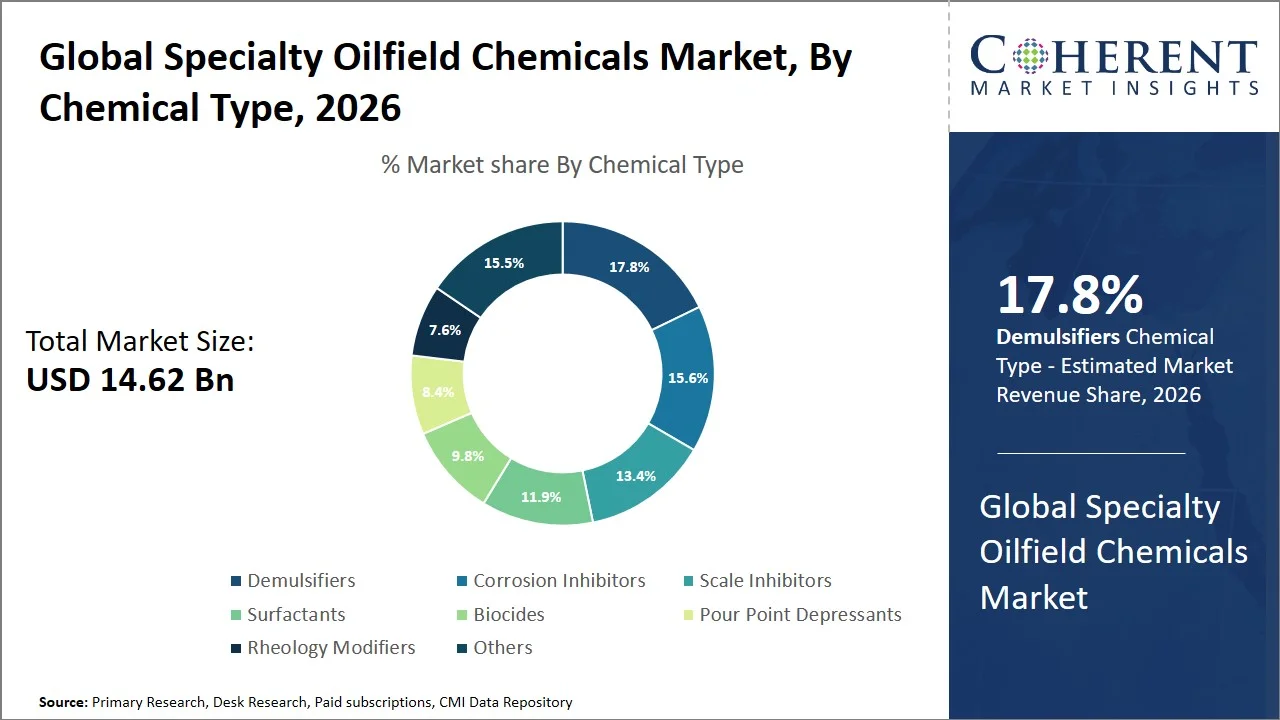
Why Do Demulsifiers Dominate the Global Specialty Oilfield Chemicals Market?
Demulsifiers are expected to account for 17.8% of the global specialty oilfield chemicals market in 2026, leading the chemical-type category because crude streams routinely contain water, salts, solids, and naturally occurring stabilizers that hinder separation. Producers depend on tailored demulsifier programs to meet basic sediment and water specifications, protect downstream equipment, reduce heating requirements, and improve saleable-oil recovery. Formulation capability is important because performance varies with crude gravity, temperature, residence time, and emulsion chemistry. This creates commercial value for suppliers offering bottle testing, field trials, dosage optimization, and locally available blends rather than standardized products alone. Refinery-bound crude, heavy-oil production, and mature fields with increasing water cuts remain core applications. In February 2025, Clariant reported the deployment of its aromatic-solvent-free PHASETREAT Nan 19037 demulsifier for a Colombian producer, improving oil–water separation while lowering treatment-related Scope 3 emissions.
- Current Industry Events of 2026
- Market Size Estimation
- Regional Breakdown
- Competitive Landscape
- Customer Intelligence
- Segmental Analysis
- Pricing Analysis
- Key Market Drivers, Challenges & Future Trends
- Customized Insights Section
Why Does Production Represent the Largest Oilfield Operation in the Global Specialty Oilfield Chemicals Market?
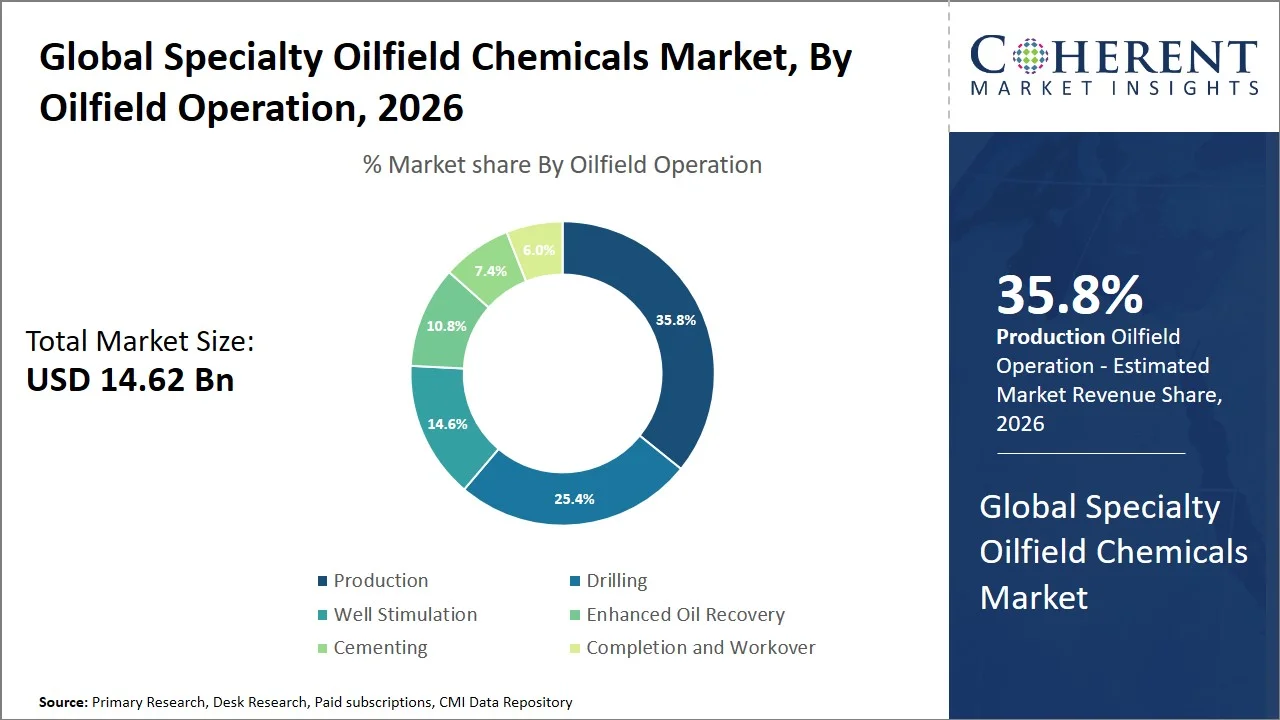
Production is expected to represent 35.8% of the global specialty oilfield chemicals market in 2026, making it the largest oilfield-operation segment because chemical treatment continues throughout the producing life of a well. Operators require programs for flow assurance, asset integrity, gas sweetening, water clarification, paraffin control, and emulsion management as reservoir conditions change. Unlike drilling chemicals, which are concentrated around campaign activity, production chemicals generate recurring operating expenditure and frequent field-service interaction. Supply strength depends on application laboratories, chemical-management personnel, storage and injection equipment, and rapid reformulation when fluids or operating rates shift. The segment is especially relevant to mature assets, artificial-lift systems, gathering networks, and facilities handling sour or high-water-cut production. In July 2025, SLB completed its acquisition of ChampionX, adding production chemicals alongside artificial-lift, digital-production, and emissions technologies to strengthen lifecycle production and recovery services.
Why Does Onshore Dominate the Location Category of the Global Specialty Oilfield Chemicals Market?
Onshore segment is expected to hold 67.2% of the global specialty oilfield chemicals market in 2026, reflecting the broad installed base of land wells, gathering systems, tank batteries, treatment facilities, and water-handling infrastructure. Chemical consumption is distributed across numerous sites, creating demand for dependable logistics, bulk storage, scheduled delivery, and field technicians who can adjust programs quickly. Shale and tight-oil developments also expose suppliers to changing fluid composition, high initial production rates, scale risk, and substantial produced-water volumes. Customers therefore value modular treatment packages and regional blending capacity that reduce transport time and support multiwell operations. The commercial opportunity extends from drilling pads through pipelines and central processing facilities, favoring suppliers with dense service coverage. In May 2024, ExxonMobil completed its acquisition of Pioneer Natural Resources, more than doubling its Permian footprint and expanding a large, technology-intensive onshore operating platform.
Current Events and their Impact
Current Event | Description and Its Impact |
UK OPRED Open-System Chemical Permit Clarification – February 2026 |
|
U.S. EPA Oil and Gas Wastewater Regulation Review – March 2025 |
|
OSPAR Review of PLONOR and PFAS-Containing Offshore Products – March 2026 |
|
Global Specialty Oilfield Chemicals Market Dynamics
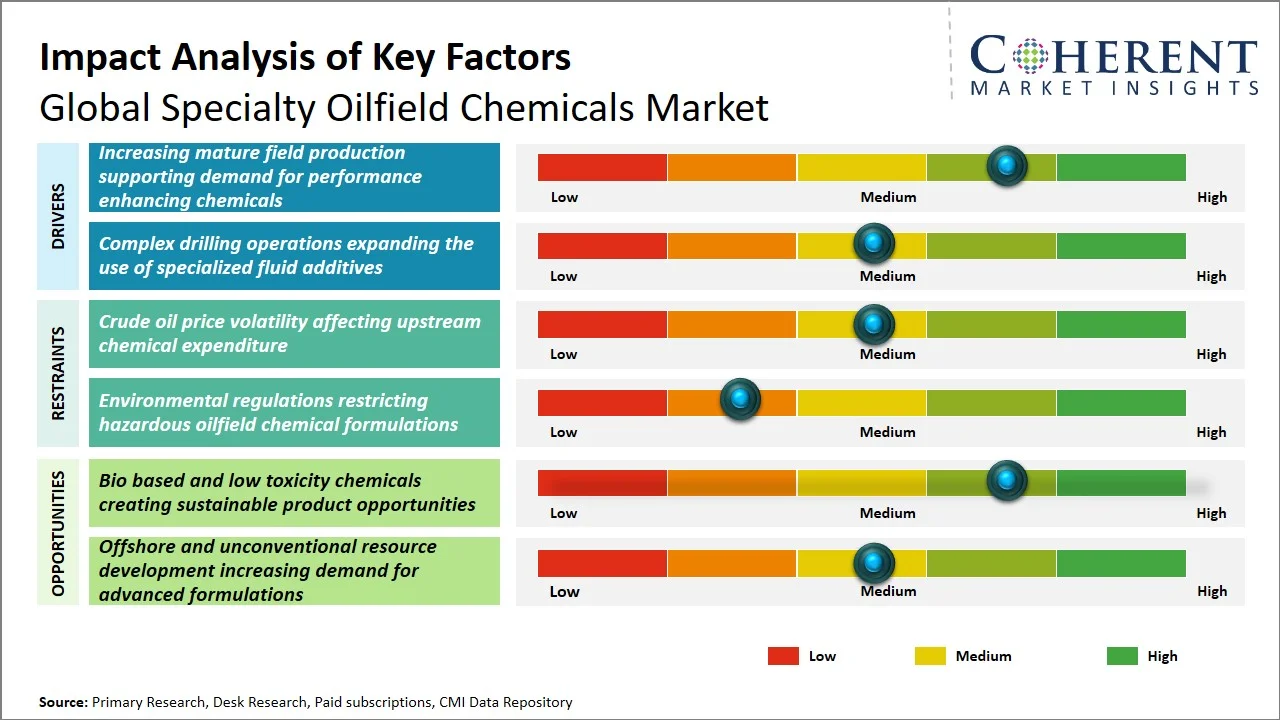
Key Market Drivers
- Mature-Field Recovery Programs Increase Chemical Intensity: Mature reservoirs increasingly require chemical intervention to preserve output as pressure declines, water cut rises, and mineral deposition becomes more severe. Polymer flooding, conformance control, scale inhibition, corrosion protection, and selective water shut-off can improve sweep efficiency and protect aging wells, pipelines, and surface facilities. This converts field-life extension into recurring demand for reservoir-specific formulations, injection equipment, monitoring, and technical services. Polymer manufacturers, production-chemical suppliers, engineering contractors, and operators with brownfield portfolios benefit, while vendors offering only standardized blends face weaker differentiation. Commercial value depends on proving incremental recovery, maintaining injectivity, and controlling total treatment cost over multi-year programs. In March 2026, SNF Flopam India secured an ONGC contract covering full-field polymer injection, facilities, chemicals, monitoring, and long-term operation at the mature Bechraji field, demonstrating the move from pilots to integrated chemical-EOR deployment.
- Complex Well Architectures Raise Additive Performance Requirements: Well construction is moving into deeper, hotter, longer, and more directionally complex intervals, increasing the performance burden on drilling-fluid additives. Operators need rheology modifiers, fluid-loss agents, shale inhibitors, lubricants, lost-circulation materials, defoamers, and cementing additives that remain stable under changing pressure, temperature, salinity, and contamination conditions. The demand mechanism is not simply more drilling; it is higher chemical intensity per technically difficult well and greater dependence on laboratory qualification before deployment. Additive manufacturers, mud-service companies, contract blenders, and suppliers with high-pressure, high-temperature testing capabilities gain the strongest commercial advantage. Failures can cause stuck pipe, formation damage, poor hole cleaning, or nonproductive time, making performance consistency more important than lowest-cost procurement. In June 2024, Aramco awarded 23 unconventional gas-rig contracts and two directional-drilling contracts for the Jafurah expansion, widening demand for specialized well-construction chemistry.
Emerging Market Trends
- Multifunctional Treatment Packages Replace Single-Purpose Products: Operators are increasingly adopting multifunctional chemical packages to reduce the number of products stored, transported, and injected at oilfield locations. Formulations combining corrosion, scale, deposition, or emulsion control can simplify treatment programs and limit chemical incompatibility. This trend favors suppliers with strong formulation expertise, application laboratories, and field-testing capabilities. It may also influence tender requirements, offshore inventory planning, and total treatment costs, while placing pressure on single-product suppliers with limited differentiation.
- Performance-Linked Contracting Changes Chemical Procurement: Oilfield chemical procurement is shifting from volume-based purchasing toward contracts linked to treatment performance. Buyers increasingly evaluate suppliers based on outcomes such as flow continuity, equipment protection, water quality, and reduced intervention needs. This approach rewards effective formulations, technical service, and reliable performance monitoring rather than low unit prices alone. Integrated providers may benefit from broader service capabilities, while regional suppliers can compete through faster field support, transparent reporting, and customized treatment programs.
Regional Insights
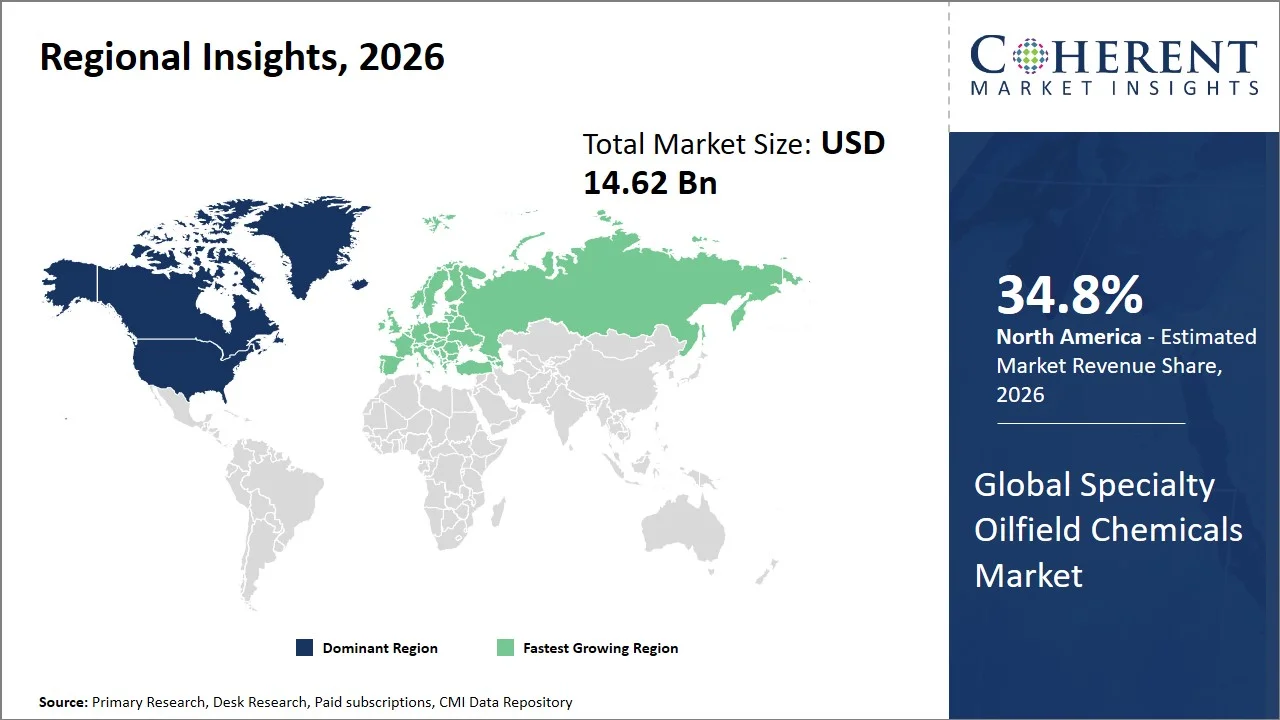
Why Does North America Dominate the Global Specialty Oilfield Chemicals Market?
North America is expected to account for 34.8% of the global specialty oilfield chemicals market in 2026. Its leadership rests on the coexistence of Canadian oil-sands operations, U.S. deepwater projects, and a mature regional chemical-service network. Bitumen handling requires emulsion breakers, diluent-management chemicals, corrosion inhibitors, and low-temperature flow-assurance products, while offshore assets purchase technically qualified formulations through long-duration service contracts. Regional blending plants, laboratories, bulk-storage terminals, and field technicians shorten response times when crude characteristics or operating conditions change. These capabilities strengthen supplier retention and support higher-value application services rather than commodity-only sales. In June 2026, the Canada Energy Regulator reported that Canadian crude oil and equivalent production averaged a record 5.35 million barrels per day in 2025, with Alberta providing most of the increase, reinforcing chemical demand across oil-sands and associated handling systems.
Why is Europe Emerging as the Fastest-Growing Region in the Global Specialty Oilfield Chemicals Market?
Europe is expected to hold 17.6% of the global specialty oilfield chemicals market in 2026 and emerge as the fastest-growing region. Expansion is supported by complex offshore reservoirs, long subsea flowlines, cold operating environments, and tighter chemical-selection requirements under European marine-protection frameworks. These conditions raise the value of high-performance scale control, hydrate management, corrosion protection, and lower-toxicity formulations that can maintain reliability at reduced dosage. Operators also increasingly connect new discoveries to existing hubs, creating targeted chemical demand without requiring entirely new processing infrastructure. This favors suppliers able to complete compatibility testing, environmental documentation, and offshore logistics alongside formulation delivery. In April 2026, Aker BP started production from the Symra field in the North Sea nine months ahead of schedule, using a four-well subsea tieback connected to established processing platforms, demonstrating continued investment in chemistry-intensive offshore production systems.
Specialty Oilfield Chemicals Market Outlook for Key Countries
Why is the U.S. a Key Market for the Specialty Oilfield Chemicals Market?
The U.S. is a key market for specialty oilfield chemicals because its Gulf of Mexico portfolio includes deepwater, high-pressure, and subsea developments where chemical failure can interrupt high-value production. Operators require qualified products for drilling-fluid stability, cement integrity, scale prevention, hydrate control, corrosion protection, and topside separation. The country also supports a concentrated ecosystem of formulation laboratories, oilfield-service headquarters, contract blenders, chemical logistics providers, and equipment manufacturers, enabling rapid technical support and field customization. Purchasing decisions increasingly consider total treatment cost, production uptime, compatibility with injection systems, and environmental performance rather than price per unit alone. In January 2025, Chevron announced first oil from the Whale semi-submersible facility in the U.S. Gulf of Mexico, adding another deepwater production system where dependable flow-assurance and asset-integrity chemistry is commercially important throughout the operating life.
Why is India Important in the Global Specialty Oilfield Chemicals Market?
India is important in the global specialty oilfield chemicals market because its upstream strategy combines mature-field recovery with expansion into deepwater and frontier basins. Domestic operators need drilling additives, cementing chemicals, corrosion inhibitors, stimulation fluids, and production-treatment programs suited to high temperatures, variable salinity, and technically difficult offshore wells. Policy reforms under HELP and OALP have widened exploration access, while the objective of reducing crude-import dependence supports sustained investment in domestic production capability. This creates opportunities for international formulators, local manufacturers, technical-service companies, and joint-development partners able to meet operator qualification and supply-security requirements. In July 2026, India’s Ministry of Petroleum and Natural Gas announced the spudding of the first appraisal well in the Mahanadi offshore basin, part of a four-well deepwater program using advanced drilling technology, directly expanding the addressable market for well-construction and offshore production chemicals.
Why Does China Support Growth in the Global Specialty Oilfield Chemicals Market?
China supports growth in the global specialty oilfield chemicals market through its large mature-field base, extensive domestic chemical-manufacturing capacity, and industrial-scale use of enhanced oil recovery. High-water-cut reservoirs create demand for polymers, surfactants, profile-control agents, scale inhibitors, and water-treatment chemicals that can extend field economics after conventional waterflooding approaches its limits. Local raw-material availability and integrated petrochemical clusters also help suppliers manufacture customized products at scale and shorten delivery cycles for national oil companies. The country’s commercialization of chemical flooding strengthens technical barriers because products must be optimized for reservoir mineralogy, salinity, temperature, and injection performance. In June 2025, CNPC reported that Daqing Oilfield’s industrialized polymer and alkali-surfactant-polymer flooding systems had raised recovery materially and sustained chemical-EOR output above 10 million tons annually for more than two decades.
Why is Germany a Strategic Country in the Specialty Oilfield Chemicals Market?
Germany is strategically important to the global specialty oilfield chemicals market primarily as a technology, formulation, and export base rather than as a major upstream producer. Its specialty-chemicals ecosystem supports the development of surfactants, polymers, amines, biocides, corrosion-control ingredients, and flow-assurance additives used by formulators serving oilfields worldwide. Strong process engineering, pilot-scale testing, regulatory documentation, and quality-control capabilities help German suppliers address demanding customer qualification procedures. The country is also well positioned to develop lower-solvent and more readily biodegradable alternatives as operators tighten environmental specifications. This creates commercial relevance for German producers through intellectual property, high-value intermediates, and technical service supplied into Europe, the Middle East, and other producing regions. In May 2026, BASF’s Performance Chemicals factbook identified Trostberg, Germany, as one of the company’s major global oilfield-chemicals production sites, confirming the country’s role within international specialty-chemical supply chains.
Why is Brazil an Important Growth Market for the Specialty Oilfield Chemicals Market?
Brazil is an important growth market for specialty oilfield chemicals because its production outlook is anchored in technically demanding pre-salt developments. Ultra-deepwater wells, high pressures, long subsea distances, gas reinjection, and complex produced fluids increase the need for scale inhibitors, corrosion protection, hydrate-management products, demulsifiers, biocides, and specialized drilling and cementing additives. Procurement is concentrated among large operators and FPSO projects, favoring suppliers that can provide offshore-qualified formulations, reliable import or local stocking, laboratory support, and continuous performance monitoring. Each new production unit creates recurring chemical requirements across wells, subsea infrastructure, processing equipment, and water-injection systems. In February 2025, Petrobras started production from FPSO Almirante Tamandaré at the Búzios pre-salt field; the unit can produce up to 225,000 barrels of oil per day and process 12 million cubic meters of gas daily.
Technology Adoption Landscape in the Global Specialty Oilfield Chemicals Market
Technology | Adoption Level | Key Application Area | Business Impact |
High-pressure, high-temperature formulation testing | High | Drilling, cementing, stimulation, and deepwater chemical qualification | Identifies instability and compatibility risks before field use, reducing chemical failure and nonproductive time. |
Low-dosage hydrate-inhibitor chemistry | High | Subsea flowlines, gas-condensate systems, and long-distance tiebacks | Reduces chemical storage and transport requirements while protecting flow continuity in cold, high-pressure systems. |
Encapsulated scale-inhibitor treatments | Medium | Downhole squeeze programs and extended-release scale control | Extends treatment duration, reduces intervention frequency, and improves chemical placement within producing formations. |
Molecular microbial monitoring | Medium | Biocide selection and microbiologically influenced corrosion management | Enables treatment programs to target identified microbial communities rather than applying broad chemical dosages. |
Tagged polymers and chemical tracers | Medium | Enhanced oil recovery, well treatments, and chemical-return monitoring | Confirms product placement, treatment persistence, and residual concentration, improving field-performance evaluation. |
Produced-water membrane treatment with chemical pretreatment | Medium | Reinjection, recycling, desalination, and beneficial water reuse | Expands demand for antiscalants, dispersants, coagulants, and fouling-control products while improving water recovery. |
How are Carbon Capture and Storage Applications Creating New Growth Opportunities in the Global Specialty Oilfield Chemicals Market?
Carbon capture and storage creates an adjacent opportunity for suppliers that can adapt oilfield chemistry expertise to carbon-dioxide injection, transport, and long-term well integrity. Dense-phase carbon dioxide can create corrosion, water-chemistry, scale, elastomer-compatibility, and cement-integrity challenges across pipelines, injection wells, and repurposed hydrocarbon assets. The opportunity remains underdeveloped because chemical qualification must account for different impurity profiles, pressure regimes, and storage formations rather than simply transferring conventional oilfield products. Customers include storage operators, pipeline developers, engineering contractors, and owners converting depleted fields. Companies can capture value through CO2-compatible corrosion inhibitors, scale-control packages, wellbore-cleanup fluids, tracer systems, and laboratory services that verify material compatibility. Participation requires high-pressure testing, geochemical expertise, regulatory documentation, and partnerships with well-integrity and subsurface specialists. Established oilfield-chemical companies hold useful technical foundations, but focused specialists may gain ground by building dedicated CCS product portfolios before procurement standards become fixed.
Market Players, Key Development, and Competitive Landscape
Key Developments
- In July 2025, Versalis transferred its Oilfield Chemicals business into the newly established Versalis Oilfield Solutions S.r.l. This is important for the global specialty oilfield chemicals market because the dedicated structure combines formulation research, outsourced production, commercial activities, and technical support within a focused organization, enabling faster portfolio development and more specialized customer service across international drilling markets.
- In May 2025, ICC, a subsidiary of SMC Global, launched AvanScav 1450, a triazine-free and amine-free hydrogen sulfide scavenger. This is important for the global specialty oilfield chemicals market because it addresses fouling, solid formation, scaling, and downstream compatibility issues associated with conventional scavenger chemistry, creating a differentiated option for upstream and processing applications requiring safer hydrogen sulfide control.
- In February 2024, Baker Hughes and Dussur inaugurated the Saudi Petrolite Chemicals manufacturing facility in Jubail, focused on local production of oilfield and industrial chemicals. This is important for the global specialty oilfield chemicals market because regional manufacturing can shorten delivery lead times, increase the use of locally sourced solvents and glycols, and improve supply continuity for Saudi Arabian operators.
Competitive Landscape
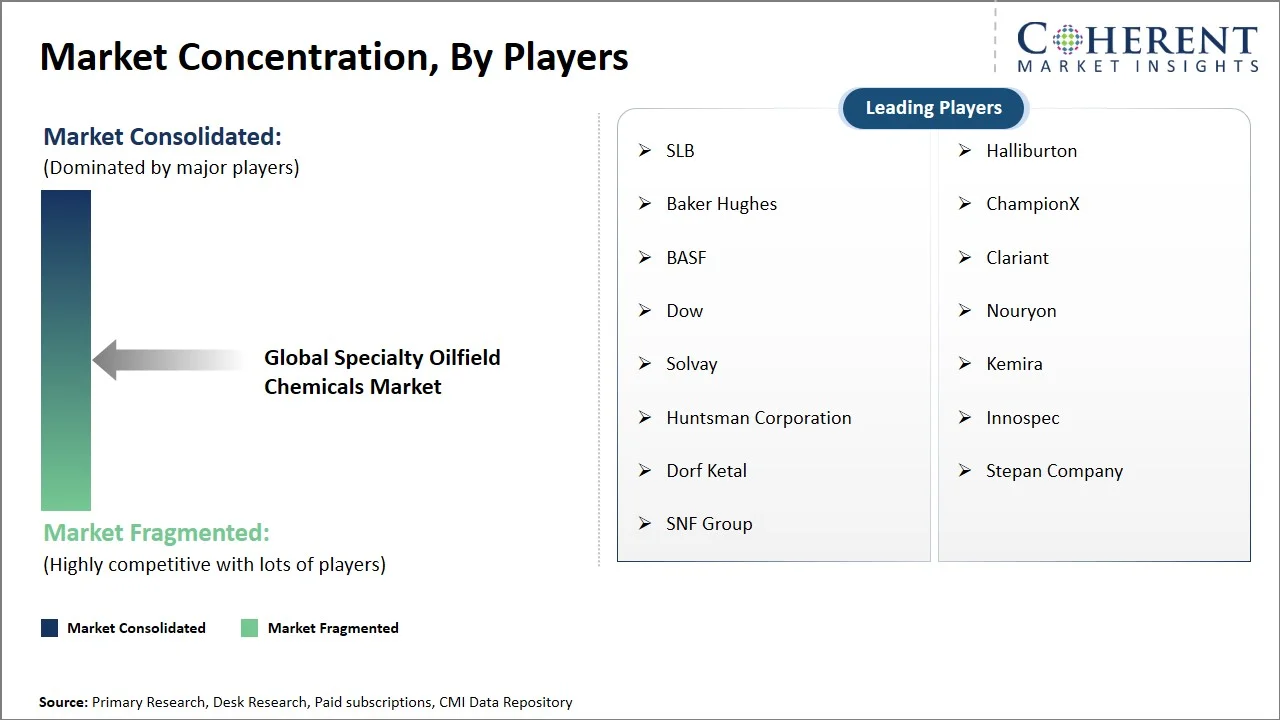
The global specialty oilfield chemicals market is moderately consolidated, with multinational oilfield-service groups and diversified specialty-chemical manufacturers controlling major international contracts, technical laboratories, and qualified product portfolios. They compete alongside independent production-chemical companies, regional formulators, contract blenders, raw-material suppliers, and application-specific technology specialists. Competition is shaped by field performance, formulation customization, response speed, regulatory acceptance, supply continuity, and the ability to demonstrate lower treatment cost across the operating cycle. Regional companies remain influential where customer proximity, local manufacturing, and rapid technical intervention outweigh global portfolio breadth.
Key focus areas include
- Reservoir and fluid compatibility: Products must address field-specific salinity, temperature, pressure, crude composition, and mineralogy.
- Technical qualification capability: Laboratory screening, pilot testing, and field validation shorten customer approval cycles.
- Treatment economics: Buyers compare dosage efficiency, intervention avoidance, production continuity, and equipment protection.
- Manufacturing resilience: Multiple raw-material sources and flexible blending plants reduce exposure to supply interruptions.
- Environmental documentation: Complete toxicity, biodegradation, safety, and discharge data influence offshore market access.
- Regional service coverage: Nearby laboratories, warehouses, transport fleets, and field personnel improve response times.
- Formulation intellectual property: Proprietary molecules, application knowledge, and historical field data support differentiation and customer retention.
Market Report Scope
Specialty Oilfield Chemicals Market Report Coverage
| Report Coverage | Details | ||
|---|---|---|---|
| Base Year: | 2025 | Market Size in 2026: | USD 14.62 Bn |
| Historical Data for: | 2020 To 2024 | Forecast Period: | 2026 To 2033 |
| Forecast Period 2026 to 2033 CAGR: | 6.3% | 2033 Value Projection: | USD 22.42 Bn |
| Geographies covered: |
| ||
| Segments covered: |
| ||
| Companies covered: | SLB, Halliburton, Baker Hughes, ChampionX, BASF, Clariant, Dow, Nouryon, Solvay, Kemira, Huntsman Corporation, Innospec, Dorf Ketal, Stepan Company, and SNF Group | ||
| Growth Drivers: |
| ||
| Restraints & Challenges: |
| ||
Analyst Opinion (Expert Opinion)
- The global specialty oilfield chemicals market leadership will increasingly depend on how effectively suppliers convert field experience into reusable treatment knowledge. Companies that develop proprietary libraries connecting fluid characteristics, failure mechanisms, formulation response, and operating conditions will qualify products faster and defend margins more effectively. Portfolio size alone will become less meaningful than the ability to translate accumulated application knowledge into consistent results across different assets.
- Simulation-led formulation qualification could materially alter established development and sales models. Digital representations of reservoir fluids, deposition behavior, chemical compatibility, and transport conditions may reduce dependence on lengthy sequential testing. Suppliers with strong modelling, laboratory-data architecture, and validation capabilities could shorten commercialization cycles, while businesses relying mainly on manual formulation adjustment may struggle to match customer expectations for speed and predictability.
- Suppliers should prioritize modular formulation platforms, regional technical laboratories, dual sourcing of critical intermediates, and regulatory-ready product dossiers. Investment should concentrate on technically difficult applications where chemical performance can be linked clearly to avoided operating costs. Companies should avoid excessive capacity for undifferentiated commodity blends, where raw-material volatility and aggressive tender pricing can quickly compress margins without creating durable customer relationships.
Speak to the analyst
Want personalized insights?
Take the findings above to one of our principal consultants, or have the report rebuilt around the segments, geographies and competitors you actually track.
Market Segmentation
- Chemical Type Insights (Revenue, USD Bn, 2021 - 2033)
- Demulsifiers
- Corrosion Inhibitors
- Scale Inhibitors
- Surfactants
- Biocides
- Pour Point Depressants
- Rheology Modifiers
- Others
- Oilfield Operation Insights (Revenue, USD Bn, 2021 - 2033)
- Production
- Drilling
- Well Stimulation
- Enhanced Oil Recovery
- Cementing
- Completion and Workover
- Location Insights (Revenue, USD Bn, 2021 - 2033)
- Onshore
- Offshore
- Product Source Insights (Revenue, USD Bn, 2021 - 2033)
- Conventional Chemicals
- Bio based Chemicals
- Regional Insights (Revenue, USD Bn, 2021 - 2033)
- North America
- U.S.
- Canada
- Latin America
- Brazil
- Argentina
- Mexico
- Rest of Latin America
- Europe
- Germany
- U.K.
- Spain
- France
- Italy
- Russia
- Rest of Europe
- Asia Pacific
- China
- India
- Japan
- Australia
- South Korea
- ASEAN
- Rest of Asia Pacific
- Middle East
- GCC Countries
- Israel
- Rest of Middle East
- Africa
- South Africa
- North Africa
- Central Africa
- North America
- Key Players Insights
- SLB
- Halliburton
- Baker Hughes
- ChampionX
- BASF
- Clariant
- Dow
- Nouryon
- Solvay
- Kemira
- Huntsman Corporation
- Innospec
- Dorf Ketal
- Stepan Company
- SNF Group
Sources
Primary Research Interviews
- Specialty oilfield chemical manufacturers, drilling- and production-chemical suppliers, raw-material producers, contract blenders, distributors, laboratories, and oilfield service companies
- R&D, drilling, production, reservoir engineering, procurement, operations, formulation, quality, regulatory, supply-chain, sustainability, technical-service, and sales executives
Stakeholders
- National oil companies, independent producers, offshore operators, drilling contractors, well-service providers, and enhanced oil recovery companies
- Surfactant, polymer, biocide, corrosion-control, injection-equipment, produced-water treatment, logistics, and engineering companies
End-use Sectors
- Drilling, cementing, completion, workover, stimulation, acidizing, and enhanced oil recovery
- Production, flow assurance, demulsification, corrosion and scale control, wax management, gas treatment, and pipeline integrity
- Produced-water treatment, offshore processing, mature fields, oil sands, unconventional resources, and deepwater operations
Regulatory & Government Bodies
- U.S. EPA, BSEE, BOEM, OSHA, and U.S. Department of Energy
- European Commission, ECHA, OSPAR Commission, UK OPRED, and North Sea Transition Authority
- Norwegian Environment Agency, Canada Energy Regulator, Alberta Energy Regulator, India Ministry of Petroleum and Natural Gas, China National Energy Administration, Brazil ANP, and IBAMA
Databases
- U.S. EIA, IEA, OPEC, JODI, World Bank, OECD, Baker Hughes Rig Count, and national petroleum databases
- UN Comtrade, ITC Trade Map, WTO Statistics, Eurostat, USITC DataWeb, China Customs, India DGCI&S, and Brazil Comex Stat
- OnePetro, SPE papers, patent databases, company filings, tender documents, product catalogues, safety data sheets, and pricing records
Magazines and Journals
- SPE Journal, Petroleum Science, Fuel, Energy & Fuels, Corrosion Science, Industrial & Engineering Chemistry Research, and Journal of Petroleum Science and Engineering
- Oilfield Technology, Offshore Magazine, World Oil, Drilling Contractor, Chemical Engineering, and Hydrocarbon Processing
Associations
- Society of Petroleum Engineers
- American Petroleum Institute
- International Association of Oil & Gas Producers
- International Association of Drilling Contractors
- AMPP
- Offshore Energies UK
- European Oilfield Specialty Chemicals Association
- Gulf Petrochemicals and Chemicals Association
Public Domain Sources
- Government production records, drilling permits, production licenses, environmental assessments, lease documents, procurement notices, and regulatory consultations
- Company annual reports, investor presentations, technical documents, product catalogues, safety data sheets, patents, and press releases
- Peer-reviewed studies on demulsifiers, corrosion and scale inhibitors, surfactants, biocides, flow assurance, enhanced oil recovery, and produced-water treatment
Key Standards and Regulations
- U.S. TSCA, Clean Water Act, RCRA, OSHA Hazard Communication Standard, and EPA effluent guidelines
- EU REACH, CLP Regulation, Offshore Safety Directive, Industrial Emissions Directive, and OSPAR offshore chemical requirements
- API, ISO 13500, ISO 10426, ISO 21457, ISO 15156, NORSOK, GHS, and relevant national offshore discharge and chemical-handling regulations
Proprietary Elements
- CMI Data Analytics Tool, Proprietary CMI Existing Repository of information for last 10 years.
Get access to 250+ pages report
Every segment, forecast, competitor profile and data table behind the analysis above — available for instant download.
- ESOMAR Member
- ISO 9001:2015 Certified
- D-U-N-S Registered
- GDPR & CCPA Compliant
Missing comfort of reading report in your local language? Find your preferred language:
Transform your Strategy with Exclusive Trending Reports
Frequently Asked Questions
The CAGR of the global specialty oilfield chemicals market is projected to be 6.3% from 2026 to 2033.
The global specialty oilfield chemicals market is estimated to be valued at USD 14.62 billion in 2026 and is expected to reach USD 22.42 billion by 2033.
Production operations generate the highest demand due to the continuous need for flow assurance, corrosion control, scale prevention, and water treatment.
Onshore operations lead the market because of their extensive well base, frequent chemical treatment requirements, and established service infrastructure.
Conventional chemicals dominate due to their established performance, broad availability, technical familiarity, and compatibility with existing oilfield processes.
Increasing mature field production supporting demand for performance enhancing chemicals and complex drilling operations expanding the use of specialized fluid additives are the major factors driving the growth of the global specialty oilfield chemicals market.
Crude oil price volatility affecting upstream chemical expenditure and environmental regulations restricting hazardous oilfield chemical formulations are the major factors hampering the growth of the global specialty oilfield chemicals market.