

Tin Chemicals Market Size and Forecast – 2026 to 2033
The Tin Chemicals Market is anticipated to grow at a CAGR of 6.7% with USD 1,701.8 Mn in 2026 and is expected to reach USD 2,309.6 Mn in 2033. The tin chemicals market grows as electronics, coatings, and chemical manufacturing industries increase demand. Manufacturers use tin-based compounds extensively in soldering, catalysts, and stabilizers, which drives market expansion.
Key Takeaways
- Sodium Stannate hold the largest market share of 38.7% in 2026 owing to the growing electroplating industry.
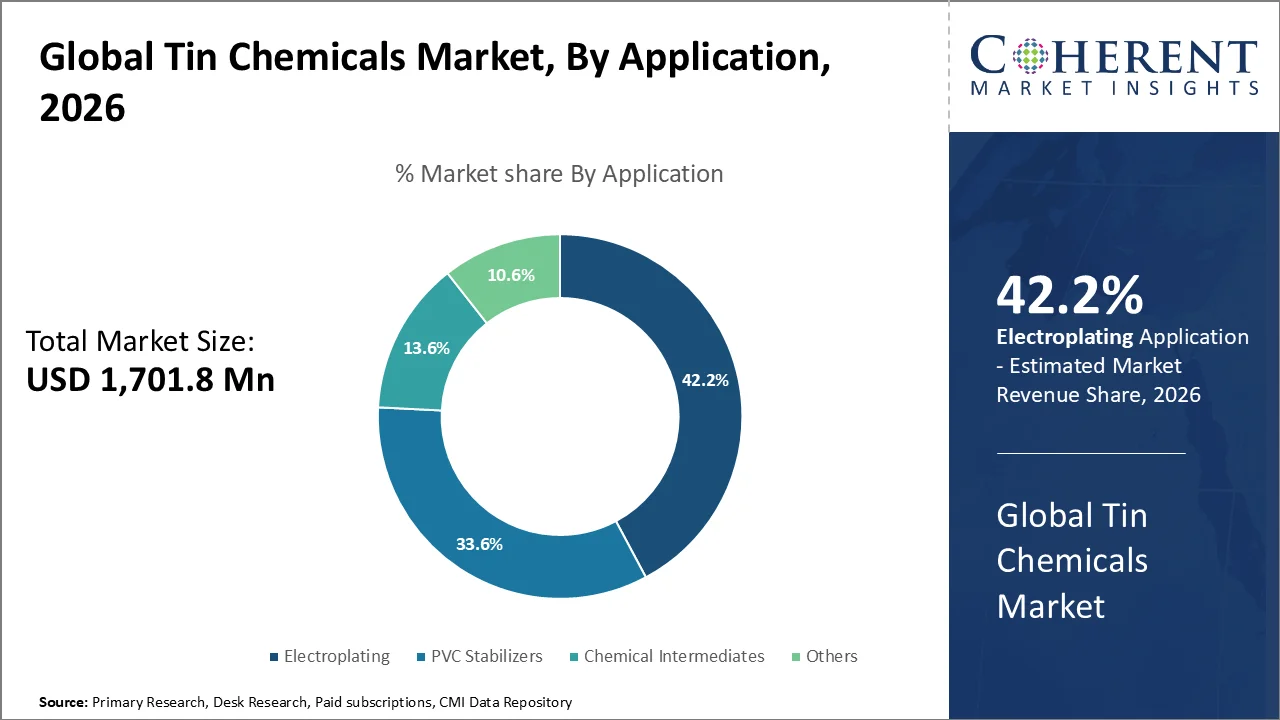
- Electroplating expected to hold largest market share of 42.2% in 2026 owing to its rising automotive production. Global automotive production totals approximately 96 Mn vehicles annually, with China producing over 30 Mn vehicles as the world's largest manufacturer. India, the fourth-largest automotive producer, manufactures more than 6 Mn vehicles annually and is the world's largest tractor manufacturer and second-largest bus producer.
- Chemical acquired the prominent market share of 37.5% in 2026 owing to the growing demand for PVC stabilizers.
- North America is expected to acquire the dominant share of 36.8% in 2026 owing to the strong electronics and electrical manufacturing. The U.S. electronics manufacturing industry supports approximately 5.2 Mn jobs, underscoring its significant contribution to the nation's economy.
Current Events and Their Impact on the Tin Chemicals Market
Current Event | Description and its Impact |
Indonesia Continues Tight Control on Tin Exports |
|
EU REACH Regulatory Reforms on Hazardous Chemicals |
|
Segmental Insights
- Current Industry Events of 2026
- Market Size Estimation
- Regional Breakdown
- Competitive Landscape
- Customer Intelligence
- Segmental Analysis
- Pricing Analysis
- Key Market Drivers, Challenges & Future Trends
- Customized Insights Section
Electroplating expected to hold largest market share
Electroplating expected to hold largest market share of 42.2% in 2026 owing to its expansion of the electronics and electrical industry. Manufacturers drive demand for tin chemicals in electroplating by applying them to produce corrosion-resistant, solderable, and electrically conductive metal coatings for automotive, electronics, aerospace, and industrial applications. They use tin chemicals to enhance the durability, appearance, and performance of connectors, fasteners, circuit boards, and other metal components. Automotive manufacturers, electronics producers, and infrastructure developers continue to increase adoption as electric vehicle production expands, electronics manufacturing grows, and industries transition toward lead-free, environmentally compliant electroplating processes. For instance, Karas Plating has commissioned a £1.5m automated 2.4-metre busbar electroplating line, expanding UK silver plating capacity and strengthening local supply chains for critical electrical components.
Which End Use Industry segment dominates the market?
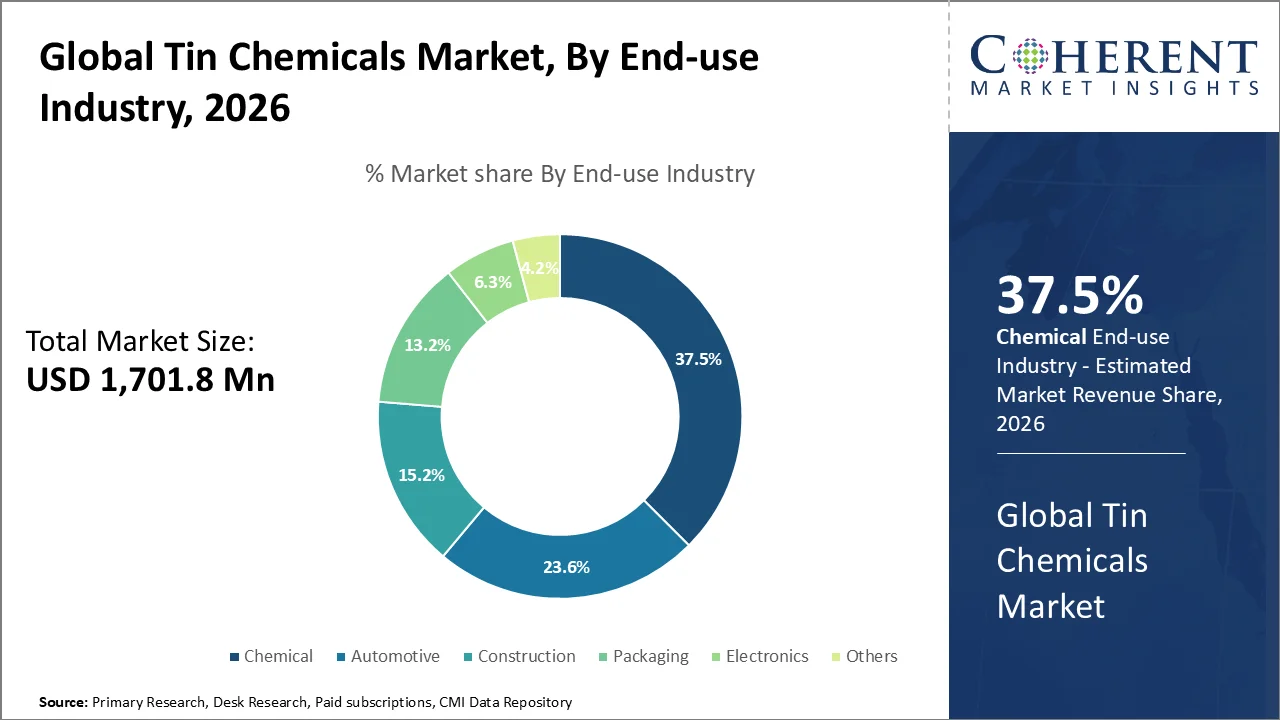
Chemical acquired the prominent market share of 37.5% in 2026. Chemical manufacturers drive demand for tin chemicals by using tin compounds as catalysts, stabilizers, and intermediates in specialty chemical production. They incorporate tin chemicals into the manufacture of PVC stabilizers, polyurethanes, silicones, coatings, adhesives, and sealants to improve processing efficiency and product performance. Construction companies, automotive manufacturers, packaging producers, and industrial manufacturers continue to increase consumption as production expands. Additionally, ongoing innovation in specialty chemical formulations and rising investments in high-value manufacturing accelerate the adoption of tin chemicals across diverse chemical applications.
Why is Sodium Stannate Acquiring the Largest Market Share?
Sodium stannate holds the largest market share of 38.7% in 2026. Manufacturers are driving demand for sodium stannate in the tin chemicals market through its widespread use in alkaline electroplating to produce corrosion-resistant, durable coatings for automotive, electronics, and industrial components. According to the International Organization of Motor Vehicle Manufacturers (OICA), global motor vehicle production reached approximately 92.5 million units in 2024, supporting demand for high-performance metal finishing and electroplating chemicals used in automotive manufacturing. Textile producers use sodium stannate as a stabilizer in hydrogen peroxide bleaching, while glass and ceramic manufacturers incorporate it as a specialty additive. Additionally, the World Steel Association reported 1.88 billion tonnes of crude steel production in 2024, reflecting sustained demand for metal processing and surface treatment chemicals across industrial manufacturing. Expanding industrialization, stricter environmental regulations promoting cleaner plating technologies, and rising investments in advanced manufacturing and metal finishing continue to accelerate the adoption of sodium stannate across diverse end-use industries.
Tin Chemicals Market Trends
- Growing demand for advanced electronics and semiconductor applications increases tin chemical consumption, as manufacturers use tin compounds in soldering materials, surface coatings, and electronic components to improve conductivity, reliability, and performance. According to the Semiconductor Industry Association (SIA), global semiconductor sales reached a record USD 627.6 billion in 2024, an increase of 19.1% from USD 526.8 billion in 2023, reflecting strong demand for semiconductor materials and packaging technologies that utilize tin-based solders.
- Rising electric vehicle (EV) production accelerates demand for tin chemicals, as EV batteries, charging systems, connectors, and power electronics require reliable tin-plated components and advanced soldering materials. According to the International Energy Agency (IEA), global electric car sales exceeded 17 million units in 2024, representing more than 20% of all new car sales worldwide, significantly increasing demand for electronic assemblies and tin-containing solder materials.
- Expansion of specialty chemical applications boosts consumption of tin-based compounds, with manufacturers increasingly using organotin compounds as catalysts, stabilizers, and additives in PVC production, coatings, adhesives, sealants, and polymer processing. According to Plastics Europe, global plastics production reached approximately 413.8 million tonnes in 2023, supporting demand for PVC stabilizers and specialty additives, including organotin compounds.
Regional Insights
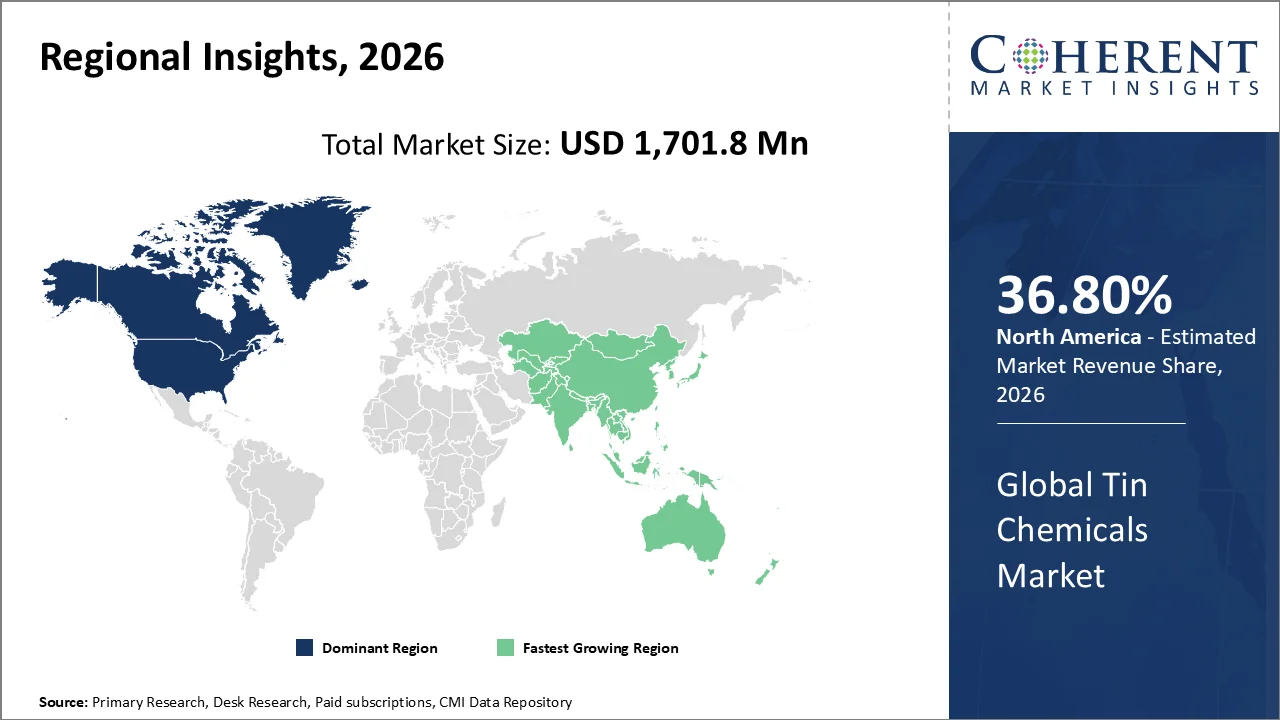
North America dominates owing to technological advancements in metal finishing
North America is expected to acquire the dominant share of 36.80% in 2026. Industries across North America drive demand for tin chemicals through increasing applications in electronics, automotive, aerospace, and specialty chemical manufacturing. Manufacturers utilize tin chemicals in soldering, electroplating, coatings, and chemical formulations to improve product performance, reliability, and durability. The expansion of electric vehicle production, semiconductor manufacturing, and advanced electronic technologies further accelerates market growth. Companies are also adopting lead-free technologies, supporting infrastructure development, and investing in sustainable manufacturing practices to increase the use of tin chemicals across diverse industrial applications in the region. Dongguan Xingma Solder and FCT Assembly launched SMT Nanaslic nano-coating, expanding FCT Assembly’s portfolio of soldering materials and precision SMT solutions.
Asia Pacific Tin Chemicals Market Trends
Industries such as electronics, automotive, and construction are driving the Asia Pacific tin chemicals market by increasing demand for advanced materials. Manufacturers are expanding semiconductor production, soldering applications, and coating technologies, which increases the use of tin-based chemicals. The India Semiconductor Mission (ISM) is strengthening India's semiconductor and display ecosystem by supporting domestic manufacturing, design, and investment, with the goal of establishing the country as a global electronics manufacturing hub. Emerging economies are accelerating urbanization, industrial growth, and infrastructure development, creating new market opportunities. The growing adoption of renewable energy systems and electric vehicles further strengthens demand for specialized tin chemicals in various manufacturing and processing applications across the region.
United States Tin Chemicals Market Trends
The United States tin chemicals market grows as industries such as electronics, automotive, construction, and packaging increase their demand for these materials. Manufacturers use tin-based compounds extensively in coatings, stabilizers, and soldering applications to support electronic device production. Infrastructure expansion and rising automotive manufacturing further drive market consumption. Companies adopt advanced materials, sustainable chemical solutions, and improved production technologies to enhance market growth. Ongoing research and stricter regulations on chemical safety encourage manufacturers to develop innovative tin chemical applications.
Japan Tin Chemicals Market Trends
Japan’s tin chemicals market grows through strong demand from the electronics, automotive, and semiconductor sectors, which use tin-based compounds for coatings, catalysts, and advanced manufacturing applications. Japanese companies advance technological innovation, develop smaller electronic components, and maintain high production standards that strengthen market expansion. The rising adoption of renewable energy technologies, electric vehicles, and sustainable chemical solutions further drives the use of tin chemicals across diverse industrial applications.
Who are the Major Companies in Tin Chemicals Industry
Some of the major key players in Tin Chemicals are Mason Corporation, Ace Chemical Company, City Chemicals LLC, TIB Chemicals AG, Pfaltz & Bauer Inc., GFS Chemicals, Showa America, S V Plastochem Private Limited, Westman Chemicals Pvt, William Blythe, Haihang Industry Co.,Ltd, and Strem Chemicals.
Key News
- In July 2026, DEScycle opened its first demonstration plant at Wilton Centre in Teesside, deploying its distributed metals processing platform to strengthen the UK’s critical minerals supply chain and reduce dependence on overseas processing.
Market Report Scope
Tin Chemicals Market Report Coverage
| Report Coverage | Details | ||
|---|---|---|---|
| Base Year: | 2025 | Market Size in 2026: | USD 1,701.8 Mn |
| Historical Data for: | 2020 To 2024 | Forecast Period: | 2026 To 2033 |
| Forecast Period 2026 to 2033 CAGR: | 6.7% | 2033 Value Projection: | USD 2,309.6 Mn |
| Geographies covered: |
| ||
| Segments covered: |
| ||
| Companies covered: | Mason Corporation, Ace Chemical Company, City Chemicals LLC, TIB Chemicals AG, Pfaltz & Bauer Inc., GFS Chemicals, Showa America, S V Plastochem Private Limited, Westman Chemicals Pvt, William Blythe, Haihang Industry Co.,Ltd, and Strem Chemicals. | ||
Analyst Opinion
- The tin chemicals market is being shaped less by short-term demand cycles and more by the strategic importance of tin in high-performance applications. The strongest growth driver is the semiconductor and electronics supply chain, where tin-based chemicals play a critical role in soldering materials, surface treatments, and specialty coatings. Global semiconductor sales surpassed USD 500 billion in recent years, highlighting the expanding need for reliable tin-based materials in advanced electronic manufacturing.
- The shift toward electric vehicles and renewable energy systems is creating a stronger demand base for tin chemicals. An electric vehicle typically requires significantly more electronic components than conventional vehicles, increasing the requirement for soldering, circuit protection, and conductive materials. With global electric vehicle sales crossing 10 million units annually, analysts view automotive electrification as a structural demand catalyst rather than a temporary market trend.
- Semiconductor miniaturization and advanced packaging technologies are expected to remain key areas of opportunity for tin chemical suppliers. As chip manufacturers move toward smaller nodes and more complex packaging designs, the industry requires higher-purity materials with improved performance characteristics. Companies capable of supplying specialty-grade tin compounds with consistent quality are likely to gain a competitive advantage, particularly in technologically advanced markets such as Japan, South Korea, Taiwan, and the United States.
Speak to the analyst
Want personalized insights?
Take the findings above to one of our principal consultants, or have the report rebuilt around the segments, geographies and competitors you actually track.
Market Segmentation
- By Product Type (Revenue, USD Mn, 2021-2033)
- Sodium Stannate
- Stannous Chloride
- Stannic Chloride
- Stannous Oxalate
- Stannic Sulphate
- Other
- By Application (Revenue, USD Mn, 2021-2033)
- Electroplating
- PVC Stabilizers
- Chemical Intermediates
- Others
- By End-use Industry (Revenue, USD Mn, 2021-2033)
- Chemical
- Automotive
- Construction
- Packaging
- Electronics
- Others
- By Region (Revenue, USD Mn, 2021-2033)
- North America
- U.S.
- Canada
- Latin America
- Brazil
- Mexico
- Argentina
- Rest of Latin America
- Europe
- Germany
- U.K.
- France
- Italy
- Spain
- Russia
- Rest of Europe
- Asia Pacific
- China
- India
- Japan
- Australia
- South Korea
- ASEAN
- Rest of Asia Pacific
- Middle East
- GCC
- Israel
- Rest of Middle East
- Africa
- South Africa
- Central Africa
- North Africa
- North America
Sources
Primary Research interviews
- Industry experts and professionals across tin chemicals manufacturing, distribution, and end-user industries
- Raw material suppliers, chemical producers, formulators, and technology providers
- Stakeholders from electronics, plating, automotive, glass, construction, and chemical processing sectors
- Trade channel participants, including distributors, wholesalers, and regional suppliers
Databases
- United Nations Comtrade Database
- International Trade Centre (ITC) Trade Map
- U.S. Geological Survey (USGS) Mineral Commodity Summaries and Mineral Industry Surveys
- World Bank Commodity Data
- International Energy Agency (IEA) industrial and energy-related databases
- National statistical databases and customs trade databases of key tin-producing and consuming countries
Magazines
- Chemical Week
- Chemical & Engineering News
- ICIS Chemical Business
- Industrial Minerals Magazine
- Metal Bulletin publications
- Electronics industry trade publications
Journals
- Journal of Applied Electrochemistry
- Surface and Coatings Technology
- Journal of Alloys and Compounds
- Materials Chemistry and Physics
- Journal of Cleaner Production
- Industrial & Engineering Chemistry Research
- Electrochimica Acta
Newspapers
- Financial Times
- The Wall Street Journal
- The Economic Times
- Reuters
- Bloomberg News
- Regional business and trade newspapers covering metals, chemicals, and manufacturing industries
Associations
- International Tin Association (ITA)
- American Chemical Society (ACS)
- The Electrochemical Society (ECS)
- National Association of Chemical Distributors (NACD)
- International Council of Chemical Associations (ICCA)
- Electronics industry and metal processing associations
Public Domain sources
- Government publications and regulatory databases
- Environmental Protection Agency (EPA) chemical information resources
- European Chemicals Agency (ECHA) substance database
- Occupational Safety and Health Administration (OSHA) chemical safety resources
- National and regional environmental regulations related to tin compounds
- Corporate annual reports and sustainability reports of publicly listed chemical manufacturers
- Government trade, import-export, and industrial production statistics
Proprietary Elements
- CMI Data Analytics Tool
- Proprietary CMI Existing Repository of information for last 10 years
Get access to 250+ pages report
Every segment, forecast, competitor profile and data table behind the analysis above — available for instant download.
- ESOMAR Member
- ISO 9001:2015 Certified
- D-U-N-S Registered
- GDPR & CCPA Compliant
Missing comfort of reading report in your local language? Find your preferred language:
Transform your Strategy with Exclusive Trending Reports
Frequently Asked Questions
Global tin chemicals market was valued at around 1,701.8 Mn in 2026.
Increasing use of tin plating among various industries coupled with significant advancements in the chemical industry is expected to propel growth of the market over the forecast period.
Significant advances in the chemical industry in recent years is one of the main trends in market.
Increasing prices of tin prices and development of new alternatives to tin chemicals is expected to restrain growth of the market.
Major players operating in the market include, Mason Corporation, Ace Chemical Company, City Chemicals LLC, TIB Chemicals AG, Pfaltz & Bauer Inc., GFS Chemicals, Showa America, S V Plastochem Private Limited, Westman Chemicals Pvt, William Blythe, Haihang Industry Co.,Ltd, and Strem Chemicals.
The market is estimated to grow at around 6.7% CAGR in the forecast period.