

Carboxymethyl Cellulose Market Size
Carboxymethyl Cellulose Market size is estimated to be valued at USD 1,359.0 Mn in 2026 and is expected to reach USD 1,824.8 Mn in 2033, exhibiting a compound annual growth rate (CAGR) of 4.3% from 2026 to 2033.
Key Takeaways
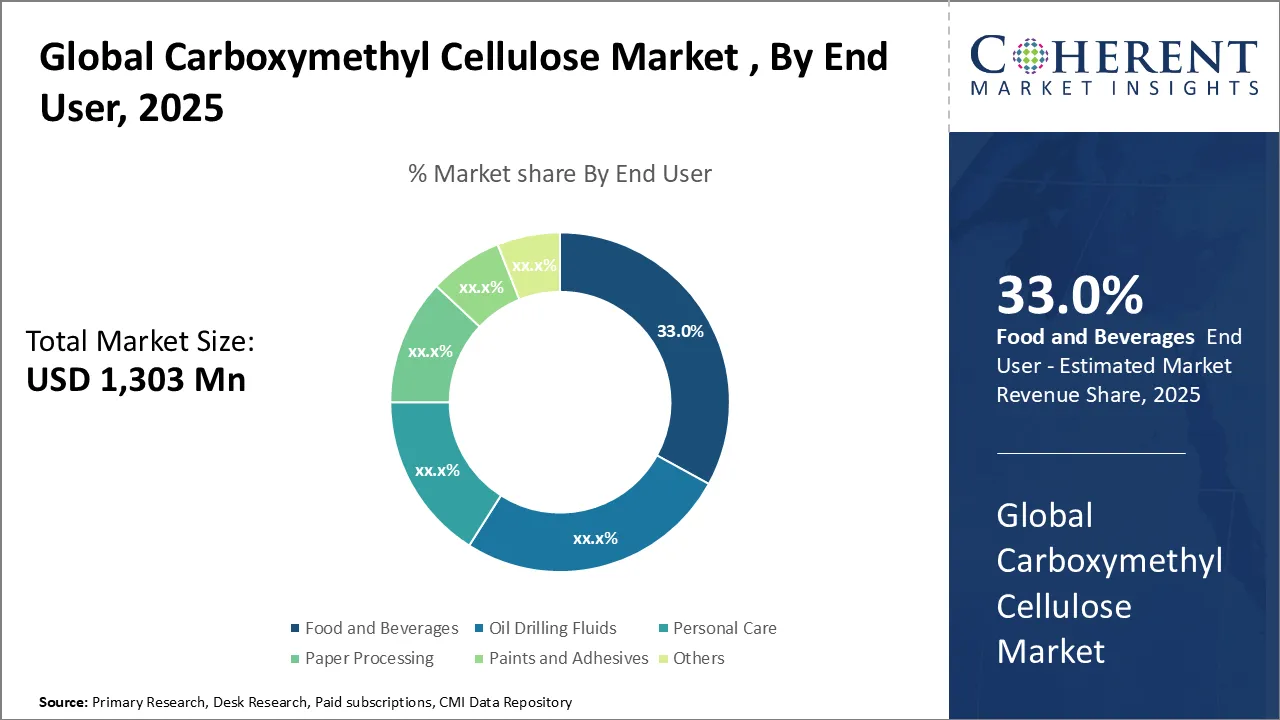
- Based on end-user, the Food & beverage segment is expected to account for 34% of the market share in 2026.
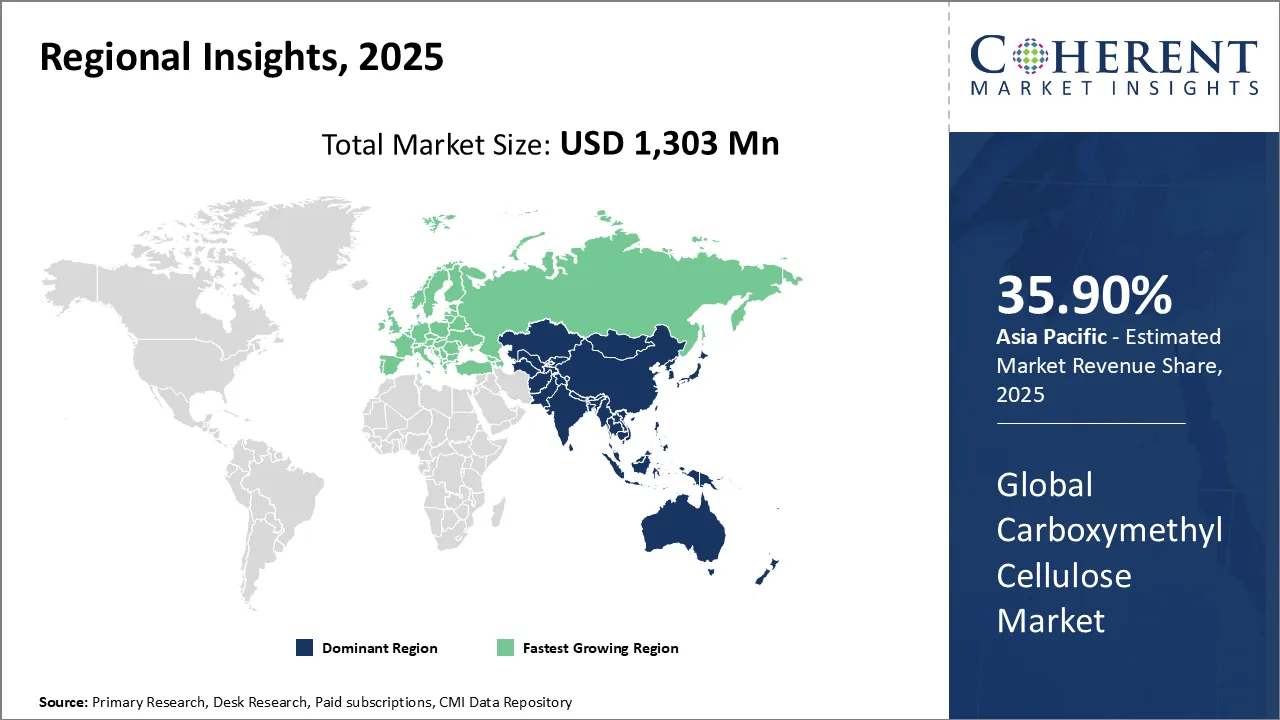
- Based on region, Asia Pacific is set to lead the global carboxymethyl cellulose market with a share 35.90% in 2026. While, Europe is considered to be the fastest growing region during the forecast period.
Market Overview
The global carboxymethyl cellulose market demand is driven by its versatility and wide range of application across industries such as a thickener, stabilizer, emulsifier, and dispersant makes it valuable in food, pharmaceuticals, construction, and other sectors. Carboxymethyl cellulose (CMC), also known as cellulose gum, is a water-soluble derivative of cellulose, a natural polymer found in plant cell walls. Additionally, it is also used in cosmetics in in hand creams and lotions due to the flavor, polish and stabilizing properties of the suspension. Also, it is used in the production of toothpaste, due to the emulsion stabilization, creating a uniform layer and thickening. CMC with standard safe intake used in food industry is safe for human consumption.
Current Events and their Impact on Carboxymethyl Cellulose Market
Current Event | Description and its Impact |
Regulatory Changes in Food Safety Standards |
|
Energy Sector Technological Developments |
|
Segmental Insights
- Current Industry Events of 2026
- Market Size Estimation
- Regional Breakdown
- Competitive Landscape
- Customer Intelligence
- Segmental Analysis
- Pricing Analysis
- Key Market Drivers, Challenges & Future Trends
- Customized Insights Section
Carboxymethyl Cellulose Market Insights, By End-User
The Food & Beverages Segment Acquires the Largest Share
In terms of end-user, the food and beverage segment is expected to contribute 34.0% share of the market in 2026, owing to its versatile functions, including thickening, stabilizing, emulsifying, and binding properties. These properties make CMC valuable in various food and beverage applications, improving texture, stability, and shelf life. For instance, according to an article published by SINOCMS, CMC is widely used in artisanal ice cream, yogurt, fruit drinks and cakes to improve the shelf life of food and have a better taste. CMC also allows for the creation of desirable textures and mouthfeel, enhancing the overall consumer experience. It is used for a viscosity modifier or thickener and to stabilize emulsions in various products, including ice cream, mayonnaise, and beverages. It is also used extensively in gluten-free and reduced-fat food products.
Regional Insights
Asia Pacific Carboxymethyl Cellulose Market Analysis & Trend
Asia Pacific region dominated the global carboxymethyl cellulose market in 2026, accounting for a 35.90% share in terms of value. Carboxymethyl cellulose market is highly demanding in Asia Pacific region due to its extensive use in food and beverage, pharmaceuticals, and personal care. Along with that, the Economic growth, industrialization, and changing consumer preferences encourage the market growth. The demand is highly observed in countries such as India, Japan and South Korea due to their large population, rapid industrialization and growing consumer demand for processed foods and convenience products.
In 2024, Japan exported ¥6.57 billion worth of Carboxymethylcellulose salts, ranking it as the 1,106th largest export product out of 4,864.
Europe Carboxymethyl Cellulose Market Analysis & Trends
Europe region is expected to exhibit the fastest growth in the market in 2026. The growth can be attributed to clean label and natural ingredient demand. Europe consumers are preferring for clean label, plant-based and natural additives in food and personal care products. CMC are derived from celluloses (typically wood pulp or cotton linter). This fits the trends of using non-toxic, biodegradable and allergen-free thickener, stabilizer and emulsifies. In Europe, 1 in 2 consumers prefer a natural or clean label approach to healthy eating. The proprietary study ATLAS was conducted in partnership with Clear Seas Research. It also found that 99% of European manufacturers see clean label products as essential to their business strategy, with 87% already incorporating these into their products. This is further propelling the carboxymethyl cellulose market demand in Europe.
Carboxymethyl Cellulose Market Outlook Country-wise
China Carboxymethyl Cellulose Market Trends
China carboxymethyl cellulose market is characterize rapidly growing processed food market uses CMC as a thickener, stabilizer, and emulsifier in sauces, dairy, baked goods, and beverages. Along with that, China is one of the world’s largest CMC producers, benefiting from abundant raw materials (like cellulose derived from wood pulp or cotton linter), low labor costs and established supply chains for domestic and export markets.
Between October 2023 and September 2024, the world received 2,264 shipments of Carboxymethyl Cellulose from China. This is further accelerating the carboxymethyl cellulose market growth.
Germany Carboxymethyl Cellulose Market Trends
Germany carboxymethyl cellulose market is renowned for its largest food processing industries in Europe. MC, being plant-derived and biodegradable, aligns with Germany’s strong environmental regulations and sustainability goals. The Federal Government will make a binding reduction of 55 percent of greenhouse gases by 2030 with the Climate Action Programme 2030 and the Climate Change Act (Klimaschutzgesetz). Such initiatives are proliferating the carboxymethyl cellulose market demand.
Market Report Scope
Carboxymethyl Cellulose Market Report Coverage
| Report Coverage | Details | ||
|---|---|---|---|
| Base Year: | 2025 | Market Size in 2026: | USD 1,359.0 Mn |
| Historical Data for: | 2020 To 2024 | Forecast Period: | 2026 To 2033 |
| Forecast Period 2026 to 2033 CAGR: | 4.3% | 2033 Value Projection: | USD 1,824.8 Mn |
| Geographies covered: |
| ||
| Segments covered: | By End-User: Food & Beverage, Oil Drilling Fluids, Paper Processing, Personal Care, Paints and Adhesives, Packaging, Others | ||
| Companies covered: | Akzo Nobel N.V., Ashland Inc., CP Kelco, Daicel Corporation, The Dow Chemical Company, Lamberti S.p.A., Penn Carbose Inc., Sichem LLC, SINCOCMC Co. Ltd, Yixing Tongda Chemical Co. Ltd, and Nouryon | ||
| Growth Drivers: |
| ||
| Restraints & Challenges: |
| ||
Global Carboxymethyl Cellulose Market Drivers
Food additive demand will rise, driving market expansion
The substantial demand from the food industry is expected to drive significant growth for carboxymethyl cellulose market growth. One of the key reasons propelling the market is the rising demand for food additives such as thickening agents, stabilizers, and viscosity-modifying agents. For instance, ice cream is made with carboxymethyl cellulose powder. Using the inclusion of CMCX, it is no longer necessary to make ice cream using churners and salt ice mixtures. Additionally, the demand for carboxymethyl cellulose is skyrocketing due to rising demand for ready-to-cook and ready-to-eat items such premixes, bakery goods, instant noodles, meat goods, sauces, quick-frozen meals, and other goods. Additionally, CMC is a fat substitute and is frequently used in the production of low-fat and gluten-free goods.
Growing Detergent Manufacturing Demand Will Advance the Market
Due to its remarkable anti-soil red-positing characteristic, sodium derivative of carboxymethyl cellulose is widely used in the production of detergents. Additionally, it works in detergents as a skin and texture protector, homogenizer, stabilizer, particle suspender, color retention agent, and color retention agent. Oil and filth are absorbed by the good thickening, emulsifying, and dispersing effect, which also keeps oil from coming into touch with the cleansed surfaces. Due to their remarkable qualities, detergents and cleaning products are in great demand, which is projected to propel carboxymethyl cellulose market vlue. For instance, as Karnataka Soaps and Detergents Limited celebrated its centenary year, the company has planned to go in for capacity enhancement by modernizing plants and machinery and launching new products to cater to market demands.
Global Carboxymethyl Cellulose Market Opportunities
More taconite and iron ore mining are anticipated to open up additional markets for carboxymethyl cellulose. It is frequently used in mining flotation operations to separate metals and contaminants. In essence, it is a modifier that is utilized in the mining flotation chemical process. Additionally, because it is quickly absorbed by the surfaces of minerals, it is also employed in nickel ore. Therefore, it is anticipated that rising demand across mining applications would promote the growth of the carboxymethyl cellulose market forecast.
It is anticipated that the increased use of carboxymethyl cellulose in the paper sector would open up new business prospects. In the making of paper, it serves as a stabilizer, binder, thickener, and dispersant. Growing paper demand from diverse uses is increasing paper output, which in turn is increasing carboxymethyl cellulose consumption.
Recent Developments
- In March 2025, Daicel Corporation launched BELLOCEA® BS7, a biodegradable cellulose‑acetate-based spherical particle designed to replace microplastic beads in cosmetics. It complies with European biodegradation standards and taps into emerging sustainable ingredients mandates.
- In April 2024, Researchers developed lithium carboxymethyl cellulose (CMC‑Li) as a water‑based binder for LiFePO₄ batteries, outperforming traditional CMC‑Na and PVDF options. This innovation underlines CMC's expanding role in advanced battery technologies.
Analyst Opinion (Expert Opinion)
The Carboxymethyl Cellulose (CMC) market is entering a defining phase, marked by innovation-driven expansion and rising input volatility, placing manufacturers in a delicate balancing act between value addition and cost control. The market's future hinges less on volume growth and more on functional customization and strategic end-user engagement—particularly in food, pharma, and personal care.
CMC is being redefined as a specialty ingredient. Food-grade CMC is increasingly engineered for specific rheological and sensory functions, such as stabilizing plant-based dairy analogs (e.g., oat and almond milk), where natural, clean-label thickeners are in high demand. For instance, formulators for Nestlé and Danone have begun shifting from carrageenan to enzymatically modified CMC due to better cold-solubility and mouthfeel control—an area where standard grades simply can’t compete.
Similarly, in pharmaceutical applications, CMC's role as a binder and disintegrant in tablet formulations has pushed suppliers toward ultra-low impurity and highly uniform grades. The rise of orally disintegrating tablets (ODTs) is a case in point, where CMC’s water uptake profile is critical for rapid release. Companies like Ashland and DKS are investing in micro-structured CMC to cater to such high-precision uses.
China’s production accounts for over 55% of global CMC output, but the market is bifurcating. While Tier-1 manufacturers in China are improving process consistency through automated etherification units, Tier-2 and Tier-3 firms still produce variable quality with high salt content and inconsistent viscosity. This has led to increasing rejections by multinational buyers in food and pharma segments.
There is a shift underway: major buyers are actively seeking dual sourcing strategies from Southeast Asia (notably Thailand and Indonesia), where GMP-certified plants are being set up. This could decentralize sourcing but increase supply chain complexity.
Speak to the analyst
Want personalized insights?
Take the findings above to one of our principal consultants, or have the report rebuilt around the segments, geographies and competitors you actually track.
Market Segmentation
- Global Carboxymethyl Cellulose Market, By End-User (Revenue, USD Mn, 2021 - 2033)
- Food & Beverage
- Oil Drilling Fluids
- Paper Processing
- Personal Care
- Paints and Adhesives
- Packaging
- Others
- Global Carboxymethyl Cellulose Market, By Region (Revenue, USD Mn, 2021 - 2033)
- North America
- U.S.
- Canada
- Latin America
- Brazil
- Argentina
- Mexico
- Rest of Latin America
- Europe
- Germany
- U.K.
- Spain
- France
- Italy
- Russia
- Rest of Europe
- Asia Pacific
- China
- India
- Japan
- Australia
- South Korea
- ASEAN
- Rest of Asia Pacific
- Middle East
- GCC Countries
- Israel
- Rest of Middle East
- Africa
- South Africa
- North Africa
- Central Africa
- North America
- Company Profiles
- Azko Nobel N.V.
- Ashland Inc.
- CP Kelco
- Daicel Corporation
- The Dow Chemical Company
- Lamberti S.p.A
- Penn Carbose Inc.
- Sichem LLC
- SINOCMC Co. Ltd.
- Yixing Tongda Chemical Co. Ltd.
- Nouryon
Sources
Primary Research Interviews from the following stakeholders:
Stakeholders:
- Interviews with cellulose derivative manufacturers, food & beverage formulators, pharmaceutical excipients managers, personal care product developers, industrial chemical buyers, R&D scientists, and supply chain/logistics heads across global markets.
Databases:
- UN Comtrade Database (Chemical Trade Codes)
- World Bank Commodity Prices Database
- FAOSTAT – Food and Agriculture Organization of the United Nations
- U.S. Geological Survey – Industrial Minerals Yearbook
- Indian Ministry of Chemicals and Fertilizers
- Eurostat – Chemical Product Codes
- China Customs General Administration – CMC HS Code Analysis
- Korea International Trade Association (KITA)
- Japan External Trade Organization (JETRO)
- Directorate General of Commercial Intelligence and Statistics (DGCIS), India
Magazines:
- Food Ingredients First
- Nutraceutical Business Review
- Pharma Technology Focus
- Cosmetics Business Magazine
- Paint & Coatings Industry Magazine
- Oilfield Technology
- Packaging World
- Pulp & Paper International (PPI)
Journals:
- Carbohydrate Polymers (Elsevier)
- Journal of Applied Polymer Science
- Food Hydrocolloids
- International Journal of Pharmaceutics
- Journal of Surfactants and Detergents
- Industrial Crops and Products
- Journal of Dispersion Science and Technology
Newspapers:
- The Economic Times – Chemicals & Pharma
- Business Standard – Agro & Industrial Materials
- Mint – FMCG and Packaging Insights
- Nikkei Asia – Chemical Industry and Raw Material Costs
- The Hindu Business Line – Industrial Raw Materials & Exports
- Financial Times – Specialty Chemicals Reports
Associations:
- International Food Additives Council (IFAC)
- American Chemical Society (ACS) – Cellulose and Renewable Materials Division
- Indian Chemical Council (ICC)
- Society of Cosmetic Chemists (SCC)
- The Indian Pharmaceutical Association (IPA)
- Association of Oil & Gas Operators (India & Global)
- European Chemical Industry Council (CEFIC)
- Japan Chemical Industry Association (JCIA)
Public Domain Sources:
- Ministry of Chemicals and Fertilizers (Government of India)
- U.S. Food and Drug Administration (FDA) – Inactive Ingredient Database
- European Food Safety Authority (EFSA) – Additives Database
- NITI Aayog Reports on Agro-Chem and Specialty Chemicals
- Reserve Bank of India (RBI) – Industrial Production Index
- India Brand Equity Foundation (IBEF) – Chemicals Sector Reports
- EU Chemicals Agency (ECHA) – Substance Information on CMC
- Ministry of Economy, Trade and Industry (METI), Japan – Cellulose Derivatives Trade Data
- Central Drugs Standard Control Organization (CDSCO), India – Excipients Regulatory Reports
Proprietary Elements:
- CMI Data Analytics Tool, and Proprietary CMI Existing Repository of information for last 8 years
*Definitions: Carboxymethyl cellulose, a kind of cellulose gum, is made from pure cotton and wood pulp. Numerous sectors, including oil and gas, agriculture, cosmetics and personal care, paint, paper manufacturing, pharmaceutical, food and beverage, and household care, utilize cellulose gum extensively.
Get access to 250+ pages report
Every segment, forecast, competitor profile and data table behind the analysis above — available for instant download.
- ESOMAR Member
- ISO 9001:2015 Certified
- D-U-N-S Registered
- GDPR & CCPA Compliant
Missing comfort of reading report in your local language? Find your preferred language:
Transform your Strategy with Exclusive Trending Reports
Frequently Asked Questions
The Carboxymethyl Cellulose Market is estimated to be valued at USD 1,359.0 Mn in 2026, and is expected to reach USD 1,824.8 Mn by 2033.
Food additive demand will rise, driving market expansion, and growing detergent manufacturing demand will advance the market.
The CAGR of the Carboxymethyl Cellulose Market is projected to be 4.3% from 2026 to 2033.
Akzo Nobel N.V., Ashland Inc., CP Kelco, Daicel Corporation, The Dow Chemical Company, Lamberti S.p.A., Penn Carbose Inc., Sichem LLC, SINCOCMC Co. Ltd, Yixing Tongda Chemical Co. Ltd, and Nouryon.
Negative Reaction to Exposure Could Hamper the Global Carboxymethyl cellulose Market.
CMC acts as a viscosifier and water loss reducer in drilling fluids, improving stability, lubrication, and wellbore integrity.
CMC pricing depends on raw material costs, purity grade, production technology, regional demand, end-use industry, and regulatory compliance requirements.