

Stereotaxic Instruments Market Size and Forecast – 2026 to 2033
The Stereotaxic Instruments Market is anticipated to grow at a CAGR of 6.3% with USD 22.7 Bn share in 2026 and is expected to reach USD 31.3 Bn in 2033. Researchers are expanding neuroscience studies and neurological disorder research, increasing the need for precise animal-model experiments. In June 2026, the Allen Institute and its partners launched the Brain Health Accelerator, a global research initiative focused on identifying the specific brain cells and neural circuits affected by neurodegenerative and other brain disorders, with the goal of accelerating the development of new treatments.
Key Takeaways
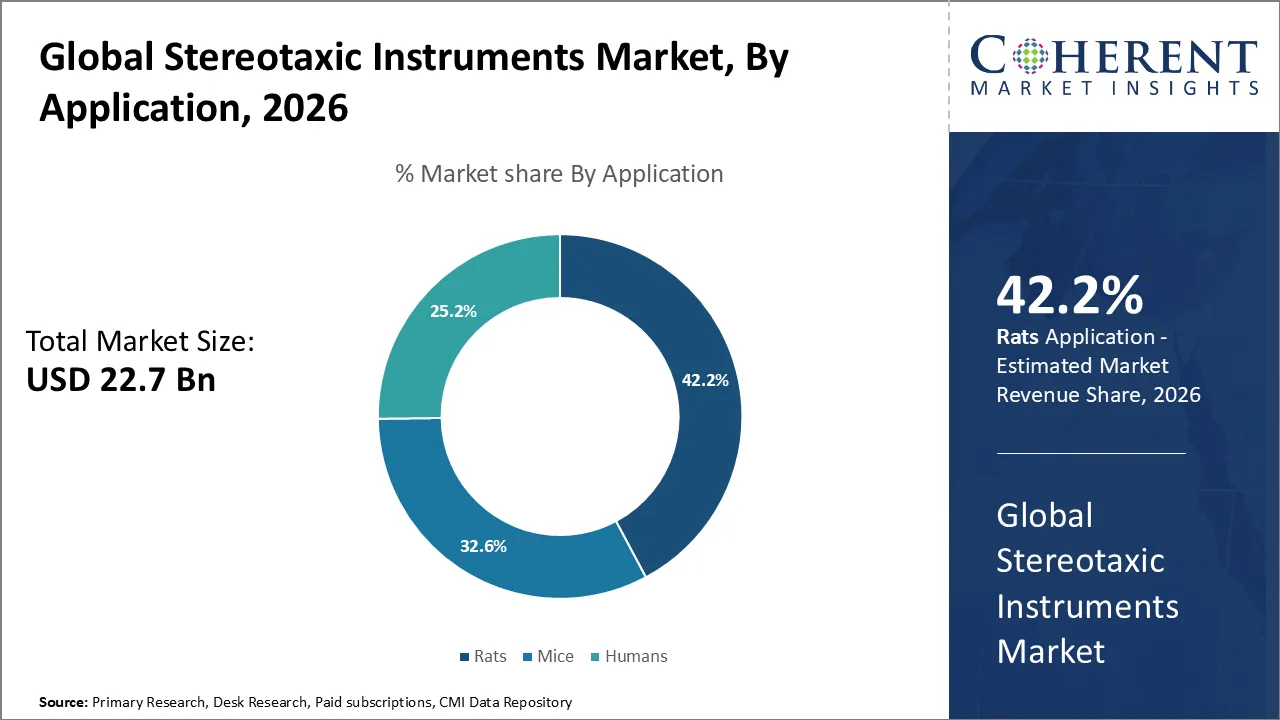
- Rats hold the largest market share of 42.2% in 2026 owing to its rising neuroscience research. Rodents, particularly rats, are valuable models for investigating the brain circuits that regulate fundamental behaviors.
- Research Institutes expected to hold largest market share of 43.3% in 2026 owing to the increasing preclinical research activities.
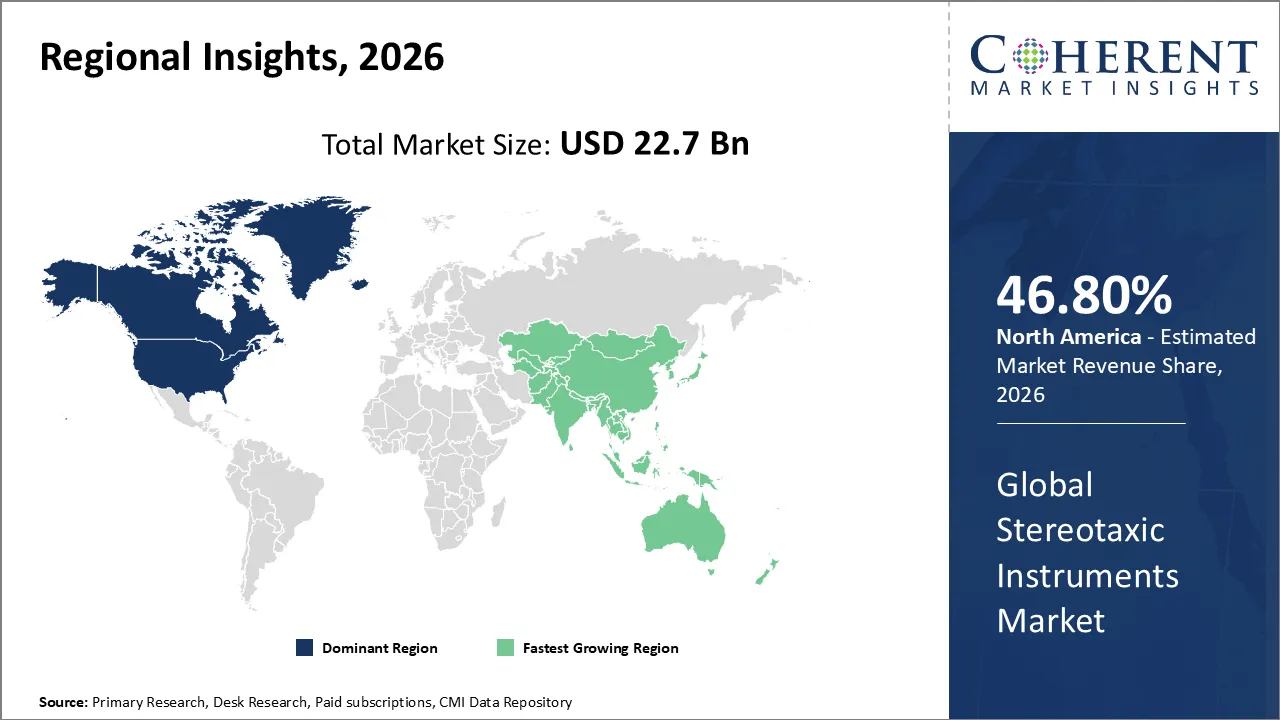
- North America is expected to acquire the dominant share of 46.8% in 2026 owing to the substantial government research funding. In September 2026, Governor Kathy Hochul announced the launch of the first phase of the SUNY Brain Institute, a statewide neuroscience research network established to advance research on age-related brain disorders.
Current Events and Their Impact on the Stereotaxic Instruments Market
Current Event | Description and its Impact |
U.S. BRAIN Initiative FY2026 Funding Increase |
|
$10 Million SUNY Brain Institute Initiative in New York |
|
Segmental Insights
- Current Industry Events of 2026
- Market Size Estimation
- Regional Breakdown
- Competitive Landscape
- Customer Intelligence
- Segmental Analysis
- Pricing Analysis
- Key Market Drivers, Challenges & Future Trends
- Customized Insights Section
Why is Rats Acquiring the Largest Market Share?
Rats hold the largest market share of 42.2% in 2026. Researchers extensively use rats in neuroscience, behavioral research, pharmacology, and preclinical drug development, making rat-based studies a significant driver of the Stereotaxic Instruments Market. Rats are widely used in behavioral psychology research because their larger brains and relatively robust behavioral responses make them suitable models for studying complex behaviors. Researchers rely on rats’ physiological and neurological similarities to humans to study brain disorders and assess potential therapies. They use stereotaxic instruments to accurately administer drugs, implant electrodes, deliver cells, and introduce other materials into specific brain regions. Increasing neurological research, expanding preclinical investigations, and the growing need for precise and reproducible experiments continue to drive demand for these instruments.
Which End User segment dominates the market?
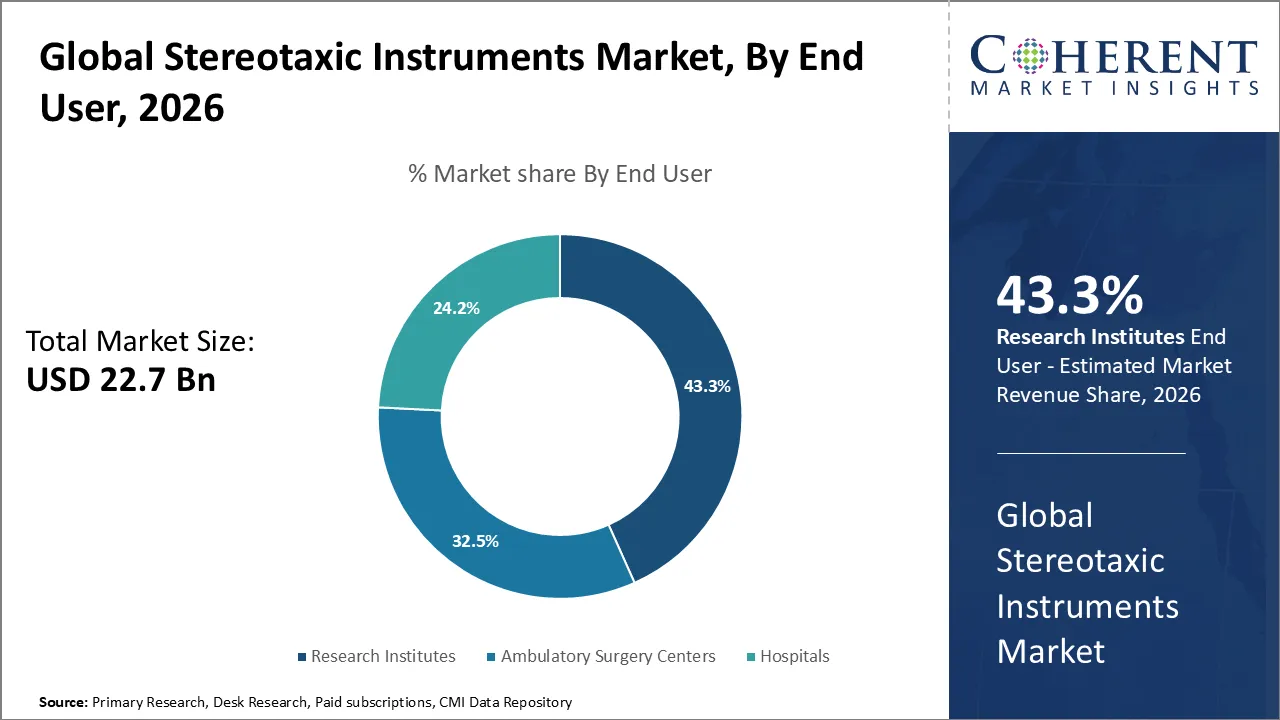
Research Institutes expected to hold largest market share of 43.3% in 2026. Research institutes strengthen the Stereotaxic Instruments Market by expanding neuroscience, neurobiology, and preclinical research programs. Researchers use stereotaxic systems for precise brain surgeries, targeted drug delivery, electrode implantation, and neural tissue investigations in animal models. Increasing research into neurological disorders such as Alzheimer’s and Parkinson’s disease further drives demand for these instruments. Government funding, expanding academic laboratories, and collaborations between universities and pharmaceutical companies support market development. In June 2026, the Allen Institute and its partners launched the Brain Health Accelerator, a global research initiative focused on identifying brain cells and neural circuits affected by neurodegenerative and other brain disorders to support the development of new treatments.
Stereotaxic Instruments Market Trends
- Rising adoption of advanced neuroscience research increases demand for stereotaxic instruments, enabling researchers to perform precise brain surgeries, targeted drug delivery, electrode implantation, and neural tissue investigations. The NIH BRAIN Initiative received a total FY2026 appropriation of USD 429 million, comprising USD 234 million in base funding and USD 195 million from the 21st Century Cures Act. This continued federal investment supports neuroscience research and neurotechnology development, providing a funding base for laboratories using precision research equipment.
- Expansion of pharmaceutical and biotechnology R&D in CNS research supports continued use of animal models for selected stages of drug discovery, gene therapy, and neuroscience research. However, this trend is being accompanied by an important regulatory shift: in April 2026, the FDA reported progress toward reducing animal testing and expanding new approach methodologies (NAMs), including in-vitro, computational, and human-derived approaches.
- Regulatory movement toward alternatives to animal testing represents a potential constraint on demand for stereotaxic instruments in applications that can be replaced by non-animal methods. In March 2026, the FDA issued draft guidance on validating NAMs for use in drug development, and in April 2026 reported that it had qualified its first AI-based drug-development tool and established a pathway for innovative methods. This does not eliminate animal research, but it may shift some preclinical spending toward alternative platforms.
Regional Insights
North America dominates owing to increasing focus on precision and reproducibility
North America is expected to acquire the dominant share of 46.80% in 2026. North American research institutions drive the Stereotaxic Instruments Market by expanding neuroscience, biomedical, and preclinical research. Universities, laboratories, and pharmaceutical companies use stereotaxic systems for neurological disease studies, drug development, brain surgeries, and neural implantation procedures. Government agencies provide research funding that supports equipment purchases and laboratory development. Researchers also adopt advanced stereotaxic technologies, including automated positioning and imaging-integrated systems, to improve targeting accuracy, experimental reproducibility, and research efficiency. Strong pharmaceutical and biotechnology R&D further sustains regional demand.
Asia Pacific Stereotaxic Instruments Market Trends
The Asia Pacific stereotaxic instruments market gains momentum from expanding neuroscience research, greater investments in preclinical studies, and improving healthcare infrastructure across China, Japan, India, and South Korea. Researchers increasingly investigate neurological disorders to advance brain disease treatments and drug development. Manufacturers also introduce digital positioning, automation, and MRI-compatible systems to enhance precision and efficiency. In March 2026, researchers at the Rohini Nilekani Centre for Brain and Mind (CBM), a collaboration between NIMHANS and NCBS-TIFR, developed CALM-Brain, India’s first digital repository containing structural and functional brain data from individuals with various psychiatric disorders.
United States Stereotaxic Instruments Market Trends
The United States stereotaxic instruments market gains momentum from strong investments in neuroscience and biomedical research. Government agencies fund universities, research centers, and biotechnology firms, strengthening research capabilities. As neurological disorders become more common, researchers and healthcare professionals increasingly rely on precise tools for brain studies and interventions. In the United States, approximately 54% of the population, or 180.3 million people, is affected by at least one neurological disease or disorder. Healthcare facilities are also adopting minimally invasive neurosurgery, robotic-assisted systems, advanced imaging technologies, and AI-driven solutions. In addition, advanced healthcare infrastructure, robust R&D activities, and the growing focus on precision medicine continue to increase demand for sophisticated stereotaxic instruments.
Japan Stereotaxic Instruments Market Trends
Japan’s stereotaxic instruments market continues to grow as neuroscience research, biomedical R&D, and efforts to address neurological disorders expand. The country’s aging population drives researchers and healthcare providers to develop solutions for conditions such as dementia and Parkinson’s disease. According to the National Institutes of Health (NIH), Parkinson’s disease affects an estimated 100–180 people per 100,000 population in Japan. Universities, research organizations, and medical facilities increasingly use precise stereotaxic instruments for brain mapping, neurosurgical procedures, and preclinical research. Japan’s expertise in robotics, medical imaging, automation, and precision engineering further supports companies and institutions in developing and adopting advanced stereotaxic systems.
Who are the Major Companies in Stereotaxic Instruments Industry
Some of the major key players in Stereotaxic Instruments are Elekta AB, Stoelting Co., Braintree Scientific Inc., David Kopf Instruments, Neuronetics, and Leica Bio systems.
Key News
- In May 2026, ZETA SURGICAL announced that the U.S. Food and Drug Administration (FDA) cleared its Zeta Navigation System, along with the navigated Zeta Stylet and Zeta Bolt instruments, through the 510(k) pathway. The FDA classifies these devices as Class II stereotaxic instruments under 21 CFR 882.4560 and assigns them product code HAW (K253663).
Stereotaxic Instruments Market Report Coverage
Report Coverage | Details | ||
Base Year: | 2025 | Market Size in 2026: | USD 22.7 Bn |
Historical Data for: | 2020 to 2024 | Forecast Period: | 2026 to 2033 |
Forecast Period 2026 to 2033 CAGR: | 6.3% | 2033 Value Projection: | USD 31.3 Bn |
Geographies covered: |
| ||
Segments covered: |
| ||
Companies covered: | Elekta AB, Stoelting Co., Braintree Scientific Inc., David Kopf Instruments, Neuronetics, and Leica Bio systems. | ||
Analyst Opinion
- Stereotaxic instruments are moving from basic positioning equipment toward precision platforms for increasingly sophisticated neuroscience workflows. The United States remains particularly important because the NIH awarded USD 35.3 billion in competing and noncompeting extramural grants in FY 2025, creating a substantial funding base for biomedical research and advanced laboratory instrumentation. This funding environment directly supports demand for high-precision stereotaxic systems used in animal models, neural recording, drug delivery, and experimental brain interventions.
- The strongest demand driver is the expansion of complex preclinical neuroscience rather than routine laboratory use. Modern stereotaxic procedures increasingly combine precise brain targeting with viral delivery, optogenetics, chemogenetics, electrophysiology, and microinjection. Published protocols specifically identify stereotaxic frames, microinjectors, microdrills, fiber-optic systems, and EEG recording equipment as core components of these workflows.
- Animal neuroscience continues to create a technically demanding use case for stereotaxic equipment. Research protocols demonstrate successful stereotaxic procedures across multiple mouse strains, while survival can reach around 90% under optimized surgical and anesthesia conditions in specific experimental settings. More recently, NIH researchers published a dedicated stereotaxic protocol for P11–P12 infant mice, highlighting the need for accurate targeting across developmental stages. These applications strengthen demand for instruments offering reproducible positioning, finer control, and compatibility with specialized accessories.
Speak to the analyst
Want personalized insights?
Take the findings above to one of our principal consultants, or have the report rebuilt around the segments, geographies and competitors you actually track.
Market Segmentation
- By Application (Revenue, USD Bn, 2021-2033)
- Rats
- Mice
- Humans
- By End User (Revenue, USD Bn, 2021-2033)
- Hospitals
- Ambulatory Surgery Centers
- Research Institutes
- By Region (Revenue, USD Bn, 2021-2033)
- North America
- U.S.
- Canada
- Latin America
- Brazil
- Mexico
- Argentina
- Rest of Latin America
- Europe
- Germany
- U.K.
- France
- Italy
- Spain
- Russia
- Rest of Europe
- Asia Pacific
- China
- India
- Japan
- Australia
- South Korea
- ASEAN
- Rest of Asia Pacific
- Middle East
- GCC
- Israel
- Rest of Middle East
- Africa
- South Africa
- Central Africa
- North Africa
- North America
Sources
Primary Research interviews
- Neuroscience researchers and principal investigators
- Preclinical research scientists
- Neurosurgeons and neurologists
- Laboratory animal research specialists
- Biomedical engineering professionals
- Pharmaceutical and biotechnology R&D professionals
- Laboratory equipment procurement managers
- Academic research laboratory directors
- Stereotaxic instrumentation and neuroscience technology specialists
Databases
- PubMed / MEDLINE
- NIH Library databases
- Web of Science
- Scopus
- ClinicalTrials.gov
- National Library of Medicine databases
- NIH RePORTER
- MeSH Database
- U.S. Census Bureau databases
- World Bank Open Data
Magazines
- Nature
- Scientific American
- Neuroscience News
- Lab Manager
- Laboratory Equipment
- Science Magazine
Journals
- Journal of Neuroscience Methods
- Journal of Neuroscience
- eNeuro
- Nature Neuroscience
- Neuroscience
- Brain Research
- Neurobiology of Disease
- Experimental Neurology
- Journal of Neurophysiology
- Frontiers in Neuroscience
Newspapers
- The New York Times
- The Washington Post
- The Wall Street Journal
- Financial Times
- The Guardian
- Nikkei Asia
Associations
- Society for Neuroscience (SfN)
- American Association for the Advancement of Science (AAAS)
- Federation of European Neuroscience Societies (FENS)
- American Neurological Association (ANA)
- Society for Brain Mapping and Therapeutics (SBMT)
- International Brain Research Organization (IBRO)
- American Association for Laboratory Animal Science (AALAS)
Public Domain sources
- National Institutes of Health (NIH)
- National Institute of Neurological Disorders and Stroke (NINDS)
- NIH BRAIN Initiative
- U.S. Food and Drug Administration (FDA)
- U.S. Department of Agriculture (USDA)
- National Library of Medicine (NLM)
- National Center for Biotechnology Information (NCBI)
- Centers for Disease Control and Prevention (CDC)
- National Science Foundation (NSF)
- U.S. Government Accountability Office (GAO)
- European Medicines Agency (EMA)
- World Health Organization (WHO)
- OECD
- Government statistical agencies of China, Japan, India, South Korea, Canada, and European countries
Proprietary Elements
- CMI Data Analytics Tool
- Proprietary CMI Existing Repository of information for last 10 years
Get access to 250+ pages report
Every segment, forecast, competitor profile and data table behind the analysis above — available for instant download.
- ESOMAR Member
- ISO 9001:2015 Certified
- D-U-N-S Registered
- GDPR & CCPA Compliant
Missing comfort of reading report in your local language? Find your preferred language:
Transform your Strategy with Exclusive Trending Reports
Frequently Asked Questions
The market is primarily driven by expanding neuroscience research, rising demand for precise brain-targeting procedures, and growing investments in biomedical and pharmaceutical R&D.
Rats represent the leading application segment, supported by their extensive use in neuroscience, behavioral research, pharmacology, and preclinical drug development.
Research institutes account for the largest end-user segment because they conduct extensive neuroscience, neurobiology, and preclinical research.
Technological advancement is shifting stereotaxic instruments from conventional mechanical positioning systems toward integrated precision platforms.
Research into Alzheimer’s disease, Parkinson’s disease, epilepsy, stroke, and other neurological conditions requires reliable animal models and precise experimental interventions.