

Dental Simulator Market Size and Trends – (2026-2033)
The Global Dental Simulator Market is estimated to be valued at USD 518.5 Mn in 2026 and is expected to reach USD 1004.0 Mn by 2033, exhibiting a compound annual growth rate (CAGR) of 9.9% from 2026 to 2033.
Key Takeaways of the Dental Simulator Market
- The hardware segment is expected to contribute the highest share of the market with 53.6% in 2026, driven by haptic, mannequin, and VR systems.
- The virtual reality simulators segment is expected to contribute the highest share with 53.6% in 2026, driven by immersive 3D and haptic training.
- The dental training & education segment is expected to contribute the largest share with 36.6% in 2026, driven by competency-based learning.
- In dental school and clinics segment is projected to account for the largest share of the market in 2026, owing to rising enrollments.
- North America is projected to top the market with 36.7% share, followed by Asia Pacific with 29.6% share in 2026
Market Overview
Factors such as increasing demand for dental education, rising government funding and investments for dental education, growing need to ensure competent dental care, and improving patient acceptance of dental care are expected to drive the market growth between 2026 and 2033. Adoption of virtual training and assessment methods have improved the effectiveness and quality of dental education and training programs globally.
Current Events and Its Impacts on the Dental Simulator Market
Current Event | Description and its Impact |
Artificial Intelligence and VR/AR Technology Advancement |
|
Regulatory and Accreditation Standards Evolution |
|
What are the novel technologies and innovations in dental simulator?
AI‑Powered Diagnostics & Feedback
- Error detection accuracy: AI models can achieve >90% sensitivity in identifying margin overcuts or perforations.
- Adaptive learning curves: Algorithms adjust difficulty based on Bayesian probability of competency, reducing training time by ~25%.
- Predictive analytics: Early session telemetry predicts OSCE pass/fail with ROC AUC >0.80.
Mixed Reality Simulators (VR/AR + Haptics)
- Immersion metrics: Eye‑tracking shows >70% fixation alignment with expert gaze patterns after 5 sessions.
- Force fidelity: Haptic devices calibrated to ±0.2 N of real tissue resistance.
- Transfer validation: Controlled trials show 30–40% reduction in clinical error rates compared to manikin‑only training.
3D Printing Integration
- Patient‑specific cases: CT‑based models allow simulation of rare anatomical variations; error rates tracked across cohorts.
- Material science metrics: Printed resin hardness within 5% of dentin modulus, enabling realistic tactile feedback.
- Hybrid datasets: Combine printed models with VR overlays for multimodal error tracking.
Motion Tracking & Biometrics
- Hand tremor frequency: Novices average 6–8 Hz vs experts at 3–4 Hz; simulator tracks reduction over time.
- Torque variability index: >15% variance indicates poor control; training reduces variance to <7%.
- Stress‑performance coupling: Heart rate variability correlates with error frequency (r ≈ 0.45), useful for resilience training.
Hybrid Simulators
- Dual‑mode assessment: Compare phantom head performance with VR overlay metrics; correlation coefficients >0.70 validate transferability.
- Error taxonomy expansion: Hybrid systems detect both tactile (force errors) and visual (margin misalignment) mistakes simultaneously.
- Competency detection: CUSUM analysis shows competency achieved 2–3 sessions earlier than with single‑mode simulators.
Cloud‑Based Data Dashboards
- Cohort benchmarking: Faculty can view percentile ranks, error heatmaps, and learning‑curve slopes across 100+ students.
- Retention analytics: Dashboards track skill decay over 1–3 months; ~20% error increase without reinforcement.
- Predictive remediation: Machine learning flags bottom 15% performers early, reducing failure rates by ~30%.
- Current Industry Events of 2026
- Market Size Estimation
- Regional Breakdown
- Competitive Landscape
- Customer Intelligence
- Segmental Analysis
- Pricing Analysis
- Key Market Drivers, Challenges & Future Trends
- Customized Insights Section
Segmental Insights
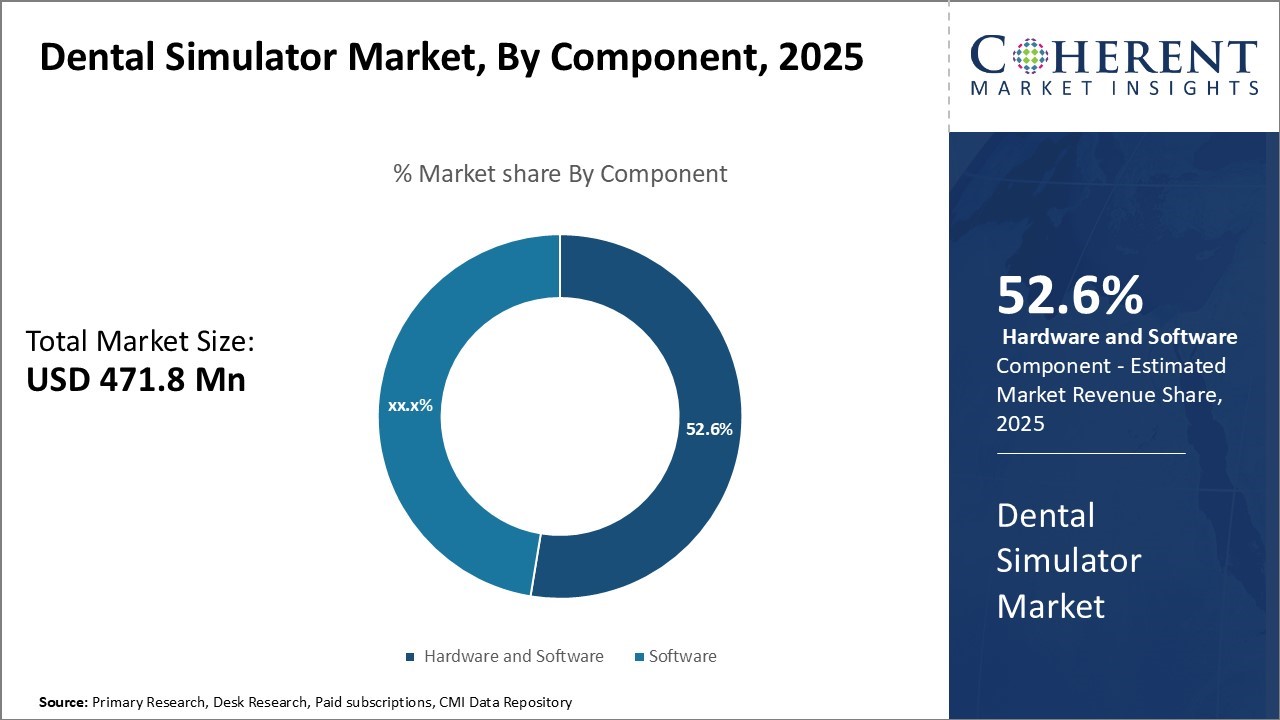
Dental Simulator Market Insights, By Component - Hardware Dominates Due to its Central Role in Simulation
In terms of component, the hardware segment is expected to contribute the highest share of the market with 53.6% in 2026 owing to its crucial role in dental simulation. Hardware forms the core technological infrastructure that enables realistic simulation of various dental procedures and techniques. Advanced hardware, such as haptic devices, mannequins, and virtual reality headsets, are necessary to provide trainees with realistic tactile feedback and an immersive simulation experience.
For instance, in July 2026, Kitware released a virtual reality dental training simulator that uses immersive headsets and haptic devices to get future dentists prepared. The system improves dental education by giving students realistic, hands-on experiences without putting patients at risk. This hardware-based innovation aims to improve skill development and close the gap between what students learn in the classroom and the tasks they do in the clinic.
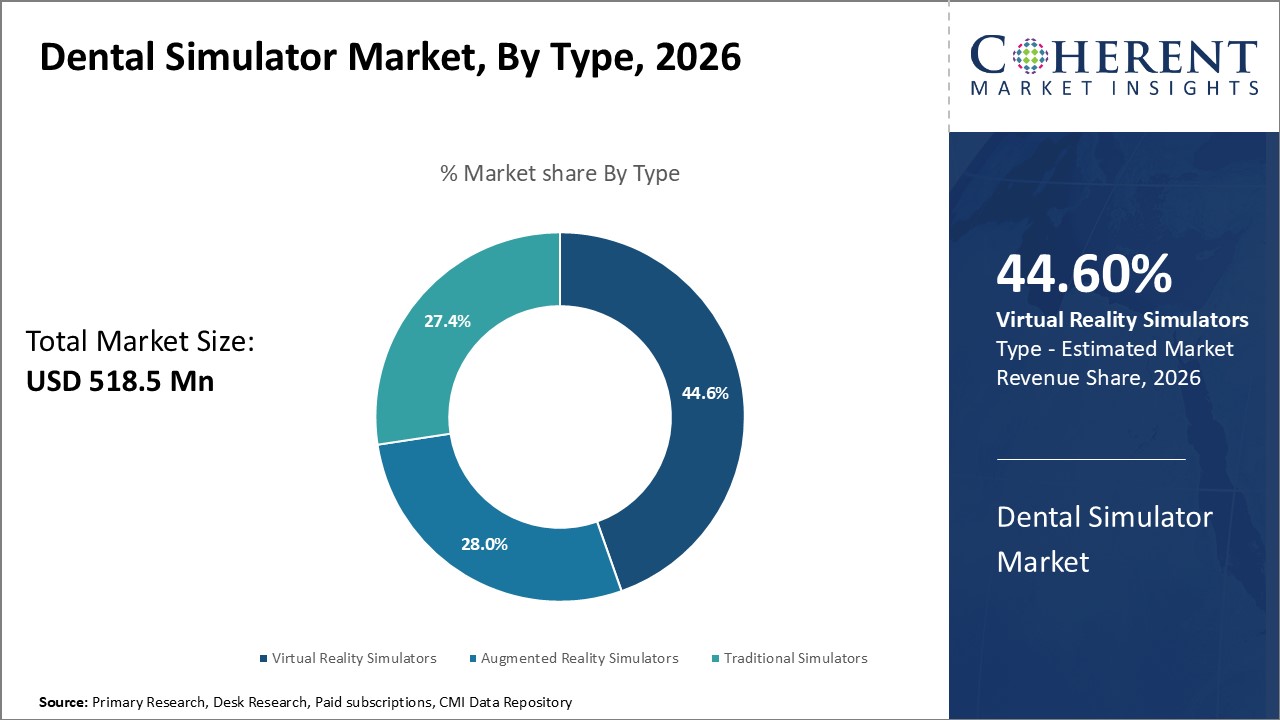
Dental Simulator Market Insights, By Type - Virtual Reality Simulators Lead Through Immersion
In terms of type, the virtual reality simulators segment is expected to contribute the highest share with 44.6% in 2026 due to their highly immersive nature. virtual reality allows dental trainees to be completely immersed in a virtual world that closely mimics the real operating environment. With the use of VR headsets and haptic controllers, users can view realistic 3D models of dental anatomy and treatment areas from any angle, while receiving tactile feedback of different tools and procedures. This offers a highly engaging and immersive simulation experience that boosts learning outcomes.
For instance, in May 2025, Ponce Health Sciences University opened its first dental clinic and invested $300,000 on Simodont Virtual Reality technology. The advanced simulator gives students realistic tactile feedback and immersive training, which makes them more ready for clinical work. This milestone puts PHSU at the forefront of new ideas in dental education by linking classroom learning with real-life patient care.
Dental Simulator Market Insights, By Application - Dental Training & Education Dominates Application Space
In terms of application, the dental training & education segment is expected to contribute the largest share with 36.62% in 2026 owing to global emphasis on competency-based learning. Dental educators rely heavily on simulation-based training to enhance psychomotor skills, critical thinking, and clinical competencies before students treat real patients. Simulation mitigates risk of errors on vulnerable patients by facilitating repetitive practice. It also enables learning complex procedures that are difficult to demonstrate physically to a large student group.
For instance, in September 2025, to improve student training, Rochester Community and Technical College has opened a new dental simulation lab. The facility has advanced simulators that mimic real clinical settings, so students in dental hygiene and assisting can safely practice before working with patients. This investment makes hands-on learning stronger and gets graduates ready for their careers.
Is rising enrollment in dental schools and clinics increasing demand for dental simulator market?
in terms of end user, the dental schools and clinics segment is expected to lead the market with largest share in 2025. Their leadership stems from rising student enrollment, growing demand for simulation-based training, and integration of advanced digital tools in curricula. Hospitals follow with steady growth, while research institutions and others contribute smaller, niche shares overall.
For instance, in September 2025, a dental school launched India’s first Dental Technology Innovation Hub. While not directly about dental stimulators, it strengthens dental schools and clinics by fostering innovation, supporting 16 projects, reducing import dependence, and enhancing education and patient care through advanced digital technologies and clinical integration.
Regional Insights
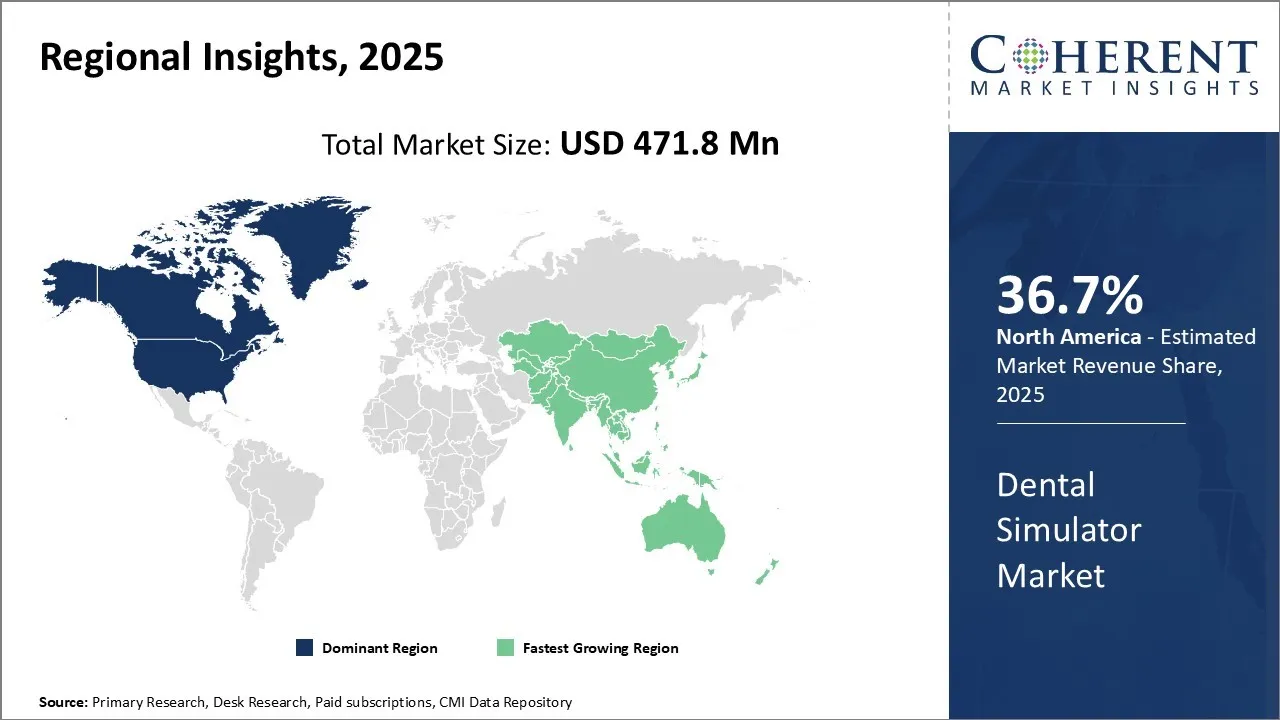
North America Dental Simulator Market Trends
North America leads the dental simulator industry with a share of 36.7% in 2026 due to its advanced healthcare infrastructure and high adoption of innovative technologies. Dentists and patients in the region are quick to embrace cutting-edge simulation tools for training and diagnosis, ensuring precision and improved patient outcomes. The presence of leading global players such as Dentsply Sirona and KaVo Kerr further reinforces the market's dominance.
For instance, in July 2026, RipeGlobal has released an AI-powered dental training platform that changes the way people learn with cloud-based simulation tools. The system lets doctors all over the world take part in immersive, scalable training. The platform uses artificial intelligence to make learning more personal, improve clinical decision-making, and make advanced dental education more available around the world, beyond what traditional hardware-based simulators can do.
Asia Pacific Dental Simulator Market Trends
Asia Pacific is witnessing the fastest growth in the dental simulator industry with share of 29.6% in 2026, driven by improved healthcare access and the rising prominence of medical tourism in countries like India, China, and Thailand. The region's developing economies are heavily investing in healthcare infrastructure to meet increasing demand for advanced dental treatments. Government initiatives promoting healthcare reforms, coupled with an expanding middle-class population seeking quality care, fuel market expansion.
For instance, in September 2026, JPS Dental introduced personalized layout planning for advanced dental simulation systems, making training spaces better for schools and clinics. The program adds cutting-edge simulators to custom lab designs, which makes things run more smoothly and improves the student experience. This change makes the infrastructure for dental education stronger by making sure that technology and facility planning work together to improve professional readiness and outcomes.
Dental Simulator Market Outlook for Key Countries
U.S. Dental Simulator Market Trends
The U.S. dominated the dental simulator industry in 2024, driven by advanced clinics and facilities equipped with cutting-edge technology that enables dental students and professionals to hone their skills in a controlled environment. These facilities utilize simulators such as manikins and virtual reality systems to mimic real-life dental procedures. Notably, in August 2024, the Case Western Reserve University School of Dental Medicine invested USD 2.6 million to upgrade its simulation clinic, enhancing dental education with state-of-the-art technology and realistic clinical environments.
U.K. Dental Simulator Market Trends
The U.K. dental simulator industry is set for significant growth, driven by a focus on hands-on training in dental education. In September 2023, the CGDent-GC Award was launched to enhance Foundation Dentists' skills in aesthetic dentistry. This initiative, a collaboration between the College of General Dentistry (CGDent) and dental manufacturer, GC, aims to provide advanced training in response to rising demand for aesthetic dental procedures.
Germany Dental Simulator Market Trends
Germany held a significant share of the dental simulator industry in 2024, driven by influential events like the International Dental Show (IDS). The 40th edition of IDS, held in March 2023 in Cologne, Germany, showcased innovations and facilitated networking across the dental industry. Recognized as one of the world’s largest trade fairs for dental professionals, the biennial event attracts a diverse audience, including practitioners, manufacturers, suppliers, and other key stakeholders, fostering growth and adoption of advanced dental simulators in the region.
India Dental Simulator Market Trends
The India dental simulator market is growing as institutions adopt advanced technologies like virtual reality and haptics for improved training. For instance, in September 2026, Union Minister Jitendra Singh opened a Dental Technology Innovation Hub to help Atmanirbhar Bharat move forward in healthcare. The hub's main goal is to improve research and skill development by developing advanced dental simulators and training systems in the country. The goal of this project is to modernize the infrastructure for dental education and make India more independent on foreign medical technology.
Market Players, Key Development, and Competitive Intelligence
Key Developments
- In December 2025, Guyana has opened high-tech digital and dental simulation labs to improve education and health care. The facilities have advanced simulators and modern technology that make training for dental students and professionals more realistic. This program helps people improve their skills, connects what they learn in the classroom with what they do in the clinic, and is an important move forward for Guyana's healthcare system.
- In January 2024, PreVu Software, a dental technology solutions company, integrated SmileAI, a proprietary artificial intelligence technology, into its smile simulation software, accelerating simulation generation to just 60 seconds. This innovation enhances patient education and engagement by providing personalized, realistic smile outcomes based on advanced facial and dental analysis.
- In October 2023, Dentsply Sirona, a dental equipment and supplies manufacturing company, introduced the SureSmile Simulator, an AI-powered application within DS Core, designed to enhance patient understanding of SureSmile Aligner Treatment. This tool provides a 3D visualization of potential post-treatment smiles, offering automated modeling and tooth segmentation in under five minutes. By showcasing esthetic outcomes and treatment complexity, it fosters informed and confident decisions.
- In July 2023, the University of Portsmouth launched UNI-SIM, an advanced training simulator incorporating haptic and virtual reality technology for medical education. This innovative platform enhances the learning experience for aspiring doctors by offering realistic simulations of real-life medical scenarios. The inclusion of haptic feedback enables users to interact with the simulator in a manner that closely replicates physical experiences, making it a highly effective training tool.
Market Report Scope
Dental Simulator Market Report Coverage
| Report Coverage | Details | ||
|---|---|---|---|
| Base Year: | 2025 | Market Size in 2026: | USD 518.5 Mn |
| Historical Data for: | 2020 To 2024 | Forecast Period: | 2026 To 2033 |
| Forecast Period 2026 to 2033 CAGR: | 9.9% | 2033 Value Projection: | USD 1004.0 Mn |
| Geographies covered: |
| ||
| Segments covered: |
| ||
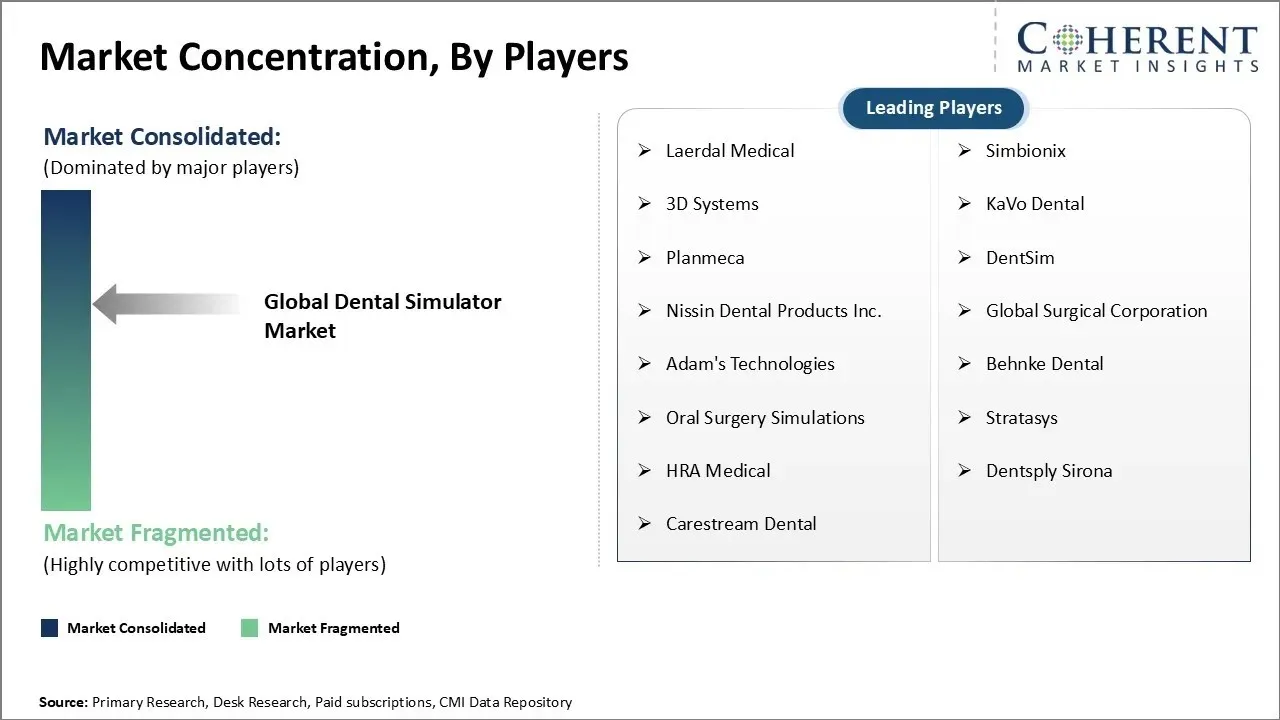
| Companies covered: | Laerdal Medical, Simbionix, 3D Systems, KaVo Dental, Planmeca, DentSim, Nissin Dental Products Inc., Global Surgical Corporation, Adam's Technologies, Behnke Dental, Oral Surgery Simulations, Stratasys, HRA Medical, Dentsply Sirona, and Carestream Dental | ||
| Growth Drivers: |
| ||
| Restraints & Challenges: |
| ||
Market Dynamics
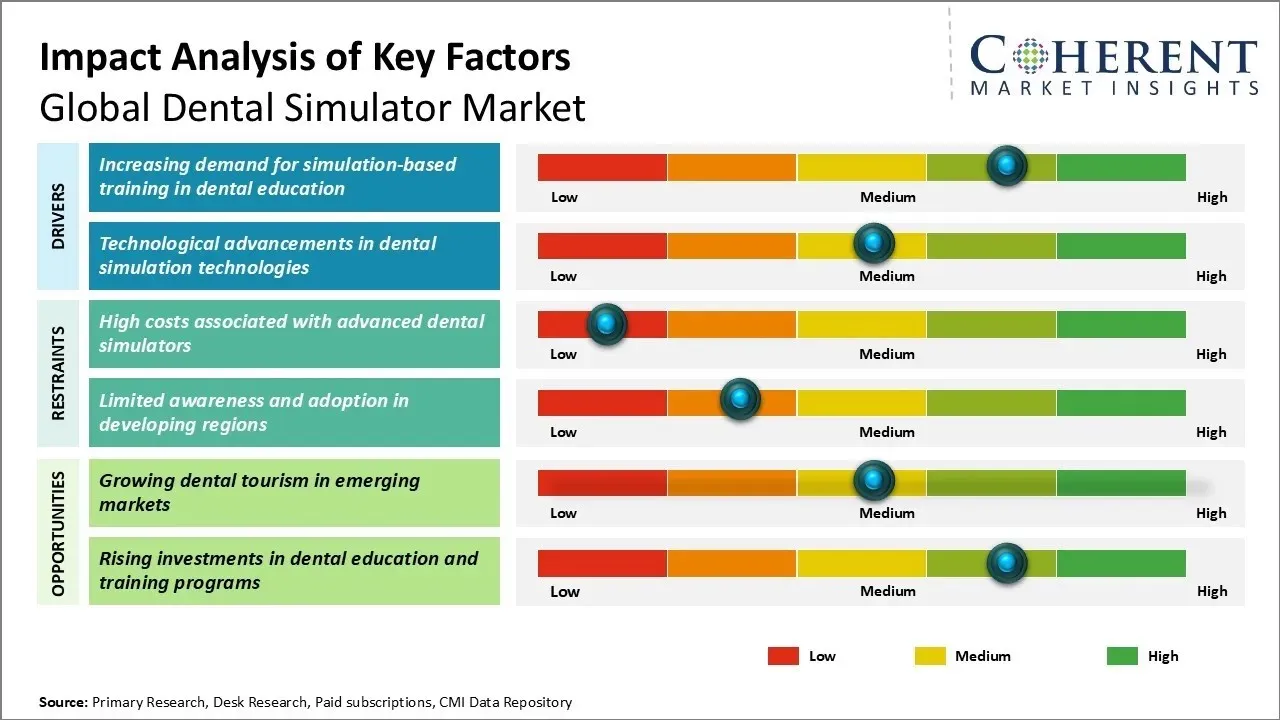
Global Dental Simulator Market Driver
Increasing demand for simulation-based training in dental education
One of the key drivers propelling the global dental simulator industry is the increasing emphasis on simulation-based training in dental education across various countries. The traditional method of training dental students involves learning procedures on real patients, which poses risks of error and harming the patient. With advancements in technology, dental simulators are able to provide realistic training experiences to students without putting any patients at risk. Dental educators have recognized the immense benefits simulation offers over traditional training methods.
Global Dental Simulator Market Opportunity
Growing dental tourism in emerging markets
One of the major opportunities for players in the global dental simulator market is the growing dental tourism industry in emerging markets. Ever-increasing medical tourism in countries such as India, Thailand, Mexico, and Hungary is positively impacting the demand for advanced dental education and practical training institutes in these markets. To cater to the foreign patients arriving for dental treatments, these countries are focusing on developing world-class dental education and certification programs that can train local dentists and technicians to international standards.
Analyst Opinion (Expert Opinion)
- The global dental simulator industry is expected to witness steady growth over the forecast period driven by the increasing demand for dental education and training. Dental simulators offer a realistic practice environment for dental students and professionals to learn and enhance their skills without risking patient safety. With rising awareness about the benefits of dental simulation training, the adoption of these systems is likely to increase significantly. North America currently dominates the market owing to extensive investments by dental schools and availability of advanced technology. Asia Pacific is expected to emerge as the fastest growing regional market supported by rising dental tourism and growing emphasis on dental healthcare.
- However, high costs associated with dental simulators could hamper market growth to some extent. Additionally, lack of training programs and instructors in developing nations poses a major challenge. Nevertheless, ongoing technological advancements leading to more realistic simulations and portability of systems will create lucrative opportunities for market players. Companies operating in this space should focus on new product launches, partnerships with dental schools, and establishing local presence in emerging countries to benefit from future opportunities. Considering the critical role of hands-on training, the demand for dental simulators is expected to steadily rise in the future.
Speak to the analyst
Want personalized insights?
Take the findings above to one of our principal consultants, or have the report rebuilt around the segments, geographies and competitors you actually track.
Market Segmentation
- Component Insights (Revenue, USD Mn, 2026 - 2033)
- Hardware
- Software
- Type Insights (Revenue, USD Mn, 2026 - 2033)
- Virtual Reality Simulators
- Augmented Reality Simulators
- Traditional Simulators
- Application Insights (Revenue, USD Mn, 2026 - 2033)
- Dental Training & Education
- Treatment Planning
- Patient Simulation
- End User Insights (Revenue, USD Mn, 2026 - 2033)
- Dental Schools/Clinics
- Hospitals
- Research Institutions
- Others
- Regional Insights (Revenue, USD Mn, 2026 - 2033)
- North America
- U.S.
- Canada
- Latin America
- Brazil
- Argentina
- Mexico
- Rest of Latin America
- Europe
- Germany
- U.K.
- Spain
- France
- Italy
- Russia
- Rest of Europe
- Asia Pacific
- China
- India
- Japan
- Australia
- South Korea
- ASEAN
- Rest of Asia Pacific
- Middle East
- GCC Countries
- Israel
- Rest of Middle East
- Africa
- South Africa
- North Africa
- Central Africa
- North America
- Key Players Insights (Revenue, USD Mn, 2021 - 2033)
- Laerdal Medical
- Simbionix
- 3D Systems
- KaVo Dental
- Planmeca
- DentSim
- Nissin Dental Products Inc.
- Global Surgical Corporation
- Adam's Technologies
- Behnke Dental
- Oral Surgery Simulations
- Stratasys
- HRA Medical
- Dentsply Sirona
- Carestream Dental
Sources
Primary Research Interviews
- Dental Simulator Manufacturers
- Dental Education & Training Equipment Providers
- Haptic Technology Developers for Dental Applications
- Dental School Deans & Clinical Training Coordinators
- Prosthodontists, Endodontists, and Oral Surgeons
- Digital Dentistry & CAD/CAM Solution Providers
- Dental Simulation Software Developers
- Others
Databases
- Bloomberg Terminal
- Thomson Reuters Eikon
- IHS Markit
- Euromonitor International
- S&P Global Market Intelligence
- Factiva
- Others
Magazines
- Dental Products Report
- Dentistry Today
- Inside Dental Technology
- Compendium of Continuing Education in Dentistry
- Medical Device Network
- Others
Journals
- Journal of Dental Education
- Journal of Dentistry
- International Journal of Computerized Dentistry
- European Journal of Dental Education
- Journal of Prosthetic Dentistry
- Others
Newspapers
- Financial Times
- The Wall Street Journal
- Reuters
- Bloomberg News
- Healthcare Business Today
- Others
Associations
- American Dental Education Association (ADEA)
- World Dental Federation (FDI)
- American Dental Association (ADA)
- European Dental Education Association (EDEA)
- International Association for Dental Research (IADR)
- Others
Public Domain Sources
- World Health Organization (WHO) – Oral Health Programme
- U.S. Food and Drug Administration (FDA) – Medical Devices
- National Institutes of Health (NIH) – Dental & Craniofacial Research
- European Commission – Medical Devices & MDR Resources
- World Bank Open Data
- Others
Proprietary Elements
- CMI Data Analytics Tool
- Proprietary CMI Existing Repository of Information for the Last 8 Years
Get access to 250+ pages report
Every segment, forecast, competitor profile and data table behind the analysis above — available for instant download.
- ESOMAR Member
- ISO 9001:2015 Certified
- D-U-N-S Registered
- GDPR & CCPA Compliant
Missing comfort of reading report in your local language? Find your preferred language:
Transform your Strategy with Exclusive Trending Reports
Frequently Asked Questions
The Dental Simulator Market is estimated to be valued at USD 518.5 Mn in 2026, and is expected to reach USD 1004.0. Mn by 2033.
The CAGR of the Dental Simulator Market is projected to be 9.9% from 2026 to 2033.
Increasing demand for simulation-based training in dental education and technological advancements in dental simulation technologies are the major factors driving the growth of the global dental simulator market.
High costs associated with advanced dental simulators and limited awareness and adoption in developing regions are the major factors hampering the growth of the global dental simulator market.
In terms of component, hardware is estimated to dominate the market revenue share in 2026.
Laerdal Medical, Simbionix, 3D Systems, KaVo Dental, Planmeca, DentSim, Nissin Dental Products Inc., Global Surgical Corporation, Adam's Technologies, Behnke Dental, Oral Surgery Simulations, Stratasys, HRA Medical, Dentsply Sirona, and Carestream Dental are the major players.
North America is expected to lead the global dental simulator market in 2026.