

Global Sustainable Finance Market Size and Forecast – 2026 To 2033
The global sustainable finance market is expected to grow from USD 8.95 Tn in 2026 to USD 22.80 Tn by 2033, registering a compound annual growth rate (CAGR) of 12% from 2026 to 2033. The global sustainable finance market is driven by the growing issuance of green bonds and sustainability linked loans. On September 19, 2025, the World Bank Group, through its private sector arm, the International Finance Corporation, closed its inaugural securitization transaction, successfully launching a new model to attract institutional private capital into emerging markets. This transaction marks the first tangible step in a larger effort to build an originate-to-distribute model for emerging market investments.
Key Takeaways of the Global Sustainable Finance Market
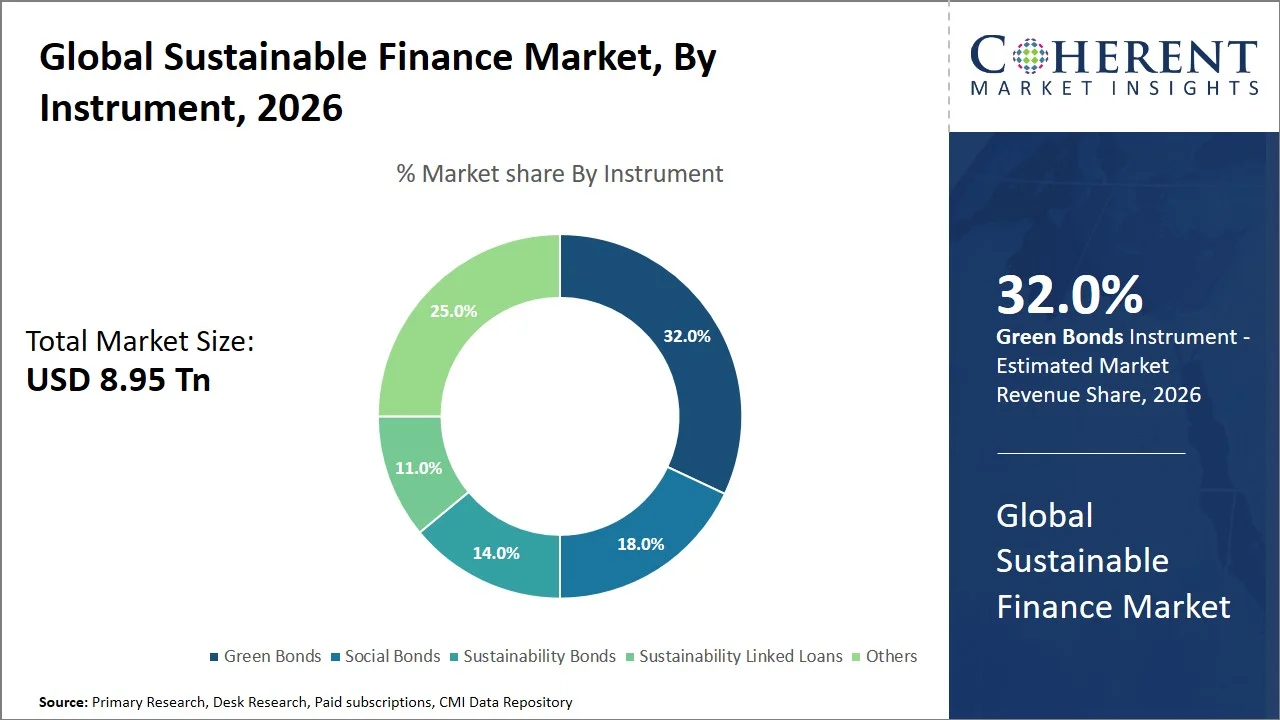
- The green bonds segment is expected to account for 32.0 % of the global sustainable finance market share in 2026. Rising corporate commitments toward net zero emissions is driving the growth of the segment. On September 23, 2025, Schneider Electric issued its revised Net Zero Roadmap, with more aggressive Scope 3 decarbonization milestones and a broader scope of collaboration with suppliers via its Zero Carbon Project.
- The ESG integration segment is estimated to capture 34.0 % of the market share in 2026. Increasing demand for transparent ESG reporting and climate risk disclosure is majorly driving the growth of the segment. On June 15, 2026, Workiva announced the launch of Workiva Sustainability Disclosure Agent, a new technology designed to assist organizations identify and fix sustainability reporting gaps and meet multiple disclosure requirements.
- The renewable energy segment is estimated to capture 26.0 % of the market share in 2026. Expansion of sustainable infrastructure and renewable energy financing is driving the growth of the segment. On January 28, 2025, Enfinity Global secured connectivity for 2 GW of utility-scale solar PV and wind projects in the states of Rajasthan, Uttar Pradesh, Maharashtra, and Karnataka in India.
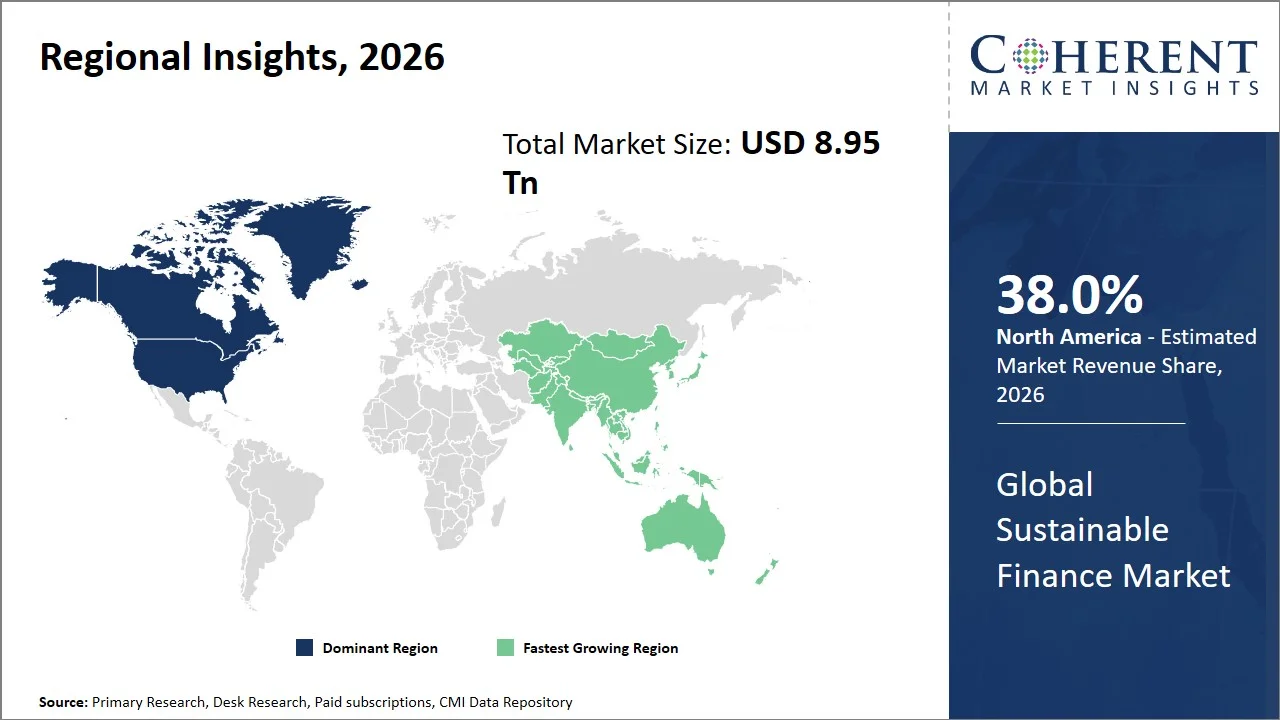
- North America is expected to dominate the sustainable finance market in 2026 with a market share of 38.0 %. Increasing integration of AI and big data in ESG risk assessment in North America is driving the growth of the regional market. On September 30, 2024, SAP enhanced SAP Sustainability Control Tower and SAP Green Ledger with AI-driven ESG analytics, climate risk modeling, and automated CSRD and ISSB reporting capabilities.
- Asia Pacific is expected to account for 29.0 % of the market share in 2026 and is projected to record the fastest growth over the forecast period. Rising investments in biodiversity and nature-based finance across Asia Pacific is driving the growth of the regional market. On October 11, 2024, Temasek-backed LeapFrog Investments announced new climate and nature-positive investment pledges throughout South and Southeast Asia.
- Rapid Expansion of Transition Finance for Hard-to-Abate Industries: Transition bonds and sustainability-linked financing structures are increasingly supporting decarbonization service projects in sectors such as steel, cement, chemicals, aviation and shipping, enabling emissions reduction while also strengthening the competitiveness of these industries.
- Growing Adoption of AI and Digital ESG Analytics Platforms: Asset managers and banks are harnessing the power of artificial intelligence, machine learning, and alternative data platforms to automate ESG scoring, climate risk modeling, portfolio monitoring and regulatory reporting to enhance investment decisions and simplify regulatory compliance.
Segmental Insights
Why Does the Green Bonds Segment Dominate the Global Sustainable Finance Market?
The green bonds segment is expected to account for 32.0% of the global sustainable finance market share in 2026. Green bonds are the most important segment of the global sustainable finance market because they offer a standardized and transparent mechanism (to finance environmentally friendly projects) that meets the investment requirements of institutional investors. Investor confidence has been boosted by their internationally recognized frameworks, transparent use-of-proceeds requirements and strong regulatory support, allowing governments, development banks, corporations and financial institutions to raise substantial capital for renewable energy, clean transportation, green buildings and climate resilience projects more efficiently and credibly. On March 4, 2026, Bank of Baroda announced the issuance of green bonds in the Indian domestic market, the proceeds of which would be utilized for financing of projects in the renewable energy, clean transportation, energy efficiency and sustainable water infrastructure space, thereby strengthening the bank’s sustainable finance strategy.
- Current Industry Events of 2026
- Market Size Estimation
- Regional Breakdown
- Competitive Landscape
- Customer Intelligence
- Segmental Analysis
- Pricing Analysis
- Key Market Drivers, Challenges & Future Trends
- Customized Insights Section
Why is ESG Integration the Most Preferred Investment Strategy?
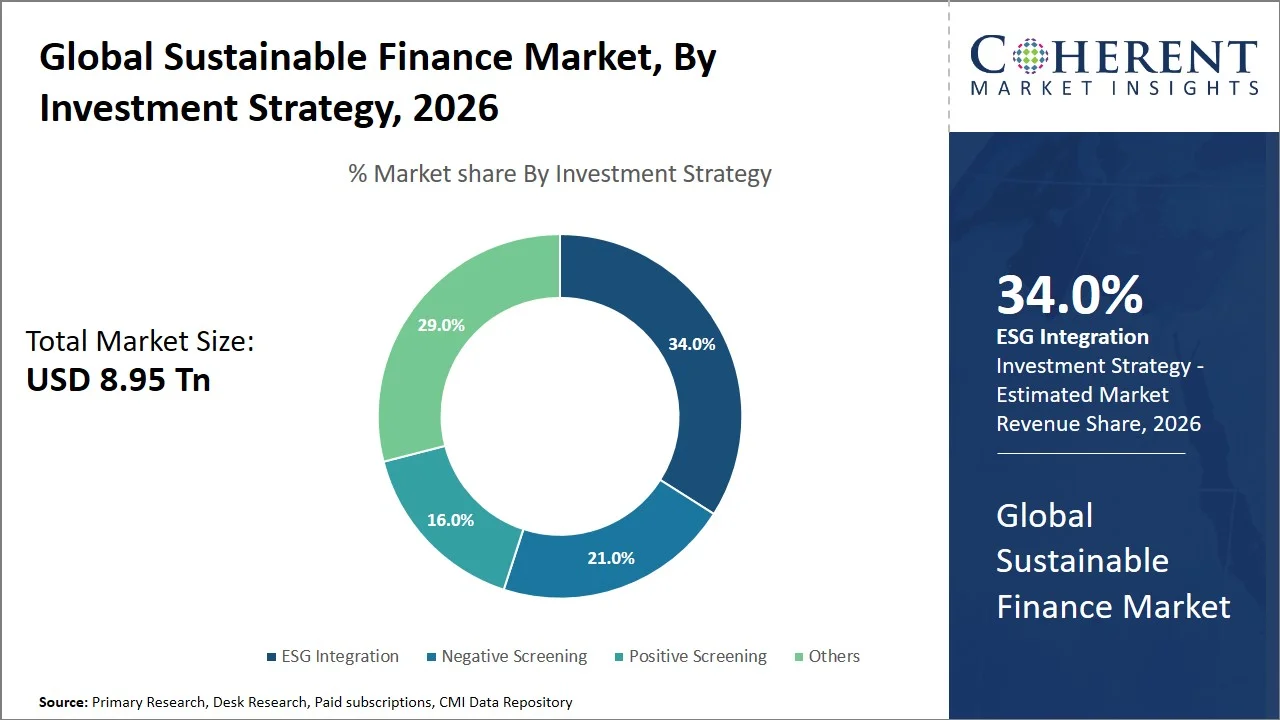
The ESG integration segment is expected to account for 34.0% of the global sustainable finance market share in 2026. ESG integration is the most popular investing technique as it allows investors to integrate environmental, social and governance aspects directly into traditional financial analysis, leading in more thorough risk assessment and better long-term investment decisions. Through a combination of financial metrics and the assessment of climate risks, governance quality, regulatory exposure, supply chain resilience and social performance, investors can improve the resilience of their portfolios, identify opportunities for sustainable growth and improve long-term risk-adjusted returns, without restricting their investment choices to specific sectors or asset classes. On July 17, 2025, BlackRock integrated ESG research firm RepRisk’s data on corporate reputational risks into its Aladdin portfolio management software for banks, asset managers and financial institutions. RepRisk’s integration will give BlackRock’s Aladdin clients access to its dataset of more than 400,000 companies covering more than 100 risk factors.
Renewable Energy Dominates the Global Sustainable Finance Market
The renewable energy segment is expected to account for 26.0% of the global sustainable finance market share in 2026. Renewable energy attracts the largest share of sustainable finance because it offers a substantial pipeline of capital-intensive projects that align directly with global decarbonization goals and climate policies. Large-scale investments in solar farms, wind power, hydropower, energy storage and grid modernization require long-term financing, which makes them suitable for green bonds, sustainability-linked loans and climate funds, while also providing measurable environmental benefits and stable long-term returns for investors. On January 8, 2026, Standard Chartered, a leading international cross-border bank connecting the world’s most dynamic markets issued its inaugural green bond. This is Standard Chartered’s fifth Sustainable Finance issuance, but its first in Green-only format, underscoring the bank’s commitment to be a repeat issuer of sustainable debt.
Current Events and their Impact
Current Events | Description and its Impact |
European Union - Corporate Sustainability Reporting Directive (CSRD) |
|
European Union – EU Green Bond Regulation (Regulation (EU) 2023/2631) |
|
Global Sustainable Finance Market Dynamics
Market Drivers
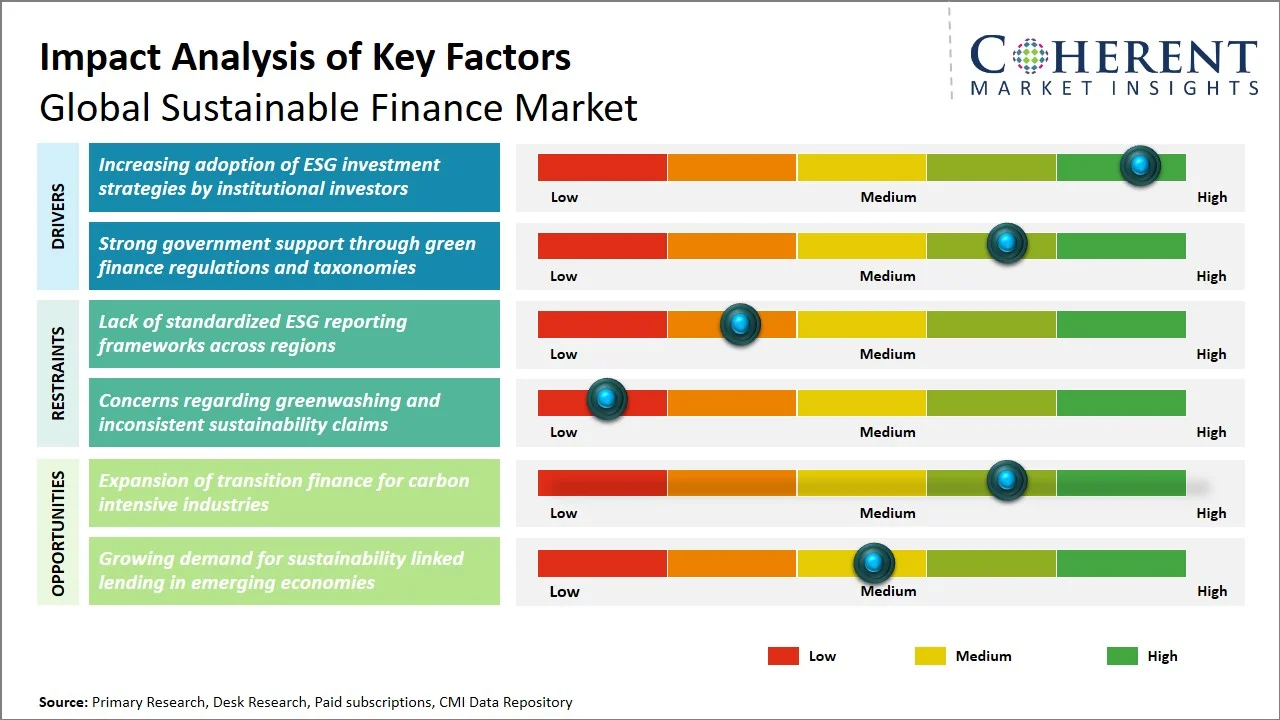
- Increasing adoption of ESG investment strategies by institutional investors: Institutional investors are progressively integrating environmental, social and governance factors into portfolio construction to enhance long-term risk-adjusted returns while mitigating climate, governance and social risks. Pension funds, sovereign wealth funds, insurance companies and asset managers are increasingly incorporating environmental, social and governance (ESG) metrics into their investment analysis, portfolio monitoring and stewardship activities in response to regulatory requirements, stakeholder expectations and the need to build resilience against environmental and economic changes. This is driving the incorporation of ESG concerns as a significant growth lever in the worldwide market for sustainable financing. On October 29, 2025, Amundi announced the launch of two new ETFs, expanding its ESG low tracking error range, the Amundi MSCI USA Screened UCITS ETF and Amundi MSCI World Screened UCITS ETF. These two funds of Amundi ETF ICAV complement the recently launched Amundi MSCI Europe Screened UCITS ETF.
- Strong government support through green finance regulations and taxonomies: Major economies are at the forefront of sustainable finance with the development of green finance regulations, sustainable investment taxonomies, mandatory climate disclosures and incentives, improving transparency and directing capital to environmentally sustainable projects. Regulatory frameworks such as the EU Taxonomy, the Corporate Sustainability Reporting Directive, the UK Sustainability Disclosure Requirements and other initiatives in Asia Pacific have helped to increase investor confidence, reduce the risk of greenwashing and encourage financial institutions to issue more green bonds, sustainable loans and ESG dedicated investment funds. On December 2, 2025, Legal & General Investment Management (LGIM) has updated its sustainable fund classification framework to meet the U.K.’s Sustainability Disclosure Requirements (SDR) and investment label regime, offering greater clarity for institutional and retail investors and reducing the risk of greenwashing.
Emerging Trends
- Rising Integration of Nature Finance and Biodiversity Investments: With more global disclosure frameworks covering nature-related financial risks as well as climate risks, investors are channeling more capital into biodiversity conservation, natural capital restoration, sustainable forestry, regenerative agriculture, and ecosystem protection.
- Increasing Development of Tokenized Green Assets and Digital Sustainable Finance: Blockchain is enabling the tokenization of green bonds, carbon credits, renewable energy certificates and sustainable investment products. This increases transparency, the traceability of environmental effect and the accessibility of sustainable finance for institutional and ordinary investors.
Regional Insights
Why is North America a Strong Market for Sustainable Finance?
North America is expected to account for a market share of 38.0% in 2026. North America continues to be the largest geographical market for sustainable finance, supported by substantial institutional capital markets and fast-growing ESG-focused investment products. The U.S. and Canada together account for the majority of regional sustainable assets under management and financial institutions including BlackRock, JPMorgan Chase, Goldman Sachs, Morgan Stanley, Bank of America and Brookfield Asset Management continue to develop green bonds, sustainability-linked loans and transition finance portfolios.
The Inflation Reduction Act has spurred funding for utility-scale solar, offshore wind, hydrogen, battery manufacturing and carbon capture projects and, as a result, more sustainable financial instruments are being issued. Canada has advanced sustainable finance through its Sustainable Finance Action Council, climate disclosure roadmap requirement and significant investments in clean electricity, critical minerals and sustainable infrastructure, while pension funds like CPP Investments and CDPQ continue to deploy capital into renewable energy and climate-focused assets across global markets.
Why Does the Asia Pacific Sustainable Finance Market Exhibit High Growth?
Asia Pacific is projected to account for 29.0% of the global sustainable finance market in 2026 and is expected to register the fastest growth. Asia Pacific is the fastest expanding sustainable finance market, fueled by national net-zero promises, green taxonomy and big scale investments in renewable energy and low carbon infrastructure. Green bond issuance, sustainable loans and transition finance initiatives have grown significantly in China, Japan, Singapore, South Korea, Australia and India, with Singapore positioning itself as a regional sustainable finance hub through the Monetary Authority of Singapore Green Finance Action Plan and environmental risk management framework. Japan has ramped up transition finance for steel, shipping and power generation as part of its Green Transformation strategy, and Australia has introduced mandatory climate-related financial disclosures for large entities from 2025. Regional multilateral institutions including the Asian Development Bank continue mobilizing sustainable capital for clean energy, resilient infrastructure, and climate adaptation projects throughout developing Asian economies.
Global Sustainable Finance Market Outlook for Key Countries
Why is the U.S. Emerging as a Major Hub in the Sustainable Finance Market?
The U.S. is the world’s largest market for sustainable financing, due to its highly established capital markets, large base of institutional investors and the strong presence of global asset managers and investment banks. Long-term tax advantages are spurring massive green project financing development, with the Inflation Reduction Act driving financing for clean hydrogen, battery manufacturing, carbon capture, electric vehicles and renewable power generation. BlackRock, JPMorgan Chase, Goldman Sachs, Morgan Stanley, Bank of America, Citigroup and State Street Global Advisors have increased their ESG investment product, climate transition finance and sustainable bond underwriting. California, New York and Massachusetts remain among the top municipal green bond issuers supporting public transit, water infrastructure, energy-efficient buildings and climate resilience projects, while the Securities and Exchange Commission has strengthened climate-related disclosure requirements for public companies.
Is China the Next Growth Engine for the Sustainable Finance Market?
China is one of the world’s biggest sustainable finance markets, with strong government backing for green lending, green bonds and low-carbon industry development. The People’s Bank of China and the National Financial Regulatory Administration are still pushing green finance for renewable energy, electric vehicles, ultra-high-voltage transmission networks, green manufacturing and ecological restoration projects. The Industrial and Commercial Bank of China, China Construction Bank, Agricultural Bank of China and Bank of China remain among the world’s largest sources of green financing. China has also established the world’s largest national emissions trading system to include the power sector and is continuing to ramp up finance for offshore wind, solar manufacturing, battery production, hydrogen projects and sustainable urban infrastructure under its carbon neutrality policy.
Germany Sustainable Finance Market Analysis and Trends
Germany is a major sustainable finance market in Europe due to robust regulatory implementation, institutional investment, and industry decarbonization financing. KfW remains one of the world’s major issuers of green bonds and finances a wide range of projects in renewable energy, energy-efficient housing, hydrogen infrastructure and sustainable mobility. Deutsche Bank, Commerzbank, Allianz Global Investors and DWS have expanded their ESG investment offerings and sustainability-linked financing in corporate and infrastructure areas. Germany has ramped up funding for offshore wind farms in the North Sea, industrial hydrogen hubs and electric vehicle production and building renovation plans. The launch of the EU Taxonomy and Corporate Sustainability Reporting Directive has significantly enhanced transparency and capital allocation for sustainable investments.
France Sustainable Finance Market Analysis and Trends
France is a world leader in sustainable finance, with sophisticated ESG laws, sovereign green bond issuance and responsible investment practices. It was one of the first countries to issue sovereign green bonds and continues to support clean transport, biodiversity conservation, renewable energy and climate adaption initiatives through green finance instruments. BNP Paribas, Crédit Agricole, Société Générale, Amundi and Natixis are recognized internationally for sustainable financing, ESG asset management and green bond underwriting. Paris continues to be a key European center for sustainable finance, with a broad array of sustainable investment and climate finance initiatives. France also mandates institutional investors to disclose climate and biodiversity-related risks under Article 29 of its Energy and Climate Law.
U.K. Sustainable Finance Market Analysis and Trends
The U.K. has been a global leader in sustainable finance with its extensive sustainability disclosure requirements, green sovereign bonds and climate-focused financial regulation. The Financial Conduct Authority has launched Sustainability Disclosure Requirements and investment labelling to improve transparency and reduce greenwashing in investment products. London remains a world leader in green bond listings, sustainable debt issuance and ESG investment management, with the support of institutions including HSBC, Barclays, Standard Chartered, Legal & General Investment Management, Schroders and Aviva Investors. The UK Infrastructure Bank continues to provide financing for clean energy, low carbon transport, local authority climate projects and nature based solutions, while the Transition Plan Taskforce framework has improved corporate climate transition planning and sustainable capital allocation across financial markets.
Global Sustainable Finance Market - Renewable Energy Financing By Technology (2025)
Renewable Energy Technology | Estimated Share of Global Renewable Energy Financing | Primary Financing Instruments |
Solar PV | 39.2% | Green bonds, Project finance, Sustainability-linked loans |
Onshore & Offshore Wind | 28.7% | Green bonds, Infrastructure funds, Syndicated loans |
Energy Storage (BESS) | 11.6% | Private equity, Green loans, Climate funds |
Hydropower | 8.5% | Multilateral finance, Sovereign green bonds, Project finance |
Green Hydrogen | 6.8% | Transition finance, Project finance, Public-private partnerships |
Bioenergy & Biomass | 3.1% | Green loans, Infrastructure finance |
Geothermal Energy | 2.1% | Development finance, Project finance |
How is the Expansion of Transition Finance For Carbon Intensive Industries Creating New Growth Opportunities in the Sustainable Finance Market?
Steel makers are leveraging sustainability-linked loans to transition from blast furnaces to direct reduction iron and electric arc furnace technologies, while cement businesses are raising transition finance for carbon capture, utilization and storage plants and low-clinker cement manufacturing. Shipping businesses are raising sustainability-linked funding to deploy boats powered by ammonia and methanol, while airlines are accessing transition capital to increase the production of sustainable aviation fuel and improve fleet efficiency.
Meanwhile, mining industries are using transition finance to electrify heavy equipment and cut methane emissions while chemical businesses are investing in low-carbon hydrogen and circular feedstock technology. These projects help to expand the addressable sustainable finance universe by allowing banks, insurers, asset managers and private credit funds to lend against measurable emissions reductions in sectors that account for a large share of global industrial carbon emissions, creating new opportunities beyond traditional renewable energy investments.
On October 2, 2025, Mitsubishi UFJ Financial Group Co Ltd broadened its transition finance framework to incorporate more financing for Japanese steel, shipping, chemicals and power companies taking measures to decarbonize, including through hydrogen, ammonia and carbon capture technologies, in accordance with Japan’s Green Transformation strategy.
Market Players, Key Development, and Competitive Landscape
Key Developments
- On September 29, 2025, HSBC Asset Management launched a Trade and Working Capital Solutions strategy in collaboration with HSBC’s Global Trade Solutions business, to provide investors with access to the growing opportunities in global trade finance.
- On July 1, 2025, BNP Paribas finalized the acquisition of AXA Investment Managers and signed a long-term partnership with the AXA Group to manage a large part of its assets. This operation will enable the BNP Paribas Group to create a leading European asset management platform with over USD 1.5 trillion in assets under management entrusted by its clients.
Competitive Landscape
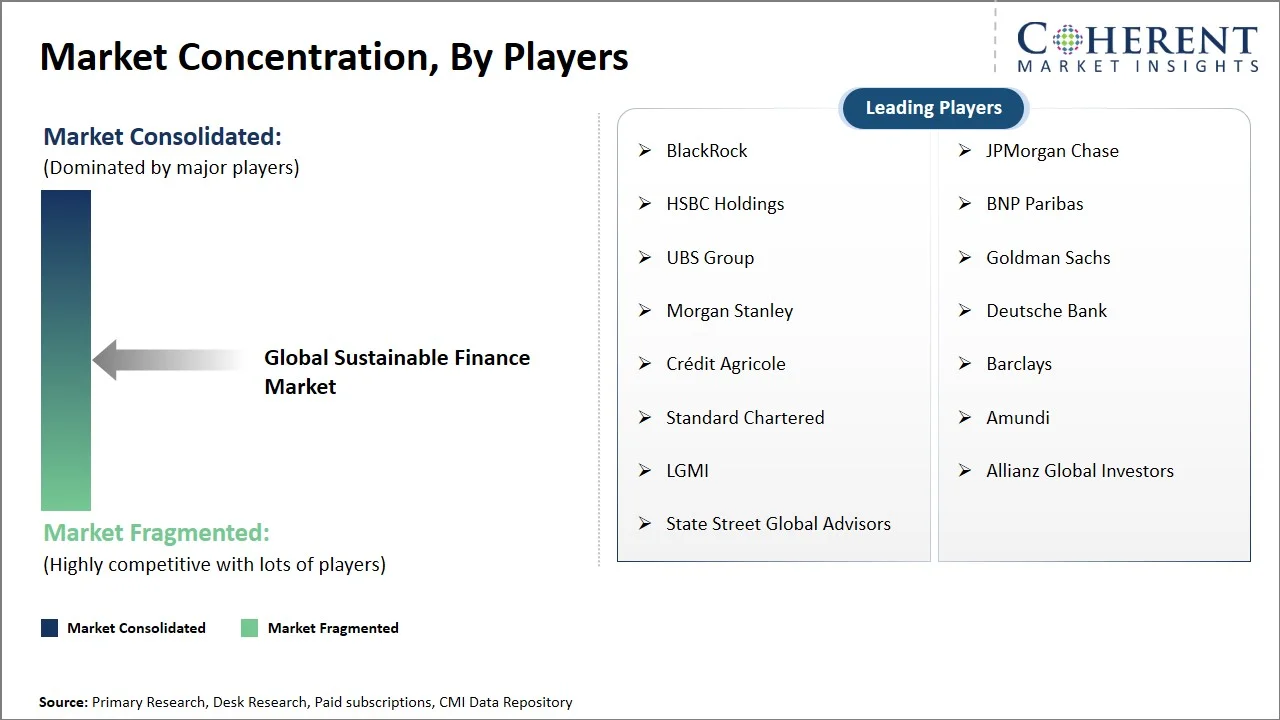
The global sustainable finance market is led by BlackRock, JPMorgan Chase, HSBC, BNP Paribas, UBS, Amundi, Goldman Sachs, Morgan Stanley, and Crédit Agricole, all of which are expanding beyond traditional ESG funds into transition finance, sustainable infrastructure, and climate technology investments. BlackRock has teamed up with Global Infrastructure Partners to speed up investment in renewable energy, power grids and digital infrastructure, while JPMorgan Chase continues to increase its Sustainable Development Target financing in clean energy, sustainable transport and industrial decarbonization.
BNP Paribas has targeted transition finance in hard-to-abate sectors including steel, cement and aviation, while HSBC has grown its sustainability-linked and transition finance in Asia. Amundi is further integrating biodiversity and climate risk analytics into portfolio construction and UBS has broadened private banking products around sustainable and impact investing. Competition is increasingly centered on proprietary ESG data platforms, AI-driven climate risk analytics, transition finance advisory services, green bond underwriting capabilities, and financing for emerging sectors such as hydrogen, carbon capture, battery supply chains, and nature-based solutions.
Market Report Scope
Sustainable Finance Market Report Coverage
| Report Coverage | Details | ||
|---|---|---|---|
| Base Year: | 2025 | Market Size in 2026: | USD 8.95 Tn |
| Historical Data for: | 2020 To 2024 | Forecast Period: | 2026 To 2033 |
| Forecast Period 2026 to 2033 CAGR: | 12% | 2033 Value Projection: | USD 22.80 Tn |
| Geographies covered: |
| ||
| Segments covered: |
| ||
| Companies covered: | BlackRock, JPMorgan Chase, HSBC Holdings, BNP Paribas, UBS Group, Goldman Sachs, Morgan Stanley, Deutsche Bank, Crédit Agricole, Barclays, Standard Chartered, Amundi, LGMI, Allianz Global Investors, and State Street Global Advisors | ||
| Growth Drivers: |
| ||
| Restraints & Challenges: |
| ||
Analyst Opinion (Expert Opinion)
- The future of the industry is expected to be shaped by the rapid expansion of transition finance rather than conventional green financing alone. Capital allocation is likely to shift toward financing industrial decarbonization projects, including low-carbon steel, sustainable aviation fuel, carbon capture, clean hydrogen, and grid modernization, supported by increasingly stringent disclosure regulations and standardized transition finance frameworks.
- The highest growth opportunity is expected in transition finance for heavy industries within China, the U.S., and Germany, where large manufacturing bases and ambitious decarbonization targets are creating sustained demand for sustainability-linked loans, transition bonds, and blended finance structures. Long-term investment potential are expected to be more robust from investment in industrial hydrogen projects, battery manufacturing plants, carbon capture infrastructure and upgrades to transmission networks than from existing renewable energy assets alone.
- Market participants need to differentiate themselves by constructing their own climate risk and transition assessment models beyond third-party ESG ratings. Institutions that can combine AI-driven sustainability analytics with sector-specific transition financing expertise, proven impact reporting and advisory capabilities for complex industries such as steel, shipping, chemicals and aviation, are likely to win more robust client relationships and higher-value financing mandates in the years ahead.
Speak to the analyst
Want personalized insights?
Take the findings above to one of our principal consultants, or have the report rebuilt around the segments, geographies and competitors you actually track.
Market Segmentation
- Instrument Insights (Revenue, USD Trillion, 2021 - 2033)
- Green Bonds
- Social Bonds
- Sustainability Bonds
- Sustainability Linked Loans
- Others
- Investment Strategy Insights (Revenue, USD Trillion, 2021 - 2033)
- ESG Integration
- Negative Screening
- Positive Screening
- Others
- Application Insights (Revenue, USD Trillion, 2021 - 2033)
- Renewable Energy
- Green Buildings
- Sustainable Transportation
- Water and Waste Management
- Clean Technology
- Healthcare and Social Infrastructure
- Climate Adaptation Projects
- End User Insights (Revenue, USD Trillion, 2021 - 2033)
- Banks
- Asset Managers
- Insurance Companies
- Pension Funds
- Sovereign Wealth Funds
- Corporates
- Government Institutions
- Retail Investors
- Regional Insights (Revenue, USD Trillion, 2021 - 2033)
- North America
- U.S.
- Canada
- Latin America
- Brazil
- Argentina
- Mexico
- Rest of Latin America
- Europe
- Germany
- U.K.
- Spain
- France
- Italy
- Russia
- Rest of Europe
- Asia Pacific
- China
- India
- Japan
- Australia
- South Korea
- ASEAN
- Rest of Asia Pacific
- Middle East
- GCC Countries
- Israel
- Rest of Middle East
- Africa
- South Africa
- North Africa
- Central Africa
- North America
- Key Players Insights
- BlackRock
- JPMorgan Chase
- HSBC Holdings
- BNP Paribas
- UBS Group
- Goldman Sachs
- Morgan Stanley
- Deutsche Bank
- Crédit Agricole
- Barclays
- Standard Chartered
- Amundi
- LGMI
- Allianz Global Investors
- State Street Global Advisors
Sources
Primary Research Interviews
- Sustainable Finance Professionals & ESG Analysts
- Investment Bankers & Green Bond Issuers
- Financial Regulatory & Compliance Officers
- Corporate Sustainability & CSR Heads
Magazines
- Environmental Finance Magazine
- Global Finance Magazine
- Responsible Investor Magazine
- ESG Investor Magazine
Journals
- Journal of Sustainable Finance & Investment
- Journal of Environmental Economics and Management
- Journal of Banking & Finance
Associations
- Global Sustainable Investment Alliance (GSIA)
- International Capital Market Association (ICMA)
- Principles for Responsible Investment (PRI)
- Climate Bonds Initiative (CBI)
Public Domain Sources
- United Nations Environment Programme Finance Initiative (UNEP FI)
- World Bank – Sustainable Finance Reports
- European Commission – Sustainable Finance Policy Framework
- International Monetary Fund (IMF) – Climate & Sustainability Reports
Proprietary Elements
- CMI Data Analytics Tool
- Proprietary CMI Existing Repository of Information for Last 10 Years
Get access to 250+ pages report
Every segment, forecast, competitor profile and data table behind the analysis above — available for instant download.
- ESOMAR Member
- ISO 9001:2015 Certified
- D-U-N-S Registered
- GDPR & CCPA Compliant
Missing comfort of reading report in your local language? Find your preferred language:
Transform your Strategy with Exclusive Trending Reports
Frequently Asked Questions
The global sustainable finance market is expected to stand at USD 8.95 Tn in 2026 and is expected to reach USD 22.80 Tn by 2033.
The CAGR of the global sustainable finance market is projected to be 12% from 2026 to 2033.
Increasing adoption of ESG investment strategies by institutional investors and strong government support through green finance regulations and taxonomies are the major factors driving the growth of the global sustainable finance market.
Lack of standardized ESG reporting frameworks across regions and concerns regarding greenwashing and inconsistent sustainability claims are the major factors hampering the growth of the global sustainable finance market.
In terms of instrument, the green bonds segment is estimated to dominate the market revenue share in 2026.
They establish common definitions for environmentally sustainable activities, improving investment transparency.
Artificial intelligence enhances ESG data analysis, climate risk modeling, and sustainability reporting.