

Hashgraph Market Size and Forecast — 2026-2033
The Hashgraph Market size is estimated to be valued at USD 1.48 billion in 2026 and is expected to reach USD 6.29 billion by 2033, exhibiting a compound annual growth rate (CAGR) of 23.0% from 2026 to 2033.
Overview
Hashgraph is an advanced type of distributed ledger technology developed by Swirlds, a US-based company. The key features of hashgraph algorithm includes fast, secure and fairness of access. Hashgraph is a data structure and distributed algorithm that reduces the requirement of major computation power and massive energy consumption. Moreover, hashgraph is expected to eliminate Ripple in banking and finance application. It can carry out functions faster than blockchain, and takes only a second for hundreds of thousands of transactions. These factors are expected to provide major growth opportunity to decentralized applications including games, stock market, and auctions.
The main objective of hashgraph is to generate trust among user by providing advanced security solutions for online transactions. The hashgraph algorithm achieves this by virtue of its features such as being fast, fair, providing Asynchronous Byzantine Fault Tolerance (aBFT), efficient, ACID compliant, inexpensive, DoS resistant, time stamped, and optionally non-permissioned. These features are attributed to broader range of applications of hashgraph, which includes distributed capital markets, distributed auctions, cryptocurrency with native micropayments, improved collaboration apps, and distributed gaming.
Key Takeaways
The Public Hashgraph segment dominates market share due to its open access and superior transaction throughput, accounting for 44.7% of the total market revenue and driving industry trends toward decentralized applications.
North America leads regional dominance, contributing over 34% to the market revenue, driven by robust technological ecosystems and regulatory support.
Asia Pacific exhibits the fastest market growth with a CAGR of 26.5%, fueled by burgeoning IoT integration and government-backed digital transformation initiatives, particularly in China and India.
Hashgraph Market – Segmentation Analysis
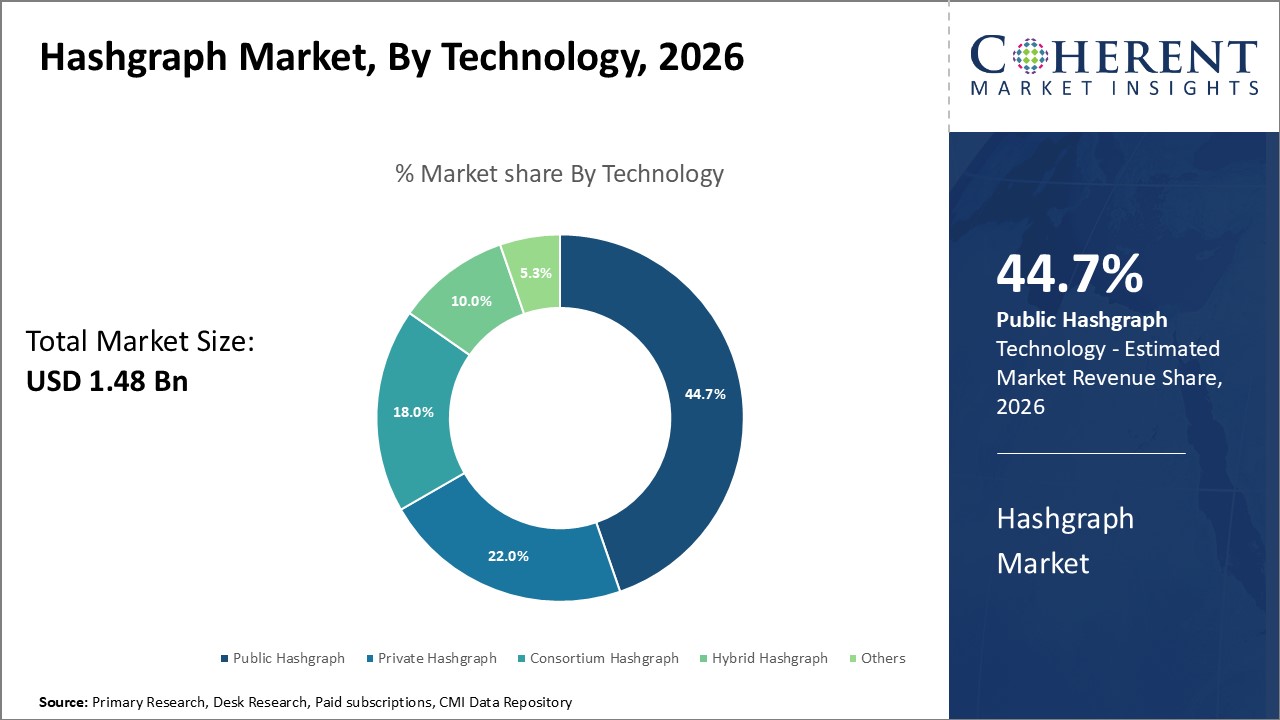
Hashgraph Market Insights, By Technology
In terms of technology, public hashgraph dominates the market share of 44.7% due to its open and decentralized nature, supporting extensive applications in tokenization and DeFi initiatives. Its superior transaction speeds and security protocols make it highly attractive for industries requiring trustless environments. Public hashgraph platforms enable real-time applications such as supply chain tracking, digital identity verification, asset tokenization, and micropayments. The presence of governing councils with major global companies adds credibility and facilitates regulatory acceptance.
Hashgraph Market Insights, By Application
In the application segment, supply chain & logistics leads with a dominant market share of 38%, credited to the technology’s ability to enhance traceability and reduce fraud in complex supply chains. Hashgraph’s low transaction costs and energy efficiency make it an attractive platform for supply chain applications, helping businesses improve resilience by enabling better anticipation, adaptation, and recovery from disruptions.
Hashgraph Market Insights, By Deployment Model
In the deployment model segment, cloud-based deployment dominates with a 52% market share, attributed to its flexibility, scalability, and cost-efficiency, enabling enterprises to deploy hashgraph solutions with minimal infrastructure investments. Cloud deployment enables scalable access to distributed ledger technology without heavy upfront infrastructure investment, making it attractive for enterprises adopting Hashgraph for applications such as finance, supply chain, and IoT.
Hashgraph Market Trends
The hashgraph market is witnessing significant shifts propelled by the mainstreaming of tokenized assets and decentralized finance (DeFi) solutions leveraging Hashgraph technology, facilitating faster transaction settlements and low fees.
In 2025, DeFi projects on hashgraph platforms surged by over 51%, marking a rapid market transformation.
Enterprise-level adoption is also trending toward cloud-based hybrid deployments, catering to evolving data privacy requirements and operational flexibility.
Furthermore, the integration of AI and machine learning with hashgraph networks is enhancing predictive analytics and security frameworks, setting new precedents for market growth and innovation.
These emerging trends underscore the necessity for market analysis to adapt continuously to technological convergences reshaping the industry landscape.
Hashgraph Market Insights, By Geography
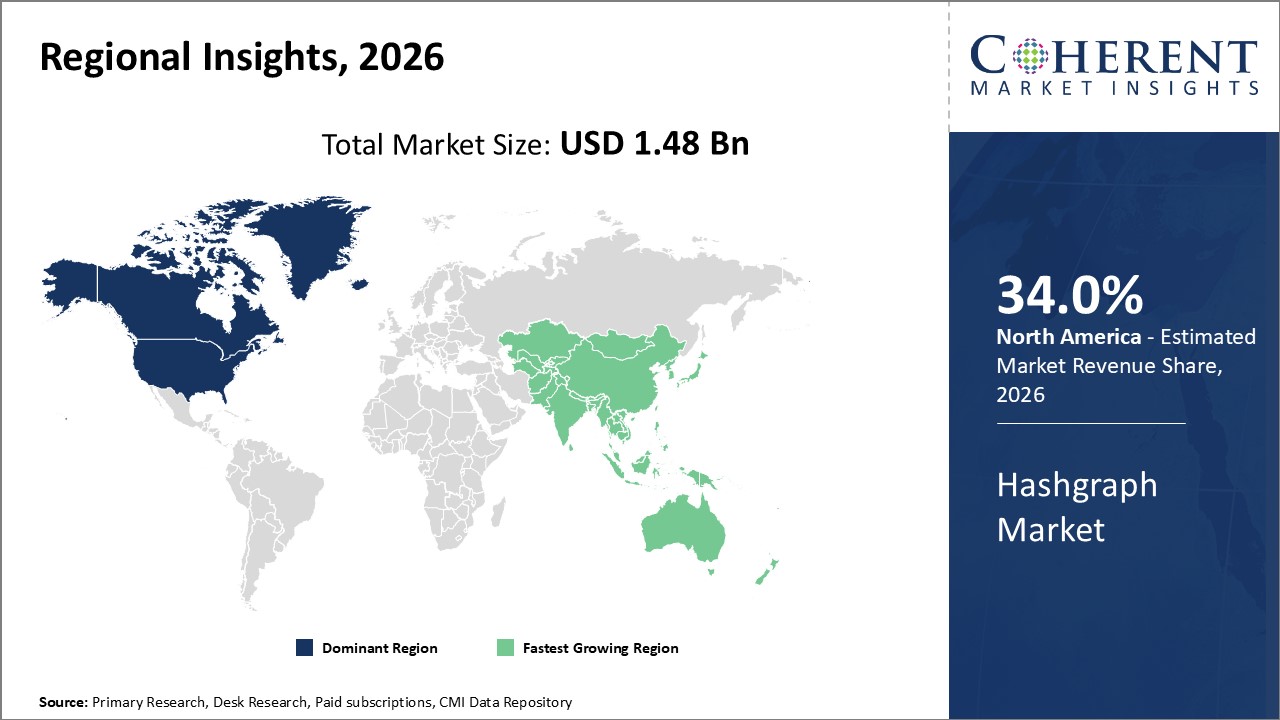
North America Hashgraph Market Analysis and Trends
The market domination of hashgraphs in North America is driven by strong digital infrastructure, strict cybersecurity regulations, and innovation-friendly legislative frameworks. Due primarily to the substantial presence and investments made by industry leaders like IBM and Hedera Hashgraph, the region holds a market share of over 34% of the worldwide hashgraph market. The proactive approach taken by the US government regarding blockchain technology significantly increases market revenue and corporate expansion prospects.
Asia Pacific Hashgraph Market Analysis and Trends
Meanwhile, the Asia Pacific exhibits the fastest growth with a CAGR of 26.5%. This is fueled by large-scale IoT deployments, rising fintech startups, and proactive digital transformation policies in China, India, and Southeast Asian countries. Government-supported projects and collaborations between local tech firms and global market players have expanded hashgraph adoption rapidly in the region.
Hashgraph Market Outlook for Key Countries
United States Hashgraph Market Analysis and Trends
The hashgraph market in the USA is a major global driver, supported by significant investments from leading technology companies and a cutting-edge ecosystem that fosters quick innovation. In 2025, a number of U.S. financial institutions used hashgraph platforms, which improved transaction transparency and cut settlement times by around 30%. Additionally, growing pilot programs in government applications and progressive regulatory settings continue to draw industry participants, growing the market's size and earnings.
China Hashgraph Market Analysis and Trends
As part of its digital economy policy, the Chinese government is focusing on blockchain and distributed ledger technology, which is accelerating the hashgraph market growth. This has prompted large-scale pilot projects in smart city initiatives and supply chain operations. To promote enterprise-grade hashgraph solutions, major regional companies are working with multinational corporations, which has a significant impact on the size of the regional market and company expansion. China also benefits from supportive policies facilitating innovation in fintech and IoT sectors, making it a focal point for emerging trends in the hashgraph market.
Analyst Opinion
High throughput and low latency of hashgraph networks are pivotal supply-side indicators contributing to accelerating market share growth. In 2025, several proof-of-concept deployments showcased transaction speeds exceeding 250,000 transactions per second, significantly outpacing popular blockchain platforms. This technical efficiency has directly expanded market revenue and attracted substantial corporate investments.
On the demand side, rapid adoption across financial services and supply chain management has created robust market growth. For example, in 2026, multiple financial institutions recorded a 31% improvement in transaction settlement times by incorporating hashgraph solutions, emphasizing practical use cases that amplify market size projections.
Nano-scale indicators such as increased developer community activity and open-source contributions surged by approximately 41% in the last year, indicating heightened engagement and innovation potential, which are expected to influence future market dynamics positively.
Pricing models evolving toward subscription-based services and enterprise licensing have facilitated wider hashgraph ecosystem accessibility. Q1 2026 saw a 16% increase in adoption driven by cost-efficiency improvements, underscoring evolving market growth strategies that leverage pricing flexibility.
- Current Industry Events of 2026
- Market Size Estimation
- Regional Breakdown
- Competitive Landscape
- Customer Intelligence
- Segmental Analysis
- Pricing Analysis
- Key Market Drivers, Challenges & Future Trends
- Customized Insights Section
Market Scope
| Report Coverage | Details | ||
|---|---|---|---|
| Base Year: | 2025 | Market Size in 2026: | USD 1.48 billion |
| Historical Data for: | 2020 To 2024 | Forecast Period: | 2026 To 2033 |
| Forecast Period 2026 to 2033 CAGR: | 23.0% | 2033 Value Projection: | USD 6.29 billion |
| Geographies covered: |
| ||
| Segments covered: |
| ||
| Companies covered: | Hedera Hashgraph, Swirlds Inc., Hashgraph Labs, BlockCerts, Chainlink, Digital Asset Holdings, ConsenSys (Hashgraph Unit), IBM Blockchain Division, Infosys, Accenture Distributed Ledger Group | ||
| Growth Drivers: |
| ||
Hashgraph Market Growth factors
Increasing enterprise demand for faster and more secure distributed ledger technologies is the primary factor accelerating business growth.
Advancements in cloud computing infrastructure facilitate scalable hashgraph deployments, allowing market players to reduce operational costs while addressing latency concerns, as seen in Asia Pacific markets leading cloud adoption.
Regulatory clarity and government incentives in blockchain and distributed ledger technologies across North America and Europe have provided a conducive environment for market expansion, stimulating greater innovation and commercial deployment of hashgraph solutions.
Rising cybersecurity concerns have further emphasized hashgraph’s asynchronous Byzantine Fault Tolerance (aBFT), enabling safer transaction validation, fostering market penetration especially in the healthcare and public sectors where data integrity is crucial.
Hashgraph Market Development
In September 2026, The Hashgraph Group (THG) has announced the release of TransAct, a ground-breaking and innovative solution that lets businesses expand on the Hedera network without having to deal with cryptocurrencies. The main operational and compliance obstacles that have prevented widespread enterprise adoption of distributed ledger technology (DLT) globally are eliminated by TransAct, which abstracts away the requirement for businesses to handle digital wallets and gas costs. With TransAct, businesses and government agencies can conduct transactions on the Hedera network without having to hold HBAR or manage cryptocurrency wallets.
Key Players
Hedera Hashgraph
Swirlds Inc.
BlockCerts
Chainlink
Digital Asset Holdings
ConsenSys (Hashgraph Unit)
IBM Blockchain Division
Infosys
Accenture Distributed Ledger Group
A number of prominent market players have implemented ambitious growth plans. For example, Hedera Hashgraph increased its market share by 19% in 2025 by branching out into tokenization and enterprise-grade smart contract implementations. Furthermore, well-known IT companies like Microsoft and IBM have made large investments in cloud-based deployments and partnership ecosystems, which have allowed them to gain a sizable portion of the market thanks to the 2026 announcements of greater interoperability and service delivery.
Hashgraph Market Future Outlook
The future perspective of the Hashgraph market highlights its strong position as a next-generation distributed ledger technology distinguished by high transaction speeds, low latency, and energy efficiency. Unlike traditional blockchains, Hashgraph processes transactions in parallel with instant finality, making it highly scalable and suitable for enterprise applications. The technology’s asynchronous Byzantine Fault Tolerance consensus mechanism enhances security and reliability while maintaining environmental sustainability through low energy consumption.
Moreover, Hashgraph is expected to grow through the integration of advanced features such as enhanced smart contract functionality and interoperability with other blockchain and distributed ledger platforms, fostering a more connected and versatile ecosystem. The platform is also preparing to address emerging challenges by incorporating cutting-edge cryptographic protections and defenses against quantum computing threats.
Historical Analysis
The Hashgraph Market evolved notably since the inception of the hashgraph consensus algorithm by Dr. Leemon Baird in the early 2010s, which led to the formation of Swirlds, Inc. in 2016 to commercialize this technology for private use. Hedera Hashgraph was founded in 2017 by Baird and Mance Harmon, launched publicly in 2018 with its initial coin offering and key milestones such as the introduction of its cryptocurrency, HBAR, and the establishment of a governing council comprising global enterprises. With its mainnet beta released in 2019, Hedera Hashgraph enabled broader accessibility for developers and organizations to build decentralized applications, marked a transition to real-world implementation.
Over subsequent years, the market witnessed the introduction of crucial services, such as the Hedera Token Service in 2020, open sourcing of the platform code under the Apache 2.0 license in 2022, and integration with major technology and enterprise partners. Strategic funding rounds, enterprise adoptions, and a focus on scalability distinguished Hashgraph technology as an efficient alternative to traditional blockchains, drove its application across enterprise, finance, and smart contract platforms worldwide. The market's historical trajectory highlighted a blend of innovation, governance development, and ecosystem expansion, positioned Hashgraph as a key contender in the distributed ledger technology sector.
Sources
Primary Research interviews:
Developers and architects working with Hashgraph
Enterprise blockchain adoption managers
Academics specializing in consensus algorithms
Databases:
Scopus
ACM Digital Library
JSTOR
Magazines:
MIT Technology Review
The Economist (Technology section)
Fast Company (Innovation section)
Journals:
Future Generation Computer Systems
International Journal of Information Management
Journal of Distributed Ledger Technology
Newspapers:
The Financial Times
The Hindu Business Line
The Economic Times
Associations:
Blockchain in Transport Alliance (BiTA)
Enterprise Ethereum Alliance (for comparative insights)
IEEE Blockchain Technical Community
Get access to 250+ pages report
Every segment, forecast, competitor profile and data table behind the analysis above — available for instant download.
- ESOMAR Member
- ISO 9001:2015 Certified
- D-U-N-S Registered
- GDPR & CCPA Compliant
Missing comfort of reading report in your local language? Find your preferred language:
Transform your Strategy with Exclusive Trending Reports
Frequently Asked Questions
The dominant players include Hedera Hashgraph, Swirlds Inc., Hashgraph Labs, IBM Blockchain Division, and Microsoft Azure Blockchain Workbench, each contributing through innovative solutions, strategic partnerships, and cloud-based deployments.
The Hashgraph market size is anticipated to grow from USD 1.48 billion in 2026 to approximately USD 6.29 billion by 2033, reflecting a robust CAGR of 23.0%.
Financial Services, followed closely by Supply Chain & Logistics, present the largest growth opportunities due to increased efficiency gains, security needs, and adoption of digital assets.
Trends will likely center around tokenization, hybrid cloud adoption, AI integration with hashgraph networks, and expansion into untapped sectors such as healthcare and government, driving deeper market penetration.
The landscape is becoming increasingly competitive, with key market companies investing heavily in R&D and strategic alliances; however, challenges remain around interoperability issues and regulatory compliance across jurisdictions.
Market players typically employ partnership ecosystems, flexible pricing models, focus on enterprise-grade scalability, and cloud-integrated solutions to maximize adoption and market share.