

Global Taurine Market Size and Forecast – 2026 To 2033
The Global Taurine Market is estimated to be valued at USD 443.8 Mn in 2026 and is expected to reach USD 694.2 Mn by 2033, exhibiting a compound annual growth rate (CAGR) of 6.60% from 2026 to 2033. Market expansion is supported by taurine’s use in energy drinks, dietary supplements, pet nutrition, pharmaceuticals, and functional food formulations. In January 2024, the U.S. National Institutes of Health’s Dietary Supplement Label Database recorded Jarrow Formulas’ Taurine 1000 mg capsules as an on-market dietary supplement, demonstrating the ingredient’s established commercial use in standalone wellness products.
Key Takeaways of the Global Taurine Market
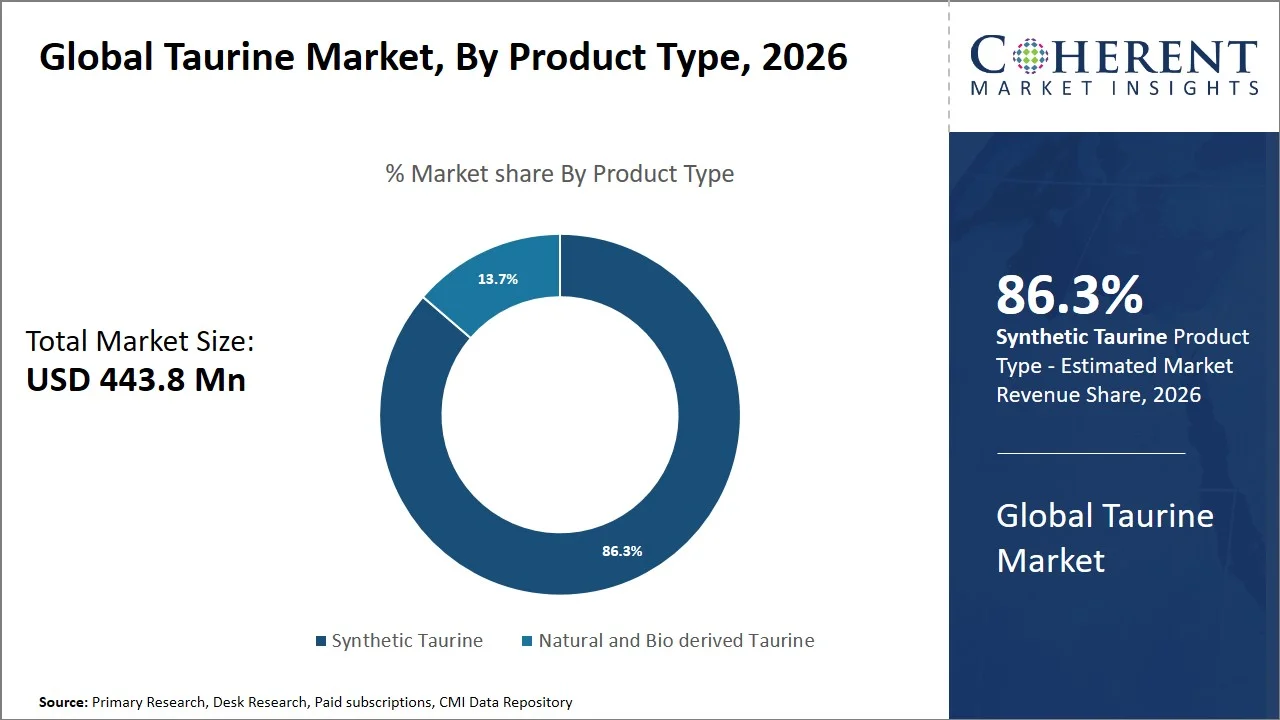
- Synthetic taurine is expected to command 86.3% of the global taurine market in 2026 because industrial synthesis provides dependable purity, large-batch availability, and predictable economics for beverage, feed, and pharmaceutical buyers. In September 2024, Qianjiang Yongan Pharmaceutical disclosed a Chinese patent covering full-recovery treatment of taurine mother liquor, illustrating how process recovery and proprietary manufacturing know-how strengthen supplier competitiveness.
- Food and beverage grade is expected to represent 45.8% of the market share in 2026, supported by high-volume purchasing, strict specifications, and standardized quality documentation across functional drinks and fortified foods. In July 2026, the U.S. FDA updated its Substances Added to Food inventory, which lists taurine as a flavoring agent or adjuvant, confirming its established role in regulated food formulation.
- Energy drinks are expected to account for 37.6% of the market share in 2026 because taurine is widely used in functional-energy formulations, while frequent consumption, global brand portfolios, and rapid flavor rotation generate recurring ingredient orders. In February 2026, Monster Beverage reported that its Monster Energy Drinks segment’s fourth-quarter sales increased 18.9% to USD 1.99 billion, signaling sustained commercial throughput in taurine’s largest application.
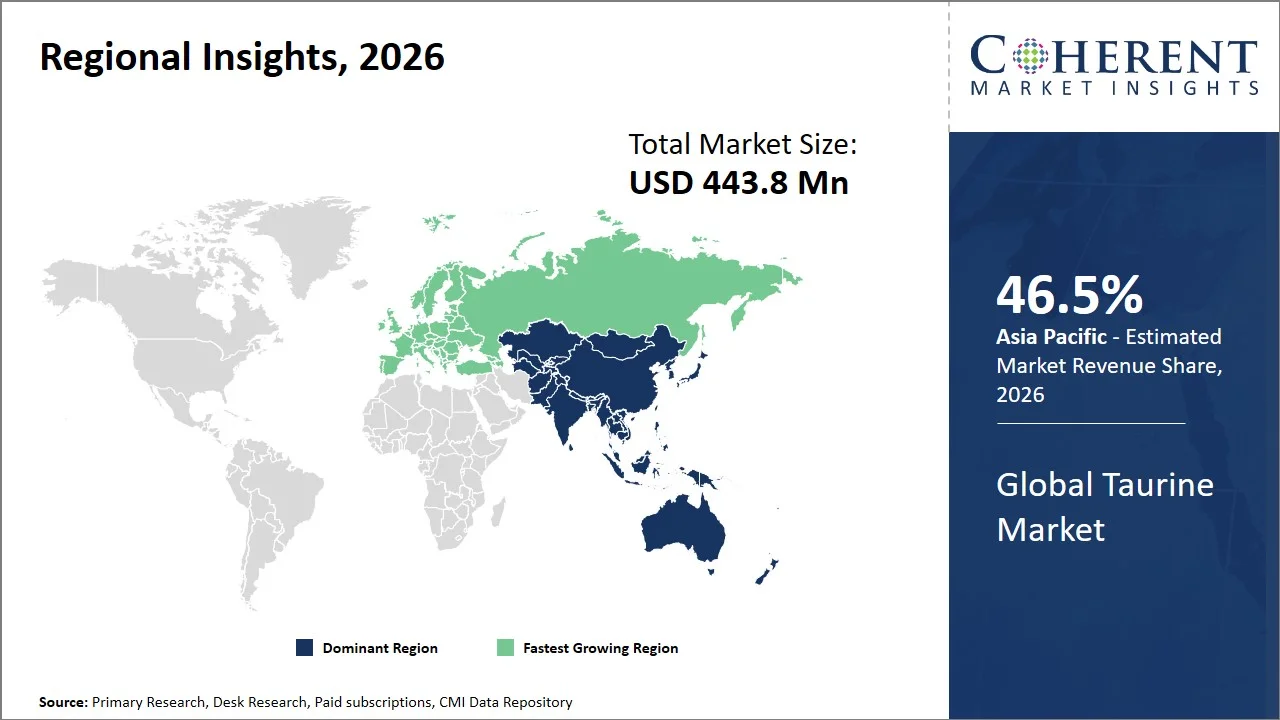
- Asia Pacific is expected to lead with 46.5% of the market share in 2026, reflecting its integrated taurine manufacturing base, large energy-drink ecosystems, expanding animal nutrition output, and efficient regional B2B supply routes. In April 2025, Thailand-based Osotspa reported that M-150 Sparkling sales had more than doubled and targeted further growth, demonstrating how local beverage innovation converts regional consumer reach into sustained ingredient demand.
- Europe, the fastest-growing region, is expected to hold 21.6% of the global taurine market in 2026 as premium functional beverages, better-for-you positioning, sophisticated retail networks, and cross-border distribution partnerships widen addressable demand. In March 2025, Celsius Holdings and Suntory Beverage & Food Benelux announced CELSIUS expansion into Belgium and Luxembourg, illustrating how distributor-led rollouts can accelerate regional uptake of functional energy formulations.
Segmental Insights
Why Does Synthetic Taurine Dominate the Global Taurine Market?
Synthetic Taurine is expected to account for 86.3% of the global taurine market in 2026 because chemical synthesis can deliver uniform molecular composition at industrial scale without dependence on animal-derived raw materials or variable biological yields. Established reaction, purification, crystallization, and drying infrastructure supports continuous production for beverage, supplement, feed, and pharmaceutical customers requiring repeatable specifications. Large output volumes also spread plant, energy, testing, and compliance costs across more tons, strengthening price competitiveness and contract-supply reliability. These benefits integrated producers and multinational ingredient buyers seeking predictable qualification and replenishment. In May 2024, the Quanzhou Ecology and Environment Bureau approved Quanzhou Shengyuan Biotechnology Engineering’s planned 40,000-ton annual taurine line, comprising sodium-sulfite, synthesis, purification, drying, packaging, storage, and environmental-control facilities, demonstrating continued investment in scaled chemical production.
- Current Industry Events of 2026
- Market Size Estimation
- Regional Breakdown
- Competitive Landscape
- Customer Intelligence
- Segmental Analysis
- Pricing Analysis
- Key Market Drivers, Challenges & Future Trends
- Customized Insights Section
Why Does Food and Beverage Grade Represent the Largest Grade Segment in the Global Taurine Market?
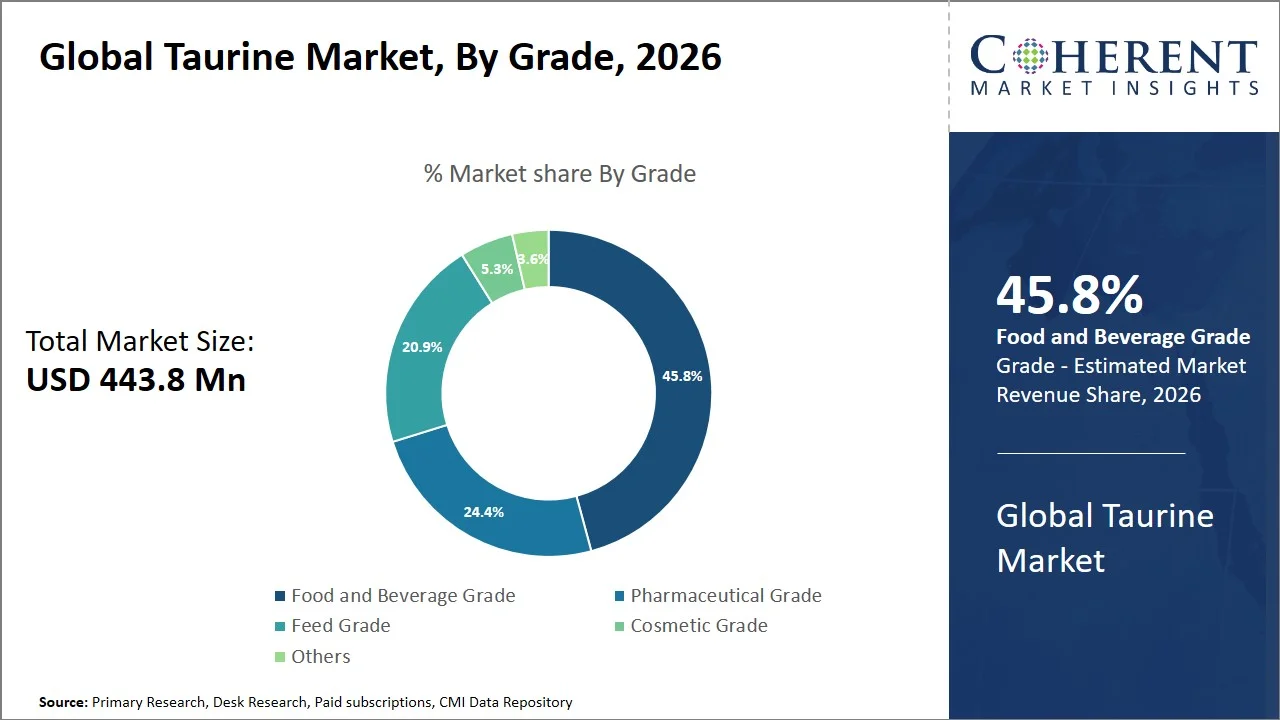
Food and Beverage Grade is expected to hold 45.8% of the global taurine market in 2026 because beverage and nutrition formulators require an ingredient that can be precisely dosed, rapidly dissolved, and documented for food-safety and labeling compliance. The grade serves energy beverages, functional drinks, fortified powders, dietary supplements, and selected nutritional formulations, creating broader batch turnover than specialized pharmaceutical or cosmetic grades. Buyers particularly value certificates of analysis, contaminant limits, allergen declarations, traceability, and compatibility with high-throughput blending and filling systems. These requirements favor suppliers with application laboratories and jurisdiction-specific regulatory support. In May 2024, Health Canada published guidance on new cautionary labeling for supplemented foods, specifically identifying taurine among added ingredients that must be communicated under the revised framework, reinforcing the commercial importance of compliant food-grade documentation.
Why Do Energy Drinks Dominate the Application Segment of the Global Taurine Market?
Energy Drinks are expected to represent 37.6% of the global taurine market share in 2026 because the category converts taurine into frequent, standardized ingredient consumption across large production runs and continuously refreshed product portfolios. Beverage companies use the ingredient within recognizable functional blends, while convenience stores, supermarkets, gyms, foodservice outlets, and e-commerce platforms provide extensive consumer access. New flavors, package sizes, sugar-free variants, and market entries also shorten innovation cycles, generating repeated formulation trials and supplier-qualification activity. Taurine manufacturers consequently benefit from recurring bulk orders but must provide strong solubility, taste neutrality, batch consistency, and rapid delivery to bottling partners. In March 2024, EFES Georgia entered the premium energy-drink category with PEAK, whose official formulation combines taurine and caffeine with five B vitamins, illustrating continued adoption in newly introduced beverage brands.
Current Events and their Impact
Current Event | Description and Its Impact |
Health Canada Supplemented-Food Compliance Requirements – January 2026 |
|
EFSA Technical Assessment of Taurine Safety for Dogs – July 2026 |
|
England Confirms Under-16 Energy-Drink Sales Ban – July 2026 |
|
Global Taurine Market Dynamic
Key Market Drivers
Energy-Drink Format Expansion Broadens Food-Grade Taurine Procurement
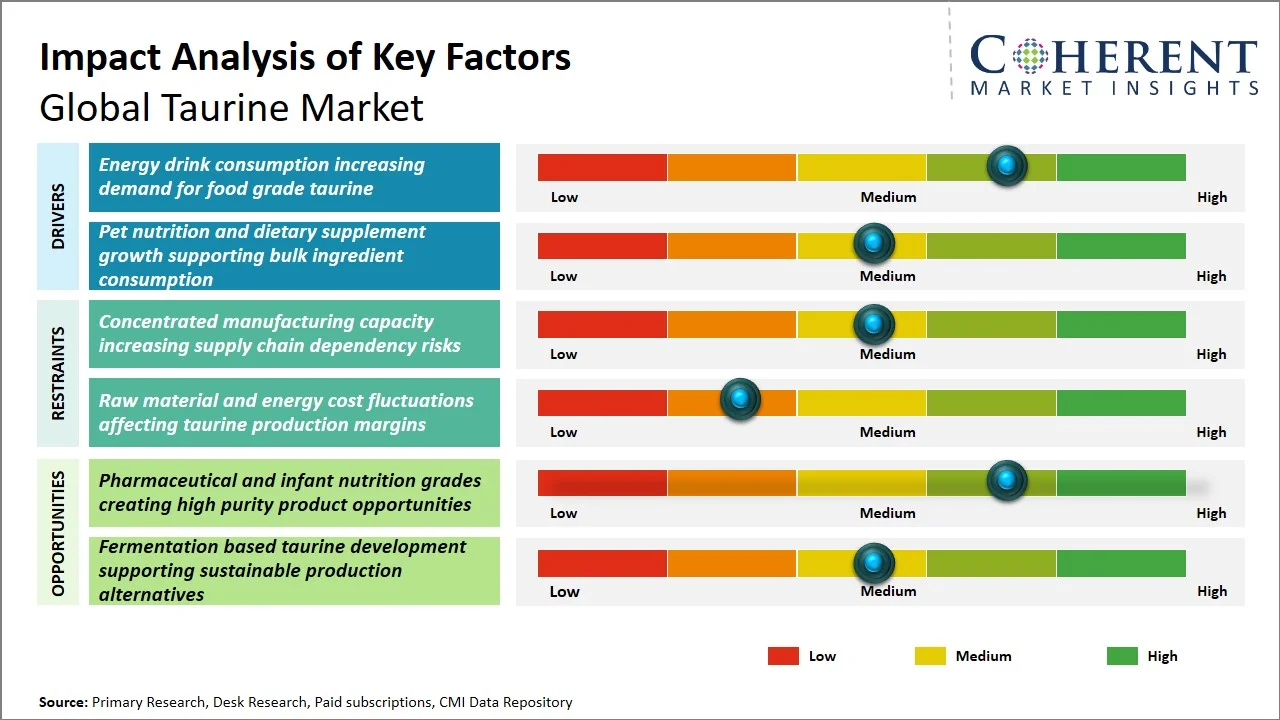
Energy drink manufacturers expand the procurement and use of food-grade taurine as they grow beyond carbonates into fruit-based, zero-sugar and hybrid functional beverages. The commercial interest in taurine is retained as it is formulation compatible, consumer familiar and highly available in standardized food grade specifications. This further extends the orders from beverage brand owners, contract manufacturers, flavor houses, premix suppliers and ingredient distributors, and also drives the producers to achieve predictable batch consistency and replenishment frequency. In October 2025, Grupo Jumex and AriZona Beverages launched Jumex Energy, combining fruit nectar with a performance blend containing taurine, guarana, and ginseng. The launch demonstrates that taurine is being carried into differentiated beverage concepts rather than remaining confined to conventional energy-drink profiles, enlarging the range of formulations that can support food-grade demand.
Pet Nutrition and Supplement Portfolios Expand Bulk Ingredient Consumption
Pet nutrition and dietary supplements are fueling a larger base of non-mainstream beverage use for bulk ingredients. Taurine holds a proven position in feline formulations, while high-quality dog foods, veterinary and sports foods, and daily well-being products are more and more demanding controlled dosage, proven purity, and reliable ingredient availability. Feed-grade manufacturers and pharmaceutical-grade suppliers, premix manufacturers, private-label supplement producers and veterinary nutrition brands all benefit from customers' portfolio and manufacturing growt. In May 2025, Mars opened a USD 450 million Royal Canin facility in Ohio, described as the company’s largest dry pet food factory globally and capable of supplying food for millions of pets annually. Such investments increase the scale and continuity of functional-ingredient procurement, favoring taurine suppliers able to support audited supply chains, multiple grades, and long-term volume agreements.
Emerging Market Trends
Caffeine Moderation Is Repositioning Taurine Within Functional Formulas
Beverage companies are incorporating taurine into lower-sugar, moderate-caffeine, hydration, and multi-benefit formulations rather than conventional stimulant-only products. This increases the importance of stability testing, sensory neutrality, dosage guidance, and regulatory documentation. Suppliers with formulation support and application expertise can strengthen customer relationships, while commodity-focused producers may face greater price pressure. The trend will encourage closer collaboration among ingredient manufacturers, beverage developers, laboratories, and regulatory teams.
Regional Stocking and Dual-Sourcing Are Becoming Procurement Standards:
Taurine buyers are adopting regional inventories, secondary suppliers, and longer-term contracts to reduce exposure to concentrated production and shipping disruptions. Distributors offering local stock, repacking, testing support, and regulatory documentation are gaining importance. Producers may establish bonded warehouses and qualified regional partnerships to improve delivery reliability. Suppliers combining competitive pricing with traceability, rapid quality release, and contingency capacity are likely to secure preferred-vendor status and more predictable contract volumes.
Regional Insights
Why Does Asia Pacific Dominate the Global Taurine Market?
Asia Pacific is expected to account for 46.5% of the global taurine market in 2026 because the region combines concentrated manufacturing capacity with broad downstream consumption across energy drinks, pharmaceutical tonics, dietary supplements, animal feed, pet food, and infant nutrition. China supports cost-efficient bulk availability, while Japan, South Korea, India, and Southeast Asian markets provide diverse formulation and distribution opportunities. Regional buyers also benefit from shorter lead times, established ingredient-trading networks, and direct access to multiple food, feed, and pharmaceutical grades. This ecosystem strengthens both domestic consumption and export-oriented supply. In March 2026, Dong-A Pharmaceutical introduced Eolbaksa Zero in South Korea with 1,000 mg of taurine, zero sugar, and low-calorie positioning, showing how Asian manufacturers are adapting taurine-containing products to daily-use and wellness-oriented purchasing preferences.
Why is Europe Emerging as the Fastest-Growing Region in the Global Taurine Market?
Europe is expected to hold 21.6% of the global taurine market in 2026 and emerge as the fastest-growing region as suppliers expand beyond conventional energy beverages into premium nutrition, pharmaceutical, veterinary, and personal-care applications. European buyers place strong emphasis on ingredient documentation, traceability, formulation mildness, environmental performance, and compliance with tightly defined product standards. These requirements support higher-value grades and taurine-derived ingredients rather than purely volume-based procurement. Specialist distributors and formulation laboratories further help manufacturers address fragmented national requirements and premium customer specifications. In April 2026, Clariant launched Hostapon CT solid, a salt-free sodium methyl cocoyl taurate surfactant for sensitive-skin cleansing applications. The development demonstrates how European specialty-chemical innovation can create additional commercial pathways for the taurine value chain through high-performance, mild, and sustainability-oriented formulations.
Global Taurine Market Outlook for Key Countries
Why is the U.S. a Key Market for the Global Taurine Market?
The U.S. is a key market for taurine because brand owners continually refresh energy beverages, sports-nutrition products, dietary supplements, and pet-food formulations across nationwide retail and e-commerce channels. Large contract-manufacturing and private-label ecosystems allow successful concepts to move rapidly from formulation trials to commercial volumes, supporting repeat purchases of food, supplement, and feed grades. Buyers nevertheless require dependable certificates of analysis, consistent solubility, contaminant control, and reliable domestic inventory because product recalls or supply interruptions can affect widely distributed portfolios. Seasonal flavor rotation also creates recurring qualification opportunities for ingredient and premix suppliers. In April 2026, Red Bull introduced its Sudachi Lime Summer Edition with and without sugar at U.S. retailers nationwide; the official product specification identifies taurine among its functional ingredients. The launch illustrates how portfolio renewal sustains taurine use within high-velocity beverage channels.
Why is India Important in the Global Taurine Market?
India is becoming increasingly important in the global taurine market as organized beverage, dietary-supplement, sports-nutrition, and pet-care companies broaden their product portfolios for urban retail and digital commerce. The market favors suppliers that can offer competitive food-grade and feed-grade material in flexible order sizes, supported by local warehousing and documentation suited to Indian food regulations. Growth also depends on clearer differentiation between regulated caffeinated beverages and products marketed more loosely as health drinks, since classification affects labeling, online placement, and consumer communication. In April 2024, the Food Safety and Standards Authority of India directed e-commerce platforms to classify beverage products correctly and clarified that the term “energy drink” may be used only for products licensed under specified caffeinated-beverage categories. This strengthens channel discipline for taurine-containing energy formulations and rewards compliant manufacturers and distributors.
Why Does China Support Growth in the Global Taurine Market?
China supports growth in the global taurine market through its integrated fine-chemical clusters, large-scale synthesis capabilities, access to industrial utilities, and established export infrastructure. These advantages enable manufacturers to serve high-volume food, feed, pharmaceutical, and supplement customers while maintaining competitive production economics. The country is also extending the value chain toward taurine derivatives used in mild surfactants and specialty formulations, allowing producers to capture more value than bulk ingredient supply alone. Domestic industrial parks facilitate shared logistics, environmental treatment, storage, and access to chemical intermediates, strengthening capacity expansion and process integration. In April 2026, Qianjiang Zhuoli New Materials Technology disclosed plans for a new facility in Hubei designed to produce 15,000 tons annually of N-methyl taurine sodium solution. The project indicates continued investment in downstream taurine chemistry and reinforces China’s position as a supply and processing hub.
Why is Germany a Strategic Country in the Global Taurine Market?
Germany is a strategic country in the global taurine market because it combines premium functional-beverage consumption with advanced pharmaceutical, nutritional, and personal-care formulation capabilities. Buyers typically demand well-characterized ingredients, precise dosing, validated analytical methods, and documentation that can withstand regulatory and customer audits. Germany’s clearly defined ingredient limits for energy drinks also provide a structured operating framework, although they increase the importance of formulation control, labeling discipline, and safety communication. This environment benefits suppliers offering reliable quality assurance and technical support rather than competing only on price. In July 2026, the German Federal Institute for Risk Assessment updated its evaluation of acute and chronic energy-drink consumption among children and adolescents and reiterated that taurine may be used up to 4,000 mg per liter under Germany’s beverage rules. The review reinforces science-based oversight of taurine-containing products.
Why is Japan an Important Growth Market for the Global Taurine Market?
Japan is an important growth market for taurine because the ingredient has a well-established role in quasi-drug tonics, fatigue-support beverages, and other tightly specified health products. Domestic pharmaceutical manufacturers combine high-purity ingredient requirements with sophisticated formulation, sensory design, and small-format packaging, creating demand that is less dependent on conventional carbonated energy drinks. Drugstores, convenience outlets, and direct consumer channels support frequent product rotation, while established brands use seasonal and lifestyle-specific positioning to widen consumption occasions. This favors suppliers capable of pharmaceutical-grade consistency, traceability, and responsive batch delivery. In May 2025, Taisho Pharmaceutical launched Lipovitan Cool for summer fatigue support, formulating each bottle with 1,000 mg of taurine alongside carnitine and B vitamins. The launch shows how Japanese companies use taurine within differentiated, regulated wellness formats rather than treating it as a generic beverage additive.
Technology Adoption Landscape in the Global Taurine Market
Technology | Adoption Level | Key Application Area | Business Impact |
Ethylene Oxide–Sodium Isethionate Synthesis | High | Large-scale synthetic taurine manufacturing | Supports high-volume production, standardized output, and competitive unit economics for food, feed, and pharmaceutical customers. |
Cyclic Ammonolysis Processing | Medium | Conversion of sodium isethionate into taurinate intermediates | Improves reaction efficiency and precursor utilization while reducing losses across repeated production cycles. |
Mother-Liquor Recovery and Recirculation | Medium | Recovery of taurine and reusable intermediates from crystallization streams | Raises overall yield, lowers wastewater burden, and improves manufacturing margins through reduced material loss. |
Multi-Stage Crystallization and Ion-Exchange Purification | High | Removal of salts, residual intermediates, and process impurities | Enables grade differentiation, consistent purity, improved appearance, and compliance with stricter customer specifications. |
HPLC and Ion-Chromatography Quality Testing | High | Raw-material inspection, in-process monitoring, and final-batch release | Provides accurate assay and impurity verification, supporting traceability, regulatory submissions, and customer qualification. |
How are Pharmaceutical-Grade and Clinical-Nutrition Applications Creating New Growth Opportunities in the Global Taurine Market?
Pharmaceutical-grade taurine can move beyond conventional supplement positioning into specialized clinical nutrition, medically supervised formulations, and condition-specific dietary products. This opportunity is strategically important because healthcare buyers value impurity control, validated analytical methods, stability evidence, traceable manufacturing, and regulatory documentation more than lowest-cost bulk supply. Potential customers include clinical-nutrition formulators, hospital-product suppliers, pharmaceutical developers, contract development and manufacturing organizations, and brands serving healthy-ageing or metabolic-support applications. Companies can capture the opportunity by building grade-segregated production, tighter contaminant specifications, pharmacopoeial testing capability, controlled packaging, and technical files suited to multiple regulatory jurisdictions. Commercial differentiation may also come from dosage-form support, compatibility studies, and small-batch supply for formulation development before scale-up. Participation requires longer qualification cycles, scientific and regulatory personnel, robust change-control systems, and dependable audit readiness. Established manufacturers have an advantage in production economics, but specialized suppliers can compete through responsiveness, documentation quality, and collaboration with clinical or pharmaceutical customers globally.
Market Players, Key Development, and Competitive Intelligence
Key Developments
- In December 2025, Mankind Pharma launched PetStar Delight, extending its PetStar portfolio into cat food with formulations containing essential taurine for vital-organ support. This is important for the global taurine market because it demonstrates the expansion of taurine-fortified feline nutrition into accessible, mass-distributed pet-care portfolios in developing consumer markets.
- In May 2025, Vytanutra launched Plus B, a daily energy and wellness supplement combining taurine with B vitamins, BioPerine, and micro-pellet delivery technology. This is important for the global taurine market because it places taurine within differentiated oral supplement formats designed around sustained wellness, absorption, and formulation convenience rather than conventional single-ingredient positioning.
- In April 2024, Vantage Specialty Chemicals announced an expansion of taurate manufacturing at its Leuna facility in Germany, including additional N-methyl taurine capacity for mild personal-care surfactants. This is important for the global taurine market because it strengthens downstream taurine-derivative availability and illustrates the material’s growing strategic relevance in sulfate-free skin and hair-care formulations.
Competitive Landscape
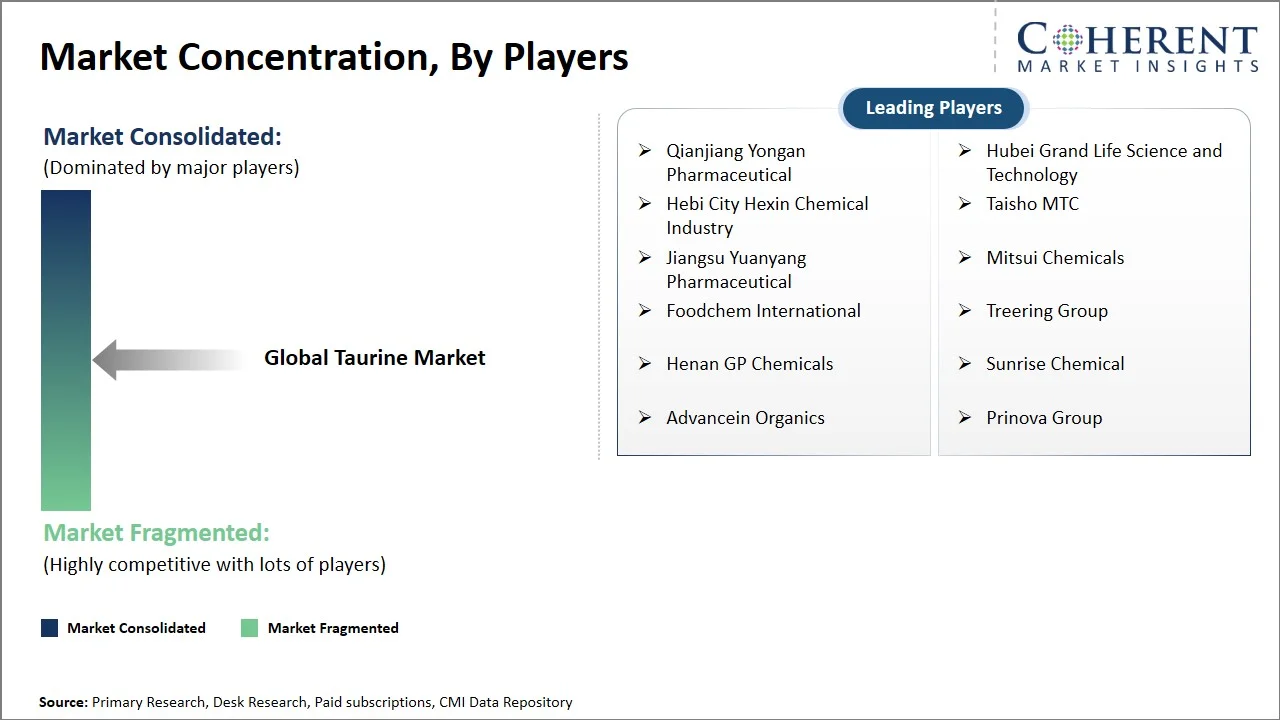
The global taurine market is moderately consolidated at the primary manufacturing level but more fragmented across distribution, premixing, repacking, and application development. Large-scale producers benefit from process ownership, established synthesis assets, and export economics, while regional distributors and specialty suppliers compete through local inventory, regulatory support, grade availability, and customer responsiveness. Competitive advantage increasingly depends on consistent purity, manufacturing efficiency, safety controls, delivery reliability, documentation quality, and the ability to serve multiple applications without compromising grade segregation.
Key focus areas include
- Purity consistency: Maintaining repeatable assay levels and controlled impurity profiles across commercial batches.
- Manufacturing economics: Improving reaction yield, energy consumption, crystallization efficiency, and mother-liquor recovery.
- Capacity reliability: Providing secure contracted volumes and contingency supply during demand spikes or logistics disruptions.
- Grade differentiation: Supporting food and beverage, pharmaceutical, feed, cosmetic, and specialized technical requirements.
- Regulatory readiness: Maintaining certificates, traceability records, safety data, audit support, and jurisdiction-specific documentation.
- Regional customer access: Combining direct B2B relationships with distributors holding local inventory and technical expertise.
- Commercial relationships: Securing multi-year supply agreements through responsive sampling, qualification support, and dependable delivery.
Market Report Scope
Taurine Market Report Coverage
| Report Coverage | Details | ||
|---|---|---|---|
| Base Year: | 2025 | Market Size in 2026: | USD 443.8 Mn |
| Historical Data for: | 2020 To 2024 | Forecast Period: | 2026 To 2033 |
| Forecast Period 2026 to 2033 CAGR: | 6.60% | 2033 Value Projection: | USD 694.2 Mn |
| Geographies covered: |
| ||
| Segments covered: |
| ||
| Companies covered: | Qianjiang Yongan Pharmaceutical, Hubei Grand Life Science and Technology, Hebi City Hexin Chemical Industry, Taisho MTC, Jiangsu Yuanyang Pharmaceutical, Mitsui Chemicals, Foodchem International, Treering Group, Henan GP Chemicals, Sunrise Chemical, Advancein Organics, and Prinova Group | ||
| Growth Drivers: |
| ||
| Restraints & Challenges: |
| ||
Analyst Opinion (Expert Opinion)
- The global taurine market leadership is likely to be determined increasingly by production discipline rather than nameplate capacity alone. Manufacturers that improve precursor conversion, impurity removal, water reuse, worker-protection systems, and grade-switching efficiency should gain structural cost and qualification advantages. Smaller producers relying on older, less recoverable processes may face margin pressure as sophisticated buyers expand environmental, safety, and process-audit requirements.
- Scientific reassessment could separate taurine demand into more clearly defined commercial pathways. Beverage, veterinary, pharmaceutical, infant-nutrition, and clinical applications may require increasingly distinct evidence standards instead of relying on generalized familiarity with the ingredient. This would pressure suppliers using uniform documentation across all customers and favor participants capable of generating application-specific safety, stability, exposure, and analytical packages.
- Suppliers should prioritize modular purification, grade-segregated storage, analytical laboratories, regulatory surveillance, and regional inventory partnerships. Long-term contracts for critical precursors and stronger distributor qualification can reduce supply vulnerability. Companies should avoid competing through unsupported consumer-health claims or excessive reliance on spot-market pricing, as both approaches can weaken customer confidence and expose margins to regulatory scrutiny and procurement volatility.
Speak to the analyst
Want personalized insights?
Take the findings above to one of our principal consultants, or have the report rebuilt around the segments, geographies and competitors you actually track.
Market Segmentation
- Product Type Insights (Revenue, USD Mn, 2021 - 2033)
- Synthetic Taurine
- Natural and Bio derived Taurine
- Grade Insights (Revenue, USD Mn, 2021 - 2033)
- Food and Beverage Grade
- Pharmaceutical Grade
- Feed Grade
- Cosmetic Grade
- Others
- Application Insights (Revenue, USD Mn, 2021 - 2033)
- Energy Drinks
- Dietary Supplements
- Animal Feed and Pet Food
- Pharmaceuticals
- Infant Formula
- Cosmetics and Personal Care
- Others
- Distribution Channel Insights (Revenue, USD Mn, 2021 - 2033)
- Direct B2B Sales
- Ingredient Distributors
- Online B2B Platforms
- Others
- Regional Insights (Revenue, USD Mn, 2021 - 2033)
- North America
- U.S.
- Canada
- Latin America
- Brazil
- Argentina
- Mexico
- Rest of Latin America
- Europe
- Germany
- U.K.
- Spain
- France
- Italy
- Russia
- Rest of Europe
- Asia Pacific
- China
- India
- Japan
- Australia
- South Korea
- ASEAN
- Rest of Asia Pacific
- Middle East
- GCC Countries
- Israel
- Rest of Middle East
- Africa
- South Africa
- North Africa
- Central Africa
- North America
Sources
Primary Research Interviews
- Synthetic, natural, and bio-derived taurine manufacturers; amino-acid, pharmaceutical-ingredient, feed-additive, and specialty chemical producers
- Energy-drink, dietary-supplement, infant-formula, pharmaceutical, pet-food, animal-feed, and cosmetic companies
- Distributors, importers, exporters, contract manufacturers, premix suppliers, wholesalers, and B2B platforms
- R&D, procurement, production, quality, regulatory, logistics, marketing, sustainability, and sales executives
Stakeholders
- Taurine producers, precursor suppliers, chemical processors, fermentation developers, purification-system providers, and contract manufacturers
- Beverage brands, nutraceutical companies, pharmaceutical firms, infant-nutrition producers, pet-food manufacturers, feed mills, and cosmetic formulators
- Testing laboratories, packaging suppliers, warehouses, logistics providers, customs brokers, distributors, importers, and exporters
End-use Sectors
- Energy drinks, functional beverages, sports drinks, beverage powders, and fortified foods
- Dietary supplements, capsules, tablets, powders, gummies, and sports-nutrition products
- Cat food, dog food, pet supplements, livestock feed, aquafeed, and feed premixes
- Pharmaceuticals, clinical nutrition, infant formula, and medical foods
- Cleansers, shampoos, body washes, skin care, hair care, and taurine-based surfactants
Regulatory and Government Bodies
- U.S. FDA
- Health Canada and Canadian Food Inspection Agency
- European Commission, EFSA, and ECHA
- UK Food Standards Agency
- China NHC, SAMR, Ministry of Agriculture, and General Administration of Customs
- Japan MHLW, Consumer Affairs Agency, MAFF, and PMDA
- FSSAI and CDSCO
- Brazil ANVISA and Ministry of Agriculture
- Codex Alimentarius Commission and JECFA
Databases
- UN Comtrade, ITC Trade Map, WTO Statistics, Eurostat, USITC DataWeb, World Bank, OECD, and FAOSTAT
- China Customs, Japan Trade Statistics, India Export Import Data Bank, Brazil Comex Stat, Statistics Canada, Destatis, and U.S. Census databases
- FDA food-substance, GRAS, dietary-supplement, and animal-food databases
- Health Canada supplemented-food ingredient resources
- EU food and feed registers, EFSA OpenFoodTox, JECFA, and Codex databases
- PubMed, ScienceDirect, Scopus, Web of Science, Espacenet, WIPO PATENTSCOPE, company filings, catalogues, pricing, and shipment records
Magazines and Journals
- BeverageDaily, FoodNavigator, NutraIngredients, Nutraceuticals World, FeedNavigator, Petfood Industry, Food Ingredients First, and Chemical & Engineering News
- Amino Acids, Nutrients, Food Chemistry, Journal of Functional Foods, Animal Feed Science and Technology, Aquaculture, Clinical Nutrition, and Food and Chemical Toxicology
Associations
- Institute of Food Technologists
- International Council on Amino Acid Science
- Council for Responsible Nutrition
- American Beverage Association
- International Society of Sports Nutrition
- Pet Food Institute
- FEDIAF
- American Feed Industry Association
- International Feed Industry Federation
- International Special Dietary Foods Industries
- Personal Care Products Council
- Cosmetics Europe
Public Domain Sources
- Ingredient approvals, safety assessments, purity requirements, labeling rules, permitted-use conditions, and maximum-use limits
- Government statistics covering beverages, supplements, pet food, animal feed, pharmaceuticals, and international trade
- Scientific studies on taurine safety, stability, metabolism, bioavailability, exercise, cardiovascular health, and animal nutrition
- Environmental approvals, factory permits, production-capacity filings, patents, annual reports, press releases, technical data sheets, product labels, and shipment records
Key Standards and Regulations
- U.S. FD&C Act, GRAS requirements, dietary-supplement cGMP, food labeling, preventive controls, and animal-food rules
- Canadian Food and Drug Regulations and Supplemented Foods Regulations
- EU food law, feed-additive regulations, labeling rules, REACH, and CLP
- UK food, supplement, feed, and labeling regulations
- China food-safety standards, feed-additive rules, labeling, and customs requirements
- Japan Food Sanitation Act, Food Labeling Act, quasi-drug standards, and feed regulations
- India caffeinated-beverage, nutraceutical, food-labeling, pharmaceutical, and import regulations
- Brazil ANVISA food, supplement, beverage, labeling, and feed requirements
- Codex, JECFA, ISO 22000, ISO/IEC 17025, HACCP, GMP, and traceability standards
Proprietary Elements
- CMI Data Analytics Tool
- Proprietary CMI Existing Repository of information for last 10 years.
Get access to 250+ pages report
Every segment, forecast, competitor profile and data table behind the analysis above — available for instant download.
- ESOMAR Member
- ISO 9001:2015 Certified
- D-U-N-S Registered
- GDPR & CCPA Compliant
Missing comfort of reading report in your local language? Find your preferred language:
Transform your Strategy with Exclusive Trending Reports
Frequently Asked Questions
The CAGR of the global taurine market is projected to be 6.60% from 2026 to 2033.
The global taurine market is estimated to be valued at USD 443.8 Mn in 2026 and is expected to reach USD 694.2 Mn by 2033.
Food and beverage grade is expected to lead the global taurine market in 2026.
Energy drinks are expected to remain the leading application in the global taurine market.
Europe is expected to emerge as the fastest-growing regional market.
Energy drink consumption increasing demand for food grade taurine and pet nutrition and dietary supplement growth supporting bulk ingredient consumption are the major factors driving the growth of the global taurine market.
Concentrated manufacturing capacity increasing supply chain dependency risks and raw material and energy cost fluctuations affecting taurine production margins are the major factors hampering the growth of the global taurine market.