

Benzocaine Market Size and Share Analysis - Growth Trends and Forecasts (2026 - 2033)
The Benzocaine market is anticipated to grow at a CAGR of 7.08% with USD 557.28 Mn in 2026 and is expected to reach USD 900.16 Mn in 2033. Increasing prevalence of dental conditions such as dental caries, periodontal diseases, and oro-dental trauma in adults globally is a major factor driving growth of the global benzocaine market. Another major growth inducing factor is an increasing prevalence of oral ulcers, also known as recurrent aphthous ulcers, globally is another factor that is expected to drive growth of the global benzocaine market.
Key Takeaways
- 98% is expected to account the largest share of 60% in 2026, 98% purity is typically used in pharmaceutical and high-quality medical applications. India’s pharmaceutical industry is one of the largest in the world, with a growing global presence. By 2025, it’s projected to be valued at over USD 65 billion, making India the third-largest global pharmaceutical market.
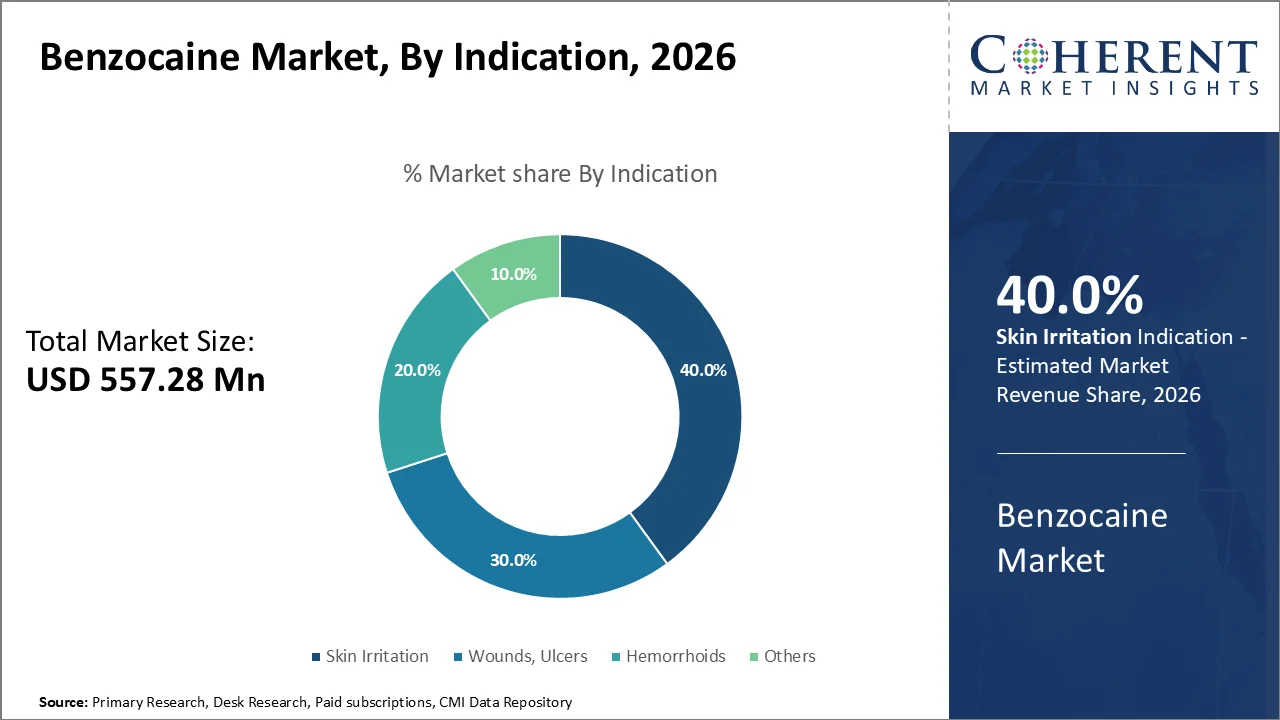
- Based on indication, skin irritation will dominate with 40% in 2026, because OTC topical creams, gels, and sprays are widely used and frequently purchased. In this survey study of 21 000 US adults, 62.3% reported past-7-day use of any OTC or prescription medication.
- Asia Pacific is expected to acquire the dominant share of 45% in 2026, rapid growth in pharmaceutical, OTC, and healthcare products in countries like India, China, and Japan. India and China supply most of the 98% purity pharmaceutical-grade Benzocaine.
Segmental Insights
Why is 98% Acquiring the Largest Market Share?
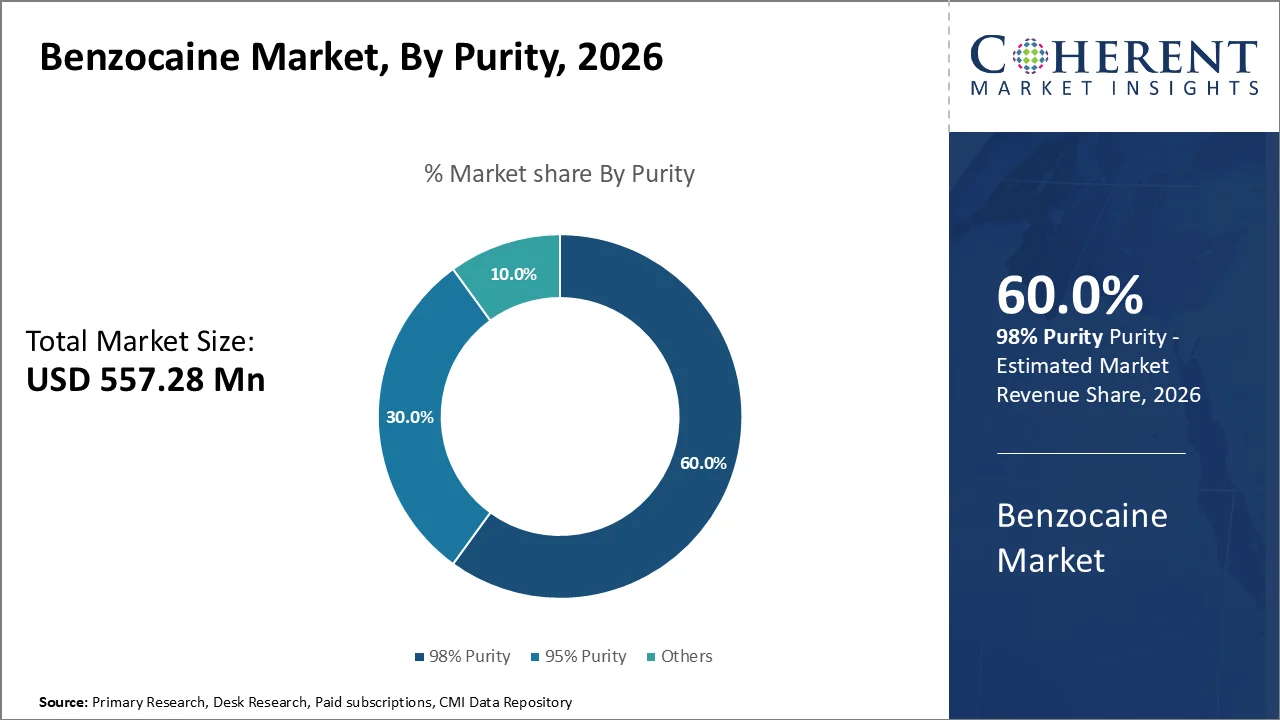
98% purity benzocaine is projected to account for the largest share of purity in 2026, representing approximately 60% of the total volume. Because of its high quality, strong effectiveness, and wide use in both medicine as well as personal care products. From 2021 to 2025, personal care launched with microbiome-related claims grew by an average of 33% annually.
The predominance of the 98% purity benzocaine is largely driven by its compliance with stringent regulatory standards imposed by international health authorities as well as government regulations.
For instance, organizations such as the U.S. Food and Drug Administration (FDA) and the European Medicines Agency (EMA) emphasize the demand for high-purity active pharmaceutical ingredients (APIs) to ensure drug safety along with effectiveness. This regulatory impetus directly elevates the preference for the 98% purity benzocaine because it assures manufacturers as well as end-users of consistent pharmacological performance and reduced risk of impurities that can potentially trigger adverse reactions.
In dental anesthetics and over-the-counter topical pain relief gels, 98% purity benzocaine offers more predictable numbness and longer-lasting relief compared to lower-purity variants.
- Current Industry Events of 2026
- Market Size Estimation
- Regional Breakdown
- Competitive Landscape
- Customer Intelligence
- Segmental Analysis
- Pricing Analysis
- Key Market Drivers, Challenges & Future Trends
- Customized Insights Section
Skin Irritation Holds the Largest Market Share
Based on indication, skin irritation dominates the market, accounting for a significant 40% share in 2026, owing to its extensive prevalence along with the growing demand for effective topical anesthetics, Dextrose Benzocaine addresses a major need for rapid relief from itching, burning, as well as discomfort associated with various dermatological conditions.
Skin diseases affect an estimated 4.69 billion people, with over 3,000 conditions usually overlooked due to their largely non-fatal nature. Common irritations rashes, eczema, and allergic reactions span all age groups, creating a consistent as well as expanding need for safe, fast-acting symptomatic treatments, particularly topical anesthetic alternatives.
Continuous Flow Chemistry is transforming the Benzocaine Industry
Continuous flow chemistry has transformed benzocaine manufacturing by allowing precise control over reactions, enhancing safety, and improving efficiency. Companies like Lonza Group and Cambrex Corporation have adopted this technology in their API as well as intermediate production, streamlining operations along with lowering risk from hazardous intermediates.
The impact of consistant flow adoption is significant, with manufacturing time shifted by 30–40%, yields consistently reaching 95–98% compared to traditional 85–90%, and a lower environmental footprint due to less waste generation. This way ensures safer, faster, as well as more sustainable benzocaine production.
Green Chemistry Processes: A major breakthrough in Benzocaine
Green chemistry processes are highly being adopted in benzocaine production, focusing on environmentally friendly synthesis through bio-catalysis and solvent-free methods. Companies like DSM Nutritional Products and Codexis Inc. have implemented enzyme-catalyzed and biocatalytic solutions, promoting sustainable manufacturing practices.
The advantages of these green processes include a 60% reduction in organic solvent use, elimination of heavy metal catalysts, as well as streamlined compliance along with environmental regulations. Additionally, manufacturers can achieve 15–25% cost savings in waste disposal, making production both greener as well as more economical.
Current Events and Their Impact on the Benzocaine Market
Current Event | Description and its Impact |
EU Green Chemistry Regulations Update (2025) |
|
U.S. FDA GMP Guidance Revision (2025) |
|
Benzocaine Market Trends
- Escalating consumer preference for self-medication as well as over-the-counter topical analgesics is driving market expansion. According to the World Health Organization (WHO, 2025), self-medication accounts for approximately 50–60% of drug use in developed countries, with topical analgesics among the fastest-growing OTC segments.
- High incorporation of benzocaine in cosmetic formulations, especially in anti-aging as well as skin care products.
- Enhanced regulatory frameworks ensuring product quality and safety standards across major markets. The U.S. FDA and European Pharmacopeia (EP 10th Edition, 2025) emphasize strict GMP compliance and ≥98% purity for benzocaine in pharmaceutical as well as OTC applications.
- Globally, regulatory harmonization across 70+ countries ensures higher product safety as well as standardized quality.
- Expansion of generic pharmaceutical formulations containing benzocaine, improving market accessibility
- Development of advanced drug delivery mechanisms including patches, gels, and sustained-release formulations
Regional Insights
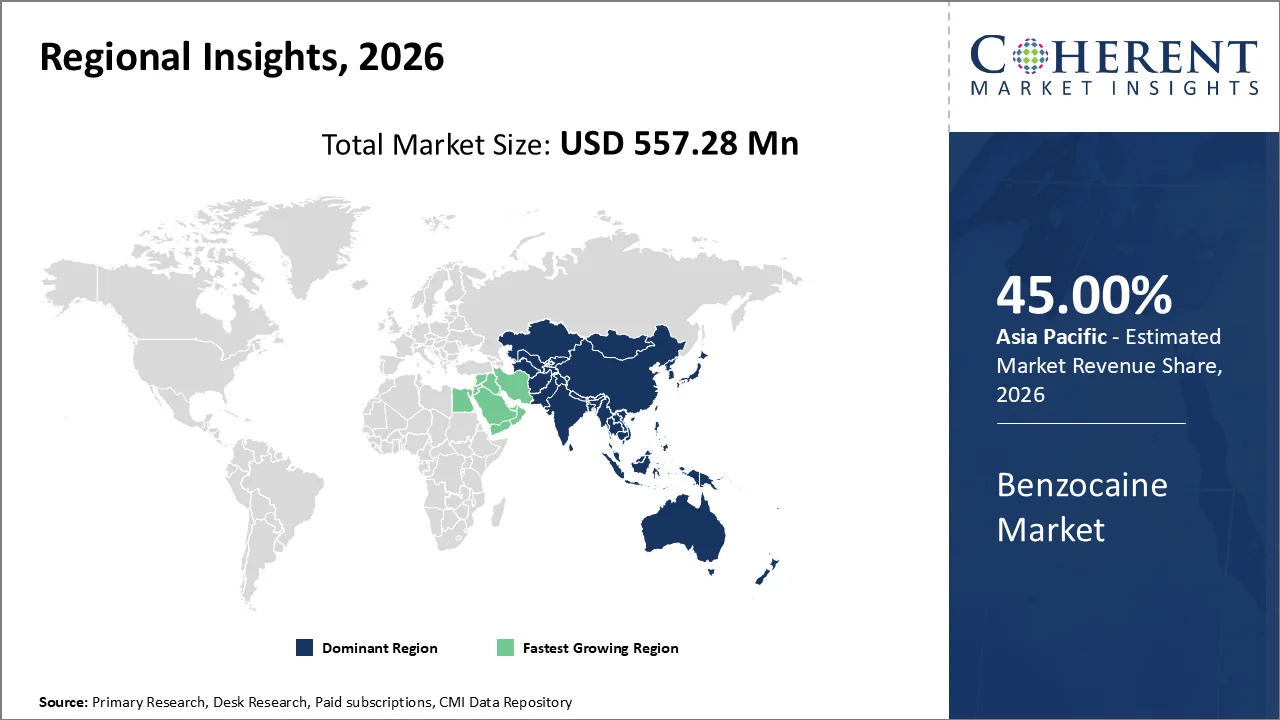
Asia Pacific dominates owing to its robust pharmaceutical manufacturing infrastructure
Asia Pacific account 45% market share in 2026, owing to its strong pharmaceutical manufacturing, many uses for local anesthetics, and a fast-growing healthcare industry. Countries like China, India, and Japan lead the region, making most of the pharmaceutical ingredients and medicines.
India now records 376,721 registered dentists against a 2025 population estimate of 1.46 billion, yielding a dentist-to-population ratio of 1:3,846, nearly double the WHO-recommended ratio of 1:7,500. This numerical surplus conceals major systemic distortions, including extreme urban clustering, rural under-service, rising unemployment among new graduates, as well as pronounced gender disparities.
Middle East Benzocaine Market Trends
The Middle East region is poised to be the fastest-growing region through 2026-2033, expanding at a CAGR of approximately 7.5%. Driven by rapid healthcare infrastructure development as well as increasing healthcare expenditure across Gulf Cooperation Council countries. Total medical costs in Middle Eastern countries are expected to increase by 12% by the end of 2025, marking the third consecutive year of rising costs.
The United Arab Emirates has positioned itself as a regional pharmaceutical hub, with Dubai Healthcare City and Abu Dhabi Global Healthcare Week showcasing major investments in pharmaceutical imports as well as distribution.
Saudi Arabia's Vision 2030 initiative has accelerated healthcare sector transformation, leading to surged demand for topical anesthetics including benzocaine in both medical as well as dental approaches
Largest producer of pharmaceutical-grade Benzocaine and intermediates is Accelerating the Benzocaine Market Demand in China
China contributes the highest share in the benzocaine market in Asia Pacific China’s dominance in benzocaine production stems from its well-established pharmaceutical manufacturing infrastructure and chemical synthesis expertise, supplying high-purity APIs for domestic and export markets. In 2025, Chinese manufacturers accounted for over 70% of global benzocaine output, ensuring a steady supply for topical anesthetic formulations globally.
The country's pharmaceutical sector has experiencing major investments in production facilities specifically designed for local anesthetic compounds, with major manufacturing hubs located in Jiangsu, Shandong, and Zhejiang provinces.
These facilities not only serve the domestic market but also supply benzocaine to other Asia Pacific countries, establishing China as a regional manufacturing hub. The Chinese government's support for pharmaceutical manufacturing through the "Made in China 2025" initiative has further supported the country's position in benzocaine production.
Saudi Arabia Benzocaine Market Trends
The Saudi Arabia contributes highest share in market in Middle East owing to its robust pharmaceutical manufacturing infrastructure as well as strategic initiatives by government authorities targeted at healthcare sector development. The Kingdom's Vision 2030 program has majorly bolstered local pharmaceutical production capabilities, with the Saudi Food and Drug Authority (SFDA) implementing streamlined regulatory frameworks that facilitate benzocaine manufacturing as well as distribution.
Prominent pharmaceutical companies like Spimaco and Jamjoom have built a strong local production of topical anesthetics, including benzocaine products.
Saudi Arabia's healthcare expenditure, which accounts for substantial portion of government budget allocation, has fueled consistent demand for dental care products as well as topical pain management solutions where benzocaine serves as a major active ingredient.
Who are the Major Companies in Benzocaine Industry
Some of the major key players in benzocaine market include, TCI Chemicals (India) Pvt. Ltd, Merck KGaA, ACETO Corporation, Alfa Aesar, Penta International Corporation, abcr GmbH, Indofine Chemical Co Inc, Jinzhou Jiutai Pharmaceutical Co., Ltd, Changzhou Sunlight Pharmaceutical Raw Material Co., Ltd, Fengchen Group Co., Ltd, and Mahendra Chemicals.
Key News
- In August 2025, Nuance Medical’s 2025 launch of Hurri-Freeze, the first FDA-cleared HFO topical anesthetic spray, underscores escalating innovation in the topical anesthetic market. The product’s rapid, safe, and environmentally friendly design reflects rising clinician and patient demand for fast-acting, point-of-care pain relief trends that directly support adoption of Dextrose Benzocaine.
Market Report Scope
Benzocaine Market Report Coverage
| Report Coverage | Details | ||
|---|---|---|---|
| Base Year: | 2025 | Market Size in 2026: | USD 557.28 Mn |
| Historical Data for: | 2020 To 2024 | Forecast Period: | 2026 To 2033 |
| Forecast Period 2026 to 2033 CAGR: | 7.08% | 2033 Value Projection: | USD 900.16 Mn |
| Geographies covered: |
| ||
| Segments covered: |
| ||
| Companies covered: | TCI Chemicals (India) Pvt. Ltd, Merck KGaA, ACETO Corporation, Alfa Aesar, Penta International Corporation, abcr GmbH, Indofine Chemical Co Inc, Jinzhou Jiutai Pharmaceutical Co., Ltd, Changzhou Sunlight Pharmaceutical Raw Material Co., Ltd, Fengchen Group Co., Ltd, and Mahendra Chemicals. | ||
| Growth Drivers: |
| ||
| Restraints & Challenges: |
| ||
Analyst Opinion
- Dextrose Benzocaine is no longer a niche product, it’s essential for pain management in minor surgical and dental procedures. In 2025, over 150 million outpatient procedures globally relied on topical anesthetics.
- Clinical efficacy and patient comfort aren’t optional, they drive adoption. Surveys in 2025 show >95% patient satisfaction when Dextrose Benzocaine is used, reinforcing its preference over alternatives.
- Innovation and regulatory approvals are expanding market reach. FDA and EMA approvals in 2025 for sustained-release as well as combination formulations accelerated uptake, especially in advancing markets.
- Emerging markets are shaping global growth. Asia-Pacific saw 10–12% annual increases in minor procedures in 2025, directly boosting demand for Dextrose Benzocaine.
- Overall, Companies that use smart, cloud-based SLM systems can work more efficiently, save money, and keep their customers satisfied.
Speak to the analyst
Want personalized insights?
Take the findings above to one of our principal consultants, or have the report rebuilt around the segments, geographies and competitors you actually track.
Market Segmentation
- By Purity
- 95%
- 98%
- Others
- By Indication
- Skin Irritation
- Wounds
- Ulcers
- Hemorrhoids
- Others
- By Region
- North America
- U.S.
- Canada
- Latin America
- Brazil
- Mexico
- Argentina
- Rest of Latin America
- Europe
- Germany
- U.K.
- France
- Italy
- Spain
- Russia
- Rest of Europe
- Asia Pacific
- China
- India
- Japan
- Australia
- South Korea
- ASEAN
- Rest of Asia Pacific
- Middle East
- GCC
- Israel
- Rest of Middle East
- Africa
- South Africa
- Central Africa
- North Africa
- North America
Sources
Primary Research Interviews
- Benzocaine Manufacturing Companies Executives
- Pharmaceutical Distributors and Suppliers
- Healthcare Professionals and Dermatologists
- Regulatory Affairs Specialists
- Others
Databases
- FDA Orange Book Database
- Global Trade Atlas
- Others
Magazines
- Pharmaceutical Manufacturing Magazine
- Chemical & Engineering News
- Drug Discovery & Development Magazine
- Cosmetics & Toiletries Magazine
- Others
Journals
- Journal of Pharmaceutical Sciences
- International Journal of Pharmaceutics
- Drug Development and Industrial Pharmacy
- Others
Newspapers
- The Wall Street Journal
- Financial Times
- Reuters Health News
- Chemical Week
- Others
Associations
- American Chemical Society (ACS)
- International Pharmaceutical Federation (FIP)
- Chemical Manufacturers Association
- Generic Pharmaceutical Association
- Others
Public Domain Sources
- U.S. Food and Drug Administration (FDA)
- European Medicines Agency (EMA)
- World Health Organization (WHO)
- Chemical Safety and Hazard Investigation Board
- Others
Proprietary Elements
- CMI Data Analytics Tool
- Proprietary CMI Existing Repository of information for last 10 years
Get access to 250+ pages report
Every segment, forecast, competitor profile and data table behind the analysis above — available for instant download.
- ESOMAR Member
- ISO 9001:2015 Certified
- D-U-N-S Registered
- GDPR & CCPA Compliant
Missing comfort of reading report in your local language? Find your preferred language:
Transform your Strategy with Exclusive Trending Reports
Frequently Asked Questions
The Benzocaine market is expected to reach USD 900.16 Mn in 2033.
Major players operating in the global Benzocaine market include TCI Chemicals (India) Pvt. Ltd, Merck KGaA, ACETO Corporation, Alfa Aesar, Penta International Corporation, abcr GmbH, Indofine Chemical Co Inc, Jinzhou Jiutai Pharmaceutical Co., Ltd, Changzhou Sunlight Pharmaceutical Raw Material Co., Ltd, Fengchen Group Co., Ltd, and Mahendra Chemicals.
Benzocaine constituent pharmaceutical products may lead to serious side effects such as swelling of skin and bluish color of nails, lips, and skin in individuals with skin sensitivity, which is a key factor hampering growth of the market.
Increasing prevalence of various diseases such as dental disorders, hemorrhoids, anal fissures, and mouth ulcers, and increasing product launches by key companies are major factors driving the market growth.
The Benzocaine market is anticipated to grow at a CAGR of 7.08% between 2026 and 2033.
Among regions, Asia Pacific is expected to account for a largest market share in the global Benzocaine market over the forecast period.
BENZOCAINE (BEN zoe kane) relieves minor pain and irritation in your mouth and throat. It works by numbing the affected area.