

Menstrual Cup Market Analysis & Forecast: 2026 to 2033
Menstrual Cup Market is estimated to be valued at USD 923.8 Mn in 2026 and is expected to reach USD 1,335.0 Mn in 2033, exhibiting a compound annual growth rate (CAGR) of 5.4% from 2026 to 2033.
Key Takeaways
- Based on Product Type, the Reusable segment is expected to hold 71% share in 2026, driven by affordability and eco-conscious adoption.
- Based on Material Type, the Silicon segment is expected to lead the market with largest share in 2026, driven by its class vi medical-grade certification and biocompatibility.
- Based on Distribution Channel, the Pharmacies & Retail Stores segment is projected to account for the greatest share of the market in 2026, driven by expanding outlets, consumer trust, and professional guidance.
- Based on Region, the North America is set to lead the menstrual cup market in 56% share in 2026. While, Asia Pacific is anticipated to be the fastest growing region.
Market Overview
The global menstrual cup market has been growing swiftly and the growth is expected to continue in the coming years. The major factors driving market growth are growing awareness regarding the availability of different options during menstruation, large number of campaigns conducted by government, women communities and educational institutes to increase awareness regarding menstrual cups. Additionally, the availability of menstrual cups in different sizes and affordable price ranges is again helping in stimulating the growth of this market. Other factors such as safety, comfort, practicality, ease of use, cleanliness, affordability and eco-friendly are further expected to augment the growth of this market.
Current Events and Its Impacts on the Menstrual Cup Market
Current Event | Description and its Impact |
Regulatory Changes in Women's Health Products |
|
Rising Environmental Consciousness and Sustainability Movements |
|
Policy & Regulation in Menstrual Cup Market
In 2025, rules and policies will have an immense effect on the menstrual cup market in different parts of the world. The FDA classifies menstrual cups as Class II medical devices in the US. New designs, like Sunny's cup, need FDA 510(k) clearance. This sets a standard for FemTech startups, making sure that safety and customer trust are high while also encouraging new ideas. Menstrual cups must meet the EU Medical Device Regulation and get CE marking in Europe. This means that once approved in one country, companies are permitted to market their products in all EU member states. This unified system makes it easier for new businesses to grow quickly while remaining safety standards high.
In India, the government and non-governmental organizations (NGOs) are encouraging people to use menstrual products by running awareness campaigns, giving out funds, and sending products to rural areas. These efforts help make reusable menstrual products more available to underserved communities by breaking down cultural barriers, making them more affordable, and making them easier to get. These rules show that the U.S. puts a lot of emphasis on safety and innovation, Europe makes it easy to grow quickly, and India focuses on making people aware of and making menstrual cups more accessible. All of these things are helping menstrual cups grow around the world.
- Current Industry Events of 2026
- Market Size Estimation
- Regional Breakdown
- Competitive Landscape
- Customer Intelligence
- Segmental Analysis
- Pricing Analysis
- Key Market Drivers, Challenges & Future Trends
- Customized Insights Section
Segmental Insights
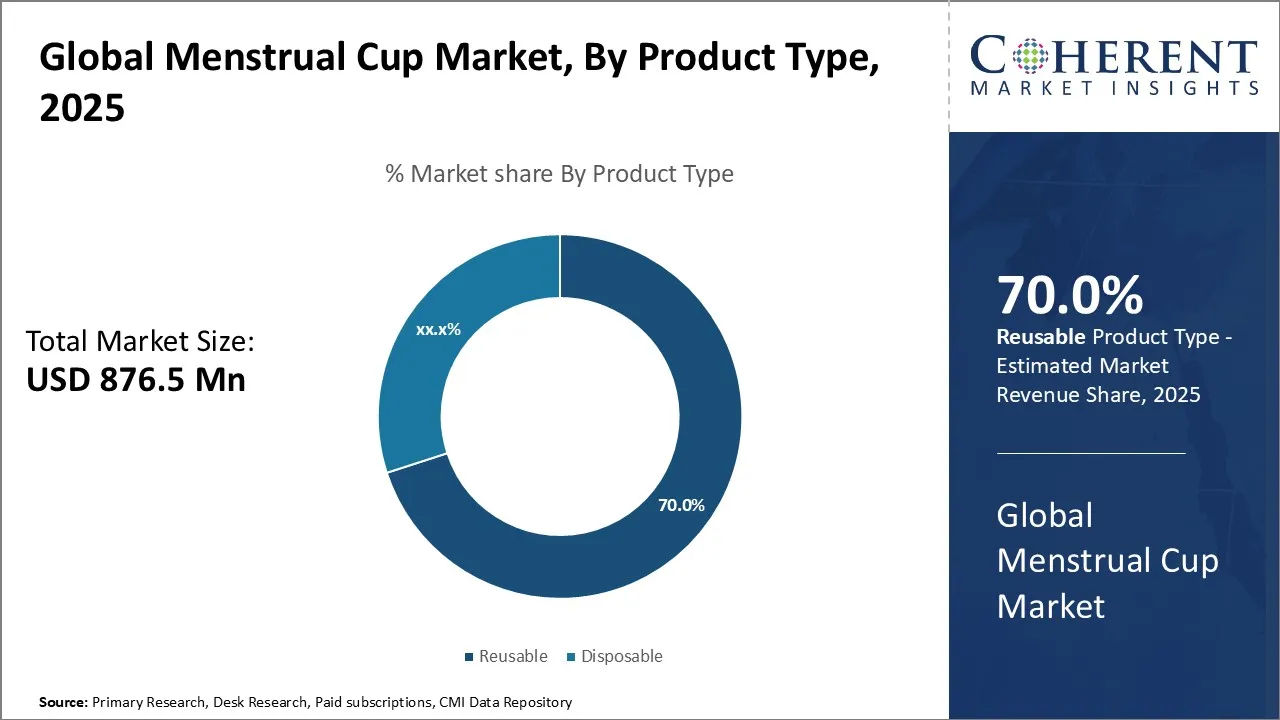
Global Menstrual Cup Market Insights, By Product Type - Reusable Menstrual Cup Dominance Is Driven by Affordability and Eco-Conscious Adoption
Based on product type, the reusable segment is expected to dominate the global market over the forecast period and this is attributed to the high adoption rate of menstrual cups by women in emerging economies due to their affordability. Additionally, the rising focus on environment conservation is further anticipated to boost the demand for menstrual cups over the forecast period.
For instance, in July 2026, Thiruvananthapuram City Corporation launched a project to distribute menstrual cups to students, aiming to promote sustainable menstrual hygiene. The initiative seeks to reduce plastic waste, encourage eco-friendly practices, and provide affordable alternatives for young women. Awareness campaigns and training sessions will support adoption and ensure safe, effective usage.
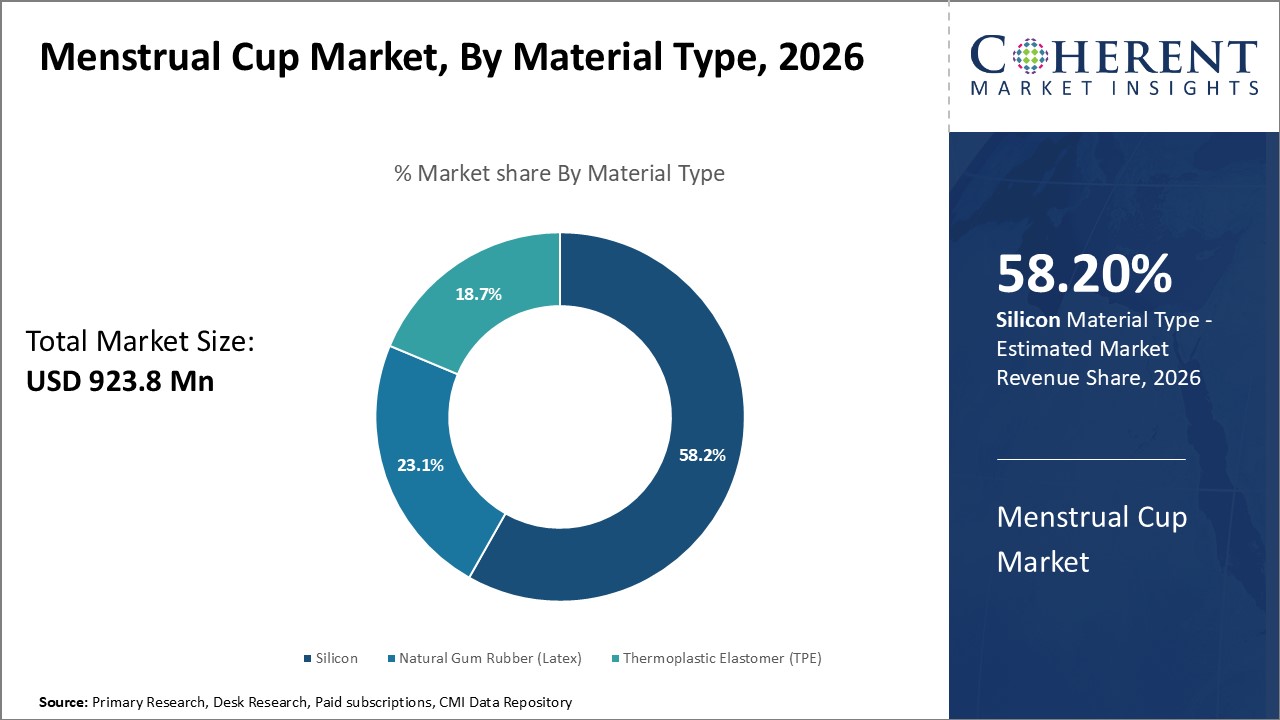
Global Menstrual Cup Market Insights, By Material Type - Silicone Dominates Driven by Its Class VI Medical-Grade Certification and Biocompatibility
Based on material type, the silicon segment is expected to dominate the global market over the forecast period and this is attributed to the fact that silicones are Class VI certified and categorized under short term implantable category. The Class VI approved materials are medical grade and are suitable for producing medical application products.
For instance, October 2026, Researchers made silicone menstrual cups easier to clean by adding a silicone oil coating that keeps bacteria and blood away. When combined with biodegradable alginate absorbent tablets, the new product improves hygiene, cuts down on spills, and safely dissolves, making it a more user-friendly and environmentally friendly way to take care of menstrual health around the world.
Global Menstrual Cup Market Insights, By Distribution Channel - Pharmacies & Retail Stores Segment Is Set to Grow Significantly, Driven by Expanding Outlets, Consumer Trust, And Professional Guidance
Based on distribution channel, the Pharmacies & retail stores segment is also expected to witness significant growth in the near future and this is owing to the growing number of pharmacies and retails stores that offers menstrual cups. Consumers often prefer purchasing menstrual products from trusted physical stores. Along with that, pharmacies provide professional guidance and expert advice.
For instance, in February 2024, Catalonia unveiled free reusable menstrual products in pharmacies, aiming to fight menstrual poverty and promote sustainability. By offering menstrual cups and cloth pads at no cost, the initiative ensures accessibility, reduces waste, and empowers women with eco-friendly hygiene solutions supported by trusted pharmacy distribution.
Regional Insights
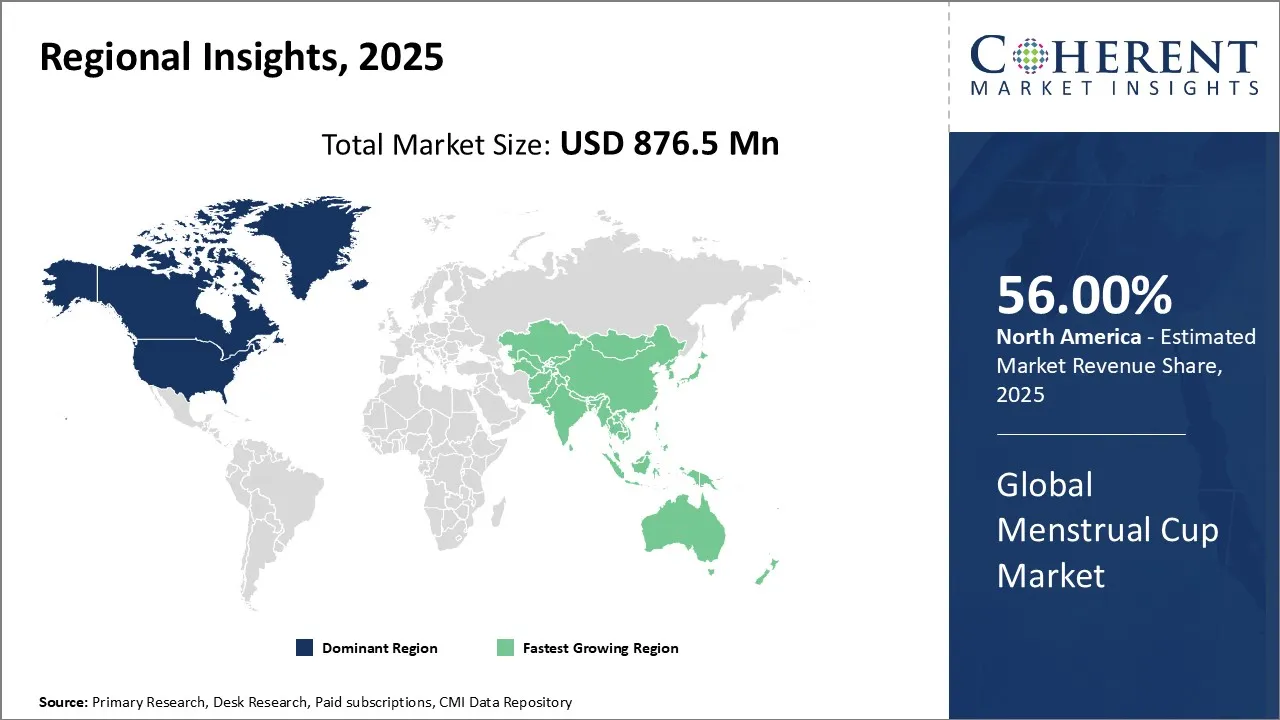
North America Menstrual Cup Market Analysis & Trends
North America is expected to dominate the global menstrual cup market over the forecast period owing to the significant income per capita supporting the market growth in this region. Moreover, the widespread availability of sustainable female hygiene products in the region is also contributing to the growth of the menstrual cup market in the North America region.
For instance, in May 2026, the Bfree Cup from Canada is the world's first antibacterial menstrual cup that requires nothing to be boiled. It changes the way we think about hygiene and convenience. It has built-in antibacterial properties, so it does not require to boil it. This makes it safer and easier to get, especially in places where sanitation is inadequate. This new idea helps the environment, cuts down on waste, and improves menstrual health around the world.
Asia Pacific Menstrual Cup Market Analysis & Trends
Asia Pacific is expected to witness fastest growth over the forecast period owing to the rapid urbanization, growing awareness among women, rising environmental concerns, and increasing number of working women. For instance, in May 2026, Perfectfit Indonesia made a medical-grade silicone menstrual cup that can be used repeatedly instead of pads and tampons. The reusable cup lowers long-term costs, reduces waste, and raises awareness of sustainable menstrual health while promoting eco-friendly period care. The project shows that Southeast Asia is increasingly looking for affordable and eco-friendly options.
Menstrual Cup Market Outlook Country-Wise
The U.S. Menstrual Cup Market Trends
In 2026, more people in the U.S. are using menstrual cups as they are better for the environment, save funds, and are good for your health. FDA-approved new products, eco-friendly materials, and more places to buy them, like pharmacies and online stores, are all reasons why people are using them. Government programs and consumers' preference for reusable products are driving market growth, making menstrual cups more and more common.
For instance, in June 2024, the FDA approved Sunny's menstrual cup with a reusable tampon-style applicator. Sunny is a new company that makes period care products. The Sunny Cup + Applicator is made of medical-grade silicone, which makes it easier to insert, holds more fluid than tampons, and can be used again for a year. This is an important leap forward in menstrual health technology.
China Menstrual Cup Market Trends
The market for menstrual cups in China in 2026 is anticipated to be driven by more people knowing about eco-friendly feminine hygiene, government programs that help, and changing consumer tastes. The market is expected to grow steadily because more people want eco-friendly alternatives to disposables, new technologies are being developed, and more products are becoming available. This is good for both the environment and health.
For instance, in November 2026, Furuize, a Chinese company that makes menstrual cups, opened an international reception hall to welcome partners from all over the world and grow its business. As part of its growing international business strategy, Furuize is using this project to show that it cares about long-term menstrual health, working together, and spreading the word about eco-friendly menstrual cups around the world.
Market Report Scope
Menstrual Cup Market Report Coverage
| Report Coverage | Details | ||
|---|---|---|---|
| Base Year: | 2025 | Market Size in 2026: | USD 923.8 Mn |
| Historical Data for: | 2020 To 2024 | Forecast Period: | 2026 To 2033 |
| Forecast Period 2026 to 2033 CAGR: | 5.4% | 2033 Value Projection: | USD 1,335.0 Mn |
| Geographies covered: |
| ||
| Segments covered: |
| ||
| Companies covered: | Blossom Cup, Diva International Inc., Fleurcup, Intimina, Jaguara, S.R.O., Lune Group Oy Ltd., Lena Cup, Mooncup Ltd., Me Luna Gmbh, Saalt, Llc, Sterne (Si-Line), The Flex Company, And Yuuki Company S.R.O. | ||
| Growth Drivers: |
| ||
| Restraints & Challenges: |
| ||
Global Menstrual Cup Market Drivers
Growing awareness regarding the menstrual cup among women to foster market growth
A growing focus on women’s health is expected to augment demand for menstrual cups. In addition, rising environmental consciousness among people is again likely to propel the demand for reusable menstrual cups. Women can wear a menstrual cup for up to ten times longer than their original size. Additionally, these cups are easy to clean and can be stored in a refrigerator or a cooler, unlike other disposable menstrual products that can only be stored in a warm place.
Availability of different sizes and cups to propel market growth
Today menstrual cup is available in different size like small (35-43 mm) and large size (43- 48 mm) based on its diameter of the rim of the cup. Moreover, the small and large size is divided into size 1, size 0, size 2, and size 3. These sizes of menstrual cup differ depending on the women’s age group such as small cups are for teenagers (age group 15-19 years), particularly designed for women with low or lower than average cervix or shorter vaginal canals. Whereas, the large size cups are designed for the women with the age over 30 years and more. Thus, the availability of different sizes of the cups and colors in the market help attract the attention of the women motivating them to try using menstrual cups instead of traditional menstrual products, which in turn augmenting the adoption of menstrual cups.
Global Menstrual Cup Market Opportunities
Growing awareness regarding the benefits of menstrual cups over sanitary and tampons is expected to offer significant market growth opportunities. Menstrual cups are an eco-friendly alternative to tampons and pads. They’re made of either silicone or latex and collect flow instead of absorbing it, which creates a seal that prevents leaks. The cup can be worn for up to 12 hours at a time and can be emptied and cleaned with water.
Growing initiatives to raise awareness regarding these cups across developing countries is expected to serve additional market growth opportunities. There is a rise in number of initiatives taken by NGO and government to raise awareness regarding the benefits of using menstrual cups that would help increase the adoption rate of the menstrual cup, which in turn is projected to propel the market growth across developing region. For instance, in 2019, there were many campaigns launched to rise in awareness toward usage of menstrual cups in India. These include ‘Project Thinkal’ and ‘Cup and Cloth’ to encourage people and government to replace disposable sanitary napkins with reusable menstrual hygiene products. Such campaigns are expected to help open new avenues for the growth of the menstrual cup market in the developing countries.
Global Menstrual Cup Market Trends
Growing trend of sustainable products
Increasing disposable income and a rise in awareness about the environmental impact of menstrual products are further fueling the demand for reusable menstrual cups. These products help reduce the amount of waste generated by disposable sanitary products, as they are reused for up to 10 years. Furthermore, the reusable nature of menstrual cups helps to reduce the burden on landfills.
Growing number of partnership and agreement to increase distribution channel
Key players are entering into partnership to expand their distribution channel. This is expected to augment the market growth. For instance, in June 2019, the Alappuzha Municipality in Kerala in a joint venture with HLL Lifecare Limited distributed 5,000 menstrual cups to women in Kerala for free. The objective of this project was to encourage and spread awareness toward people to use these cups instead of non-biodegradable sanitary pads.
Analyst Opinion (Expert Opinion)
- The market for menstrual cups is expanding steadily around the world, in part due to more people being interested in eco-friendly and reusable menstrual products. Independent research sources all agree that the market value is in the middle to upper range of feminine hygiene categories, and that it is growing steadily in all regions. North America is currently a major contributor to overall revenue as consumers there are very aware of it, digital retail is very popular, and people there were early adopters. Asia-Pacific, on the other hand, has the most potential for growth, with rapid urbanization, better access to e-commerce, and more public health programs all helping to speed up adoption.
- Medical-grade silicone cups make up most of the products on the market since they are safe and last a long time. Most sales are for reusable formats, but softer materials, different sizes, and bundled accessories show that the company keeps coming up with new ideas for products. Online channels continue to influence how brands get new customers, and education-based digital marketing is a big part of that.
- Adoption is still not the same in all markets. Survey-based studies show that informed groups have relatively high trial and satisfaction rates. However, in many developing markets, broad national penetration remains low amid cultural barriers and misunderstandings about hygiene. Regulatory scrutiny of sustainability claims and clinical guidance, especially about how well they work with intrauterine devices, continues to affect the ways brands are positioned.
- Overall, the market has strong structural drivers, and long-term growth potential is shaped by sustainability, cost-effectiveness, and digital engagement.
Speak to the analyst
Want personalized insights?
Take the findings above to one of our principal consultants, or have the report rebuilt around the segments, geographies and competitors you actually track.
Global Menstrual Cup Market: Key Developments
- In December 2025, CFti launched the Cup of Care initiative in rural Raigad to improve menstrual hygiene. By distributing reusable menstrual cups and conducting awareness programs, the project aims to reduce health risks, promote sustainability, and empower women with affordable, eco-friendly period care solutions in underserved communities.
- In November 2025, Emm, a London-based FemTech startup, raised $9 million in initial funding to produce and sell the world's first smart menstrual cup. The device is made of medical-grade silicone and has sensors built in. It connects to a mobile app to give you real-time information about your menstrual health. The oversubscribed round will help Emm develop new products and launch in the UK in 2026, making it a leader in women's health technology.
- In April 2023, Tru Hair & Skin, a revolutionary hair and skincare brand, has made a significant move towards corporate social responsibility (CSR) activities by partnering with Humanity Foundation India to support women's hygiene in rural areas.
Market Segmentation
- Global Menstrual Cup Market, By Product Type (Revenue, USD Mn, 2021 - 2033)
- Disposable
- Reusable
- Global Menstrual Cup Market, By Material Type (Revenue, USD Mn, 2021 - 2033)
- Silicon
- Natural Gum Rubber (Latex)
- Thermoplastic Elastomer (TPE)
- Global Menstrual Cup Market, By Distribution Channel (Revenue, USD Mn, 2021 - 2033)
- Online stores
- Pharmacies & Retail Stores
- Global Menstrual Cup Market, By Region (Revenue, USD Mn, 2021 - 2033)
- North America
- U.S.
- Canada
- Latin America
- Brazil
- Argentina
- Mexico
- Rest of Latin America
- Europe
- Germany
- U.K.
- Spain
- France
- Italy
- Russia
- Rest of Europe
- Asia Pacific
- China
- India
- Japan
- Australia
- South Korea
- ASEAN
- Rest of Asia Pacific
- Middle East & Africa
- GCC Countries
- Israel
- Rest of Middle East & Africa
- North America
- Global Menstrual Cup Market: Key Companies Insights
- Blossom Cup
- Diva International Inc.
- Fleurcup
- Intimina
- Jaguara
- R.O.
- Lune Group Oy Ltd.
- Lena Cup
- Mooncup Ltd.
- Me Luna Gmbh
- Saalt, Llc
- Sterne (Si-Line)
- The Flex Company
- Yuuki Company S.R.O.
Sources
Primary Research Interviews
- Menstrual Cup Manufacturers
- Femcare Product OEMs & Private Labelers
- Raw Material & Medical-Grade Silicone Suppliers
- R&D and Product Development Scientists
- Gynecologists, Obstetricians & Sexual Health Specialists
- Femtech Startups & App Providers
- Retail Buyers (Pharmacies, Supermarkets, E-commerce Category Managers)
- Distribution & Logistics Partners
- Consumer Insights & Market Research Agencies
- NGOs and Public-Health Organisations focused on Menstrual Hygiene
- Regulatory & Compliance Consultants
- End-users / Focus Groups (urban & rural cohorts)
- Others
Databases
- Euromonitor International
- NielsenIQ
- IMS Health / IQVIA (for health-adjacent consumer data)
- Bloomberg Terminal
- Thomson Reuters Eikon
- Others
Magazines
- Women’s Health
- Allure (Beauty & Feminine Care sections)
- Cosmetics Business
- Healthcare Packaging
- Femtech Insider
- Beauty Packaging Magazine
- Retail Week (health & personal care coverage)
- Others
Journals
- Journal of Women’s Health
- Contraception
- BMC Women’s Health
- Reproductive Health
- International Journal of Gynecology & Obstetrics
- Journal of Public Health Policy (menstrual hygiene studies)
- Others
Newspapers
- Financial Times
- The Wall Street Journal
- The New York Times
- The Guardian
- Reuters
- Bloomberg News
- Others
Associations
- Menstrual Health Alliance / National Menstrual Health Coalitions
- Women in Global Health
- International Federation of Gynecology and Obstetrics (FIGO)
- Water, Sanitation and Hygiene (WASH) Partnerships / Networks
- Femtech Industry Associations
- Consumer Goods Forum (personal care working groups)
- Others
Public Domain Sources
- World Health Organization (WHO) – menstrual hygiene guidance and reports
- U.S. Food & Drug Administration (FDA) – medical device & consumer product guidance
- European Medicines Agency / European Commission (consumer safety & product rules)
- UNICEF – WASH and menstrual hygiene reports
- National health ministries / public-health agencies (country market regulations)
- World Bank Open Data (socioeconomic indicators relevant to market access)
- Others
Proprietary Elements
- CMI Data Analytics Tool
- Proprietary CMI Existing Repository of Information for the Last 8 Years
*Definition: A menstrual cup is a flexible funnel-shaped feminine hygiene product made of medical grade silicone or elastomer that collects menstrual fluid during periods. It can be worn for up to 12 hours at a time and is reusable, which helps in reducing menstrual care waste.
Get access to 250+ pages report
Every segment, forecast, competitor profile and data table behind the analysis above — available for instant download.
- ESOMAR Member
- ISO 9001:2015 Certified
- D-U-N-S Registered
- GDPR & CCPA Compliant
Missing comfort of reading report in your local language? Find your preferred language:
Transform your Strategy with Exclusive Trending Reports
Frequently Asked Questions
The Menstrual Cup Market is estimated to be valued at USD 923.8 Mn in 2026, and is expected to reach USD 1,335.0 Mn by 2033.
The CAGR of the Menstrual Cup Market is projected to be 5.4% from 2026 to 2033.
Growing awareness regarding the menstrual cup and availability of different sizes and cups are fuelling the market.
The Reusable segment is the leading component segment in the market.
Availability of substitute is the major factors restraining growth of the market.
Blossom Cup, Diva International Inc., Fleurcup, Intimina, Jaguara, S.R.O., Lune Group Oy Ltd., Lena Cup, Mooncup Ltd., Me Luna Gmbh, Saalt, Llc, Sterne (Si-Line), The Flex Company, And Yuuki Company S.R.O.