

Global Tire Changers Market Size and Forecast – 2026 To 2033
The global tire changers market is expected to grow from USD 2.05 Bn in 2026 to USD 2.80 Bn by 2033, registering a compound annual growth rate (CAGR) of 3.8% from 2026 to 2033. The global tire changers market is driven by increasing adoption of automated and touchless tire changers. On August 14, 2025, Hunter Engineering introduced the Maverick Pro, an enhanced automated center-clamp tire changer featuring a leverless operating system, ergonomic wheel-lift technology, automated inflation functions, and improved visibility systems. (Source: Hunter Engineering)
Key Takeaways of the Global Tire Changers Market
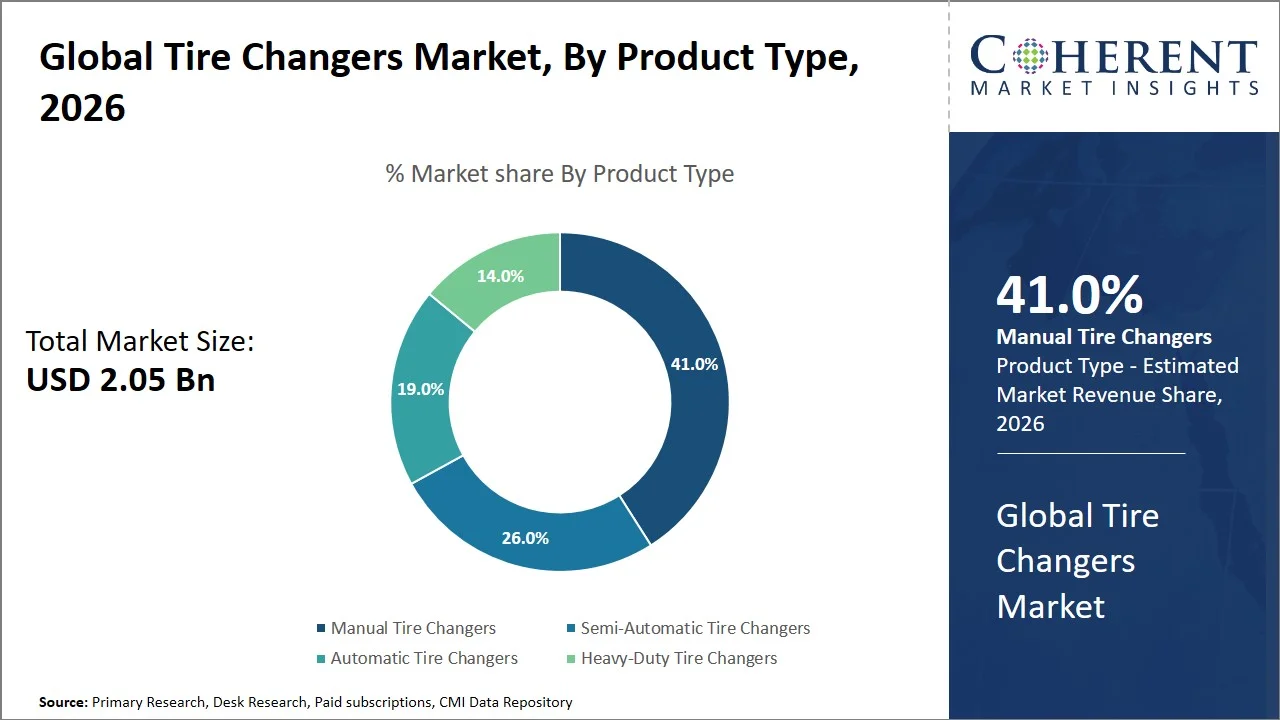
- The manual tire changers segment is expected to account for 41.0 % of the global tire changers market share in 2026. Expansion of commercial vehicle and fleet maintenance operations is driving the growth of the segment. On October 2, 2025, Ryder announced it has opened a new full-service commercial truck rental and maintenance facility at 6110 Leeville Pike in Lebanon, Tennessee, U.S. With five maintenance bays, integrated technology, and efficient operations, the site is equipped to provide fleet and commercial truck rental support to Ryder customers. (Source: Ryder)
- The passenger vehicle tires segment is estimated to capture 54.0 % of the market share in 2026. Increasing popularity of luxury passenger vehicles is driving the growth of the segment. For instance, Mercedes-Benz grew its revenues in India in 2025 owing to strong demand for its high-end luxury cars, even as stiff competition from rival BMW in the entry-level part of the luxury market pulled down the carmaker's overall sales in the country.
- The electric segment is estimated to capture 34.0 % of the market share in 2026. Integration of AI-assisted diagnostics and smart workshop systems is a major factor driving the growth of the segment. On February 12, 2025, PTC announced the release of the ServiceMax AI field service management assistant powered by generative artificial intelligence (GenAI). ServiceMax AI leverages the full documented history of a field asset stored in the ServiceMax platform, including equipment data, service history, and known service resolutions, to help field service technicians get more done in less time. (Source: PTC)
- North America is expected to dominate the tire changers market in 2026 with a market share of 36.0 %. Rising demand from logistics and commercial fleet operators is driving the growth of the regional market. On January 6, 2026, Ryder System, Inc. completed the acquisition of Truck Service Depot, an Atlanta, U.S.-based mobile maintenance business servicing commercial trucks and trailers in Georgia, U.S. (Source: Ryder)
- Asia Pacific is expected to account for 28.0 % share in 2026 and is projected to record the fastest growth over the forecast period. Expansion of organized tire retail networks in Asia Pacific is expected to drive the growth of the regional market. On September 1, 2025, Apollo Tyres launched its first Super Premium Retail Outlet in Bengaluru, India, introducing a new retail concept focused on premium tire solutions, digital appointment systems, lounge-style customer areas, and mobility services. (Source: Apollo Tyres)
- Rapid Adoption of Touchless and Fully Automatic Tire Changers: Automotive shops are spending more and more in touchless tire changers to reduce the interaction with rims and tires when mounting and demounting. Systems that are designed to minimize the possibility of wheel damage, boost technician efficiency and are particularly suited for premium alloy wheels, low profile tires and high performance automobiles.
- Growing Demand Driven by Electric Vehicle (EV) Tire Servicing: The growth of the electric vehicle fleet is driving the need for improved tire-changing equipment capable of handling larger wheel diameters, greater vehicle weights and unique electric vehicle and hybrid vehicle Servicing facilities are upgrading equipment to support the special maintenance needs of EVs and to make servicing more efficient.
Segmental Insights
Why Do Manual Tire Changers Dominate the Global Tire Changers Market?
The manual tire changers segment is expected to account for 41.0% of the global tire changers market share in 2026. The main driving force behind the supremacy of manual tire changers is that they are cost-effective and affordable by most. Small garages and independent tire shops and service centers especially in emerging markets favor manual equipment due to much lower up-front investment, little maintenance and no complex automation systems. This makes manual tire changers an economical choice for organizations that handle moderate volumes of tire service and want to stay profitable. On May 26, 2026, BendPak announced the launch of the Ranger R980DP swing-arm tire changer, which is meant to enhance productivity while retaining the affordable benefits of classic tire-changing platforms. The business said the equipment lets shops work on contemporary tires without spending money on high-end robotic tire-changing systems. (Source: BendPak)
- Current Industry Events of 2026
- Market Size Estimation
- Regional Breakdown
- Competitive Landscape
- Customer Intelligence
- Segmental Analysis
- Pricing Analysis
- Key Market Drivers, Challenges & Future Trends
- Customized Insights Section
Why are Passenger Vehicle Tires the Most Popular Vehicle Type?
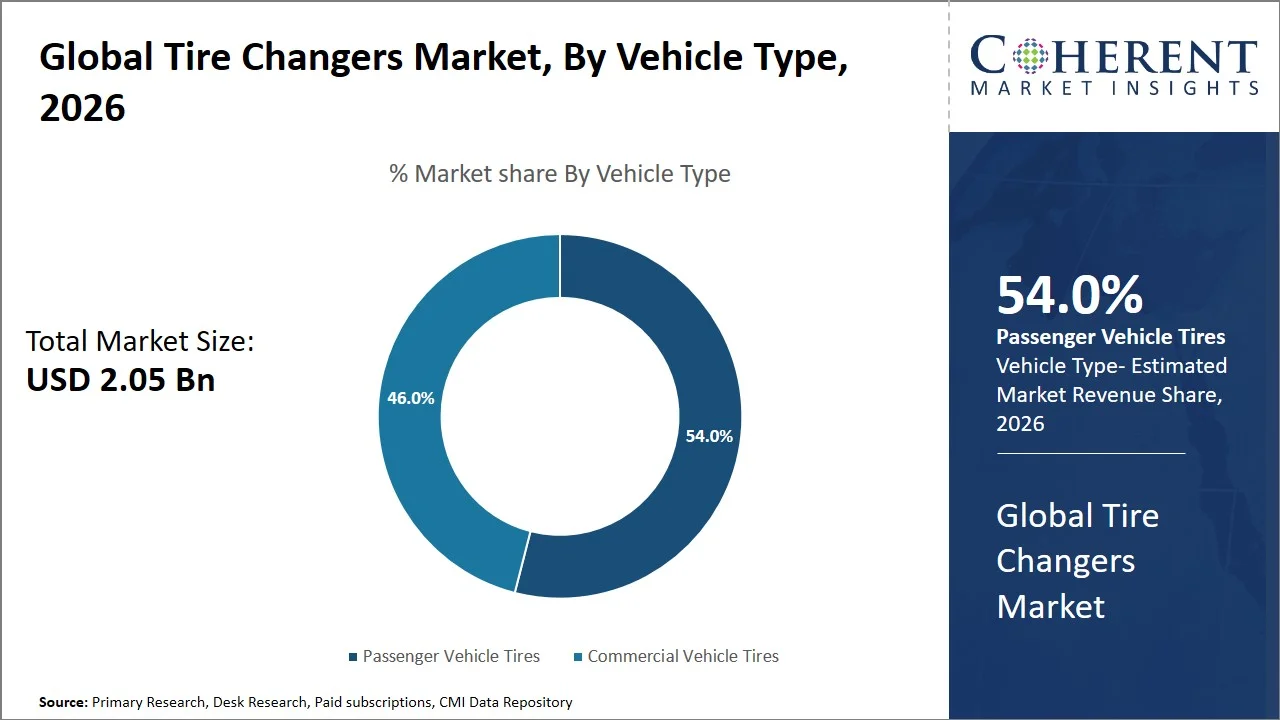
The passenger vehicle tires segment is expected to account for 54.0% of the global tire changers market share in 2026. The dominance of passenger car tires is driven by the huge and ever-expanding worldwide passenger vehicle fleet. Passenger cars have the biggest number of vehicles on road and require frequent tire changing, seasonal tire changing, balancing and maintenance therefore accounting for the highest demand for tire changing equipment across service facilities, dealerships and tire retail outlets across the globe. For instance, on January 29, 2026, Toyota Motor announced that it has sold a record 11.3 million vehicles worldwide in 2025, holding its crown as the world's top-selling carmaker for a sixth straight year. Group sales worldwide grew 4.6% from a year ago, including the parent company’s Toyota and Lexus brand vehicles and those sold by small-car affiliate Daihatsu and truck-maker Hino Motors.
Electric Dominates the Global Tire Changers Market
The electric segment is expected to account for 34.0% of the global tire changers market share in 2026. Electric tire changers are dominating the market due to their higher operational efficiency and productivity. Electric-powered machines deliver faster tire mounting and demounting, consistent performance and less human effort, enabling automobile workshops and tire service centers to increase service volume while enhancing technician efficiency and service quality. On May 29, 2025, Hofmann introduced the monty 3550 smartSpeed. The device has an electric drive that automatically adapts torque and speed to tire resistance. The technology helps to increase productivity by optimizing rotation speed during mounting and demounting operations, so personnel can perform jobs faster and with less danger of wheel damage. (Source: Hofmann)
Currents Events and their Impact
Current Events | Description and its Impact |
EU Data Act |
|
EU Right-to-Repair Directive |
|
Global Tire Changers Market - Annual Tire Replacement Volumes
The tire changers market is driven by the quantity of tire replacements made annually, as each replacement cycle creates the need for tire mounting, demounting, balancing and other workshop services. The biggest replacement tire volumes are in areas with large vehicle populations, high vehicle use rates, and extensive road networks and developed aftermarket ecosystems. AsiaPacific accounts for the largest share of worldwide tire replacement demand, due to the large vehicle parc and rising automotive ownership. Replacement demand in North America and Europe is robust, due to high vehicle mileage and stringent tire care procedures.
- Annual Tire Replacement Volumes by Region (2026 Estimate)
- Asia Pacific: 780 million tires replaced annually
- North America: 420 million tires replaced annually
- Europe: 390 million tires replaced annually
- Latin America: 135 million tires replaced annually
- Middle East & Africa: 95 million tires replaced annually
- Electric vehicle tire replacement is expanding at over 20% per year, faster than growth in conventional vehicle tire replacement.
- Globally, it is anticipated that more than 1.8 billion tires are replaced annually in passenger, commercial and specialist vehicle segments.
- Replacement tire installations are increasingly dominated by organized tire retail chains and dealership service networks, especially in North America, Europe, China and India.
- Replacement tire volumes continue to grow due to larger tire sizes and higher average tire replacement values, which is driven by increased SUV ownership.
Global Tire Changers Market - Automated Tire Changer Adoption Rate
Automotive workshops, tire retail chains, dealership service centers and fleet maintenance facilities are looking for more productivity, less labor dependence and better wheel protection and this has led to the steady growth in acceptance of automated tire changers. The demand for automated, touchless tire changers is increasing, especially in areas with high labor costs, rising EV populations and more premium vehicles with larger wheels and low-profile tires. High-volume service activities are moving towards automation; however emerging markets still rely on manual and semi-automatic methods.
- Automated Tire Changer Adoption Rate by Region (2026 Estimate)
- North America: 68% of professional tire service locations use automated tire changers
- Europe: 65% adoption rate
- Asia-Pacific: 42% adoption rate
- Latin America: 28% adoption rate
- Middle East & Africa: 22% adoption rate
- Estimated global penetration of robot tire changers is about 48-50% of professional tire servicing facilities.
- Almost 18-20% of all automatic tire changer installations are touchless tire changers worldwide.
- Over 75% of premium car dealer locations have automated or touchless tire changing equipment.
- 80%+ usage of automated tire changers in EV-certified service centers in developed markets.
- Why Large tire retail chains are roughly 2 times more likely than individual garages to utilize automated systems.
- Asia Pacific is projected to experience the fastest adoption increase through 2033, fueled by workshop modernization and EV expansion.
- Automated tire changers can boost tire servicing throughput by 25–40% compared to conventional manual equipment.
- Advanced automated solutions can cut technician labor requirements per tire change by roughly 30–50%
Tire Changers Market Dynamics
Market Drivers
Rising global vehicle parc and tire replacement volumes
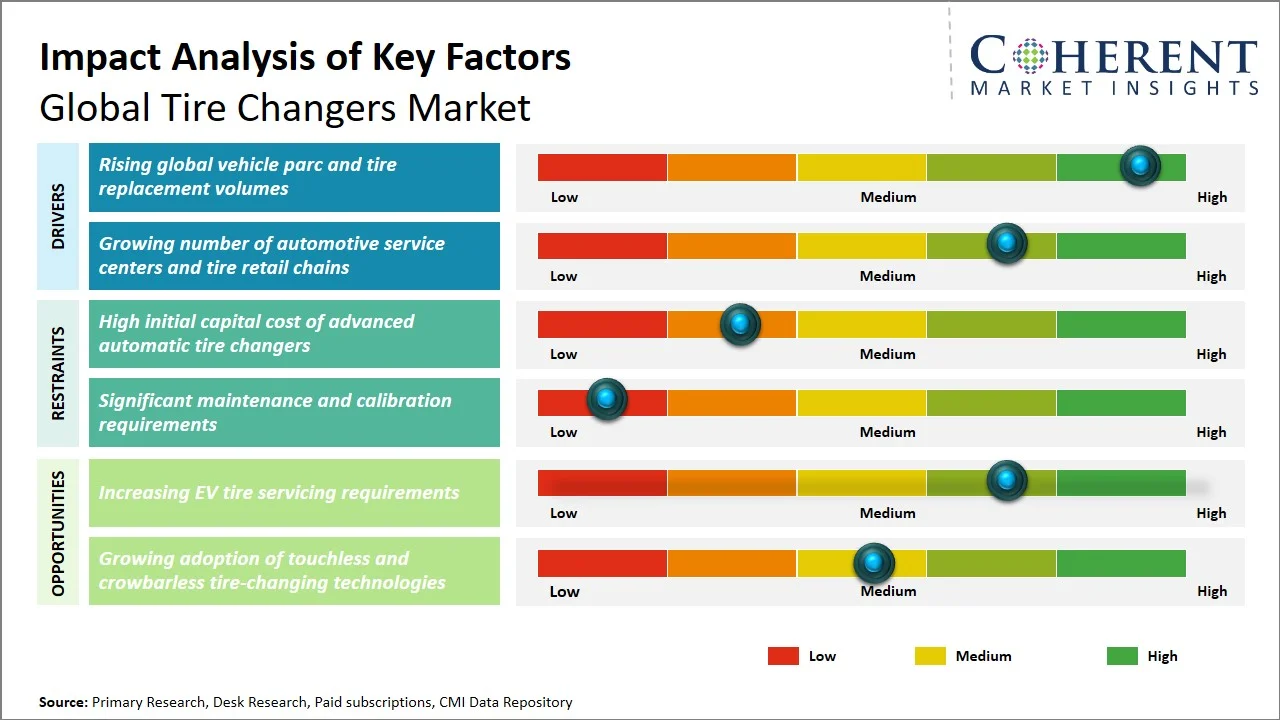
The growth in tire replacement volumes and the global vehicle parc are major growth factors for the tire changers market as the growing number of passenger cars, commercial vehicles, and electric vehicles on roads across the globe increases the need for regular tire maintenance and replacement. Tires need replacement every few years because of wear, changes in the seasons and safety standards, creating a constant flow of repair visits to workshops, dealerships and tire retail locations. The increased need for service is compelling automotive repair companies to invest in efficient tire changing equipment to enhance productivity, minimize turnaround time and serve a bigger number of customers.
On June 30, 2025, Bridgestone announced the further expansion of its premium replacement tire business with a focus on goods for passenger vehicles equipped with ENLITEN technology. The endeavor was spurred by the longer replacement cycles due to a larger global vehicle parc and the increasing share of vehicles requiring high-performance and EV-compatible tires. (Source: Bridgestone)
Growing number of automotive service centers and tire retail chains
Increasing number of automotive service centers and tire retail chains is significantly driving the growth of the tire changers market, as growing vehicle ownership and maintenance needs are escalating the emergence of new workshops, franchise service outlets and organized tire retail networks across the globe. These facilities need reliable and efficient tire-changing equipment to handle growing client traffic, increase service quality and cut labor-intensive processes. The rise in professional service infrastructure, especially in developing nations, is driving a steady demand for automated and manual tire changers in the automobile aftermarket industry.
On January 29, 2026, Ford Pro increased its Elite Commercial Service Center network to roughly 70 dedicated locations. These facilities provide dedicated fleet maintenance, tire service and repair operations, demonstrating ongoing investment in professional automotive service infrastructure. (Source: Ford Pro)
Emerging Trends
- Integration of Smart Diagnostics and Digital Workshop Connectivity: Modern tire changers are rapidly being connected with digital workshop management systems, cloud-based monitoring platforms, and diagnostic tools. Automated wheel measurement, service data tracking, predictive maintenance alerts and remote equipment diagnostics are some of the features improving operating efficiency and reducing downtime.
- Rising Popularity of Heavy-Duty and Multi-Purpose Tire Changing Equipment: The rise in commercial transportation, construction, mining, and agricultural machinery sectors has increased the demand for tire changers that can work with a variety of tire sizes. Manufacturers are designing multi-purpose equipment that can handle passenger vehicles, trucks, buses and off-road gear on a single platform to improve equipment usage and return on investment.
Global Tire Changers Market - Rise of Robotic Tire-Changing Systems
Robotic tire-changing systems are revolutionizing the face of the tire servicing industry with completely automated and semi-autonomous devices that can mount, demount, handle and check tires with little human intervention. The technologies help solve the technician shortage, enhance service consistency, reduce the danger of wheel damage and boost workshop productivity. The adoption is being driven by large tire retail chains, commercial fleet operators, EV repair facilities and high-volume dealerships that seek to improve labor efficiency and handle increasingly complicated tire and wheel assemblies.
- Rise of Robotic Tire-Changing Systems - Key Data Points (2026 Estimate)
- Global robotic/fully automated tire changers market penetration: ~6–8% of new tire changer installations
- Annual growth rate of robotic tire-changing installations: ~18–22%
- Average reduction in tire service labor requirements: ~50–70%
- Average increase in tire service throughput: ~30–45%
- Reduction in wheel/rim damage claims: ~40–60%
- Share of installations in large tire retail chains and fleet service centers: ~65%
- Average tire change cycle-time reduction: ~20–35%
- EV-focused service centers adopting robotic systems: ~15–20% globally
- Current robotic tire-changing installations are concentrated in North America and Europe, accounting for about 70%.
- Robotic tire-changing systems are the fastest growing end-user sector for commercial fleet maintenance operations.
- Robotic systems are being increasingly combined with AI-assisted inspection, wheel balancing and workplace management software.
- Premium automobile dealers are early adopters as they need to properly deal with pricey alloy wheels.
- Most robotic tire changers are built for big diameter EV, SUV and performance vehicle tires.
- Fully automated solutions can assist workshops overcome the problem of a shortage of competent workers with minimal interaction from a technician.
- Technology is taking hold in smart workshop settings where the focus is on connected equipment and automated digital workflows.
- Robotic and touchless tire-service technologies are part of the next generation of workshop automation and leading equipment manufacturers are investing extensively in this.
Regional Insights

Why is North America a Strong Market for Tire Changers?
North America is expected to account for a market share of 36.0% in 2026. North America is still a technology-driven tire changers market with the rapid growth of huge tire retail chains and dealership service networks. Major service providers such as Goodyear, Discount Tire and Monro Inc. continue to invest in automated and touchless tire service equipment to enhance throughput and reduce wheel damage claims. The region also has a high demand for equipment that can service EVs, as larger wheel diameters and low-profile tires used by manufacturers like Tesla require more sophisticated tire-changing systems than those used on traditional passenger vehicles. On April 3, 2025, Ranger Division of BendPak launched the Ranger Select service program to provide professional installation, setup and on-site training for new Ranger wheel balancers, tire changers, and brake lathes across the United States. (Source: BendPak)
Why Does the Asia Pacific Tire Changers Market Exhibit High Growth?
Asia Pacific is projected to account for 28.0% of the global tire changers market and is expected to register the fastest growth. Asia Pacific tire changers market is witnessing considerable traction from the workshop modernization process and growth of structured automobile service networks. In countries such as China, India, Japan and South Korea, there is more investment in dealership service centers and branded tire outlets run by businesses like as Bridgestone, Michelin and Yokohama Rubber. The rising popularity of EVs and premium passenger vehicles has hastened the introduction of automatic and touchless tire changers, especially in metro service hubs where faster turnaround times and wheel protection are significant competitive advantages. On October 15, 2025, SAMFD, a Chinese producer of workshop equipment, launched its new Swing Arm 24-inch economic tire changer for passenger vehicle and light commercial vehicle service centers. The company pointed to higher productivity, configurable flexibility and a competitive price for independent garages and tire dealers, indicating ongoing investment in the tire service equipment sector in China. (Source: SAMFD)
Global Tire Changers Market Outlook for Key Countries
Why is the U.S. Emerging as a Major Hub in the Tire Changers Market?
The U.S. tire changers market has a high penetration of automated workshop equipment and a robust replacement tire culture. Tire businesses like as Discount Tire and Tire Discounters are extending their store networks and investing in high-end tire-changing bays that can handle large SUV and EV wheels. Next generation touchless tire changers designed to eliminate technician involvement and increase productivity while preventing rim damage in high volume service operations are also being produced by equipment manufacturers such as Hunter Engineering Company.
Is China the Next Growth Engine for the Tire Changers Market?
China’s fast growing EV ecosystem and fiercely competitive automotive aftermarket are driving the tire changers industry. Service networks affiliated with local EV makers such as BYD and NIO are improving their workshop facilities for bigger EV tires and wheels. Local equipment vendors are increasingly manufacturing clever tire changers with automated positioning, digital controls and integrated wheel measurement systems to enable service centers enhance productivity while supporting the growing volume of passenger car repair.
Germany Tire Changers Market Analysis and Trends
Germany is one of the most advanced markets for tire service equipment in Europe, driven by its large premium automotive base and high service quality standards. Touchless tire changers are becoming more common in workshops that service BMW, Mercedes-Benz and Volkswagen automobiles because they safeguard pricey alloy wheels and run-flat tires. German equipment manufacturers, such as Ravaglioli and Hofmann, continue to focus on automation, ergonomics and digital workshop integration to fulfill the needs of high-end service centers.
India Tire Changers Market Analysis and Trends
The tire changers market in India is being driven by the fast growth of organized aftermarket service chains and OEM approved workshops. Companies such as MRF, Apollo Tyres and JK Tyre & Industries are constantly increasing their branded retail and service shops in Tier-1 and Tier-2 cities, which is boosting demand for contemporary tire-changing equipment. The increasing popularity of SUVs, premium passenger vehicles and electric two-wheelers has also resulted in service centers replacing manual systems with semi-automated and automatic tire changes to enhance the speed of service and minimize dependence on labor.
Japan Tire Changers Market Analysis and Trends
Japan’s tire changers market is driven by a very organized vehicle inspection and maintenance environment, where precision and equipment reliability are significant purchasing criteria. The tire service networks of Bridgestone and Yokohama Rubber have been constantly upgrading to modern automatic tire changers that can accommodate low-profile and high-performance tires. The expansion of the country's hybrid and EV fleet has also pushed workshops to invest in compact, high-precision tire servicing equipment to efficiently service new vehicles while meeting strict quality standards.
Global Tire Changers Market - Tire Changer Installed Base
Country | Installed Tire Changers (Units) |
China | 245,000 |
U.S. | 195,000 |
Germany | 68,000 |
Japan | 62,000 |
India | 58,000 |
U.K. | 42,000 |
France | 39,000 |
Italy | 37,000 |
South Korea | 34,000 |
Canada | 28,000 |
Global Tire Changers Market - Smart/Connected Tire Changer Installations
Region | Smart/Connected Tire Changers Installed (Units) |
North America | 46,500 |
Europe | 43,500 |
Asia Pacific | 42,000 |
Latin America | 10,500 |
Middle East & Africa | 7,500 |
How are Increasing EV Tire Servicing Requirements Creating New Growth Opportunities in the Tire Changers Market?
Increasing electric vehicle tire service requirements offer a substantial potential opportunity in the tire changers industry. Electric vehicles often have bigger wheel assemblies with low profile tires, stronger sidewalls and tires with better load-carrier ability to carry bigger battery packs. These features increase the complexity of tire mounting and demounting over typical automobiles, boosting demand for advanced automatic and touchless tire changers that can work safely with premium wheels and minimize damage. The global growth in EV adoption, and new electric models from Tesla, BYD, Hyundai, BMW and Mercedes-Benz is driving dealerships, tire retailers and independent workshops to update equipment to meet the specific servicing requirements for EV tires, leaving a high demand for next generation tire changing solutions.
On November 25, 2025, Michelin and Hyundai Motor Company renewed their partnership to create next-generation tires specifically designed for premium electric vehicles. The collaboration is focused on tires that are capable of supporting bigger battery-powered vehicles, boosting longevity and combining real-time tire monitoring systems underlining the increasing complexity of EV tire service needs. (Source: Hyundai)
Market Players, Key Development, and Competitive Intelligence

Key Developments
- On May 12, 2026, Automated Tire, Inc unveiled SmartBay, its industry-first, AI-powered robotic platform designed to execute automotive services, starting with tire changes, wheel balancing, and vehicle inspections.
- On March 13, 2025, Hunter Engineering announced the launch of the new TCX53Pro tire changer, matching the class-leading TCXH chassis with the power and safety of Hunter’s exclusive hybrid leverless head. Designed to deliver premium features and productivity in a familiar swing-arm format, the 53Pro also includes a locking lower disc and dual upper press rollers, equipping it to handle everything from 19.5s to advanced EV fitments.
Competitive Landscape
The global tire changers market is characterized by the existence of several established equipment manufacturers which compete on the basis of technological innovation, automation capabilities, product reliability and after-sales service support. The market is dominated by companies such as Hunter Engineering, Snap-on, Bosch Automotive Service Solutions, Corghi, Ravaglioli, Hofmann and Mondolfo Ferro. Regional players are also gaining ground with competitive pricing and local distribution networks. Growing emphasis on touchless tire changing technology, digital workshop integration and equipment intended for EV and premium car tire servicing is driving fierce competition in both developed and emerging markets.
Market Report Scope
Tire Changers Market Report Coverage
| Report Coverage | Details | ||
|---|---|---|---|
| Base Year: | 2025 | Market Size in 2026: | USD 2.05 Bn |
| Historical Data for: | 2020 To 2024 | Forecast Period: | 2026 To 2033 |
| Forecast Period 2026 to 2033 CAGR: | 3.8% | 2033 Value Projection: | USD 2.80 Bn |
| Geographies covered: |
| ||
| Segments covered: |
| ||
| Companies covered: | Hunter Engineering Company, Snap-on Incorporated, Bosch Automotive Service Solutions, Corghi, Ravaglioli, Hofmann, SICE, Mondolfo Ferro, Giuliano Automotive, Fasep, SICAM, Twin Busch, Coats, Accu-Turn, and TECO Automotive Equipment | ||
Analyst Opinion (Expert Opinion)
- Modernization of automobile service infrastructure and the increased complexity of vehicle tire systems are leading to a steady transformation of the tire changers industry. Service centers are investing more in automated and touchless technology in a bid to boost production, mitigate the danger of wheel damage and cope with manpower shortages. The adoption of electric vehicles, premium tire applications and the growth of organized aftermarket service networks globally are also predicted to impact the demand to a greater extent.
- Market is predicted to increase more in the approaching years owing to the increasing vehicle ownership and the ever-increasing need for tire replacement activities in all vehicle types. The rapid expansion of electric vehicles, greater use of linked workshop technologies and growing demand for improved tire servicing solutions capable of servicing larger, more complex wheel assemblies are expected to generate significant opportunities. Furthermore, investment in smart garages, dealer service centers, fleet maintenance facilities and branded tire retail networks is projected to drive the continuous adoption of next generation tire changers worldwide.
Speak to the analyst
Want personalized insights?
Take the findings above to one of our principal consultants, or have the report rebuilt around the segments, geographies and competitors you actually track.
Market Segmentation
- Product Type Insights (Revenue, USD Billion, 2021 - 2033)
- Manual Tire Changers
- Semi-Automatic Tire Changers
- Automatic Tire Changers
- Heavy-Duty Tire Changers
- Vehicle Type Insights (Revenue, USD Billion, 2021 - 2033)
- Passenger Vehicle Tires
- Commercial Vehicle Tires
- Power Source Insights (Revenue, USD Billion, 2021 - 2033)
- Electric
- Pneumatic
- Hydraulic
- Manual
- Mounting Type Insights (Revenue, USD Billion, 2021 - 2033)
- Portable Tire Changers
- Stationary Tire Changers
- End User Insights (Revenue, USD Billion, 2021 - 2033)
- Automotive Service Centers
- Tire Retail Stores
- Automotive Dealerships
- Fleet Operators
- Vehicle Manufacturing Facilities
- Regional Insights (Revenue, USD Billion, 2021 - 2033)
- North America
- U.S.
- Canada
- Latin America
- Brazil
- Argentina
- Mexico
- Rest of Latin America
- Europe
- Germany
- U.K.
- Spain
- France
- Italy
- Russia
- Rest of Europe
- Asia Pacific
- China
- India
- Japan
- Australia
- South Korea
- ASEAN
- Rest of Asia Pacific
- Middle East
- GCC Countries
- Israel
- Rest of Middle East
- Africa
- South Africa
- North Africa
- Central Africa
- North America
- Key Players Insights
- Hunter Engineering Company
- Snap-on Incorporated
- Bosch Automotive Service Solutions
- Corghi
- Ravaglioli
- Hofmann
- SICE
- Mondolfo Ferro
- Giuliano Automotive
- Fasep
- SICAM
- Twin Busch
- Coats
- Accu-Turn
- TECO Automotive Equipment
Sources
Primary Research Interviews
- Tire changer equipment manufacturers and suppliers
- Automotive service center operators and fleet managers
- Tire retail chain executives and independent tire shop owners
- Equipment distributors and aftermarket service providers
Magazines
- Tire Business Magazine
- Modern Tire Dealer Magazine
- Automotive Service Professional Magazine
- Fleet Equipment Magazine
Journals
- International Journal of Automotive Technology
- Journal of Automobile Engineering
- Automotive Industries Research Journal
Associations
- Tire Industry Association (TIA)
- Automotive Service Association (ASA)
- International Automotive Technicians Network (iATN)
- European Tyre and Rubber Manufacturers' Association (ETRMA)
Public Domain Sources
- U.S. Bureau of Labor Statistics automotive sector reports
- European Automobile Manufacturers Association (ACEA) publications
- International Trade Administration automotive equipment data
- National Highway Traffic Safety Administration (NHTSA) reports
Proprietary Elements
- CMI Data Analytics Tool
- Proprietary CMI Existing Repository of information for last 10 years
Get access to 250+ pages report
Every segment, forecast, competitor profile and data table behind the analysis above — available for instant download.
- ESOMAR Member
- ISO 9001:2015 Certified
- D-U-N-S Registered
- GDPR & CCPA Compliant
Missing comfort of reading report in your local language? Find your preferred language:
Transform your Strategy with Exclusive Trending Reports
Frequently Asked Questions
The global tire changers market is expected to stand at USD 2.05 Bn in 2026 and is expected to reach USD 2.80 Bn by 2033.
The CAGR of the global tire changers market is projected to be 3.8% from 2026 to 2033.
In terms of product type, the manual tire changers segment is estimated to dominate the market revenue share in 2026.
Expanding tire retail chains increase demand for modern tire service equipment across multiple service locations.
They increase service capacity, reduce labor requirements, and enable faster customer turnaround times.
Rising global vehicle parc and tire replacement volumes and growing number of automotive service centers and tire retail chains are the major factors driving the growth of the global tire changers market.
High initial capital cost of advanced automatic tire changers and significant maintenance and calibration requirements are the major factors hampering the growth of the global tire changers market.