

Tungsten Electrode Market Size and Share Analysis – 2026 To 2033
The global Tungsten Electrode Market size is expected to reach USD 133.51 Mn by 2033, exhibiting a CAGR of 2.5% from 2026 to 2033. The market was valued at USD 111.94 Mn in 2026. Increasing demand for precision welding in automotive and aerospace manufacturing, rising adoption of tungsten inert gas (TIG) welding in industrial applications, increasing investment in fabrication and metalworking activities, and growing use of tungsten electrodes for high-quality welding of stainless steel, aluminum, and specialty alloys are the major growth factors. The International Organization of Motor Vehicle Manufacturers (OICA) reported that global motor vehicle production increased from 92.7 Mn units in 2024 to 96.4 Mn units in 2025, a 3.9% increase.
Key Takeaways
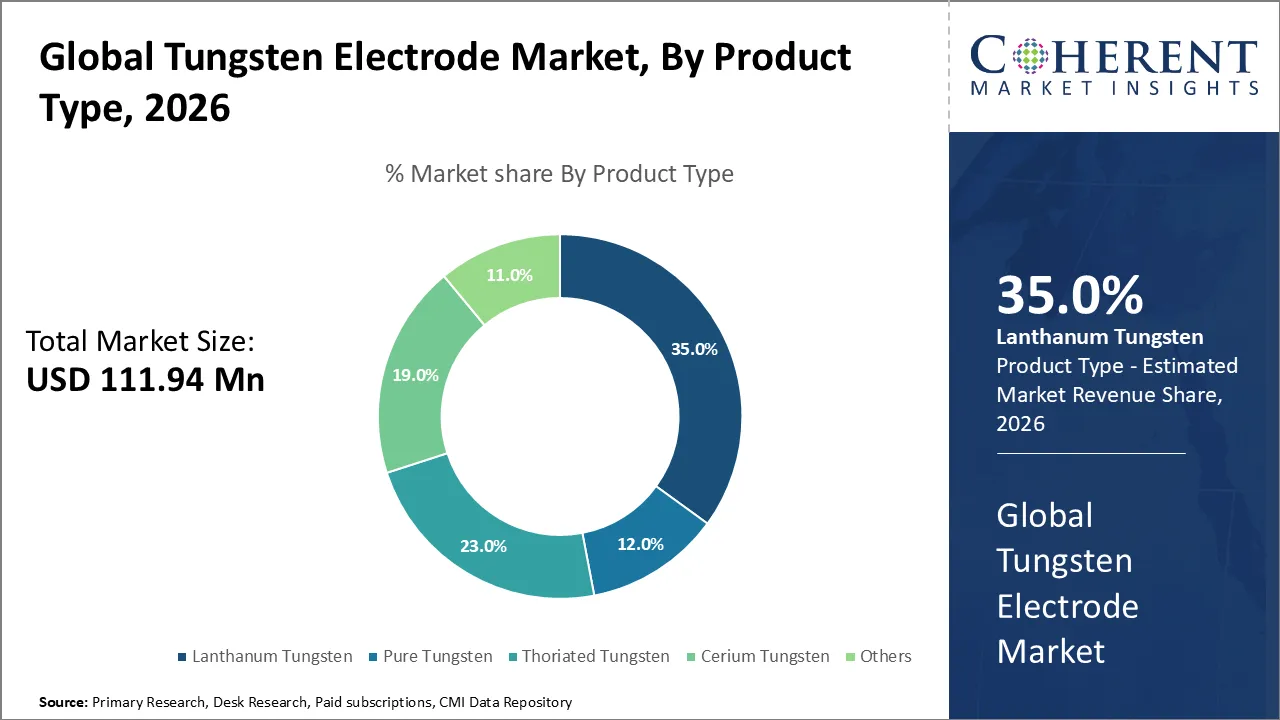
- The Lanthanum Tungsten segment is projected to dominate the global tungsten electrode market, in terms of share, with an estimated 35.0% by 2026. The segment is growing due to superior arc starting, improved arc stability, reduced electrode wear and the increasing switch to non-radioactive thoriated tungsten electrode substitutes. According to Miller Electric’s TIG welding guidance recommends 2% lanthanated tungsten electrodes for precision DC TIG welding, and prefers lanthanated and ceriated electrodes over pure tungsten in modern inverter-based welding systems.
- TIG Welding segment is expected to hold the largest market share of 75.0% in 2026. The growth is driven by high-precision welding demand in aerospace, automotive manufacturing, stainless steel fabrication and specialized industrial applications. According to the American Welding Society (AWS), the United States is expected to need approximately 320,500 new welding professionals by 2029, with an average of 80,000 welding jobs to fill every year between 2025-2029. This continues to reflect ongoing workforce needs in welding intensive manufacturing and infrastructure activities, supporting the wider welding equipment and consumables ecosystem.
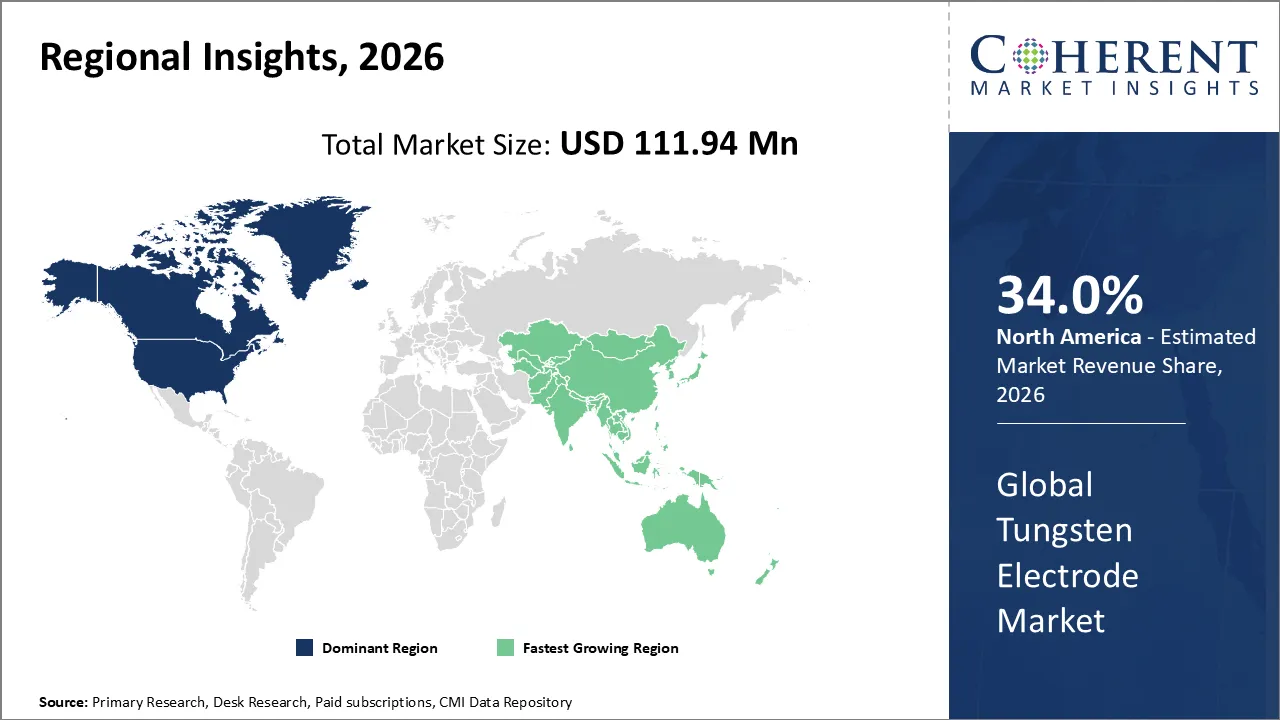
- North America is anticipated to hold a market share of approximately 34.0% of the global tungsten electrode market by 2026. Regional demand is driven by established aerospace and automotive manufacturing industries, precision metal fabrication activities, advanced welding technologies and investment in industrial infrastructure. According to the Mineral Commodity Summaries 2026 from the U.S. Geological Survey, the United States imported an estimated 10,000 metric tons of tungsten, excluding ores and concentrates, in 2025, up from 8,730 metric tons in 2024, an increase of about 14.5%.
Market Drivers
Rising Demand for Precision Welding in Aerospace Manufacturing is Driving the Tungsten Electrode Market
The global tungsten electrode market is growing steadily, fueled by rising demand for high-precision welding solutions in aerospace manufacturing, aircraft component fabrication, and specialized metalworking applications. Gas tungsten arc welding (GTAW) relies on tungsten electrodes to deliver controlled heat input, stable arc performance and high-quality welds for thin-gauge metals and specialty alloys. The increasing manufacturing requirements for aircraft engines, structural assemblies and critical components are propelling the demand for reliable welding consumables.
According to Boeing’s third-quarter 2026 financial results, the company delivered 475 commercial aircraft in the first nine months of 2026, up from 440 aircraft in the same period in 2025, an increase of about 8.0%. The company’s commercial airplane backlog also exceeded 6,300 aircraft valued at approximately USD 612 Billion, indicative of continued aerospace manufacturing demand.
Additionally, Boeing said its 787 production program was running at eight aircraft per month in the third quarter of 2026. Rising aircraft production and manufacturing activity is opening opportunities for precision welding equipment and consumables used in qualifying aerospace fabrication processes.
Expansion of Oil & Gas Infrastructure and LNG Projects is Supporting Market Growth
Rising investments in oil & gas infrastructure, liquefied natural gas (LNG) processing facilities and industrial pipeline systems are becoming significant growth drivers of the global tungsten electrode market. Tungsten inert gas (TIG) welding is commonly used for the manufacture of high integrity pipe joints, stainless steel equipment, pressure containing components and also corrosion resistant alloys. The demand for tungsten electrodes is growing as the importance of weld integrity, corrosion resistance and reliable industrial operations increases in specialized fabrication and maintenance activities.
According to the International Energy Agency’s Global LNG Capacity Tracker, updated in October 2026 finds that projects already under construction and with final investment decisions at the start of 2025 are expected to bring on stream more than 330 bcm/year of new LNG export capacity worldwide between 2025 and 2030. This is the biggest wave of LNG capacity additions ever in the history of the industry.
Furthermore, the U.S. Energy Information Administration (EIA) also reported in September 2026 that U.S. LNG exports averaged 17.4 billion cubic feet per day during the first half of 2026, up 23% from the same period in 2025. As LNG export terminals, liquefaction trains, and related processing infrastructure increase in number, there should be a corresponding increase in demand in welding and metal fabrication work.
Current Events and Their Impact on the Tungsten Electrode Market
Current Event | Description and its Impact |
China Introduces Export Controls on Tungsten-Related Materials (February 2025) |
|
U.S. Government Reaffirms Tungsten as a Critical Mineral in Updated 2025 List (November 2025) |
|
- Current Industry Events of 2026
- Market Size Estimation
- Regional Breakdown
- Competitive Landscape
- Customer Intelligence
- Segmental Analysis
- Pricing Analysis
- Key Market Drivers, Challenges & Future Trends
- Customized Insights Section
Segmental Insights
Why is Lanthanum Tungsten Acquiring the Largest Market Share?
On the basis of product type, the Lanthanum Tungsten is expected to hold the largest share of the global Tungsten Electrode Market, with an estimated 35.0% in 2026. The segment's growth is due to its superior arc-starting characteristics, prolonged electrode life, excellent thermal stability, and increasing demand for non-radioactive replacements to thoriated tungsten electrodes. Lanthanated tungsten electrodes are widely used for precision welding of stainless steel, aluminum, titanium and other specialty alloys.
In January 2025, Yaskawa Motoman reported that 2% lanthanated tungsten electrodes contain about 98% tungsten and 2% lanthanum, which provides excellent arc stability and is suitable for alternating current (AC) and direct current (DC) welding. The company also lists 1.5% and 2% lanthanated electrodes as multi-purpose choices for welding a variety of metals.
TIG Welding Holds the Largest Market Share
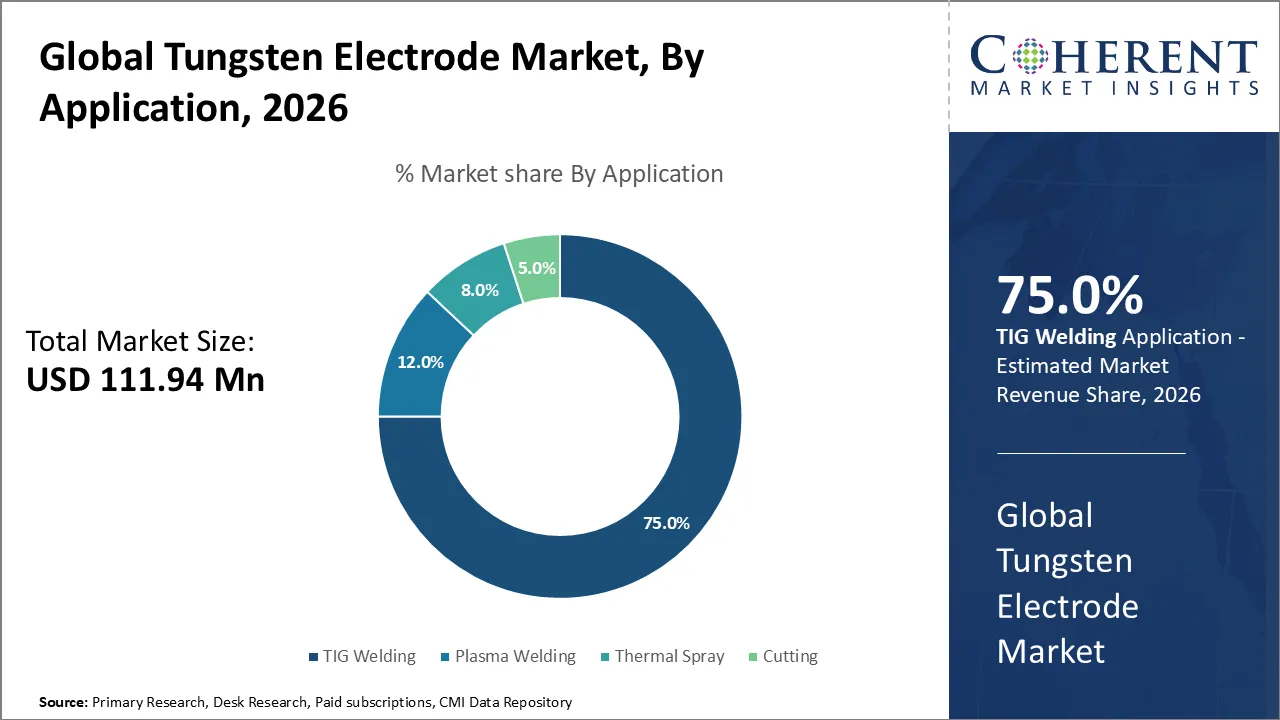
Based on application, the TIG Welding segment is expected to hold the largest share of the global Tungsten Electrode Market by 2026, at 75.0%. The segment growth is attributed to the rising demand for high-quality weld joints, precise heat control, low weld contamination, and increased structural integrity in automotive, aerospace, chemical processing, and industrial fabrication applications. TIG welding employs non-consumable tungsten electrodes to form stable welding arcs, ideal for joining thin-section metals, stainless steel and specialty alloys.
According to a study, published in April 2026 in Scientific Reports, investigated TIG welding of AISI 304L and AISI 409M stainless steel, noting welded-joint tensile strengths ranging from 522 MPa to 644 MPa depending on the welding conditions. The study emphasizes the need to optimize welding current, shielding gas flow, and travel speed for achieving uniform weld quality in industrial applications.
Additionally, a study published in Results in Materials in 2026 studied gas tungsten arc welding of AISI 304 stainless steel and reported an optimal welding current range of 25–30 amperes for achieving balanced mechanical strength and fusion integrity in thin-section welded joints. Such findings underscore the significance of controlled TIG welding processes and suitable tungsten electrodes for precision metal fabrication.
Tungsten Electrode Market Trends
- The increasing adoption of advanced TIG welding automation and robotic manufacturing systems is driving the demand for high-performance tungsten electrodes that deliver consistent arc stability, accurate weld control and reduced electrode wear. “Global industrial robot installations grew by 11% in 2025 to over 600,000 units, and the operational stock was estimated at some 5 million units in September 2026,” said the International Federation of Robotics. The expansion is a reflection of the growing trend in industrial automation, opening possibilities for the use of tungsten electrodes in automated TIG welding systems.
- The increasing popularity of non-radioactive lanthanated, ceriated and rare-earth-blended tungsten electrodes is helping to drive the shift to safer and more efficient welding consumables. These electrodes are designed for better arc starting, consistent electrical performance and compatibility with AC/DC welding equipment, making them ideal for precision fabrication, aerospace components and specialty metal joining applications
- Increasing emphasis on tungsten recycling and sourcing of alternative raw materials is transforming procurement strategies across tungsten electrode market. China’s tungsten concentrate output was about 65,000 metric tons of metal content in 2025, down 0.9% from a year earlier, as domestic primary tungsten demand rose 4.3%, CMOC Group said.
Regional Insights
North America Dominates Owing to Advanced Aerospace Manufacturing and Strong Precision Welding Infrastructure
North America is expected to hold around 34.0% of the global Tungsten Electrode Market by 2026. The region’s growth is driven by its strong aerospace and defense manufacturing industries, growing adoption of precision TIG welding technologies, advanced metal fabrication infrastructure, and demand for high-performance welding consumables. Continued investment in industrial manufacturing and major welding equipment manufacturers are supporting the use of lanthanated, ceriated and other tungsten electrodes.
According to the Aerospace Industries Association (AIA), total sales in the U.S. aerospace and defense industry in 2025 were USD 988.6 billion, with capital expenditures increasing 13% year-on-year to USD 45 billion in June 2026. Nationwide, the industry also supported some 9,300 establishments, highlighting the size of aerospace manufacturing and its related industrial supply chains.
In addition, the World Steel Association’s September 2026 data showed that North American crude steel production rose 4.7% in January-September 2026 from a year earlier. The United States grew 5.8% over the same stretch. The expansion is indicative of continued activity in the regional metal fabrication ecosystem that could support downstream demand for welding equipment and consumables.
Asia Pacific Tungsten Electrode Market Trends
The Asia Pacific region is anticipated to be the fastest growing region in the global Tungsten Electrode Market from 2026 to 2033. Growth in the region is driven by rising automotive and electronics manufacturing, demand for industrial welding technologies and increasing investments in metal fabrication infrastructure across China, India, Japan, South Korea and Southeast Asia. In addition, the regional supply chain for tungsten electrodes is supported by the presence of major tungsten processing and manufacturing facilities, particularly in China.
India produced 164.9 million metric tons of crude steel in 2025, up 10.4% from the previous year, the World Steel Association reported in January 2026. Vietnam grew 12.2%, producing 24.7 million metric tons. The increase in industrial metal production points to increasing opportunities for downstream fabrication, including applications requiring TIG welding and tungsten electrode consumables.
In addition, the OECD Steel Outlook 2026 projects that India’s steel production will increase from about 164.4 million metric tons in 2025 to 208.3 million metric tons by 2030, at a CAGR of 4.8%. ASEAN steel production is projected to increase from 60.2 million metric tons to 90.6 million metric tons during the same period, with a CAGR of 8.5%. The expected regional growth in steel production will boost metal fabrication activities and provide growth prospects for precision welding technologies and tungsten electrode manufacturers.
Growing Demand for Precision Welding and Skilled Fabrication Workforce is Supporting the Tungsten Electrode Market in the United States
The U.S. Tungsten Electrode Market is projected to experience consistent growth due to the growing demand for precision welding technologies used in industrial machinery, transportation equipment, specialty metal fabrication, and infrastructure maintenance. The growing emphasis on weld quality, high-performance electrode materials, and automated TIG welding systems is supporting demand for lanthanated, ceriated, and other tungsten electrodes.
According to the U.S. Bureau of Labor Statistics (BLS), in its 2026 Occupational Outlook, approximately 40,300 job openings for welders, cutters, solderers, and brazers are projected annually during 2025–2035, with employment expected to increase by 2.0% over the period. These projections highlight continued workforce requirements across metal fabrication, machinery manufacturing, and infrastructure-related welding activities, supporting the broader demand environment for welding equipment and consumables.
China Tungsten Electrode Market Trends
China is expected to remain a major manufacturing and consumption hub for tungsten electrodes, supported by its established tungsten processing industry, expanding welding equipment production, and growing adoption of precision welding technologies across automotive, machinery, electronics, and industrial fabrication applications. The presence of specialized tungsten electrode producers and increasing investments in manufacturing infrastructure are supporting the country's competitive position in the global market.
In July 2026, Shandong Weldstone Tungsten Industry Co., Ltd., part of the ABICOR GROUP, inaugurated an additional manufacturing facility in Zibo, China. The new building covers approximately 8,800 square meters, including 2,850 square meters of production space, 1,800 square meters of storage facilities, and 3,510 square meters for administration and testing. The company manufactures tungsten electrodes, welding accessories, and specialized tungsten components.
Who are the Major Companies in Tungsten Electrode Industry
Some of the major key players in Tungsten Electrode Market are Diamond Ground Products, Astaras, Inc., Weldstone, Winner Tungsten Products Co. Ltd., Huntingdon Fusion Techniques, Metal Cutting, BGRIMM Advanced Materials Science & Technology Co., Ltd., Sunrain Tungsten, and ATTL Advanced Materials Co., Ltd.
Key News
- In August 2025, Astaras inaugurated a tungsten heavy-alloy manufacturing facility in Clearwater, Florida, and introduced its DENSALLOY U.S.-made tungsten heavy alloys brand. The development expands U.S. manufacturing capabilities for aerospace and defense-related tungsten materials.
- In June 2026, Diamond Ground Products published an update highlighting elevated tungsten raw material prices, with European ammonium paratungstate prices reported at approximately USD 3,000–3,200 per metric ton unit (MTU). The development highlighted raw material cost pressures affecting the tungsten electrode supply chain and the growing importance of electrode utilization and procurement optimization.
Market Report Scope
Tungsten Electrode Market Report Coverage
Report Coverage | Details | ||
Base Year: | 2025 | Market Size in 2026: | USD 111.94 Mn |
Historical Data for: | 2020 to 2024 | Forecast Period: | 2026 to 2033 |
CAGR: | 2.5% | 2033 Value Projection: | USD 133.51 Mn |
Geographies covered: |
| ||
Segments covered: |
| ||
Companies covered: | Diamond Ground Products, Astaras, Inc., Weldstone, Winner Tungsten Products Co. Ltd., Huntingdon Fusion Techniques, Metal Cutting, BGRIMM Advanced Materials Science & Technology Co., Ltd., Sunrain Tungsten, and ATTL Advanced Materials Co., Ltd. | ||
Growth Drivers: |
| ||
Restraints & Challenges: |
| ||
Analyst Opinion
- The global Tungsten Electrode Market is expected to witness steady growth, supported by increasing demand for precision welding, high-performance consumables, and advanced material processing technologies. However, rising tungsten prices are likely to influence manufacturers' production costs and procurement strategies. According to a September 2026 filing with the U.S. Securities and Exchange Commission (SEC), European ammonium paratungstate (APT) prices increased from about USD 330 per metric ton unit (MTU) in January 2025 to USD 3,075 per MTU in June 2026. The steep rise indicates the increasing significance of raw material efficiency and electrode life in the welding consumables market.
- The growing focus on supply chain diversification and regional processing of tungsten is likely to change the competitive dynamics for tungsten electrode manufacturers. Fastmarkets said international tungsten concentrate prices were USD 2,500-2,800 per MTU in June 2026, against USD 750-850 per MTU at the beginning of 2026. The widening gap between domestic Chinese prices and international market prices reflects the increasing complexity of sourcing. This should prompt electrode manufacturers to explore alternative sourcing partnerships, enhance inventory management and invest in tungsten recycling.
- The growing non-radioactive welding consumables demand is expected to drive the technological advancement of tungsten electrode market, particularly lanthanated and ceriated electrodes. The International Atomic Energy Agency (IAEA) recommends that, where possible, thoriated tungsten electrodes should be replaced by non-radioactive alternatives containing cerium oxide or lanthanum oxide. This guidance promotes the use of safer electrode materials in precision TIG welding applications. The manufacturers providing advanced non-radioactive electrodes with stable arc performance, better ignition characteristics and longer service life are expected to improve their competitive positioning over the forecast period.
Speak to the analyst
Want personalized insights?
Take the findings above to one of our principal consultants, or have the report rebuilt around the segments, geographies and competitors you actually track.
Market Segmentation
- By Product Type (Revenue, USD Mn, 2021-2033)
- Pure Tungsten
- Thoriated Tungsten
- Lanthanum Tungsten
- Cerium Tungsten
- Others (Yttrium Tungsten, Zirconiated Tungsten, and Others)
- By Application (Revenue, USD Mn, 2021-2033)
- TIG Welding
- Plasma Welding
- Thermal Spray
- Cutting
- By Region (Revenue, USD Mn, 2021-2033)
- North America
- U.S.
- Canada
- Latin America
- Brazil
- Mexico
- Argentina
- Rest of Latin America
- Europe
- Germany
- U.K.
- France
- Italy
- Spain
- Russia
- Rest of Europe
- Asia Pacific
- China
- India
- Japan
- Australia
- South Korea
- ASEAN
- Rest of Asia Pacific
- Middle East
- GCC
- Israel
- Rest of Middle East
- Africa
- South Africa
- Central Africa
- North Africa
- North America
Sources
Primary Research Interviews
- Tungsten electrode manufacturers and suppliers
- TIG welding equipment manufacturers and technology developers
- Tungsten mining, refining, and processing industry experts
- Welding engineers and industrial fabrication specialists
- R&D heads from welding consumables and advanced materials companies
- Aerospace, automotive, oil & gas, and industrial manufacturing procurement managers
- Key opinion leaders (KOLs) in welding technologies and tungsten metallurgy
Databases
- U.S. Geological Survey (USGS)
- World Bank
- Organisation for Economic Co-operation and Development (OECD)
- United Nations Comtrade Database (UN Comtrade)
- U.S. International Trade Commission (USITC)
- National Institute of Standards and Technology (NIST)
- U.S. Bureau of Labor Statistics (BLS)
Magazines
- The Welding Journal
- The Fabricator
- Welding & Gases Today
- Metalworking World Magazine
- Manufacturing Today
- Industrial Heating
Journals
- Welding in the World
- Science and Technology of Welding and Joining
- Journal of Materials Processing Technology
- Journal of Manufacturing Processes
- Materials Science and Engineering: A
- International Journal of Refractory Metals and Hard Materials
Newspapers
- The Wall Street Journal
- Financial Times
- Reuters
- The Economic Times
- Nikkei Asia
Associations
- American Welding Society (AWS)
- International Institute of Welding (IIW)
- The Welding Institute (TWI)
- International Tungsten Industry Association (ITIA)
- ASTM International – Welding and Tungsten Material Standards
- European Welding Federation (EWF)
- Society of Manufacturing Engineers (SME)
Public Domain Sources
- Company Annual Reports and Investor Presentations
- Government Mining and Mineral Commodity Statistics
- Tungsten Production, Import, and Export Statistics
- Company Product Catalogs and Technical Specifications
- Welding Equipment and Tungsten Electrode Manufacturer Publications
- Patent Databases such as WIPO, USPTO, and Google Patents
- Publicly Available Welding Technology and Industrial Manufacturing Research Reports
- Regulatory and Standards Publications Related to Tungsten Materials, Welding Safety, and Industrial Applications
Proprietary Elements
- CMI Data Analytics Tool
- Proprietary CMI Existing Repository of Information for the Last 10 Years
Get access to 250+ pages report
Every segment, forecast, competitor profile and data table behind the analysis above — available for instant download.
- ESOMAR Member
- ISO 9001:2015 Certified
- D-U-N-S Registered
- GDPR & CCPA Compliant
Missing comfort of reading report in your local language? Find your preferred language:
Transform your Strategy with Exclusive Trending Reports
Frequently Asked Questions
The global Tungsten Electrode Market is expected to reach USD 133.51 Mn by 2033, increasing from USD 111.94 Mn in 2026.
Major players operating in the global Tungsten Electrode Market include Diamond Ground Products, Astaras, Inc., Weldstone, Winner Tungsten Products Co. Ltd., Huntingdon Fusion Techniques, Metal Cutting, BGRIMM Advanced Materials Science & Technology Co., Ltd., Sunrain Tungsten, and ATTL Advanced Materials Co., Ltd.
High volatility in tungsten raw material prices, supply chain disruptions, dependence on China for tungsten supply, and health and safety concerns associated with thoriated tungsten electrodes are the major factors hampering market growth.
Increasing adoption of precision TIG welding in automotive and aerospace manufacturing, rising demand for high-performance welding consumables, and expanding industrial metal fabrication activities are the major factors driving market growth.
The global Tungsten Electrode Market is anticipated to grow at a CAGR of approximately 2.5% between 2026 and 2033.
North America is expected to account for the largest share of the global Tungsten Electrode Market, with an estimated 34.0% share in 2026, supported by advanced aerospace manufacturing and precision welding infrastructure.
Asia Pacific is expected to witness the fastest growth during the forecast period, owing to expanding automotive manufacturing, industrial fabrication, welding equipment production, and tungsten processing activities across China, India, and Southeast Asia.