

Welding Consumables Market Analysis & Forecast: 2026-2033
Welding Consumables Market is estimated to be valued at USD 19.98 Bn in 2026 and is expected to reach USD 30.04 Bn in 2033, exhibiting a compound annual growth rate (CAGR) of 6.0% from 2026 to 2033.
Key Takeaways
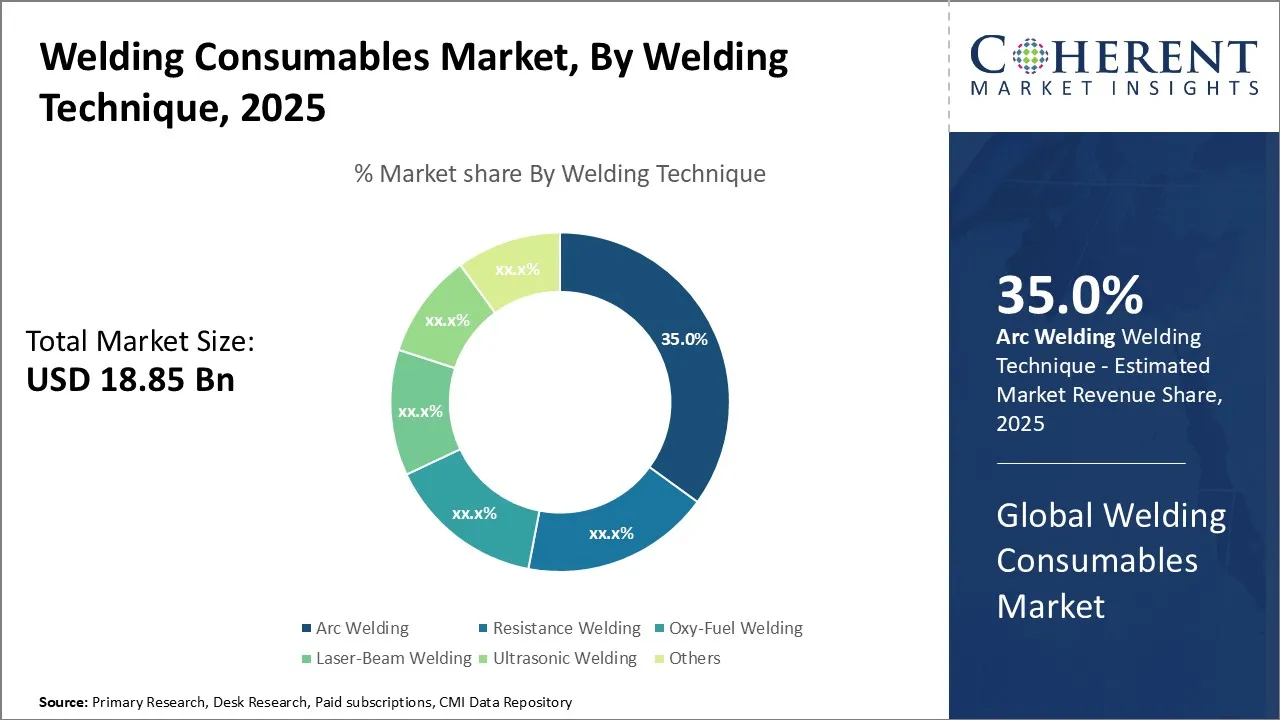
- According to Welding Techniques, The Arc Welding Segment is anticipated to hold major share of 36% for the Welding Consumables market in 2026.
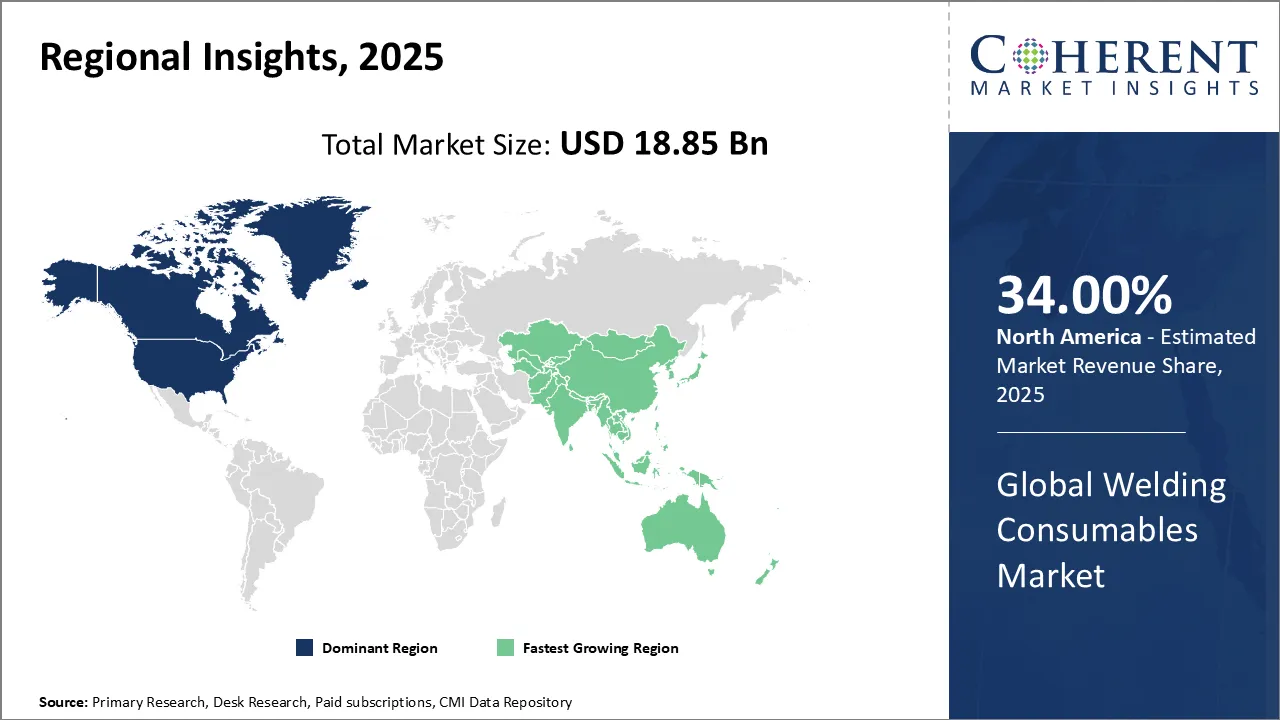
- According to region, North America also holds the largest market share of 34.0% for Welding Consumables market growth by 2026.
Market Overview
The Welding Consumables Market Size is expanding rapidly because to technology breakthroughs, infrastructure expansion, and industrialization In order to protect the weld pool from oxidation, a widely used method involves the utilization of flux, which generates a shielding gas to envelop the weld. Various types of consumables are available, including stick electrodes, flux-cored wires, SAW wires & fluxes, and other specialized options, catering to distinct welding requirements.
For instance, in May 2024, Superon Technik India has become a name associated with trust and quality in the welding industry in this country. Superon is now the leading manufacturer and supplier of stainless-steel welding consumables, serving an enormous customer base of over five lakh fabricators and welders across India.
Current Events and Its Impact on the Welding Consumables Market
Event | Description and Impact |
Surge in European infrastructure and construction investment |
|
Automotive sector shift to lightweight, high-strength vehicles |
|
Segmental Insights
- Current Industry Events of 2026
- Market Size Estimation
- Regional Breakdown
- Competitive Landscape
- Customer Intelligence
- Segmental Analysis
- Pricing Analysis
- Key Market Drivers, Challenges & Future Trends
- Customized Insights Section
Welding Consumables Market Insights, by Welding Technique
In terms of Welding Technique, the arc welding segment is expected to contribute largest share of the Welding Consumables market trends in 2026. This growth is driven by the versatility of arc welding, which can be applied to a broad range of materials such as carbon steel, stainless steel, aluminum, and various alloys, making it suitable for diverse industrial applications.
Welding Consumables Market Insights, by Welding Consumables
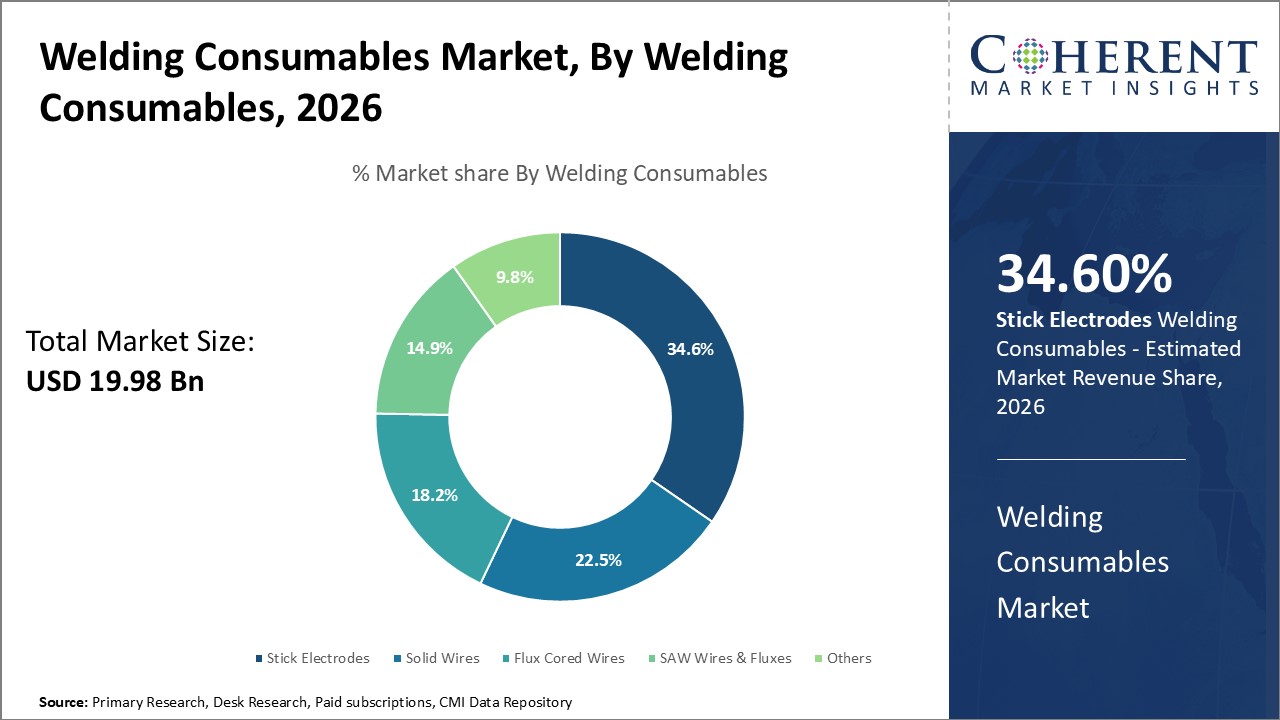
In terms of Welding Consumables, the Stick Electrodes segment is expected to contribute largest share of the Welding Consumables market trends in 2026. Stick electrodes, also known as shielded metal arc welding (SMAW) electrodes, are widely used due to their ability to weld a variety of metals including steel, stainless steel, cast iron, and aluminum without the need for external shielding gases or complex setups.
Welding Consumables Market Insights, by Application
In terms of Application, the Automotive & Transportation segment is expected to contribute largest share of the Welding Consumables market trends in 2026. This segment benefits from the extensive use of welding consumables in vehicle manufacturing, where they are essential for producing lightweight, high-quality parts and ensuring the structural integrity of modern vehicle designs.
The automotive industry relies heavily on various welding techniques, especially arc welding—for joining chassis components, frames, and other parts that require both strength and flexibility in design.
Regional Insights
North America Welding Consumables Market
Asia Pacific has historically been the dominant region as it drives major Welding Consumables Market Trends with 34.0% market share. North America leads the global welding consumables market, holding the largest market share, largely due to its early adoption of automation and robotics in manufacturing, which demands high-quality and consistent welding consumables.
The region is characterized by significant infrastructure and construction projects, as well as strong activity in industries such as automotive, aerospace, and energy, all of which require reliable welding solutions to ensure structural integrity and compliance with stringent quality standards.
Asia Pacific Welding Consumables Market
Asia Pacific is expected to witness significant growth in the forecast period as countries such as China, India, Japan, and Indonesia in the Asia Pacific region are fast emerging economies. Corporate sector and manufacturing sector is growing rapidly and hence infrastructure such as corporate buildings, and manufacturing plants requirements is also increasing rapidly.
Asia Pacific is experiencing a rising demand for welding consumables due to their utilization in the construction sector for joining metal framework, including roofs, walls, and other structural components. As a result, the demand for welding consumables in the Asia Pacific region is on the upward trajectory.
Europe Welding Consumables Market
Stick electrodes represent the largest product segment, while arc welding is the most widely used technique in the region. The construction industry remains the leading end-user, benefitting from ongoing residential, commercial, and infrastructure development across Europe.
Additionally, the adoption of advanced welding technologies, such as laser and ultrasonic welding, is enhancing the production of lightweight and high-strength components, especially in automotive and aerospace applications.
Welding Consumables Market Outlook Country-Wise
U.S Welding Consumables Market
The U.S. market also benefits from advanced welding technologies and automation, particularly in automotive, aerospace, and energy industries, which demand high-performance and reliable welding consumables. The presence of major manufacturers and a strong focus on quality and safety standards further reinforce the United States’ leadership in this sector.
India Welding Consumables Market
India’s welding consumables market is experiencing rapid expansion, driven by large-scale infrastructure projects, urbanization, and the growth of the automotive and manufacturing sectors. The government’s focus on initiatives such as “Make in India” and investments in smart cities and industrial corridors are creating substantial demand for welding consumables.
China Welding Consumables Market
China stands as the largest market for welding consumables globally, underpinned by its massive manufacturing base, extensive infrastructure development, and leadership in shipbuilding, automotive, and construction industries. The country’s ongoing urbanization, investments in high-speed rail, and renewable energy projects further drive demand for welding consumables.
Market Report Scope
Welding Consumables Market Report Coverage
| Report Coverage | Details | ||
|---|---|---|---|
| Base Year: | 2025 | Market Size in 2026: | USD 19.98 Bn |
| Historical Data for: | 2020 To 2024 | Forecast Period: | 2026 To 2033 |
| Forecast Period 2026 to 2033 CAGR: | 6.0% | 2033 Value Projection: | USD 30.04 Bn |
| Geographies covered: |
| ||
| Segments covered: |
| ||
| Companies covered: | Voestalpine AG, Arcon Welding Equipment, Colfax Corporation, Kemppi Oy, The Lincoln Electric Company, Tianjin Bridge Welding Materials Co., Ltd., Air Liquide, Fronius International GmbH, Hyundai Welding Co., Ltd., Denyo Co., Ltd., Obara Corporation, Illinois Tool Works Inc., Panasonic Corporation, and others | ||
| Growth Drivers: |
| ||
| Restraints & Challenges: |
| ||
Welding Consumables Market: Growth Drivers
- Adoption Of IoT
The incorporation of IoT (Internet of Things) technology in welding consumables is an emerging trend that has the potential to revolutionize the welding industry. While IoT integration in welding consumables is still in its early stages, it offers numerous benefits and opportunities for improvement.
- Technological Advancements
Advancements in welding technologies and processes drive the demand for specialized welding consumables. For example, the adoption of advanced welding techniques like laser welding, friction stir welding, and robotic welding creates the need for specific consumables tailored for these processes. The market responds by introducing innovative and efficient welding consumables.
Welding Consumables Market: Trends
- Focus on Environmentally Friendly Solutions
The Global Welding industry is increasingly conscious of environmental concerns, leading to a growing demand for eco-friendly welding consumables. This includes consumables with reduced emissions of fumes and gases, as well as those that minimize waste and promote recycling. Manufacturers are developing new consumables that meet these requirements to cater to environmentally conscious customers.
- Introduction of Innovative Alloys
The development of new alloys and materials has been influencing the welding consumable market. With advancements in industries such as aerospace, automotive, and energy, there is a need for welding consumables that can effectively join and repair these advanced materials. Consumables designed for welding high-strength steels, aluminum alloys, and exotic metals are in high demand.
Welding Consumables Market: Opportunities
- Rapid Industrialization is Driving the need for Welding Consumable
Rapid industrialization is a global phenomenon characterized by the fast-paced growth and expansion of industries across various sectors. This process is driven by factors such as technological advancements, increasing urbanization, and rising demands for goods and services. As industries expand, there is a corresponding increase in the need for welding consumables, which play a crucial role in the welding process.
Welding consumables are materials that are used during welding operations to join or fuse two or more pieces of metal together. They include electrodes, filler metals, fluxes, and gases, among others. These consumables are essential for creating strong and durable weld joints, ensuring the structural integrity of various industrial components.
- Industrial Manufacturing
Welding is a critical process in various industries, including automotive, aerospace, shipbuilding, and heavy machinery. The growing industrial manufacturing sector, particularly in emerging economies, offers opportunities for welding consumable suppliers to cater to the increasing demand for welding applications.
Welding Consumables Market: Key Developments
- May 2025, Miller Electric Mfg. LLC, a leading manufacturer of welding equipment, has announced the launch of the Syncrowave®️ 212, a brand-new AC/DC TIG welder that is simplifying the process, so users can take on TIG with more confidence. The need for more welding professionals is continuing to increase with 330,000 new positions predicted by the American Welding Society by 2028.
Analyst Opinion
- Strong demand from the construction industry, which is the region's major end-user of welding consumables due to its ongoing substantial residential, commercial, and industrial expansion, supports this trend.
- Another important factor is the automobile sector, which is driven by manufacturers' growing need for cutting-edge consumables to create vehicles that are safe, lightweight, and fuel-efficient particularly with the use of cutting-edge welding technologies like laser and ultrasonic welding.
Speak to the analyst
Want personalized insights?
Take the findings above to one of our principal consultants, or have the report rebuilt around the segments, geographies and competitors you actually track.
Market Segmentation
- Global Welding Consumables Market, By Welding Consumables (Revenue, USD Bn, 2021 - 2033)
- Stick Electrodes
- Solid Wires
- Flux Cored Wires
- SAW Wires & Fluxes
- Others
- Global Welding Consumables Market, By Welding Technique (Revenue, USD Bn, 2021 - 2033)
- Arc Welding
- Resistance Welding
- Oxy-Fuel Welding
- Laser-Beam Welding
- Ultrasonic Welding
- Others
- Global Welding Consumables Market, By Application (Revenue, USD Bn, 2021 - 2033)
- Automotive & Transportation
- Building & Construction
- Marine Applications
- Others
- Global Welding Consumables Market, By Region (Revenue, USD Bn, 2021 - 2033)
- North America
- U.S.
- Canada
- Latin America
- Brazil
- Argentina
- Mexico
- Rest of Latin America
- Europe
- Germany
- U.K.
- Spain
- France
- Italy
- Russia
- Rest of Europe
- Asia Pacific
- China
- India
- Japan
- Australia
- South Korea
- ASEAN
- Rest of Asia Pacific
- Middle East
- GCC Countries
- Israel
- Rest of Middle East
- Africa
- South Africa
- North Africa
- Central Africa
- Company Profiles
- Voestalpine AG
- Arcon Welding Equipment
- Colfax Corporation
- Kemppi Oy
- The Lincoln Electric Company
- Tianjin Bridge Welding Materials Co., Ltd.
- Air Liquide
- Fronius International GmbH
- Hyundai Welding Co., Ltd.
- Denyo Co., Ltd.
- Obara Corporation
- Illinois Tool Works Inc
- Panasonic Corporation
- Others
Sources
Primary Research interviews
- Industry Experts (Welding Engineers, Metallurgists, Plant Managers)
- Procurement Heads (from Automotive, Construction, Oil & Gas sectors)
- Distributors & Dealers of Welding Equipment
- Fabrication Shop Owners
- Production Managers (Shipbuilding, Railways, Heavy Machinery)
- Indian Institute of Welding (IIW)
- American Welding Society (AWS)
- European Welding Federation (EWF)
Databases
- World Steel Association Database
- United Nations Comtrade Database
- CMIE Prowess
- IBISWorld
- Technavio
- IndustryARC
- Orbis Research
Magazines
- Welding Journal
- Industrial Heating
- The Fabricator
- MetalForming Magazine
- Modern Metals
- Manufacturing Today
Journals
- Journal of Materials Processing Technology
- Welding in the World
- Journal of Manufacturing Processes
- Journal of Pressure Vessel Technology
- International Journal of Advanced Manufacturing Technology
- Science and Technology of Welding and Joining
Newspapers
- The Economic Times
- Business Standard
- Financial Express
- Mint
- The Hindu BusinessLine
- Nikkei Asia (for Japan & APAC welding markets)
- South China Morning Post (for China industry news)
Associations
- American Welding Society (AWS)
- European Federation for Welding, Joining and Cutting (EWF)
- International Institute of Welding (IIW)
- Indian Institute of Welding (IIW-India)
- Bureau of Indian Standards (BIS) – Welding Division
- Japan Welding Engineering Society (JWES)
- German Welding Society (DVS)
Proprietary Elements
- CMI Data Analytics Tool
- Proprietary CMI Existing Repository of information for last 8 years
Get access to 250+ pages report
Every segment, forecast, competitor profile and data table behind the analysis above — available for instant download.
- ESOMAR Member
- ISO 9001:2015 Certified
- D-U-N-S Registered
- GDPR & CCPA Compliant
Missing comfort of reading report in your local language? Find your preferred language:
Transform your Strategy with Exclusive Trending Reports
Frequently Asked Questions
The Welding Consumables Market size is estimated to be valued at USD 19.98 Bn in 2026, and is expected to reach USD 30.04 Bn by 2033.
The CAGR of the global Market is projected to be 6.0% from 2026 to 2033.
Major factor driving the growth of Market during the forecast period is Adoption Of IoT.
Major factors hampering the growth of the market during the forecast period is Environmental regulations.
North America Market is expected to generate the highest revenue during the forecast period.