

U.S. Electric Detonator Market Size and Forecast – 2026-2033
The U.S. electric detonator market is estimated to be valued at USD 198.5 Mn in 2026 and is expected to reach USD 358.1 Mn by 2033, exhibiting a compound annual growth rate (CAGR) of 8.8% from 2026 to 2033.
Key Takeaways of the Electric Detonator Market
- The SDD (Short Delay Detonators) segment is expected to account for 54.4 % of the U.S. electric detonator market share in 2026.
- The conventional wired detonation system segment is projected to command 49.4 % of the market share in 2026.
- The mining segment is estimated to capture 50.6 % of the market share in 2026.
Market Overview
In the U.S. electric detonator market, a major trend is the growing use of detonator systems that are smart and wireless, powered by the need for safe blasting along with precise blast chillers control. Furthermore, the implementation of strict safety regulations and the need to protect the environment are factors leading companies towards using electric detonators that are safe and green. The application of IoT and automation in the blasting process is one of the factors that are influencing the market and making it more resource-efficient and safe, thus gradually increasing the market size for the next few years.
Current Events and Its Impact
Current Events | Description and its Impact |
Surge in U.S. infrastructure and mining activity post–IIJA and IRA funding |
|
Adoption of digital blasting platforms and smart detonator systems |
|
Segmental Insights
- Current Industry Events of 2026
- Market Size Estimation
- Regional Breakdown
- Competitive Landscape
- Customer Intelligence
- Segmental Analysis
- Pricing Analysis
- Key Market Drivers, Challenges & Future Trends
- Customized Insights Section
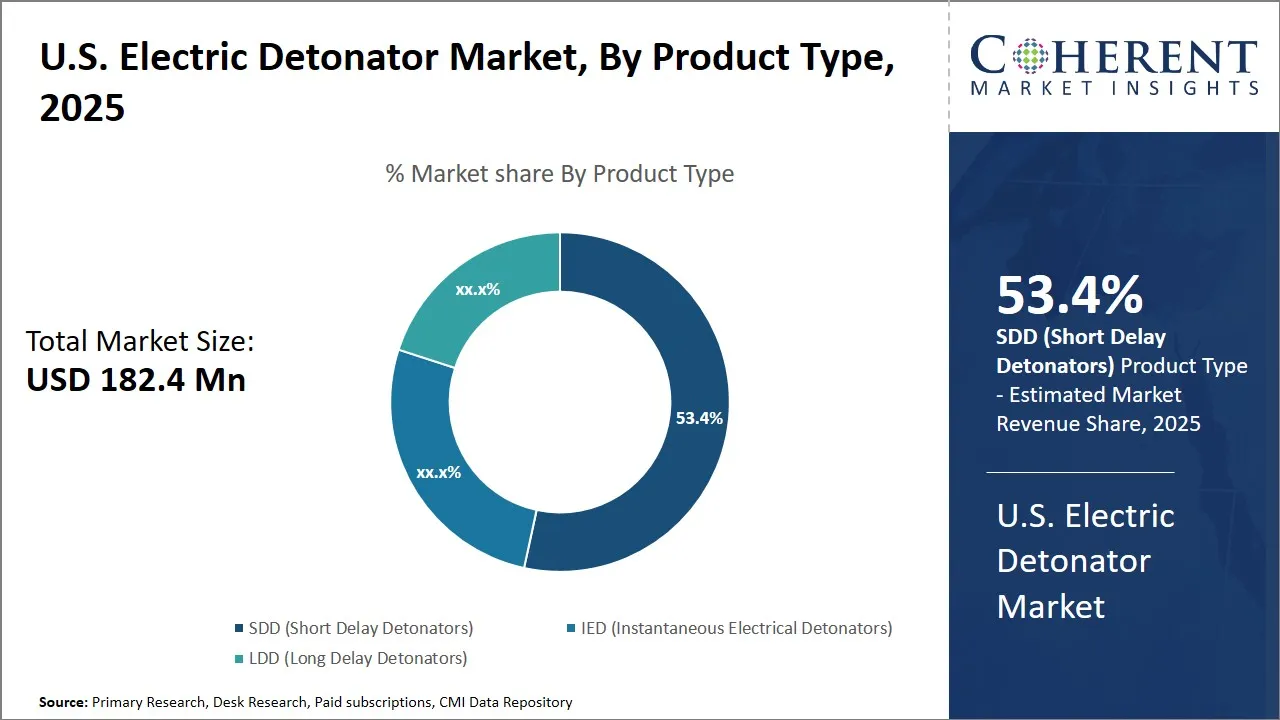
Electric Detonator Market Insights, By Product Type - SDD (Short Delay Detonators) Segment Dominates the Market Due to Precision and Safety
The SDD (Short Delay Detonators) segment will account for 54.4% of the electric detonator market share in 2026, as a result of their superior timing accuracy and blast control. These detonators are created to give very precise microsecond delays between the blasts which in turn allows controlled fragmentation and comparatively lesser ground vibrations — a very important matter in operations where safety and lesser environmental impact are the main concerns. By precisely adjusting the delay times in SDDs, more efficient rock breaking is achieved and better muck pile management is done thus optimizing the later processes of loading and hauling.
For instance, the Hudson Tunnel Project (Gateway Program, NY–NJ) uses SDDs to minimize the impact of vibrations on the rail operations that are live.
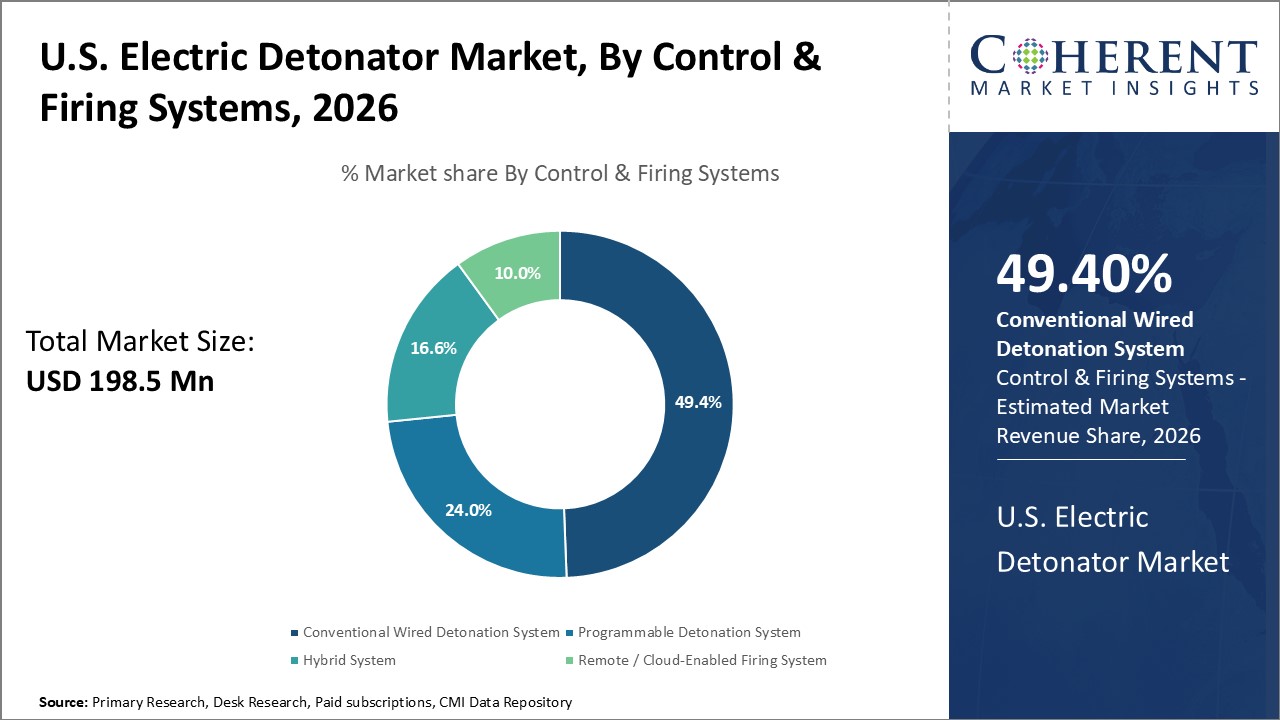
Electric Detonator Market Insights, By Control & Firing Systems - Conventional Wired Detonation System Dominates the Market Due to Its Established Reliability
The conventional wired detonation system segment is expected to hold 49.4% of the market share in 2026, driven primarily by its longstanding reputation for reliability and safety. This system leverages well-understood wiring technologies to ensure secure and direct transmission of firing signals, minimizing latency and reducing risks of misfires caused by signal interference or equipment failure.
Blasting experts’ widespread acceptance of this method has also helped it to remain on top. With cable-based systems, the operators and technical staff have quite a bit of experience when it comes to installation, maintenance, and troubleshooting, and thus, it remains the most favored system for many users who want to rely on something tried and tested and cut down on training costs. Besides, the equipment used in these systems is normally less expensive at the start than that of programmable or remote systems, hence the attraction for projects with tight budgets.
Electric Detonator Market Insights, By End-use Industry – Mining Segment Dominates the Market Due to Its High Explosives Consumption in Mining Operations
Mining segment is set to hold 51.6% of the U.S. electric detonator market share in 2026, and this is made possible by the sector’s heavy dependence on controlled blasting for the efficient extraction of minerals. Precise and safe detonators are needed for mining to break the rock formations and access the ore bodies, so electric detonators have become a must in this area.
Mining sector has been the main reason for electric detonators to be the dominant factor as the industry continues to strive for higher productivity while still being mindful of the environment and safety regulations. Electric detonators, particularly those that have very accurate timing such as SDDs, allow mining companies to arrange blast sequences such that they make the least possible vibrations, controlling fly-rock and dust emissions at the same time. These factors not only help meet the environmental standards but also improve relations with the community in the mining areas.
Technology Adoption: Shift from Non-Electric to Electric/Smart Detonators
- The move from non-electric to electric and smart detonators in the U.S. is largely motivated by the superior control and programmability that electronic detonators provide.
- Unlike non-electric systems (like shock tube detonators) that rely on pyrotechnic delays, electric and especially electronic detonators offer programmable delays, advanced safety features, and reliable firing sequences, reducing risks from stray currents, electromagnetic interference, and static discharge.
- Electronic detonators feature advanced protection mechanisms, unique IDs for secure inventory control, and programmable equipment, making unauthorized use far less likely.
- The adoption of these detonators is further driven by the rise in automation in mining and construction, enhanced environmental standards, and the need for precision in large-scale blasting.
- The U.S. Bureau of Labor Statistics has reported increased construction activity, and this industry growth is accelerating the switch for both safety and efficiency benefits.
Market Players, Key Development, and Competitive Intelligence
Key Development
- In March 2025, ORICA received CE certification for its fully lead-free Neo electronic detonators, marking a significant milestone in the company’s commitment to innovation and sustainability in the mining and quarrying industries. The lead-free detonators will be available in Europe across Orica’s entire range of electronic blasting systems, including the new eDev II Neo, uni tronic 600 Neo, and i-kon III Neo.
Top Strategies Followed by U.S. Electric Detonator Market Players
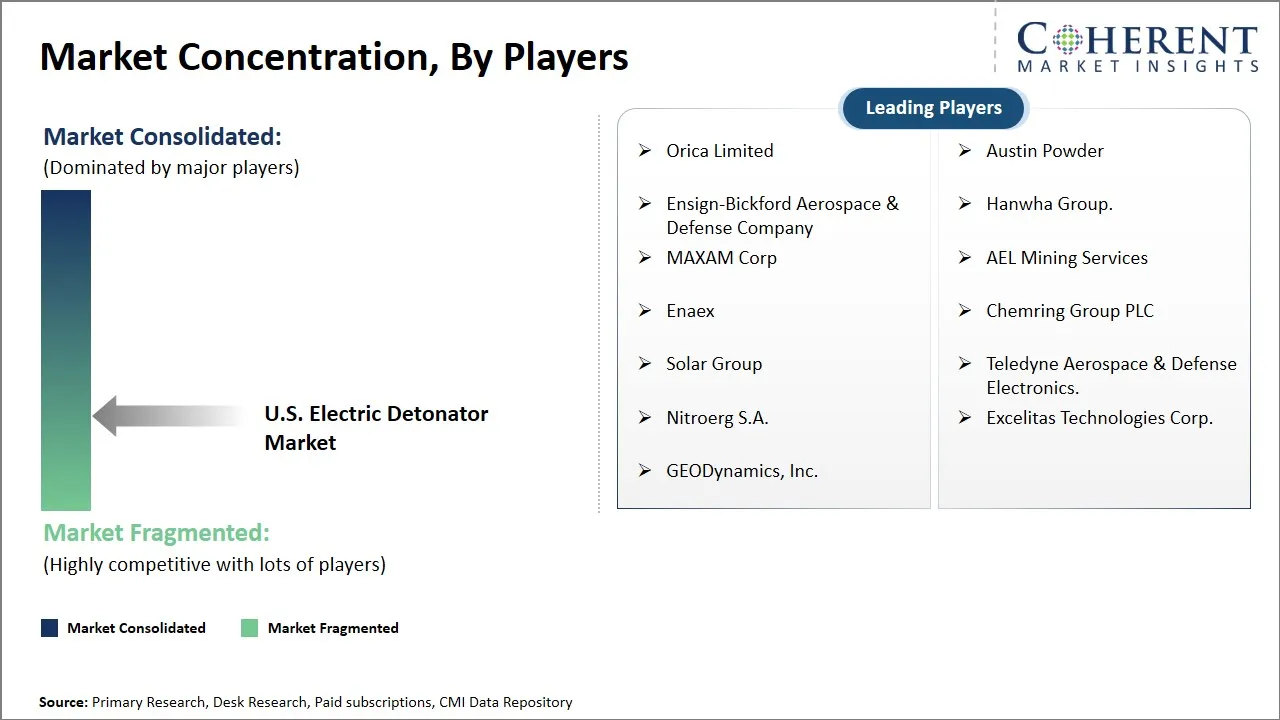
- The market is occupied by the big companies, which invest substantially in R&D, thus, being able to manufacture the best products in the market that meet the very high safety and operational standards. R&D is one of the aspects of the market where the big companies are focusing strongly. These companies are experimenting with new and improved technologies for detonators that come with better reliability, precise timing, and more safety features. At the same time, the mining, construction, and oil & gas industries, which are their main customers, can have all their demanding wants fulfilled.
- For example, state-of-the-art blasting platforms are developed like Orica BlastIQ or Dyno Nobel's DynoLogix, that make use of data analytics and blast optimization software to enhance safety, fragmentation, and efficiency of operation.
- Mid-level firms got the economy position of the market by giving electric detonator solutions which are cheap but of good quality at the same time. These companies, which are well aware of the price sensitivity in some market segments, are making their products affordable to the people with less money without giving up on the quality. This strategy not only wins over a larger customer group but also brands the mid-level manufacturers as trustworthy substitutes to the expensive brands.
- For instance, ENAEX (U.S. operations) reduces logistics and compliance expenditures by collaborating with local distributors for the contract manufacture of electronic delay detonators.
- Small players active in the U.S. electric detonator market come up with very specialized tactics in order to capture the market through the smallest segments. Such companies usually focus on bringing out new products with unique characteristics which are specifically catered to certain applications like personalized firing sequences or eco-friendly formulations. They also make use of advanced technologies such as IoT-enabled detonators and digital initiation systems to set their products apart and to attract customers looking for cutting-edge or tailor-made solutions.
- One example is the Nelson Brothers pilots' intelligent detonators which come with telemetry systems and are utilized for underground metal mines that require precise sequencing control.
Regulatory & Safety Compliance (ATF, MSHA Requirements & Impact on Demand)
ATF Requirements
- The Bureau of Alcohol, Tobacco, Firearms and Explosives (ATF) classify detonators as explosives under 18 U.S.C. 841(d) and 27 CFR Part 555.
- Detonators that are electric or electronic must only be stored in magazines that are properly approved and secured. They should also have very strict inventory control and annual reporting, which includes tracking through unique identification codes or lot numbers.
- With compliance in recordkeeping, transport, and secure handling, manufacturers and end users will incur increased operational costs. Nevertheless, this situation will also keep driving the demand for advanced detonators with built-in security features and traceability systems.
MSHA Safety Compliance
- The Mine Safety and Health Administration (MSHA) has set the blasting safety standards in mining operations, which require that the detonators must be able to withstand initiation due to DC stray currents, static and RF (radio frequency) energy.
- The preference of electronic detonators is based on their built-in protection (including spark gap devices, current-limiting resistors, and password-controlled electronic blasting machines). They provide lower risks of accidental initiation.
- Mine Safety and Health Administration (MSHA) ensures that all the prevalent safety practices and training are strictly followed. It is a prerequisite that the manufacturer provides training for electronic blasting systems and the area where the blast is taking place is cleared before and after the setup to minimize the exposure of personnel.
Market Report Scope
U.S. Electric Detonator Market Report Coverage
| Report Coverage | Details | ||
|---|---|---|---|
| Base Year: | 2025 | Market Size in 2026: | USD 198.5 Mn |
| Historical Data for: | 2020 To 2024 | Forecast Period: | 2026 To 2033 |
| Forecast Period 2026 to 2033 CAGR: | 8.8% | 2033 Value Projection: | USD 358.1 Mn |
| Segments covered: |
| ||
| Companies covered: | Orica Limited, Austin Powder, Ensign-Bickford Aerospace & Defense Company, Hanwha Group., MAXAM Corp, AEL Mining Services, Enaex, Chemring Group PLC, Solar Group, Teledyne Aerospace & Defense Electronics., Nitroerg S.A., Excelitas Technologies Corp., and GEODynamics, Inc. | ||
| Growth Drivers: |
| ||
| Restraints & Challenges: |
| ||
Electric Detonator Market Dynamics
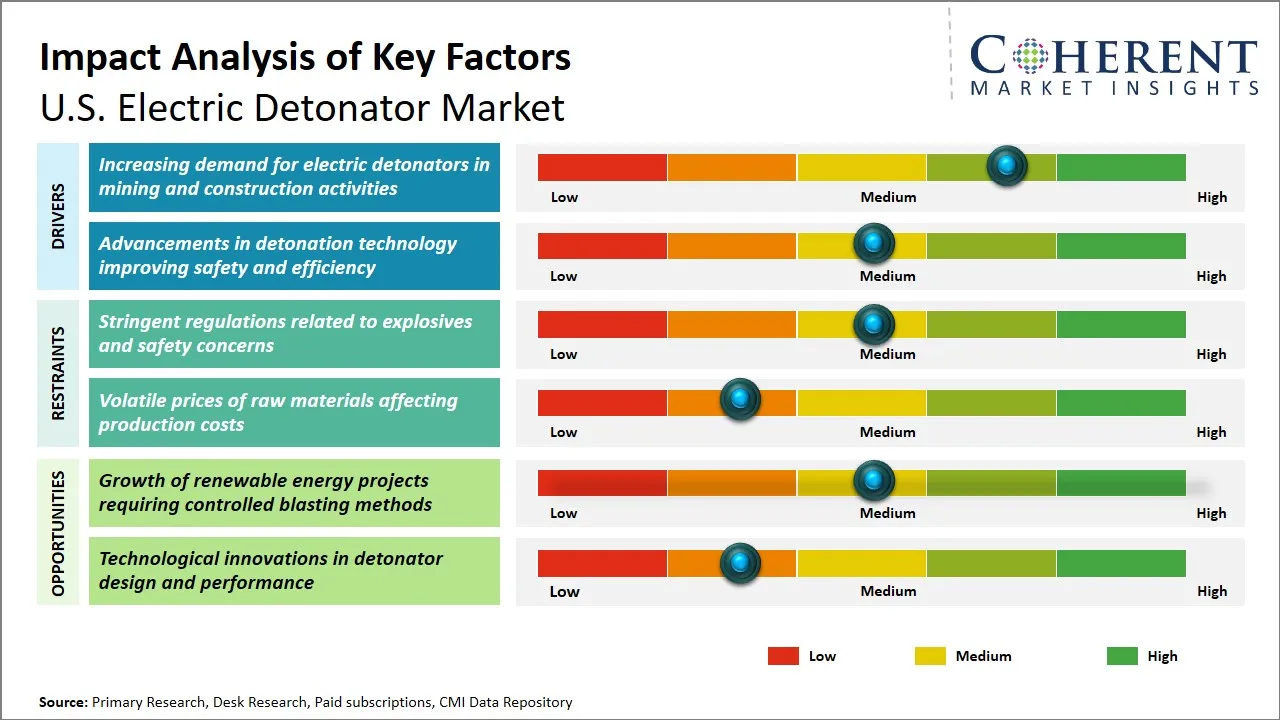
Electric Detonator Market Driver - Increasing Demand for Electric Detonators in Mining and Construction Activities
The electric detonator market is majorly driven by the growing demand from smart mining and construction sectors across the U.S., as these detonators are noted for their higher precision and reliability. To take mining companies’ operations to the next level, electric detonators are the only ones that allow the greatest control for every blast happening underground thus leading to better mineral liberation and less ground vibration. In the same way, the construction sector, particularly infrastructure projects on a grand scale such as highways, tunnels, and urban areas, is turning more and more to electric detonators to guarantee the safety and operational efficiency of controlled demolitions and excavation that are conducted by electric detonators.
For instance, Nevada Gold Mines (Barrick–Newmont JV) is deepening underground operations in the Carlin and Cortez areas. The electric detonators with their precision timing are increasingly relied on by these mines to help avoid any instability of the mine walls and to improve ore fragmentation, indirectly leading to a reduction of the milling costs upstream.
Electric Detonator Market Opportunity - Expansion Driven by Renewable Energy Projects Requiring Controlled Blasting
The U.S. electric detonator market is set to reap enormous advantages from the rapid development of renewable energy projects, like wind farms, solar power plants, and hydroelectric facilities, which, in turn, are increasingly relying on controlled blasting methods during their site preparation and construction phases. The implementation of such projects normally results in extensive digging, rock cutting, and soil moving operations where precise and safe blasting solutions are demanded to maintain safety and productivity. Electric detonators are the answer as they provide better timing accuracy, lower rates of misfire, and superior blast control vis-a-vis conventional detonators, thus they are suited to the intricate requirements of renewable energy infrastructures.
For example, Rye Development’s Goldendale Pumped Storage Project (Washington State), for instance, recognizes controlled rock blasting as a technique for constructing a reservoir and underground water conveyance tunnels; electric detonators allow for firing to be synchronized with almost no overbreak.
Market Segmentation
- Product Type Insights (Revenue, USD Mn, 2021 - 2033)
- SDD (Short Delay Detonators)
- IED (Instantaneous Electrical Detonators)
- LDD (Long Delay Detonators)
- Control & Firing System Insights (Revenue, USD Mn, 2021 - 2033)
- Conventional Wired Detonation System
- Programmable Detonation System
- Hybrid System
- Remote / Cloud-Enabled Firing System
- End-use Industry Insights (Revenue, USD Mn, 2021 - 2033)
- Mining
- Construction & Civil Engineering
- Oil & Gas
- Seismic / Geophysical Surveying
- Others (Cement Industry Blasting, etc.)
- Distribution Channel Insights (Revenue, USD Mn, 2021 - 2033)
- Direct
- Indirect (via distributors, etc.)
- Key Players Insights
- Orica Limited
- Austin Powder
- Ensign-Bickford Aerospace & Defense Company
- Hanwha Group.
- MAXAM Corp
- AEL Mining Services
- Enaex
- Chemring Group PLC
- Solar Group
- Teledyne Aerospace & Defense Electronics.
- Nitroerg S.A.
- Excelitas Technologies Corp.
- GEODynamics, Inc.
Sources
Primary Research Interviews
- R&D Director – Leading Electric Detonator Manufacturer
- Procurement Manager – Major Explosives Supplier for Mining and Construction
- Product Development Head – Well-Known Electric Detonator Brand
Stakeholders
- Manufacturers of electric detonators and related blasting accessories
- End-use sectors
- Mining (coal, metals, minerals)
- Construction and Infrastructure (tunneling, demolition)
- Oil & Gas sector (hydraulic fracturing, well completions)
- Quarrying industries
- Regulatory and Certification Bodies (OSHA, MSHA, ATF)
- Distributors and E-commerce Platforms for industrial explosives
- Technology Providers: IoT and AI for blast optimization and safety monitoring
Databases
- U.S. Geological Survey (USGS) data on mining activity and explosives consumption
- Bureau of Alcohol, Tobacco, Firearms and Explosives (ATF) explosive device statistics
- U.S. Customs and Border Protection import-export data for detonators
- Industry proprietary sales and shipment databases
Magazines
- International Mining Magazine – Technologies and trends in mining explosives
- Explosives Engineering Review – Innovations in detonator technology
- Mining Weekly – Market updates for mining consumables including detonators
- Industrial Safety & Hygiene News – Regulatory updates and safety best practices for detonators
- Blasting Journal – Insights on blasting techniques and electric detonator application
Journals
- Journal of Explosives Engineering – Research on detonator performance and development
- Safety Science Journal – Studies on safety and risk management in explosives use
- Journal of Mining Science – Use of electric detonators in various mining operations
- International Journal of Mining, Reclamation and Environment – Environmental impact of blasting technologies
Newspapers
- The Wall Street Journal – Market and investment trends in mining technology
- The New York Times – Coverage on mining sector innovations and safety
- Mining Journal – Industry news on explosives market shifts
- Financial Times – Business developments in mining consumables
Associations
- Institute of Makers of Explosives (IME)
- National Mining Association (NMA)
- Mine Safety and Health Administration (MSHA)
- American Society of Safety Professionals (ASSP)
Public Domain Sources
- OSHA – Regulations and guidelines on explosives handling and use
- MSHA – Reports on mining safety and detonator usage
- ATF – Explosives laws and statistics
Proprietary Elements
- CMI Data Analytics Tool, Proprietary CMI Existing Repository of information for last 8 years.
Get access to 250+ pages report
Every segment, forecast, competitor profile and data table behind the analysis above — available for instant download.
- ESOMAR Member
- ISO 9001:2015 Certified
- D-U-N-S Registered
- GDPR & CCPA Compliant
Missing comfort of reading report in your local language? Find your preferred language:
Transform your Strategy with Exclusive Trending Reports
Frequently Asked Questions
The U.S. electric detonator market is estimated to be valued at USD 198.4 Mn in 2026 and is expected to reach USD 358.1 Mn by 2033.
The CAGR of the U.S. electric detonator market is projected to be 8.8% from 2026 to 2033.
Increasing demand for electric detonators in mining and construction activities and advancements in detonation technology improving safety and efficiency are the major factors driving the growth of the U.S. electric detonator market.
Stringent regulations related to explosives and safety concerns and volatile prices of raw materials affecting production costs are the major factors hampering the growth of the U.S. electric detonator market.
In terms of product type, the SDD (Short Delay Detonators) is estimated to dominate the market revenue share in 2026.
Orica Limited, Austin Powder, Ensign-Bickford Aerospace & Defense Company, Hanwha Group., MAXAM Corp, AEL Mining Services, Enaex, Chemring Group PLC, Solar Group, Teledyne Aerospace & Defense Electronics., Nitroerg S.A., Excelitas Technologies Corp., and GEODynamics, Inc. are the major players.