

U.S. Mobile Health Vehicle Market Size and Forecast – 2026 To 2033
The U.S. mobile health vehicle market is expected to grow from USD 2,148.5 Mn in 2026 to USD 5,385.1 Mn by 2033, registering a compound annual growth rate (CAGR) of 14% from 2026 to 2033. The U.S. mobile health vehicle market is poised for significant expansion, fueled by the surging need to improve healthcare access in medically underserved areas.
According to the U.S. Department of Agriculture (USDA), about 46 million people lived in rural America in 2023, accounting for 14% of the U.S. population, highlighting the growing demand for mobile health vehicles to deliver preventive, primary, and diagnostic healthcare services directly to underserved populations.
Key Takeaways of the U.S. Mobile Health Vehicle Market
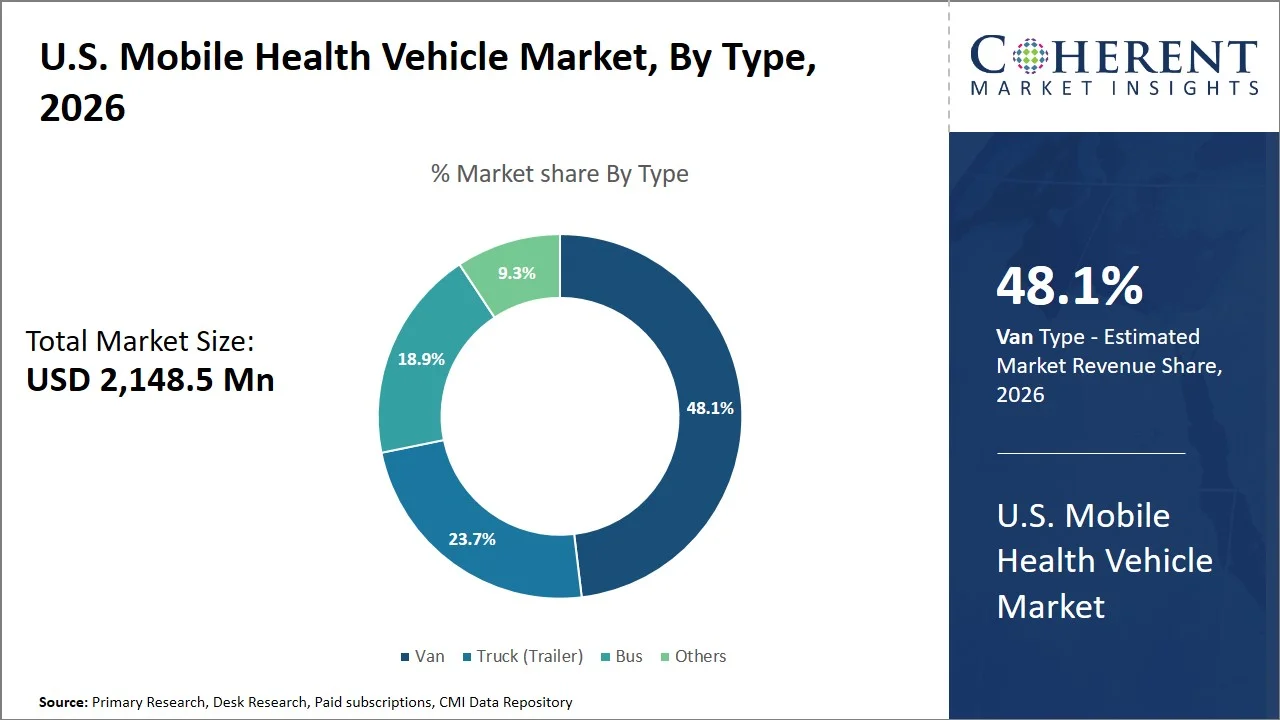
- The van segment is projected to hold 48.1 % of the U.S. mobile health vehicle market share in 2026, making it the dominant type segment, owing to its operational flexibility, lower deployment costs, and ability to provide primary care, diagnostics, and preventive services across diverse communities. The segment continues to benefit from regulatory support for mobile healthcare delivery. For instance, the U.S. Health Resources and Services Administration (HRSA) requires each mobile van/unit to be registered as an individual service site under Form 5B Scope of Project guidance, formally recognizing mobile vans as approved healthcare delivery sites for federally funded health centers.
- General medicine is projected to hold 24.5 % of the U.S. mobile health vehicle market share in 2026, making it the dominant service type segment, driven by growing demand for accessible primary and preventive healthcare services. The segment is further supported by policies promoting integrated community-based care and digital health. For instance, the U.S. Department of Health and Human Services (HRSA), through its Office for the Advancement of Telehealth, extended Medicare telehealth flexibilities through January 2026, allowing Federally Qualified Health Centers (FQHCs) and Rural Health Clinics (RHCs) to continue delivering remote clinical services, thereby strengthening the capabilities of mobile general medicine units equipped with telehealth technologies.
- Expansion of Mobile Clinical Trial and Decentralized Research Programs: The growing adoption of decentralized clinical trials (DCTs) is creating demand for mobile health vehicles capable of conducting patient screening, sample collection, diagnostics, and follow-up visit closer to participants' homes. Pharmaceutical companies and contract research organizations are increasingly utilizing mobile clinics to improve patient recruitment, enhance trial diversity, and reduce participant dropouts, particularly in geographically dispersed populations.
- Increasing Deployment of Mobile Specialty Care Units for Maternal and Women's Health: A significant opportunity lies in the expansion of mobile specialty healthcare vehicles dedicated to maternal health, prenatal care, breast cancer screening, and women's preventive services. Rising federal and state initiatives aimed at reducing maternal mortality and improving early disease detection are encouraging healthcare providers to deploy specialized mobile units equipped with mammography, ultrasound, and obstetric care capabilities, particularly across medically underserved communities.
Segmental Insights
Why Does the Van Segment Dominate the U.S. Mobile Health Vehicle Market?
The van segment is projected to hold a market share of 48.1% in 2026, because of its maneuverability, low cost of operation, and versatility that allows healthcare facilities to offer various health care services to urban, rural, and remote populations. Due to their compact size, vans can be mobilized quickly, while offering space for primary care, diagnostic tests, dental screenings, mammography screenings and telehealth capabilities in a flexible clinic. For instance, Matthews Specialty Vehicles the company has manufactured more than 1,500 mobile healthcare vehicles, including medical clinics, dental units, and mammography vehicles over the past 30 years, highlighting the widespread adoption of van-based mobile healthcare platforms in the U.S.
- Current Industry Events of 2026
- Market Size Estimation
- Regional Breakdown
- Competitive Landscape
- Customer Intelligence
- Segmental Analysis
- Pricing Analysis
- Key Market Drivers, Challenges & Future Trends
- Customized Insights Section
Why Does General Medicine Represent the Largest Service Type Segment in the U.S. Mobile Health Vehicle Market?
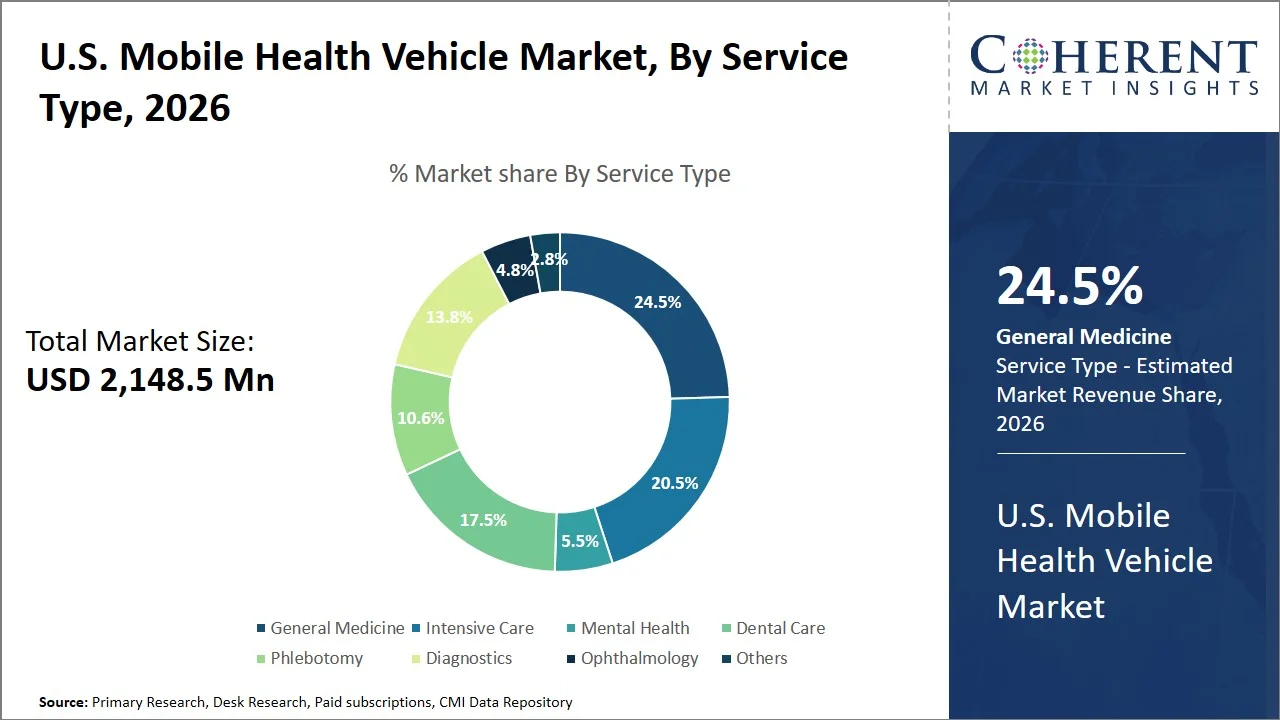
General medicine is projected to hold 24.5% of the market share in 2026, due to the widespread applications that include basic healthcare services, disease prevention screening, chronic disease management, immunizations, and health education delivered using a single unit. By offering these services, mobile health vehicles are expected to bring these services to patients and also to medically underserved, rural and frail individuals, thus mitigating their reliance on hospitals. Their versatility also enables rapid deployment during public health emergencies and community outreach initiatives. For instance, in May 2025, Maryland’s Montgomery County Department of Health and Human Services (DHHS) introduced its new Mobile Health Clinic as a key piece of the state's health department in expanding community-based general medicine practice through the delivery of health, dental, mental, and behavioral health care and social services to needy county residents.
Currents Events and their Impact
Current Events | Description and its Impact |
U.S. Centers for Medicare & Medicaid Services (CMS) Updates Medicare Policy for Rural Health Clinics and Federally Qualified Health Centers (March 2025) |
|
U.S. Centers for Medicare & Medicaid Services (CMS) Revises Rural Health Clinic Conditions for Certification (September 2025) |
|
U.S. Mobile Health Vehicle Market Dynamics
Market Drivers
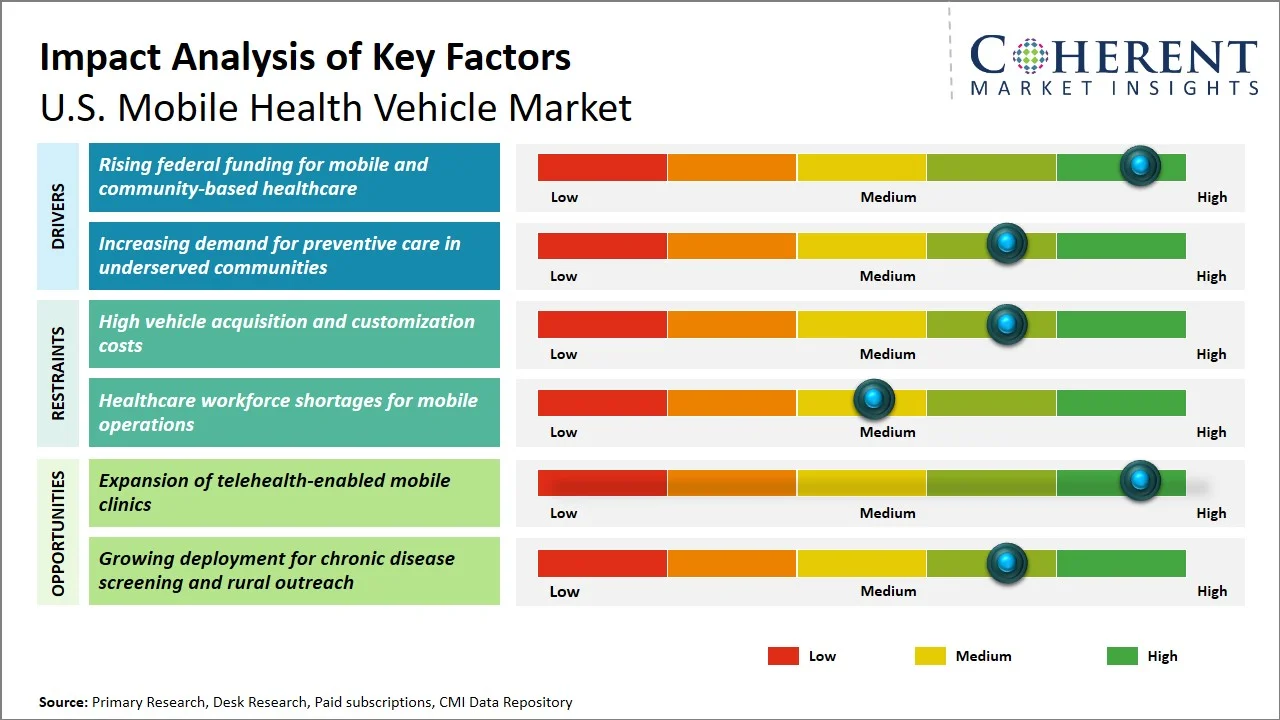
- Rising federal funding for mobile and community-based healthcare: The expansion of Federally Qualified Health Centers (FQHCs) and community-based healthcare networks is driving the demand for mobile health vehicles as providers seek to extend primary care, preventive services, and chronic disease management beyond fixed clinical facilities. Mobile units enable FQHCs to reach underserved populations while supporting outreach, screening, and continuity of care in medically vulnerable communities. For instance, in September 2025, the U.S. Health Resources and Services Administration (HRSA) awarded approximately USD 90 million to 1,368 Health Center Program recipients to expand community-based primary healthcare capacity, supporting outreach models that include mobile healthcare services
- Increasing demand for preventive care in underserved communities: The growing focus on delivering preventive healthcare in underserved communities is driving the adoption of mobile health vehicles across the U.S., enabling providers to offer screenings, immunizations, chronic disease assessments, and wellness services closer to patients. These mobile units improve early disease detection while reducing barriers related to transportation and healthcare access. For instance, in July 2025, the U.S. Centers for Disease Control and Prevention (CDC), through its National Breast and Cervical Cancer Early Detection Program (NBCCEDP), currently funds 71 award recipients across all 50 states, the District of Columbia, U.S. territories, and tribal organizations to expand access to preventive screening services for uninsured and underinsured women, supporting the deployment of community-based and mobile screening initiatives.
Emerging Trends
- Shift Toward Zero-Emission Mobile Healthcare Fleets: Healthcare providers and public health agencies are increasingly adopting electric and low-emission mobile health vehicles to reduce operating costs and support institutional sustainability goals. Manufacturers are developing battery-electric mobile clinics with onboard power management systems capable of supporting advanced diagnostic and clinical equipment without compromising operational efficiency.
- Growing Adoption of Modular and Multi-Specialty Mobile Clinic Designs: Healthcare organizations are increasingly investing in modular mobile health vehicles that can be rapidly reconfigured for multiple specialties, including primary care, imaging, dental care, behavioral health, and vaccination services. This flexible design approach enables providers to maximize vehicle utilization, respond quickly to evolving community healthcare needs, and improve return on investment through multi-purpose deployments.
U.S. Regulatory & Reimbursement Framework Governing Mobile Health Vehicles
Regulatory Authority / Agency | Key Regulation / Program | Relevance to Mobile Health Vehicles | Market Impact |
Health Resources and Services Administration (HRSA) | Health Center Program & Mobile Service Sites (Form 5B – Scope of Project) | Regulates mobile service sites operated by Federally Qualified Health Centers (FQHCs) | Facilitates expansion of mobile primary healthcare services |
Centers for Medicare & Medicaid Services (CMS) | Medicare & Medicaid Reimbursement Policies | Defines reimbursement for eligible healthcare services delivered through qualified providers | Improves financial sustainability and adoption of mobile health units |
U.S. Food and Drug Administration (FDA) | Medical Device Regulations (21 CFR) | Regulates diagnostic, imaging, laboratory, and point-of-care devices installed within mobile clinics | Ensures safety, quality, and regulatory compliance of onboard medical equipment |
National Highway Traffic Safety Administration (NHTSA), U.S. Department of Transportation (DOT) | Federal Motor Vehicle Safety Standards (FMVSS) | Establishes vehicle design, safety, crashworthiness, and operational standards for customized medical vehicles | Drives compliant vehicle engineering and certification |
State Departments of Health and State Medical Licensing Boards | State Mobile Clinic Licensure & Healthcare Facility Regulations | Govern licensing, clinical operations, and provider credentialing requirements for mobile healthcare services | Influences operational approvals and multi-state market expansion |
How is the expansion of telehealth-enabled mobile clinics creating new growth opportunities in the U.S. mobile health vehicle market?
The growing adoption of mobile clinics integrated with telehealth solutions presents significant growth opportunities for the U.S. mobile health vehicle market. These connected mobile units enable healthcare providers to reach isolated and underserved communities while delivering essential primary care, specialist consultations, behavioral healthcare, and chronic disease management services. The integration of telehealth facilities within mobile clinics streamlines care accessibility and enhances the ability of the clinicians to provide access to specialist knowledge without developing new infrastructure. For instance, the U.S. Department of Veterans Affairs (VA) is broadening its Mobile Medical Unit (MMU) Program, using the virtual health features available through a number of mobile units to deliver coordinated care services to veterans in rural, remote, and disaster areas-emphasizing the importance of connected mobile health vehicle deployment.
Market Players, Key Development, and Competitive Landscape
Key Developments
- In April 2026, the Burlington County Health Department launched a new Mobile Health Vehicle to expand access to preventive healthcare services across local communities in New Jersey. The vehicle is designed to deliver health screenings, vaccinations, overdose prevention education, and community outreach programs directly to underserved populations, strengthening the county's public health infrastructure and improving healthcare accessibility. The initiative reflects the growing adoption of mobile health vehicles by local health agencies to enhance community-based care delivery across the U.S.
- In February 2025, Mission Mobile Medical and REE Automotive announced a strategic collaboration to develop next-generation electric mobile health vehicles for underserved rural communities across the U.S. Mission Mobile which intends to build its new fleet on REE's software-defined P7 electric truck platform, supporting more than 200 mobile healthcare programs across 42 states and improving healthcare access for over 2 million Americans. The partnership is expected to accelerate the deployment of sustainable, customizable mobile clinics for primary, preventive, and specialty care in remote areas.
Competitive Landscape
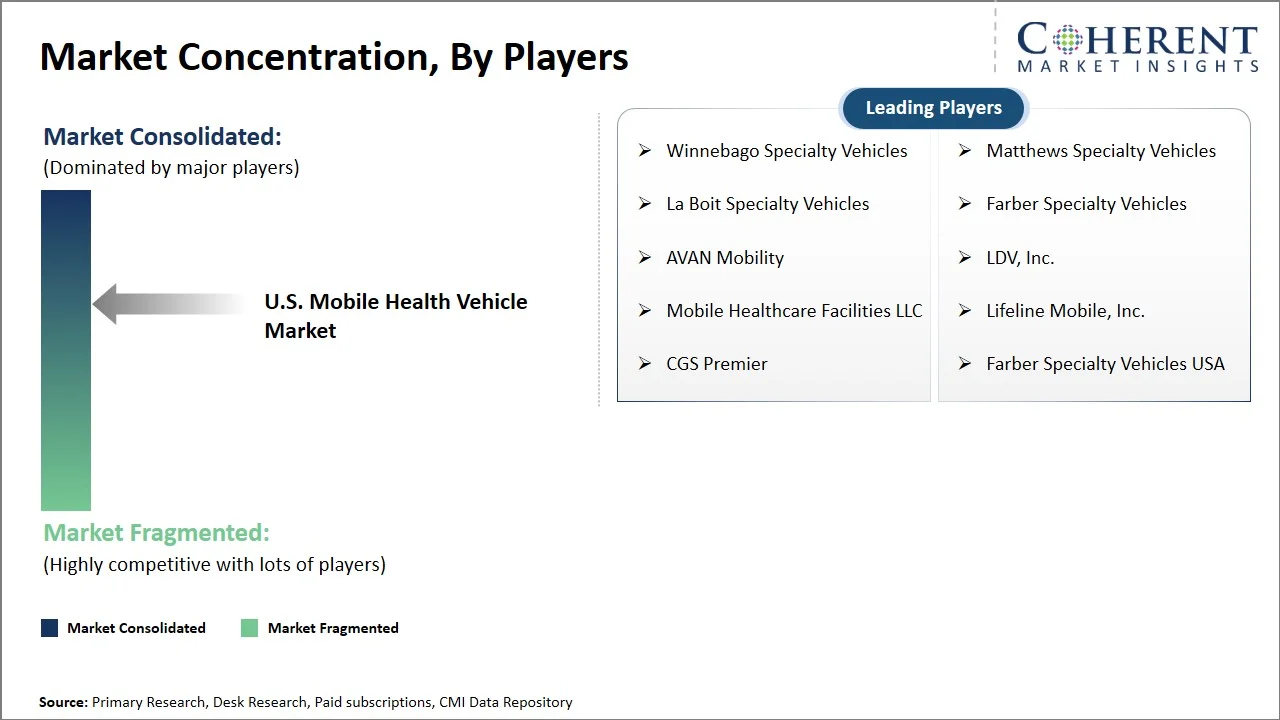
The U.S. mobile health vehicle market is moderately competitive, with companies focusing on expanding comprehensive mobile healthcare solutions through vehicle customization, telehealth integration, and advanced onboard diagnostic capabilities. Market participants are strengthening their presence by collaborating with hospitals, Federally Qualified Health Centers (FQHCs), public health agencies, and government programs to improve healthcare accessibility in underserved communities. They are also investing in specialized mobile units for primary care, diagnostics, dental care, imaging, and preventive health services while incorporating digital health technologies to enhance operational efficiency. Key focus areas include:
- Development of telehealth-enabled and digitally connected mobile clinic vehicles
- Expansion of customized mobile units for primary care, dental, imaging, and diagnostic services
- Strategic partnerships with hospitals, Federally Qualified Health Centers (FQHCs), and public health agencies
- Integration of portable diagnostics, electronic health records (EHRs), and remote patient monitoring technologies
- Investment in modular vehicle designs and sustainable fleet solutions to improve operational efficiency and outreach
Market Report Scope
U.S. Mobile Health Vehicle Market Report Coverage
| Report Coverage | Details | ||
|---|---|---|---|
| Base Year: | 2025 | Market Size in 2026: | USD 2,148.5 Mn |
| Historical Data for: | 2020 To 2024 | Forecast Period: | 2026 To 2033 |
| Forecast Period 2026 to 2033 CAGR: | 14% | 2033 Value Projection: | USD 5,385.1 Mn |
| Segments covered: |
| ||
| Companies covered: | Winnebago Specialty Vehicles, Matthews Specialty Vehicles, La Boit Specialty Vehicles, Farber Specialty Vehicles, AVAN Mobility, LDV, Inc., Mobile Healthcare Facilities LLC, Lifeline Mobile, Inc., CGS Premier, and Farber Specialty Vehicles USA | ||
| Growth Drivers: |
| ||
| Restraints & Challenges: |
| ||
Analyst Opinion (Expert Opinion)
- In the coming years, the U.S. mobile health vehicle market will be driven by the transition toward decentralized, preventive, and value-based healthcare delivery. Mobile health vehicles are expected to become integral extensions of health systems by combining telehealth, point-of-care diagnostics, AI-enabled clinical workflows, and remote patient monitoring to improve healthcare access while reducing overall treatment costs.
- The maximum growth opportunity lies within van-based mobile health vehicles deployed for primary care and preventive health services across rural and medically underserved regions of the U.S. Increasing investments by Federally Qualified Health Centers (FQHCs), state public health departments, and integrated delivery networks to expand community outreach programs will continue to accelerate the demand for versatile mobile healthcare platforms.
- In order to create an advantage for themselves, the market players should prioritize modular vehicle designs, seamless integration of telehealth and electronic health record (EHR) systems, and partnerships with healthcare providers, public health agencies, and government-funded community health programs. Strengthening nationwide service networks, offering customizable vehicle configurations, and ensuring compliance with evolving federal and state healthcare regulations will be critical differentiators in capturing long-term market share.
Speak to the analyst
Want personalized insights?
Take the findings above to one of our principal consultants, or have the report rebuilt around the segments, geographies and competitors you actually track.
Market Segmentation
- Type Insights (Revenue, USD Mn, 2021 - 2033)
- Van
- Truck (Trailer)
- Bus
- Others
- Service Type Insights (Revenue, USD Mn, 2021 - 2033)
- General Medicine
- Intensive Care
- Mental Health
- Dental Care
- Phlebotomy
- Diagnostics
- Ophthalmology
- Others
- Key Players Insights
- Winnebago Specialty Vehicles
- Matthews Specialty Vehicles
- La Boit Specialty Vehicles
- Farber Specialty Vehicles
- AVAN Mobility
- LDV, Inc.
- Mobile Healthcare Facilities LLC
- Lifeline Mobile, Inc.
- CGS Premier
- Farber Specialty Vehicles USA
Sources
Primary Research Interviews
- Mobile Health Program Directors – fleet deployment strategies and community outreach models
- Community Health Center (CHC) & Federally Qualified Health Center (FQHC) Administrators – mobile clinic utilization and preventive care delivery
- Emergency Medical Services (EMS) and Mobile Clinic Operators – vehicle design, operational challenges, and patient access
- Telehealth & Digital Health Specialists – integration of virtual care, remote monitoring, and connected diagnostics
- Public Health Officials – rural healthcare accessibility, immunization programs, and mobile health initiatives
Stakeholders
- Mobile Health Vehicle Manufacturers (e.g., Farber Specialty Vehicles, Matthews Specialty Vehicles, AVAN Mobility, La Boit Specialty Vehicles, Life Line Emergency Vehicles)
- End-use Sectors
- Hospitals and Health Systems
- Federally Qualified Health Centers (FQHCs)
- Rural Health Clinics (RHCs)
- Public Health Departments
- Nonprofit and Community Healthcare Organizations
- Regulatory & Health Bodies
- U.S. Department of Health and Human Services (HHS)
- Health Resources and Services Administration (HRSA)
- Centers for Medicare & Medicaid Services (CMS)
- Centers for Disease Control and Prevention (CDC)
- National Highway Traffic Safety Administration (NHTSA)
Databases
- Health Resources and Services Administration (HRSA) Data Warehouse – Health Professional Shortage Areas (HPSAs) and community health center data
- Centers for Medicare & Medicaid Services (CMS) Data & Research – reimbursement and healthcare utilization statistics
- Centers for Disease Control and Prevention (CDC) PLACES & National Center for Health Statistics (NCHS) – chronic disease and population health indicators
- National Rural Health Resource Center (NRHRC) – rural healthcare access and mobile health program resources
- ClinicalTrials.gov – ongoing studies involving mobile health, telehealth, and community-based healthcare delivery
Magazines
- Health Facilities Management Magazine
- EMS World Magazine
- Modern Healthcare Magazine
- Medical Design & Outsourcing Magazine
Journals
- Journal of Mobile Technology in Medicine
- American Journal of Public Health
- Journal of Emergency Medical Services (JEMS)
Associations
- American Mobile Healthcare Association (AMHA)
- National Association of Emergency Medical Technicians (NAEMT)
- American Hospital Association (AHA)
- National EMS Management Association (NEMSMA)
Public Domain Sources
- U.S. Department of Health and Human Services (HHS) Reports
- Centers for Disease Control and Prevention (CDC) Public Data
- Federal Emergency Management Agency (FEMA) Resources
- Health Resources & Services Administration (HRSA) Publications
Proprietary Elements
- CMI Data Analytics Tool, Proprietary CMI Existing Repository of information for last 10 years.
Get access to 250+ pages report
Every segment, forecast, competitor profile and data table behind the analysis above — available for instant download.
- ESOMAR Member
- ISO 9001:2015 Certified
- D-U-N-S Registered
- GDPR & CCPA Compliant
Missing comfort of reading report in your local language? Find your preferred language:
Transform your Strategy with Exclusive Trending Reports
Frequently Asked Questions
The U.S. mobile health vehicle market is estimated to be valued at USD 2,148.5 Mn in 2026 and is expected to reach USD 5,385.1 by 2033.
Van dominates due to its superior maneuverability, lower operating costs, ease of deployment in urban and rural settings, and flexibility to accommodate a wide range of healthcare services.
A mobile health vehicle is a specially equipped vehicle that delivers clinical, diagnostic, preventive, and telehealth services directly to patients outside traditional healthcare facilities.
The CAGR of the U.S. mobile health vehicle market is projected to be 14% from 2026 to 2033.
They integrate broadband connectivity, telemedicine platforms, and remote diagnostic equipment to enable real-time virtual consultations and specialist care.
Mobile health vehicles are typically equipped with examination rooms, point-of-care diagnostic devices, imaging systems, laboratory analyzers, refrigeration units, and electronic health record (EHR) systems.
Rising federal funding for mobile and community-based healthcare, and increasing demand for preventive care in underserved communities are the major factors driving the growth of the U.S. mobile health vehicle market.