

Global Volleyball Shoes Market Size and Forecast – 2026 To 2033
The Global Volleyball Shoes Market is estimated to be valued at USD 2,026.5 Mn in 2026 and is expected to reach USD 2,947.9 Mn by 2033, growing at a compound annual growth rate (CAGR) of 5.50% from 2026 to 2033. The market growth is supported by increasing participation in organized volleyball, expansion of competitive leagues, rising demand for sport-specific footwear, and greater consumer preference for shoes offering improved cushioning, stability, and court performance.
Growth opportunities are emerging as volleyball continues gaining visibility among younger athletes, recreational players, and organized sports communities. In September 2025, the U.S. Department of Education’s National Center for Education Statistics reported continued participation of Mns of students in high school athletics, including volleyball as one of the established girls’ team sports categories, supporting the long-term athlete pipeline that contributes to demand for volleyball equipment and performance footwear.
Key Takeaways of the Global Volleyball Shoes Market
- All round Volleyball Shoes are expected to hold 44.6% share in the global volleyball shoes market, with an estimated CAGR of 5.2%, supported by their broad suitability across setters, defensive players, and recreational athletes requiring balanced cushioning, traction, and lateral stability. Their multi-position applicability enables manufacturers to achieve higher production scalability and wider retail distribution compared with specialized footwear categories. In May 2025, Volleyball World extended its partnership with Mizuno, strengthening commercial engagement around volleyball-specific products and global volleyball visibility.
- Men are projected to account for 58.7% share in the global volleyball shoes market, with an estimated CAGR of 5.6%, reflecting stronger participation in competitive volleyball environments and preference for durable footwear designed for powerful jumps, rapid court movements, and intensive gameplay. This segment creates opportunities for brands to develop premium performance models targeting clubs, teams, and individual athletes with higher replacement frequency. In January 2022, USA Volleyball partnered with Mizuno through 2028, reinforcing structured athlete program support.
- Professional and Competitive Players are expected to represent 34.8% share in 2026, with an estimated CAGR of 5.9%, as elite athletes require footwear engineered for repeated jumping, quick directional changes, stability, and match endurance. This segment has a strong influence on footwear innovation because professional performance requirements often translate into features adopted across wider consumer categories. In July 2026, Mizuno expanded athlete collaboration initiatives with Japanese volleyball players to strengthen performance-focused product development.
- North America is forecast to dominate the global volleyball shoes market with 34.8% share in 2026, registering an estimated CAGR of 5.5%, supported by established collegiate volleyball programs, professional leagues, club competitions, and premium sports footwear purchasing behavior. The region provides manufacturers with access to performance-focused consumers and organized team procurement channels. In January 2022, USA Volleyball announced its partnership with Mizuno through 2028, supporting national-level volleyball development activities.
- Asia Pacific is expected to account for 28.9% share in the global volleyball shoes market, with the highest regional CAGR of 6.3%, supported by strong volleyball participation in China and Japan, expanding competition structures, and integrated sports footwear manufacturing capabilities. The region offers commercial advantages through efficient supply chains and growing consumer access to specialized volleyball products. In May 2025, Volleyball World announced initiatives supporting Asian volleyball development through regional partnerships.
Segmental Insights
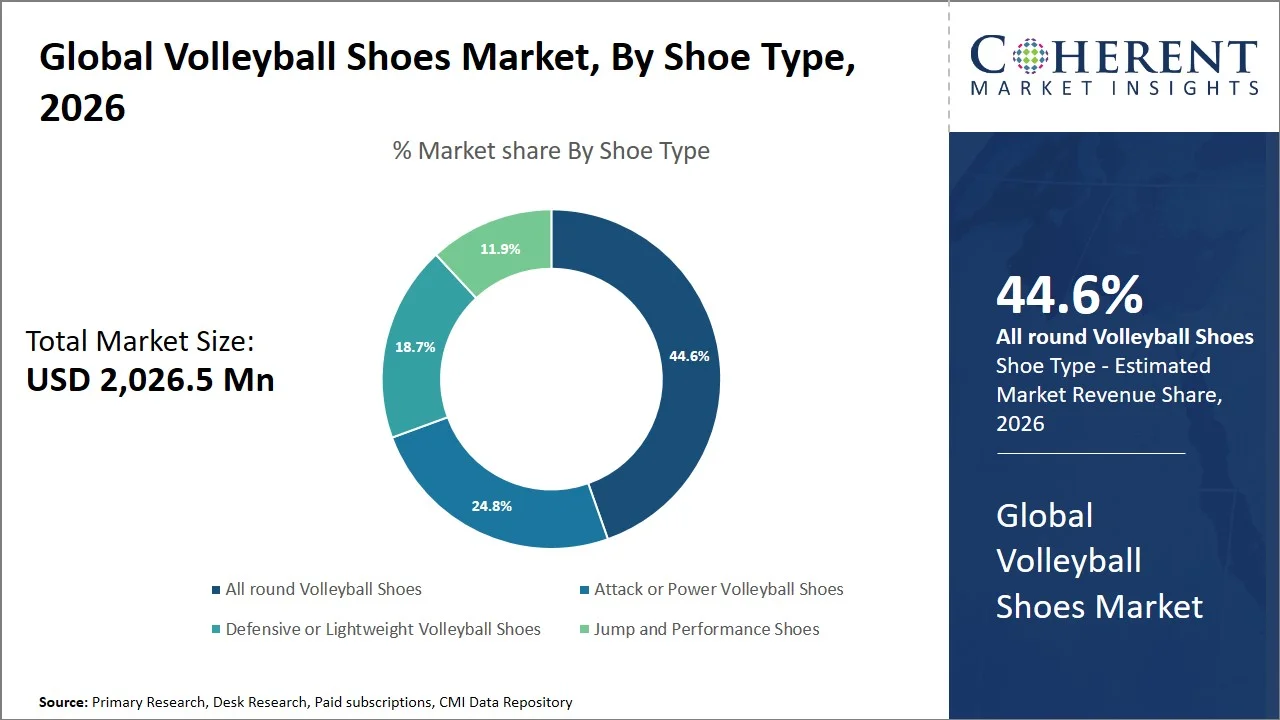
Why Do All round Volleyball Shoes Dominate the Global Volleyball Shoes Market?
All round Volleyball Shoes are expected to capture 44.6% share in the global volleyball shoes market, leading the shoe type category due to their suitability across multiple volleyball positions, including setters, defensive players, and recreational athletes. Unlike specialized footwear designed mainly for attackers or jump-focused players, All round models provide a balanced combination of cushioning, court grip, lateral support, and durability, making them the preferred choice for players seeking one versatile solution. Manufacturers benefit from broader customer applicability, higher production scalability, and stronger availability across online and offline channels. Retailers also favor this category because it addresses both entry-level and advanced users. In May 2025, Volleyball World extended its partnership with Mizuno, highlighting continued commercial focus on volleyball-specific products and global athlete engagement.
- Current Industry Events of 2026
- Market Size Estimation
- Regional Breakdown
- Competitive Landscape
- Customer Intelligence
- Segmental Analysis
- Pricing Analysis
- Key Market Drivers, Challenges & Future Trends
- Customized Insights Section
Why Does Men Represent the Largest Consumer Type in the Global Volleyball Shoes Market?
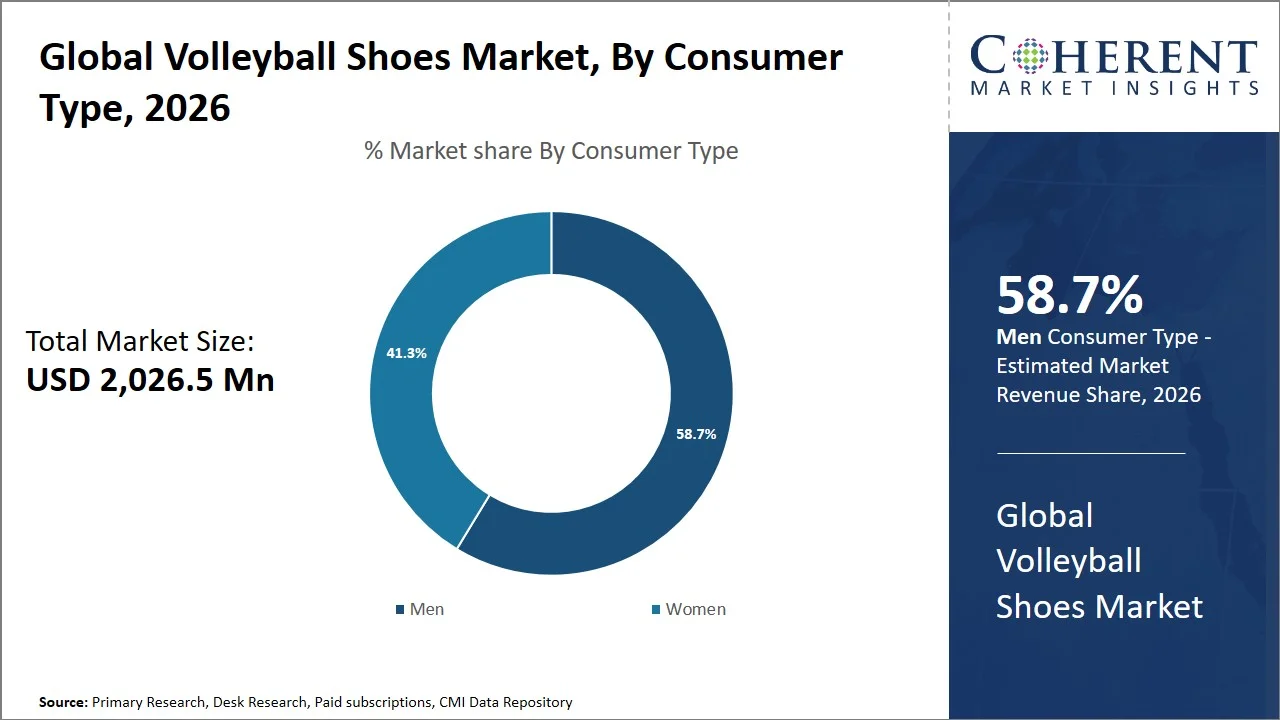
Men are projected to account for 58.7% share in the global volleyball shoes market, representing the largest consumer segment due to stronger participation in competitive leagues, club volleyball, and high-intensity training environments. Male players typically demand footwear capable of handling greater impact forces generated through powerful spikes, repeated jumping, and aggressive defensive movements. This creates commercial opportunities for manufacturers offering enhanced stability, durability, and performance-focused designs. The segment also supports premium pricing as competitive athletes prioritize footwear performance over basic functionality. Distribution networks targeting clubs, academies, and team procurement channels further strengthen segment demand. In January 2025, the Fédération Internationale de Volleyball (FIVB) continued expanding international competition structures, supporting professional-level volleyball visibility and athlete engagement globally.
Why Do Professional and Competitive Players Dominate the Playing Level Category of the Global Volleyball Shoes Market?
Professional and Competitive Players are expected to hold 34.8% share in the global volleyball shoes market, leading the playing level category due to their requirement for specialized footwear that supports frequent training sessions, tournament schedules, and high-performance movements. This segment strongly influences product development because manufacturers use athlete feedback to refine traction patterns, cushioning response, weight distribution, and stability features. Teams, professional clubs, and advanced academies often prioritize reliable footwear performance because equipment directly affects athlete comfort and movement efficiency during competition. The segment also drives innovation that later reaches recreational consumers through mainstream product ranges. In February 2026, FIVB highlighted the continued global development of volleyball through its partnership ecosystem with commercial partners supporting athlete and fan engagement.
Current Events and their Impact
Current Event | Description and Business Impact |
Volleyball World and Mizuno Partnership Extension – May 2025 |
|
FIVB Volleyball Development Initiatives – 2025 |
|
LA28 Olympic Volleyball Preparation Activities – 2025 |
|
Global Volleyball Shoes Market Dynamics
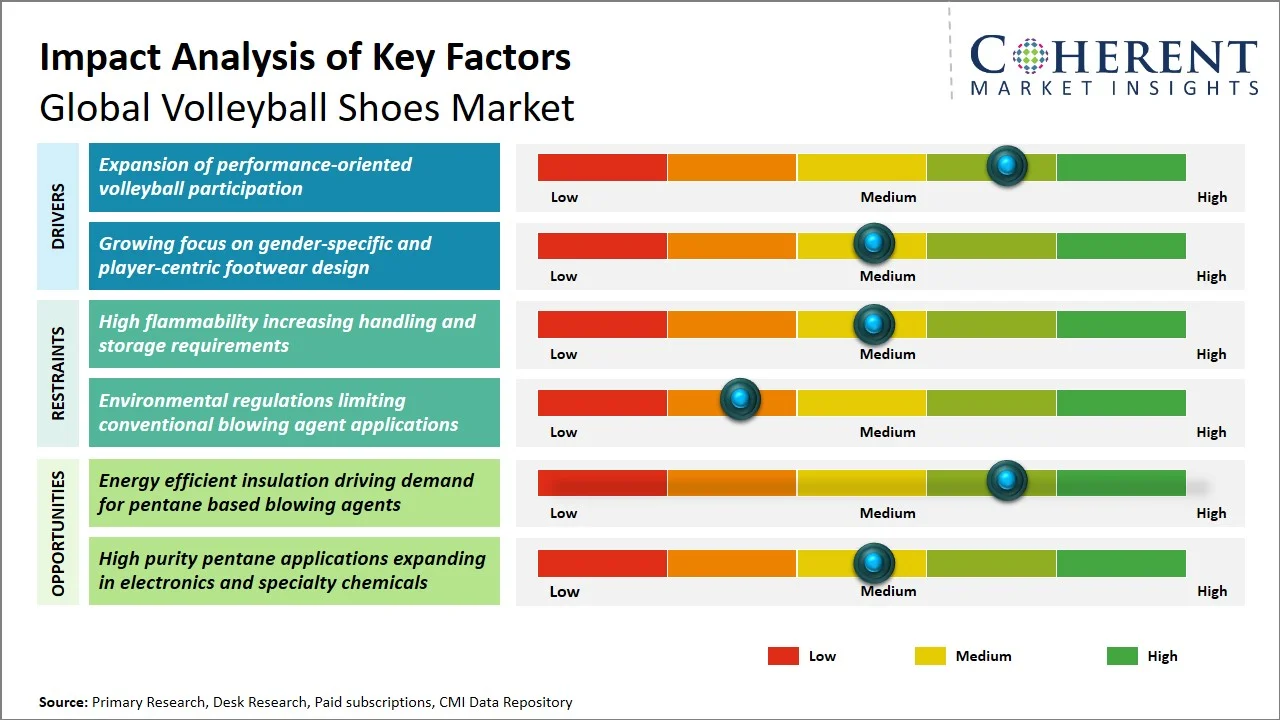
Key Market Drivers
Expansion of Performance-Oriented Volleyball Participation
The increasing emphasis on athletic performance, injury prevention, and court-specific functionality is encouraging players across professional, collegiate, and recreational categories to invest in specialized volleyball footwear. Manufacturers benefit from demand for shoes offering improved stability, cushioning, grip, and lightweight construction, while retailers gain opportunities through premium product positioning. This shift influences product pricing as performance-focused models command higher value compared with general indoor footwear. In May 2025, Volleyball World extended its partnership with Mizuno, strengthening global volleyball engagement and supporting visibility of specialized volleyball equipment.
Growing Focus on Gender-Specific and Player-Centric Footwear Design
The expansion of women’s volleyball participation and increasing product customization requirements are encouraging brands to develop footwear tailored around different playing styles, biomechanics, and comfort preferences. This driver supports manufacturers through wider product portfolios, improves consumer purchasing confidence, and enables brands to strengthen loyalty among specific athlete groups. Retail channels benefit from expanded segmentation across performance levels and user profiles. In March 2025, the International Volleyball Federation (FIVB) continued initiatives supporting global women’s volleyball development through expanded competition visibility and athlete engagement programs.
Emerging Market Trends
Shift Toward Multi-Functional Volleyball Footwear for Diverse Playing Styles
Volleyball footwear development is moving toward versatile designs that combine speed, stability, and impact protection rather than focusing on single performance attributes. Consumers increasingly expect shoes that support different positions, training sessions, and competition environments. Manufacturers are responding by optimizing sole structures, cushioning systems, and upper materials to create adaptable products. This trend is influencing procurement decisions among teams and individual players, while brands are competing through broader product ranges rather than limited specialist offerings.
Increasing Influence of Digital Commerce on Volleyball Footwear Purchasing
Online purchasing is becoming a strategic channel for volleyball shoe brands as consumers seek wider product availability, detailed performance information, and easier access to specialized footwear. Digital platforms allow manufacturers to reach players beyond traditional sporting goods stores while enabling targeted marketing based on skill level, position, and playing requirements. This transformation is reshaping distribution strategies, encouraging direct-to-consumer approaches, and increasing competition between global brands and specialized volleyball footwear providers.
Regional Insights
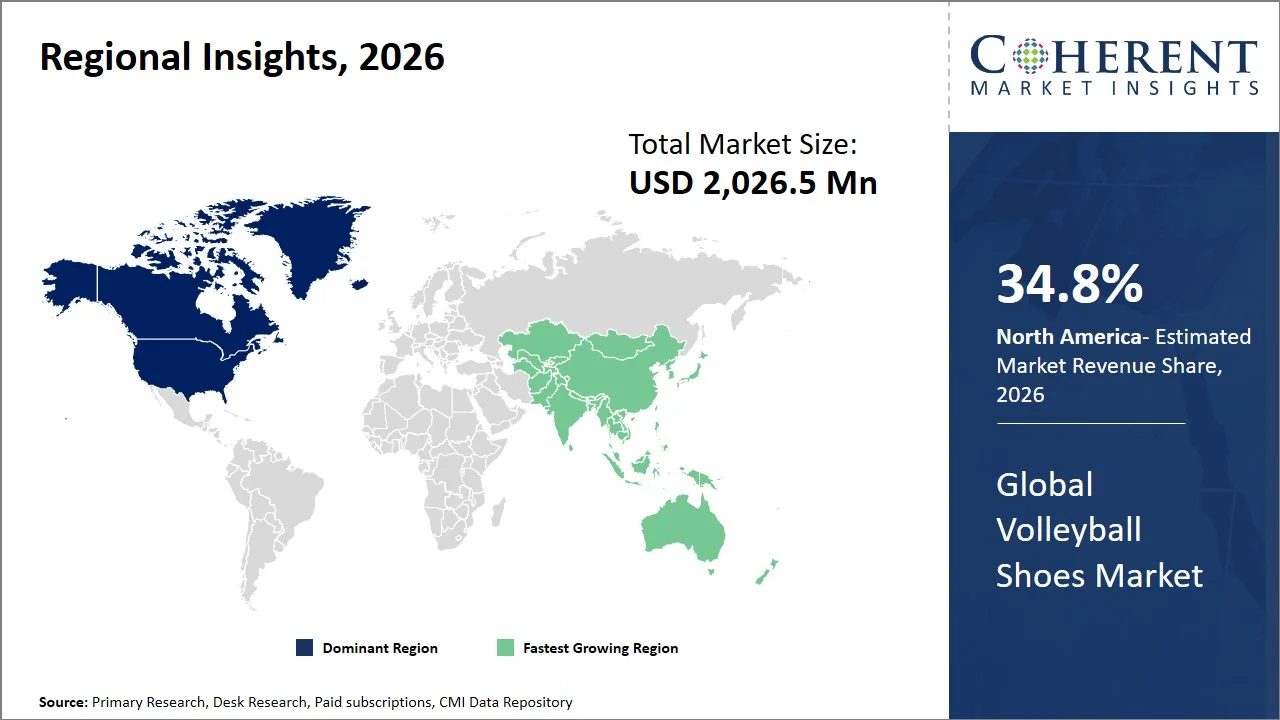
Why Does North America Dominate the Global Volleyball Shoes Market?
North America is expected to account for 34.8% share of the global volleyball shoes market in 2026, supported by its structured volleyball ecosystem spanning collegiate programs, school competitions, professional leagues, and club-based participation. The region generates consistent footwear demand because athletes frequently replace performance shoes based on training intensity, court conditions, and competition schedules. The U.S. collegiate volleyball system remains a major commercial channel, creating demand for specialized footwear among student-athletes and teams. Strong purchasing power, established sports retail networks, and high acceptance of premium athletic products further support regional leadership. Manufacturers benefit from direct access to performance-focused consumers and organized team procurement opportunities. In August 2025, USA Volleyball continued expanding athlete development initiatives and competition pathways, reinforcing the country’s organized volleyball ecosystem.
Why Is Asia Pacific Emerging as the Fastest-Growing Region in the Global Volleyball Shoes Market?
Asia Pacific is expected to represent 28.9% share of the global volleyball shoes market in 2026, supported by a combination of strong volleyball participation, expanding competition structures, and a well-established sporting goods manufacturing ecosystem. China, Japan, and Southeast Asian countries contribute significantly through professional leagues, school-level programs, and large consumer bases seeking performance footwear. The region also provides strategic advantages for manufacturers due to established footwear production capabilities, efficient supply chains, and proximity to major athletic goods markets. Increasing investment in volleyball development programs is improving athlete participation and commercial opportunities for footwear suppliers. In August 2026, Volleyball World and the Asian Volleyball Confederation extended their commercial partnership until 2052, supporting long-term professionalization and expansion of volleyball across Asia.
Global Volleyball Shoes Market Outlook for Key Countries
Why Is the U.S. a Key Market for the Global Volleyball Shoes Market?
The U.S. is a key market for the global volleyball shoes market due to its highly organized player development structure, including NCAA volleyball, club programs, youth academies, and professional competitions. Unlike markets dependent mainly on recreational participation, the U.S. generates demand through institutional buyers such as schools, universities, and competitive clubs that require regular footwear replacement. Consumers also show strong preference for branded athletic products with specialized performance features, supporting premium volleyball footwear sales. The presence of major sporting goods retailers and established e-commerce platforms improves product accessibility across different player categories. In September 2025, USA Volleyball announced continued expansion of its national programs and athlete development initiatives, strengthening the foundation for long-term volleyball equipment demand.
Why Is China Important in the Global Volleyball Shoes Market?
China plays an important role in the global volleyball shoes market due to its dual position as both a major volleyball participation market and a critical sports footwear manufacturing hub. The country has extensive domestic production capabilities covering footwear materials, manufacturing, and export-oriented supply chains, enabling efficient availability of volleyball-specific products. Volleyball remains strongly integrated into schools, professional competitions, and national sports programs, creating demand among athletes and consumers. Domestic brands and international manufacturers benefit from China’s manufacturing expertise and large consumer base. In September 2025, the Chinese Volleyball Association continued national competition activities and athlete development programs, supporting the country’s structured volleyball ecosystem and strengthening demand for specialized equipment.
Why Is Japan a Strategic Country in the Global Volleyball Shoes Market?
Japan represents a strategic market for the global volleyball shoes market due to its strong volleyball culture, technology-focused consumers, and preference for high-quality performance equipment. Volleyball maintains significant relevance through school competitions, professional leagues, and national team programs, creating consistent demand for specialized indoor court footwear. Japanese consumers typically prioritize product durability, comfort, lightweight construction, and technical functionality, encouraging manufacturers to introduce advanced footwear designs. The country also serves as an important innovation market were brands test performance features before wider commercialization. In March 2025, the Japan Volleyball Association continued strengthening domestic competition structures through its national volleyball calendar, supporting athlete development and sustained demand for professional-grade equipment.
Why Is Germany a Strategic Country in the Global Volleyball Shoes Market?
Germany is strategically important in the global volleyball shoes market because of its organized club-based volleyball structure, strong sporting goods consumption, and preference for durable, high-quality equipment. The country’s volleyball ecosystem includes professional clubs, regional associations, and recreational players who require reliable indoor footwear for regular training and competition. German consumers also place greater emphasis on product quality, sustainability attributes, and responsible manufacturing practices, influencing brand positioning strategies. The country’s role as a major European sporting goods market enables international brands to strengthen distribution across the wider region. In February 2025, the German Volleyball Association continued supporting national volleyball competitions and development activities, reinforcing organized participation and equipment requirements.
Why Is Brazil an Important Growth Market for the Global Volleyball Shoes Market?
Brazil represents an important growth market for the global volleyball shoes market due to its deep volleyball heritage, strong fan engagement, and broad participation across professional, youth, and recreational segments. Volleyball is one of the country’s most established sports, creating a strong cultural connection between athletes, clubs, and performance equipment brands. The country’s professional competitions and national team success contribute to consumer interest in specialized volleyball products, while regional sports retailers expand access beyond major cities. Manufacturers benefit from Brazil’s large athlete community and demand for durable footwear suited to intensive playing conditions. In September 2025, Brazil’s volleyball ecosystem continued to expand through national competitions organized by the Brazilian Volleyball Confederation, supporting ongoing player participation and equipment demand.
Consumer Preference and Product Evolution Landscape
Category | Current Status / Adoption Level | Key Application or Impact | Business Implication |
Cushioning and Impact Protection | High adoption across performance footwear | Supports repeated jumping and landing movements | Enables premium positioning through comfort and injury-conscious designs |
Lightweight Construction | Increasing preference among competitive players | Improves agility and movement efficiency | Encourages material innovation and product differentiation |
Court-Specific Traction Systems | Established requirement for volleyball footwear | Enhances grip during lateral movements | Strengthens competition between specialized footwear brands |
Gender-Oriented Product Design | Growing commercial focus | Addresses different athlete requirements | Expands customer segmentation opportunities |
Sustainable Material Integration | Emerging product consideration | Supports environmentally conscious purchasing | Creates differentiation opportunities for brands |
Digital Product Customization | Developing adoption area | Improves consumer engagement and purchasing confidence | Supports direct-to-consumer strategies |
How Can Advanced Performance Engineering Create New Growth Opportunities in the Global Volleyball Shoes Market?
Advanced performance engineering represents a significant opportunity as players increasingly evaluate footwear based on measurable functional benefits rather than brand recognition alone. Manufacturers that integrate optimized cushioning, stability systems, lightweight materials, and position-specific designs can capture higher-value customer segments. Professional teams, academies, and serious recreational players represent key customers seeking footwear that improves comfort and performance consistency. Companies investing in material expertise, athlete feedback programs, and efficient manufacturing capabilities can strengthen competitive positioning. However, entry barriers remain high due to the need for specialized sports science knowledge, strong distribution networks, and credibility among volleyball communities. Strategic success will depend on balancing technical performance, affordability, sustainability expectations, and accessibility across global markets.
Market Players, Key Development, and Competitive Intelligence
Key Developments
- In July 2025, Nike, Inc maintained its focus on basketball and volleyball-adjacent court footwear technologies, leveraging advanced materials and athlete-driven design approaches to strengthen its position in performance sports footwear markets.
- In May 2025, Mizuno Corporation extended its partnership with Volleyball World covering major international volleyball events. This strengthens Mizuno’s global volleyball presence and supports continued visibility of its volleyball footwear portfolio among athletes and consumers.
- In February 2025, ASICS Corporation highlighted its indoor volleyball footwear portfolio featuring models such as SKY ELITE FF 3 PARIS, NETBURNER BALLISTIC FF MT 3, and POWERBREAK FF, designed around jumping performance, agility, stability, and court movement control. This strengthens ASICS’ positioning in specialized volleyball footwear by addressing performance requirements across attackers, defensive players, and All round court athletes
Competitive Landscape
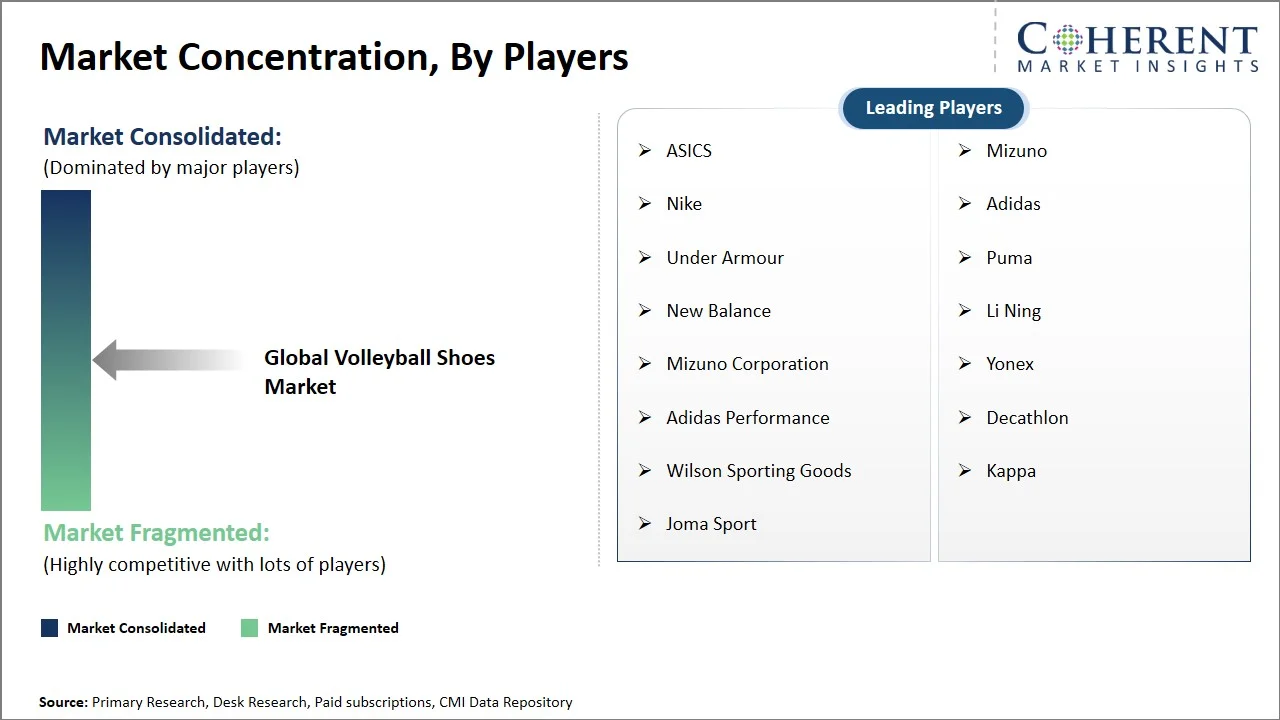
The global volleyball shoes market demonstrates a moderately concentrated structure, with global sportswear companies competing alongside specialized volleyball footwear manufacturers. Competition is primarily based on performance characteristics, athlete endorsement, product innovation, pricing strategy, and distribution reach. Established players differentiate through volleyball-specific engineering, while emerging brands compete through affordability and regional market penetration.
Key focus areas include
- Product performance and court-specific functionality
- Cushioning, stability, and traction technologies
- Brand credibility among professional athletes
- Distribution network strength across online and offline channels
- Product portfolio breadth across player categories
- Pricing competitiveness across consumer segments
- Sustainable material adoption and manufacturing practices
- Partnerships with volleyball organizations and communities
Market Report Scope
Volleyball Shoes Market Report Coverage
| Report Coverage | Details | ||
|---|---|---|---|
| Base Year: | 2025 | Market Size in 2026: | USD 2,026.5 Mn |
| Historical Data for: | 2020 To 2024 | Forecast Period: | 2026 To 2033 |
| Forecast Period 2026 to 2033 CAGR: | 5.50% | 2033 Value Projection: | USD 2,947.9 Mn |
| Geographies covered: |
| ||
| Segments covered: |
| ||
| Companies covered: | ASICS, Mizuno, Nike, Adidas, Under Armour, Puma, New Balance, Li Ning, Mizuno Corporation, Yonex, Adidas Performance, Decathlon, Wilson Sporting Goods, Kappa, Joma Sport | ||
| Growth Drivers: |
| ||
| Restraints & Challenges: |
| ||
Analyst Opinion (Expert Opinion)
- The global volleyball shoes market is expected to evolve toward greater specialization, where manufacturers compete through functional differentiation rather than basic footwear availability. Successful brands will require stronger understanding of athlete requirements, including position-specific movement patterns, comfort expectations, and performance outcomes. Companies with integrated product development capabilities and strong volleyball ecosystem relationships are likely to maintain competitive advantages.
- A major industry transition will be the movement from traditional sports footwear purchasing toward performance-driven selection. Players are increasingly evaluating shoes based on technical benefits such as stability, responsiveness, and durability. Brands unable to demonstrate clear functional value may face pressure as consumers become more informed and selective.
- Future success will depend on balancing innovation with affordability, expanding digital reach, and maintaining reliable supply chains. Manufacturers should prioritize athlete insights, sustainable materials, and regional distribution capabilities. Key risks include increasing production costs, intense competition from established sportswear companies, and challenges in differentiating products within a specialized footwear category.
Speak to the analyst
Want personalized insights?
Take the findings above to one of our principal consultants, or have the report rebuilt around the segments, geographies and competitors you actually track.
Market Segmentation
- Shoe Type Insights (Revenue, USD Mn, 2021 - 2033)
- All round Volleyball Shoes
- Attack or Power Volleyball Shoes
- Defensive or Lightweight Volleyball Shoes
- Jump and Performance Shoes
- Consumer Type Insights (Revenue, USD Mn, 2021 - 2033)
- Men
- Women
- Playing Level Insights (Revenue, USD Mn, 2021 - 2033)
- Professional and Competitive Players
- Collegiate and School Players
- Recreational Players
- Distribution Channel Insights (Revenue, USD Mn, 2021 - 2033)
- Online Retail
- Specialty Sports Stores
- Brand owned Stores
- Supermarkets and General Retail
- Others
- Regional Insights (Revenue, USD Mn, 2021 - 2033)
- North America
- U.S.
- Canada
- Latin America
- Brazil
- Argentina
- Mexico
- Rest of Latin America
- Europe
- Germany
- U.K.
- Spain
- France
- Italy
- Russia
- Rest of Europe
- Asia Pacific
- China
- India
- Japan
- Australia
- South Korea
- ASEAN
- Rest of Asia Pacific
- Middle East
- GCC Countries
- Israel
- Rest of Middle East
- Africa
- South Africa
- North Africa
- Central Africa
- North America
Sources
Primary Research Interviews
- Volleyball footwear manufacturers, sportswear brands, distributors, retailers, professional athletes, coaches, team managers, and sports academies
- Product designers, material specialists, procurement professionals, sporting goods executives, and industry experts
Stakeholders
- Volleyball shoe manufacturers, athletic footwear companies, sports equipment brands, and private-label footwear producers
- Raw material suppliers, footwear component manufacturers, sports retailers, e-commerce platforms, distributors, and team procurement organizations
- Professional clubs, schools, universities, training academies, and recreational sports organizations
End-use Sectors
- Professional and competitive volleyball
- Collegiate, school, and youth volleyball programs
- Recreational and amateur sports activities
- Indoor sports, athletic training, and fitness applications
Regulatory and Industry Bodies
- Federation International de Volleyball (FIVB)
- National volleyball federations and sport’s governing organizations
- Olympic sports organizations
- Regional sports authorities and athletic associations
Databases
- Company annual reports, investor presentations, and corporate filings
- Trade statistics and footwear industry databases
- Retail and e-commerce product databases
- Sports participation and athlete development databases
- Industry publications and product portfolio analysis
Magazines and Journals
- Sports Engineering journals
- Footwear technology and materials science publications
- Sporting goods industry publications
- Athletic performance and sports biomechanics research journals
Associations
- Federation Internationale de Volleyball (FIVB)
- Asian Volleyball Confederation (AVC)
- European Volleyball Confederation (CEV)
- National volleyball associations
- Sporting goods and athletic footwear associations
Public Domain Sources
- Volleyball participation and competition developments
- Professional league and tournament updates
- Athletic footwear innovation and material advancements
- Sports retail and e-commerce channel developments
- Consumer trends in performance footwear and indoor sports equipment
Key Standards and Regulations
- Footwear quality and safety standards
- Material testing and durability requirements
- Product labeling and consumer safety regulations
- Sustainable footwear manufacturing guidelines
- International trade and import regulations for sporting goods
Proprietary Elements
- CMI Data Analytics Tool
- Proprietary CMI repository containing 10+ years of sports, footwear, and consumer market intelligence.
Get access to 250+ pages report
Every segment, forecast, competitor profile and data table behind the analysis above — available for instant download.
- ESOMAR Member
- ISO 9001:2015 Certified
- D-U-N-S Registered
- GDPR & CCPA Compliant
Missing comfort of reading report in your local language? Find your preferred language:
Frequently Asked Questions
The CAGR of global volleyball shoes market is projected to be 5.50% from 2026 to 2033.
The global volleyball shoes market is estimated to be valued at USD 2,026.5 Mn in 2026 and is expected to reach USD 2,947.9 Mn.
Companies should evaluate consumer preferences, competitive positioning of leading footwear brands, regional demand patterns, product innovation trends, distribution strategies, and opportunities within professional, collegiate, and recreational volleyball segments before entering the market.
The competitive landscape consists of global sportswear manufacturers, specialized volleyball footwear brands, and regional sports equipment companies competing through product performance, brand reputation, athlete partnerships, distribution reach, and technological differentiation.
Emerging opportunities include development of lightweight performance footwear, expansion of online sales channels, increasing focus on customized athlete solutions, growth of youth volleyball programs, and rising demand for sustainable materials in sports footwear manufacturing.
The report provides comprehensive insights covering market size and forecast, competitive landscape, company profiles, segment analysis, regional trends, growth opportunities, industry developments, and strategic factors influencing the future direction of the global volleyball shoes market.
Expansion of performance-oriented volleyball participation and growing focus on gender-specific and player-centric footwear design are the major factor driving the growth of global volleyball shoes market.