

Global Water Quality Testing Market Size and Forecast – 2026-2033
The global water quality testing market is estimated to be valued at USD 4.42 Bn in 2026 and is expected to reach USD 5.55 Bn by 2033, exhibiting a compound annual growth rate (CAGR) of 3.3% from 2026 to 2033.
Key Takeaways of the Water Quality Testing Market
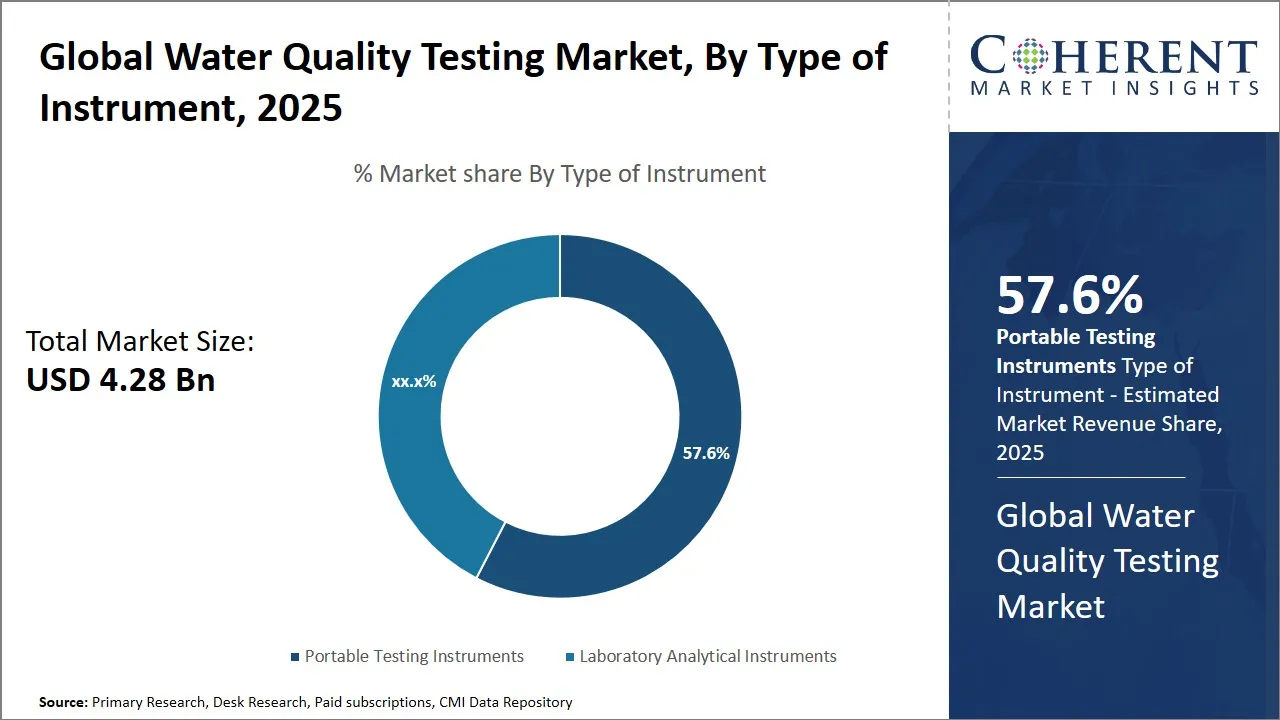
- The portable testing instruments segment is expected to hold 58.6 % of the global water quality testing market share in 2026.
- The drinking water testing segment is projected to account for 60.7 % of the market share in 2026.
- Electrochemical sensors are expected to capture 54.8 % of the market share in 2026.
- Asia Pacific is expected to lead the global water quality testing market in 2026 with a 34.2 % share.
- North America, holding an estimated share of 20.5% in 2026, is projected to be the fastest-growing region.
Market Overview
Market trends reflect a major transformation towards the use of sophisticated technologies like real-time monitoring solutions, IoT-based sensor, and digital water quality analysis. In addition, the heightened emphasis on sustainability along with government initiatives to ensure access to clean water is stimulating investments in innovative testing technologies. Furthermore, the application of AI and machine learning in water quality testing is already resulting in improved accuracy and operational efficiencies, which will also contribute to the market growth during the forecast period.
Current Events and Its Impact
Current Events | Description and its Impact |
Increased Regulatory Stringency Worldwide |
|
Advancements in Water Testing Technologies |
|
Segmental Insights
- Current Industry Events of 2026
- Market Size Estimation
- Regional Breakdown
- Competitive Landscape
- Customer Intelligence
- Segmental Analysis
- Pricing Analysis
- Key Market Drivers, Challenges & Future Trends
- Customized Insights Section
Water Quality Testing Market Insights, By Type of Instrument - Portable Testing Instruments Segment Dominates the Market Due to Convenience and Real-Time Analysis
Portable testing instruments segment is expected to contribute 58.6% of the global water quality testing market share in 2026, due to their unparalleled convenience and capacity to analyze real-time on-site water quality. The devices allow field technicians, environmental inspectors, and water treatment operators to test immediately without having to transport samples to a lab. This immediacy is essential for quick decision-making, especially in situations where water safety is a matter of public health. Portability eliminates time and expenses for sample preservation, transport, and delays in receiving test results.
In 2024, a major municipality in California, U.S. adopted portable water quality testing devices to monitor water safety in real-time across its network of public water sources. The portable instruments allowed the local environmental agency to immediately detect contamination events like elevated lead levels in drinking water, enabling rapid response and mitigation efforts.
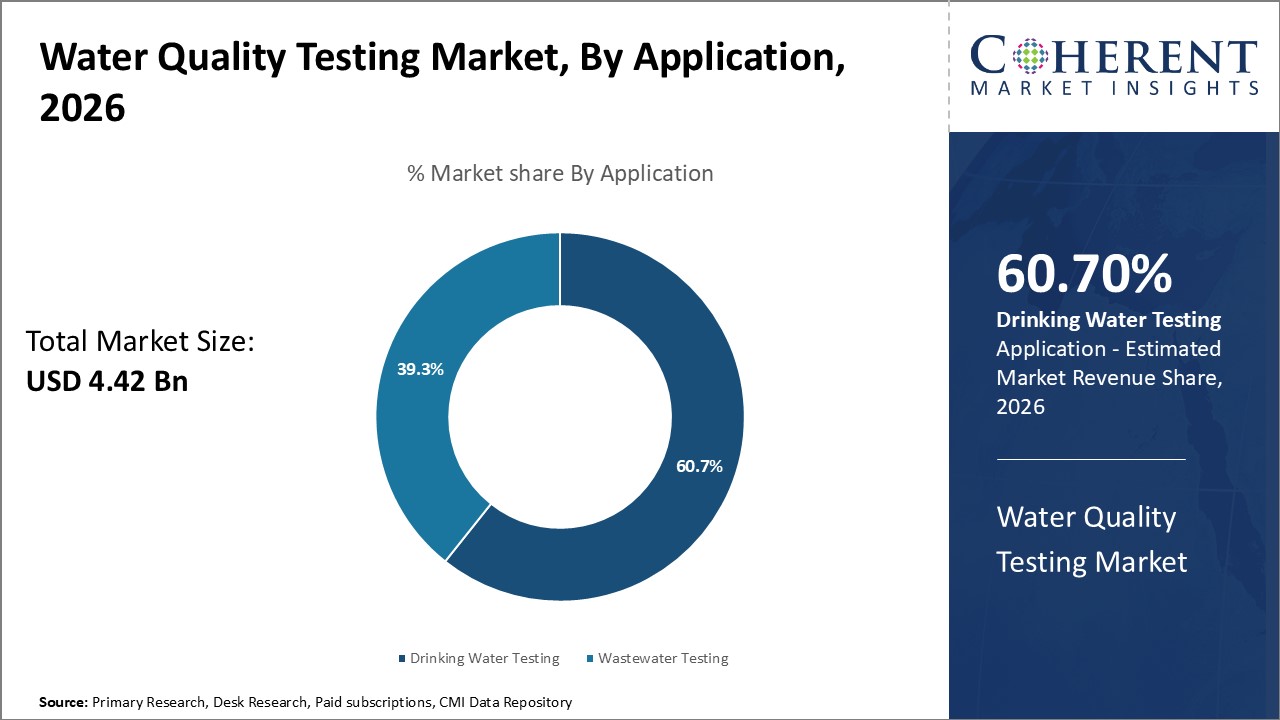
Water Quality Testing Market Insights, By Application - Drinking Water Testing Segment Dominates the Market Driven by Public Health Imperatives
The drinking water testing segment is projected to hold 60.7% of the market share in 2026, owing to the paramount significance of providing safe and drinkable water supply. With global urbanization on the rise, so too are the population numbers and growing concern about waterborne illnesses and pollutants. The demand for stringent testing of drinking water supplies has picked up as a result. Monitoring the quality of drinking water is an important focus of governments and public health organizations to prevent outbreaks of disease caused by pathogens, chemical contaminants, and heavy metals, all serious health concerns.
Key drivers of growth in this application market are the stringent regulation requirements and surveillance by organizations like the World Health Organization as well as domestic authorities. These regulatory requirements call for regular and thorough examination of municipal drinking water sources, pushing for widespread use of robust water test technologies. Emphasis on compliance to allowable contaminant levels, such as lead, arsenic, nitrates, and microbial indicators, maintains the water quality testing market on firm footing.
Water Quality Testing Market Insights, By Technology - Electrochemical Sensors Segment Dominates the Market Driven by Sensitivity and Versatility
Electrochemical sensors are anticipated to hold 54.8% share in 2026, due to their high sensitivity, fast response rates, and wide usage in water quality parameters. Electrochemical sensing technologies comprise potentiometric, amperometry, and conductometric sensors for the detection of single ions, dissolved oxygen, pH, chlorine, and other chemical species based on measurement of electrical changes caused by chemical reactions in the test sample.
The extensive use of electrochemical sensors is based on the accuracy and reproducibility of measurements, which is fundamental to the measurement of key water quality parameters. The applicability of electrochemical sensors is universal to many testing scenarios, which can be as simple as on-site portable instrumentation or more complex laboratory-based systems. Moreover, electrochemical sensors require less sample preparation and provide real-time information for measurements of water quality, resulting in improved operational efficiency.
Regional Insights
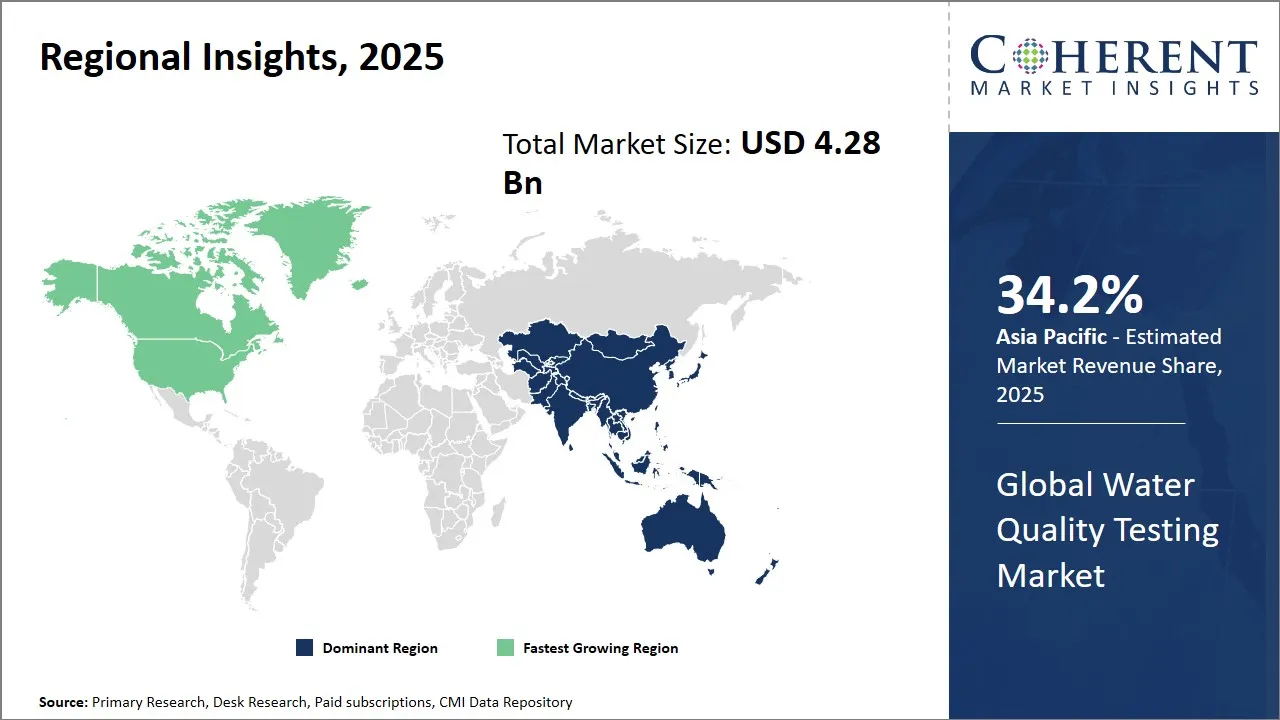
Asia Pacific Water Quality Testing Market Analysis and Trends
The Asia Pacific region is expected to dominate the market, accounting for 34.2% of the market share in 2026, which will be supported by the speed of urbanization, industrialization, and the need for governments to address water pollution. China and India face serious issues with water pollution, which is driving the demand for advanced, cost-effective, water quality monitoring mechanisms.
Government initiatives aimed at improving water safety/sanitation to meet sustainable development objectives, such as China's Water Ten Plan, and the National Water Mission in India are significant players that will drive market growth. There has also been greater participation from the Asia Pacific region players like Hunan Chuanglin Environmental Protection Group and larger international players like Merck KGaA and Agilent Technologies who are establishing themselves in the region.
Trade liberalization and expanding environmental consciousness among consumers and industries support the ecosystem, promoting adoption of water testing technologies in residential, farming, and industrial segments at a quicker rate.
North America Water Quality Testing Market Analysis and Trends
The North America region is expected to exhibit the fastest growth in the market, contributing 20.5% share in 2026, due to the region's developed technological infrastructure, environmental standards, and a robust industrial eco-system.
The U.S. and Canada have robust government regulations for water safety and sustainability enforced through organizations like the EPA. These rules require ongoing water quality monitoring and testing, generating steady demand for test equipment and services.
The availability of prominent industry giants like Thermo Fisher Scientific, Hach Company, and Danaher Corporation, who have their headquarters or major operations in North America, supports the market dominance. These players have heavily invested in R&D, offering advanced, reliable, and holistic water testing solutions covering municipal, industrial, and environmental applications. Furthermore, the highly established supply networks and trade channels enable effective distribution and uptake of cutting-edge water testing technology in the region.
Global Water Quality Testing Market Outlook for Key Countries
U.S. Water Quality Testing Market Analysis and Trends
The water quality testing market of the U.S. is dominated by its strong regulatory environment headed by the Environmental Protection Agency, which requires periodic water quality monitoring. Major players like Hach Company and Thermo Fisher Scientific, with headquarters in the U.S., make valuable contributions by offering a wide range of sophisticated water test equipment and services. The nation's extensive industrial base, coupled with increasing green awareness and federal investment in infrastructure upgrades, supports robust demand. In addition, expansive IoT and digital water quality monitoring system adoption is driving improved real-time data analysis and operational efficiencies in water testing.
China Water Quality Testing Market Analysis and Trends
The water quality testing market in China is expanding rapidly due to strengthened government efforts to curb water pollution from industrial and urban waste. The Chinese government has been implementing strict environmental policies such as the Water Pollution Prevention and Control Action Plan, which has created considerable demand for testing solutions.
Large Chinese companies and international companies like Merck KGaA and Agilent Technologies are investing heavily in developing innovative, indigenous testing kits and sensors. A strengthened industrial base in China, especially due to manufacturing and mining, has lent urgency to the need for regular water quality testing to be compliant with environmental regulations.
India Water Quality Testing Market Analysis and Trends
India retains the top spot in the market growth pattern in Asia Pacific with its imperative demand for water quality testing driven by endemic contamination and water scarcity problems. Government initiatives such as the National Water Mission and Jal Jeevan Mission emphasize water safety and encourage investments in water testing facilities. A number of local firms and startups are coming forward with low-cost and portable testing technologies appropriate for rural and urban water supply networks. In the meantime, global players like Thermo Fisher Scientific and Hach Company are also actively involved through partnership and distribution networks to improve market penetration and technology transfer.
Germany Water Quality Testing Market Analysis and Trends
Germany water quality testing market flourishes from its rigorous environmental regulations and advanced industrial segments that focus on sustainable management of water. Being part of the European Union, Germany is aligned with the Water Framework Directive of the EU, implementing strict water testing and quality measures.
Leading local companies, such as Sartorius AG, and multinational corporations, such as Danaher Corporation, manufacture high-quality water analysis equipment used in municipal treatment facilities and chemical production facilities worldwide. The emphasis by Germany on new product innovation and the need for accurate, real-time water quality test/compliance solutions maintains consistent demand in a mature market ecosystem and trading networks in Europe.
Brazil Water Quality Testing Market Analysis and Trends
Brazil water quality testing market is driven by rising environmental concerns such as agricultural runoff and urbanization. Government programs designed to improve water infrastructure and establish water quality standards are driving growth in professional testing services and use of water testing technology. Domestic companies, as well as international companies such as Agilent Technologies and Hach Company, are making it possible to develop, and use water quality testing technologies suited to Brazil's unique environmental concerns. Finally, regional trade and investing in smart water monitoring technologies are helping to strengthen Brazil's water quality testing market.
Macro and Micro Economic Factors Impacting the Water Quality Testing Market Growth
Macroeconomic Factors
- Regulatory Environment: Global regulations are becoming stricter regarding water quality standards such as those established by the U.S. EPA as well as other organizations worldwide. These regulations will create a greater demand for advanced water testing technologies and compliance participation. In addition, increased government initiatives related to water quality monitoring will further encourage growth in the market.
- Industrialization and Urbanization: Increased industrialization and urban development is contributing to higher water pollution and therefore a need for consistent water quality testing, particularly in urbanizing regions of cities that are primarily in the Asia-pacific region and emerging markets.
- Environmental Concerns and Climate Change: A rise in awareness about water pollution, waterborne illness, and climate change impacting water sources have positively influenced the demand for water testing, further supporting growth in the market. These factors promoting investments in water testing solutions have been aided by the global water crisis.
Microeconomic Factors
- Investment and Costs: Water testing laboratories require extensive investments in infrastructure and other capital and are also dependent on having cleared and qualified individuals to operate testing. The investment and operating costs of market actors are based on capital investment and qualified staff. For that reason, entities within the market are considering outsourcing testing or renting testing capabilities to reduce costs.
- Industry Demand: Water quality testing for various industries is expected to continue to rise which indicates economic growth in the water quality testing market. Common industries relying on water testing for health and safety and for products such as pharmaceutical production, municipal water supplies and food & beverages represent quality testing which has been shown to be in demand.
Market Players, Key Development, and Competitive Intelligence
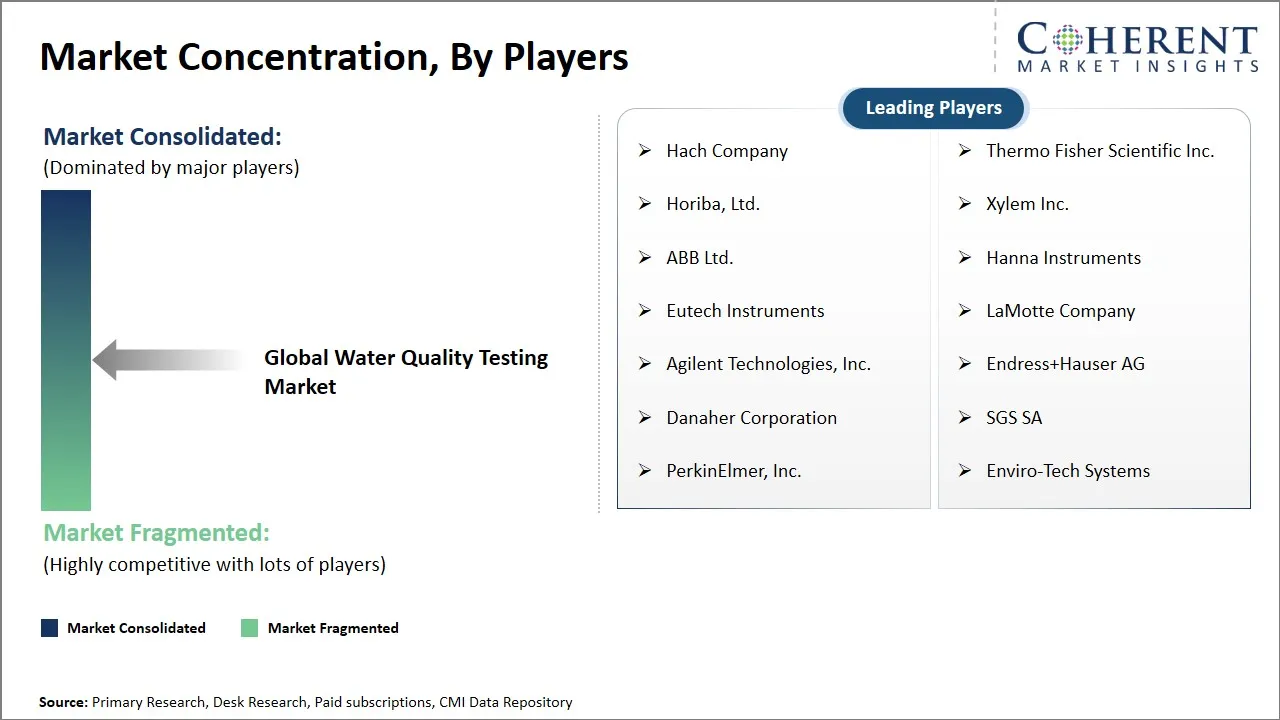
Key Developments
- In May 2025, Yorkshire Water and UnifAI Technology won USD 2.38 Mn to develop an AI-based continuous river monitoring system that will be deployed across 20 inland bathing sites in the U.K.
- In March 2025, UVM researchers launched an AI-powered predictive tool capable of forecasting contamination threats upstream in municipal water systems across the U.S.
- In July 2024, Wessex Water and Southern Water introduced real-time sensors at southern England swimming locations to predict bacterial presence with 87% accuracy.
Top Strategies Followed by Global Water Quality Testing Market Players
- Established market players in the global water quality testing market predominantly invest heavily in research and development (R&D) initiatives to stimulate innovation and facilitate the introduction of higher-performance products into the market. They should focus on the creation of advanced testing solutions that demonstrate improved accuracy, speed, and ease of use in response to regulatory requirements and consumer expectations regarding clean water.
- For example, Thermo Fisher Scientific has continuously improved its water testing instruments through the establishment of high-precision sensors and the development of real-time monitoring solutions. As a leader in the market, Theor Fisher Scientific provides reliable results for all testing parameters through its wide range of ORION series of water quality testing equipment, which are validated against relevant global standards.
- Mid-tier players in the global water quality testing market tend to take a slightly different approach, which focuses on the provision of most cost-effective water quality testing solutions while balancing quality and affordability, and are typically targeting very price-sensitive sub-segments of consumers, such as small municipalities, moderate-capital industries, and water utilities in developing regions, where inexpensive but reliable water testing is especially critical.
- As an example, Hanna Instrument HI98194 portable multiparameter meter, is targeted to environmental professionals and small utilities.
- Established companies in the international water quality testing industry usually operate in niche markets, where they can work to compete in their industry by leveraging features or product designs that are unique to them. They offer products that include highly targeted testing products such as portable testing devices, rapid testing kits, and products that are designed for specific contaminants and industry needs.
- For example, Aqualabo is an example of this type of business and specializes in portable, easy-to-use test kits for industrial needs. Aqualabo products, such as the Laqua Twin portable water quality analyzer, suit testing water in aquaculture, for example, or testing water in industrial cooling systems.
Market Report Scope
Water Quality Testing Market Report Coverage
| Report Coverage | Details | ||
|---|---|---|---|
| Base Year: | 2025 | Market Size in 2026: | USD 4.42 Bn |
| Historical Data for: | 2020 To 2024 | Forecast Period: | 2026 To 2033 |
| Forecast Period 2026 to 2033 CAGR: | 3.3% | 2033 Value Projection: | USD 5.55 Bn |
| Geographies covered: |
| ||
| Segments covered: |
| ||
| Companies covered: | Hach Company, Thermo Fisher Scientific Inc., Horiba, Ltd., Xylem Inc., ABB Ltd., Hanna Instruments, Eutech Instruments, LaMotte Company, Agilent Technologies, Inc., Endress+Hauser AG, Danaher Corporation, SGS SA, PerkinElmer, Inc., and Enviro-Tech Systems | ||
| Growth Drivers: |
| ||
| Restraints & Challenges: |
| ||
Water Quality Testing Market Dynamics
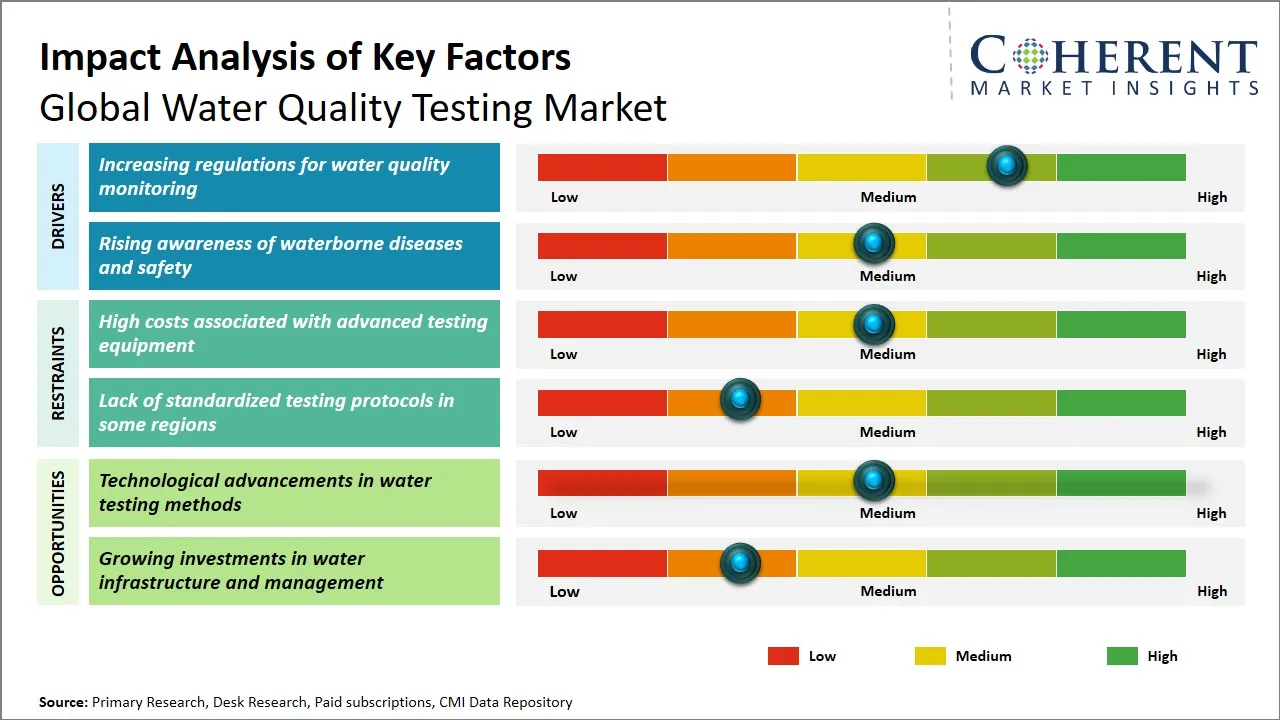
Water Quality Testing Market Driver - Increasing Regulations for Water Quality Monitoring
The increasing focus on regulations for water quality monitoring is a key driver of the global water quality testing market for water quality testing. Governments and environmental agencies globally produce increasingly rigorous standards and blueprints to protect people and the environment from unsafe water resources, which drives the demand for innovative water quality testing technologies. These regulations typically require regular and reliable assessments of water bodies to look for contaminants such as heavy metals, pathogens, and chemicals, which is compelling industries, municipalities, and farms to utilize water quality testing technologies.
For example, one regulation that is driving the water quality testing market is the Safe Drinking Water (SDWA) Act in the U.S., which requires public water systems to comply with minimum water quality standards. This regulation requires consistent testing of water sources to ensure they are below threshold indicators of safety, which is increasing the demand for various testing technologies.
Water Quality Testing Market Opportunity - Technological Advancements in Water Testing Methods
The global water quality testing market is expected to rapidly grow as a result of advancements in water testing technology. Innovations, such as portable testing devices, real-time monitoring systems, and advanced sensors, have changed how water quality is analyzed for accuracy, speed, and efficiency. The portable and handheld devices enable testing to be completed on-site, at any time, and reduce reliance on centralized laboratories, especially for rapid decision making in urban areas, and remote and developing country environments.
For example, technological advancements, especially have led to growth in areas that focus on real-time water quality monitoring systems. For example, Xylem Inc. is a global leader in water technology and has developed EXO Series of water quality sensors to monitor key water quality parameters (e.g., pH, dissolved oxygen, turbidity) in real-time.
Analyst Opinion (Expert Opinion)
- The global water quality testing market is set for high growth due to increased regulatory pressure and higher public attention to water safety issues. Discussions at the Water Quality Technology Conference (2023) and the International Water Association World Water Congress (2022) explored significant innovations in water quality testing, with Hach Company and Thermo Fisher Scientific providing advanced testing technology insights.
- Hach's recent launch of portable water quality testing kits using smartphone connectivity is a clear demonstration of the push towards the market's continued focus on user-friendly and accessible solutions for consumers and professionals. Discussions at these conferences highlighted the fundamental role in real-time data monitoring, to facilitate higher water management practices and address contamination risks. That said, the high cost of advanced testing devices, as well as the barrier of skilled personnel, were highlighted regularly.
- Companies focused on innovating and developing more affordable options, along with training end-users, will see a higher likelihood of adoption. In addition, companies should explore partnerships with local government and local non-government organizations to add outreach capacity and facilitate greater market penetration. Ultimately, the global water quality testing market's growth will depend on innovation to ensure accessible and reliable water safety measures.
Speak to the analyst
Want personalized insights?
Take the findings above to one of our principal consultants, or have the report rebuilt around the segments, geographies and competitors you actually track.
Market Segmentation
- Type of Instrument Insights (Revenue, USD Bn, 2021 - 2033)
- Portable Testing Instruments
- Laboratory Analytical Instruments
- Application Insights (Revenue, USD Bn, 2021 - 2033)
- Drinking Water Testing
- Wastewater Testing
- Technology Insights (Revenue, USD Bn, 2021 - 2033)
- Electrochemical Sensors
- Spectroscopy
- End-use Industry Insights (Revenue, USD Bn, 2021 - 2033)
- Municipal
- Pharmaceuticals
- Regional Insights (Revenue, USD Bn, 2021 - 2033)
- North America
- U.S.
- Canada
- Latin America
- Brazil
- Argentina
- Mexico
- Rest of Latin America
- Europe
- Germany
- U.K.
- Spain
- France
- Italy
- Russia
- Rest of Europe
- Asia Pacific
- China
- India
- Japan
- Australia
- South Korea
- ASEAN
- Rest of Asia Pacific
- Middle East
- GCC Countries
- Israel
- Rest of Middle East
- Africa
- South Africa
- North Africa
- Central Africa
- North America
- Key Players Insights
- Hach Company
- Thermo Fisher Scientific Inc.
- Horiba, Ltd.
- Xylem Inc.
- ABB Ltd.
- Hanna Instruments
- Eutech Instruments
- LaMotte Company
- Agilent Technologies, Inc.
- Endress+Hauser AG
- Danaher Corporation
- SGS SA
- PerkinElmer, Inc.
- Enviro-Tech Systems
Sources
Primary Research Interviews
- R&D Director – Leading Water Quality Testing Equipment Manufacturer
- Procurement Manager – Major Environmental Monitoring Agency
- Product Development Head – Well-Known Analytical Instrument Brand
Stakeholders
- Manufacturers of water testing instruments and kits
- End-use sectors
- Municipal Water Treatment Pl
- Industrial Process Water
- Agricultural Water Quality Management
- Regulatory & Certification Bodies
- E-commerce Platforms and Distributors
- Technology Integration Players: AI and IoT-based water quality monitoring solution providers
Databases
- UN Comtrade Database
- India Import Export (EXIM) Database
Magazines
- Water Technology Magazine – Innovations in water testing technologies
- Environmental Science & Technology – Research updates on water monitoring methods
- Global Water Intelligence – Market trends and industry insights for water quality testing
- Water Quality Products Magazine – Product developments and certification news
Journals
- Journal of Water Quality and Health – Water testing methodologies and effects
- Water Research Journal – Advances in water quality testing science
- Environmental Monitoring and Assessment – Monitoring technologies and impact studies
- Journal of Analytical Methods in Chemistry – Analytical techniques for water testing
Newspapers
- The Financial Times – Market growth and investment in water quality technologies
- The Guardian – Policy and consumer trends in water safety and monitoring
- Asia Water Journal – Growth of water quality testing in Asia-Pacific markets
- European Environmental News – Water regulations and compliance trends
Associations
- American Water Works Association (AWWA)
- Water Environment Federation (WEF)
- International Water Association (IWA)
- Environmental Protection Agency (EPA)
- European Water Association (EWA)
Public Domain Sources
- U.S. Environmental Protection Agency (EPA) – Guidelines for water quality standards and testing
- World Health Organization (WHO) – Drinking water quality and safety standards
- European Commission – Water Framework Directive and regulatory policies
- United Nations Environment Programme (UNEP) – Global water quality reports and assessments
Proprietary Elements
- CMI Data Analytics Tool, Proprietary CMI Existing Repository of information for last 8 years.
Get access to 250+ pages report
Every segment, forecast, competitor profile and data table behind the analysis above — available for instant download.
- ESOMAR Member
- ISO 9001:2015 Certified
- D-U-N-S Registered
- GDPR & CCPA Compliant
Missing comfort of reading report in your local language? Find your preferred language:
Transform your Strategy with Exclusive Trending Reports
Frequently Asked Questions
The global water quality testing market is estimated to be valued at USD 4.42 Bn in 2026 and is expected to reach USD 5.55 Bn by 2033.
The CAGR of the global water quality testing market is projected to be 3.3% from 2026 to 2033.
AI is transforming the quality testing market by enabling faster, more accurate, and automated analysis, reducing human error and improving efficiency.
High costs associated with advanced testing equipment and lack of standardized testing protocols in some regions are the major factors hampering the growth of the global water quality testing market.
In terms of type of instrument, the portable testing instruments segment is estimated to dominate the market revenue share in 2026.
Hach Company, Thermo Fisher Scientific Inc., Horiba, Ltd., Xylem Inc., ABB Ltd., Hanna Instruments, Eutech Instruments, LaMotte Company, Agilent Technologies, Inc., Endress+Hauser AG, Danaher Corporation, SGS SA, PerkinElmer, Inc., and Enviro-Tech Systems are the major players.
Asia Pacific is expected to lead the global water quality testing market in 2026.