

Global Wheat Germ Oil Market Size and Forecast – 2026 To 2033
The Global Wheat Germ Oil Market is estimated to be valued at USD 803.8 Mn in 2026 and is expected to reach USD 1,192.7 Mn by 2033, exhibiting a compound annual growth rate (CAGR) of 5.8% from 2026 to 2033. Growth will be supported by wheat germ oil’s natural vitamin E, essential fatty-acid, and antioxidant profile, which enables its use in dietary supplements, functional foods, skincare, haircare, and selected pharmaceutical formulations.
Clean-label preferences and the commercial utilization of wheat-milling by-products are also encouraging manufacturers to develop cold-pressed and application-specific oil grades. In April 2024, the U.S. FDA’s DailyMed database recorded the marketing start of IHAVE Sunscreen, an over-the-counter sunscreen cream formulated with wheat germ oil among its inactive ingredients, demonstrating its continued incorporation into functional personal-care products.
Key Takeaways of the Global Wheat Germ Oil Market
- Liquid oil is expected to hold 42.0 % of the global wheat germ oil market in 2026 because it can move directly into supplements, topical blends, serums, and specialty food formulations without additional format conversion. In May 2024, Gun Ana launched skincare essentials incorporating wheat germ oil across its Body Repair Serum, UV Body Mist, and Face Cream.
- Cold pressed segment is expected to command 58.0 % of the market share in 2026 because solvent-free processing supports premium positioning, cleaner ingredient declarations, and broader acceptance among natural-product buyers. In February 2025, Poultry Science published a controlled study evaluating cold-pressed wheat germ oil in broiler diets under heat stress, reinforcing commercial interest in function-preserving extraction across nutrition applications.
- Dietary supplements are expected to account for 34.2 % of the market share in 2026, supported by convenient dosing, established softgel manufacturing, and wheat germ oil’s fit within vitamin E and specialty lipid portfolios. In September 2025, the NIH Dietary Supplement Label Database entered an on-market Standard Process Wheat Germ Oil product classified as a botanical soft gel capsule.
- North America is expected to represent 34.2 % of the global revenue in 2026, reflecting mature supplement purchasing, extensive natural-products retail, established contract manufacturing, and strong consumer familiarity with nutritional oils. In October 2024, the Council for Responsible Nutrition reported that three-quarters of Americans used dietary supplements, strengthening the addressable base for wheat germ oil capsules and liquid formulations.
- Europe is expected to hold 29.2 % of the market share in 2026 while emerging as the fastest-growing region, supported by natural-cosmetic formulation, organic sourcing, ingredient documentation, and demand for traceable plant oils. In April 2024, NATRUE-issued documentary evidence confirmed that Germany-based Henry Lamotte Oils listed raw materials, including refined wheat germ oil, complied with the natural-cosmetics standard.
- Stability-First Formulation and Shelf-Life Protection: Oxidation management is becoming central to product strategy because wheat germ oil’s value depends on preserving sensitive lipids and tocopherols through processing, transport, and consumer use. Suppliers combining encapsulation, protective packaging, controlled storage, and application-specific shelf-life testing can reduce formulation risk, support premium claims, and become preferred development partners for supplement, cosmetics, and functional-food brands.
- Traceable Upcycling and Circular Value Creation: Wheat germ oil is increasingly positioned as a high-value output from grain-milling side streams rather than as a standalone agricultural commodity. This shifts competitive advantage toward suppliers that secure consistent germ quality, document origin, and integrate stabilization near milling operations. Stronger traceability can improve procurement confidence, support sustainability narratives, and encourage longer-term contracts between millers, extractors, formulators, and brand owners.
Segmental Insights
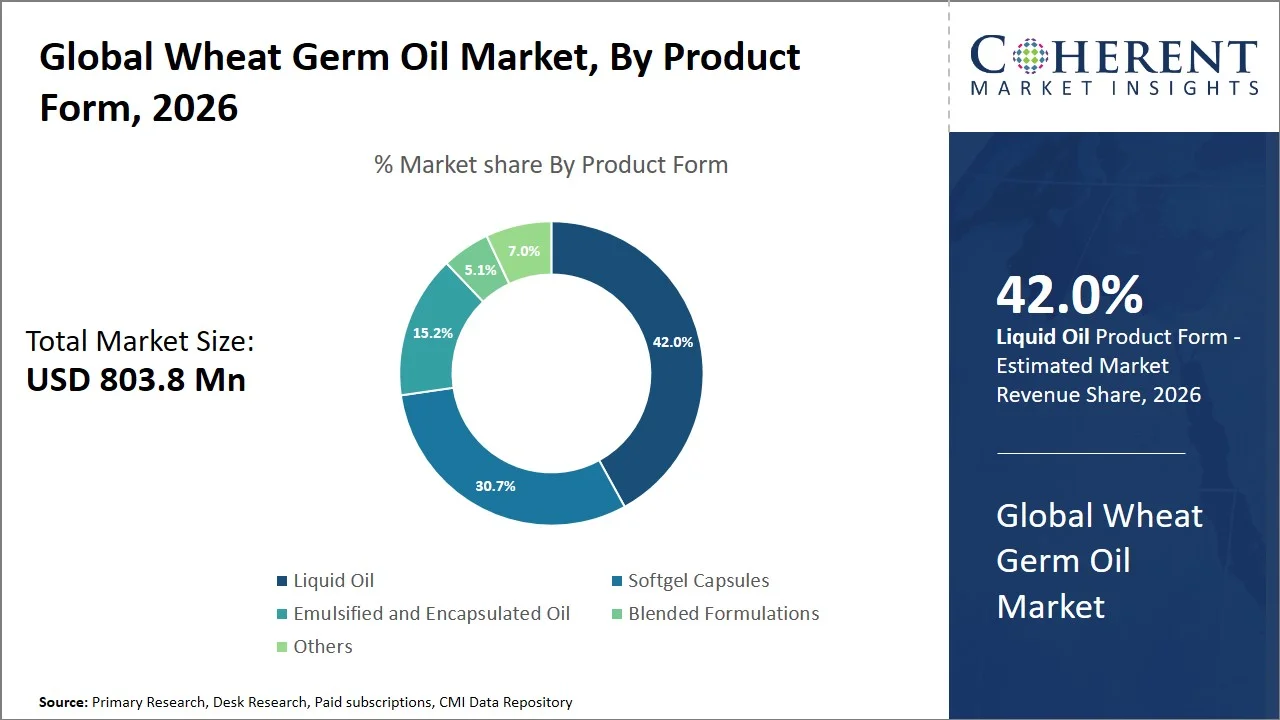
Why Does Liquid Oil Dominate the Global Wheat Germ Oil Market?
Liquid oil is expected to hold 42.0% of the product form category in 2026 because it offers the widest formulation latitude across nutraceutical, cosmetic, pharmaceutical, and specialty-food manufacturing. Buyers can dose it directly, combine it with carrier oils, or convert it into emulsions, capsules, and encapsulated ingredients without first reversing a solid delivery format. Bulk liquid supply also suits direct B2B procurement, flexible batch sizes, and private-label production, reducing conversion steps for formulators. Its principal commercial constraint is oxidation sensitivity, making nitrogen flushing, light-resistant containers, controlled storage, and rapid inventory rotation important supplier capabilities. In September 2024, the European Journal of Lipid Science and Technology published research that loaded wheat germ oil into optimized chitosan–nettle seed gum–ovalbumin nanocarriers and evaluated emulsion stability, thermal behavior, particle characteristics, and cytotoxicity, demonstrating how liquid oil functions as the adaptable starting material for advanced delivery systems.
- Current Industry Events of 2026
- Market Size Estimation
- Regional Breakdown
- Competitive Landscape
- Customer Intelligence
- Segmental Analysis
- Pricing Analysis
- Key Market Drivers, Challenges & Future Trends
- Customized Insights Section
Why Does Cold Pressed Represent the Largest Extraction Type in the Global Wheat Germ Oil Market?
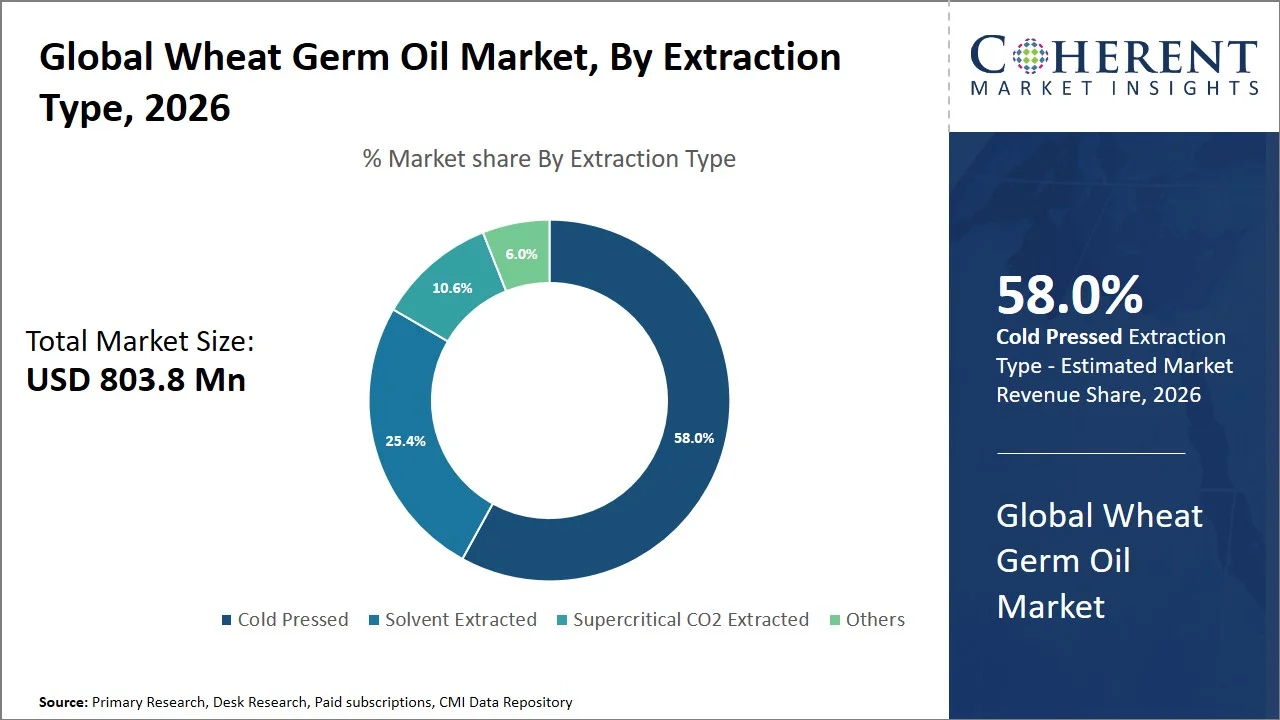
Cold pressed is expected to represent 58.0% of the extraction type category in 2026 because it aligns product quality with the clean-label expectations of supplement, natural-cosmetic, and premium edible-oil buyers. Mechanical pressing avoids routine solvent handling and supports marketing around minimally processed oil, while preserving a commercially attractive connection between wheat-milling by-products and higher-value wellness ingredients. Producers nevertheless require freshly separated germ, rapid stabilization, oxygen control, low-temperature processing, and protective packaging because endogenous enzymes and unsaturated lipids can shorten usable shelf life. These requirements favor suppliers integrated with flour mills or equipped for immediate germ treatment. In January 2024, LWT published a comparative assessment of four wheat-germ stabilization techniques and found vibrated fluidized-bed treatment provided the strongest lipid stability while limiting structural change, highlighting the upstream process control needed to manufacture consistently high-quality mechanically extracted wheat germ oil.
Why Do Dietary Supplements Dominate the Application Category of the Global Wheat Germ Oil Market?
Dietary supplements are projected to represent 34.2% of global wheat germ oil market applications in 2026, supported by the growing use of capsules and pre-measured liquid formulations that offer convenient, familiar, and repeat-use wellness options for delivering the oil’s fat-soluble nutrients. Supplement brands can position wheat germ oil within vitamin E, essential fatty acid, antioxidant, skin-health, and general nutrition portfolios, while contract manufacturers already possess softgel filling, bottling, labeling, and online fulfillment infrastructure. The category also supports differentiated strengths, blends, serving sizes, and premium sourcing claims without requiring major changes to consumer routines. Commercial success will depend on oxidation control, substantiated label language, allergen communication, and consistent active-component specifications. In March 2025, Biomolecules published molecular profiling and FTIR characterization of wheat germ oil, examining its essential fatty acids, sterols, tocopherols, polyphenols, antioxidant activity, and anti-inflammatory properties, expanding the evidence base available to nutraceutical developers evaluating formulation and positioning.
Current Events and their Impact
Current Event | Description and Its Impact |
January 2025 – FDA Finalizes Food-Allergen Labeling Guidance |
|
March 2026 – Updated Canadian Natural Health Product GMP Guidance Takes Effect |
|
June 2026 – India Prohibits a Wheat Germ Oil-Containing Fixed-Dose Combination |
|
Global Wheat Germ Oil Market Dynamics
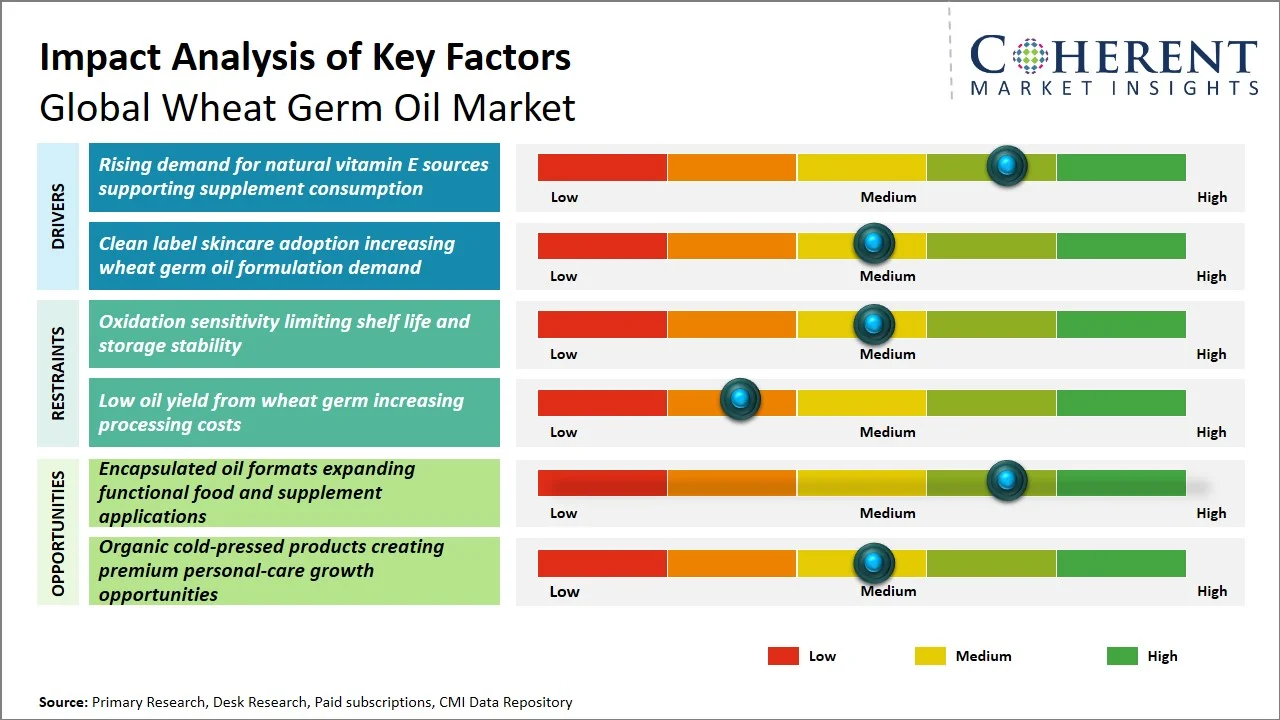
Key Market Drivers
- Natural Vitamin E Procurement Expands Supplement Formulation: Natural vitamin E sourcing is becoming a stronger purchasing criterion in supplements because brands want recognizable plant-derived actives rather than petroleum-linked synthetic positioning. Wheat germ oil can benefit as a naturally tocopherol-bearing lipid that supports softgels, liquid supplements, beauty-from-within products, and blended nutritional oils. The mechanism is commercial as well as nutritional: formulators can combine vitamin E positioning with minimally processed sourcing and a familiar food-derived ingredient. Extractors, standardized-oil suppliers, capsule manufacturers, and private-label nutraceutical companies gain when they can document tocopherol composition, oxidation stability, and batch consistency. However, competing sunflower and soybean tocopherols require wheat germ oil suppliers to differentiate through whole-oil functionality rather than vitamin E content alone. In April 2025, Kensing introduced Sun E, an upcycled sunflower-derived natural tocopherol for supplements and personal care, confirming active industry investment in clean-label plant vitamin E and intensifying specification-based competition.
- Clean-Label Skincare Broadens Botanical Oil Utilization: Clean-label skincare is expanding wheat germ oil’s formulation role because cosmetic buyers increasingly scrutinize ingredient origin, processing history, and label clarity alongside sensory performance. The oil offers emollience and a plant-based lipid profile suitable for facial oils, barrier-support products, hair treatments, body serums, and blended carrier systems. Demand does not automatically convert into sales: its color, aroma, viscosity, oxidation sensitivity, and wheat-derived identity must be managed through grade selection, deodorization where appropriate, protective packaging, and transparent allergen communication. Cosmetic ingredient suppliers, contract formulators, indie brands, certification providers, and testing laboratories benefit as brands seek verifiable natural-content claims. Premium opportunities are strongest for suppliers offering organic documentation, traceable lots, and application support rather than undifferentiated bulk oil. In March 2025, NSF reported that 74% of surveyed U.S. consumers considered organic ingredients important in personal care products, reinforcing the commercial value of certified and clearly documented botanical inputs.
Emerging Market Trends
- Application-Specific Grades Replace Generic Oil Specifications: Wheat germ oil suppliers are shifting toward food, supplement, cosmetic, pharmaceutical-support, and animal-nutrition grades with defined tocopherol content, oxidation limits, sensory properties, and allergen documentation. This favors integrated processors that provide stable specifications, certificates of analysis, and formulation support. Traders offering inconsistent bulk oil may lose customers as technical qualification, differentiated packaging, and quality assurance become more important.
- Topical and Ingestible Beauty Portfolios Converge: Beauty brands are increasingly combining wheat germ oil-based skincare, haircare, softgels, and nutritional products under coordinated wellness portfolios. This creates opportunities for manufacturers capable of supplying both cosmetic and supplement formats with consistent sourcing and compliant claims. Brands must clearly separate cosmetic, nutritional, and therapeutic messaging, while using coordinated packaging, distribution, and consumer education to strengthen cross-category purchasing and customer retention.
Regional Insights
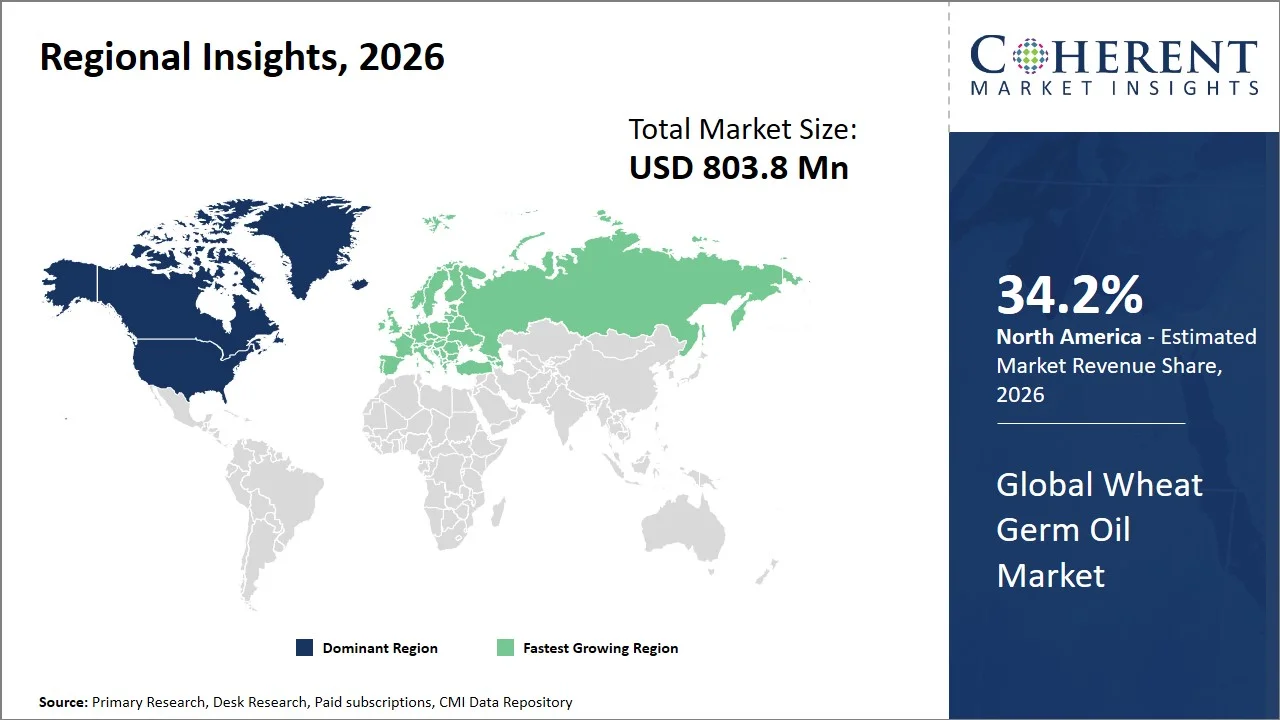
Why Does North America Dominate the Global Wheat Germ Oil Market?
North America is expected to account for 34.2% of the global wheat germ oil market in 2026 because the region combines established dietary-supplement consumption, sophisticated ingredient distribution, large-scale softgel and liquid-filling capacity, and broad access to natural personal-care products. Wheat germ oil can therefore move through multiple commercial routes, including branded supplements, private-label formulations, specialty nutrition, cosmetics, and animal wellness. The region’s mature testing, labeling, traceability, and retail infrastructure also helps suppliers commercialize premium cold-pressed and standardized oils while managing oxidation-sensitive inventories. In May 2026, the U.S. National Center for Health Statistics reported that 60.2% of adults used a dietary supplement during the measured period, while 38.7% used two or more products. This established supplement behavior enlarges the addressable customer base for wheat germ oil softgels and nutritional blends across North America.
Why is Europe Emerging as the Fastest-Growing Region in the Global Wheat Germ Oil Market?
Europe is expected to represent 29.2% of the global wheat germ oil market in 2026 and expand faster than other regions as natural-cosmetic formulation, circular processing, cleaner extraction, and premium ingredient traceability become stronger procurement priorities. European millers can create additional value from wheat germ that would otherwise remain a lower-value milling stream, while specialist oil processors serve supplements, dermatological care, functional foods, and animal nutrition. Buyers also place commercial weight on solvent reduction, documented origin, and environmental performance, encouraging investment in alternative extraction and stabilization systems. In August 2025, the European Commission’s CORDIS platform updated the EcoXtract project, which received USD 3.16 million in EU funding and developed a bio-based substitute for petroleum-derived hexane, including industrial-scale extraction plants in Europe. Such processing innovation improves the strategic environment for differentiated plant oils, including wheat germ oil.
Global Wheat Germ Oil Market Outlook for Key Countries
Why is the U.S. a Key Market for the Global Wheat Germ Oil Market?
The U.S. is a key market for wheat germ oil because it links a substantial wheat and flour-milling base with an advanced nutraceutical, cosmetics, veterinary, and specialty-ingredient ecosystem. Commercial millers generate wheat germ at scale, giving extractors access to a domestic co-product that can be upgraded into liquid oil, softgels, skin-care ingredients, or equine and companion-animal supplements. Contract manufacturers, national pharmacy chains, natural-product retailers, and e-commerce platforms shorten the route from bulk ingredient to finished product. U.S. buyers also value supplier documentation covering identity, allergens, oxidation stability, and batch consistency, which benefits technically capable processors. In October 2024, USDA’s Economic Research Service estimated U.S. wheat production at 1.971 billion bushels for 2024/25, 9% above the previous year and the highest level since 2016/17. This stronger crop base supports milling throughput and potential wheat-germ availability.
Why is India Important in the Global Wheat Germ Oil Market?
India is important in the global wheat germ oil market because its large wheat economy, extensive milling network, expanding nutraceutical manufacturing, and cost-competitive botanical processing create opportunities across both domestic consumption and exports. Flour mills can improve co-product economics by separating and stabilizing germ for oil extraction instead of directing all residual material toward lower-value uses. Indian processors also serve Ayurvedic-inspired wellness, beauty oils, softgel supplements, and private-label brands sold through pharmacies and digital marketplaces. The commercial opportunity depends on rapid germ stabilization, food-grade quality systems, and packaging that protects tocopherol-rich oil from heat and oxygen. In April 2026, India’s Ministry of Agriculture and Farmers Welfare reported that wheat had been sown across an estimated 33.4 million hectares for the 2025–26 season, with early planting and no major pest or disease incidence reported. This scale supports a broad upstream feedstock base for value-added wheat derivatives.
Why Does China Support Growth in the Global Wheat Germ Oil Market?
China supports growth in the global wheat germ oil market through its extensive wheat-processing capacity, large consumer-products manufacturing base, and ability to scale ingredient extraction, encapsulation, packaging, and online distribution. Dense milling clusters can supply germ to specialized processors, while domestic cosmetics, nutrition, food, and feed manufacturers provide several end-use outlets. China’s manufacturing advantage is particularly relevant for blended formulations and encapsulated oils, where cost control, production throughput, and flexible packaging formats influence supplier selection. Producers that strengthen oxidation management, contaminant testing, and traceable sourcing can also address premium domestic buyers and export customers. In December 2024, China’s National Bureau of Statistics reported wheat production of 140.099 million metric tons from 23.587 million hectares during 2024. This large raw-material system provides a substantial foundation for wheat milling and creates scope to recover more germ for higher-value oil production rather than conventional by-product channels.
Why is Germany a Strategic Country in the Global Wheat Germ Oil Market?
Germany is a strategic country for the global wheat germ oil market because it combines concentrated grain milling, specialist plant-oil processing, premium natural cosmetics, organic retail, and demanding ingredient-quality standards. German formulators can use wheat germ oil in skin and hair care, dietary supplements, specialty foods, and professional wellness products, while domestic technical expertise supports refining, deodorization, blending, encapsulation, and protective packaging. The country’s strong B2B distribution networks also allow certified oils to reach manufacturers across the wider European market. Suppliers must compete through analytical documentation, sustainable sourcing, low-oxidation handling, and application support rather than price alone. In December 2025, Germany’s IKW industry association reported that beauty and home-care revenue reached USD 40.57 billion in 2025, with domestic sales rising to USD 27.24 billion and e-commerce recording the strongest channel growth. This creates a receptive commercial environment for differentiated botanical oils used in personal-care formulations.
Why is Japan an Important Growth Market for the Global Wheat Germ Oil Market?
Japan is an important growth market for the global wheat germ oil market because consumers and manufacturers place high value on ingredient purity, measured dosage, convenient softgel formats, and carefully documented health and beauty products. The country’s supplement, pharmacy, cosmetics, and functional-food channels provide suitable outlets for refined or cold-pressed wheat germ oil, particularly when suppliers offer precise specifications, freshness protection, and compact packaging. Japan’s dependence on imported wheat also means that germ availability is connected to stable government-managed procurement and domestic milling rather than agricultural output alone. In March 2026, Japan’s Ministry of Agriculture, Forestry and Fisheries set the April 2026 government selling price for imported wheat at USD 382.32 per metric ton, a 2.5% increase from the prior period. Predictable procurement and pricing mechanisms help mills plan throughput, supporting continued access to wheat-processing co-products that can be upgraded into specialty oils.
Technology Adoption Landscape in the Global Wheat Germ Oil Market
Technology | Adoption Level | Key Application Area | Business Impact |
Temperature-Controlled Cold Pressing | High | Premium supplement, cosmetic, food, and carrier-oil grades | Supports minimally processed positioning and native-component retention but requires stabilized germ and strict temperature management. |
Wheat Germ Stabilization Systems | Medium | Enzyme inactivation before extraction | Fluidized-bed, microwave, infrared, or controlled-heat treatment extends the processing window and reduces oil degradation before extraction. |
Supercritical Carbon Dioxide Extraction | Medium | High-purity cosmetic, nutraceutical, and pharmaceutical-support grades | Enables selective, solvent-free extraction and premium positioning, although equipment cost and technical complexity restrict wider deployment. |
Microencapsulation and Spray Drying | Medium | Powdered supplements, functional foods, beverages, and animal nutrition | Protects sensitive lipids, improves dispersibility, simplifies dosing, and allows wheat germ oil to enter dry-product formulations. |
Molecular Distillation and Controlled Deodorization | Medium | Refined cosmetic, food, and specialty ingredient grades | Improves odor, color, purity, and sensory compatibility while helping suppliers customize oil for demanding formulations. |
HPLC, GC, FTIR, and Oxidation Analytics | High | Identity, tocopherol, fatty-acid, purity, and stability testing | Strengthens batch release, certificates of analysis, shelf-life validation, customer qualification, and regulatory documentation. |
How are Protected Powder and Lipid-Delivery Systems Creating New Growth Opportunities in the Global Wheat Germ Oil Market?
Microencapsulated wheat germ oil systems represent an underdeveloped opportunity because they can convert an oxidation-sensitive liquid into dispersible powders, protected lipid carriers, and precisely dosed functional ingredients. Such formats could serve powdered supplements, medical nutrition, bakery mixes, beverage premixes, animal nutrition, and co-delivery systems for fat-soluble actives. Commercial value comes from solving handling and shelf-life barriers that currently limit oil inclusion in dry or water-based products. Companies can capture the opportunity by developing stable emulsions, selecting food- or cosmetic-grade wall materials, validating spray-drying or freeze-drying conditions, and generating application-specific stability and release data. Participation requires pilot-scale formulation capability, analytical testing, sensory control, regulatory classification expertise, and partnerships with finished-product manufacturers. Specialist encapsulation companies and vertically integrated oil processors are best positioned initially, although contract manufacturers can enter through licensed technology or joint development. The opportunity should support premium pricing when suppliers sell a validated delivery solution rather than commodity oil, but scale-up economics and active-load consistency will determine whether adoption moves beyond niche formulations.
Market Players, Key Development, and Competitive Landscape
Key Developments
- In May 2026, RVL Pharmaceuticals launched Upneeq Reveal Under Eye Complex, a fragrance-free skincare formulation incorporating wheat germ oil and pomegranate sterols to support the delicate under-eye skin barrier. This is important for the global wheat germ oil market because it shows the ingredient moving into targeted, premium skincare developed with clinical and cosmetic formulation expertise rather than remaining limited to general-purpose botanical oils.
- In August 2025, SULU Organics introduced new packaging and oil blends across its plant-oil portfolio, which includes organic, cold-pressed, unrefined wheat germ oil in retail and bulk formats. This is important for the global wheat germ oil market because recyclable packaging, varied pack sizes, and combined consumer and wholesale availability can improve product differentiation and serve both small formulators and larger B2B buyers.
Competitive Landscape
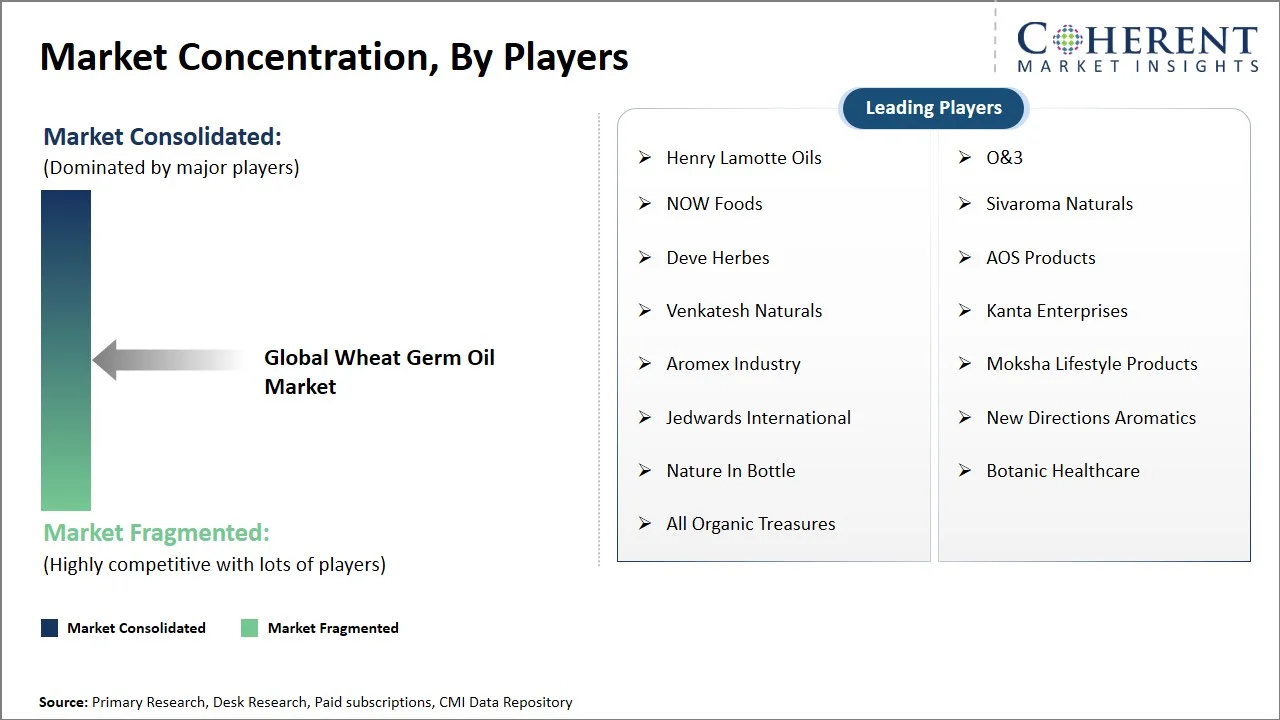
The global wheat germ oil market is fragmented, with competition spanning milling-linked extractors, specialty vegetable-oil processors, nutraceutical ingredient suppliers, cosmetic raw-material distributors, contract manufacturers, and consumer brands. Scale alone does not secure leadership because wheat germ deteriorates quickly and finished oil performance varies with stabilization, extraction, refining, storage, and packaging. Competitive advantage therefore rests on repeatable specifications, dependable germ sourcing, application-grade customization, compliance documentation, and the ability to protect product quality through delivery. Regional specialists remain important where they combine local mill relationships with flexible order quantities and technical support.
Key focus areas include
- Composition consistency: Suppliers compete on verified tocopherol profiles, fatty-acid composition, oxidation indices, and batch-to-batch reproducibility.
- Feedstock access: Direct relationships with flour mills improve germ freshness, procurement continuity, and production planning.
- Grade differentiation: Food, cosmetic, supplement, pharmaceutical-support, and animal-nutrition grades reduce dependence on commodity pricing.
- Certification and compliance: Organic, non-GMO, quality-management, allergen, and manufacturing documentation influence supplier approval.
- Private-label capability: Softgel filling, liquid bottling, blending, and customized packaging strengthen access to emerging brands.
- Packaging performance: Light-resistant containers, nitrogen flushing, smaller pack sizes, and controlled logistics support product stability.
- Technical relationships: Formulation support, responsive sampling, stability guidance, and flexible minimum-order quantities improve customer retention.
Market Report Scope
Wheat Germ Oil Market Report Coverage
| Report Coverage | Details | ||
|---|---|---|---|
| Base Year: | 2025 | Market Size in 2026: | USD 803.8 Mn |
| Historical Data for: | 2020 To 2024 | Forecast Period: | 2026 To 2033 |
| Forecast Period 2026 to 2033 CAGR: | 5.8% | 2033 Value Projection: | USD 1,192.7 Mn |
| Geographies covered: |
| ||
| Segments covered: |
| ||
| Companies covered: | Henry Lamotte Oils, O&3, NOW Foods, Sivaroma Naturals, Deve Herbes, AOS Products, Venkatesh Naturals, Kanta Enterprises, Aromex Industry, Moksha Lifestyle Products, Jedwards International, New Directions Aromatics, Nature in Bottle, Botanic Healthcare, and All Organic Treasures | ||
| Growth Drivers: |
| ||
| Restraints & Challenges: |
| ||
Analyst Opinion (Expert Analyst)
- The global wheat germ oil market leadership will shift from selling a broadly described botanical oil toward supplying application-ready lipid systems. Buyers will increasingly expect a defined specification, evidence package, compatible packaging, and formulation guidance tailored to supplements, cosmetics, foods, or animal nutrition. Companies that organize portfolios around customer outcomes rather than extraction method alone should strengthen retention and reduce exposure to commodity price comparison.
- The most disruptive change could be the separation of wheat germ oil into standardized fractions and delivery systems rather than marketing the whole oil as the only commercial endpoint. Concentrates, protected powders, and tailored lipid carriers could capture value from specific components and applications. Undifferentiated bulk sellers would face pressure, while processors combining separation science, formulation capability, and customer validation would gain influence over product design.
- Global wheat germ oil market participants should prioritize rapid germ stabilization, oxidation analytics, allergen governance, and small-batch grade customization, supported by regional packaging or contract-manufacturing partners. Margin risk will remain high where suppliers compete only on crude-oil price or accept weak shelf-life assumptions. Investment should target customers with technically defined needs, while avoiding excessive spending on broad consumer claims, unsupported therapeutic positioning, or capacity that lacks secured milling relationships.
Speak to the analyst
Want personalized insights?
Take the findings above to one of our principal consultants, or have the report rebuilt around the segments, geographies and competitors you actually track.
Market Segmentation
- Product Form Insights (Revenue, USD Mn, 2021 - 2033)
- Liquid Oil
- Softgel Capsules
- Emulsified and Encapsulated Oil
- Blended Formulations
- Others
- Extraction Type Insights (Revenue, USD Mn, 2021 - 2033)
- Cold Pressed
- Solvent Extracted
- Supercritical CO2 Extracted
- Others
- Application Insights (Revenue, USD Mn, 2021 - 2033)
- Dietary Supplements
- Cosmetics and Personal Care
- Food and Beverages
- Pharmaceuticals
- Animal Nutrition
- Others
- Distribution Channel Insights (Revenue, USD Mn, 2021 - 2033)
- Direct B2B Sales
- Online Retail
- Specialty Health and Beauty Stores
- Supermarkets and Hypermarkets
- Pharmacies and Drugstores
- Others
- Regional Insights (Revenue, USD Mn, 2021 - 2033)
- North America
- U.S.
- Canada
- Latin America
- Brazil
- Argentina
- Mexico
- Rest of Latin America
- Europe
- Germany
- U.K.
- Spain
- France
- Italy
- Russia
- Rest of Europe
- Asia Pacific
- China
- India
- Japan
- Australia
- South Korea
- ASEAN
- Rest of Asia Pacific
- Middle East
- GCC Countries
- Israel
- Rest of Middle East
- Africa
- South Africa
- North Africa
- Central Africa
- North America
- Key Players Insights
- Henry Lamotte Oils
- O&3
- NOW Foods
- Sivaroma Naturals
- Deve Herbes
- AOS Products
- Venkatesh Naturals
- Kanta Enterprises
- Aromex Industry
- Moksha Lifestyle Products
- Jedwards International
- New Directions Aromatics
- Nature In Bottle
- Botanic Healthcare
- All Organic Treasures
Sources
Primary Research Interviews
- Wheat millers, wheat germ processors, vegetable-oil extractors, cold-pressed oil manufacturers, supercritical CO₂ extraction companies, ingredient suppliers, distributors, private-label firms, and contract manufacturers
- R&D, procurement, production, quality assurance, regulatory affairs, formulation, marketing, sustainability, and sales executives
Stakeholders
- Nutraceutical manufacturers, cosmetic formulators, functional-food producers, pharmaceutical companies, animal-nutrition companies, wellness brands, and specialty-oil buyers
- Wheat farmers, flour mills, germ-stabilization technology providers, extraction-equipment manufacturers, encapsulation companies, packaging suppliers, testing laboratories, and logistics providers
- Importers, exporters, wholesalers, pharmacies, health and beauty stores, supermarkets, specialty nutrition retailers, and e-commerce platforms
End-use Sectors
- Dietary supplements, softgel capsules, liquid nutritional oils, functional foods, bakery products, beverages, and specialty food formulations
- Skincare, haircare, facial oils, body-care products, anti-aging formulations, massage oils, and personal-care products
- Pharmaceutical formulations, animal feed, pet nutrition, equine supplements, and specialty veterinary products
Regulatory & Government Bodies
- U.S. FDA, USDA, FTC, European Commission, EFSA, UK FSA, Health Canada, CFIA, and Natural and Non-prescription Health Products Directorate
- FSSAI, India Ministry of AYUSH, China SAMR and NHC, Japan MHLW and Consumer Affairs Agency
- Brazil ANVISA, FSANZ, Codex Alimentarius Commission, and national food, customs, agriculture, and consumer-protection authorities
Databases
- UN Comtrade, ITC Trade Map, WTO Statistics, Eurostat, USITC DataWeb, FAOSTAT, World Bank, OECD, and International Grains Council databases
- USDA FoodData Central, NIH Dietary Supplement Label Database, PubMed, ClinicalTrials.gov, and European Union Clinical Trials Information System
- China Customs, India DGCI&S, Brazil Comex Stat, company filings, retail listings, product-label databases, pricing records, trade data, and consumer-review platforms
Magazines and Journals
- Nutraceuticals World, Nutrition Insight, FoodNavigator, CosmeticsDesign, Personal Care Magazine, and Natural Products Insider
- Food Chemistry, LWT, Journal of the American Oil Chemists’ Society, Industrial Crops and Products, Journal of Functional Foods, Nutrients, and Biomolecules
- International Journal of Cosmetic Science, Journal of Cosmetic Dermatology, and Journal of Food Science and Technology
Associations
- American Oil Chemists’ Society
- Council for Responsible Nutrition
- Food Supplements Europe
- Personal Care Products Council
- Cosmetics Europe
- North American Millers’ Association
- International Association of Operative Millers
- International Grains Council
Public Domain Sources
- Food-safety, dietary-supplement, cosmetic, pharmaceutical, animal-feed, labeling, allergen, packaging, trade, customs, and consumer-protection authorities
- Company annual reports, product catalogues, ingredient labels, safety data sheets, certificates of analysis, organic certifications, technical documents, patents, and press releases
- Pharmacy, nutraceutical, cosmetic, specialty-food, health-store, distributor, and online marketplace listings
- Peer-reviewed studies covering extraction, stabilization, tocopherol retention, fatty-acid composition, oxidation, encapsulation, formulation, and biological activity
Key Standards and Regulations
- U.S. FD&C Act, Dietary Supplement Health and Education Act, FSMA, dietary-supplement GMP, food-allergen labeling, cosmetic labeling, and animal-feed requirements
- EU General Food Law, Food Information to Consumers Regulation, food-supplement rules, cosmetic products regulation, novel-food requirements, REACH, and packaging regulations
- Codex standards covering edible oils, food additives, hygiene, contaminants, allergens, nutrition labeling, and methods of analysis
- India FSSAI food-product, nutraceutical, labeling, packaging, and advertising regulations
- China GB food-safety, nutrition-labeling, cosmetic, health-food, and additive standards
- Canada Natural Health Products Regulations, Food and Drugs Act, cosmetic notification, allergen-labeling, and GMP requirements
- Japan Food Sanitation Act, Foods with Function Claims framework, cosmetic standards, and health-food labeling requirements
- Brazil ANVISA and FSANZ requirements for foods, supplements, cosmetics, labeling, additives, and product safety
Proprietary Elements
- CMI Data Analytics Tool, Proprietary CMI Existing Repository of information for last 10 years.
Get access to 250+ pages report
Every segment, forecast, competitor profile and data table behind the analysis above — available for instant download.
- ESOMAR Member
- ISO 9001:2015 Certified
- D-U-N-S Registered
- GDPR & CCPA Compliant
Missing comfort of reading report in your local language? Find your preferred language:
Transform your Strategy with Exclusive Trending Reports
Frequently Asked Questions
The CAGR of the global wheat germ oil market is projected to be 5.8% from 2026 to 2033.
The global wheat germ oil market is estimated to be valued at USD 803.8 million in 2026 and is expected to reach USD 1,192.7 million by 2033.
Cold-pressed extraction is the leading extraction type due to its clean-label positioning and ability to retain naturally occurring nutrients.
Dietary supplements lead the market owing to the widespread use of wheat germ oil in softgels and nutritional formulations.
Europe is expected to be the fastest-growing region, supported by strong demand for natural cosmetics, supplements, and traceable plant-based ingredients.
Rising demand for natural vitamin E sources supporting supplement consumption and clean label skincare adoption increasing wheat germ oil formulation demand are the major factors driving the growth of the global wheat germ oil market.
Oxidation sensitivity limiting shelf life and storage stability and low oil yield from wheat germ increasing processing costs are the major factors hampering the growth of the global wheat germ oil market.