

Hybrid Seeds Market Size and Forecast — 2026 - 2033
The Global Hybrid Seeds Market size is estimated to be valued at USD 25.6 billion in 2026 and is expected to reach USD 41.9 billion by 2033, exhibiting a compound annual growth rate (CAGR) of 7.4% from 2026 to 2033.
Overview
The Hybrid Seeds Market is driven by the rising need to improve agricultural productivity to meet the growing global food demand. Increasing adoption of high-yielding and disease-resistant crop varieties supports farmers in achieving better output and profitability. Climate change and unpredictable weather conditions are encouraging the use of hybrid seeds that offer greater resilience and adaptability. Government initiatives promoting sustainable farming techniques and subsidies for quality seeds further boost market growth. Additionally, expanding commercial agriculture and growing awareness among farmers about advanced seed technologies are strengthening demand. Technological advancements in seed breeding and biotechnology continue to enhance crop quality and overall agricultural efficiency.
Key Takeaways
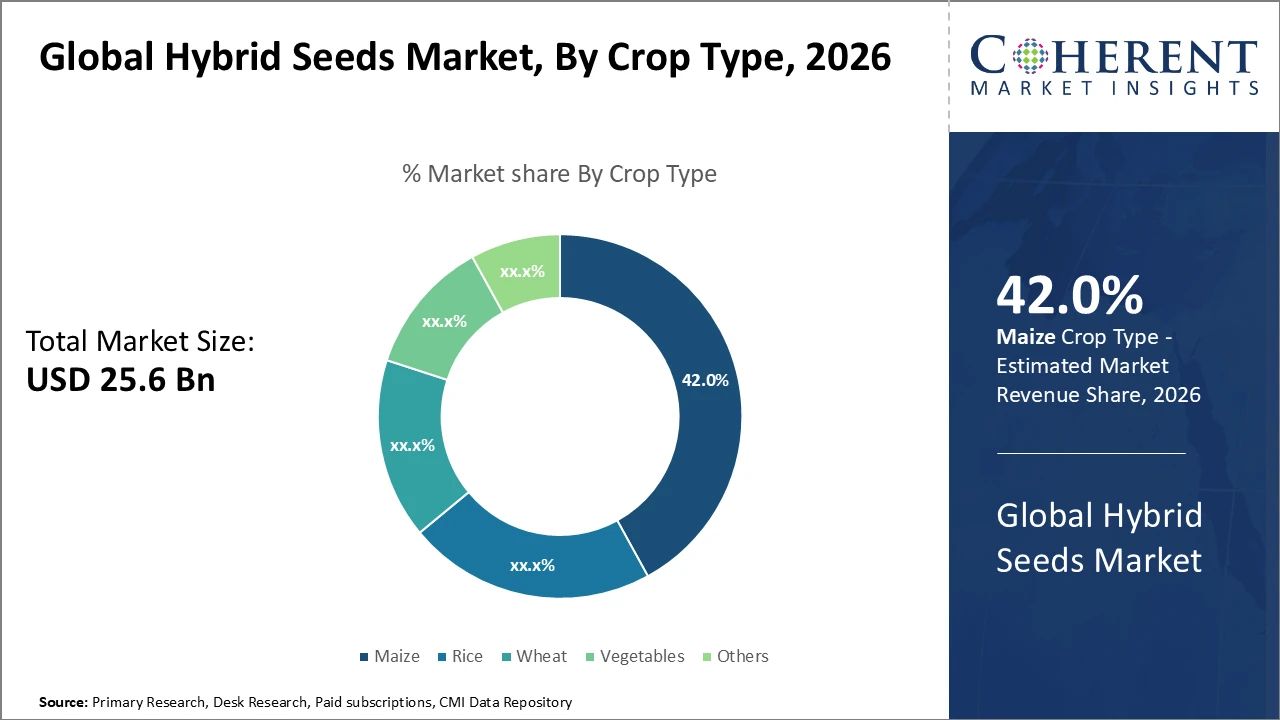
Maize segment dominates the hybrid seeds market share due to widespread cultivation and consistent adoption of technologically advanced hybrids, providing stable revenue channels.
Biotechnological hybridization subsegment is the fastest-growing category, fueled by gene editing technologies that enhance trait specificity and yield in challenging environments.
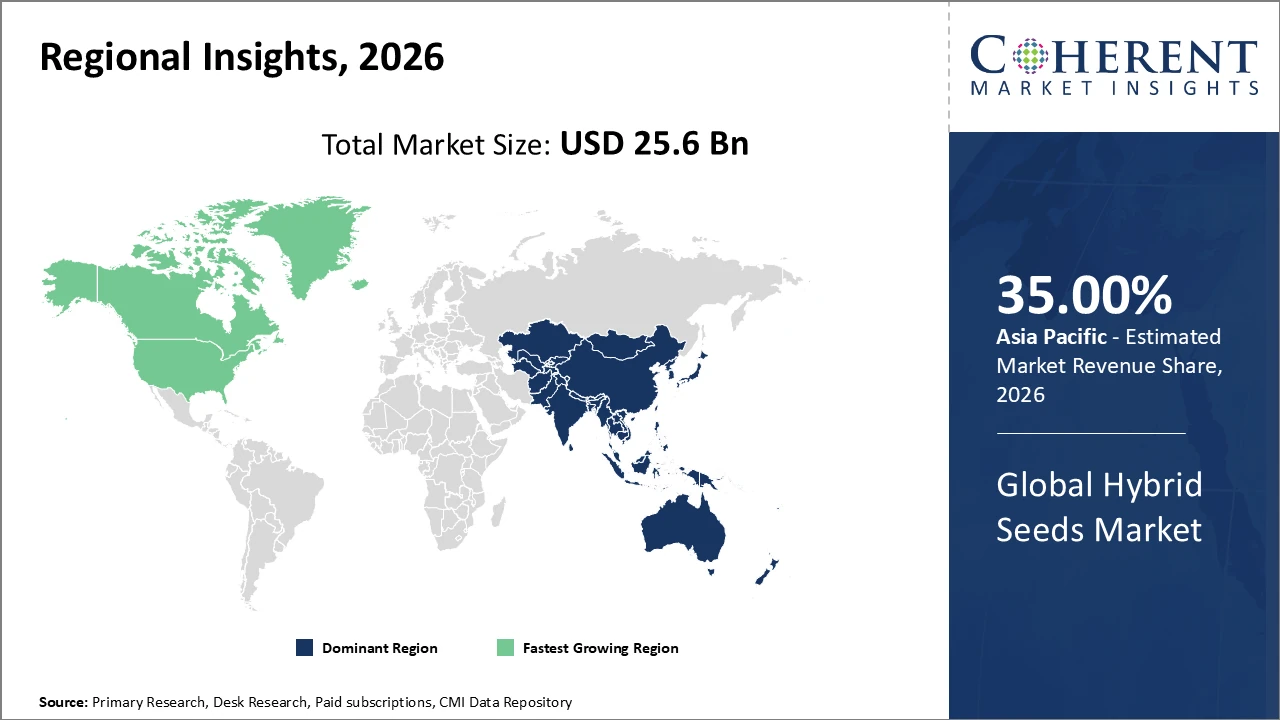
Asia Pacific emerges as a lucrative region, supported by government subsidies and a large farming population, accounting for an estimated 35% of market revenue in 2026.
North America maintains significant market share because of its advanced agricultural R&D ecosystem and early adoption of hybrid seeds, with the U.S. serving as a global innovation hub.
Hybrid Seeds Market Segmentation Analysis
Hybrid Seeds Market Insights, By Crop Type
Maize dominates the hybrid seeds market, driven by its widespread cultivation and the high effectiveness of hybrids in boosting yield and pest resistance. The maize subsegment accounts for over 42% of market share, reflecting its crucial role in food and feed industries. Rice is the fastest-growing crop type, particularly in Asia Pacific, with hybrid varieties resilient to abiotic stresses leading to a 12% expansion in cultivated area in 2025. Wheat and vegetable subsegments maintain steady demand due to targeted genetic improvements. The ‘Others’ category includes specialty crops with emerging hybrid seed applications, representing a smaller but growing portion of the market.
Hybrid Seeds Market Insights, By Application
Commercial farming dominates the hybrid seeds market, accounting for over 50% of revenue, as hybrid seeds enable higher scale and profitability. Large-scale growers primarily drive demand, particularly for cereals and cash crops. Contract farming is the fastest-growing application, especially in developing regions like Brazil and India, where collaborations between seed companies and farmers ensure quality and supply security, reflecting 15% annual growth in 2025. Subsistence and organic farming adopt hybrid seeds selectively; organic farming growth remains limited due to non-GMO preferences, though interest in compatible hybrids is emerging. ‘Others’ include urban and experimental agriculture, representing a minor but strategic segment.
Hybrid Seeds Market Insights, By Technology
Conventional hybridization dominates the hybrid seeds market, representing nearly 60% of volume due to its broad applicability and cost-effectiveness in staple crops with established hybrid vigor traits. Biotechnological hybridization is the fastest-growing technology segment, driven by innovations such as gene editing and marker-assisted selection, which enable precise incorporation of desirable traits. In 2025, this segment experienced over 18% year-over-year growth, primarily in maize and vegetable seeds. The ‘Others’ category includes emerging experimental technologies and integrative breeding approaches, currently holding a minor share but representing potential future advancements in hybrid seed development and precision agriculture applications.
Hybrid Seeds Market Trends
Accelerated innovation in biotechnological hybridization drives the development of drought- and pest-resistant seed varieties, supporting food security in vulnerable regions.
Adoption of AI and genomics tools shortens variety development cycles, improving responsiveness to emerging agricultural challenges.
Data analytics integration in seed performance assessment enables precision breeding, enhancing overall market growth.
Asia Pacific leads in hybrid seed demand due to large farming communities and widespread adoption of commercial and subsistence farming practices.
Government subsidies and policies in countries like India and China significantly boost hybrid seed usage and market revenue.
North America maintains market leadership through advanced R&D infrastructure, representing around 30% of the market share in 2026.
Europe emphasizes organic-compatible hybrid seeds, aligning with sustainability trends and consumer demand.
Hybrid Seeds Market Insights, By Geography
Asia Pacific Hybrid Seeds Market Analysis and Trends
In Asia Pacific, the hybrid seeds market is dominated by expansive agricultural land, growing food production demands, and strong government support. Adoption rates for hybrid seeds rose by 14% in India and China in 2025, driven by subsidy programs and increasing farmer awareness of yield and disease resistance benefits. The region’s market strength is further reinforced by major multinational companies investing in localized research and development of hybrid seed varieties tailored to regional climates and crop preferences. These factors collectively ensure steady market growth, higher adoption of improved seeds, and consolidation of Asia Pacific’s leading position in the global hybrid seeds industry.
North America Hybrid Seeds Market Analysis and Trends
The North America hybrid seeds market is characterized by advanced agricultural infrastructure, high R&D investment, and early adoption of innovative seed technologies. The region holds a significant share, driven by demand for high-yield, climate-resilient crops across the U.S. and Canada. Maize and soybean hybrids dominate, supported by large-scale commercial farming and precision agriculture practices. Technological advancements, including gene editing, marker-assisted selection, and AI-driven breeding programs, are accelerating the development of improved seed varieties. Additionally, strategic collaborations between seed companies and research institutions enhance innovation. Sustainability initiatives and focus on climate-resilient crops continue to shape market trends and growth trajectories in North America.
Hybrid Seeds Market Outlook for Key Countries
USA Hybrid Seeds Market Analysis and Trends
The U.S. hybrid seeds market leads in technological innovation and commercial adoption, with farmers consuming over 28% of global maize hybrid seeds in 2025. Key players, including Corteva Agriscience, focus on biotech-enhanced seeds featuring herbicide tolerance and insect resistance, ensuring stable and higher crop yields. Robust government-funded research programs and strong intellectual property protections support sustained R&D investments, driving continuous improvements in seed performance. These initiatives not only bolster domestic agricultural productivity but also strengthen market revenue. Combined with advanced farming practices and precision agriculture, the U.S. maintains its position as a global hub for hybrid seed innovation and adoption.
Germany Hybrid Seeds Market Analysis and Trends
Germany’s hybrid seeds market is driven by advanced agricultural practices, strong R&D capabilities, and a focus on sustainable farming solutions. Maize and vegetable hybrids dominate due to high yield potential and resistance to pests and diseases. The adoption of biotechnological hybridization, including marker-assisted selection and precision breeding, is accelerating, enhancing crop performance and resilience. Government policies supporting sustainable agriculture and organic-compatible hybrids further influence market dynamics. Leading seed companies actively invest in localized research to develop varieties suited to Germany’s temperate climate. Overall, the market reflects a balance of technological innovation, environmental sustainability, and demand for high-quality, high-yield hybrid seeds.
Analyst Opinion
The market’s growth is driven by increased adoption of hybrid seeds in staple crops like maize and rice, which together account for over 60% of total market share. Maize hybrid seed demand rose by 8.5% in 2025, particularly in North America, due to improved yield performance and pest resistance.
Technological advancements in seed processing and biotechnology, such as CRISPR gene editing, reduced production costs by nearly 15% in 2024, enabling broader market penetration in developing regions. Asia Pacific farmers increased hybrid seed usage by 13% year-over-year, reflecting a shift toward cost-efficient, high-performance varieties.
Government initiatives supporting hybrid seed adoption, aimed at improving food security, bolster market revenue. In 2026, India’s subsidy program increased hybrid rice cultivation acreage by 10%, driving expansion in agrarian economies.
Export volumes of hybrid seeds exceeded USD 5 billion in 2025, with major exporters developing varieties tailored to regional agro-climatic conditions, allowing companies to address diverse demand and strengthen the global competitive landscape.
- Current Industry Events of 2026
- Market Size Estimation
- Regional Breakdown
- Competitive Landscape
- Customer Intelligence
- Segmental Analysis
- Pricing Analysis
- Key Market Drivers, Challenges & Future Trends
- Customized Insights Section
Market Scope
| Report Coverage | Details | ||
|---|---|---|---|
| Base Year: | 2025 | Market Size in 2026: | USD 25.6 billion |
| Historical Data for: | 2020 To 2024 | Forecast Period: | 2026 To 2033 |
| Forecast Period 2026 to 2033 CAGR: | 7.4% | 2033 Value Projection: | USD 41.9 billion |
| Geographies covered: |
| ||
| Segments covered: |
| ||
| Companies covered: | Bayer Crop Science, DLF Seeds, HM. CLAUSE, BASF SE, RAGT Semences, KWS Saat SE, Syngenta AG, Limagrain, Bejo Zaden, Takii & Co. | ||
| Growth Drivers: |
| ||
Hybrid Seeds Market Growth Factors
The rising global population and limited arable land are driving farmers to adopt hybrid seeds to maximize output per hectare. Hybrid seeds provide enhanced resistance to pests and diseases, crucial amid increasing crop failures from climate extremes reported in 2025. Technological advancements, including gene editing and molecular breeding, have improved seed performance while reducing reliance on chemical inputs, appealing to environmentally conscious farmers. Supportive government policies and subsidy programs, particularly in India and China, have further encouraged adoption among smallholder farmers. Together, these factors sustain market growth, boosting revenue and expanding the global hybrid seeds industry.
Hybrid Seeds Market Development
In April 2026, the International Institute of Tropical Agriculture (IITA) and the International Maize and Wheat Improvement Centre (CIMMYT) launched an initiative to promote faster adoption of climate-resilient, high-yield maize hybrids across West Africa’s crop and seed sector.
Key Players
Leading Companies of the Market
Bayer Crop Science
Syngenta AG
Limagrain
Takii & Co.
BASF SE
Bejo Zaden
RAGT Semences
HM. CLAUSE
KWS Saat SE
DLF Seeds
Competitive strategies in the hybrid seeds market focus on mergers and acquisitions, robust R&D investments, and regional expansion. In 2025, Bayer’s acquisition of a leading biotech seed company improved hybrid seed yield efficiency by 12%, strengthening its market share in North America. Likewise, Syngenta’s collaborative partnerships with local seed producers in Asia Pacific in 2024 expanded its hybrid seed portfolio, driving double-digit growth in the region. These strategic initiatives highlight how companies leverage innovation, collaboration, and market consolidation to enhance product offerings, increase regional penetration, and maintain a competitive edge in the global hybrid seeds industry.
Hybrid Seeds Market Future Outlook
The hybrid seeds market is expected to witness sustained growth driven by increasing global food demand, limited arable land, and the need for higher crop productivity. Advances in biotechnology, including gene editing and molecular breeding, will continue to enhance seed performance, offering drought, pest, and disease resistance. Adoption of precision agriculture and data-driven farming practices will further optimize hybrid seed utilization. Government support through subsidies and policies promoting food security will accelerate market penetration, particularly in Asia Pacific and Latin America. With ongoing innovation, strategic collaborations, and expansion into emerging regions, the hybrid seeds market is poised for robust growth through 2035.
Hybrid Seeds Market Historical Analysis
The hybrid seeds market has experienced steady growth over the past decade, driven by the increasing need for higher crop yields and improved resistance to pests and diseases. Early adoption was led by maize, rice, and vegetable hybrids in North America and Europe, supported by advanced agricultural practices and strong R&D capabilities. Technological advancements in conventional and biotechnological hybridization, including marker-assisted selection, contributed to enhanced productivity and seed performance. Expansion into Asia Pacific and Latin America further fueled market growth, aided by government subsidies and rising awareness among farmers. These historical trends laid a solid foundation for the market’s ongoing global expansion.
Sources
Primary Research Interviews:
Seed company executives, R&D managers, and agronomists involved in hybrid seed development and commercialization.
Farmers, cooperative leaders, and agricultural consultants overseeing adoption of hybrid seeds and cultivation practices.
Industry experts from biotechnology firms and agricultural equipment providers focusing on precision farming, seed technology, and sustainability.
Magazines:
Seed World – Trends in hybrid seed development, crop improvement, and global seed markets.
AgriBusiness Global – Updates on agricultural technology, seed innovations, and market trends.
The Packer – Insights on vegetable and fruit seed hybrids and market adoption.
Journals:
Crop Science – Research on hybrid seed performance, breeding techniques, and agronomic impact.
Euphytica – Studies on plant breeding, genetics, and hybrid crop development.
Journal of Plant Biotechnology – Advances in molecular breeding, gene editing, and hybrid seed technology.
Newspapers:
The Wall Street Journal – Investments, mergers, and global seed industry news.
Financial Times – Agricultural policy updates, market trends, and sustainability initiatives.
Reuters – Innovations, regulatory changes, and company performance in seed markets.
Bloomberg – Seed company strategies, market performance, and investment trends.
Associations:
International Seed Federation (ISF) – Global standards, research, and policy insights for seed development.
American Seed Trade Association (ASTA) – Data, best practices, and policy advocacy for the U.S. seed industry.
European Seed Association (ESA) – Guidelines, research, and market data for European hybrid seed operations.
Get access to 250+ pages report
Every segment, forecast, competitor profile and data table behind the analysis above — available for instant download.
- ESOMAR Member
- ISO 9001:2015 Certified
- D-U-N-S Registered
- GDPR & CCPA Compliant
Missing comfort of reading report in your local language? Find your preferred language:
Transform your Strategy with Exclusive Trending Reports
Frequently Asked Questions
Leading companies include Bayer Crop Science, Syngenta AG, Bayer AG, and Limagrain, which hold significant market shares due to expansive product portfolios and strong innovation capabilities.
The Hybrid Seeds market size is projected to grow from USD 25.6 billion in 2026 to USD 41.9 billion by 2033, reflecting a CAGR of 7.4% during the forecast period.
Commercial farming dominates the application segment, driven by demand for high-yield crops in staple food markets globally.
The market will be shaped by rapid adoption of advanced biotechnologies, digital integration in seed lifecycle management, and a focus on climate-resilient crop varieties.
The market is highly competitive, emphasizing innovation and regional customization, with challenges including regulatory compliance and protection of intellectual property.
Key strategies include collaborations with farmers via contract farming, strategic acquisitions to enhance R&D, and government partnership programs to expand market reach.