

Global Wine Glass Market Size and Forecast – 2026 To 2033
The Global Wine Glass Market is estimated to be valued at USD 1.22 Bn in 2026 and is expected to reach USD 1.46 Bn by 2033, exhibiting a compound annual growth rate (CAGR) of 2.60% from 2026 to 2033. Market growth is supported by broader participation in wine culture, expansion of restaurants, hotels, wineries, and tasting rooms, and increased household spending on coordinated tableware and home-entertaining products. Consumers are also showing greater interest in varietal-specific bowls, thin rims, lead-free materials, reinforced stems, dishwasher compatibility, and visually distinctive designs.
These preferences are encouraging manufacturers to balance sensory performance with durability and accessible pricing. E-commerce and specialty homeware channels are further widening access to both economy multipacks and premium collections. In July 2026, Bormioli Luigi’s official store featured its Michelangelo Masterpiece red wine glasses made from recyclable Sparkx glass, with titanium-reinforced stems and durability tested for more than 2,000 dishwasher cycles. This illustrates how manufacturers are combining sustainability, visual clarity, and everyday resilience to strengthen product value.
Key Takeaways of the Global Wine Glass Market
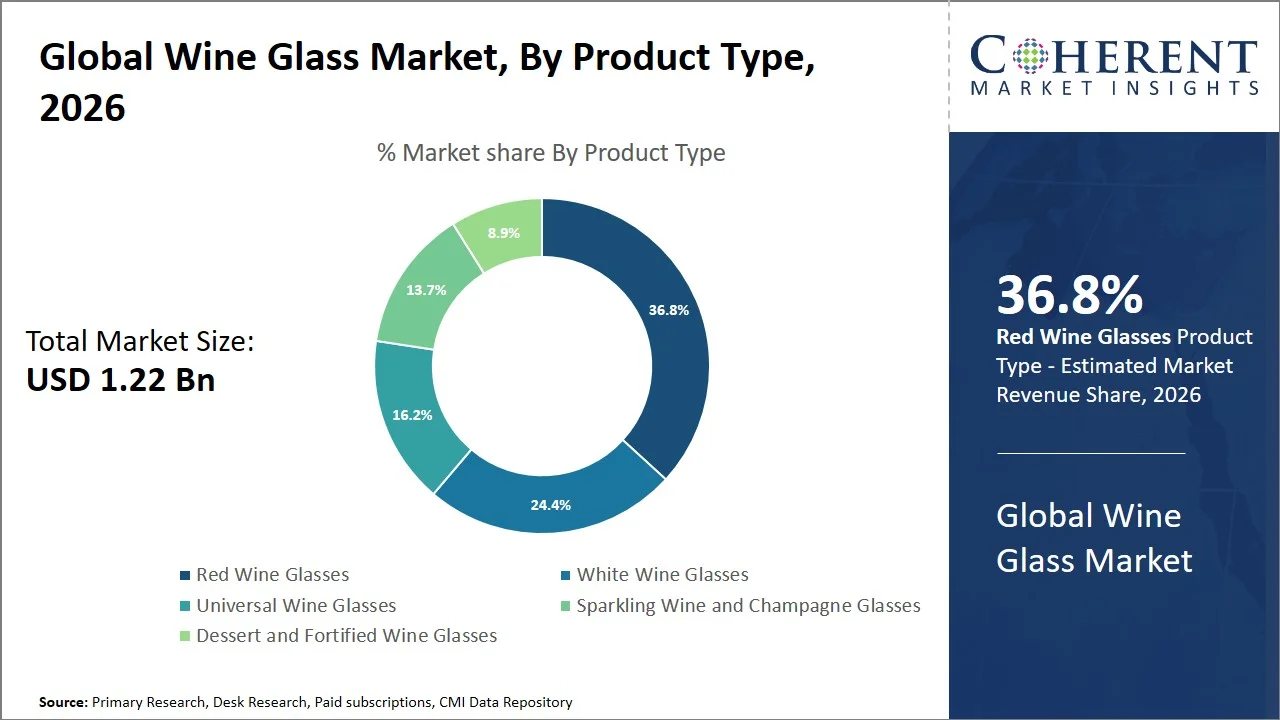
- Red wine glasses are expected to hold 36.8% of the global wine glass market in 2026 because larger bowls, varietal-specific profiles, and strong gifting appeal support household replacement and restaurant assortment depth. In June 2025, Zwiesel Glas introduced Enoteca Colors with dedicated red wine, white wine, and champagne shapes, demonstrating continued investment in category-specific stemware.
- Soda lime glass is expected to account for 52.6% of the market share in 2026, supported by automated production, optical clarity, dishwasher suitability, and favorable unit economics for frequent-use stemware. In August 2026, Libbey listed lead-free soda lime stemless wine glasses as durable, stackable, budget-friendly products for everyday use and entertaining, illustrating the material’s mass-market versatility.
- The economy segment is expected to represent 42.8% of the market share in 2026 as multipack purchasing, replacement frequency, and price-sensitive household demand favor functional designs distributed at scale. In April 2025, IKEA launched STOCKHOLM 2025 globally through stores and online channels, including a new series of glasses, widening consumer access through an established high-volume home-furnishings network.
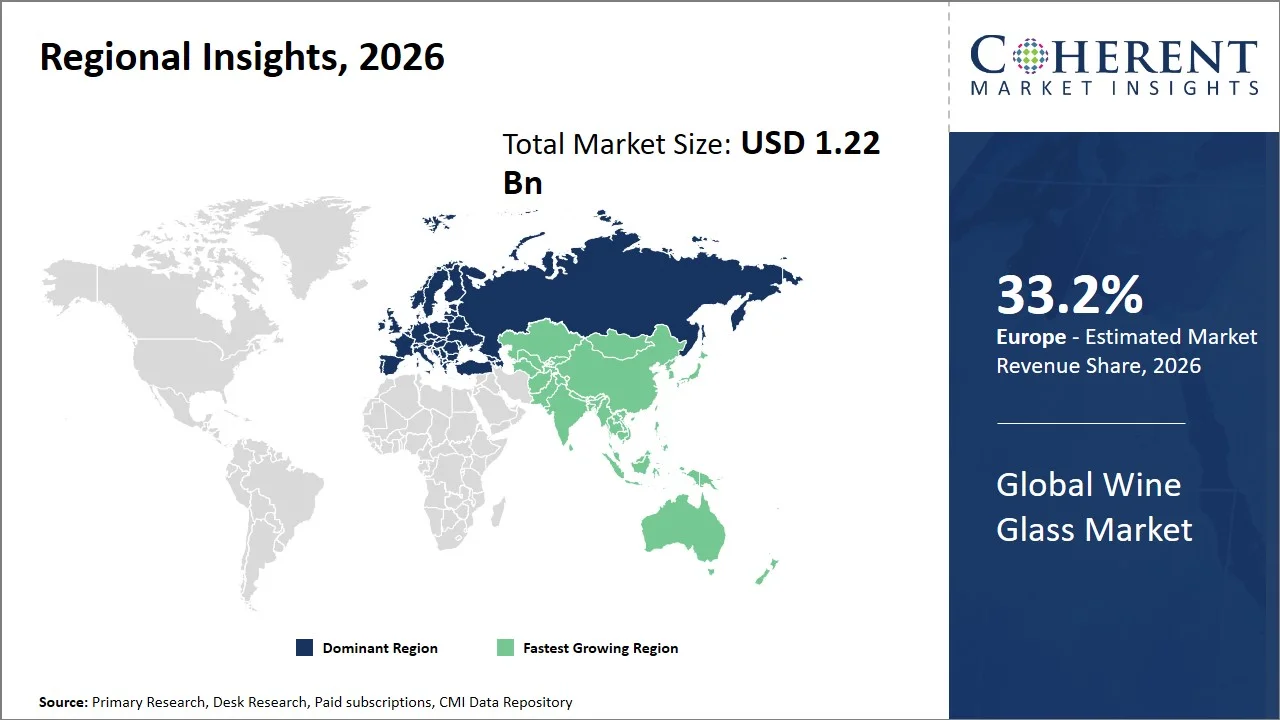
- Europe is expected to account for 33.2% of the global wine glass market share in 2026, reflecting entrenched wine culture, dense hospitality infrastructure, established glassmaking clusters, and consumer familiarity with varietal-specific stemware. In May 2026, the International Organisation of Vine and Wine identified Portugal and parts of Eastern and Central Europe among the key wine-consumption growth markets for 2025, reinforcing regional usage occasions.
- Asia Pacific is expected to hold 28.5% of the market share in 2026, with expansion supported by premium dining, wine retail, tourism, gifting, and imported-wine availability. In July 2025, Wine Australia reported that exports to Southeast Asia increased in volume, led by Thailand, Singapore, and Malaysia, while mainland China received shipments following tariff removal, supporting glassware demand across on-trade and household channels.
Segmental Insights
Why Do Red Wine Glasses Dominate the Global Wine Glass Market?
Red Wine Glasses are expected to lead the product type category with a 36.8% of the market share in 2026. Their larger bowls create greater wine-to-air contact and provide space for complex aromas, making them relevant for Cabernet Sauvignon, Pinot Noir, Shiraz, Merlot, and other widely served red varietals. Restaurants and tasting rooms maintain several red-wine formats to support food pairing and premium presentation, while households commonly purchase red-wine glasses in multipacks or mixed stemware sets. Machine-made production allows suppliers to reproduce differentiated bowl geometries consistently and address both mid-range and premium price points. This leadership gives manufacturers opportunities to build varietal-led portfolios, sell replacement sets, and secure recurring hospitality orders. In May 2025, RIEDEL conducted a Wine Glass Experience in Australia using its Veloce series, including varietal-matched Pinot Noir and Shiraz glasses, demonstrating the commercial role of bowl design in consumer wine education.
- Current Industry Events of 2026
- Market Size Estimation
- Regional Breakdown
- Competitive Landscape
- Customer Intelligence
- Segmental Analysis
- Pricing Analysis
- Key Market Drivers, Challenges & Future Trends
- Customized Insights Section
Why Does Soda Lime Glass Represent the Largest Material Segment in the Global Wine Glass Market?
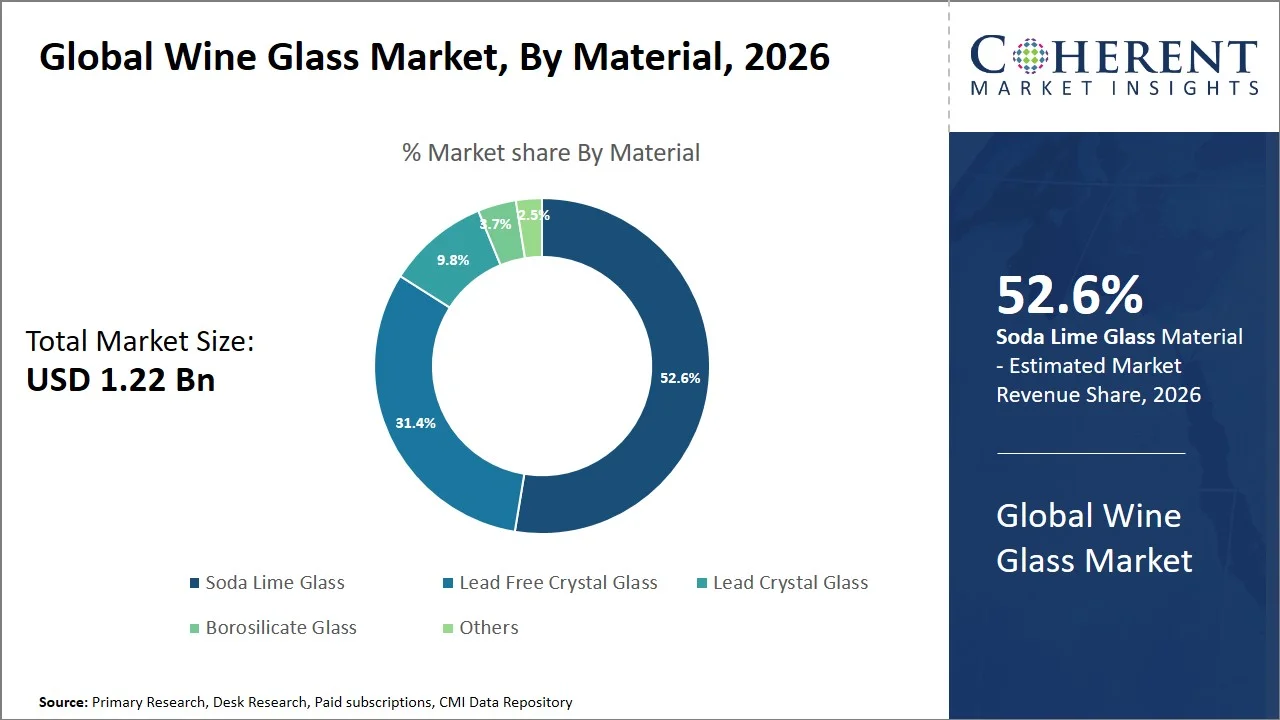
Soda lime glass is expected to represent 52.6% of the material category in 2026 because it supports scalable production without restricting suppliers to premium-only positioning. The material can be formed rapidly, decorated, strengthened, and supplied in standardized designs suitable for frequent household and foodservice use. Its established raw-material base and compatibility with automated furnaces help producers maintain broad assortments, dependable replenishment, and competitive unit economics. Hotels, restaurants, caterers, and households value transparent, dishwasher-suitable wine glasses that can be replaced economically when breakage occurs. For manufacturers, the segment supports high-capacity utilization and distribution through supermarkets, specialty stores, and institutional channels. In May 2026, Şişecam reported first-quarter production of 1.3 million tons of glass and 1.1 million tons of soda ash, alongside operations spanning glassware and chemicals, illustrating the integrated industrial scale supporting soda-lime product availability.
Why Does the Economy Segment Dominate the Price Range of the Global Wine Glass Market?
The economy segment is expected to dominate the price range category with a 42.8% share in 2026. Wine glasses are breakage-prone household and hospitality items, making replacement cost, pack size, and immediate availability central purchasing considerations. Value-oriented buyers typically prioritize functional bowl shapes, dishwasher compatibility, and consistent appearance over artisanal finishing or highly specialized crystal compositions. Automated forming, standardized molds, simplified decoration, and high-throughput packaging allow manufacturers to supply multipacks while protecting retailer margins. Supermarkets, hypermarkets, department stores, promotional programs, and entry-level restaurant operations provide the segment with broad commercial reach. This creates opportunities for producers that can combine volume manufacturing with reliable quality control and regional replenishment. In January 2025, Arc stated that its brands served mass retail and hospitality channels and that its global production network manufactured more than four million glass articles daily, demonstrating the scale economics underpinning accessible glassware.
Current Events and their Impact
Current Event | Description and Its Impact |
December 2024 – EU General Product Safety Regulation Became Applicable |
|
February 2025 – EU Packaging and Packaging Waste Regulation Entered into Force |
|
February 2026 – Denmark Notified Lower Lead and Cadmium Migration Limits for Glassware |
|
Global Wine Glass Market Dynamics
Key Market Drivers
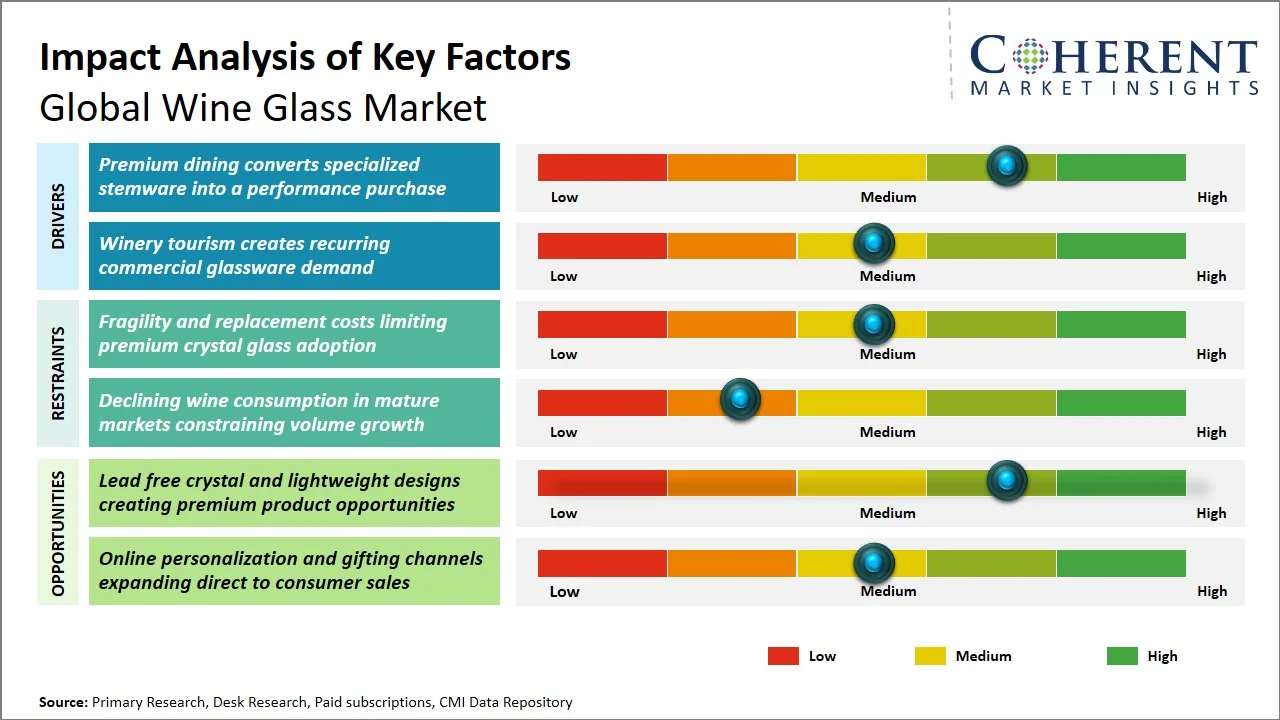
Premium Dining Converts Specialized Stemware into a Performance Purchase
Premium dining and home entertaining are raising the commercial value of wine glasses from basic tableware to sensory and presentation tools. Restaurants, sommeliers, event caterers, and design-conscious households increasingly evaluate bowl geometry, rim finesse, stem balance, and visual compatibility with the table setting. This supports wider assortments across red, white, sparkling, and universal formats and gives premium suppliers room to defend margins through performance narratives rather than decoration alone. Hospitality distributors benefit from specification-led orders, while specialty retailers gain from occasion-based bundles and gifting. In April 2025, Michelin announced that the 2025 MICHELIN Guide France Sommelier Award was sponsored by designer glassmaker NUDE, placing specialist glassware directly within a high-end restaurant and professional wine-service setting. The association illustrates how professional endorsement can transfer technical credibility to consumer purchasing.
Winery Tourism Creates Recurring Commercial Glassware Demand
Expansion in winery tourism and hospitality increases wine glass consumption through opening stock, tasting flights, breakage replacement, events, and branded retail. Unlike household purchases, commercial venues require standardized shapes that can be reordered, cleaned repeatedly, stored efficiently, and matched across dining rooms or tasting counters. Wineries also use glassware to structure visitor education and often sell branded or take-home pieces, creating both operating demand and ancillary revenue. Manufacturers with durable lines, customization, and regional inventory are positioned to win recurring accounts; distributors benefit from replenishment contracts rather than one-time sales. In June 2025, Pennsylvania Ag Secretary Tours announced USD 224,190 in agriculture-promotion grants at Waltz Estate Winery, including support for wine-sector promotion and regional agritourism linked to a state industry with more than 400 wineries. Such public investment expands visitor-facing wine activity and the number of commercial settings requiring dependable tasting and service glassware.
Emerging Market Trends
Thin-Wall Durability Becomes a Core Design Requirement
Thin-walled wine glasses are evolving from a premium design feature into a performance requirement. Buyers expect refined rims, balanced stems, and lightweight construction without frequent breakage during washing or handling. Manufacturers are therefore improving rim strength, stem-to-bowl transitions, lead-free compositions, and forming consistency. Suppliers that combine elegance with durability can reduce replacement costs for hospitality operators, strengthen premium positioning, and generate repeat orders.
Lifestyle-Led Table Styling Reframes Wine Glass Purchasing
Wine glasses are increasingly positioned as lifestyle and décor products. Colored stems, textured surfaces, sculptural bowls, and coordinated collections support entertaining, gifting, and seasonal merchandising. This encourages faster design cycles, flexible decoration, and smaller production runs. Design-led brands and specialty retailers can benefit from stronger visual differentiation, while manufacturers must balance fashion appeal with wine-service functionality to avoid short product lifecycles and excess inventory.
Regional Insights
Why Does Europe Dominate the Global Wine Glass Market?
Europe is expected to dominate the global wine glass market with a 33.2% share in 2026. The region combines mature household ownership, frequent restaurant wine service, established wine tourism, and broad consumer familiarity with varietal-specific stemware. Demand is also reinforced by premium table-setting traditions, replacement purchases, specialty homeware retail, and proximity to internationally recognized glassware producers. These conditions support both high-volume soda lime products and higher-value lead-free crystal collections. In April 2025, Eurostat reported that wine of fresh grapes represented €16.8 billion, or 56.2%, of the EU’s alcoholic-beverage exports in 2024. This scale of wine production and trade sustains tasting, hospitality, gifting, and branded serviceware requirements, giving European suppliers and distributors a structurally deep customer base across household and commercial channels.
Why is Asia Pacific Emerging as the Fastest-Growing Region in the Global Wine Glass Market?
Asia Pacific is expected to emerge as the fastest-growing region while accounting for 28.5% of the global wine glass market in 2026. Growth is supported by premium restaurant development, expanding hotel capacity, wine education, imported-label availability, e-commerce, and consumers experimenting with food-and-wine pairing. China, Japan, India, Singapore, South Korea, and Australia create distinct demand pools spanning entry-level multipacks, universal glasses, and premium crystal stemware. In May 2026, Vinexpo Asia returned to Hong Kong as a regional business platform connecting international producers with key Asia Pacific buyers. Its focus on changing consumption habits, e-commerce, travel retail, food pairing, and market-specific distribution highlights the commercial infrastructure forming around wine consumption. This ecosystem broadens procurement opportunities for glassware brands serving hospitality operators, specialist retailers, wineries, and increasingly informed household buyers.
Global Wine Glass Market Outlook for Key Countries
Why is the U.S. a Key Market for the Global Wine Glass Market?
The U.S. is a key country in the global wine glass market because it combines a large wine-consuming population with developed restaurant, winery, specialty retail, department-store, and direct-to-consumer channels. Household entertaining supports multipack and universal-glass purchases, while tasting rooms and premium restaurants create demand for varietal-specific bowls, durable commercial stemware, and replacement stock. Suppliers can also address differentiated buyer preferences through stemless, dishwasher-safe, lead-free crystal, and occasion-based collections. In November 2025, the Wine Institute launched the Share Wine Co-Lab to help wineries and industry participants connect with a new generation of wine consumers through shared insights and collaborative learning. Broader consumer engagement of this kind can expand tasting occasions and encourage retailers and hospitality operators to refresh glassware assortments around approachable wine experiences rather than formal consumption alone.
Why is India Important in the Global Wine Glass Market?
India is becoming increasingly relevant to the global wine glass market as urban hospitality, premium dining, destination weddings, home entertaining, and domestic wineries broaden the settings in which wine is served. Demand is concentrated in major metropolitan areas and wine-producing clusters, where hotels, restaurants, tasting rooms, specialty stores, and online channels require affordable but visually refined stemware. Economy and mid-range products remain commercially important, although premium venues are creating selective opportunities for lead-free crystal and varietal-specific designs. In April 2025, the Agricultural and Processed Food Products Export Development Authority stated that India aimed to increase alcoholic-beverage exports, including wine, from USD 370.5 million to USD 1 billion by 2030. Greater product visibility, export-oriented quality improvement, and organized tasting activity can support professional glassware procurement and gradually deepen household familiarity with appropriate wine-serving formats.
Why Does China Support Growth in the Global Wine Glass Market?
China supports growth in the global wine glass market through its extensive consumer-goods manufacturing base, large urban retail network, digital commerce ecosystem, and evolving wine preferences. Commercial opportunities are shifting from purely formal gifting toward casual dining, home consumption, bistros, premium catering, and experience-led retail. This favors versatile glasses, accessible premium products, compact multipacks, and designs suited to white, sparkling, and lighter wine styles. In November 2025, ProWine Shanghai attracted about 630 exhibitors from 29 countries and regions and 21,590 professional visitors. The organizer also reported growing participation from hotels, catering businesses, bistros, e-commerce operators, and instant-retail buyers. That increasingly diversified trade audience provides glassware suppliers with wider routes to market beyond traditional wine importers and strengthens demand for assortments tailored to different price points, channels, and consumption occasions.
Why is Germany a Strategic Country in the Global Wine Glass Market?
Germany is a strategic country in the global wine glass market because its wine culture, quality-focused hospitality sector, specialist retail structure, and established tableware expertise support demand across household and professional users. Riesling, sparkling wine, regional tasting events, and food-pairing traditions encourage the use of purpose-designed bowls, while consumers’ emphasis on durability and material safety benefits lead-free crystal and dishwasher-resistant products. Germany also serves as an important European trade and exhibition hub, enabling glassware brands to reach importers, restaurateurs, and specialist buyers. In March 2026, the German Wine Institute reported that German wine export volume increased by 1% in 2025 and that quality wines represented 71% of exports. The continued commercial relevance of quality wine supports premium presentation standards and reinforces demand for glassware that communicates provenance, sensory performance, and refined service.
Why is Brazil an Important Growth Market for the Global Wine Glass Market?
Brazil is an important growth market for the global wine glass market because expanding domestic wine production, imported-wine availability, regional gastronomy, and wine tourism are creating more frequent consumption occasions. Demand extends from household multipacks and online purchases to restaurants, hotels, specialist stores, and winery tasting facilities. Local buyers require products that balance affordability, visual appeal, breakage resistance, and suitability for red, white, sparkling, and emerging low-intervention wines. In March 2026, Miolo introduced Wild Gamay 2026 as the first red wine from Brazil’s 2026 vintage, positioning it as a vegan wine made without added sulfites. Product launches that emphasize freshness, provenance, and differentiated winemaking can stimulate trial, tasting events, and premium presentation, supporting demand for appropriate stemware while strengthening Brazil’s role as a South American distribution and consumption market.
Technology Adoption Landscape in the Global Wine Glass Market
Technology | Adoption Level | Key Application Area | Business Impact |
One-Piece Pulled-Stem Forming | High | Machine-made premium and hospitality stemware | Removes the visible bowl-to-stem joint, improves dimensional consistency, and enables elegant designs at commercial production volumes. |
Laser Rim Cutting and Fire Polishing | High | Thin and uniform drinking rims | Improves mouthfeel, reduces finishing variability, and supports premium product positioning without relying solely on hand finishing. |
Ion-Exchange Chemical Strengthening | Medium | Lightweight lead-free crystal and thin-wall glassware | Enhances resistance to handling and washing damage while allowing suppliers to retain fine rims and lighter product profiles. |
Computer-Aided Bowl Geometry and Mold Simulation | Medium | Varietal-specific and universal wine glass development | Accelerates prototyping, improves dimensional repeatability, and reduces mold rework before commercial production. |
Automated Optical Defect Inspection | High | Detection of bubbles, inclusions, rim defects, and stem distortion | Improves production yields, lowers customer returns, and delivers more consistent quality for retail and hospitality contracts. |
Laser Engraving and Digital Decoration | Medium | Hospitality branding, gifting, private labels, and personalization | Makes shorter customized production runs commercially viable and strengthens differentiation across direct-to-consumer and B2B channels. |
How are Curated Wine-Education Kits Creating New Growth Opportunities in the Global Wine Glass Market?
Curated wine-education kits represent an underdeveloped opportunity to convert glassware from a replacement purchase into an experience-led product. A kit can combine universal and varietal-specific glasses with tasting cards, food-pairing guidance, QR-based instruction, and structured comparison exercises. The proposition is relevant to wineries, wine clubs, culinary schools, corporate gifting programs, restaurants, specialty retailers, and consumers entering the category in developing wine markets. Suppliers can capture the opportunity through modular sets, localized educational content, low-breakage transit packaging, replacement-piece availability, and collaborations with sommeliers or tasting venues. The model supports premiumization without relying exclusively on expensive materials because value is created through curation and learning. Participation requires content capability, reliable fulfilment, design consistency, and channel partnerships that can deliver both the product and the tasting occasion. Specialist brands may lead in authority and storytelling, while larger manufacturers are better positioned to scale private-label programs and serve multi-country retailers. Subscription replenishment and seasonal tasting modules could also create recurring revenue beyond the initial glassware sale.
Market Players, Key Development, and Competitive Intelligence
Key Developments
- In May 2026, RCR Cristalleria Italiana launched the Magnum collection, comprising oversized M140 and M160 goblets with capacities of 140 cl and 160 cl for full-bodied wines, hospitality, mixology, and retail applications. This is important for the global wine glass market because it demonstrates how manufacturers can use unconventional formats and proprietary material platforms to create premium experiential products rather than compete solely through conventional varietal shapes.
- In February 2026, Stolzle Lausitz entered a global partnership with Star Wine List, under which its glass collections would be featured at international wine-list events and within editorial content for wine professionals. This is important for the global wine glass market because it expands direct exposure to sommeliers, wine bars, and restaurant decision-makers, strengthening specification-led brand visibility in the professional channel rather than relying only on conventional retail promotion.
- In September 2024, Orrefors launched the Orrefors x Bjorn Frantzen collection, a six-glass series developed with sommeliers working alongside chef Bjorn Frantzen. The glasses were introduced for use in Frantzén restaurants internationally and for sale to consumers. This is important for the global wine glass market because it connects professional hospitality testing with consumer commercialization, creating a credible pathway for chef- and sommelier-developed stemware collections.
Competitive Landscape
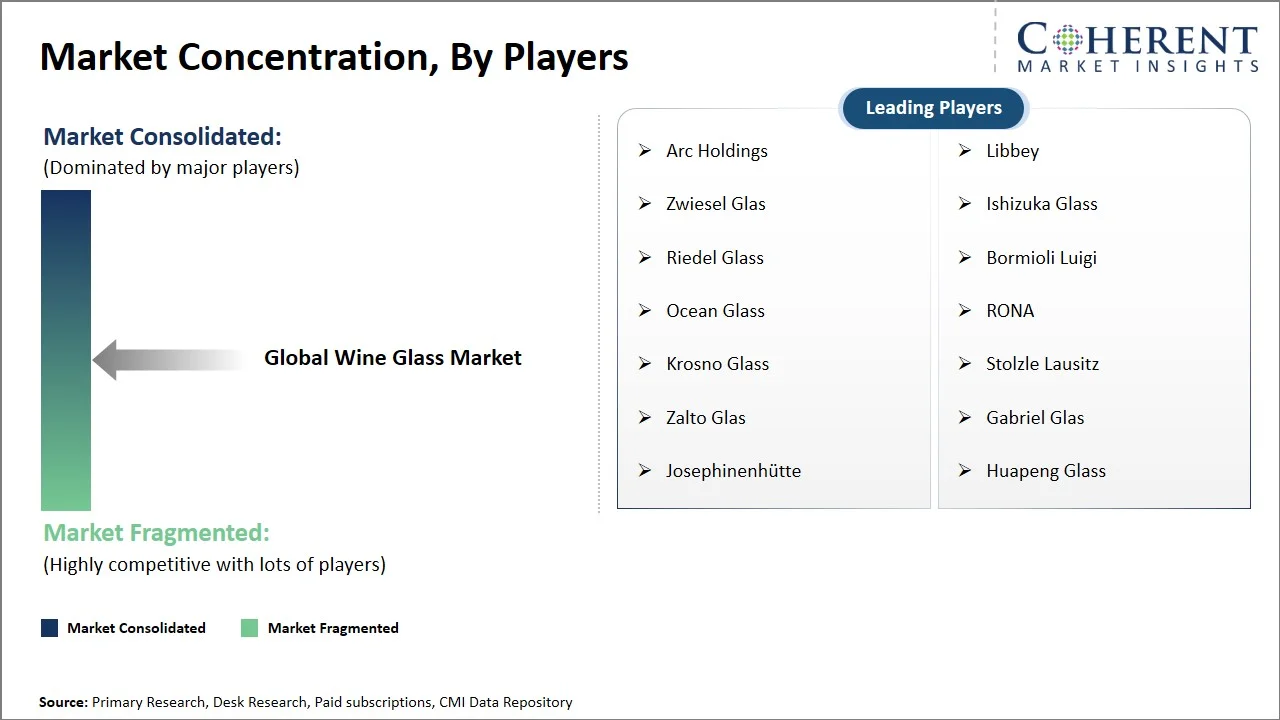
The global wine glass market is fragmented, although high-volume machine-made production is comparatively concentrated among manufacturers with established furnaces, mould-making capabilities, and international distribution. Competition spans global glassware producers, premium crystal houses, regional factories, artisanal studios, private-label suppliers, importers, and design-led consumer brands. Market positioning depends on the ability to balance sensory performance, durability, visual identity, price, fulfilment reliability, regulatory documentation, and channel access. Regional manufacturers remain relevant where shorter lead times, customization, and lower freight exposure outweigh the assortment breadth of global suppliers.
Key focus areas include
- Bowl architecture and sensory positioning: Brands differentiate through shapes designed around aroma concentration, oxygen exposure, and specific wine styles.
- Breakage economics: Hospitality buyers increasingly assess replacement frequency, washing resilience, storage efficiency, and continuity of supply alongside initial price.
- Manufacturing flexibility: Producers capable of switching between large production runs and smaller customized batches can serve retail, hospitality, gifting, and private-label accounts.
- Material and safety assurance: Lead-free composition, food-contact documentation, migration testing, and quality consistency affect retailer and distributor approval.
- Private-label capabilities: Engraving, decoration, custom packaging, and exclusive mould development help manufacturers secure longer-term customer relationships.
- Distribution and replenishment: Regional warehousing, replacement-piece availability, and dependable lead times are critical for restaurants, hotels, and institutional buyers.
- Protective packaging performance: Suppliers must minimize transit breakage while reducing excessive packaging material, particularly for online and cross-border sales.
Market Report Scope
Wine Glass Market Report Coverage
| Report Coverage | Details | ||
|---|---|---|---|
| Base Year: | 2025 | Market Size in 2026: | USD 1.22 Bn |
| Historical Data for: | 2020 To 2024 | Forecast Period: | 2026 To 2033 |
| Forecast Period 2026 to 2033 CAGR: | 2.60% | 2033 Value Projection: | USD 1.46 Bn |
| Geographies covered: |
| ||
| Segments covered: |
| ||
| Companies covered: | Arc Holdings, Libbey, Zwiesel Glas, Ishizuka Glass, Riedel Glass, Bormioli Luigi, Ocean Glass, RONA, Krosno Glass, Stolzle Lausitz, Zalto Glas, Gabriel Glas, Josephinenhütte, and Huapeng Glass | ||
| Growth Drivers: |
| ||
| Restraints & Challenges: |
| ||
Analyst Opinion (Expert Opinion)
- The global wine glass market leadership is likely to shift from selling individual glass designs toward managing complete stemware programs. Winning suppliers will help hospitality and retail customers select assortments, control replacement inventories, train staff, customize products, and maintain collection continuity. This transition will favor companies that combine manufacturing capabilities with category management and customer service rather than depending entirely on aesthetic product differentiation.
- Digital configuration and short-run personalization could materially change how wine glasses reach customers. Buyers may increasingly select bowl shapes, engravings, pack configurations, and gifting elements through direct ordering platforms, reducing dependence on fixed wholesale assortments. Producers with flexible decoration, real-time visualization, integrated fulfilment, and customer-data capabilities will be positioned to capture fragmented orders without making customization operationally uneconomic.
- Market participants should prioritize durable thin-wall platforms, automated quality inspection, flexible mold programs, protective e-commerce packaging, and regional replenishment capacity. Hospitality trials and winery partnerships should be used to validate performance before wider commercialization. Companies must manage energy, freight, breakage, and discounting risks carefully and should avoid overinvesting in narrowly defined varietal shapes that create tooling expense and slow-moving inventories without clear customer commitment.
Speak to the analyst
Want personalized insights?
Take the findings above to one of our principal consultants, or have the report rebuilt around the segments, geographies and competitors you actually track.
Market Segmentation
- Product Type Insights (Revenue, USD Bn, 2021 - 2033)
- Red Wine Glasses
- White Wine Glasses
- Universal Wine Glasses
- Sparkling Wine and Champagne Glasses
- Dessert and Fortified Wine Glasses
- Material Insights (Revenue, USD Bn, 2021 - 2033)
- Soda Lime Glass
- Lead Free Crystal Glass
- Lead Crystal Glass
- Borosilicate Glass
- Others
- Price Range Insights (Revenue, USD Bn, 2021 - 2033)
- Economy
- Mid Range
- Premium
- End User Insights (Revenue, USD Bn, 2021 - 2033)
- Household
- Hotels Restaurants and Catering
- Wineries and Tasting Rooms
- Distribution Channel Insights (Revenue, USD Bn, 2021 - 2033)
- Specialty Homeware and Glassware Stores
- Supermarkets and Hypermarkets
- Online Retail
- Department Stores
- Direct B2B Sales
- Others
- Regional Insights (Revenue, USD Bn, 2021 - 2033)
- North America
- U.S.
- Canada
- Latin America
- Brazil
- Argentina
- Mexico
- Rest of Latin America
- Europe
- Germany
- U.K.
- Spain
- France
- Italy
- Russia
- Rest of Europe
- Asia Pacific
- China
- India
- Japan
- Australia
- South Korea
- ASEAN
- Rest of Asia Pacific
- Middle East
- GCC Countries
- Israel
- Rest of Middle East
- Africa
- South Africa
- North Africa
- Central Africa
- North America
Sources
Primary Research Interviews
- Wine glass manufacturers using soda lime glass, lead-free crystal, lead crystal, and borosilicate glass
- Hotels, restaurants, wineries, tasting rooms, retailers, distributors, importers, exporters, and private-label suppliers
- Product design, manufacturing, quality, procurement, regulatory, logistics, sustainability, marketing, and sales executives
Stakeholders
- Glass manufacturers, processors, artisanal studios, contract manufacturers, and raw-material suppliers
- Hotels, restaurants, caterers, wineries, retailers, e-commerce platforms, and household consumers
- Testing laboratories, certification bodies, warehouses, logistics providers, distributors, importers, and exporters
End-use Sectors
- Household dining, home entertaining, gifting, and festive occasions
- Hotels, restaurants, bars, catering companies, banquet venues, and cruise lines
- Wineries, vineyards, tasting rooms, wine clubs, and sommelier training centers
- Specialty stores, supermarkets, department stores, online retail, and direct B2B sales
Regulatory and Government Bodies
- U.S. FDA, CPSC, EPA, and U.S. Customs and Border Protection
- Health Canada and Canada Border Services Agency
- European Commission, ECHA, CEN, and national market-surveillance authorities
- UK Food Standards Agency and Office for Product Safety and Standards
- China NHC, SAMR, and General Administration of Customs
- Japan MHLW, Consumer Affairs Agency, and Japan Customs
- FSSAI, BIS, CPCB, and Directorate General of Foreign Trade
- Brazil ANVISA, INMETRO, and Receita Federal
- ISO, ASTM International, and International Commission on Glass
Databases
- UN Comtrade, ITC Trade Map, WTO Statistics, Eurostat, USITC DataWeb, World Bank, and OECD
- U.S. Census Bureau, Statistics Canada, Destatis, China Customs, Japan Trade Statistics, India Export Import Data Bank, and Brazil Comex Stat
- Trade data under HS 7013 and related classifications for tableware, drinking glassware, stemware, and crystal products
- EU Safety Gate, CPSC recalls, ECHA databases, patent databases, company filings, catalogues, pricing, and shipment records
Magazines and Journals
- Glass International, Glass Worldwide, Tableware International, Hospitality Design, Wine Business Monthly, and The Drinks Business
- Journal of Non-Crystalline Solids, International Journal of Applied Glass Science, Ceramics International, and Materials & Design
- International Journal of Hospitality Management, Tourism Management, and Journal of Wine Economics
Associations
- International Commission on Glass
- Society of Glass Technology
- Glass Alliance Europe
- Glass Manufacturing Industry Council
- International Organisation of Vine and Wine
- Wine Institute
- National Restaurant Association
- American Hotel & Lodging Association
- International Sommelier Association
Public Domain Sources
- Food-contact standards, lead and cadmium migration limits, product-safety rules, labeling, and traceability requirements
- Government data covering wine consumption, hospitality, tourism, retail sales, household expenditure, and glassware trade
- Scientific studies on glass strength, composition, thermal resistance, dishwasher performance, and migration testing
- Environmental permits, furnace approvals, emission standards, recycling policies, patents, annual reports, technical data sheets, press releases, and shipment records
Key Standards and Regulations
- U.S. food-contact, consumer-product safety, hazardous-substance, and California Proposition 65 requirements
- EU General Product Safety Regulation, REACH, CLP, packaging rules, and food-contact migration standards
- UK product-safety, food-contact, chemical, and packaging requirements
- China GB 4806 food-contact standards and customs requirements
- Japan Food Sanitation Act and food-utensil standards
- India FSSAI, BIS, Legal Metrology, packaging, and import requirements
- Brazil ANVISA, INMETRO, ABNT, customs, and environmental regulations
- ISO 7086, EN 1388, ASTM C927, ISO 9001, ISO 14001, ISO 45001, and life-cycle assessment standards
Proprietary Elements
- CMI Data Analytics Tool
- Proprietary CMI Existing Repository of information for last 10 years.
Get access to 250+ pages report
Every segment, forecast, competitor profile and data table behind the analysis above — available for instant download.
- ESOMAR Member
- ISO 9001:2015 Certified
- D-U-N-S Registered
- GDPR & CCPA Compliant
Missing comfort of reading report in your local language? Find your preferred language:
Transform your Strategy with Exclusive Trending Reports
Frequently Asked Questions
The CAGR of the global wine glass market is projected to be 2.60% from 2026 to 2033.
The global wine glass market is estimated to be valued at USD 1.22 Bn in 2026 and is expected to reach USD 1.46 Bn by 2033.
Wine glasses are primarily manufactured using soda lime glass, lead-free crystal glass, lead crystal glass, and borosilicate glass.
Primary end users include households, hotels, restaurants, catering companies, wineries, and tasting rooms.
Key channels include specialty homeware stores, supermarkets, online retailers, department stores, and direct business-to-business sales.
Premium dining and home entertaining trends supporting specialized glassware demand and hospitality and winery tourism expansion increasing commercial wine glass consumption are the major factors driving the growth of the global wine glass market.
Fragility and replacement costs limiting premium crystal glass adoption and declining wine consumption in mature markets constraining volume growth are the major factors hampering the growth of the global wine glass market.