

Global Yersinia Diagnostics Market Size and Forecast – 2026 To 2033
The global yersinia diagnostics market is expected to grow from USD 324.6 Mn in 2026 to USD 466.0 Mn by 2033, registering a compound annual growth rate (CAGR) of 5.3% from 2026 to 2033. The market for global yersinia diagnostics is poised for significant expansion, fueled by the rising incidence of Yersinia infections, which is increasing the need for timely and accurate pathogen detection.
According to the U.S. Centers for Disease Control and Prevention (CDC), FoodNet recorded 1,782 Yersinia infections in 2024, while estimated incidence increased to 3.5 cases per 100,000 population from 0.8 cases per 100,000 during 2016–2018. This increase is supporting greater utilization of culture-independent and molecular diagnostic methods for Yersinia detection.
Key Takeaways of the Global Yersinia Diagnostics Market
- Kits and reagents are projected to hold 44.8 % of the global yersinia diagnostics market share in 2026, making it dominant product type segment, across North America due to established government laboratory testing frameworks for Yersinia detection. For instance, the U.S. CDC classifies Yersinia as a nationally reportable enteric pathogen and provides standardized laboratory guidance covering specimen collection, selective culture media, and confirmatory identification, supporting consistent utilization of diagnostic kits and reagents.
- Molecular tests are projected to hold 39.7 % of the global yersinia diagnostics market share in 2026, making it dominant test type segment, across North America due to the growing role of molecular methods in standardized enteric pathogen testing. For instance, the U.S. FDA recognizes nucleic-acid-based assays as a dedicated class of in-vitro diagnostic devices for the detection of gastrointestinal microorganisms, supporting the integration of molecular platforms into clinical enteric testing.
- Yersiniosis is projected to hold 76.4 % of the global yersinia diagnostics market share in 2026, making it dominant disease type segment, across Europe due to the formal inclusion of Yersinia infections within the EU's zoonotic-disease monitoring framework. The European Commission requires Member States to collect and report data on zoonoses and zoonotic agents under its One Health surveillance framework, which includes Yersinia-related infection.
- North America market maintains dominance with an expected share of 38.4 % in 2026, bolstered by advanced public-health laboratory infrastructure and government-led pathogen characterization programs. For instance, the California Department of Public Health routes recovered Yersinia isolates for molecular characterization using whole-genome sequencing (WGS) for public-health surveillance and epidemiological investigations, strengthening demand for advanced Yersinia diagnostic and characterization technologies.
- Asia Pacific is expected to exhibit the fastest growth in the global yersinia diagnostics market, registering an estimated CAGR of 6.7 % during 2026–2033, driven by strengthening food-safety surveillance and government-led pathogen monitoring. For instance, New Zealand's Ministry for Primary Industries maintains a dedicated Yersinia enterocolitica risk profile for pork and has conducted government-supported surveys using rapid methods to detect and enumerate the pathogen in retail raw pork, supporting the expansion of foodborne Yersinia testing across the region.
Segmental Insights
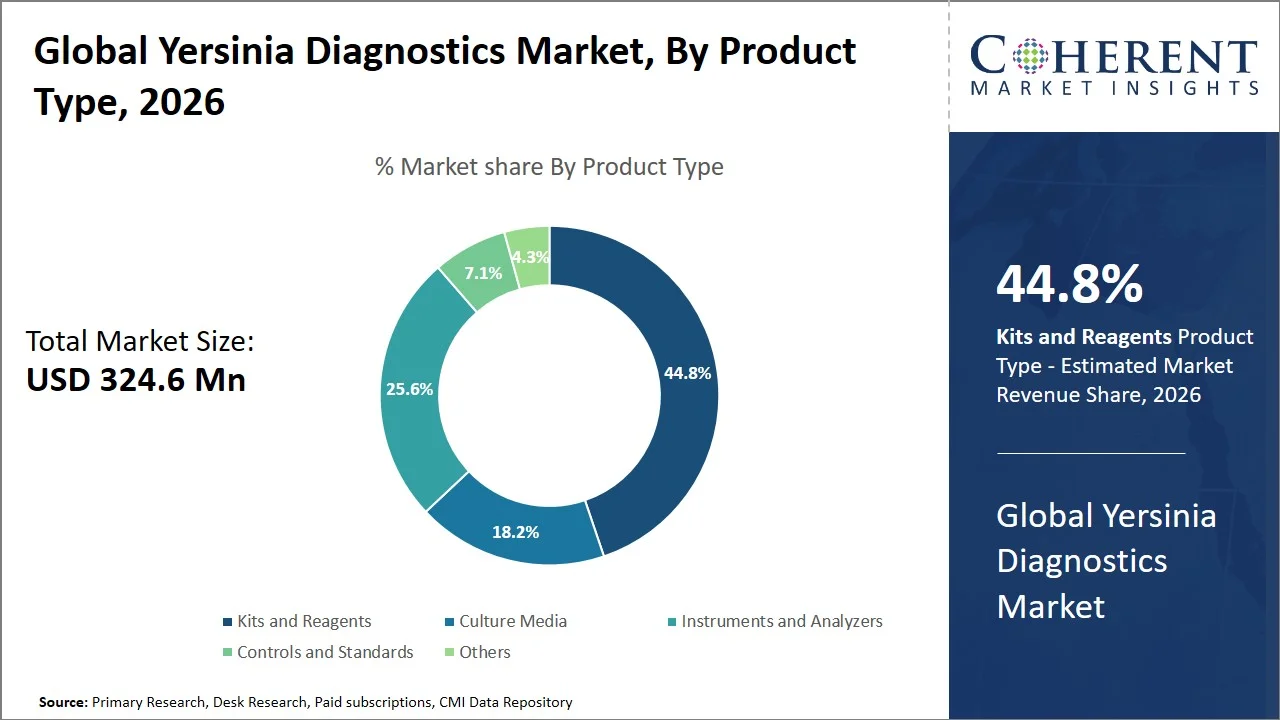
Why Do Kits and Reagents Dominate the Global Yersinia Diagnostics Market?
Kits and reagents are projected to hold the market share of 44.8% in 2026, as they are utilized by most clinical laboratories in all forms of test formats including culture-based, molecular-based and confirmatory tests, and laboratory automation. This allows laboratories to ensure testing consistency and turnaround time which increases reagent usage, especially for clinical and public-health laboratories. For instance, the Oregon State Public Health Laboratory's 2026 menu of tests has a separate, specific, Yersinia spp. identification test and has accepted specimens previously tested with a culture-independent diagnostic assay, emphasizing requirement for confirmatory diagnostic reagents and consumables.
- Current Industry Events of 2026
- Market Size Estimation
- Regional Breakdown
- Competitive Landscape
- Customer Intelligence
- Segmental Analysis
- Pricing Analysis
- Key Market Drivers, Challenges & Future Trends
- Customized Insights Section
Why Does Molecular Tests Represent the Largest Test Type Segment in the Yersinia Diagnostics Market?
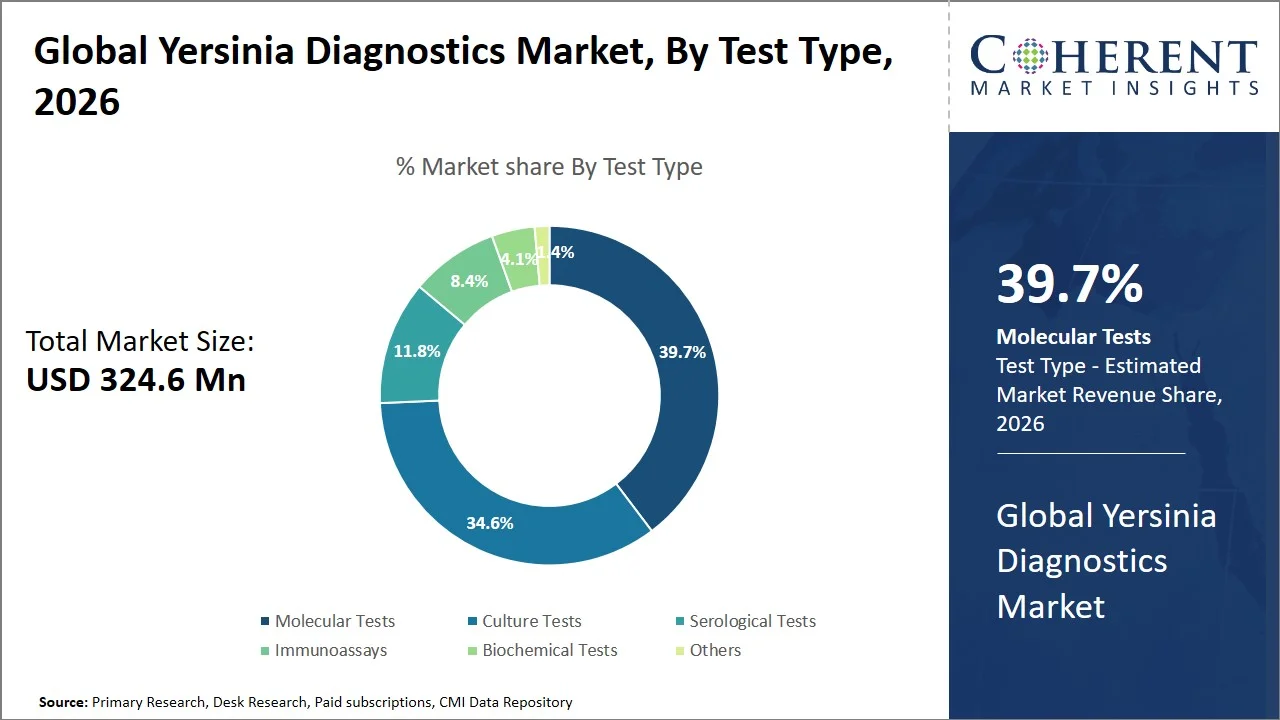
Molecular tests are projected to hold a market share of 39.7% in 2026, due to their high sensitivity and specificity, as well as faster results compared to conventional culture methods. A continued integration of real-time PCR and multiplex molecular tests has enhanced pathogen identification and is facilitating faster detection in a timely manner for both clinical and food-safety laboratories. For instance, Health Canada's MFLP-118 suggests that real time PCR is the most feasible technique to detect Yersinia enterocolitica colonies from food sample as a basis to a standardized molecular work flow.
Yersiniosis Segment Dominates the Global Yersinia Diagnostics Market
The yersiniosis segment is projected to hold a market share of 76.4% in 2026, owing to its considerably high incidence as well as a more definite foodborne transmission when equated to that of Yersinia infections. The segment benefits from continuous surveillance programs conducted at a clinical and public health level specifically on the Y. Enterocolitica. For instance, in July 2024, European Centre for Disease Prevention and Control (ECDC) reviewed a multi-country outbreak of Yersinia enterocolitica linked to raw goat cheese that caused 136 infections in France, Belgium, Norway and Luxembourg. This demonstrates sustained burden yersiniosis places on public health, and the necessity for pathogen-specific diagnostics.
Current Events and their Impact
Current Events | Description and its Impact |
U.S. Centers for Disease Control and Prevention (CDC) Updated Clinical Guidance for Yersiniosis Diagnosis (March 2026) |
|
Public Health Ontario Discontinued Routine Yersinia Serology (November 2025) |
|
UK Health Security Agency (UKHSA) Expanded Mandatory Reporting to Include Yersinia (April 2025) |
|
Yersinia Diagnostics Market Dynamics
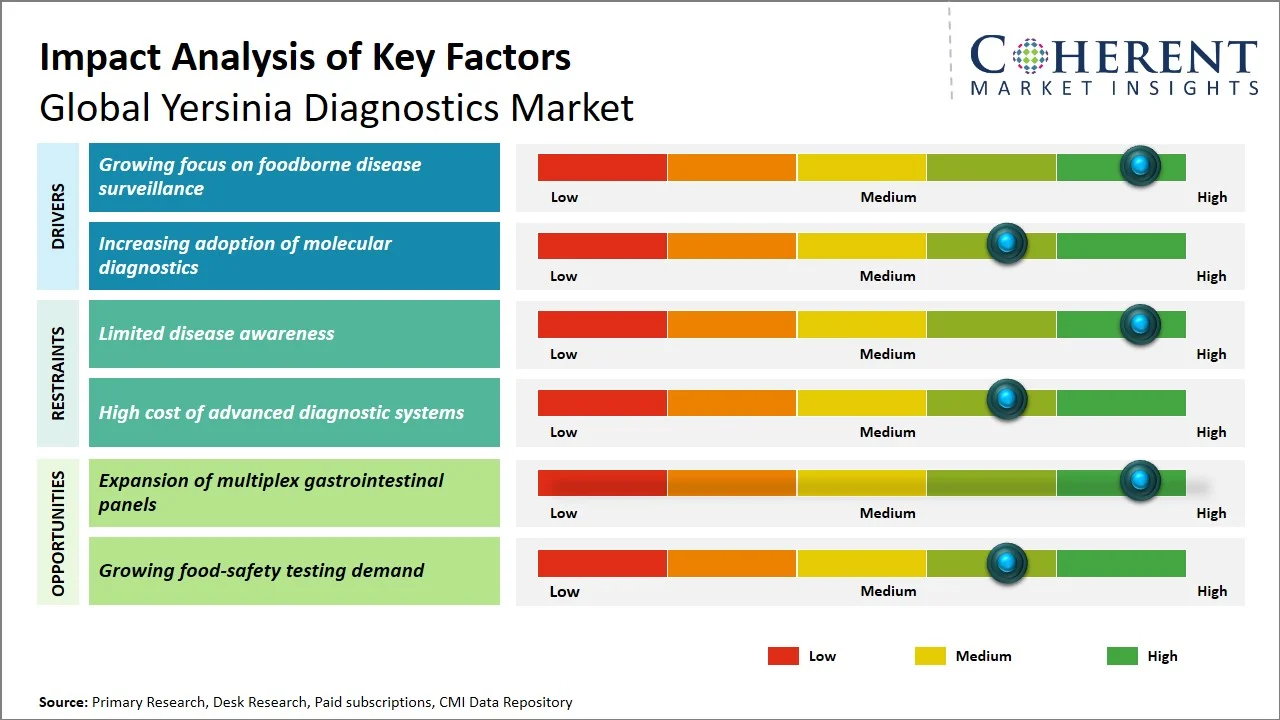
Market Drivers
- Growing focus on foodborne disease surveillance: The growing government focus on foodborne disease surveillance and systematic pathogen monitoring is increasing the need for yersinia testing across clinical and food-testing laboratories. The expansion of surveillance programs is encouraging routine sampling of high-risk foods and the use of culture and molecular methods for pathogen identification. For instance, the UK National Monitoring Plan for imported foods for 2025/26 specifically lists Yersinia among the hazards requiring sampling of swine products, including raw and ready-to-eat meat.
- Increasing adoption of molecular diagnostics: Increasing adoption of molecular diagnostics is supporting the yersinia diagnostics market by enabling faster pathogen detection and improving identification of infections that may be missed through conventional approaches. The growing use of nucleic-acid-based methods is also strengthening their integration into standardized public-health testing workflows. For instance, the U.S. CDC’s 2025 surveillance case definition recognizes NAAT or other molecular testing as presumptive laboratory evidence for non-pestis yersiniosis, formally incorporating molecular detection into U.S. case classification.
- Strengthening government laboratory surveillance: Strengthening government-led laboratory surveillance and outbreak investigation programs is supporting demand for yersinia diagnostics by expanding pathogen testing across clinical, food, and environmental samples. The development of tiered public-health laboratory networks is also improving access to microbiological and molecular testing. For instance, India's Integrated Disease Surveillance Programme operates District Public Health Laboratories for routine microbiological testing and outbreak investigations, with 397 laboratories currently functional.
Emerging Trends
- Growing adoption of multiplex molecular diagnostics: Multiplex PCR and other culture-independent platforms are increasingly being used to detect Yersinia alongside multiple gastrointestinal pathogens from a single specimen, enabling faster and broader pathogen identification.
- Increasing integration of whole-genome sequencing: Whole-genome sequencing is emerging as an important tool for Yersinia surveillance and outbreak investigation by enabling strain-level identification, transmission tracking, and antimicrobial-resistance characterization.
- Expansion of genomic and environmental surveillance: Public-health agencies are increasingly integrating pathogen genomics with environmental and foodborne-disease surveillance, creating opportunities for advanced molecular and sequencing-based Yersinia detection beyond conventional clinical testing.
Regional Insights
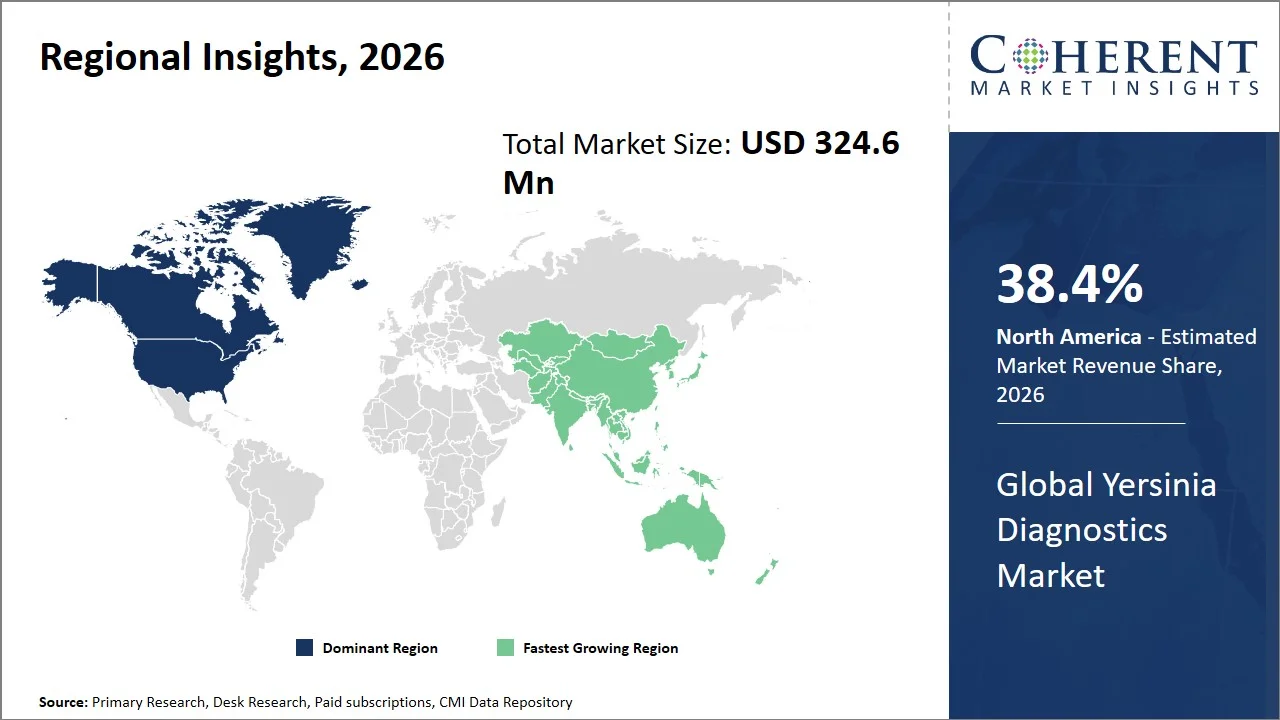
Why is North America a Strong Market for Yersinia Diagnostics?
North America leads the global yersinia diagnostics market, accounting for an estimated 38.4% share in 2026, owing to the well-developed healthcare infrastructure, established public health laboratory facilities, large scale Infectious disease research activities. The strict regulatory scenario and the various awareness campaigns for infectious diseases control have boosted the demand for specific and fast detection of yersinia.
For instance, Yersinia enterocolitica educational campaign, launched in Georgia, worked to inform the public about food hazards posed by chitterlings and safer food handling practices. This campaign directly contributed to the prevention of yersinia infections through targeted public education. (Source: The Digital Library of Georgia) Furthermore, the adequate interaction between the various public health agencies and the diagnostic laboratories enhance reliable and fast detection technology with respect to its uniform analysis.
Why Does Asia Pacific Yersinia Diagnostics Market Exhibit High Growth?
Asia Pacific is expected to exhibit the fastest growth in the global yersinia diagnostics market, registering an estimated CAGR of 6.7% during 2026–2033. The region is projected to account for 22.8% of the global market in 2026, driven by an increase in healthcare infrastructure, the raising public perception for food-safety, and governmental support to combat the infection. For instance, the national monitoring system in China, designed by the Chinese Center for Disease Control and Prevention, utilizes the National Plague Prevention and Control Management Information System to accumulate human and animal plague surveillance data, assisting government-controlled monitoring Yersinia pestis and preparing diagnosis capability.
The expansion of diagnostic laboratory facilities and pathogen detection surveillance systems in countries such as China, India, and Japan is increasing availability of the Yersinia test. Furthermore, the growth of advanced molecular tests and an increasing preparedness of public health are accelerating growth for the region.
Global Yersinia Diagnostics Market Outlook for Key Countries
Why is the U.S. Leading Innovation and Adoption in the Yersinia Diagnostics Market?
The U.S. has been in the forefront of innovation and adoption in the yersinia diagnostics market due to established routine implementation of CIDTs into surveillance and laboratory procedures at clinical facilities. The FoodNet surveillance system, operated by the U.S. CDC, tracks Yersinia testing at ~700 public health clinical laboratories including methods utilizing culture-independent diagnostic testing (CIDT) and culture for detection. These facilities are linked with rapid molecular diagnostics with reflex culture for detection of cases, public health characterization to facilitate outbreak investigations, and genomic surveillance.
Is Japan a Favorable Market for Yersinia Diagnostics Market?
Japan offers an attractive market as it has an organized infectious-disease surveillance program and well-established Yersinia species testing ability. Japan's health system holds a dedicated information on Yersinia diagnosis. The identification of these bacteria and food-safety administration acknowledges Yersinia enterocolitica as food-borne pathogen transmitted via pork and other meat food sources.
Is China Emerging as a Key Growth Hub for the Yersinia Diagnostics Market?
China is emerging as a key growth hub, due to a growing national pathogen-surveillance and –laboratories infrastructure within China. Chinese Center for Disease Control & Prevention carries out a national etiological surveillance network and established a nation-wide laboratory network covering infectious disease monitoring in the country. In addition, China cis building a pathogen surveillance & outbreak-warning network within the laboratory, creating greater scope for Yersinia diagnostic testing.
Why Does Germany Top the European Yersinia Diagnostics Market?
Germany boasts the highest market penetration in Europe, due to an enforced reporting mandate for intestinal Yersinia infections and a well-established national laboratory surveillance infrastructure. The Robert Koch Institute adheres to standard definitions of cases and supports molecular-based, culture-based, and genomics characterization of Yersinia in a network of reference laboratories. Furthermore, the comprehensive diagnostic and surveillance system has created on-going market demand for progressive testing for Yersinia in Germany.
Is Yersinia Diagnostics Market Developing in India?
South Korea represents a developing market due to the increase of decentralized laboratory capability and testing for foodborne-pathogens. A 2025 foodborne pathogen surveillance protocol from the Indian Council of Medical Research calls for testing for Yersinia enterocolitica and the national surveillance network continue to enhance its district and reference laboratories.
Regional Yersiniosis Disease Burden
Region | Notification / Incidence Rate | Key Diagnostic Relevance |
North America | 3.5 per 100,000 | High use of laboratory-based and culture-independent diagnostics |
Europe | 2.2 per 100,000 | Established regional surveillance and laboratory confirmation |
Asia Pacific | Country-specific | Increasing food-safety and infectious-disease testing infrastructure |
Latin America | Limited comparable data | Expanding foodborne-disease surveillance |
Middle East & Africa | Limited comparable data | Developing public-health laboratory capacity |
How is the expansion of multiplex gastrointestinal panels creating new growth opportunities in the yersinia diagnostics market?
The growth of multiplex GI panels represents a compelling market for Yersinia diagnostics, as it allows the detection of Yersinia along with other enteric pathogens from one stool sample. With faster and more comprehensive pathogen detection, these technologies will aid in therapy choices and allow the laboratory workflow to be streamlined. For instance, U.S. Centers for Medicare & Medicaid Services (CMS) Local Coverage Determination (L39226 - Effective April 2026) provides coverage for multiplex GI pathogen panels in certain acute-diarrhea situations and particularly includes Yersinia in the targeted pathogens, allowing for greater clinical utilization of multiplex panels for detecting Yersinia.
Market Players, Key Development, and Competitive Landscape
Key Developments
- In June 2026, bioMérieux submitted its BIOFIRE FILMARRAY GI1.1 Panel and GI1.1 Panel Mid to the U.S. FDA for 510(k) review. The multiplex PCR panels detect multiple gastrointestinal pathogens, including Yersinia enterocolitica, from a single stool sample with results in approximately one hour. Impact: The development strengthens rapid, culture-independent Yersinia detection and expands advanced molecular testing options.
- In November 2025, BD received U.S. FDA 510(k) clearance and CE-IVDR certification for its Enteric Bacterial Panel and Enteric Bacterial Panel plus on the BD COR System. The expanded panel detects Yersinia enterocolitica alongside other gastrointestinal pathogens using PCR technology. Impact: The development supports high-throughput automated Yersinia testing and streamlines enteric pathogen detection in clinical laboratories.
- In October 2025, Hologic, Inc. received U.S. FDA clearance and CE marking for its Panther Fusion GI Bacterial and Expanded Bacterial Assays. The molecular assays detect Yersinia along with other bacterial causes of infectious gastroenteritis and can be run individually or in combination. Impact: The development expands customizable automated molecular testing and supports faster identification of Yersinia infections.
Competitive Landscape
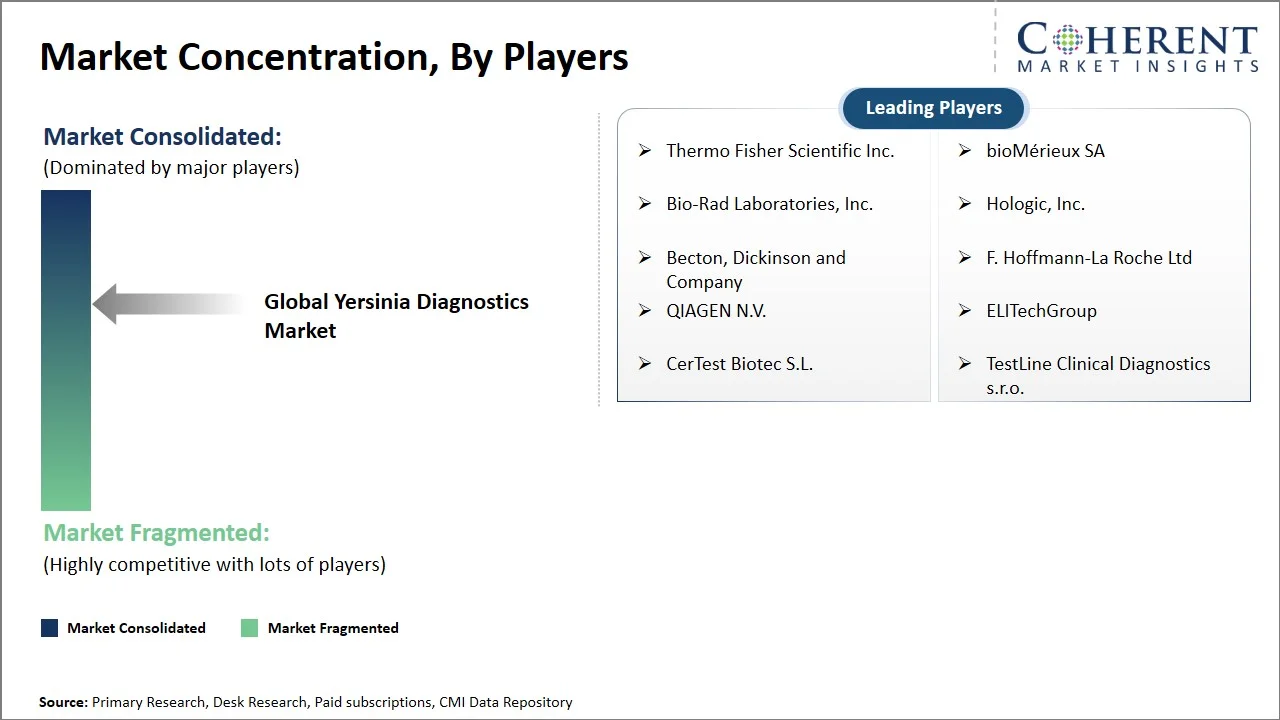
The global yersinia diagnostics market is moderately competitive, with competition centered on diagnostic accuracy, turnaround time, multiplexing capabilities, assay sensitivity, and compatibility with laboratory workflows. Market participants are increasingly focusing on molecular diagnostics, multiplex gastrointestinal testing, genomic characterization, and integrated foodborne-pathogen surveillance to strengthen clinical and public-health applications. Key focus areas include:
- Development of multiplex PCR panels
- Advancement of molecular detection technologies
- Integration of whole-genome sequencing and genomic characterization
- Expansion of foodborne pathogen testing solutions
- Development of automated and high-throughput diagnostic workflows
Market Report Scope
Yersinia Diagnostics Market Report Coverage
| Report Coverage | Details | ||
|---|---|---|---|
| Base Year: | 2025 | Market Size in 2026: | USD 324.6 Mn |
| Historical Data for: | 2020 To 2024 | Forecast Period: | 2026 To 2033 |
| Forecast Period 2026 to 2033 CAGR: | 5.3% | 2033 Value Projection: | USD 466.0 Mn |
| Geographies covered: |
| ||
| Segments covered: |
| ||
| Companies covered: | Thermo Fisher Scientific Inc., bioMérieux SA, Bio-Rad Laboratories, Inc., Hologic, Inc., Becton, Dickinson and Company, F. Hoffmann-La Roche Ltd, QIAGEN N.V., ELITechGroup, CerTest Biotec S.L., TestLine Clinical Diagnostics s.r.o. | ||
| Growth Drivers: |
| ||
| Restraints & Challenges: |
| ||
Analyst Opinion (Expert Opinion)
- In the coming years, global yersinia diagnostics market is expected to shift from standalone, culture-based testing toward multiplex molecular and integrated diagnostic workflows. Multiplex GI panels will increasingly incorporate Yersinia targets alongside other enteric pathogens, while culture and sequencing will remain important for confirmation, strain characterization, and surveillance. Automation, higher-throughput testing, and integration with laboratory information systems are expected to further improve turnaround time and diagnostic efficiency.
- The maximum opportunities are foreseen within molecular tests for clinical diagnostics in India. The country offers significant scope for expanding molecular gastrointestinal testing as diagnostic infrastructure develops and laboratories increasingly move toward faster, syndromic pathogen detection. Players should focus on cost-efficient multiplex GI panels that include Yersinia, with scalable platforms suitable for hospitals, diagnostic chains, and public-health laboratories.
- In order to gain a competitive advantage, market players should prioritize multiplexing, workflow automation, and cost optimization rather than competing solely on standalone Yersinia assays. Developing assays that combine Yersinia detection with broader gastrointestinal pathogen panels, while maintaining compatibility with existing PCR platforms and providing culture-confirmation pathways, can improve laboratory adoption. Localized distribution partnerships and affordable testing formats will also help players penetrate emerging markets and build recurring consumables revenue.
Speak to the analyst
Want personalized insights?
Take the findings above to one of our principal consultants, or have the report rebuilt around the segments, geographies and competitors you actually track.
Market Segmentation
- Product Type Insights (Revenue, USD Mn, 2021 - 2033)
- Kits and Reagents
- Culture Media
- Instruments and Analyzers
- Controls and Standards
- Others
- Test Type Insights (Revenue, USD Mn, 2021 - 2033)
- Molecular Tests
- Culture Tests
- Serological Tests
- Immunoassays
- Biochemical Tests
- Others
- Disease Type Insights (Revenue, USD Mn, 2021 - 2033)
- Yersiniosis
- Plague
- Yersinia pseudotuberculosis Infection
- Others
- Technology Insights (Revenue, USD Mn, 2021 - 2033)
- Polymerase Chain Reaction (PCR)
- Multiplex PCR
- DNA Probes
- Immunoassay
- Monoclonal Antibodies
- MALDI-TOF Mass Spectrometry
- Sequencing
- Others
- Sample Type Insights (Revenue, USD Mn, 2021 - 2033)
- Stool Samples
- Blood Samples
- Tissue Samples
- Food Samples
- Environmental Samples
- Others
- Application Insights (Revenue, USD Mn, 2021 - 2033)
- Clinical Diagnostics
- Food Safety Testing
- Public Health Surveillance
- Veterinary Diagnostics
- Research and Academic Use
- Others
- End User Insights (Revenue, USD Mn, 2021 - 2033)
- Hospitals and Clinics
- Diagnostic Laboratories
- Public Health Laboratories
- Food Testing Laboratories
- Veterinary Laboratories
- Research and Academic Institutes
- Others
- Regional Insights (Revenue, USD Mn, 2021 - 2033)
- North America
- U.S.
- Canada
- Latin America
- Brazil
- Argentina
- Mexico
- Rest of Latin America
- Europe
- Germany
- U.K.
- Spain
- France
- Italy
- Russia
- Rest of Europe
- Asia Pacific
- China
- India
- Japan
- Australia
- South Korea
- ASEAN
- Rest of Asia Pacific
- Middle East
- GCC Countries
- Israel
- Rest of Middle East
- Africa
- South Africa
- North Africa
- Central Africa
- North America
- Key Players Insights
- Thermo Fisher Scientific Inc.
- bioMérieux SA
- Bio-Rad Laboratories, Inc.
- Hologic, Inc.
- Becton, Dickinson and Company
- Hoffmann-La Roche Ltd
- QIAGEN N.V.
- ELITechGroup
- CerTest Biotec S.L.
- TestLine Clinical Diagnostics s.r.o.
Sources
Primary Research Interviews
- Gastroenterologists, infectious-disease physicians, clinical microbiologists, and laboratory medicine specialists involved in Yersinia diagnosis
- Clinical laboratory directors, microbiology laboratory managers, and molecular diagnostics specialists
- Hospital and diagnostic-laboratory procurement professionals responsible for infectious-disease testing
- Food-safety laboratory managers and foodborne-pathogen testing specialists
- Public-health laboratory scientists and epidemiologists involved in Yersinia surveillance and outbreak investigations
- Molecular diagnostics, PCR, multiplex-panel, and genomic-testing specialists
Stakeholders
- Yersinia diagnostic kit, reagent, culture-media, and molecular assay manufacturers
- Hospitals, diagnostic laboratories, public-health laboratories, food-testing laboratories, and veterinary laboratories
- Infectious-disease, gastroenterology, microbiology, and epidemiology departments
- Food manufacturers, meat processors, and food-safety testing service providers
- Laboratory equipment suppliers and diagnostic technology distributors
- End-use Sectors
- Hospitals and Health Systems
- Diagnostic Laboratories
- Public Health Laboratories
- Food Testing Laboratories
- Veterinary Diagnostic Laboratories
- Academic and Research Institutions
- Food Processing and Quality-Control Facilities
- Regulatory & Health Bodies
- U.S. Food and Drug Administration – Center for Devices and Radiological Health
- Centers for Disease Control and Prevention
- European Commission – Directorate-General for Health and Food Safety
- European Centre for Disease Prevention and Control
- Medicines and Healthcare products Regulatory Agency, United Kingdom
Databases
- ClinicalTrials.gov – Clinical trials involving gastrointestinal infections, infectious-disease diagnostics, and Yersinia
- WHO International Clinical Trials Registry Platform – Global clinical-trial records
- U.S. Food and Drug Administration Medical Device Databases – Diagnostic-device classifications, submissions, recalls, and safety information
- EUDAMED – European medical-device registration and regulatory information
- CDC FoodNet – Foodborne disease surveillance and diagnostic laboratory-practice data
- ECDC Surveillance Atlas – European yersiniosis cases, notification rates, hospitalizations, and deaths
- CDC Infectious Diseases Laboratories Test Directory – Public-health laboratory testing and Yersinia-related test services
- World Health Organization Global Health Observatory – Global health and infectious-disease statistics
Associations
- American Society for Microbiology
- Infectious Diseases Society of America
- Association of Public Health Laboratories
- International Society for Infectious Diseases
- European Society of Clinical Microbiology and Infectious Diseases
- International Association for Food Protection
- European Public Health Association
Public Domain Sources
- Centers for Disease Control and Prevention – Yersinia diagnosis, laboratory testing, FoodNet surveillance, and plague information
- European Centre for Disease Prevention and Control – Yersiniosis surveillance and epidemiological data
- World Health Organization – Plague surveillance, diagnosis, prevention, and control
- U.S. Food and Drug Administration – Yersinia in-vitro diagnostic device regulatory information
- U.S. Department of Agriculture – Food Safety and Inspection Service – Foodborne pathogen and meat-safety information
- UK Health Security Agency – Gastrointestinal infection and Yersinia surveillance
- European Food Safety Authority – Foodborne zoonoses and food-safety surveillance
- National public-health and food-safety agencies across Asia Pacific, Latin America, and the Middle East & Africa
Proprietary Elements
- CMI Data Analytics Tool, Proprietary CMI Existing Repository of information for last 10 years.
Get access to 250+ pages report
Every segment, forecast, competitor profile and data table behind the analysis above — available for instant download.
- ESOMAR Member
- ISO 9001:2015 Certified
- D-U-N-S Registered
- GDPR & CCPA Compliant
Missing comfort of reading report in your local language? Find your preferred language:
Frequently Asked Questions
Yersinia infections are diagnosed using clinical specimens such as stool, blood, or tissue through culture, PCR-based molecular testing, and other pathogen-specific laboratory methods.
Yersinia enterocolitica is the most commonly detected species, while Yersinia pestis and Yersinia pseudotuberculosis are also important diagnostic targets.
PCR enables rapid and sensitive detection of Yersinia-specific genetic targets and can identify infections faster than conventional culture-based approaches.
Stool is the primary clinical sample for yersiniosis testing, while blood, tissue, food, and environmental samples are also used depending on the suspected infection and application.
Multiplex gastrointestinal panels simultaneously detect Yersinia and other enteric pathogens from a single specimen, improving diagnostic efficiency and reducing testing time.
Culture-based testing remains important for isolating Yersinia organisms and supporting species identification, antimicrobial susceptibility testing, and epidemiological investigations.
Food safety laboratories use Yersinia diagnostics to detect contamination in high-risk food products and support pathogen surveillance, quality control, and outbreak investigations.