

Single Cell Genome Sequencing Market Size and Forecast — 2026-2033
The Global Single Cell Genome Sequencing Market size is estimated to be valued at USD 1.39 billion in 2026 and is expected to reach USD 3.93 billion by 2033, exhibiting a compound annual growth rate (CAGR) of 16.0% from 2026 to 2033.
Overview
Single-cell genome sequencing products are advanced molecular biology tools that enable genomic analysis at the resolution of individual cells. These include microfluidic devices, reagents, sequencing kits, and bioinformatics software optimized for single-cell isolation, amplification, and data interpretation. Such technologies are crucial for studying cellular heterogeneity in cancer, immunology, and developmental biology. Recent innovations have focused on improving accuracy, throughput, and coverage while reducing cost per cell. Integration with next-generation sequencing (NGS) platforms and AI-driven analysis tools allows researchers to extract detailed molecular insights from complex cell populations.
Key Takeaways
The microfluidics technology segment is pivotal, commanding over 43% of the market share due to its superior single cell isolation efficiency and scalability.
Within applications, cancer research remains the largest revenue contributor, comprising more than 61% of market adoption, driven by precision oncology imperatives.
On the regional front, North America dominates the Single Cell Genome Sequencing Market with over 38% industry share, buoyed by a mature research ecosystem and substantial funding support.
Asia Pacific is the fastest-growing region, with a CAGR exceeding 18%, propelled by rising genomics initiatives in China and India alongside expanding biotechnology infrastructure.
Single Cell Genome Sequencing Market Segmentation Analysis
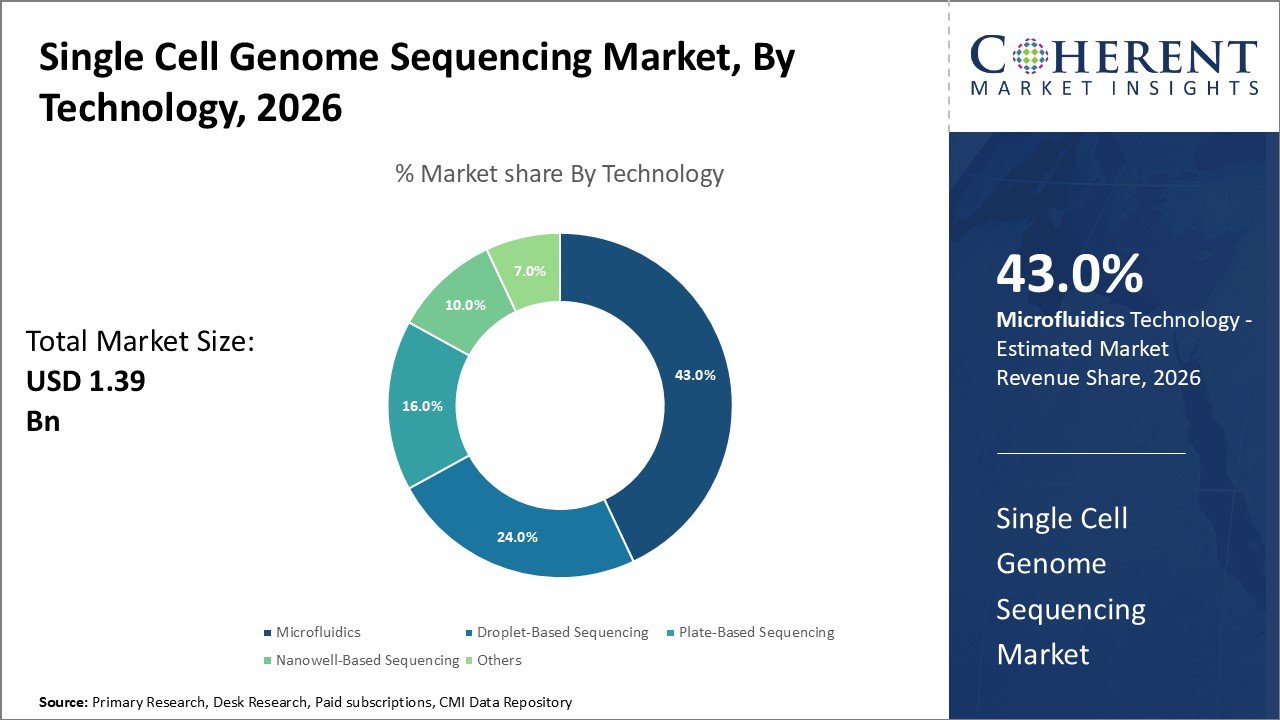
Single Cell Genome Sequencing Market Insights, By Technology
In terms of technology, Microfluidics dominates the market share due to its unparalleled efficiency in isolating individual cells with minimal reagent consumption, enabling high-throughput analysis demanded by large-scale research projects. The scalable and automated nature of microfluidic devices supports cost-effective processing of thousands of cells concurrently, fueling their adoption, especially in pharmaceutical research. Droplet-based sequencing is the fastest-growing subsegment owing to its ability to encapsulate individual cells rapidly, facilitating enhanced multiplexing and sequencing accuracy.
Single Cell Genome Sequencing Market Insights, By Application
Cancer Research dominates the market share. This predominance stems from personalized oncology becoming reliant on dissecting tumor heterogeneity at the cellular level. Technologies that reveal intra-tumor genomic variation aid in targeted therapy development and clinical trial stratification, driving significant industry revenue. Immunology is the fastest-growing application segment, propelled by interest in immune cell profiling relevant to autoimmune diseases and vaccine development.
Single Cell Genome Sequencing Market Insights, By End-User
In terms of end-user industry, Pharmaceutical & Biotechnology Companies dominate the market share. These companies are primary adopters, integrating single-cell sequencing into drug discovery, biomarker identification, and precision medicine pipelines. Continuous demand for personalized therapeutics has positioned this segment as a critical market revenue contributor. Academic & Research Institutes constitute the fastest-growing segment due to increased research funding and novel academic programs emphasizing single-cell genomic technologies.
Single Cell Genome Sequencing Market Trends
The Single Cell Genome Sequencing Market trend is rapidly shifting towards integrative approaches combining multiple omics layers, enhancing holistic cellular understanding.
For example, a 2026 study published in *Nature* demonstrated how integrating epigenomics and genome sequencing improved cancer subtype classification accuracy by 28%.
Another trend is the rise of spatially resolved sequencing methods that preserve tissue architecture, amplifying functional genomics research impact.
Additionally, cloud-based sequencing analytics have risen sharply, with companies adopting these platforms reporting operation cost reductions and enhanced collaboration across global research teams.
These trends signify an evolution from standalone sequencing to comprehensive, data-driven insights, thereby increasing market scope and complexities.
Single Cell Genome Sequencing Market Insights, By Geography
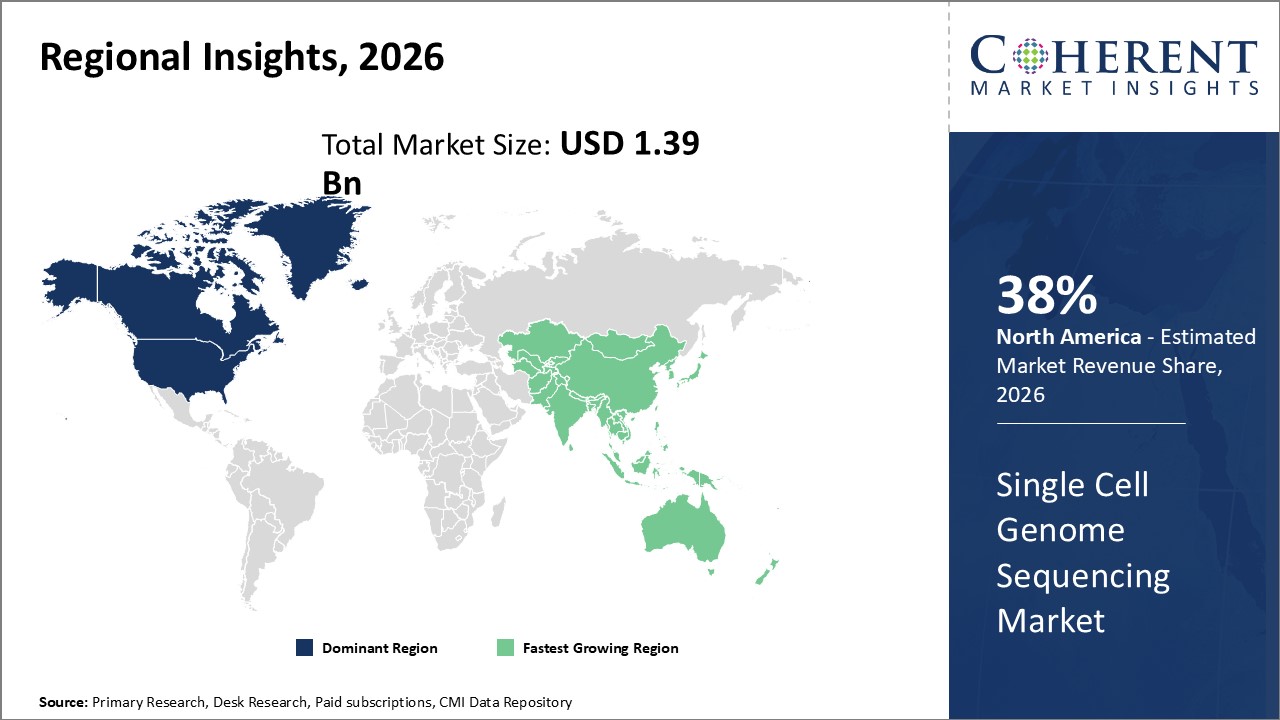
North America Single Cell Genome Sequencing Market Analysis and Trends
In North America, the dominance in the Single Cell Genome Sequencing Market is underpinned by robust infrastructure, significant government funding and a high concentration of innovative companies such as Illumina and 10x Genomics. The region captures approximately 38% of the industry share, driven by widespread adoption in academic and clinical research sectors and the early integration of novel sequencing technologies.
Asia Pacific Single Cell Genome Sequencing Market Analysis and Trends
Meanwhile, the Asia Pacific exhibits the fastest growth, with a CAGR exceeding 18%. This expansion is fueled by increasing investments in genomics research by governments in China and India, growing biotechnology hubs, and rising demand for precision medicine. Chinese enterprises like BGI Group have notably contributed by launching cost-effective sequencing platforms, enabling rapid penetration in emerging markets.
Single Cell Genome Sequencing Market Outlook for Key Countries
USA Single Cell Genome Sequencing Market Analysis and Trends
The USA's single-cell genome Sequencing Market is a powerhouse of innovation and adoption. Government initiatives promoting genomic research and precision medicine, coupled with substantial venture capital inflows, have driven market advancement. In 2025, the U.S. accounted for over 30% of global revenue, with top market players investing in AI-based sequencing analytics and novel assay kits. The presence of leading pharmaceutical companies integrating single-cell sequencing in drug development pipelines bolsters sustained market growth and expansion.
China Single Cell Genome Sequencing Market Analysis and Trends
China’s market has witnessed exponential growth due to aggressive national genomics programs and strategic public-private partnerships. Investments exceeding USD 500 million in genomics infrastructure during 2023-2026 have empowered local companies like BGI Group to introduce affordable platforms, making single-cell genome sequencing accessible to a broader user base. Furthermore, collaborations with global market players have accelerated technology transfer, enabling China to emerge as a key growth hub in the Asia Pacific.
Analyst Opinion
Supply-side indicators such as manufacturing capacity enhancements in sequencing platforms have led to increased throughput and accuracy. For instance, in 2025, a leading biotech instrumentation firm expanded its sequencing output by 31%, enabling broader market penetration. These improvements directly bolster market growth by reducing per-sample costs, making single-cell genome sequencing more accessible to diverse research domains.
Demand-side drivers include burgeoning applications in oncology and neurogenomics, with over 61% of single-cell sequencing usage reported in cancer research in 2026. This significant demand from clinical research fuels market revenue and reinforces the market forecast for this segment’s rapid expansion.
Nano-scale indicators reflect the rising integration of microfluidics with genome sequencing workflows, enhancing single-cell capture and analysis efficiency. In late 2025, the implementation of microfluidic-based kits demonstrated a 26% increase in cellular throughput during sequencing runs, consolidating the microfluidics subsegment’s prominence.
Pricing dynamics also indicate progressive democratization of single-cell genome sequencing, driven by new assay kits launched in 2026 that reduced reagent costs by 19%. This cost optimization is anticipated to further accelerate market growth strategies adopted by market players globally.
- Current Industry Events of 2026
- Market Size Estimation
- Regional Breakdown
- Competitive Landscape
- Customer Intelligence
- Segmental Analysis
- Pricing Analysis
- Key Market Drivers, Challenges & Future Trends
- Customized Insights Section
Market Scope
| Report Coverage | Details | ||
|---|---|---|---|
| Base Year: | 2025 | Market Size in 2026: | USD 1.39 billion |
| Historical Data for: | 2020 To 2024 | Forecast Period: | 2026 To 2033 |
| Forecast Period 2026 to 2033 CAGR: | 16.0% | 2033 Value Projection: | USD 3.93 billion |
| Geographies covered: |
| ||
| Segments covered: |
| ||
| Companies covered: | Thermo Fisher Scientific Inc., Pacific Biosciences of California, Inc., Mission Bio, Inc., Bio-Rad Laboratories, Inc., Fluidigm Corporation, Oxford Nanopore Technologies Ltd., Agilent Technologies, Inc., QIAGEN N.V., Takara Bio Inc., Roche Diagnostics, Merck KGaA. | ||
| Growth Drivers: |
| ||
Single Cell Genome Sequencing Market Growth Factors
The increasing prevalence of personalized medicine is a fundamental growth driver, as single-cell genome sequencing offers unparalleled resolution in genetic profiling, critical for tailor-made therapies. In 2025, approximately 35% of oncology clinical trials incorporated single-cell genome sequencing techniques, underscoring this market growth impetus. Technological advancements such as AI-enhanced bioinformatics tools are optimizing data analysis workflows, significantly reducing turnaround time and labor costs, which has contributed to a 22% improvement in operational efficiency.
Expanding applications beyond oncology into immunology and neurobiology creates diversified revenue streams. For example, neurodegenerative disease research grew by 19% in 2026, driven by insights from single-cell sequencing. Apart from this, government funding and supportive regulatory frameworks for genomics research, particularly in the U.S. and Europe, are enabling accelerated adoption and commercialization, with dedicated programs increasing genomics research funding by 26% during 2023-2026.
Single Cell Genome Sequencing Market Development
In March 2026, Almac Diagnostic Services (part of the Almac Group) announced the commercial launch of its Single Cell RNA Sequencing Service, leveraging the 10x Genomics Chromium X platform to generate high-resolution gene expression data at the individual cell level. The service supports both cryopreserved cell suspensions and formaldehyde-fixed samples, and is backed by a scalable bioinformatics pipeline (via the 10x Genomics Cell Ranger software) that performs cell type identification, differential expression, and pathway analysis.
In July 2026, CS Genetics launched its 96-Sample SimpleCell™ 3’ Gene Expression Kit, a high-throughput single-cell RNA-sequencing kit designed to process up to 96 independent samples in parallel while maintaining data consistency and quality. The kit builds on the company’s SimpleCell platform, enabling same-day workflows, compatibility with standard lab equipment, and significantly lower per-sample costs — making it well-suited for scalable genomics studies, screening, and AI-driven research.
Key Players
Leading Companies of the Market
Thermo Fisher Scientific Inc.
Pacific Biosciences of California, Inc.
Mission Bio, Inc.
Bio-Rad Laboratories, Inc.
Fluidigm Corporation
Oxford Nanopore Technologies Ltd.
Agilent Technologies, Inc.
QIAGEN N.V.
Takara Bio Inc.
Roche Diagnostics
Merck KGaA
Competitive strategies highlight that Illumina’s acquisition of Pacific Biosciences in 2026 expanded its technological portfolio, allowing seamless integration of long-read and single-cell sequencing solutions, resulting in a 15% revenue uplift in that fiscal year. Meanwhile, 10x Genomics accelerated product innovation by launching a next-gen microfluidics platform that enhanced cell throughput by 40%, establishing dominance in microfluidic-based sequencing. Fluidigm Corporation leveraged strategic partnerships with academic institutions to expand clinical applications, boosting their market visibility and customer base in 2025.
Single Cell Genome Sequencing Market Future Outlook
Future single-cell genome sequencing technologies will focus on scalability, affordability, and multi-omics integration. Hybrid platforms combining genomic, transcriptomic, and epigenomic profiling will enable holistic cellular analysis. AI-driven bioinformatics tools will automate data interpretation, reducing analysis time dramatically. Portable sequencing instruments will extend research beyond core facilities, supporting real-time, in-field applications. As cost-per-cell decreases, single-cell sequencing is poised to become a routine tool in diagnostics, precision medicine, and drug discovery.
Single Cell Genome Sequencing Market Historical Analysis
Single-cell sequencing technologies originated in the early 2010s, offering researchers an unprecedented view of cellular heterogeneity. Initially, low-throughput and high-cost methods restricted adoption to specialized genomic labs. However, microfluidic platforms, improved amplification chemistries, and automation breakthroughs rapidly expanded accessibility. Integration with next-generation sequencing (NGS) systems enhanced data depth and accuracy. These advances enabled key discoveries in cancer evolution, immunology, and stem cell research, solidifying single-cell analysis as a cornerstone of modern molecular biology.
Sources
Primary Research Interviews:
Molecular Biologists
Genomic Data Scientists
Bioinformatics Engineers
Sequencing Technologists
Databases:
NCBI GenBank
EMBL-EBI Genomics Database
GlobalData Genomics Reports
Human Cell Atlas Data Portal
Magazines:
GenomeWeb
BioTechniques
Nature Biotechnology
The Scientist
Journals:
Nature Genetics
Genome Research
Cell Genomics
PLOS Computational Biology
Newspapers:
The Guardian (Science)
The New York Times (Technology)
The Wall Street Journal (Biotech)
The Hindu (Health)
Associations:
International Society for Computational Biology (ISCB)
American Society of Human Genetics (ASHG)
Global Alliance for Genomics & Health (GA4GH)
Wellcome Sanger Institute
Get access to 250+ pages report
Every segment, forecast, competitor profile and data table behind the analysis above — available for instant download.
- ESOMAR Member
- ISO 9001:2015 Certified
- D-U-N-S Registered
- GDPR & CCPA Compliant
Missing comfort of reading report in your local language? Find your preferred language:
Transform your Strategy with Exclusive Trending Reports
Frequently Asked Questions
Leading market companies include Illumina Inc., 10x Genomics, BGI Group, and Thermo Fisher Scientific Inc., each driving innovation and maintaining substantial market shares through product development and strategic partnerships.
The market size is projected to grow from USD 1.39 billion in 2026 to USD 3.93 billion by 2033, reflecting a CAGR of 16.0%, fueled by technological advancements and increasing applications.
The pharmaceutical and biotechnology companies dominate growth opportunities, particularly through oncology-centered research and drug development programs demanding high-resolution genomic data.
Market trends will likely emphasize multi-omics integration, spatial transcriptomics, and AI-powered bioinformatics, enabling comprehensive cellular insights and faster data analytics workflows.
The market landscape is marked by rapid innovation, aggressive product launches, and strategic M&As. Challenges include managing large sequencing data, maintaining cost efficiency, and addressing technical complexities.
Market players employ product diversification, strategic collaborations with research institutions, regional expansion, and continuous R&D investments to sustain business growth and market share.