

Sterile Filtration Market Size and Forecast: 2026 - 2033
The Sterile Filtration Market is estimated to be valued at USD 9.98 Bn in 2026 and is expected to reach USD 16.25 Bn by 2033, exhibiting a compound annual growth rate (CAGR) of 10.24% from 2026 to 2033.
Key Takeaways
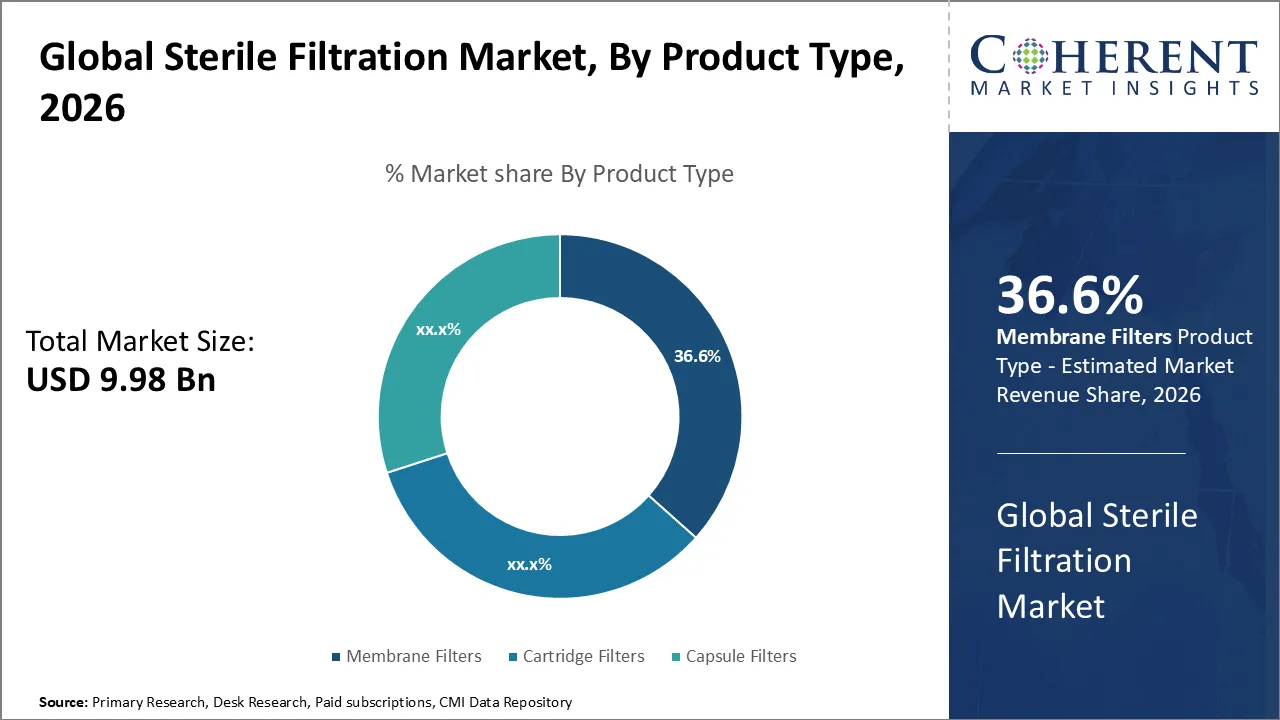
- By Product Type, Membrane Filters hold the largest market share of 36.6% in 2026 owing to the rapid growth of pharmaceutical & biopharmaceutical production.
- By Application, Bioprocess expected to hold the largest market share of 43.4% in 2026 owing to its surging demand for vaccines and cell/ gene therapies.
- By Membrane Pore Size, 0.5um acquired the prominent market share of 46.6% in 2026 owing to the balance of efficiency and throughput in processing.
- By End User, Pharmaceutical and Biotechnology Companies capture the largest market share of 53.3% in 2026 owing to the growth of biopharmaceutical & complex therapeutic production.
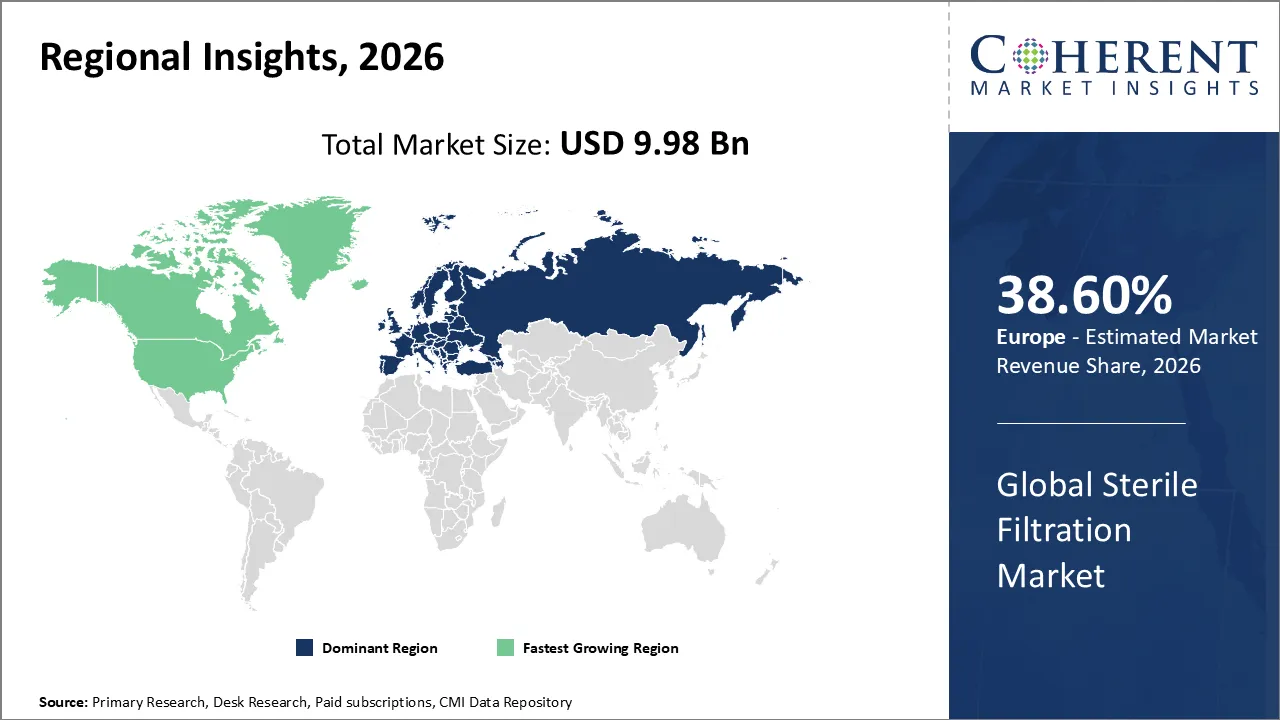
- By Region, Europe dominates the overall market with an estimated share of 38.6% in 2026 owing to the stringent regulatory & quality standards.
Market Overview
The sterile filtration market ensures product safety and quality across pharmaceutical, biotechnology, healthcare, food and beverage, and laboratory applications. Growing demand for contamination control in biologics, vaccines, injectable drugs, and advanced therapies actively drives the market. Strict regulatory requirements, increased adoption of single-use systems, and ongoing innovation in membrane materials and filtration technologies continue to strengthen market expansion and encourage widespread use in manufacturing and research processes.
Current Events and Its Impact on the Sterile Filtration Market
Current Events | Description and its impact |
Geopolitical and Regulatory Developments |
|
Technological Innovations and Industry Advances |
|
Regional Infrastructure and Capacity Expansion |
|
Segmental Insights
- Current Industry Events of 2026
- Market Size Estimation
- Regional Breakdown
- Competitive Landscape
- Customer Intelligence
- Segmental Analysis
- Pricing Analysis
- Key Market Drivers, Challenges & Future Trends
- Customized Insights Section
Sterile Filtration Market Insights, By Product Type - Membrane Filters contribute the highest share of the market owing to its adoption of single-use and disposable filtration technologies
Membrane Filters hold the largest market share of 36.6% in 2026. The sterile filtration industry is powered by membrane filters. They get rid of germs while keeping fragile items safe. Pharmaceutical and biotech businesses utilize them to keep biologics, injectables, and vaccines sterile. Using it often for clarifying, pre-filtration, and final filtering makes the process more efficient and guarantees that the result is always of high quality. Improvements in membrane chemistry, flow performance, and compatibility with single-use items make it easier to employ in regulated manufacturing, laboratory, and quality control environments.
Sterile Filtration Market Insights, By Application - Bioprocess contribute the highest share of the market owing to its stringent regulatory and quality standards
Bioprocess expected to hold the largest market share of 43.4% in 2026. Bioprocessing plays a key role in sterile filtration. Manufacturers follow strict guidelines to prevent contamination in upstream and downstream processes. Biologics, cell cultures, and fermentation products are becoming more complex, requiring reliable filtration to protect purity and yield. Demand grows as single-use systems expand, production volumes increase, and companies adopt flexible manufacturing. Sterile filtration is essential in bioprocess workflows to meet strict quality standards and support continuous process improvement.
For instance, in October 2025, Avantor launched a next-generation sterile sampling platform with PUPSIT assemblies, offering modular, closed-path, and supplier-agnostic setups that streamline bioprocessing and reduce line breaks and operator intervention.
Sterile Filtration Market Insights, By Membrane Pore Size - 0.5um contribute the highest share of the market owing to its broad laboratory and analytical use cases
0.5um acquired the prominent market share of 46.6% in 2026. In the sterile filtration sector, manufacturers are the ones who want 0.5 µm filters. These filters keep high flow rates while getting rid of bigger particles and lowering bioburden. Companies utilize them as pre-filters or to clean things up before finer sterile filtration. This keeps membranes downstream safe and makes the process work better. Companies that want reliable performance, operational efficiency, and consistent quality use them. They work in labs to do research, for practical purposes, and with systems that can only be used once.
Sterile Filtration Market Insights, By End User - Pharmaceutical and Biotechnology Companies contribute the highest share of the market owing to its shift toward single-use & flexible processing technologies
Pharmaceutical and Biotechnology Companies capture the largest market share of 53.3% in 2026. The sterile filtration sector is mostly made up of pharmaceutical and biotechnology industries. They make sure that vaccinations, biologics, and injectables stay safe and clean. They employ modern filtration to keep everything clean, follow the rules, and keep the quality high. To make manufacturing easier and better, many organizations are using single-use systems and novel membrane technologies. As they grow their business, invest in research and development, and work with contract manufacturers, sterile filtering becomes even more important. For instance, in December 2024, UK-based Amazon Filters launched SupaPore TMB, a high-temperature-resistant membrane for vent applications in pharmaceutical and biotech processes like sterile air venting and large-scale fermentation.
Regional Insights
Europe Sterile Filtration Market Trends
Europe dominates the overall market with an estimated share of 38.6% in 2026. Europe has rigorous rules for the sterile filtration business. These guidelines make sure that bioprocess and pharmaceutical goods are always safe and of high quality. sophisticated filtration is in high demand because of the growth of biologics, vaccines, and sophisticated medicines. More and more, manufacturers are using single-use technology and automated systems to make things more efficient and less dirty. Research and development, investments in infrastructure, and biotech clusters are what make new things happen. Sustainability programs and partnerships with contract manufacturers also have an impact on market trends and the use of new technologies. For instance, in October 2025, ABN Cleanroom Technology launched CYTONIX, a turnkey rental solution for cytostatics production, ahead of new 2026 pharmaceutical inspection regulations in Belgian hospitals.
North America Sterile Filtration Market Trends
A robust pharmaceutical and biotech ecosystem helps North America's sterile filtration business. Growth is driven by better healthcare infrastructure and big investments in research and development. To meet rigorous rules and better prevent contamination, businesses use new filtering technologies, such as single-use and automated systems. The US is the most advanced country in terms of adoption because it makes a lot of biopharmaceuticals and focuses on biologics and vaccines. Canada increases demand in the region by increasing biotech development. For instance, in September 2025, Brainlab received FDA 510(k) clearance and launched Spine Mixed Reality Navigation in the US, combining its precise optical navigation system with advanced mixed reality for enhanced visualization in the sterile field.
United Kingdom Sterile Filtration Market Trends
The UK sterile filtration market is rising because there is a strong biopharmaceutical base and more money is going into biologics and precision medicines. Single-use, scalable filtering solutions help companies be more flexible, follow the rules, and control pollution. Demand is high since there are strict rules on the safety and quality of products. Research hubs and partnerships with contract manufacturers help filtration technologies move forward and find new uses in pharmaceutical production and lab work.
United States Sterile Filtration Market Trends
The US market for sterile filtration is growing because of a focus on making vaccines and biopharmaceuticals. This growth is supported by advanced healthcare infrastructure and a lot of money spent on research and development. Companies use single-use and automated filtration technologies to make sure that their products are safe, satisfy FDA criteria, and work better. There is a lot of demand for biologics, cell, and gene therapies because they are leading the way and have a lot of clinical activity. The market is growing even faster because of the widespread usage of both large-scale and small-batch processing. For instance, in July 2024, Parker Bioscience Filtration, part of Parker Hannifin, introduced a new range of sterilising-grade gas filters to enhance microbial safety and lower operational costs in the food and beverage industry.
End-user Feedback and Unmet Needs in the Sterile Filtration Market
- Demand for Higher Flow Rates and Efficiency: End-users frequently report a need for filtration systems that combine high microbial retention with faster flow rates. Many conventional membranes slow production and reduce throughput, especially in large-scale bioprocessing. Users seek filters that maintain efficiency without compromising sterility, particularly for high-volume biologics and vaccine manufacturing processes.
- Compatibility with Single-Use and Flexible Systems: Manufacturers emphasize the need for sterile filters that integrate seamlessly with single-use and modular bioprocess setups. Existing filters sometimes face material compatibility or connection issues, limiting flexibility. Users look for adaptable, ready-to-use membranes that simplify installation, reduce contamination risks, and support rapid changeovers in modern, flexible manufacturing environments.
- Durability and Longevity in Filtration: End-users highlight concerns about membrane durability and lifespan, particularly under repeated sterilization or high-stress conditions. Short filter life increases operational costs and downtime. There’s demand for robust, chemically resistant, and mechanically stable membranes that maintain consistent performance throughout long production cycles, especially in continuous bioprocessing and high-volume pharmaceutical manufacturing.
Sterile Filtration Market Trend
Growing Adoption of Single-Use Filtration Systems
The sterile filtration market is increasingly embracing single-use systems to reduce contamination risks and simplify operations. These disposable filters eliminate cleaning and sterilization steps, saving time and lowering cross-contamination potential. They are particularly favored in biologics and vaccine production, as well as in flexible and modular manufacturing setups. End-users benefit from faster batch changeovers, operational efficiency, and regulatory compliance, making single-use filtration a key trend in modern pharmaceutical and biotechnology workflows.
Integration of Automated Filtration Technologies
Automation is reshaping sterile filtration processes, with manufacturers adopting systems that include real-time monitoring, integrity testing, and process control. Automated filtration minimizes human intervention, reducing the risk of contamination and operational errors. It enhances reproducibility and efficiency, particularly in high-volume production or complex biologics manufacturing. This trend reflects the broader industry movement toward Industry 4.0, where smart, automated, and validated processes are essential to meet regulatory expectations and accelerate production timelines.
Sterile Filtration Market Opportunity
Adoption of Single-Use and Modular Systems
The shift toward single-use and modular manufacturing platforms creates opportunities for sterile filtration providers. End-users seek disposable, ready-to-use filters that reduce cleaning, validation, and contamination risks while improving operational flexibility. Companies can capitalize on this trend by offering versatile, easy-to-integrate filtration systems compatible with single-use bioreactors, modular cleanrooms, and flexible production lines, meeting evolving pharmaceutical and biotech demands while streamlining workflows and enhancing process efficiency.
Market Report Scope
Sterile Filtration Market Report Coverage
| Report Coverage | Details | ||
|---|---|---|---|
| Base Year: | 2025 | Market Size in 2026: | USD 9.98 Bn |
| Historical Data for: | 2020 To 2024 | Forecast Period: | 2026 To 2033 |
| Forecast Period 2026 to 2033 CAGR: | 10.24% | 2033 Value Projection: | USD 16.25 Bn |
| Geographies covered: |
| ||
| Segments covered: |
| ||
| Companies covered: | 3M, Merck & Co., Inc., General Electric Company, Pall Corporation, Parker Hannifin Corporation, Porvair Filtration Group, Sterlitech Corporation, Sartorius, Starlab Scientific Co., Ltd., Sigma Aldrich Corporation, and Thermo Fisher Scientific. | ||
| Growth Drivers: |
| ||
| Restraints & Challenges: |
| ||
Sterile Filtration Market News
- In September 2024, Donaldson Company, Inc. expanded the food and beverage market by launching filtration services in France, Germany, and Austria, including filter testing, equipment calibration, air quality measurement, and full filter management.
- In June 2024, Asahi Kasei launched a membrane system for producing WFI (water for injection), using its Microza hollow-fiber membrane to provide a modern alternative to conventional distillation for sterile water production.
Analyst Opinion (Expert Opinion)
- The sterile filtration market is no longer a peripheral utility within bioprocessing; it has become a core strategic enabler for biopharmaceutical manufacturing. Adoption rates of single‑use and membrane‑based sterile filters are now reflected in adoption data showing over 59% of bioprocessing facilities deploying single‑use filtration units, a shift that correlates directly with shorter changeover times and significantly reduced contamination risk in high‑value biologics production.
- The influence of regulatory regimes such as the revised EU GMP Annex 1 has materially altered filtration practices, mandating rigorous integrity testing and environmental controls that make robust sterile filtration non‑negotiable in aseptic processing. This has driven manufacturers to invest in advanced filtration platforms capable of meeting stringent particulate and microbial criteria in final fill and media preparation steps.
- Technological evolution within membrane materials — particularly the dominance of PES membranes accounting for over 40% of installations due to their superior flow and chemical compatibility — demonstrates that end‑users are prioritizing reliability over cost when product integrity is at stake.
- However, the market is constrained by capital and operational barriers: validation protocols alone represent a substantial proportion of implementation cost, and smaller manufacturers frequently delay upgrades due to high upfront investments and complex qualification requirements. Regulatory compliance timelines for validation extend project cycles, creating a bottleneck that disproportionately affects innovation agility.
- Emerging supply chain fragilities — as evidenced by raw material shortages during recent global disruptions — highlight a structural risk inherent to sterile filtration’s dependence on specialized polymers and limited membrane producers. This vulnerability underscores the need for diversified sourcing strategies, lest prolonged lead times undermine production continuity.
Speak to the analyst
Want personalized insights?
Take the findings above to one of our principal consultants, or have the report rebuilt around the segments, geographies and competitors you actually track.
Market Segmentation
- By Product Type
- Membrane Filters
- Cartridge Filters
- Capsule Filters
- By Application
- Bioprocesses
- Fill-finish Process
- Pre-filtration
- Utilities Filtration
- By Membrane Pore Size
- 1um
- 2 um
- 5 um
- By End User
- Pharmaceutical and Biotechnology Companies
- Academic Research Institute
- By Regional Insights
- North America
- U.S.
- Canada
- Latin America
- Brazil
- Argentina
- Mexico
- Rest of Latin America
- Europe
- Germany
- U.K.
- Spain
- France
- Italy
- Russia
- Rest of Europe
- Asia Pacific
- China
- India
- Japan
- Australia
- South Korea
- ASEAN
- Rest of Asia Pacific
- Middle East
- GCC Countries
- Israel
- Rest of Middle East
- Africa
- South Africa
- North Africa
- Central Africa
- North America
- Key Players Insights
- 3M
- Merck & Co., Inc.
- General Electric Company
- Pall Corporation
- Parker Hannifin Corporation
- Porvair Filtration Group
- Sterlitech Corporation
- Sartorius
- Starlab Scientific Co., Ltd.
- Sigma Aldrich Corporation
- Thermo Fisher Scientific
Sources
Primary Research interviews
- Industry experts from pharmaceutical, biotechnology, and medical device companies
- Manufacturing and operations managers at filtration product companies
- R&D scientists and quality assurance professionals
Databases
- PubChem
- FDA Database (Drugs, Biologics, and Medical Devices)
- ClinicalTrials.gov
- WHO Global Health Observatory
Magazines
- Pharmaceutical Technology
- BioProcess International
- Filtration Industry Analyst
- GEN (Genetic Engineering & Biotechnology News)
Journals
- Journal of Membrane Science
- Biotechnology and Bioengineering
- Journal of Pharmaceutical Innovation
- PDA Journal of Pharmaceutical Science and Technology
Newspapers
- The New York Times (Health & Science section)
- The Guardian (Science section)
- Financial Times (Healthcare & Biotech coverage)
Associations
- Parenteral Drug Association (PDA)
- International Society for Pharmaceutical Engineering (ISPE)
- American Society for Microbiology (ASM)
- European Federation of Biotechnology (EFB)
Public Domain sources
- WHO Reports
- FDA Guidelines and Reports
- CDC Publications
- National Institutes of Health (NIH) Publications
Proprietary Elements
- CMI Data Analytics Tool
- Proprietary CMI Existing Repository of information for last 8 years
Get access to 250+ pages report
Every segment, forecast, competitor profile and data table behind the analysis above — available for instant download.
- ESOMAR Member
- ISO 9001:2015 Certified
- D-U-N-S Registered
- GDPR & CCPA Compliant
Missing comfort of reading report in your local language? Find your preferred language:
Transform your Strategy with Exclusive Trending Reports
Frequently Asked Questions
The global sterile filtration market is estimated to surpass USD 16.25 Bn by 2033
Major players operating in the global sterile filtration market include 3M, Merck & Co., Inc., General Electric Company, Pall Corporation, Parker Hannifin Corporation, Porvair Filtration Group, Sterlitech Corporation, Sartorius, Starlab Scientific Co., Ltd., Sigma Aldrich Corporation, and Thermo Fisher Scientific.
Poor compliance with stringent government regulations for validation of filtration processis one of the major factors that is expected to hamper growth of the market over the forecast period.
Increasing investments in pharmaceuticals and high prevalence of chronic and acute diseases aresome of the major factors that are expected to propel growth of the market over the forecast period.
The global sterile filtration market is estimated to exhibit a CAGR of 10.24% over the forecast period.
Among regions, Europe is expected to witness significant growth in the global sterile filtration market over the forecast period.