

Atmospheric Water Generator Market Size and Forecast – 2026 To 2033
The Atmospheric Water Generator Market is anticipated to grow at a CAGR of 9.1% with USD 3.8 Bn share in 2026 and is expected to reach USD 6.4 Bn in 2033. Rising water scarcity, demand for sustainable water solutions, and increasing adoption across residential, commercial, and industrial sectors drive the Atmospheric Water Generator Market. Approximately 4 billion people, nearly two-thirds of the global population, experience severe water scarcity for at least one month each year.
Key Takeaways
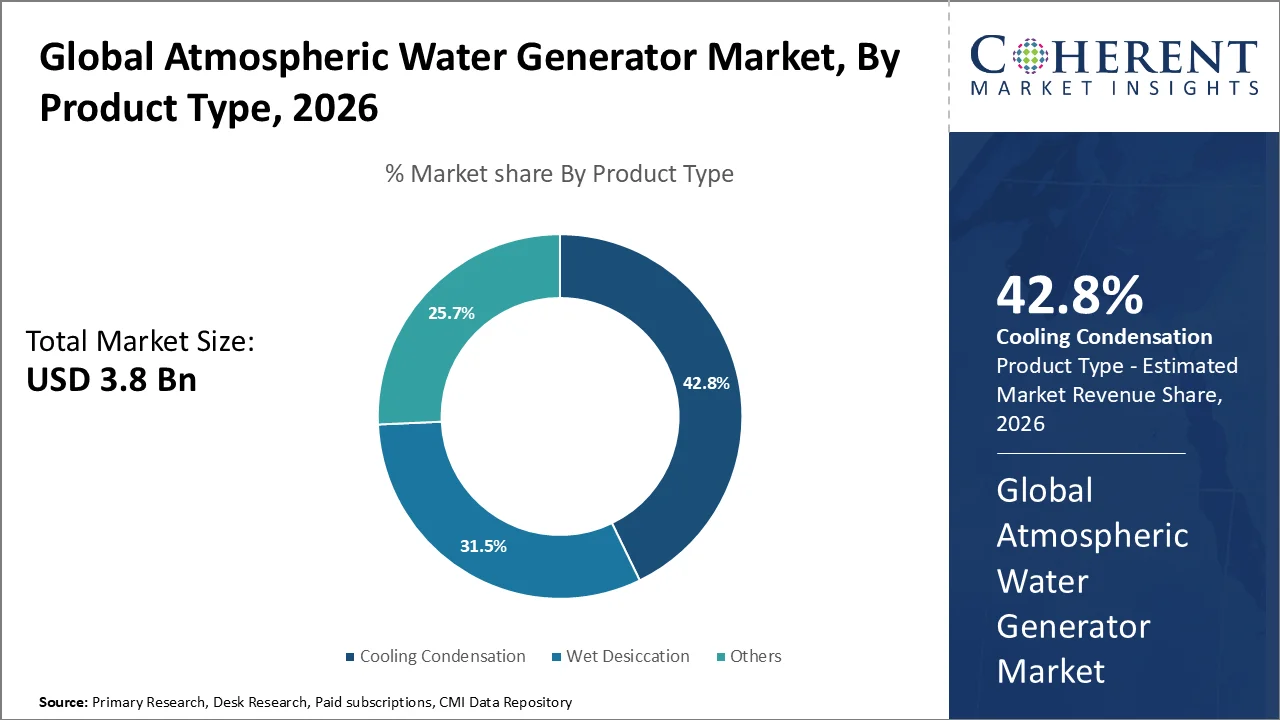
- Cooling Condensation hold the largest market share of 42.8% in 2026 owing to the increasing global water scarcity. Approximately 2.1 billion people worldwide lack access to safely managed drinking water services at home.
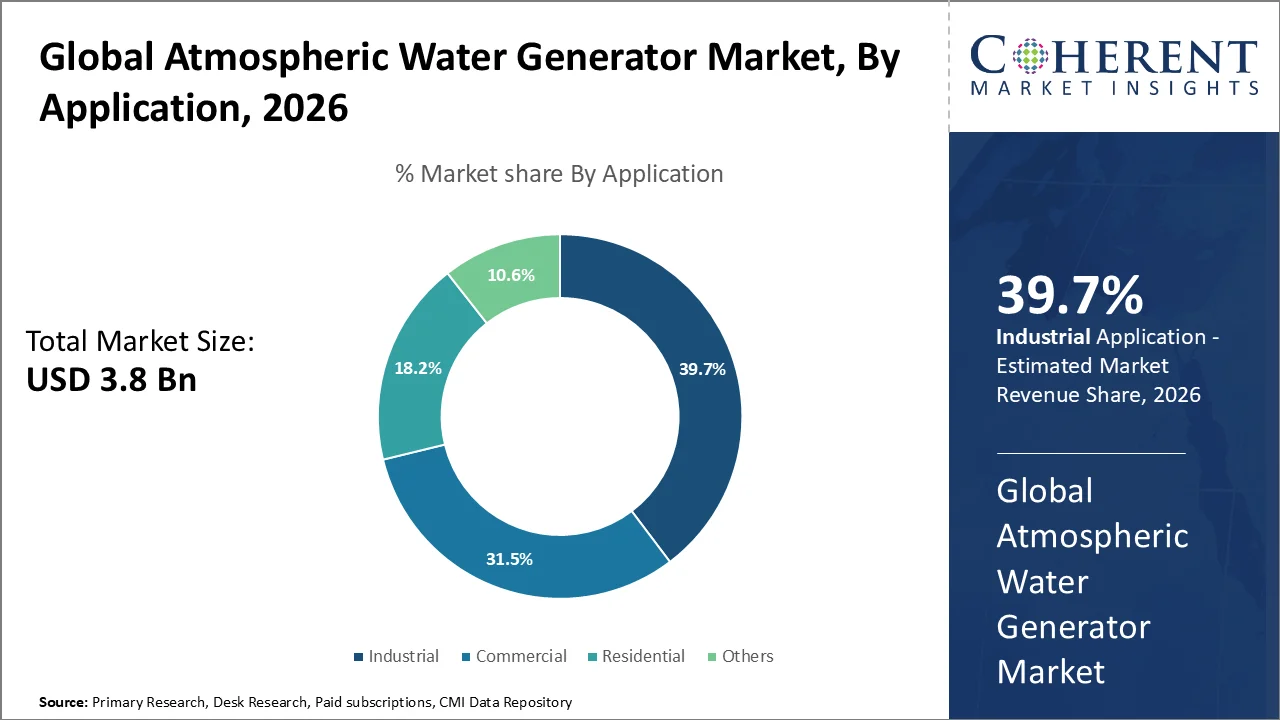
- Industrial expected to hold largest market share of 39.7% in 2026 owing to its increasing industrial water demand. According to India Renewable Energy Consulting, industrial activities account for approximately 10% of total water consumption in India, representing around 75 billion cubic meters of water annually. Source: India Renewable Energy Consulting
- 100-250L acquired the prominent market share of 43.3% in 2026 owing to the growing demand for medium-scale water solutions.
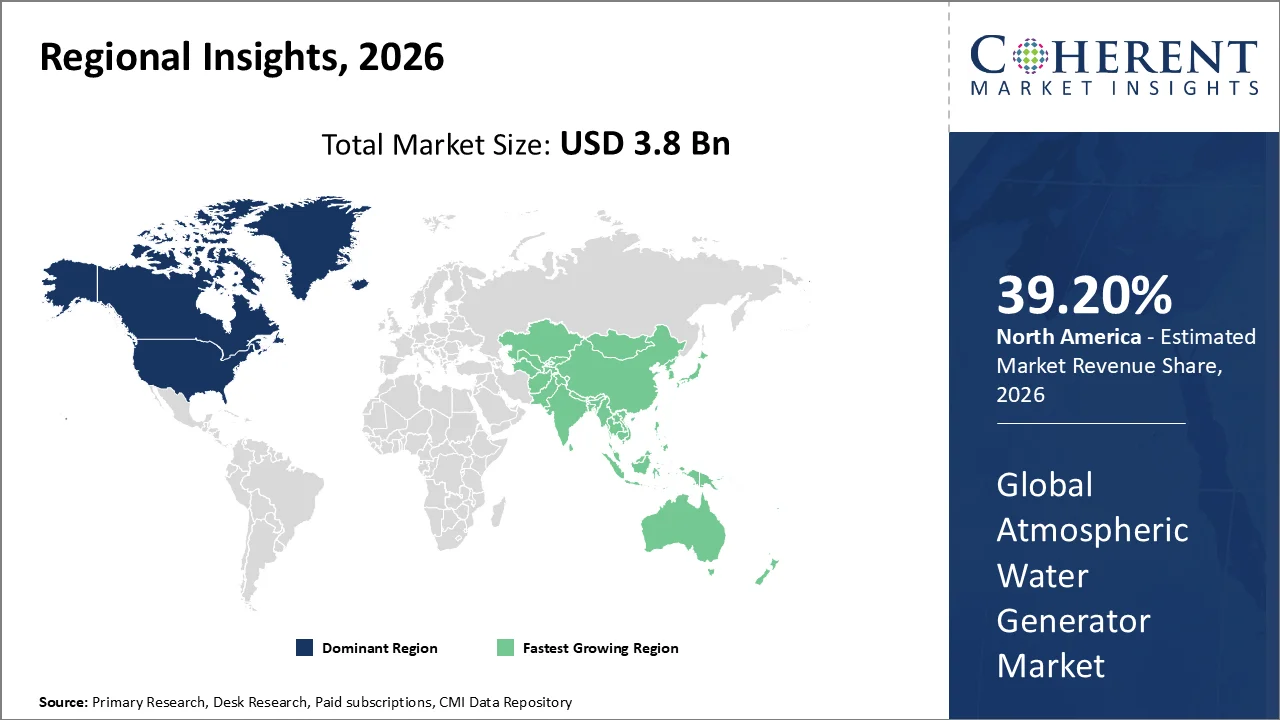
- North America is expected to acquire the dominant share of 39.2% in 2026 owing to its increasing adoption in commercial and industrial applications. The GEN-350 can produce up to approximately 600 liters of water per day under optimal temperature and humidity conditions.
Current Events and Their Impact
Current Event | Description and its Impact |
Increasing Global Water Stress and Rising Demand for Alternative Water Sources |
|
United Nations and Global Water Security Initiatives |
|
Segmental Insights
- Current Industry Events of 2026
- Market Size Estimation
- Regional Breakdown
- Competitive Landscape
- Customer Intelligence
- Segmental Analysis
- Pricing Analysis
- Key Market Drivers, Challenges & Future Trends
- Customized Insights Section
Why is Cooling Condensation Acquiring the Largest Market Share?
Cooling Condensation hold the largest market share of 42.8% in 2026. The cooling condensation segment of the Atmospheric Water Generator market is gaining momentum as increasing water scarcity, demand for decentralized water solutions, and adoption across residential, commercial, and industrial sectors drive growth. Manufacturers are improving refrigeration technologies, energy-efficient components, and moisture extraction systems to enhance AWG performance and reliability. Organizations are increasingly adopting cooling condensation AWGs to secure sustainable water sources, strengthen climate resilience, and reduce reliance on conventional water supplies, especially in water-stressed and remote areas. For instance, in April 2026, DREO launched its TurboCool Misting Fan lineup, introducing indoor misting fans with TurboCool Ultra Mist Technology that delivers effective cooling without dampness.
Industrial expected to hold largest market share
Industrial expected to hold largest market share of 39.7% in 2026 owing to its expansion of remote industrial operations. The industrial segment of the Atmospheric Water Generator market is growing as industries seek reliable water sources, expand operations, and address increasing water scarcity concerns. Companies are adopting AWG systems to minimize reliance on conventional water supplies, strengthen operational continuity, and achieve sustainability objectives. Manufacturers are developing energy-efficient technologies, high-capacity systems, and smart monitoring solutions that improve performance and encourage adoption across manufacturing, mining, healthcare, and other industrial sectors, especially in areas experiencing water supply challenges. For instance, in June 2026, AirJoule Technologies launched its Prime system, an atmospheric water extraction technology that uses proprietary materials to provide continuous water supply for industrial applications without traditional sources.
Which Range dominates the market?
100-250L acquired the prominent market share of 43.3% in 2026. The 100–250L capacity segment of the Atmospheric Water Generator market is expanding as consumers and organizations seek compact, efficient, and decentralized water-generation solutions for residential, small commercial, and institutional needs. Users are adopting these systems to overcome water quality issues, supply limitations, and the need for dependable on-site water production. Manufacturers are enhancing energy-efficient components, compact designs, and filtration technologies to improve system performance and accessibility, driving adoption across urban areas, offices, schools, and remote locations.
Atmospheric Water Generator Market Trends
- Rising demand for sustainable water solutions and decentralized water generation systems is accelerating the adoption of Atmospheric Water Generators (AWGs), enabling households, businesses, and industries to produce water on-site while reducing dependence on traditional water supply networks. According to WHO and UNICEF, 2.1 billion people worldwide lacked access to safely managed drinking water services at home as of 2022, highlighting the continued need for alternative and decentralized water solutions.
- Increasing global water scarcity, climate change impacts, and freshwater resource depletion drive demand for alternative water-generation technologies. According to the World Resources Institute (WRI), 25 countries, representing approximately one-quarter of the global population, face extremely high water stress annually, increasing pressure to develop resilient water supply solutions. Additionally, the United Nations estimates that around 4 billion people experience severe water scarcity for at least one month each year, reinforcing the need for innovative water-generation technologies.
- Expansion of commercial and industrial applications strengthens market growth, with hotels, healthcare facilities, manufacturing units, military installations, and disaster-response organizations adopting AWGs to ensure reliable water availability and improve operational resilience. The United Nations reports that industry accounts for approximately 19% of global freshwater withdrawals, emphasizing the growing importance of water-efficiency solutions across industrial sectors.
Regional Insights
North America dominates owing to technological advancements in AWG systems
North America is expected to acquire the dominant share of 39.20% in 2026. The North America Atmospheric Water Generator market is expanding as water scarcity, demand for sustainable water solutions, and the need for decentralized water-generation systems increase. Organizations are adopting AWGs to strengthen water security, minimize reliance on conventional water sources, and achieve environmental sustainability objectives. Manufacturers are enhancing energy-efficient technologies, smart monitoring systems, and renewable energy integration to improve system performance. Residential, commercial, industrial, and emergency response applications are driving greater adoption of AWG solutions across the region. For instance, Ahead of the Las Vegas Grand Prix, organizers launched a first-of-its-kind water conservation program to implement technologies that reduce and eventually offset outdoor water use at large-scale sporting events.
Asia Pacific Atmospheric Water Generator Market Trends
The Asia Pacific Atmospheric Water Generator Market gains momentum as consumers, businesses, and governments address rising water scarcity and seek sustainable drinking water solutions. Increasing awareness of clean water technologies, rapid urbanization, and industrial expansion encourage organizations to adopt alternative water sources. Manufacturers continue to enhance atmospheric water generation systems by improving technology and energy efficiency. Growing investments in water infrastructure also drive the adoption of these solutions across residential, commercial, and industrial sectors in the region. For instance, in November 2025, India launched its first atmospheric water generation-based bottled water initiative, producing clean drinking water from air through a zero-extraction, sustainable model.
United States Atmospheric Water Generator Market Trends
The United States Atmospheric Water Generator Market grows as consumers and industries seek sustainable water solutions, address rising water scarcity concerns, and adopt decentralized water supply systems. Residential, commercial, and industrial users increasingly implement advanced atmospheric water generation technologies, strengthening market expansion. Government programs that support water conservation, climate resilience, and clean water accessibility also promote adoption. Additionally, growing environmental awareness and recognition of the benefits of extracting water from the atmosphere continue to drive market development. For instance, Kubota Corporation launched a U.S. pilot program to demonstrate decentralized water infrastructure solutions for water-scarce and contaminated communities.
China Atmospheric Water Generator Market Trends
China’s atmospheric water generator market is being driven by growing concerns over water scarcity, environmental stress, and the need for decentralized clean water solutions. Rapid industrial expansion, urban population growth, and increasing demand for sustainable water sources are encouraging adoption across residential, commercial, and industrial sectors. Advancements in moisture extraction technology, energy efficiency, and smart monitoring systems are further improving product appeal. Government focus on water conservation and climate resilience is also supporting market development across diverse regions. China launched a project to strengthen and improve rural drinking water safety, supported by a total investment of RMB 24 billion.
Who are the Major Companies in Atmospheric Water Generator Industry
Some of the major key players in Atmospheric Water Generator are WaterMicronWorld, Dew Point Manufacturing, Watair Inc., Ambient Water, Saisons Technocom Pvt. Ltd., WaterMaker India Pvt. Ltd., Planets Water, Eurosport Active World Corporation Technologies, Atlantis Solar, Air2Water LLC, Konia, and Ecoloblue, Inc.
Key News
- In September 2025, Aeronero Solutions launched Aeronero 2.0, a next-generation air water generation system, in Bengaluru on September 4, 2025, showcasing India’s advancements in water technology.
Market Report Scope
Atmospheric Water Generator Market Report Coverage
| Report Coverage | Details | ||
|---|---|---|---|
| Base Year: | 2025 | Market Size in 2026: | USD 3.8 Bn |
| Historical Data for: | 2020 To 2024 | Forecast Period: | 2026 To 2033 |
| Forecast Period 2026 to 2033 CAGR: | 9.1% | 2033 Value Projection: | USD 6.4 Bn |
| Geographies covered: |
| ||
| Segments covered: |
| ||
| Companies covered: | WaterMicronWorld, Dew Point Manufacturing, Watair Inc., Ambient Water, Saisons Technocom Pvt. Ltd., WaterMaker India Pvt. Ltd., Planets Water, Eurosport Active World Corporation Technologies, Atlantis Solar, Air2Water LLC, Konia, and Ecoloblue, Inc. | ||
Analyst Opinion
- Atmospheric water generation is shifting from a niche sustainability concept to a strategic water security solution. The core market opportunity is not driven by environmental branding alone but by increasing pressure on freshwater availability. In China, regions facing uneven water distribution and rapid industrial activity are likely to accelerate interest in decentralized water generation technologies.
- Industrial and institutional demand will be the strongest adoption catalyst for atmospheric water generators in China. Water-intensive sectors such as electronics manufacturing, pharmaceuticals, and food processing require reliable high-quality water supplies. China’s semiconductor industry, for example, continues expanding production capacity, while semiconductor fabrication facilities require millions of liters of ultra-pure water daily. Atmospheric water generators can complement existing systems by providing localized supply and reducing dependence on stressed municipal resources.
- Technological improvements in energy efficiency and smart water management will determine market winners. Earlier atmospheric water generators faced limitations due to high power consumption and climate dependency, but newer systems using advanced condensation materials, IoT monitoring, and optimized refrigeration cycles are improving operational feasibility. China’s focus on energy-efficient technologies and carbon reduction targets is expected to favor manufacturers capable of delivering low-energy water harvesting solutions rather than conventional high-power units.
- The long-term opportunity in China’s atmospheric water generator market will depend on positioning the technology as critical infrastructure, not a premium sustainability product. Companies that demonstrate lower energy consumption, reliable output in varied humidity conditions, and integration with industrial water systems are more likely to gain adoption. The market’s success will be shaped less by consumer awareness and more by its ability to solve specific water security challenges for high-demand users.
Speak to the analyst
Want personalized insights?
Take the findings above to one of our principal consultants, or have the report rebuilt around the segments, geographies and competitors you actually track.
Market Segmentation
- By Product Type: (Revenue, USD Bn, 2021-2033)
- Cooling Condensation
- Wet Desiccation
- Others
- By Application: (Revenue, USD Bn, 2021-2033)
- Industrial
- Commercial
- Residential
- Others
- By Range: (Revenue, USD Bn, 2021-2033)
- 20L-80L
- 100L-250L
- 500-3000L
- By Region: (Revenue, USD Bn, 2021-2033)
- North America
- U.S.
- Canada
- Latin America
- Brazil
- Mexico
- Argentina
- Rest of Latin America
- Europe
- Germany
- U.K.
- France
- Italy
- Spain
- Russia
- Rest of Europe
- Asia Pacific
- China
- India
- Japan
- Australia
- South Korea
- ASEAN
- Rest of Asia Pacific
- Middle East
- GCC
- Israel
- Rest of Middle East
- Africa
- South Africa
- Central Africa
- North Africa
- North America
- Key Players
- WaterMicronWorld
- Dew Point Manufacturing
- Watair Inc.
- Ambient Water
- Saisons Technocom Pvt. Ltd.
- WaterMaker India Pvt. Ltd.
- Planets Water
- Eurosport Active World Corporation Technologies
- Atlantis Solar
- Air2Water LLC
- Konia
- Ecoloblue, Inc.
Sources
Primary Research interviews
- Industry executives and technology specialists involved in atmospheric water generation systems
- Manufacturers, suppliers, and distributors of atmospheric water generators
- Research and development professionals working on water harvesting technologies
- End users from residential, commercial, industrial, and institutional sectors
- Water management experts and sustainability professionals
- Government officials and regulatory representatives associated with water resources and environmental policies
Databases
- United Nations Water (UN-Water) databases
- World Bank water and development databases
- International Energy Agency (IEA) databases
- U.S. Geological Survey (USGS) water resources databases
- Food and Agriculture Organization (FAO) AQUASTAT database
- Government environmental and water resource databases
- Patent databases including WIPO and national intellectual property databases
- Trade and import-export databases
Magazines
- Water Technology Magazine
- WaterWorld Magazine
- Environmental Science & Technology News publications
- Renewable energy and sustainability-focused industry magazines
- Industrial automation and engineering magazines
- Climate and environmental technology publications
Journals
- Journal of Water Process Engineering
- Desalination and Water Treatment Journal
- Water Research Journal
- Environmental Science & Technology Journal
- Renewable and Sustainable Energy Reviews
- Applied Energy Journal
- International Journal of Environmental Research and Public Health
- Sustainability Journal
Newspapers
- The Guardian (Environment section)
- The New York Times (Climate and Environment section)
- The Washington Post (Climate and Science section)
- Reuters (Environment and Technology coverage)
- The Economic Times (Energy and Sustainability coverage)
- Business Standard (Industry and Infrastructure coverage)
- Government and regional newspapers covering water scarcity and climate initiatives
Associations
- International Water Association (IWA)
- American Water Works Association (AWWA)
- Water Environment Federation (WEF)
- International Desalination Association (IDA)
- World Water Council (WWC)
- International Association for Water Law (IAWL)
- American Society of Mechanical Engineers (ASME)
- International Society of Indoor Air Quality and Climate (ISIAQ)
Public Domain sources
- Government water resource reports and environmental publications
- United Nations climate and water reports
- World Health Organization (WHO) water quality publications
- Environmental Protection Agency (EPA) reports
- National water policy documents
- Climate change assessment reports
- Academic research repositories
- Open-access scientific publications
- Regulatory filings and publicly available company information
- Patent filings and technology disclosures
Proprietary Elements
- CMI Data Analytics Tool, and Proprietary CMI Existing Repository of information for last 10 years
Get access to 250+ pages report
Every segment, forecast, competitor profile and data table behind the analysis above — available for instant download.
- ESOMAR Member
- ISO 9001:2015 Certified
- D-U-N-S Registered
- GDPR & CCPA Compliant
Missing comfort of reading report in your local language? Find your preferred language:
Transform your Strategy with Exclusive Trending Reports
Frequently Asked Questions
The Atmospheric Water Generator market is primarily driven by increasing water scarcity, rising demand for decentralized water solutions, climate-related challenges, and the need for sustainable alternatives to traditional water supply systems.
An Atmospheric Water Generator extracts moisture from the air, condenses it into liquid water, and passes it through filtration and purification stages to produce clean drinking water.
Key adoption areas include residential buildings, offices, hospitality facilities, healthcare institutions, manufacturing plants, remote communities, and defense applications.
High energy requirements, dependence on atmospheric conditions, initial equipment costs, and limited awareness in developing regions remain key challenges.
China’s growing concerns around regional water shortages, industrial water demand, and environmental sustainability are creating opportunities for atmospheric water generation solutions.