

Ceramic Decal Market Size and Share Analysis- 2026 To 2033
The Ceramic Decal Market size is anticipated to grow at a CAGR of 4.9%, with USD 248.51 Mn in 2026, and is expected to reach USD 347.52 Mn in 2033. The primary drivers are largely defined by the rising demand for customized and decorative ceramic products, increasing consumption of tableware and household ceramics, growing applications of ceramic decals in sanitary ware and tiles, and wider adoption of advanced digital and screen-printing technologies for high-quality ceramic decoration. According to Confindustria Ceramica, Italian ceramic tile production increased 5.7% year-on-year to 390.9 Mn square meters in 2025, while total tile sales rose 2.3% to 386.9 Mn square meters.
Key Takeaways
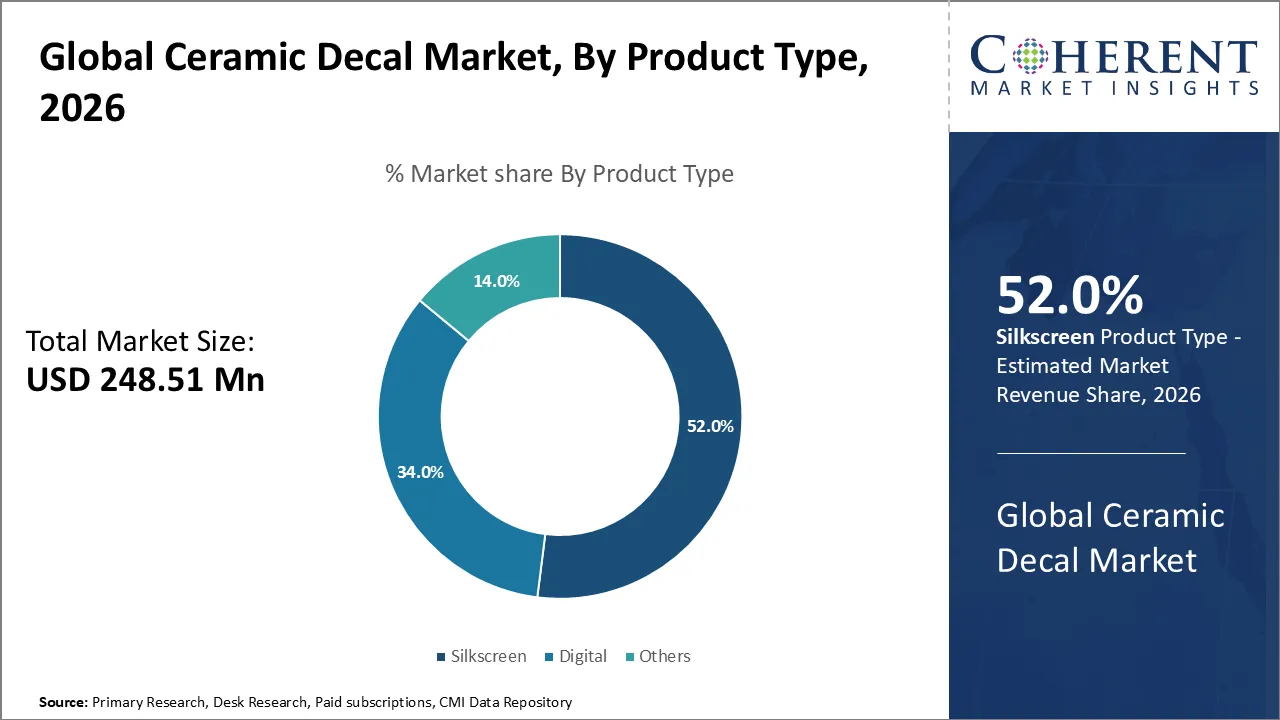
- The silkscreen segment is estimated to dominate the market with 52.0% in 2026. The segment’s leading position is owing to its established use in high-volume ceramic decoration, strong color consistency, durability after firing, suitability for standardized designs, and widespread installed manufacturing base across tableware, tiles, sanitary ware, and decorative ceramics. According to Confindustria Ceramica, the Italian ceramic industry in 2025 comprised 242 companies with revenues of approximately EUR 7.5 billion and 25,550 employees, illustrating the scale of the existing ceramic manufacturing infrastructure that supports both conventional and advanced decoration processes.
- The indirect application method segment is estimated to dominate the market with 48.0% in 2026. The segment’s growth is due to the ability of ceramic decals to transfer complex graphics onto irregular, curved, convex, and concave surfaces where direct printing can be difficult. In 2025, the Italian porcelain and ceramic tableware industry produced and sold some 9,600 tons of finished products, generating EUR 60 Mn in revenues, reflecting ongoing production activity in an important end-use sector for transfer-decoration technologies.
- The ceramic tiles segment is projected to dominate the application category with 42.0% in 2026. The segment’s growth is driven by the large production volume of wall and floor tiles, increasing demand for differentiated surface designs, adoption of decorative patterns and customized finishes, and sustained consumption of ceramic products in residential and commercial construction. In 2025, the production of ceramic tile in Spain grew by 2.7% to approximately 427 Mn square meters and the turnover of the sector reached some EUR 4.83 billion. This large production volume creates a large addressable base for ceramic surface-decoration and printing technologies.
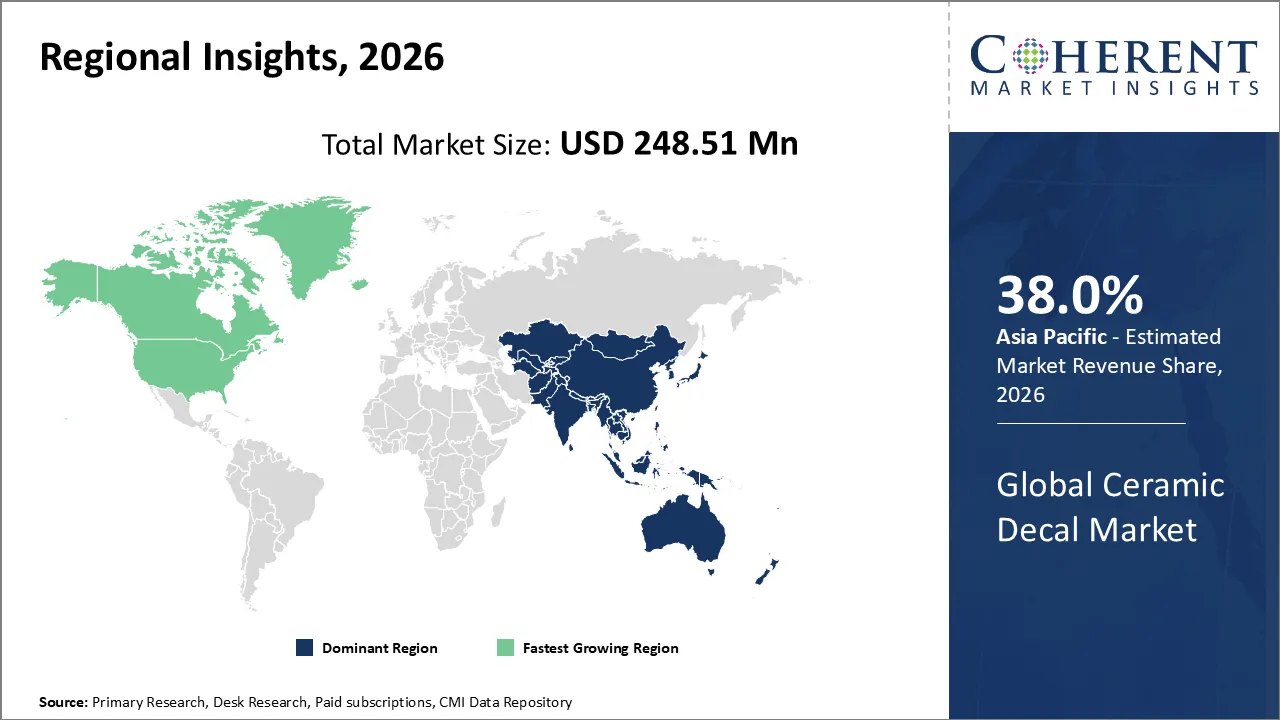
- Asia Pacific is expected to acquire the largest Ceramic Decal Market share of approximately 38.0% in 2026. The region’s dominance is owing to the large ceramic manufacturing base in China and India, high production of ceramic tiles and tableware, strong export-oriented manufacturing clusters, comparatively lower production costs, and increasing adoption of customized and digitally decorated ceramic products. According to China Customs data released by CeramBath in June 2025, China exported 42.98 Mn sqm of ceramic tiles in March 2025, an increase of 42.44% YoY, while export value increased 9.97% to USD 261 Mn.
Market Drivers
Growing Demand for Premium and Large-Format Ceramic Tiles is Supporting the Ceramic Decal Market
Growing demand for premium ceramic and porcelain tiles with unique colors, graphics, textures and surface finishes is driving the Ceramic Decal Market. Ceramic decoration lets manufacturers differentiate products with stone, marble, wood, geometric and custom visual effects, and as tile producers move toward higher-value product portfolios, decorative technologies become more important.
In February 2026, RAK Ceramics reported that its tile division revenue increased 1.9% year-on-year to AED 1.89 billion in 2025, compared with AED 1.86 billion in 2024. The company specifically attributed the performance partly to growing demand for large-format porcelain tiles and a higher contribution from project-based business.
Current Events and Their Impact on the Ceramic Decal Market
Current Event | Description and its Impact |
Netherlands Introduces Stricter Lead and Cadmium Migration Limits for Decorated Ceramic Food-Contact Products (2026) |
|
European Commission Moves to Revise EU ETS Rules as Ceramic Producers Face New Carbon-Cost Benchmarks (2026) |
|
- Current Industry Events of 2026
- Market Size Estimation
- Regional Breakdown
- Competitive Landscape
- Customer Intelligence
- Segmental Analysis
- Pricing Analysis
- Key Market Drivers, Challenges & Future Trends
- Customized Insights Section
Segmental Insights
Why is Silkscreen Acquiring the Largest Share?
On the basis of product type, the silkscreen segment is estimated to account for the largest Ceramic Decal Market share of 52.0% in 2026. The segment’s dominance is owing to its established use in mass-production ceramic decoration, strong opacity and color density, precise registration of multiple solid colors, compatibility with specialty ceramic pigments, and suitability for long production runs across tableware, tiles, sanitary ware, glass, and decorative ceramics.
Industrial equipment supplier SPS TechnoScreen describes ceramic decal manufacturing as a typical screen-printing application involving multiple solid colors printed in close registration. The company currently reports an installed base of more than 1,000 SPS printing units within the ceramic decal industry, with some machines operating for more than 20 years. Its ceramic decal presses can operate at speeds of up to approximately 1,600 impressions per hour.
Why is the Indirect Application Method Acquiring the Largest Share?
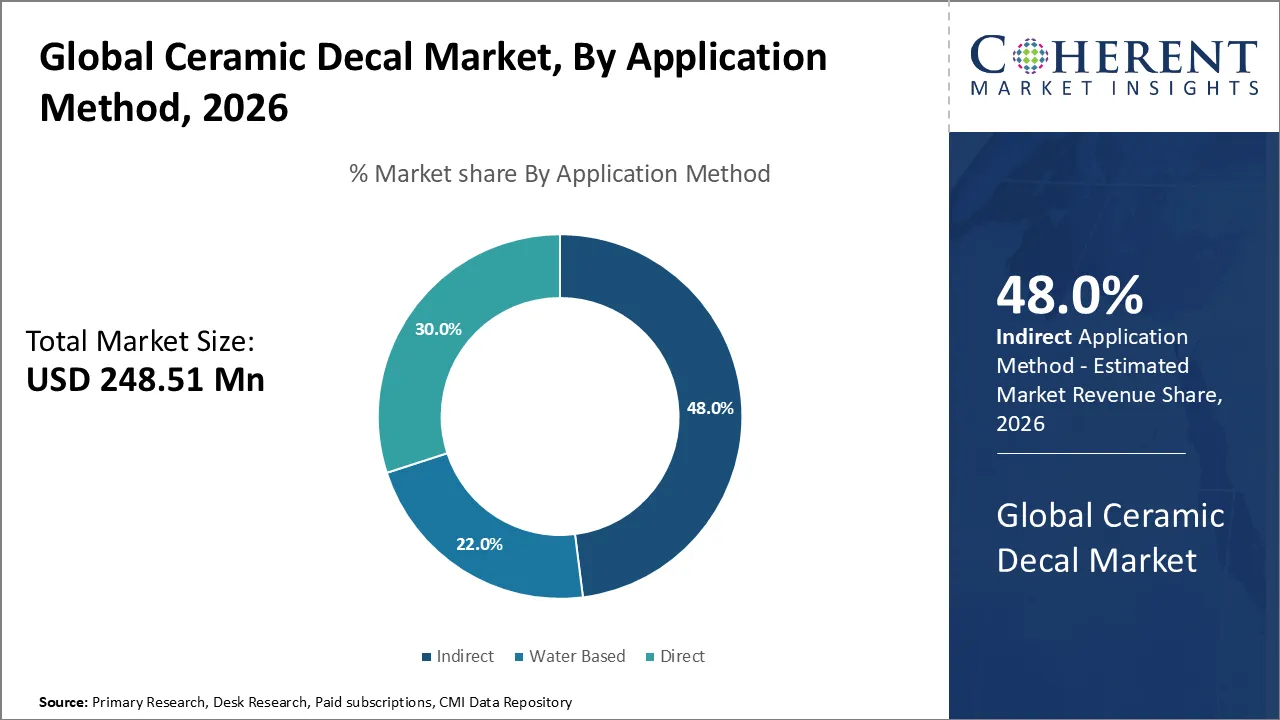
On the basis of application method, the indirect application method segment is estimated to lead the Ceramic Decal Market with 48.0% in 2026. The segment’s dominance is primarily owing to the ability of transfer decals to decorate curved, irregular, concave, and complex ceramic surfaces that can be difficult to print directly. The method also enables manufacturers to prepare designs separately before transferring and firing them onto finished ceramic products, providing greater flexibility for customized and multicolor decoration.
According to Noritake Itron, the use of decal-transfer technology allows for decoration on curved surfaces and on materials that do not allow direct printing, as well as supporting ceramic, enamel, glass, resin and metal applications. This technical advantage is particularly important for cups, bowls, plates, sanitary ware and other three-dimensional ceramic products.
In June 2025, Hosen Home announced it would introduce a new line of ceramic tableware featuring decal-transfer decoration at the HouseHold Expo 2025, to be held in Moscow September 9-11, 2025.
Why are Ceramic Tiles Acquiring the Largest Application Share?
On the basis of application, the ceramic tiles segment is estimated to account for the largest Ceramic Decal Market share of 42.0% in 2026. The segment’s dominance is owing to the enormous global production base for wall and floor tiles, frequent introduction of new surface designs, growing demand for marble-, stone-, wood-, and textile-inspired finishes, and the need for decorative differentiation across residential and commercial construction.
According to Mohawk Industries’ 2025 Form 10-K, the Global Ceramic segment generated net sales of USD 4.29 billion in 2025, accounting for about 40% of Mohawk's total USD 10.79 billion revenue. Ceramic and stone products accounted for USD 4.22 billion in sales in 2025, an increase from USD 4.17 billion in 2024.
In March 2026, EeasyTile Wholesale Limited launched a new home tile collection comprising ceramic, porcelain, textured, and large-format surfaces for residential and commercial applications.
Ceramic Decal Market Trends
- Growing consumer preference toward customized and branded ceramic tableware is driving the demand for ceramic decals that can replicate company logos, signature motifs, artwork, and complex multicolor patterns. PATRA Porcelain sharpened its focus in September 2026 on custom decal tableware for hotels, restaurants, cafes, retail brands and corporate projects, pointing to decals as a practical way to integrate brand recognition directly into porcelain products.
- Increased use of digital ceramic decoration allows for shorter production runs, faster design changes, accurate color control and greater customization. At the 139th Canton Fair in April 2026, WWS Group launched a 16-piece “Fern Shadow” porcelain dinnerware set with digital inkjet decoration. The technology fuses reactive-glaze appearance, embossed effects and underglaze-style durability in a single firing process, doing away with the multiple decoration steps required by traditional methods.
- The rising demand for lead-free and cadmium-free ceramic decoration is encouraging decal and ceramic-color suppliers to develop safer formulations suitable for food-contact tableware. WWS Group's newly introduced Fern Shadow collection is lead- and cadmium-free and designed to comply with EU, U.S. FDA, and California Proposition 65 requirements. This trend is increasing the importance of low-metal-release pigments and compliant ceramic decal formulations.
Regional Insights
Asia Pacific Dominates Owing to its Large Ceramic Manufacturing Base and Established Decoration Ecosystem
The Asia Pacific region accounts for approximately 38.0% of the Ceramic Decal Market share in 2026. The region’s dominance is owing to the large-scale production of ceramic tiles, tableware, sanitary ware, and decorative ceramics in China and India, coupled with established decal, pigment, ink, and ceramic-printing supply chains. The availability of cost-efficient manufacturing capabilities and growing demand for customized ceramic products are further strengthening regional decal consumption.
According to China's National Public Service Platform for Standards, China produced approximately 5.91 billion square meters of ceramic tiles in 2024, while the country had 993 above-designated-size architectural ceramic enterprises and 2,193 ceramic production lines.
North America Ceramic Decal Market Trends
North America is expected to emerge as the fastest-growing region in the Ceramic Decal Market over the forecast period. The region’s growth is owing to rising demand for personalized and premium ceramic products, rapid introduction of design-focused tile collections, greater adoption of digitally assisted decoration, and a large distribution network for imported ceramic tiles and decorative surfaces.
According to the Tile Council of North America (TCNA), U.S. ceramic tile consumption totaled 2.57 billion square feet in 2025, while imports reached approximately 1.86 billion square feet and represented 72.4% of total U.S. ceramic tile consumption, compared with 71.5% in 2024. The high penetration of globally sourced tiles provides a broad addressable base for differentiated graphics, decorative finishes, ceramic transfers, and decal-based product customization.
In March 2026, Coverings 2026, North America's largest international tile and stone exhibition, showcased exhibitors from nearly 40 countries, demonstrating the ongoing influx of new designs, surface technologies, and decorative ceramic products into the North American marketplace.
Strong Construction Activity and Demand for Design-Led Ceramic Surfaces are Supporting the Ceramic Decal Market in the United States
The U.S. Ceramic Decal Market is experiencing stable growth driven by rising demand for decorative and customized ceramic products, ongoing residential and commercial renovation work, and growing consumer preference for ceramic surfaces that imitate natural stone, wood, artistic patterns, and customized designs. The trends are driving tile and tableware manufacturers to increase the use of advanced surface decoration, ceramic transfers and specialized decal technologies.
Product launches also bear witness to the increasing focus on highly decorative ceramic surfaces. In June 2026, Floor & Decor launched NatureMatch with 99 products in porcelain tile, luxury vinyl plank and waterproof laminate. The collection seeks to recreate the authentic look of stone and wood for floors, walls and countertops.
China Ceramic Decal Market Trends
China is a major hub for both production and supply within the Ceramic Decal market. This is due to the country’s extensive ceramic manufacturing ecosystem, a large export-oriented tile and tableware industry, a well-established supply chain for pigments and printing materials, and increasing investment in automated and digitally controlled ceramic production.
China's ceramic producers are also accelerating manufacturing modernization. In March 2026, New Pearl Group Commissioned Phase II of its Digital Demonstration Factory in Foshan, Guangdong. The project replaced production infrastructure that had operated for more than 20 years and consolidated five traditional kilns into two intelligent production lines, while integrating automated inspection, smart warehousing, flexible manufacturing, and energy-saving technologies
Who are the Major Companies in Ceramic Decal Industry
Some of the major key players in Ceramic Decal Market are Stechcol Ceramic Crafts Development (Shenzhen) Co., Ltd, Bailey Decal Limited, Leipold International GmbH, Tullis Russell Group Ltd, Bel Inc., Design Point Decal, Inc.
Key News
- In April 2026, Tullis Russell announced an expansion of its manufacturing capabilities through its £13 million Coater 4 investment at the company's Bollington facility. The three-story coating system incorporates curtain and gravure coating and can apply aqueous as well as highly viscous coatings to paper and film substrates.
- In August 2026, Stechcol Ceramic Crafts Development (Shenzhen) Co., Ltd. was featured by Longgang Government as part of a new industrial and cultural tourism initiative highlighting the integration of advanced manufacturing with traditional porcelain craftsmanship.
Market Report Scope
Ceramic Decal Market Report Coverage
Report Coverage | Details | ||
Base Year: | 2025 | Market Size in 2026: | USD 248.51 Mn |
Historical Data for: | 2020 to 2024 | Forecast Period: | 2026 to 2033 |
CAGR: | 4.9% | 2033 Value Projection: | USD 347.52 Mn |
Geographies covered: |
| ||
Segments covered: |
| ||
Companies covered: | Stechcol Ceramic Crafts Development (Shenzhen) Co., Ltd, Bailey Decal Limited, Leipold International GmbH, Tullis Russell Group Ltd, Bel Inc., Design Point Decal, Inc. | ||
Growth Drivers: |
| ||
Restraints & Challenges: |
| ||
Analyst Opinion
- The Ceramic Decal Market is expected to remain structurally supported by the large global ceramic tile manufacturing and consumption base, particularly across emerging Asian economies. While direct digital printing is gaining penetration in high-volume tile manufacturing, decals continue to retain importance for customized designs, specialty decoration, tableware, irregular ceramic surfaces, and applications requiring flexible transfer printing. According to the MECS Research Center, ceramic tile consumption in Asia-Far East is projected to reach approximately 10.8 billion square meters by 2028, growing at an average annual rate of 1.8%, while regional production is projected to reach 11.6 billion square meters.
- Technology adoption is likely to create a more hybrid ceramic decoration market rather than completely replaces conventional decal technologies. Large tile manufacturers are increasingly adopting integrated digital systems for high-volume surface graphics, while screen-printed and transfer decals remain well suited to tableware, customized products, multicolor specialty decoration, and complex three-dimensional ceramic surfaces. In February 2025, SACMI reported that more than 200 Continua+ ceramic production lines had been sold globally, while its newly introduced Hyper-Speed configuration can exceed 30,000 square meters of ceramic tiles and slabs per day. SACMI is also integrating surface and in-body digital decoration to reproduce marble-, stone-, and wood-like effects.
- Sustainability and manufacturing efficiency are expected to become increasingly important competitive factors for ceramic decal and decoration suppliers. Ceramic manufacturers are seeking lower-emission inks, energy-efficient firing, reduced material losses, and environmentally improved printing systems as energy and environmental compliance costs increase. SACMI currently states that optimized ceramic production technologies can provide annual gas savings of up to 20% and electricity savings of up to 14%, while its ceramic printer portfolio is designed to operate with water-based inks and materials.
Speak to the analyst
Want personalized insights?
Take the findings above to one of our principal consultants, or have the report rebuilt around the segments, geographies and competitors you actually track.
Market Segmentation
- By Product Type (Revenue, USD Mn, 2021-2033)
- Silkscreen
- Digital
- Others
- By Application Method (Revenue, USD Mn, 2021-2033)
- Water Based
- Direct
- Indirect
- By Application (Revenue, USD Mn, 2021-2033)
- Tableware
- Sanitary Ware
- Ceramic Tiles
- Others
- By Region (Revenue, USD Mn, 2021-2033)
- North America
- U.S.
- Canada
- Latin America
- Brazil
- Mexico
- Argentina
- Rest of Latin America
- Europe
- Germany
- U.K.
- France
- Italy
- Spain
- Russia
- Rest of Europe
- Asia Pacific
- China
- India
- Japan
- Australia
- South Korea
- ASEAN
- Rest of Asia Pacific
- Middle East
- GCC
- Israel
- Rest of Middle East
- Africa
- South Africa
- Central Africa
- North Africa
- North America
Sources
Primary Research Interviews
- Ceramic decal manufacturers and transfer-printing specialists
- Ceramic tile, tableware, and sanitary ware manufacturers
- Ceramic pigment, frit, glaze, and ink suppliers
- Screen-printing and digital ceramic printing equipment manufacturers
- Ceramic decorators and contract decal printing companies
- R&D and product development heads from ceramic manufacturers
- Distributors and suppliers of ceramic decoration materials
- Procurement managers from tableware, hospitality, tile, and sanitary ware companies
- Ceramic printing and surface-decoration technology experts
Databases
- UN Comtrade Database
- International Trade Centre (ITC) Trade Map
- World Bank
- Organisation for Economic Co-operation and Development (OECD)
- Eurostat
- U.S. Census Bureau
- General Administration of Customs of China
- European Commission – Access2Markets
Magazines
- Ceramic World Review
- Tile International
- Ceramic Industry
- Ceramic Applications
- Glass International
- Screen Printing Magazine
Journals
- Ceramics International
- Journal of the European Ceramic Society
- Journal of the American Ceramic Society
- International Journal of Applied Ceramic Technology
- Journal of Asian Ceramic Societies
- Applied Surface Science
- Journal of Materials Processing Technology
Newspapers
- Reuters
- Financial Times
- The Wall Street Journal
- The Economic Times
- Business Standard
- South China Morning Post
Associations
- Cerame-Unie – European Ceramic Industry Association
- Confindustria Ceramica
- Spanish Ceramic Tile Manufacturers’ Association (ASCER)
- Tile Council of North America (TCNA)
- China Building Ceramic & Sanitaryware Association
- Indian Council of Ceramic Tiles and Sanitaryware (ICCTAS)
- British Ceramic Confederation (BCC)
- American Ceramic Society (ACerS)
- ASTM International – Ceramic and Glass Standards
Public Domain Sources
- Company annual reports, financial statements, and investor presentations
- Ceramic decal and transfer manufacturer product catalogs
- Ceramic tile and tableware manufacturer technical publications
- Government customs and international trade statistics
- Government construction and manufacturing statistics
- Patent databases including WIPO, USPTO, and Google Patents
- Technical datasheets for ceramic pigments, inks, frits, and glazes
- Food-contact ceramic regulations covering lead and cadmium migration
- Environmental regulations governing ceramic firing, emissions, and heavy metals
- Trade association production, sales, export, and consumption statistics
Proprietary Elements
- CMI Data Analytics Tool
- Proprietary CMI Existing Repository of Information for the Last 10 Years
Get access to 250+ pages report
Every segment, forecast, competitor profile and data table behind the analysis above — available for instant download.
- ESOMAR Member
- ISO 9001:2015 Certified
- D-U-N-S Registered
- GDPR & CCPA Compliant
Missing comfort of reading report in your local language? Find your preferred language:
Transform your Strategy with Exclusive Trending Reports
Frequently Asked Questions
The Ceramic Decal Market is expected to reach USD 347.52 Mn in 2033, compared with USD 248.51 Mn in 2026.
Major players operating in the global Ceramic Decal Market include Stechcol Ceramic Crafts Development (Shenzhen) Co., Ltd, Bailey Decal Limited, Leipold International GmbH, Tullis Russell Group Ltd, Bel Inc., and Design Point Decal, Inc.
The high investment cost for advanced ceramic printing and decal production equipment and rising raw material and specialty pigment costs are the key factors hampering growth of the Ceramic Decal Market.
The increasing demand for customized and decorative ceramic tableware and expansion of ceramic colors, glazes, and surface-decoration materials are key factors driving growth of the Ceramic Decal Market. Rising demand for premium ceramic tiles and greater adoption of advanced digital ceramic decoration are also supporting market growth.
The Ceramic Decal Market is anticipated to grow at a CAGR of 4.9% between 2026 and 2033.
Among regions, Asia Pacific is expected to account for the largest Ceramic Decal Market share, with approximately 38.0% in 2026. The region’s dominance is supported by its large ceramic manufacturing base, particularly in China and India, and established decal, pigment, ink, and ceramic-printing supply chains.
North America is expected to emerge as the fastest-growing region over the forecast period, supported by increasing demand for personalized and premium ceramic products, greater adoption of digitally assisted decoration, and a large distribution network for ceramic tiles and decorative surfaces.