

Coffee Beauty Products Market Size and Share Analysis – (2026-2033)
The Coffee Beauty Products Market size is projected to witness a CAGR of 3.1%, achieving a market value of USD 740 Mn in 2026 and expected to reach USD 916 Mn by 2033. The major factors contributing to the growth include the increasing preference among consumers for natural and organic beauty products, increasing demands for caffeine-based skincare products, increased consumer awareness regarding coffee as an active ingredient in antioxidants and anti-aging products, and increasing trends of clean beauty around the world. In March 2025, as per NSF, 74% of the consumers believed that the presence of organic ingredients was important in their personal care products.
Key Takeaways
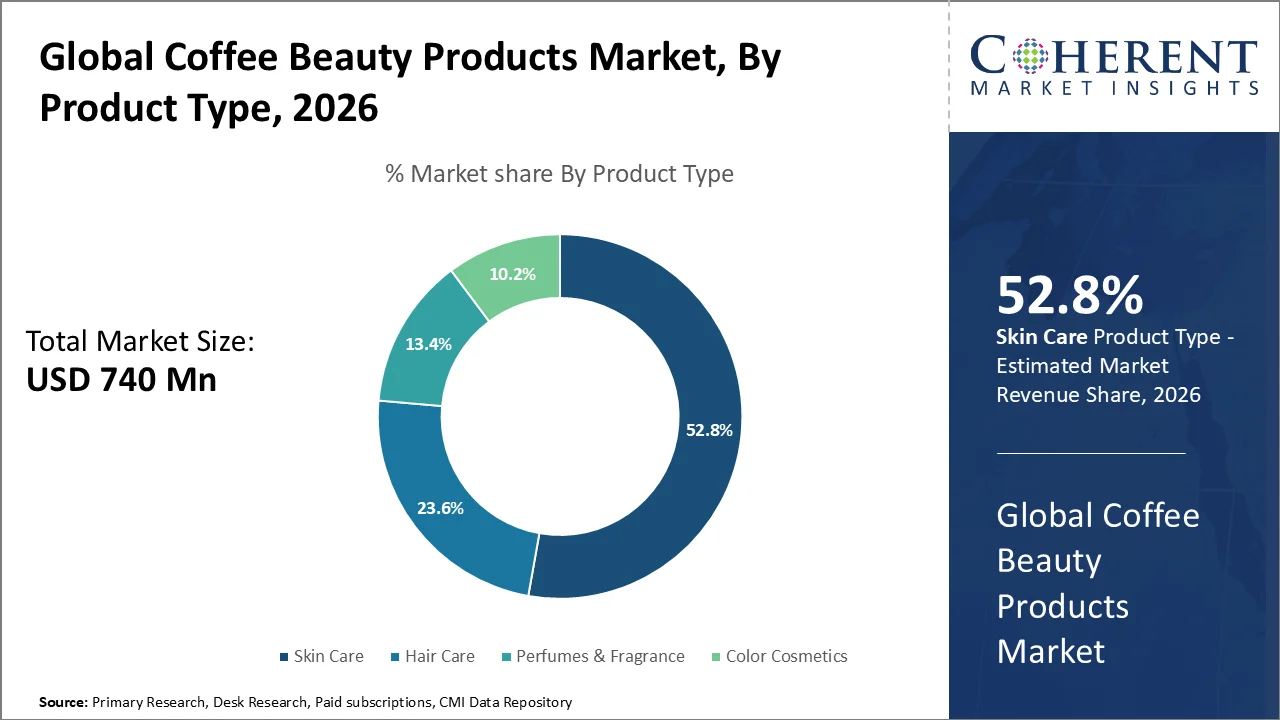
- The skin care segment is likely to dominate the Coffee Beauty Products Market with 52.8% in 2026. The segment’s growth is owing to the increasing incorporation of coffee extract, caffeine, coffee oil, and ground coffee particles in facial scrubs, body exfoliators, serums, eye creams, masks, and anti-cellulite formulations. In May 2026, Circana reported that face creams, serums, and eye treatments accounted for the majority of U.S. prestige skincare category growth, while clinical skincare brands captured more than one-third of skincare dollar sales, highlighting strong demand for efficacy-focused and science-backed formulations.
- The online channel subsegment will command the highest market share of 35.6% within the distribution channel segment in 2026. The growth witnessed in the online channel subsegment will be due to the increasing number of DTC beauty products for coffee, easy access to niche and clean label products, availability of information about the ingredients, consumer reviews, personalized recommendations, and social media influencer-led product discovery. According to NielsenIQ, in October 2025, the beauty products sold online grew nine times faster than those sold offline, with online sales growing at 21%, 20%, and 10% in North America, Asia Pacific, and Europe, respectively.
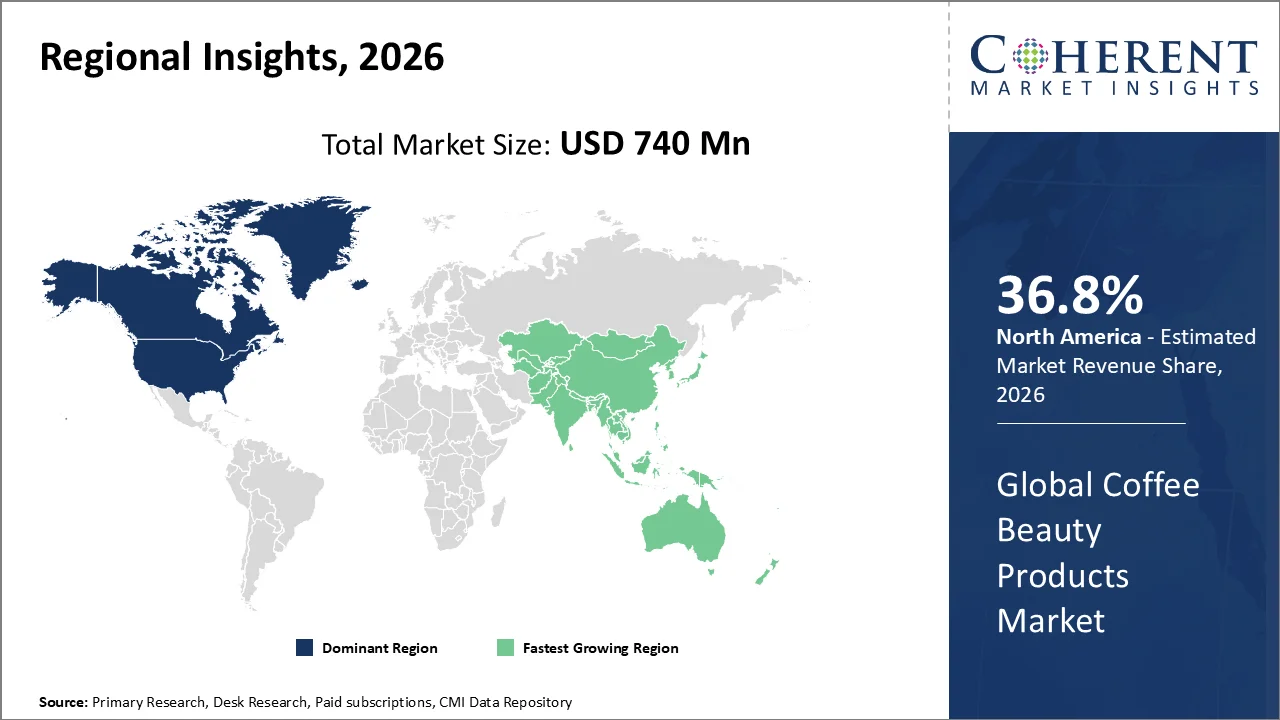
- North America is anticipated to account for a market share of 36.8% of the global Coffee Beauty Products Market in 2026. The leadership in the North American region is driven by high consumer spending on luxury skincare products, strong penetration of naturally made beauty formulations, wide consumer awareness regarding the use of coffee ingredients, and availability of specialist retail outlets, direct to consumer brands and online stores. According to the National Coffee Association cited in September 2025, 66% of adults in the US were daily consumers of coffee, while the consumption of specialty coffee stood at a record 48%.
Market Drivers
Scientific Validation of Coffee Bioactives Is Accelerating Product Development
Coffee Beauty Products Market is gaining traction as the scientific community’s evidence is building up to the rationale behind the use of caffeine, chlorogenic acids, flavonoids, coffee seed oil, and other components derived from coffee. The said ingredients have started to be examined for their applications as antioxidants, anti-inflammatories, moisturizers, photoprotection, anti-aging, hair, and skincare agents. In a 2026 review, it was observed that the concentration of coffee-derived products used for various studies on pre-clinical topical applications varied between 0.01% and 5.0% (w/v).
In February 2026, Rhode released the Caffeine Reset Sculpting Cream Mask that contains caffeine in high amounts and is meant to make puffiness less apparent and to lift and refresh tired-looking skin.
Rising Preference for Effective and Naturally Derived Skincare Is Increasing Product Adoption
The desire of consumers to have cosmetics containing ingredients that they can recognize as well as those that work has spurred the use of coffee as an ingredient for making beauty formulations. Ingredients like coffee and caffeine are highly recognized by consumers and can be used to market products on issues such as puffiness, dullness, skin texture, dehydration, cellulite, and aging.
According to YouGov, a survey conducted in September 2025 involving 2,095 adults from the United Kingdom showed that 60% of the respondents had bought skin care products for themselves in the last 12 months. For 47% of skin care product buyers, proven effectiveness was the key factor in buying, whereas 14% of buyers were interested in products containing natural or 'clean' ingredients. Therefore, just being natural is not enough.
Current Events and Their Impact on the Coffee Beauty Products Market
Current Event | Description and its Impact |
U.S. FDA Expands MoCRA Cosmetics Oversight and Product-Listing Requirements (May 2026) |
|
EU Deforestation Regulation Introduces Traceability Requirements for Covered Coffee Inputs (March 2026 Update) |
|
- Current Industry Events of 2026
- Market Size Estimation
- Regional Breakdown
- Competitive Landscape
- Customer Intelligence
- Segmental Analysis
- Pricing Analysis
- Key Market Drivers, Challenges & Future Trends
- Customized Insights Section
Segmental Insights
Why Is Skin Care Acquiring the Largest Share?
On the basis of product type, the skin care segment is projected to account for the largest Coffee Beauty Products Market share of 52.8% in 2026. The segment’s leadership is attributable to the extensive incorporation of caffeine, coffee seed oil, coffee extracts, chlorogenic acids, and ground coffee particles in facial serums, eye creams, moisturizers, masks, body scrubs, anti-cellulite creams, and skin-revitalizing treatments. Coffee-derived ingredients are particularly suitable for skin care because they can support antioxidant, exfoliating, moisturizing, depuffing, and appearance-enhancing product positioning.
According to Cosmetics Europe’s 2025 market data, skin care was the largest cosmetics and personal-care product category in Europe, generating €32.3 billion in retail sales. This was considerably higher compared to hair care at €20.3 billion, fragrances and perfumes at €17.1 billion, and decorative cosmetics at €13.6 billion, thus highlighting the significant commercial potential of the skin care market.
In February 2026, L’Oréal announced that the Dermatological Beauty segment achieved €7.20 billion in revenues for 2025, marking a growth of 5.5%. Continued expansion of products that have a clinical position and ingredient-centric skin care presents potential for coffee beauty brands with functional benefits.
Why Are Online Channels Holding the Largest Market Share?
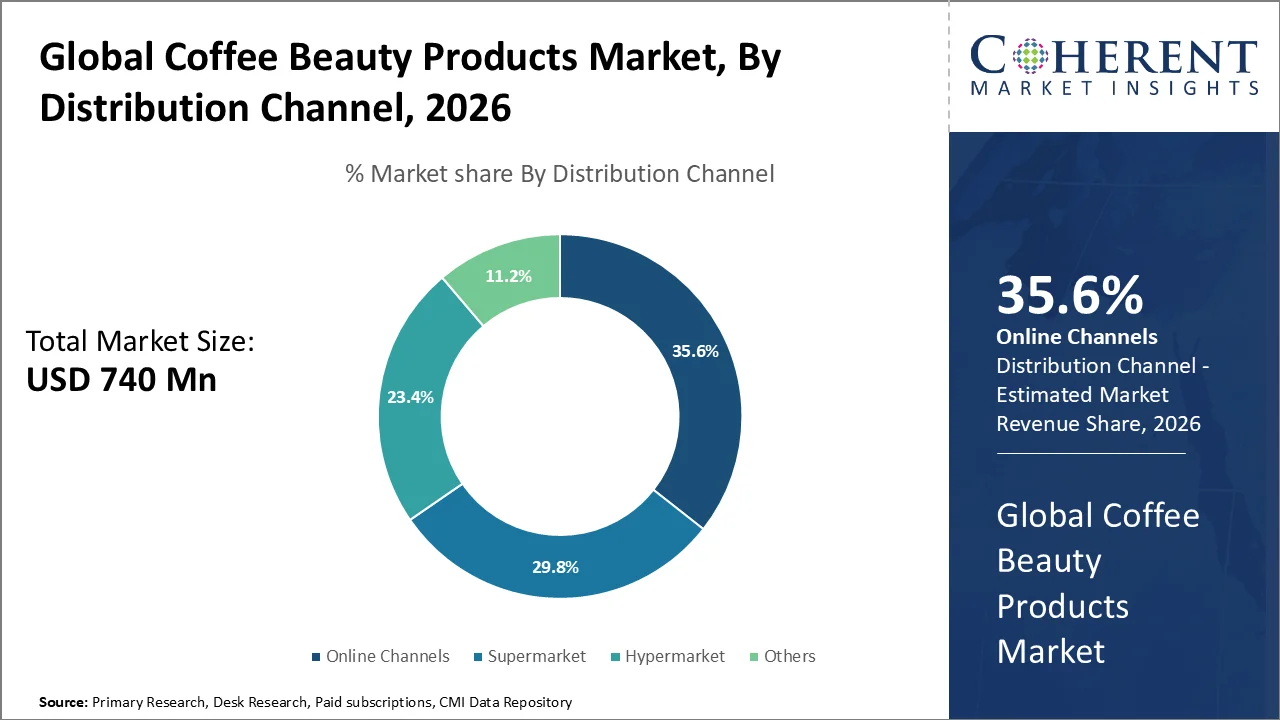
On the basis of distribution channel, the online channels segment is expected to lead the Coffee Beauty Products Market with 35.6% in 2026. The segment’s growth is driven by the strong digital presence of niche and direct-to-consumer coffee beauty brands, wider access to specialty products, detailed ingredient information, customer reviews, influencer-led discovery, subscription purchasing, and convenient product comparison. Online marketplaces also enable emerging brands to reach consumers without establishing extensive physical retail networks.
According to NielsenIQ, global beauty e-commerce value sales grew by 18% in 2025, significantly surpassing growth in offline markets. Additionally, NielsenIQ pointed out that the process of product research and analysis is done through social networks, marketplaces, beauty apps, and various other digital channels before visiting brick-and-mortar stores.
In March 2026, PEP Brands, the parent company of coffee-based personal-care brand mCaffeine, reported a 23% increase in operating revenue to ₹237.5 crore in FY2025, while its net loss narrowed by 81% to ₹17.6 crore. mCaffeine distributes its coffee-infused face washes, body scrubs, hair-care products, and other personal-care offerings primarily through its direct website, online marketplaces, and quick-commerce platform.
Coffee Beauty Products Market Trends
- Green extraction methods are improving the efficiency of isolating ingredients for cosmetics from coffee. Some of these methods include subcritical water, high pressure CO2, ultrasonic, microwave, and supercritical fluid extractions that are making it easier to isolate caffeine and phenols without having to employ organic solvents. In a March 2025 Scientific Reports publication, researchers extracted 230.13 mg GAE/g dry weight of phenols and 32.63 µmol TE/g of antioxidants from coffee cherry pulps by subcritical water and carbon dioxide extractions.
- Scalp and hair care products containing caffeine have increased the scope of the market from regular body scrubbers. Caffeine-containing hair care products are gaining popularity because of the ability of caffeine to penetrate into the body through hair follicles. According to the scientific research article published in January 2025, caffeine can remain inside hair follicles for 48 hours, whereas satisfaction rate from the therapy of study subjects is 67% to 100%.
- Increased interest in natural and biodegradable exfoliating agents has been associated with increased utilization of spent coffee grounds for cosmetic purposes. Particles of coffee have been designed as substitutes for synthetic abrasives used in body and face scrubs. According to an estimate presented in February 2025, around 6 million tonnes of spent coffee grounds are produced worldwide every year. Stable coffee-based scrub formulations consisting of particles with size 150-300 microns were obtained, and selected formulations were found to be stable during 60 days of observation.
Regional Insights
North America Dominates Owing to Its Large Beauty Industry and Strong Product-Innovation Ecosystem
North America is expected to account for the largest share of the global Coffee Beauty Products Market at 36.8% in 2026. The region’s leadership is attributable to high consumer spending on functional skincare, the early adoption of ingredient-led beauty products, strong demand for premium and natural formulations, and the presence of extensive research, manufacturing, retail, and direct-to-consumer infrastructure. Coffee-derived caffeine, seed oil, antioxidants, and exfoliating particles are increasingly suited to the region’s demand for performance-oriented eye care, facial skincare, body care, and scalp treatments.
In February 2026, L’Oréal reported that its North American sales increased by 3.4% on a like-for-like basis in 2025, with growth accelerating from approximately 2% in the first half to nearly 5% in the second half. The company also identified e-commerce as the region’s primary growth engine across all four operating divisions. This expanding market environment provides greater commercialization opportunities for specialized coffee- and caffeine-based formulations.
Asia Pacific Coffee Beauty Products Market Trends
Asia Pacific is projected to hold approximately 23.1% of the Coffee Beauty Products Market in 2026 and is expected to emerge as the fastest-growing region during the forecast period. Regional growth is being driven by expanding skincare routines, strong interest in botanical and locally sourced ingredients, the influence of Korean and Japanese beauty innovation, increasing beauty expenditure in India and Southeast Asia, and the rapid expansion of online and social-commerce channels. The region also has a well-established coffee-processing sector, creating opportunities to convert coffee pulp, husks, silverskin, beans, and spent grounds into value-added cosmetic ingredients.
The region’s broader growth potential is also reflected in L’Oréal’s 2025 performance. The company reported 10.9% like-for-like sales growth across its SAPMENA–SSA zone, with India, Vietnam, Thailand, Australia and New Zealand among the principal contributors. Dermatological Beauty was the most dynamic division, while online channels remained a major growth driver in India and Southeast Asia. These conditions provide a favorable platform for digitally marketed coffee scrubs, caffeine serums, eye treatments, hair-care products, and upcycled coffee formulations.
In February 2026, Shiseido reported that the Asia Pacific prestige beauty market returned to growth across most Southeast Asian countries and regions during the fourth quarter of 2025.
Large E-commerce Base and Ingredient-Led Product Innovation Are Accelerating the Coffee Beauty Products Market in the United States
The US Coffee Beauty Products Market is experiencing consistent growth due to high expenditure by consumers on niche skincare, increasing use of functional ingredients, well-established DTC systems, and increased focus on products that address problems like puffiness, dullness, uneven skin texture, and visible signs of aging. Coffee extracts and caffeine are gaining popularity in eye care products, masks, body scrubs, hair serums, and moisturizers because they resonate well with the desire for functional botanical ingredients.
In May 2026, the U.S. Census Bureau reported that national retail e-commerce sales reached USD 326.7 billion in the first quarter of 2026, increasing 2.7% from the fourth quarter of 2025. Total retail sales increased by 1.5% during the same period, indicating that e-commerce continued to expand faster than the overall retail market. This strong digital infrastructure benefits emerging coffee beauty brands that rely on online product education, reviews, targeted advertising, and nationwide fulfillment.
China Coffee Beauty Products Market Trends
China is expected to witness strong growth in the Coffee Beauty Products Market over the forecast period. The country’s growth is attributable to its large skincare consumer base, expanding online retail ecosystem, growing demand for plant-derived cosmetic actives, and increasing domestic investment in innovative ingredient development. Coffee-derived caffeine, oils, polyphenols, and exfoliating particles are well positioned for eye care, anti-fatigue skincare, scalp treatments, masks, and circular-beauty formulations.
China’s National Bureau of Statistics reported that cosmetics retail sales among enterprises above the designated size reached RMB 229.1 billion during the first half of 2025, representing 2.9% year-on-year growth. The country’s total online retail sales subsequently reached RMB 15.97 trillion in 2025, increasing 8.6%, while physical goods sold online accounted for 26.1% of total consumer-goods retail sales.
In May 2025, China’s National Institutes for Food and Drug Control introduced a new digital module permitting the simultaneous submission of new cosmetic ingredients and related finished products.
Who are the Major Companies in Coffee Beauty Products Industry
Some of the major key players in Coffee Beauty Products Market are Procter & Gamble, Estée Lauder Inc, Avon, Caudalie, L’OREAL PARIS, Unilever, JAVA Skin Care, LLC, Nails inc. limited, The Nature's Bounty Co, and Bean Body Care.
Key News
- In February 2026, Estee Lauder Companies’ Origins brand launched an official digital campaign highlighting its caffeine-powered GinZing skincare range.
- In October 2024, Avon introduced the Beyond Glow Niacinamide 10% Eye Cream through its Campaign 21 product cycle.
Market Report Scope
Coffee Beauty Products Market Report Coverage
| Report Coverage | Details | ||
|---|---|---|---|
| Base Year: | 2025 | Market Size in 2026: | USD 740 Mn |
| Historical Data for: | 2020 To 2024 | Forecast Period: | 2026 To 2033 |
| Forecast Period 2026 to 2033 CAGR: | 3.1% | 2033 Value Projection: | USD 916 Mn |
| Geographies covered: |
| ||
| Segments covered: |
| ||
| Companies covered: | Procter & Gamble, Estee Lauder Inc, Avon, Caudalie, L’ORÉAL PARIS, Unilever, JAVA Skin Care, LLC, Nails inc. limited, The Nature's Bounty Co, and Bean Body Care. | ||
| Growth Drivers: |
| ||
| Restraints & Challenges: |
| ||
Analyst Opinion
- The Coffee Beauty Products Market is expected to evolve from a niche exfoliation category into a broader functional-beauty segment covering eye care, facial skincare, body care, and scalp treatments. According to McKinsey, the global beauty industry will grow at a rate of about 5% per year to reach $590 billion by 2030, with a sustained focus of consumers on skincare and blended formulas. The success of coffee-inspired beauty brands will be higher compared to the mere positioning of such beauty products.
- Digital-first distribution is crucial for market expansion, especially in terms of coffee beauty brands that are new and specialized. According to a June 2026 McKinsey report, e-commerce has been responsible for 28% of beauty sales worldwide, making it the biggest channel for beauty retail. Beauty sales on TikTok in the USA are estimated to be $4 billion in 2026, and skincare sales have grown by almost 300% per year since 2023. This environment favors visually demonstrable products such as coffee scrubs, caffeine eye treatments, masks, and scalp formulations.
- The long-term opportunity will increasingly depend on converting coffee-processing residues into standardized, high-performance cosmetic ingredients. USDA forecasts global coffee production at a record 178.8 million 60-kilogram bags in 2025/26, creating a substantial base of beans and associated processing by-products. A December 2025 peer-reviewed study estimated that coffee roasting generates 0.2–0.4 million tonnes of silverskin annually and recovered 44.15 mg GAE/g of polyphenols through a green extraction process. However, variations arising from coffee origin, roasting conditions, and storage will require stronger ingredient standardization and quality control before widespread cosmetic commercialization.
Speak to the analyst
Want personalized insights?
Take the findings above to one of our principal consultants, or have the report rebuilt around the segments, geographies and competitors you actually track.
Market Segmentation
- By Product Type (Revenue, USD Mn, 2021-2033)
- Skin Care
- Hair Care
- Perfumes & Fragrance
- Color Cosmetics
- By Application (Revenue, USD Mn, 2021-2033)
- Supermarket
- Hypermarket
- Online Channels
- Others
- By Region (Revenue, USD Mn, 2021-2033)
- North America
- U.S.
- Canada
- Latin America
- Brazil
- Mexico
- Argentina
- Rest of Latin America
- Europe
- Germany
- U.K.
- France
- Italy
- Spain
- Russia
- Rest of Europe
- Asia Pacific
- China
- India
- Japan
- Australia
- South Korea
- ASEAN
- Rest of Asia Pacific
- Middle East
- GCC
- Israel
- Rest of Middle East
- Africa
- South Africa
- Central Africa
- North Africa
- North America
Sources
Primary Research Interviews
- Cosmetic formulators and product-development scientists
- Dermatologists and cosmetic-science experts
- Coffee extract, caffeine, and coffee seed oil suppliers
- Coffee processors and upcycled ingredient manufacturers
- R&D heads from skincare, hair-care, and personal-care companies
- Procurement managers from beauty and cosmetic manufacturers
- Online beauty retailers, supermarkets, and specialty-store buyers
- Direct-to-consumer coffee beauty brand executives
- Sustainable packaging and clean-beauty consultants
- Key opinion leaders in natural and organic cosmetics
Databases
- U.S. Food and Drug Administration Cosmetics Database
- European Commission CosIng Database
- European Commission Safety Gate
- Eurostat
- United Nations Comtrade Database
- International Trade Centre Trade Map
- World Bank
- Organisation for Economic Co-operation and Development
- U.S. Department of Agriculture
- International Coffee Organization
- National Center for Biotechnology Information
- China National Medical Products Administration
Magazines
- Cosmetics & Toiletries
- CosmeticsDesign
- Global Cosmetic Industry Magazine
- BeautyMatter
- Cosmetics Business
- Happi Magazine
- Premium Beauty News
- Personal Care Magazine
- Beauty Packaging
- Drug Store News
Journals
- International Journal of Cosmetic Science
- Journal of Cosmetic Dermatology
- Journal of Cosmetic Science
- Cosmetics
- Molecules
- Antioxidants
- Scientific Report
- International Journal of Pharmaceutics
- Industrial Crops and Products
- Journal of Cleaner Production
- Phytotherapy Research
- Food and Chemical Toxicology
Newspapers
- The New York Times
- The Guardian
- The Wall Street Journal
- Financial Times
- USA Today
- The Economic Times
- Business Standard
- South China Morning Post
- The Japan Times
- China Daily
Associations
- Personal Care Products Council
- Cosmetics Europe
- International Federation of Societies of Cosmetic Chemists
- Society of Cosmetic Chemists
- International Fragrance Association
- International Natural and Organic Cosmetics Association
- International Coffee Organization
- National Coffee Association of U.S.A.
- Organic Trade Association
- Sustainable Packaging Coalition
Public Domain Sources
- Company annual reports and investor presentations
- Official company and brand product-launch announcements
- Cosmetic ingredient lists and product specification sheets
- Government cosmetic safety and regulatory publications
- Cosmetic facility registration and product-listing records
- Scientific publications on caffeine and coffee-derived compounds
- University research publications and technology-transfer reports
- Patent databases such as WIPO, USPTO, EPO, and Google Patents
- International trade, retail-sales, and consumer-spending statistics
- Coffee production, processing, and agricultural waste reports
- E-commerce platform and beauty retail trend reports
- Sustainability, packaging, and ingredient-traceability regulations
Proprietary Elements
- CMI Data Analytics Tool
- Proprietary CMI Existing Repository of Information for the Last 10 Years
Get access to 250+ pages report
Every segment, forecast, competitor profile and data table behind the analysis above — available for instant download.
- ESOMAR Member
- ISO 9001:2015 Certified
- D-U-N-S Registered
- GDPR & CCPA Compliant
Missing comfort of reading report in your local language? Find your preferred language:
Transform your Strategy with Exclusive Trending Reports
Frequently Asked Questions
The Coffee Beauty Products Market is expected to reach USD 916 Mn by 2033, compared to USD 740 Mn in 2026.
Major players operating in the global Coffee Beauty Products Market include Procter & Gamble, Estée Lauder Inc, Avon, Caudalie, L’OREAL PARIS, Unilever, JAVA Skin Care, LLC, Nails inc. limited, The Nature's Bounty Co, and Bean Body Care.
High formulation and product-development costs, limited clinical evidence for certain coffee-based cosmetic claims, variability in coffee extract quality, and stringent safety and labeling requirements are the key factors hampering market growth.
Increasing demand for natural and organic beauty products, rising adoption of caffeine-infused skincare formulations, growing awareness of coffee-derived antioxidant benefits, and expansion of clean and sustainable beauty trends are driving market growth.
The Coffee Beauty Products Market is anticipated to grow at a CAGR of 3.1% between 2026 and 2033.
Among regions, North America is expected to account for the largest share of the global Coffee Beauty Products Market, with an estimated 36.8% share in 2026.
Asia Pacific is expected to be the fastest-growing region over the forecast period, supported by expanding skincare consumption, rapid e-commerce growth, and increasing demand for botanical and caffeine-based beauty formulations.