

Antimicrobial Coatings Market Size and Share Analysis- 2026 To 2033
The Antimicrobial Coatings Market size is anticipated to grow at a CAGR of 15.0%, with USD 16.5 Bn in 2026 and is expected to reach approximately USD 44.0 Bn by 2033. The primary drivers are largely defined by the rising focus on infection prevention and hygiene, increasing use of antimicrobial-treated surfaces across healthcare facilities and medical devices, growing adoption in food processing and packaging applications, and expanding demand for durable antimicrobial protection across commercial and industrial environments. According to the U.S. Centers for Disease Control and Prevention (CDC) estimated that in 2023, approximately 1 in 38 hospitalized patients had at least one healthcare-associated infection on any given day. This translates to an estimated 518,000 healthcare-associated infections in U.S. acute-care hospitals. This underscores the continued need for infection-prevention measures in healthcare settings.
Key Takeaways
- The medical devices segment is set to lead with approximately 25.0% in 2026. The segment’s growth is owing to the rising utilization of antimicrobial coatings on urinary and vascular catheters, implants, surgical components, medical trays, and other devices where microbial colonization can increase infection risk. According to the U.S. Centers for Disease Control and Prevention (CDC), 15,347 catheter-associated urinary tract infections (CAUTIs) were reported across U.S. general acute-care hospitals in 2024, with 3,782 hospitals reporting data.
- The silver segment is likely to dominate the market with approximately 42.0% in 2026. The segment’s growth is owing to silver’s broad-spectrum antimicrobial activity, compatibility with polymers and surface-coating systems, and increasing utilization across medical devices, healthcare surfaces, textiles, and other hygiene-sensitive applications. A 2024 systematic review and meta-analysis indexed by the U.S. National Library of Medicine found that silver-based antimicrobial catheters were associated with a lower likelihood of urinary tract infection compared with standard catheters, with a pooled odds ratio of 0.67 under the random-effects model.
- North America is expected to acquire the prominent share of approximately 38.0% in 2026. The region’s growth is owing to its large healthcare infrastructure, high adoption of advanced infection-control technologies, strong medical-device industry, and increasing use of antimicrobial surfaces across hospitals, commercial buildings, HVAC systems, and food-processing facilities. According to the Centers for Medicare & Medicaid Services (CMS), U.S. healthcare expenditure reached USD 5.3 trillion in 2024, increasing 7.2% year-on-year, while hospital-care expenditure alone increased 8.9% to USD 1.63 trillion.
Market Drivers
Growing Food Safety and Hygiene Requirements are Expanding Antimicrobial Coating Applications
The increasing need for microbial control throughout food manufacturing, processing, storage and packaging is providing further opportunities for antimicrobial coatings. Hygiene control is important for food contact equipment, processing surfaces, storage infrastructure and packaging systems to minimize contaminations and improve product safety.
According to the European Food Safety Authority (EFSA) and ECDC, in 2024 the number of reported cases of campylobacteriosis was 168 396 and salmonellosis 79 703 in the EU. In addition, 3,041 confirmed invasive cases of listeriosis were reported during the year. These pathogens remain particularly important for food-processing environments because microbial persistence on processing equipment and surfaces can increase cross-contamination risks.
Regulatory Recognition of Long-Lasting Antimicrobial Surfaces is Supporting Market Commercialization
The development of formal regulatory pathways for residual antimicrobial coatings is supporting product validation and commercialization, particularly for hard, non-porous surfaces used in healthcare, institutional, commercial, and industrial environments. Regulatory clarity is important because manufacturers increasingly seek to demonstrate that antimicrobial coatings maintain activity between routine cleaning and disinfection cycles.
The U.S. Environmental Protection Agency (EPA) currently provides specific guidance and testing procedures for supplemental residual antimicrobial surface coatings, films, paints, and solid surfaces. The EPA framework has supplemental antimicrobial coatings tested on organisms such as Staphylococcus aureus and Pseudomonas aeruginosa and expects a 3-log bacterial reduction for qualifying supplemental residual claims.
Current Events and Their Impact on the Antimicrobial Coatings Market
Current Event | Description and its Impact |
U.S. EPA Strengthens the Regulatory Pathway for Residual Antimicrobial Coating Claims (2026) |
|
EPA Updates Regulatory Framework for Antimicrobial Products Making Biofilm-Control Claims (2026) |
|
- Current Industry Events of 2026
- Market Size Estimation
- Regional Breakdown
- Competitive Landscape
- Customer Intelligence
- Segmental Analysis
- Pricing Analysis
- Key Market Drivers, Challenges & Future Trends
- Customized Insights Section
Segmental Insights
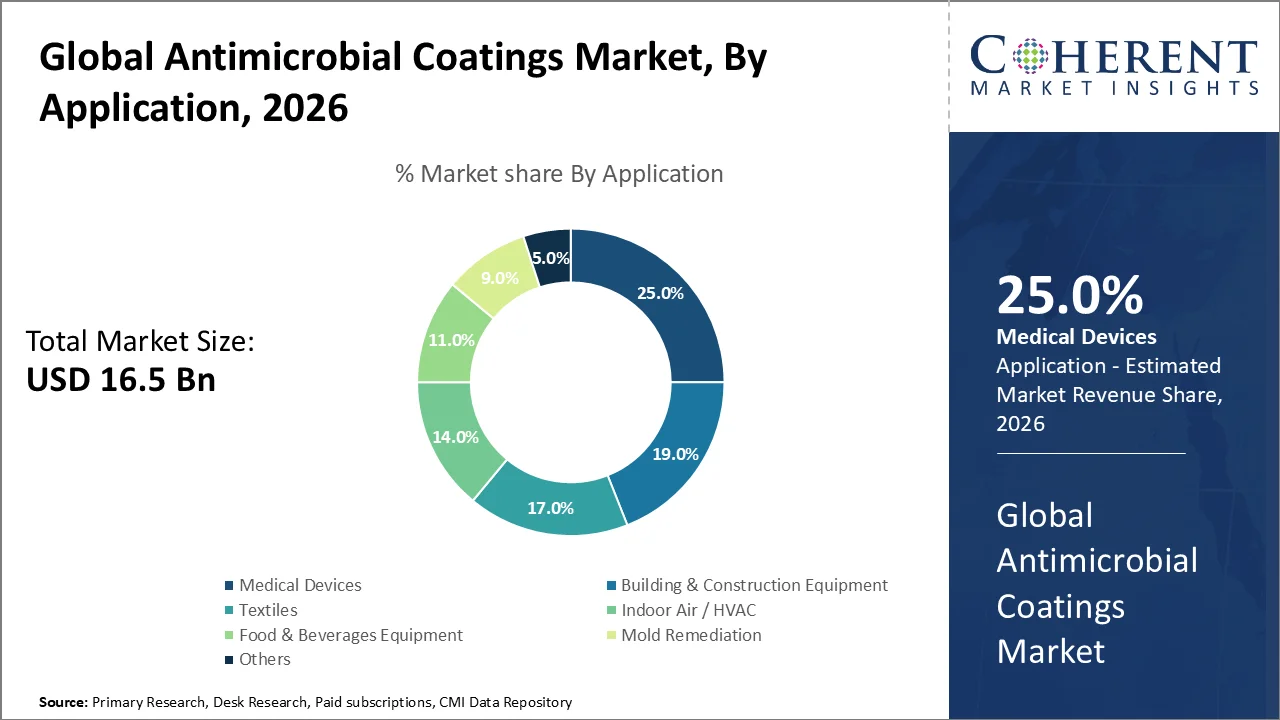
Why are Medical Devices Acquiring the Largest Share?
On the basis of application, the medical devices segment is projected to account for the largest Antimicrobial Coatings Market share of approximately 25.0% in 2026. The segment’s growth is owing to the increasing need to limit microbial adhesion and biofilm formation on urinary catheters, central venous catheters, implants, surgical components, wound-care products, and other devices that remain in direct or prolonged contact with patients.
The CDC’s 2024 National and State Healthcare-Associated Infections Progress Report, released in January 2026, found that between 2023 and 2024, U.S. acute-care hospitals saw a 9% decline in central line-associated bloodstream infections and a 10% decline in catheter-associated urinary tract infections.
In June 2025, Aesculap, Inc. introduced XABO Antibiotic-Impregnated Catheters in the U.S. for treating hydrocephalus in pediatric and adult patients. The catheters are designed to reduce the risk of shunt-related infections.
Why is Silver Acquiring the Largest Share?
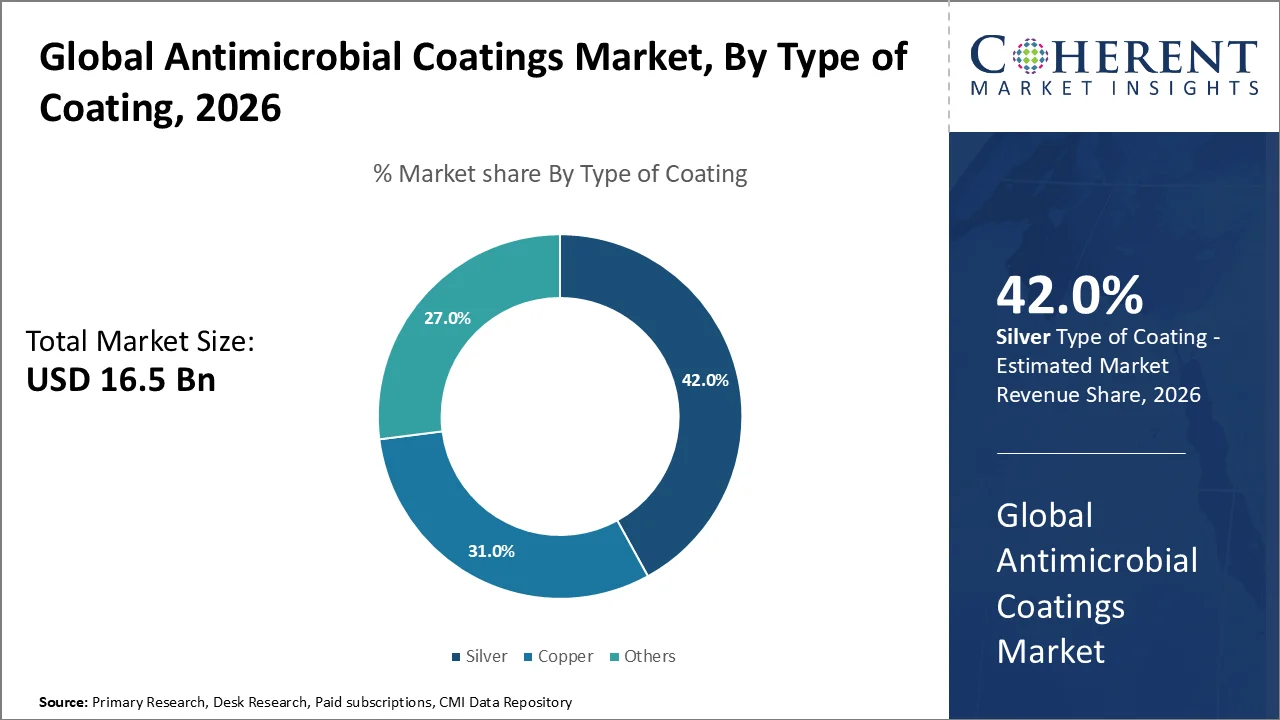
On the basis of type of coating, the silver segment is projected to account for the largest Antimicrobial Coatings Market share of approximately 42.0% in 2026. The segment’s growth is owing to silver’s broad-spectrum antimicrobial activity, sustained silver-ion release, compatibility with polymer and composite matrices, and extensive application across healthcare surfaces, medical devices, textiles, food-contact materials, and industrial coatings.
Furthermore, a 2025 comprehensive review indexed by the U.S. National Library of Medicine screened 634 scientific records and 21 studies met the final inclusion criteria. The assessment concluded that silver nanoparticle-functionalized plastics significantly reduced microbial loads including Escherichia coli, Staphylococcus aureus, and Candida albicans. These are commonly used in catheters, dental prostheses, wound dressings, and orthodontic resins.
In February 2026, Nuvoco Vistas Corporation Limited launched Nuvoco Zero M Triple Shield Putty, a premium wall-care product with Silver Ion Technology. The product is designed to prevent bacteria, fungi and algae developing, as well as waterproofing and anti-efflorescence properties.
Antimicrobial Coatings Market Trends
- Active antimicrobial functionality is increasingly being incorporated into sustainable food packaging to create coatings that combine microbial suppression with barrier protection, UV resistance, antioxidant activity and shelf-life extension. A 2026 review in Carbohydrate Polymers notes that chitosan-based nanocomposite films containing silver, zinc oxide, and copper nanoparticles are rapidly developing for use in meat, poultry, dairy, fruits, vegetables, bakery products, and seafood.
- The development of smart and stimuli-responsive antimicrobial coatings makes it possible to switch on the antimicrobial activity selectively by infection-related or external stimuli such as pH, bacterial enzymes, temperature, light and near-infrared radiation. In 2026, researchers reported an intelligent pH-responsive charge-switching coating for catheters, providing antifouling and antimicrobial functions.
- The increasing interest in bio-based and biodegradable antimicrobial coatings is promoting the replacement of petroleum-based coating and packaging materials with chitosan, cellulose, lignin, tannic acid, natural antimicrobials and bio-nanocomposites. In 2025 peer-reviewed research on chitosan-ZnO antimicrobial nanocomposite films demonstrated about 76% biodegradation in 28 days and antimicrobial activity against Staphylococcus aureus and Escherichia coli.
Regional Insights
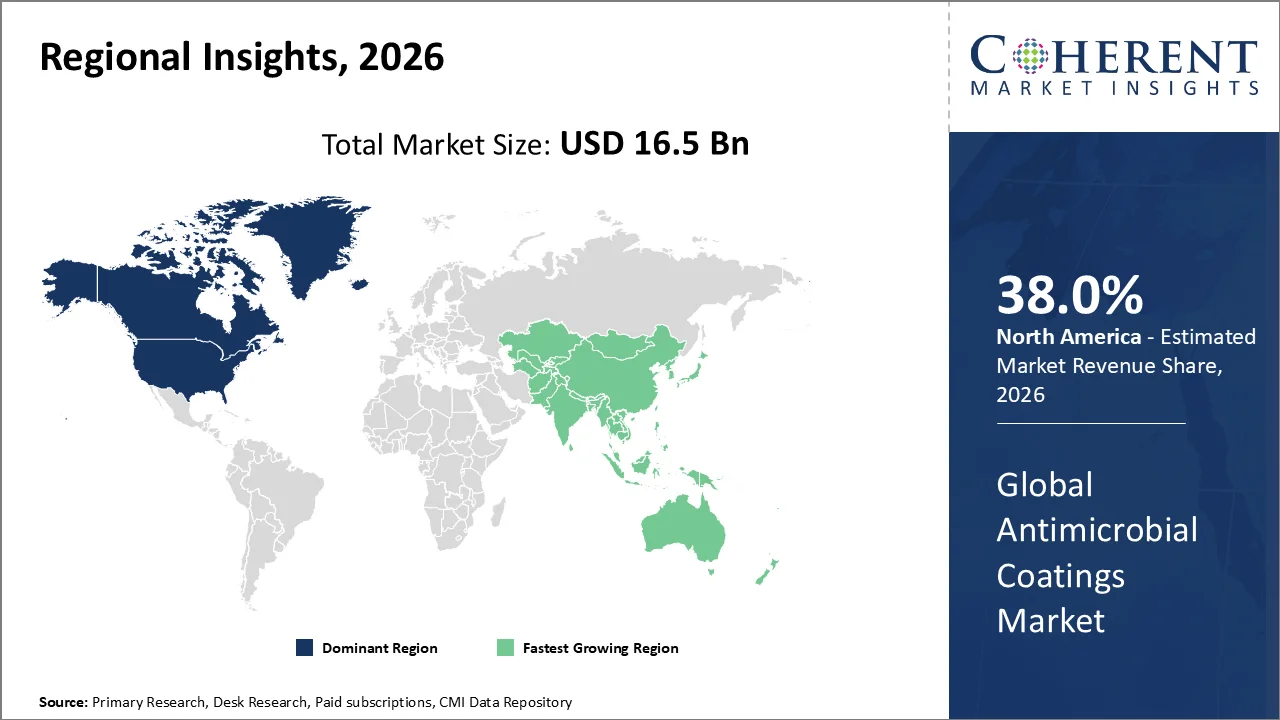
North America Dominates Owing to the Mature Antimicrobial Product Ecosystem and Strong Healthcare Demand
North America is expected to account for approximately 38.0% of the Antimicrobial Coatings Market in 2026. The region’s dominance is owing to the mature antimicrobial-product ecosystem, stringent hygiene and infection-control standards, large medical-device industry, and broad use of antimicrobial technologies across healthcare, HVAC, food processing, construction, and institutional surfaces.
The U.S. Environmental Protection Agency (EPA) states that more than 4,000 antimicrobial products are currently registered and sold in the U.S., incorporating approximately 275 different active ingredients, while about USD 1 billion is spent annually on antimicrobial products. This large regulated commercial base provides a favorable environment for antimicrobial coating manufacturers developing products for healthcare and other hygiene-sensitive surfaces.
In March 2026, Microban International, a U.S.-based antimicrobial technology company, announced the showcase of its latest coating technologies at the American Coatings Show 2026 in Indianapolis, Indiana.
Asia Pacific Antimicrobial Coatings Market Trends
Asia Pacific is expected to emerge as the fastest-growing region in the Antimicrobial Coatings Market over the forecast period. The region’s growth is owing to rapid expansion of healthcare and medical-device manufacturing, rising construction activity, greater emphasis on hygiene-sensitive materials, and expanding food-processing and packaging industries across China, India, Japan, South Korea, and Southeast Asia.
India is showing a similar expansion in medical-device manufacturing. The Government of India's Economic Survey 2025–26 reported that medical-device exports increased from USD 2.5 billion in FY2021 to USD 4.1 billion in FY2025, with exports reaching 187 countries.
In August 2026, Nippon Paint Holdings Co., Ltd. and the University of Tokyo announced that they have found strong antiviral activity in natural mordenite-type zeolite (MOR). The zeolite framework structure and surface acid strength were found to be the most important factors controlling antiviral performance, and the study suggested the potential for developing low-cost, metal-free antiviral materials.
Strong Coatings Manufacturing Base and Regulatory Infrastructure are Accelerating the Antimicrobial Coatings Market in the United States
The U.S. Antimicrobial Coatings Market is experiencing robust growth, driven by the country's well-established coatings manufacturing ecosystem, rising development of durable antimicrobial surfaces, stringent product-performance requirements, and broad acceptance in healthcare, commercial buildings, transportation, consumer products, and industrial applications.
According to the American Coatings Association, the U.S. paint and coatings industry generates approximately USD 36 billion in economic activity and supports more than 360,000 workers. U.S. coating product shipments are estimated at approximately USD 33.2 billion, while exports reached USD 2.8 billion in 2025.
China Antimicrobial Coatings Market Trends
China is expected to witness strong growth in the Antimicrobial Coatings Market over the forecast period. The growth is owing to the country's massive coatings manufacturing capacity, expanding healthcare infrastructure, rising demand for functional and high-value coatings, and increasing adoption of antimicrobial technologies across medical facilities, consumer products, electronics, transportation, food-contact surfaces, and architectural applications.
China's large healthcare infrastructure is also creating a substantial addressable base for antimicrobial surface technologies. According to the National Bureau of Statistics of China, the country had approximately 1.107 million medical and healthcare institutions in 2025, including about 38,000 hospitals, with 10.09 million medical and healthcare beds nationwide. Healthcare institutions recorded approximately 10.58 billion patient visits during 2025.
Who are the Major Companies in Antimicrobial Coatings Industry
Some of the major key players in Antimicrobial Coatings Market are AkzoNobel Coatings Inc., BASF, RPM International, Dow Chemicals, PPG Industries, Diamond Vogel, RPM International Inc., PPG Industries Inc., Royal DSM, Sherwin-Williams Company.
Key News
- In May 2026, Dow Global Technologies published a new patent covering an aqueous antimicrobial coating composition incorporating an emulsion polymer, silver salt providing 15–1,000 ppm of silver, and a protease.
- In January 2026, BASF introduced its Near-Zero SVOC dispersion technology for interior coatings, targeting healthier indoor environments in homes, schools, workplaces, and public buildings.
Market Report Scope
Antimicrobial Coatings Market Report Coverage
| Report Coverage | Details | ||
|---|---|---|---|
| Base Year: | 2025 | Market Size in 2026: | USD 16.5 Bn |
| Historical Data for: | 2020 To 2024 | Forecast Period: | 2026 To 2033 |
| Forecast Period 2026 to 2033 CAGR: | 15.0% | 2033 Value Projection: | USD 44.0 Bn |
| Geographies covered: |
| ||
| Segments covered: |
| ||
| Companies covered: | AkzoNobel Coatings Inc., BASF, RPM International, Dow Chemicals, PPG Industries, Diamond Vogel, RPM International Inc., PPG Industries Inc., Royal DSM, Sherwin-Williams Company. | ||
| Growth Drivers: |
| ||
| Restraints & Challenges: |
| ||
Analyst Opinion
- The Antimicrobial Coatings Market is expected to benefit from the widening gap between global infection-prevention requirements and current implementation levels. According to the World Health Organization (WHO), 71% of countries had an active infection prevention and control program in 2023–2024, but only 6% met all WHO minimum IPC requirements, compared with a global target of more than 90% by 2030.
- Regulatory emphasis is increasingly shifting from basic antimicrobial activity toward durability and validated residual performance, which is likely to favor technically differentiated coating manufacturers. Durability testing for residual antimicrobial coating claims must include abrasion and chemical exposure as required by the U.S. Environmental Protection Agency (EPA).
- The market is also likely to become increasingly performance-driven, with buyers placing greater emphasis on real-world validation rather than laboratory efficacy alone. A 2025 study published in Applied and Environmental Microbiology evaluated a commercial surface-anchoring antimicrobial treatment carrying a 30-day protection claim and found no measurable antimicrobial effect after either five or 30 days under real-world conditions involving routine cleaning.
Speak to the analyst
Want personalized insights?
Take the findings above to one of our principal consultants, or have the report rebuilt around the segments, geographies and competitors you actually track.
Market Segmentation
- By Application (Revenue, USD Bn, 2021-2033)
- Building & Construction Equipment
- Indoor Air / HVAC
- Mold Remediation
- Medical Devices
- Textiles
- Food & Beverages Equipment
- Others
- By Type of Coating (Revenue, USD Bn, 2021-2033)
- Silver
- Copper
- Others
- By Region (Revenue, USD Bn, 2021-2033)
- North America
- U.S.
- Canada
- Latin America
- Brazil
- Mexico
- Argentina
- Rest of Latin America
- Europe
- Germany
- U.K.
- France
- Italy
- Spain
- Russia
- Rest of Europe
- Asia Pacific
- China
- India
- Japan
- Australia
- South Korea
- ASEAN
- Rest of Asia Pacific
- Middle East
- GCC
- Israel
- Rest of Middle East
- Africa
- South Africa
- Central Africa
- North Africa
- North America
Sources
Primary Research Interviews
- Antimicrobial coating manufacturers
- Coatings formulation scientists and surface chemistry experts
- Medical device coating developers
- R&D heads from paints, coatings, and specialty chemical companies
- Hospital infection prevention and infection control professionals
- Procurement managers from healthcare, food processing, HVAC, textile, and construction industries
- Distributors and applicators of industrial and specialty coatings
- Key opinion leaders (KOLs) in antimicrobial materials, microbiology, and surface engineering
Databases
- World Bank
- Organisation for Economic Co-operation and Development (OECD)
- U.S. Centers for Disease Control and Prevention (CDC)
- World Health Organization (WHO)
- European Centre for Disease Prevention and Control (ECDC)
- European Food Safety Authority (EFSA)
- U.S. Environmental Protection Agency (EPA)
- Eurostat
- National Bureau of Statistics of China
Magazines
- Coatings World
- PCI Magazine
- European Coatings Journal
- Paint & Coatings Industry
- Chemical & Engineering News
- Medical Device and Diagnostic Industry
Journals
- Progress in Organic Coatings
- Surface & Coatings Technology
- Journal of Coatings Technology and Research
- Applied Surface Science
- Materials Science and Engineering: C
- Bioactive Materials
- International Journal of Biological Macromolecules
- Applied and Environmental Microbiology
Newspapers
- The Wall Street Journal
- Financial Times
- Reuters
- The Guardian
- The Economic Times
- Nikkei Asia
Associations
- American Coatings Association (ACA)
- European Council of the Paint, Printing Ink and Artists' Colours Industry (CEPE)
- Society for Protective Coatings / AMPP
- ASTM International
- International Organization for Standardization (ISO)
- China National Coatings Industry Association
- British Coatings Federation (BCF)
- European Federation of Corrosion (EFC)
Public Domain Sources
- Company Annual Reports and Investor Presentations
- Company Product Brochures, Technical Data Sheets, and Safety Data Sheets
- Government Publications on Infection Prevention and Antimicrobial Products
- U.S. EPA Antimicrobial Product Registration and Efficacy Guidance
- European Commission and ECHA Biocidal Products Regulation Publications
- CDC, WHO, ECDC, and EFSA Infection and Hygiene Statistics
- University Research Publications on Antimicrobial Materials and Surface Technologies
- Patent Databases such as WIPO, USPTO, EPO, and Google Patents
- Medical Device Regulatory Databases and Product Clearances
- Publicly Available Coatings Industry Production, Trade, and Manufacturing Statistics
Proprietary Elements
- CMI Data Analytics Tool
- Proprietary CMI Existing Repository of Information for the Last 10 Years
Get access to 250+ pages report
Every segment, forecast, competitor profile and data table behind the analysis above — available for instant download.
- ESOMAR Member
- ISO 9001:2015 Certified
- D-U-N-S Registered
- GDPR & CCPA Compliant
Missing comfort of reading report in your local language? Find your preferred language:
Transform your Strategy with Exclusive Trending Reports
Frequently Asked Questions
The Antimicrobial Coatings Market is expected to reach approximately USD 44.0 Bn by 2033.
Major players operating in the global Antimicrobial Coatings Market include AkzoNobel Coatings Inc., BASF, RPM International, Dow Chemicals, PPG Industries, Diamond Vogel, RPM International Inc., PPG Industries Inc., Royal DSM, and Sherwin-Williams Company.
The high cost of antimicrobial coating formulations and stringent regulatory approval requirements are among the key factors hampering growth of the market.
The increasing demand for infection-control and hygienic surfaces in healthcare and rising adoption of antimicrobial coatings in medical devices are key factors driving growth of the Antimicrobial Coatings Market.
The Antimicrobial Coatings Market is anticipated to grow at a CAGR of 15.0% between 2026 and 2033.
Among regions, North America is expected to account for the largest share of the global Antimicrobial Coatings Market, with approximately 38.0% share in 2026.
Antimicrobial coatings are functional surface coatings designed to inhibit or reduce the growth of microorganisms such as bacteria, fungi, and other microbes on treated surfaces. They are used to improve hygiene, reduce microbial contamination, and provide additional surface protection across healthcare, commercial, industrial, and other applications.