

Medical Device Coating Market Size and Trends
The global medical device coating market size was estimated at USD 17,448.4 Mn in 2026 and is projected to reach USD 29,326.8 Mn by 2033, growing at a CAGR of 7.7% from 2026 to 2030.
Key Takeaways
- Based on the Coating Type, the Hydrophilic segment is expected to dominate the market in 2026, owing to an increase in minimally invasive surgeries.
- Based on the Application Type, the Cardiovascular segment is expected to lead the market in 2026, owing to the rise in prevalence of cardiovascular diseases.
- Based on Region, North America is expected to dominate the market in 2026, increasing research and development activities by key market players.
Market Overview
The medical device coating market is an emerging market. It is driven by a variety of factors, like the rise in demand for minimally invasive surgeries, and the need for infection-resistant surfaces. Medical coatings are becoming essential for improving the biocompatibility, reducing friction, and lowering the risk of clotting.
Current Events and Their Impacts on Medical Device Coating Market
Current Events | Description and its impact |
Technological Innovations in Coating Materials |
|
Geopolitical Industrial Strategies |
|
End-User Feedback
Medical professionals and OEMs generally show strong approval for coatings that enhance device usability and patient safety. Hydrophilic coatings are praised for reducing friction in catheters and guidewires, making procedures smoother and less traumatic. Antimicrobial coatings have received positive feedback, as they help reduce infection rates and improve clinical outcomes. Manufacturers also value coatings that remain effective after sterilization processes like autoclaving or gamma radiation.
Pain Points
Despite advancements, several challenges persist
- Adhesion issues are common, especially with complex or miniature device geometries, leading to performance inconsistency.
- Short-term effectiveness is a concern, particularly in long-term implants where coatings may degrade or peel off.
- High production costs and technical complexities make it difficult to scale advanced coating technologies such as drug-eluting or nano-coatings.
- Integration challenges arise when coatings are not easily compatible with existing manufacturing processes.
Unmet Needs
There’s growing demand for
- Long-lasting coatings with proven in vivo durability and minimal biological response.
- Tailored solutions that address specific clinical requirements—e.g., anti-thrombogenic coatings for cardiovascular devices or anti-biofilm properties for urinary catheters.
- Simplified application methods that reduce production steps and costs while ensuring consistency.
- Current Industry Events of 2026
- Market Size Estimation
- Regional Breakdown
- Competitive Landscape
- Customer Intelligence
- Segmental Analysis
- Pricing Analysis
- Key Market Drivers, Challenges & Future Trends
- Customized Insights Section
Segmental Insights
Medical Device Coating Market Insights, By Coating Type
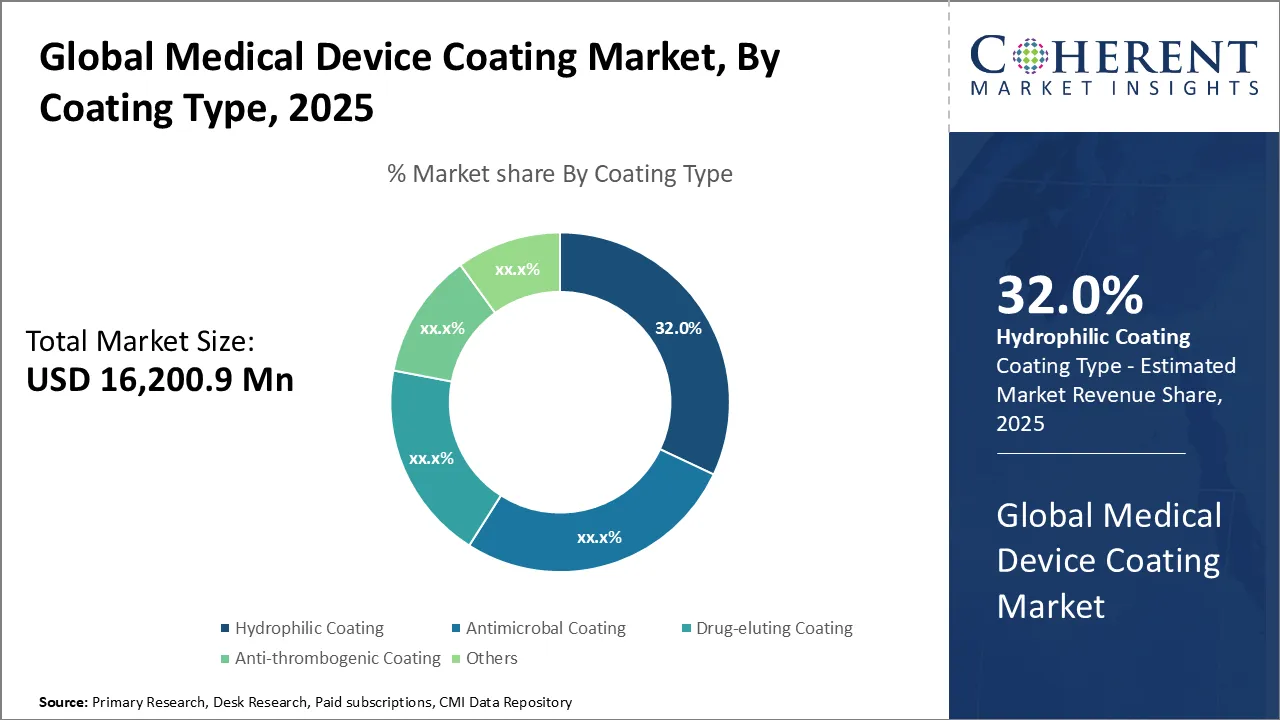
Increase in Minimally Invasive Surgeries is driving the Hydrophilic Coatings Segment
The Hydrophilic Coatings segment is expected to dominate the market with a share of 33% in 2026, owing to the rise in demand for minimally invasive surgeries. In these kinds of surgeries, guidewires and catheters with low friction are required. Hydrophilic coatings are also said to improve the movement of the device and reduce tissue damage. For instance, in January 2026, Vita Tek announced the availability of VitaCoat. It is an open-source hydrophilic coating, UV-cured, and ready-mixed.
Medical Device Coating Market Insights, By Application
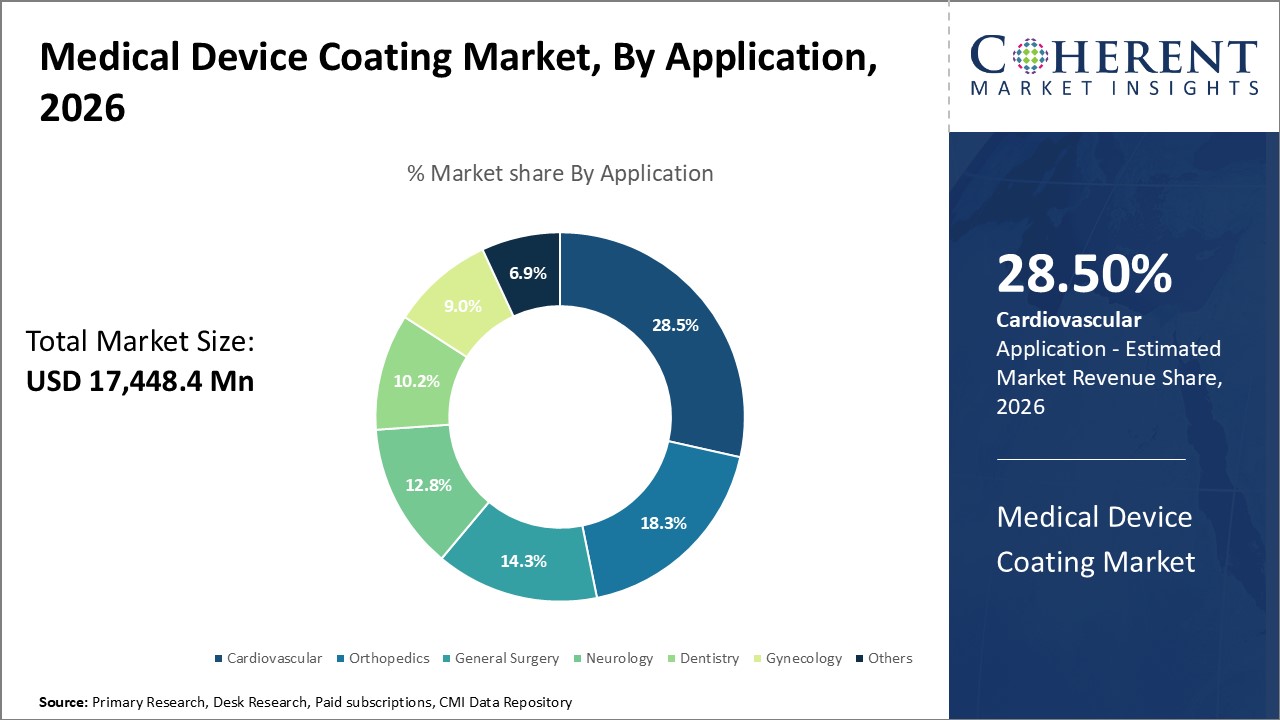
The rising prevalence of cardiovascular diseases globally is driving the market
The cardiovascular segment is expected to dominate the market over the forecast period, and this is attributed to the rising prevalence of cardiovascular disease globally. The growth can be attributed to the rise in interventional cardiology procedures and the need for drug-eluting and anti-thrombogenic coatings for catheters.
For instance, in March 2026, Biocoat Incorporated, a medical device company based in the U.S., announced that its HYDAK UV coating is being used on two medical devices that have been awarded FDA 510(k) clearance status. The first interventional device using HYDAK UV that received 510(k) clearance is a neurovascular thrombus retriever catheter. The second device is an interventional catheter designed to remove thrombus from the peripheral vasculature. Apart from this, Medthin™ 43 ADLC is a specialized coating for medical devices, particularly suited for implantable cardiovascular components. It enhances the durability of these devices and lowers the likelihood that patients will require additional surgeries. This is further accelerating the medical device coating market demand.
Regional Insights
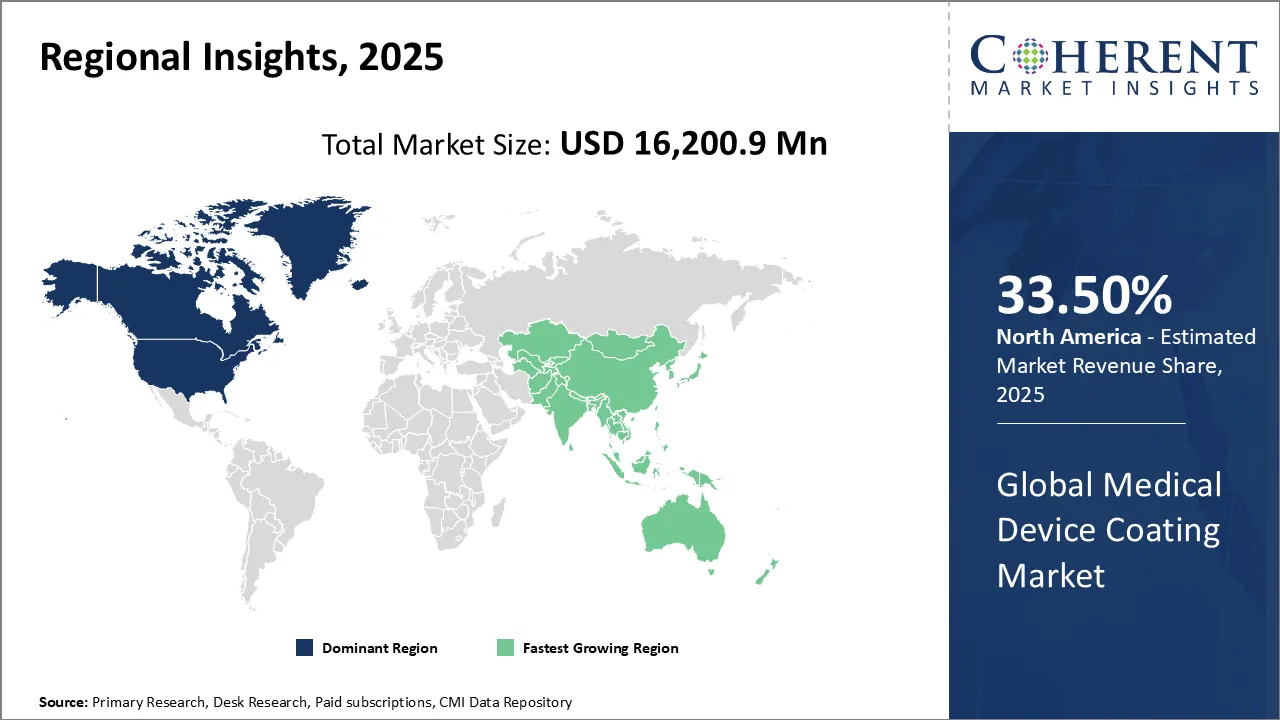
North America Medical Device Coating Market Trends
Among regions, North America is estimated to hold a dominant position in the global medical device coating market over the forecast period. North America is estimated to hold 33.50% of the market share in 2026. For instance, Precision Coating Co., Inc., a medical devices company, discussed innovations in medical device coatings at a webinar. The webinar focused on technological innovation in medical device coatings such as MICRALOX, which offers several advantages such as a long-lasting and virtually indestructible surface and superior chemical and corrosion resistance.
Asia Pacific Medical Device Coatings Market Trends
Rapid expansion of hospitals, surgical centres, and diagnostic facilities—especially in China, India, Japan, South Korea, and Southeast Asia—increases demand for coated medical devices like catheters, implants, and IV sets. Apart from this, the government across various countries are taking initiatives to develop the medical devices. For example, in May 2026, the Indian government introduced the National Medical Device Policy, aimed at advancing the growth and development of the country's medical device industry in line with its broader vision for the sector.
United States Medical Device Coating Market Trends
The United States medical device coating market is the largest in North America. The growth can be attributed to the advanced healthcare infrastructure, the presence of leading manufacturers, and high R&D investments. The prevalence of chronic diseases and an aging population is also fueling the demand for coated devices. For instance, in April 2026, the FDA granted 510 (k) clearance to the CentroVena One Central Venous Catheter from Becton Dickinson. It features a hydrophilic coating that is especially designed to enhance catheter performance.
Canada Medical Devices Coating Market Trends
Canada is the second-largest market in the North American region. The growth is attributed to the upcoming government initiatives for improving healthcare facilities, and growth in the orthopedic and dental device usage. In November 2024, researchers at the University of British Columbia (UBC) in Canada created a new coating for medical devices that come into contact with blood, aiming to lower the risk of both blood clots and bleeding. Designed to mimic the natural function of blood vessels, this innovative material could make devices like catheters, stents, dialysis machines, and blood-oxygenation equipment safer to use—especially in scenarios where the formation of blood clots is a significant concern.
Market Report Scope
Medical Device Coating Market Report Coverage
| Report Coverage | Details | ||
|---|---|---|---|
| Base Year: | 2025 | Market Size in 2026: | USD 17,448.4 Mn |
| Historical Data for: | 2020 To 2024 | Forecast Period: | 2026 To 2033 |
| Forecast Period 2026 to 2033 CAGR: | 7.7% | 2033 Value Projection: | USD 29,326.8 Mn |
| Geographies covered: |
| ||
| Segments covered: |
| ||
| Companies covered: | AdvanSource Biomaterials Corporation (Mitsubishi Chemical America, Inc.), Specialty Coating Systems Inc., AdvanSource Biomaterials, AST Products, Inc., Biocoat Incorporated., Coatings2Go, Covalon Technologies Ltd., Harland Medical Systems, Inc., Hemoteq AG (Freudenberg Medical), Hydromer, Merit Medical Systems, PPG Industries, Inc. and Precision Coating Company, Inc. | ||
| Growth Drivers: |
| ||
| Restraints & Challenges: |
| ||
Key Developments
- In May 2025, Surface Solutions Group (SSG) expanded its production capacity by adding a new automated electrostatic robotic coating line. This brings the company’s total to 30 coating lines—12 automated electrostatic, 8 automated dip, and 10 manual—enhancing its ability to meet rising global demand for medical device coatings.
- In March 2025, The U.S. Federal Trade Commission filed a lawsuit to block private equity firm GTCR’s acquisition of Surmodics, citing concerns that combining Surmodics with Biocoat would give the merged company over 50% of the hydrophilic coatings market, reducing competition and potentially increasing costs.
- In May 2024, Hydromer Inc. introduced HydroThrombX™ thromboresistant coating. It is a next-gen update to its F200 product line.
Analyst Viewpoint
- The medical device coating sector stands at a critical inflection point, driven not by incremental growth, but by an urgent need for functional differentiation and regulatory alignment. In this space, commoditized hydrophilic coatings are quickly losing strategic relevance, particularly in high-margin cardiovascular and neurovascular device segments. OEMs are now scrutinizing not just biocompatibility, but also mechanical adhesion, elution kinetics, and post-sterilization performance, demanding more from coatings than simple surface modification.
- The shift toward multi-functional coatings—those offering anti-microbial, thromboresistant, and drug-eluting properties simultaneously—is not a trend but a necessity. For instance, drug-eluting stents (DES) with proprietary polymer coatings such as Abbott's Xience (fluorinated copolymers) or Boston Scientific's Synergy (bioabsorbable polymers) illustrate the market's push toward coatings that are not merely passive barriers but active therapeutic interfaces. The distinction between a device and its coating is collapsing; coatings are now central to the value proposition, particularly in Class III devices.
- Despite the urgency of innovation, regulatory constraints remain a major bottleneck. The FDA’s increased scrutiny post the 2019 heparin-coated catheter recalls has created an environment where even minor modifications in coating chemistry trigger full 510(k) or PMA reevaluations. This has led to a noticeable slowdown in pipeline velocity, particularly among smaller players lacking regulatory infrastructure. The opportunity lies with coating suppliers who offer regulatory-ready platforms, not just materials—those that come with pre-clinical validation data, sterilization compatibility matrices, and documented extractables/leachables profiles.
- Another underappreciated force reshaping the landscape is the reemergence of plasma-based and nanocoating techniques. Companies like Surmodics and Biocoat are advancing plasma-activated coatings that dramatically improve substrate adhesion and reduce delamination—an issue that has historically plagued long indwelling catheters. In one clinical evaluation, Surmodics’ Serene™ hydrophilic coating demonstrated a 78% reduction in particulate shedding compared to legacy PEG-based coatings, a critical metric as regulatory agencies intensify their focus on particulate burden.
- Yet, the market’s biggest failure—and perhaps its biggest opportunity—is the lack of standardized durability metrics. Currently, in-vitro abrasion testing protocols vary dramatically across manufacturers. This has created a fragmented data landscape where comparing coating durability is nearly impossible, despite it being a primary cause of adverse events in catheters and guidewires. The absence of standardized coating performance benchmarks not only delays procurement decisions but also increases post-market surveillance costs. This opens a clear opportunity for coating suppliers that can align with, or even lead, the development of standardized durability frameworks recognized across geographies.
Medical Device Coating Market Trends
Increasing funding by the market players
Increasing growth strategies by the market players, such as funding and others, are expected to drive growth in the market over the forecast period. For instance, in September 2023, Bioretec Ltd, a pioneering company dedicated to advancing biodegradable orthopedic implants, announced that they had received a grant of a maximum of USD 1.04 Bn for its research and development (R&D) work from Business Finland’s Co-Innovation project funding for the period March 2023 – February 2025.
Medical Device Coating Market Drivers
Rising number of business development strategies by market players
Key players operating in the medical device coating market are using several business development strategies, such as acquisitions, mergers, collaborations, and others, to expand their product offerings, which, in turn, is expected to fuel market growth over the forecast period. For instance, Advanced Medical Solutions Group plc, a medical device company, announced that it had acquired Raleigh Adhesive Coatings Limited, a medical device coating company. This acquisition will further strengthen the company’s position in the wound care sector by expanding its in-house specialist services, such as acrylic and silicone coating, bulk material converting capabilities, and perforation processing, among others.
Market Segmentation
- By Coating Type (Revenue, USD Mn, 2021 - 2033)
- Hydrophilic Coating
- Antimicrobial Coatings
- Drug-eluting Coatings
- Anti-thrombogenic Coatings
- Others (Hydrophobic Coating, etc.)
- By Application (Revenue, USD Mn, 2021 - 2033)
- Neurology
- Orthopedics
- General Surgery
- Cardiovascular
- Dentistry
- Gynecology
- Others (Respiratory, etc.)
- By Region (Revenue, USD Mn, 2021 - 2033)
- North America
- U.S.
- Canada
- Latin America
- Brazil
- Argentina
- Mexico
- Rest of Latin America
- Europe
- Germany
- U.K.
- Spain
- France
- Italy
- Russia
- Rest of Europe
- Asia Pacific
- China
- India
- Japan
- Australia
- South Korea
- ASEAN
- Rest of Asia Pacific
- Middle East
- GCC Countries
- Israel
- Rest of Middle East
- Africa
- South Africa
- North Africa
- Central Africa
- Key Player Insights (Revenue, USD Mn, 2021 - 2033)
- AdvanSource Biomaterials Corporation (Mitsubishi Chemical America, Inc.)
- Specialty Coating Systems Inc.
- AdvanSource Biomaterials
- AST Products, Inc.
- Biocoat Incorporated.
- Coatings2Go
- Covalon Technologies Ltd.
- Harland Medical Systems, Inc.
- Hemoteq AG (Freudenberg Medical)
- Hydromer
- Merit Medical Systems
- PPG Industries, Inc.
- Precision Coating Company, Inc.
Sources
Primary Research Interviews
- Interviews with R&D heads, product managers, and regulatory affairs professionals from medical device manufacturers
- Discussions with healthcare professionals, hospital procurement heads, and biomedical engineers
- Consultations with academic researchers in biomaterials and coatings
Databases
- Medtech Insight
- World Bank Data
- WHO Global Health Observatory
Magazines
- Medical Design Briefs
- MedTech Innovation News
- Today's Medical Developments (TMD)
- Medical Device and Diagnostic Industry (MD+DI)
Journals
- Journal of Biomedical Materials Research
- Materials Science and Engineering
- Coatings (MDPI)
- ACS Applied Materials & Interfaces
- Journal of Controlled Release
Newspapers
- The Wall Street Journal – Healthcare & Life Sciences section
- The Economic Times – Healthcare & Pharma
- The Hindu BusinessLine – Health & Science
- Financial Times – Health
Associations
- Association for the Advancement of Medical Instrumentation (AAMI)
- Medical Device Manufacturers Association (MDMA)
- European Medical Device Industry Group (EMIG)
- Society for Biomaterials
- Regulatory Affairs Professionals Society (RAPS)
Public Domain Sources
- U.S. Food and Drug Administration (FDA) – Device Approvals
- European Medicines Agency (EMA)
- Centers for Medicare & Medicaid Services (CMS)
- U.S. Patent and Trademark Office (USPTO)
- ClinicalTrials.gov
- OECD Health Statistics
- Indian Ministry of Health & Family Welfare (MOHFW)
*Definition: Medical device coatings enhance the maneuverability and performance of medical devices in various applications, such as neurology and others. These coatings reduce friction for catheters, guide wires, and other minimally invasive devices. Medical device coatings are primarily classified as lubricious, anti-microbial, drug-eluting stents, and parylene polymers. These coatings are primarily incorporated into class II and class III medical devices.
Get access to 250+ pages report
Every segment, forecast, competitor profile and data table behind the analysis above — available for instant download.
- ESOMAR Member
- ISO 9001:2015 Certified
- D-U-N-S Registered
- GDPR & CCPA Compliant
Missing comfort of reading report in your local language? Find your preferred language:
Transform your Strategy with Exclusive Trending Reports
Frequently Asked Questions
The global medical device coating market size was estimated at USD 17,448.4 Mn in 2026 and is projected to reach USD 29,326.8 Mn by 2033, growing at a CAGR of 7.7% from 2026 to 2030.
A rising number of business development strategies by market players and the increasing prevalence of cancer are expected to drive the market’s growth.
Hydrophilic segment is expected to dominate the market in 2026.
The high cost of volatile raw materials is expected to hinder the market over the forecast period.
Major players operating in the market are AdvanSource Biomaterials Corporation (Mitsubishi Chemical America, Inc.), Specialty Coating Systems Inc., AdvanSource Biomaterials, AST Products, Inc., Biocoat Incorporated, Coatings2Go, Covalon Technologies Ltd., Harland Medical Systems, Inc., Hemoteq AG (Freudenberg Medical), Hydromer, Merit Medical Systems, PPG Industries, Inc., and Precision Coating.