

Aerospace Interior Adhesives Market Size and Forecast — 2026-2033
Overview
Adhesives are materials, which have the ability to join two surfaces using linkage and consistent mechanisms. Adhesives play a major role in aircraft interior manufacturing. Aerospace adhesives are strong and fire & chemical resistant with superior bond performance and elasticity. Aerospace adhesives help maintain the interior quality of the aircraft without adding any additional weight. Increasing number of aircrafts, rise in interior renovation, and leasing of aircrafts also contribute to the growth of aerospace interior adhesives market.
Decline in aviation fuel prices, growing demand for low cost carrier flights, and attainment of new aircrafts by airline operators are the key factors expected to drive the growth of aerospace interior adhesives market. Ecological regulations are also projected to confine the growth of aerospace interior adhesives market. Aircraft manufactures need to ensure passenger safety, weight management, and aesthetic appeal of the aircraft cabin interior while selecting adhesives. Several regulations are issued pertaining to passenger safety, which greatly influences the market growth.
Aerospace Interior Adhesives Market Size and Forecast – 2026 – 2033
The Aerospace Interior Adhesives Market size is estimated to be valued at USD 555.9 million in 2026 and is expected to reach USD 886.8 million by 2033, exhibiting a compound annual growth rate (CAGR) of 6.9% from 2026 to 2033.
Key Takeaways
The Epoxy adhesive segment leads the aerospace interior adhesives market with a robust 39% market share, driven by superior bonding strength and thermal resistance.
Laminate bonding applications are rapidly growing, accounting for 41% of the applications market, owing to their critical role in cabin finishings. Commercial aircraft remain the largest end-user segment, dominating with a 53% industry share due to the high volume of aircraft deliveries globally.
North America holds the commanding position regionally, contributing approximately 35% to the aerospace interior adhesives market share, propelled by the presence of major aircraft manufacturers and extensive aftermarket refurbishment activities.
Meanwhile, Asia Pacific is the fastest-growing region, with a CAGR exceeding 8%, underpinned by expanding aerospace manufacturing hubs in China and India alongside supportive government aerospace initiatives.
Aerospace Interior Adhesives Market – Segmentation Analysis
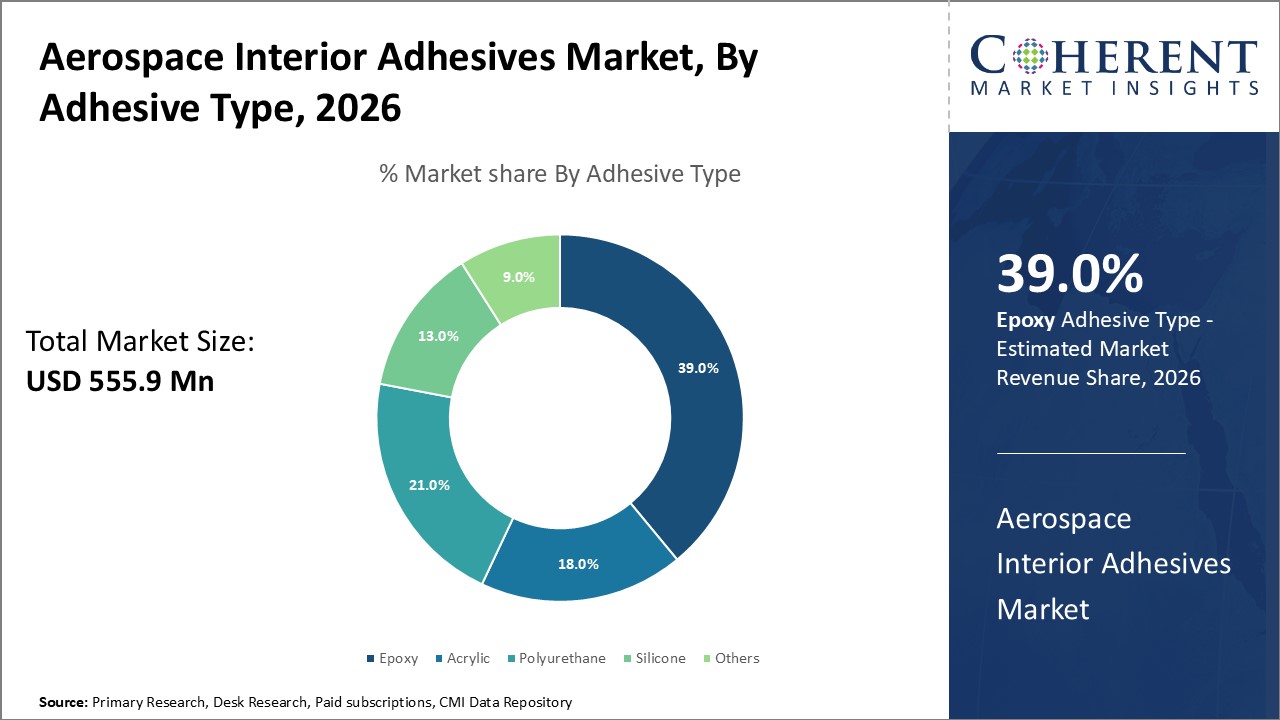
Aerospace Interior Adhesives Market Insights, By Adhesive Type
In terms of adhesive type, the Aerospace Interior Adhesives Market is segmented into Epoxy, Acrylic, Polyurethane, Silicone, and Others, among which Epoxy dominates the market share with 38%. Epoxy adhesives are favored for their superior mechanical strength, resistance to heat and chemicals, and excellent durability, making them highly suitable for bonding composite materials and structural elements in aircraft interiors. Their dominance stems from their extensive use in both new aircraft assembly and interior refurbishment programs.
Aerospace Interior Adhesives Market Insights, By Application
The Aerospace Interior Adhesives Market by application is segmented into Composite Bonding, Laminate Bonding, Foam Bonding, Sealing & Gasketing, and Others, with Composite Bonding leading the market with a 40% share. Composite bonding is critical for aircraft cabin interiors as it enables the integration of lightweight materials without compromising structural integrity, directly influencing fuel efficiency and emission reductions.
Aerospace Interior Adhesives Market Insights, By End-User
The end-user segmentation divides the market into Commercial Aircraft, Military Aircraft, Business Jets, and Others, with Commercial Aircraft holding a dominant 52% market share. This dominance arises from increasing global passenger traffic and aircraft deliveries necessitating vast quantities of interior adhesives for cabin outfitting and safety requirements. Military aircraft represent a stable yet niche segment focused on performance and durability under extreme conditions, with moderate growth due to modernization programs.
Aerospace Interior Adhesives Market Insights, By Geography
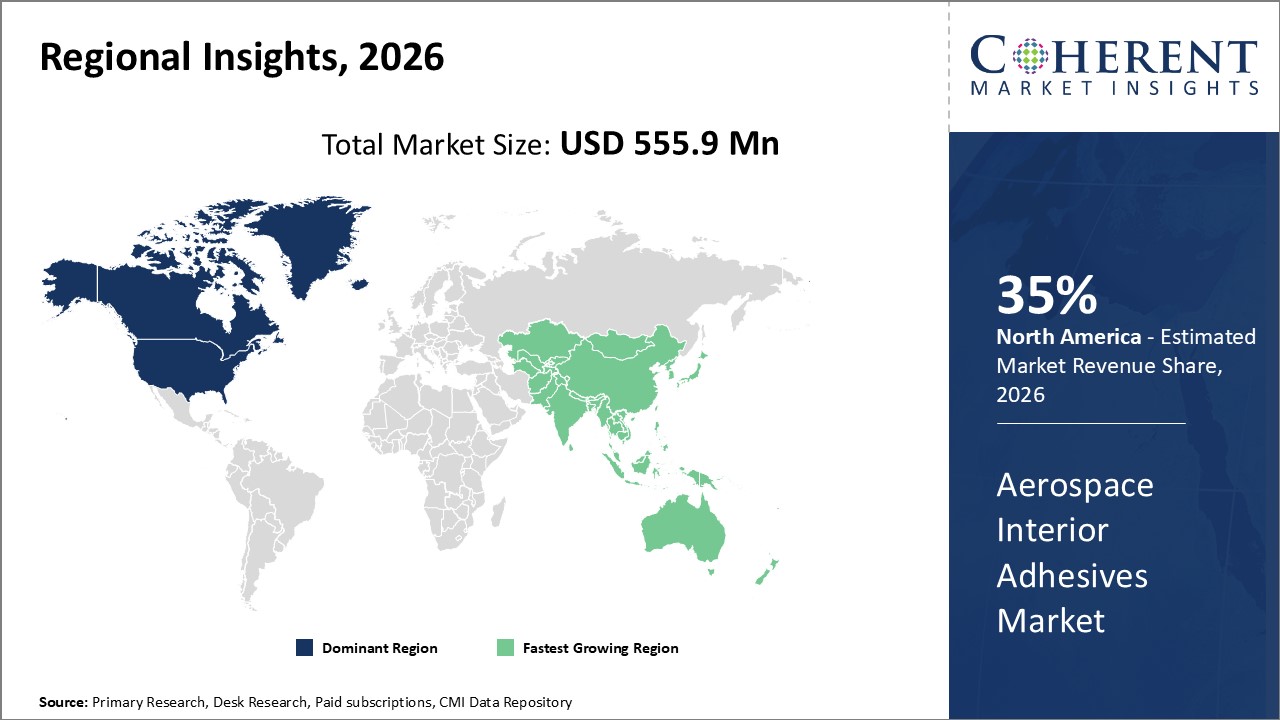
North America Aerospace Interior Adhesives Market Analysis and Trends
Approximately 35% of the North American market is controlled by the United States, which is home to top aircraft manufacturers and tier-1 suppliers. Advanced interior adhesives are in high demand because to the strong aftermarket refurbishment activity and strict FAA requirements. Important market participants strategically concentrate on innovation and partnerships with regional aerospace OEMs.
Asia Pacific Aerospace Interior Adhesives Market Analysis and Trends
As a result of growing aircraft manufacturing facilities in China, India, and emerging Southeast Asian nations, Asia Pacific is growing at the quickest rate, with a compound annual growth rate (CAGR) of 8%. Growing demand for commercial aircraft and government programs promoting the growth of the aerospace industry both significantly boost market expansion. Investments in adhesive production capacity and research and development are growing in the area, serving both domestic and international aerospace industries.
Aerospace Interior Adhesives Market Outlook for Key Countries
United States Aerospace Interior Adhesives Market Analysis and Trends
The U.S. aerospace interior adhesives market benefits from the concentration of major aircraft OEMs such as Boeing, Lockheed Martin, and numerous tier-1 suppliers who consistently push demand for advancements in interior adhesive solutions. Government regulations by the FAA on fire resistance and VOC limits drive R&D investments and adoption of state-of-the-art adhesive technologies. For instance, Boeing’s 2026 report highlighted a 10% increase in epoxy adhesive consumption linked to new 787 Dreamliner interior upgrades. Additionally, the growing refurbishment market in the U.S. supports sustained adhesive revenue streams, reinforcing the country’s pivotal role in the market’s landscape.
China Aerospace Interior Adhesives Market Analysis and Trends
China’s aerospace interior adhesives market is expanding rapidly due to aggressive aircraft production ramp-ups supported by companies like COMAC and AVIC. 2025 saw domestic adhesive manufacturers increasing their aerospace-certified adhesive output by over 25%, aligning with China’s “Made in China 2026” initiative focused on aerospace industry self-sufficiency. Increasing collaboration between Chinese adhesive producers and global aerospace companies also spurs technology transfers, improving adhesive quality and broadening applications. Furthermore, growing civil aviation passenger traffic, forecast to surpass 800 million by 2030, fuels demand for new aircraft interiors and corresponding adhesive solutions.
Analyst Opinion
Increasing demand for lightweight aircraft interiors is a crucial market driver, with manufacturers moving towards adhesives that reduce overall weight without compromising strength. For instance, in 2025, Airbus reported a 16% weight reduction in cabin interiors utilizing advanced adhesive technologies, directly impacting fuel efficiency and emissions reductions.
Supply chain dynamics highlight robust growth in key adhesive resin production capacity, especially in Asia Pacific. China and India expanded production volumes by over 20% in 2025, meeting regional demand across OEMs and aftermarket aerospace interior refurbishments.
Pricing trends for aerospace-grade adhesives have shown moderate fluctuation due to raw material volatility. Yet, cost pass-through remain manageable, with prices stabilizing at an average of USD 8.5 per kilogram in 2025, fostering wider adoption across mid-tier aircraft programs.
Diverse end-use industries fuel demand for aerospace interior adhesives beyond commercial aviation. Military upgrades and VIP business aviation sectors increased adhesive procurement by approximately 13% in 2026, capitalizing on enhanced fire retardancy and bond strength features.
- Current Industry Events of 2026
- Market Size Estimation
- Regional Breakdown
- Competitive Landscape
- Customer Intelligence
- Segmental Analysis
- Pricing Analysis
- Key Market Drivers, Challenges & Future Trends
- Customized Insights Section
Market Scope
| Report Coverage | Details | ||
|---|---|---|---|
| Base Year: | 2025 | Market Size in 2026: | USD 555.9 million |
| Historical Data for: | 2020 To 2024 | Forecast Period: | 2026 To 2033 |
| Forecast Period 2026 to 2033 CAGR: | 6.9% | 2033 Value Projection: | USD 886.8 million |
| Geographies covered: |
| ||
| Segments covered: |
| ||
| Companies covered: | 3M Company, Henkel AG & Co. KGaA, Huntsman Corporation, H.B. Fuller Company, Sika AG, LORD Corporation, Ashland Global Holdings Inc., Dow Inc., Arkema Group, Illinois Tool Works Inc., BASF SE | ||
| Growth Drivers: |
| ||
Growth factors
The expansion of the Aerospace Interior Adhesives Market is principally fuelled by accelerating aircraft production rates, especially within commercial aviation where growing passenger demand necessitates faster delivery timelines. With OEMs like Airbus and Boeing collectively increasing production rates by 12% in 2025, the need for efficient, durable adhesives has surged. Secondly, increased regulatory enforcement for fire retardant and low volatile organic compound (VOC) emissions in aircraft interiors acts as a significant growth driver, encouraging the adoption of compliant adhesive technologies. Additionally, the use of materials such as aluminum extrusion plays a vital role in aerospace interiors, providing lightweight, strong, and corrosion-resistant components that complement adhesive applications in interior structures.
Thirdly, innovations in composite materials for aircraft cabins demand specialized adhesives that provide high bonding strength and flexibility, evidenced by a 9% rise in composite bonding applications across new aircraft deliveries in 2026. Lastly, aftermarket refurbishment activities, driven by aging aircraft fleets seeking cabin upgrades, have increased adhesive consumption markedly; North America alone saw a 14% rise in refurbishment-related adhesive sales in 2025.
Aerospace Interior Adhesives Market Development
In February 2026, Westlake Corporation announced that Westlake Epoxy would launch EpoVIVE™ at JEC. This new portfolio of epoxy phenolics, resins, and curing agents is designed with sustainability in mind to support customer environmental goals. EpoVIVE™ reflects Westlake’s commitment to sustainable innovation and value-chain collaboration, with applications across industries such as adhesives and aerospace.
In February 2026, Hexcel unveiled new aerospace and automotive innovations at JEC. A number of important Hexcel aerospace technologies are now set up for automation and out-of-autoclave (OOA) production in response to the aerospace industry's need for higher production rates.
Market Trends
The Aerospace Interior Adhesives Market is witnessing a notable shift towards bio-based and sustainable adhesive solutions, driven by the aerospace industry's carbon footprint reduction targets. Notably, in 2026, a leading adhesive manufacturer introduced an epoxy adhesive variant with 30% bio-content while maintaining aerospace-grade performance.
Additionally, digitalization in production, including AI-enabled adhesive application systems, is gaining traction, allowing precision bonding with minimal waste, as demonstrated by trials in Boeing’s assembly lines in 2025. Another emerging trend is the increased focus on multifunctional adhesives combining structural bonding with sound dampening properties; these hybrid adhesives are finding uptake in luxury business jets aiming to enhance passenger comfort without adding weight.
Key Players
3M Company
Henkel AG & Co. KGaA
Huntsman Corporation
H.B. Fuller Company
LORD Corporation
Ashland Global Holdings Inc.
Dow Inc.
Arkema Group
Illinois Tool Works Inc.
BASF SE
Leading companies actively pursue growth through strategic partnerships and product innovations targeting specific aerospace needs. For example, Henkel AG collaborated with Boeing in 2025 to develop next-generation epoxy adhesives achieving 15% faster cure times while maintaining enhanced durability, directly reducing assembly time on the 737 MAX interior line. Similarly, 3M launched a new aerospace-grade acrylic adhesive in late 2026, which demonstrated a 10% increase in heat resistance, catering to rising demand in business jet refurbishments, thereby strengthening its market presence.
Aerospace Interior Adhesives Market Future Outlook
The construction of more airplanes and the growing need for fire-resistant, long-lasting, and lightweight adhesives to join panels, seats, flooring, luggage bins, and transparent plastics are the main drivers of this increase. The main market for these adhesives is the commercial aviation industry, which is bolstered by rising air traffic and fleet expansion as well as heightened awareness of safety and environmental norms.
Technological advancements in adhesives, including epoxy, silicone, and polyurethane types, contribute to enhanced bonding strength and resistance to extreme conditions. Additionally, the Asia-Pacific region is emerging as a high-growth market due to expanding aviation infrastructure and aircraft manufacturing, while North America remains a dominant player with mature aerospace industries and strong demand for premium cabin interiors. The market also benefits from ongoing aircraft retrofitting and refurbishment projects, emphasizing fuel efficiency, passenger comfort, and compliance with stringent fire and smoke toxicity standards. Overall, the aerospace interior adhesives market is positioned for steady growth, linked closely to industry innovation, sustainability efforts, and expanding commercial and military aviation sectors.
Historical Analysis
In June 2019, Henkel’s Adhesive Technologies business unit started its new production plant for aerospace applications in Montornès, Spain. The new plant increased production capacity of Henkel and helped the company to meet increasing demand for high performance solutions from the aerospace industry.
In May 2019, Huntsman Corporation launched new adhesives and composites systems EPOCAST 1648 and EPOCAST 1649 for aircraft interior construction. The products offered low density, fast cure, and met flame, smoke and toxicity (FST) requirements. The material found application in ditch potting, insert potting, edge filling, and reinforcement of honeycomb structures.
In 2017, Hexcel Corporation acquired Structil SA, a French-based manufacturer of high performance composites for aerospace, defense and industrial markets. The company’s product portfolio included prepregs, structural adhesives and pultruded profiles used in aerospace interiors, engine nacelles, military jets etc.
In 2017, DELO Industrial Adhesives launched a new two-component adhesive DELO-DUOPOX AB8390 for aircraft interiors. The new adhesive was used for bonding of lightweight sandwich panels and fulfilled FST requirements.
Sources
Primary Research interviews:
MRO (Maintenance, Repair & Overhaul) Companies
Aviation Interior Designers & Engineers
Airline Procurement & Fleet Managers
Databases:
SpringerLink
Wiley Online Library
JSTOR
Magazines:
Composites World
Aerospace America
Air & Space Magazine
Journals:
International Journal of Adhesion and Adhesives
Journal of Aircraft
Progress in Organic Coatings
Newspapers:
Financial Times (Aerospace & Defense)
The New York Times (Business – Aviation)
The Guardian (Business – Aerospace)
Associations:
Aerospace Industries Association (AIA)
European Aviation Safety Agency (EASA)
Federal Aviation Administration (FAA)
Get access to 250+ pages report
Every segment, forecast, competitor profile and data table behind the analysis above — available for instant download.
- ESOMAR Member
- ISO 9001:2015 Certified
- D-U-N-S Registered
- GDPR & CCPA Compliant
Missing comfort of reading report in your local language? Find your preferred language:
Transform your Strategy with Exclusive Trending Reports
Frequently Asked Questions
Leading companies include 3M Company, Henkel AG & Co. KGaA, Huntsman Corporation, H.B. Fuller Company, and Sika AG, which control a significant share through innovations and strategic partnerships.
The market is projected to grow from USD 555.9 million in 2026 to USD 886.8 million by 2033, registering a CAGR of 6.9% over the forecast period.
The commercial aircraft segment represents the largest growth opportunity, driven by increasing aircraft production rates and refurbishment cycles globally.
Trends will lean towards sustainable adhesives, multifunctional bonding solutions, and digital process integrations enhancing efficiency, backed by stringent regulations and end-user demand.
The competitive landscape is characterized by a few dominant market players investing heavily in R&D and production scale-up, while challenges include raw material volatility and compliance with evolving aerospace standards.
Strategies include product innovation, collaborative development with OEMs, strategic acquisitions, and expanding regional manufacturing footprints, particularly in Asia Pacific and North America.