

Transparent Plastics Market Size and Forecast – 2026 to 2033
Transparent Plastics Market is estimated to be valued at USD 186.49 Bn in 2026 and is expected to reach USD 243.11 Bn in 2033, exhibiting a compound annual growth rate (CAGR) of 3.9% from 2026 to 2033.
Key Takeaways
- By Type, Acrylic acquired the prominent share in 2026 owing to its construction & architecture growth.
- By Application, Packaging holds the largest market share in 2026 owing to the visibility & consumer appeal.
- By End User Industry, Food & Beverage dominates the overall market share in 2026 as product visibility & consumer appeal.
- By Region, Asia Pacific expected to hold largest market share in 2026 owing to the chemical recycling & circular economy initiatives.
Market Overview
Rising demand across packaging, construction, automotive, electronics, and healthcare industries drives the transparent plastics market growth. Manufacturers value these plastics for their clarity, durability, lightweight nature, and design flexibility, which suit a wide range of consumer and industrial uses. The market continues to grow as companies increasingly adopt transparent plastics in food packaging, electric vehicles, and smart electronics. Ongoing innovations in recyclable and bio-based materials, along with supportive sustainability regulations, actively shape the market’s development and broaden its global reach.
Current Events and their Impact on the Transparent Plastics Market
Current Events | Description and its impact |
Geopolitical and Trade Dynamics |
|
Economic and Market Trends |
|
Environmental and Regulatory Pressures |
|
End-User Feedback and Unmet Needs in the Transparent Plastics Market
- Demand for Enhanced Clarity: End-users emphasize the need for transparent plastics with superior optical clarity and minimal haze, especially in applications like eyewear, displays, and packaging, where visual appeal and product visibility are critical.
- Environmental Sustainability Concerns: Consumers and businesses seek biodegradable or recyclable transparent plastics, pushing manufacturers to innovate eco-friendly solutions that reduce plastic waste without compromising transparency or strength.
- Durability Under Harsh Conditions: End-users require transparent plastics that maintain clarity and structural integrity under extreme temperatures, UV exposure, and chemical contact, particularly for automotive and outdoor applications.
- Current Industry Events of 2026
- Market Size Estimation
- Regional Breakdown
- Competitive Landscape
- Customer Intelligence
- Segmental Analysis
- Pricing Analysis
- Key Market Drivers, Challenges & Future Trends
- Customized Insights Section
Segmental Insights
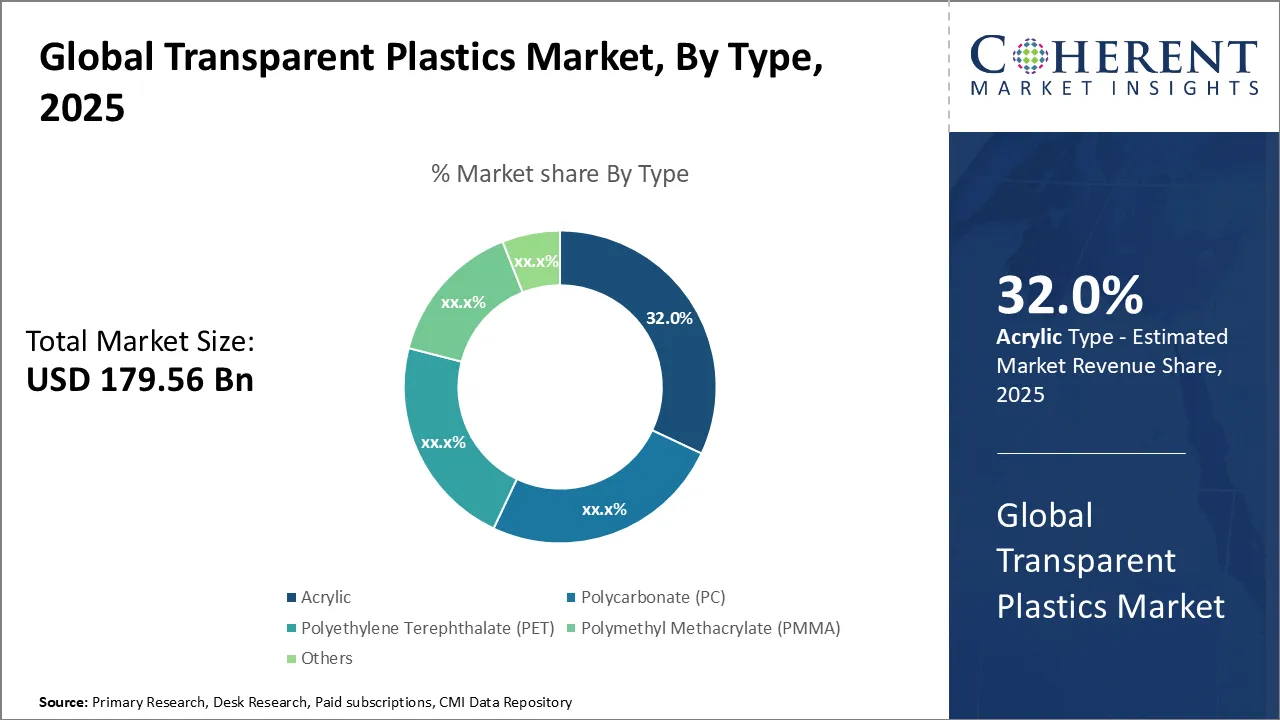
Transparent Plastics Market Insights, By Type: Acrylic contribute the highest share of the market owing to its electronics, displays & consumer goods
Acrylic acquires the largest share of 33.0% in the transparent plastics market with its outstanding optical clarity, durability in various weather conditions, and ease of manufacturing. Manufacturers across construction, automotive, signage, and medical sectors choose acrylic for its strength, lightweight properties, and aesthetic appeal. Companies increasingly use it in LED lighting, display screens, and protective barriers. Innovations in scratch-resistant surfaces and recyclable formulations further boost its attractiveness. Its adaptability enables industries to develop new solutions, reinforcing acrylic’s role in expanding transparent plastic applications.
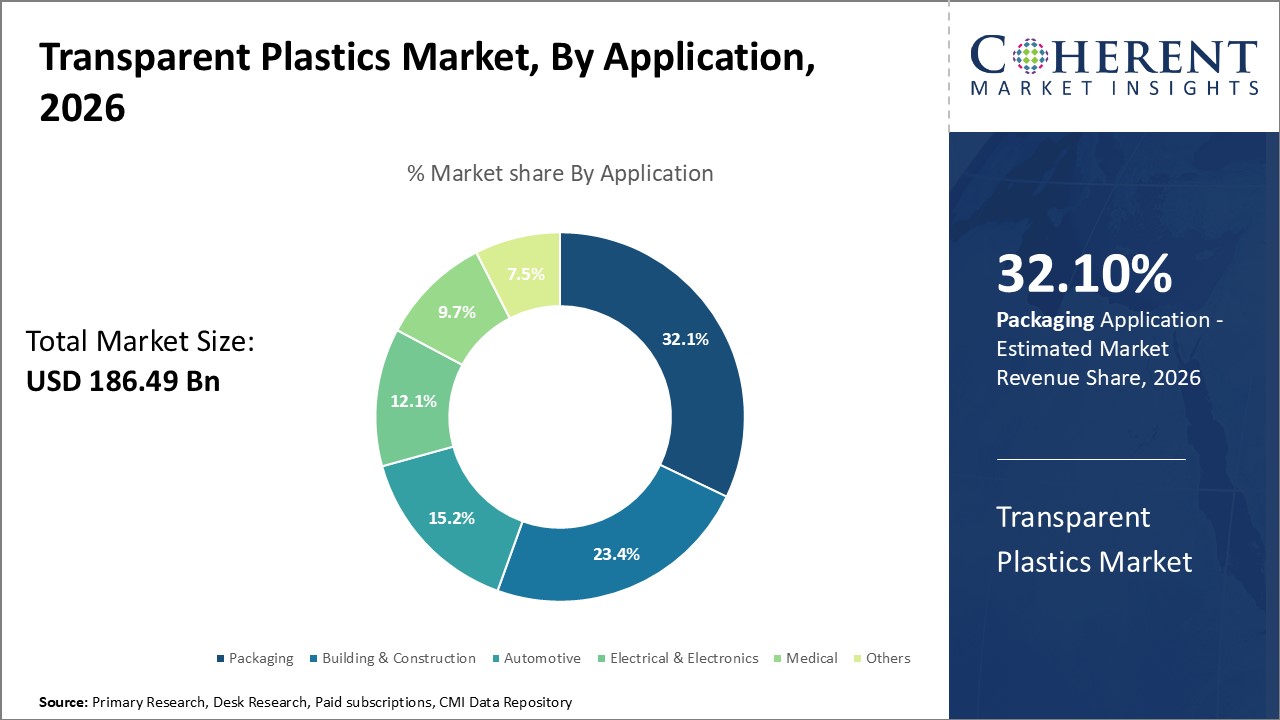
Transparent Plastics Market Insights, By Application: Packaging contributes the highest share of the market owing to its growth in e‑commerce & organized retail
Brands drive the transparent plastics market by choosing materials that offer product visibility, durability, and cost efficiency. Transparent plastics enable consumers to clearly see the contents, building trust and appeal. Their lightweight properties help companies’ lower transportation costs while ensuring product protection. The growth of convenience foods and e-commerce increases the demand for clear and functional packaging designs. Additionally, companies develop recyclable and sustainable plastic options to meet rising environmental demands, actively promoting transparent plastics as both effective and eco-friendly packaging solutions. For instance, After over five years of research and development with European scientists, French company Reborn (formerly Excelrise), which specializes in recycled flexible plastic packaging, has launched France’s first plastic film de-inking line. Installed at its Ogeu-les-Bains site in the Pyrénées-Atlantiques, the new line now allows printed plastic films to be de-inked and recycled into transparent films.
Transparent Plastics Market Insights, By End-User Industry: Food & Beverage contribute the highest share of the market owing to its sustainability trends & material innovations
The food and beverage sector drives demand for transparent plastics by focusing on product freshness, safety, and clear consumer visibility. Transparent packaging lets customers easily inspect products, increasing their confidence and likelihood to buy. Manufacturers benefit from its lightweight and durable qualities, which lower shipping costs and protect contents. Growing consumer preference for ready-to-eat and convenience foods further boosts demand. Companies develop sustainable materials and enhance barrier properties to meet food safety requirements while addressing environmental concerns, encouraging broader use across food and beverage applications. For instance, Global brands are increasingly adopting environmentally friendly packaging, particularly in the olive oil sector, where they are using innovative solutions to improve product quality and enhance the consumer experience.
Regional Insights
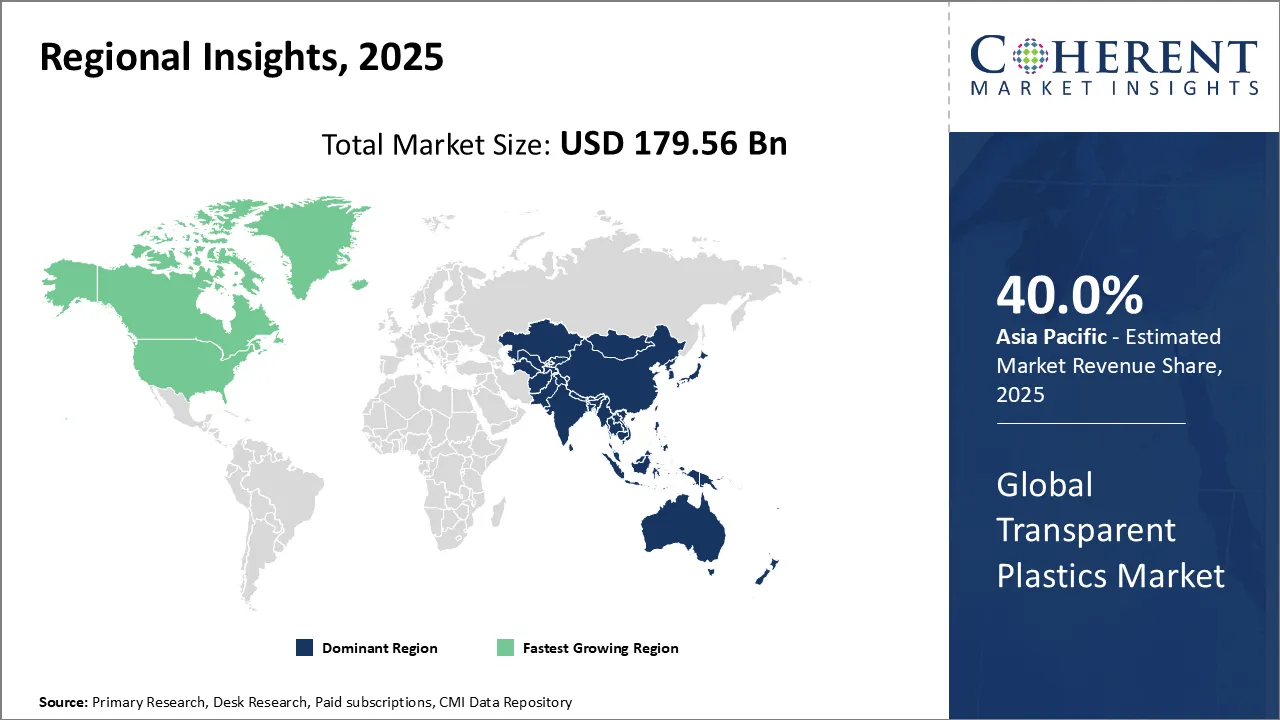
Asia Pacific Transparent Plastics Market
Asia-Pacific dominates the transparent plastics market, accounting for 40.0% of global demand in 2026. Rapid industrialization, urbanization, and rising consumer incomes in countries like China, India, and Japan are key drivers. China’s automotive boom, with vehicle sales projected to reach 32.9 million in 2026, is significantly boosting demand for transparent materials in lighting and interiors. India’s expanding packaging sector is further accelerating growth, supported by manufacturing incentives. Additionally, rising investments in recycled PET and bio-based transparent plastics reflect the region’s push for sustainability. Innovation in functional films and UV-resistant materials also positions Asia-Pacific as a hub for advanced plastic solutions.
North America Transparent Plastics Market Trends
Sustainability and innovation drive the evolution of North America’s transparent plastics market. Companies in the region actively incorporate recycled materials and develop chemical recycling technologies to meet environmental targets. Growing demand from healthcare, automotive, and construction industries pushes the use of high-performance transparent plastics. The expansion of electric vehicles and smart electronics increases the need for lightweight, durable, and clear materials. Continuous improvements in materials and supportive regulations actively shape market growth and broaden applications across multiple sectors. For instance, Braskem has launched a new polypropylene (PP) grade under its INSPIRE brand, specifically developed to replace polyethylene terephthalate (PET) in consumer food packaging applications that require greater temperature resistance.
Europe Transparent Plastics Market Trends
Manufacturers across Europe are driving the transparent plastics market by focusing on sustainability, innovation, and regulatory compliance. They prioritize developing recyclable and bio-based transparent polymers to achieve environmental goals. Industries like automotive, healthcare, and packaging continue to demand materials with clarity, strength, and lightweight characteristics. Advances in polymer chemistry are enhancing thermal resistance and durability. Additionally, European companies actively invest in circular economy initiatives to minimize waste and support closed-loop recycling systems. For instance, UK based, Nichols PLC has announced the rollout of fully recyclable clear plastic bottles for its Levi Roots Caribbean Crush range, along with refreshed labeling. The company says switching from green to clear bottles will make the products easier for consumers to spot on shelves and better emphasize their recyclability.
United States Transparent Plastics Market Trends
Sustainability and technological innovation drive the advancement of the United States transparent plastics market. Companies focus on creating recyclable and bio-based plastics to comply with strict environmental regulations and satisfy consumer demand. The healthcare and automotive industries boost market growth by demanding high-quality, durable, and clear materials. The rise of e-commerce increases the need for lightweight and protective packaging solutions. Manufacturers continually improve material performance, while government support actively encourages the widespread adoption of transparent plastics across diverse applications throughout the country. For instance, the Procter & Gamble Co. (P&G), headquartered in Cincinnati, has launched the Fairy Ocean Plastic bottle, made entirely from post-consumer recycled (PCR) plastic and ocean plastic. With this initiative, P&G aims to raise awareness about ocean plastic pollution and highlight actions that can prevent plastic from entering the oceans.
New Jersey Transparent Plastics Market Trends
Manufacturers in New Jersey are driving significant changes in the transparent plastics market by responding to rising demand in packaging, medical devices, and consumer goods. They are developing lightweight, durable, and recyclable materials to meet sustainability goals and comply with regulations. Companies are also advancing high-clarity polymers like polycarbonate and acrylics for use in electronics and automotive interiors. To boost production efficiency and address growing regional demand, local firms are investing in modern extrusion and molding technologies. For instance, As You Sow has announced the launch of the Plastic Solutions Investor Alliance, an international coalition of investors formed to engage publicly traded consumer goods companies on the risks associated with plastic waste and pollution.
Market Report Scope
Transparent Plastics Market Report Coverage
| Report Coverage | Details | ||
|---|---|---|---|
| Base Year: | 2025 | Market Size in 2026: | USD 186.49 Bn |
| Historical Data for: | 2020 To 2024 | Forecast Period: | 2026 To 2033 |
| Forecast Period 2026 to 2033 CAGR: | 3.9% | 2033 Value Projection: | USD 243.11 Bn |
| Geographies covered: |
| ||
| Segments covered: |
| ||
| Companies covered: | Dow Inc., Covestro AG, Eastman Chemical Company, SABIC, Arkema S.A., Mitsubishi Chemical Corporation, Evonik Industries AG, Sumitomo Chemical Co., Ltd., Teijin Limited, LG Chem Ltd. | ||
| Growth Drivers: |
| ||
| Restraints & Challenges: |
| ||
Transparent Plastics Market Trend
- Shift Toward Biodegradable and Bio-based Plastics
The market is witnessing a growing trend toward developing transparent plastics derived from renewable resources. This shift is driven by increasing environmental regulations and consumer demand for sustainable products. Manufacturers are investing in bio-based polymers that offer transparency comparable to traditional plastics but with reduced ecological footprints. This trend is reshaping product design and supply chains, encouraging innovations that blend transparency with biodegradability and compost ability for packaging, consumer goods, and medical applications.
Transparent Plastics Market Opportunity
- Expansion into Healthcare and Medical Devices
Transparent plastics present vast opportunities in the healthcare sector, especially for medical devices, diagnostic equipment, and pharmaceutical packaging. Their clarity aids in precise monitoring and containment, while their lightweight and sterilizable nature enhances usability and safety. As demand grows for more durable, biocompatible, and transparent materials, manufacturers can innovate tailored solutions that improve patient care and comply with strict regulatory standards, driving market growth.
Transparent Plastics Market News
- In March 2025, Borealis expanded its thermoforming portfolio by introducing HC609TF, a high-stiffness polypropylene (PP) homopolymer developed for packaging applications. This new material delivers a blend of transparency, improved stiffness, and excellent processability, making it well-suited for products that require both high performance and visual appeal.
Analyst Opinion (Expert Opinion)
- The transparent plastics market is poised at a critical inflection point driven by innovation rather than mere volume growth. From my perspective, the industry’s future hinges less on expanding production and more on material science breakthroughs addressing long-standing limitations like UV stability and environmental impact. For instance, Eastman’s development of Tritan™ copolyester, known for its BPA-free composition and dishwasher durability, exemplifies how performance-focused innovation drives adoption in premium consumer goods.
- The real game-changer will be the integration of bio-based polymers that do not compromise optical clarity—an area still in nascent stages but showing promise. NatureWorks’ Ingeo PLA has made strides but remains constrained by brittleness and limited heat resistance. If companies solve these issues, transparent plastics could revolutionize packaging and medical sectors, especially amid increasing regulatory pressures on single-use plastics.
- One cannot ignore the growing consumer and legislative demand for sustainability, forcing companies to rethink the entire lifecycle of transparent plastics. The success of brands like Patagonia, which pioneered recycled plastics in outdoor gear, signals rising consumer intolerance for opaque environmental claims. Transparent plastics manufacturers must embrace circular economy principles or risk obsolescence.
Speak to the analyst
Want personalized insights?
Take the findings above to one of our principal consultants, or have the report rebuilt around the segments, geographies and competitors you actually track.
Market Segmentation
- Global Transparent Plastics Market, By Type (Revenue, USD Bn, 2021 - 2033)
- Polycarbonate
- Acrylic
- Polyethylene terephthalate (PET)
- Polymethyl methacrylate (PMMA)
- Others
- Global Transparent Plastics Market, By Application (Revenue, USD Bn, 2021 - 2033)
- Packaging
- Building & Construction
- Automotive
- Electrical & Electronics
- Medical
- Others
- Global Transparent Plastics Market, End Use Industry
- Food & Beverage
- Healthcare
- Automotive
- Construction
- Others
- Global Transparent Plastics Market, By Region (Revenue, USD Bn, 2021 - 2033)
- North America
- U.S.
- Canada
- Latin America
- Brazil
- Argentina
- Mexico
- Rest of Latin America
- Europe
- Germany
- U.K.
- Spain
- France
- Italy
- Russia
- Rest of Europe
- Asia Pacific
- China
- India
- Japan
- Australia
- South Korea
- ASEAN
- Rest of Asia Pacific
- Middle East
- GCC Countries
- Israel
- Rest of Middle East
- Africa
- South Africa
- North Africa
- Central Africa
- North America
- Key Players Insights
- Dow Inc.
- Covestro AG
- Eastman Chemical Company
- SABIC
- Arkema S.A.
- Mitsubishi Chemical Corporation
- Evonik Industries AG
- Sumitomo Chemical Co., Ltd.
- Teijin Limited
- LG Chem Ltd.
Sources
Primary Research Interviews
- Senior procurement managers from packaging and automotive industries
- Product development heads from polymer manufacturing companies
- Sustainability officers from FMCG brands using transparent packaging
- R&D specialists in bioplastics and advanced polymer applications
- Distributors and regional suppliers of transparent plastic resins
Databases
- World Bank – Environment and Materials Data
- UN Comtrade Database – Plastics trade flows
- PlasticsEurope Database
- OECD Plastics Outlook
- Statista – Industry-specific consumption patterns
Magazines
- Plastics Technology
- Packaging World
- Modern Plastics India
- Plastics News
- Chemical & Engineering News
Journals
- Journal of Applied Polymer Science
- Polymer Degradation and Stability
- Journal of Plastic Film and Sheeting
- Materials Today Proceedings
- Progress in Polymer Science
Newspapers
- The Economic Times (Industry & Manufacturing section)
- Financial Times (Sustainable Business section)
- The Guardian (Environment and Plastics Pollution features)
- The Hindu BusinessLine (Manufacturing and Materials focus)
- Nikkei Asia (Plastics innovation in Asia-Pacific coverage)
Associations
- Plastics Industry Association (PLASTICS)
- Society of Plastics Engineers (SPE)
- European Plastics Converters (EuPC)
- Indian Plastics Institute (IPI)
- Biodegradable Products Institute (BPI)
Public Domain Sources
- U.S. Food and Drug Administration (FDA) – Regulations on plastic use in food packaging
- European Chemicals Agency (ECHA) – Restrictions on BPA and other additives
- U.S. Environmental Protection Agency (EPA) – Plastic waste guidelines
- Ministry of Environment, Forest and Climate Change (India) – Plastic waste rules
- World Economic Forum – Circular plastics economy insights
Proprietary Elements
- CMI Data Analytics Tool, and Proprietary CMI Existing Repository of information for last 8 years
Get access to 250+ pages report
Every segment, forecast, competitor profile and data table behind the analysis above — available for instant download.
- ESOMAR Member
- ISO 9001:2015 Certified
- D-U-N-S Registered
- GDPR & CCPA Compliant
Missing comfort of reading report in your local language? Find your preferred language:
Transform your Strategy with Exclusive Trending Reports
Frequently Asked Questions
The Transparent Plastics Market is estimated to be valued at USD 186.49 Bn in 2026, and is expected to reach USD 243.11 Bn by 2033.
Increasing demand for lightweight and durable packaging materials is expected to drive the market.
Among region, Asia Pacific is expected to hold a dominant position in the market over the forecast period.
Major players operating in the market include Dow Inc., Covestro AG, Eastman Chemical Company, SABIC, Arkema S.A., Mitsubishi Chemical Corporation, Evonik Industries AG, Sumitomo Chemical Co., Ltd., Teijin Limited, LG Chem Ltd.
The CAGR of the Transparent Plastics Market is projected to be 3.9% from 2026 to 2033.