

Germany Acid Proof Lining Market Size and Share Analysis - 2026 To 2033
The Germany Acid Proof Lining Market is projected to grow at a CAGR of 6.0%, from USD 7.55 Bn in 2026 to USD 11.35 Bn by 2033. The major factors contributing to the growth of the market include the increasing application of corrosion resistant lining systems in industries such as chemical processing, metal manufacturing, power generation, wastewater treatment, pharmaceuticals, and food processing. As per German Chemical Industry Association, the country’s chemical and pharmaceutical industry recorded a sale of EUR 220 Bn in 2025.
Key Takeaways
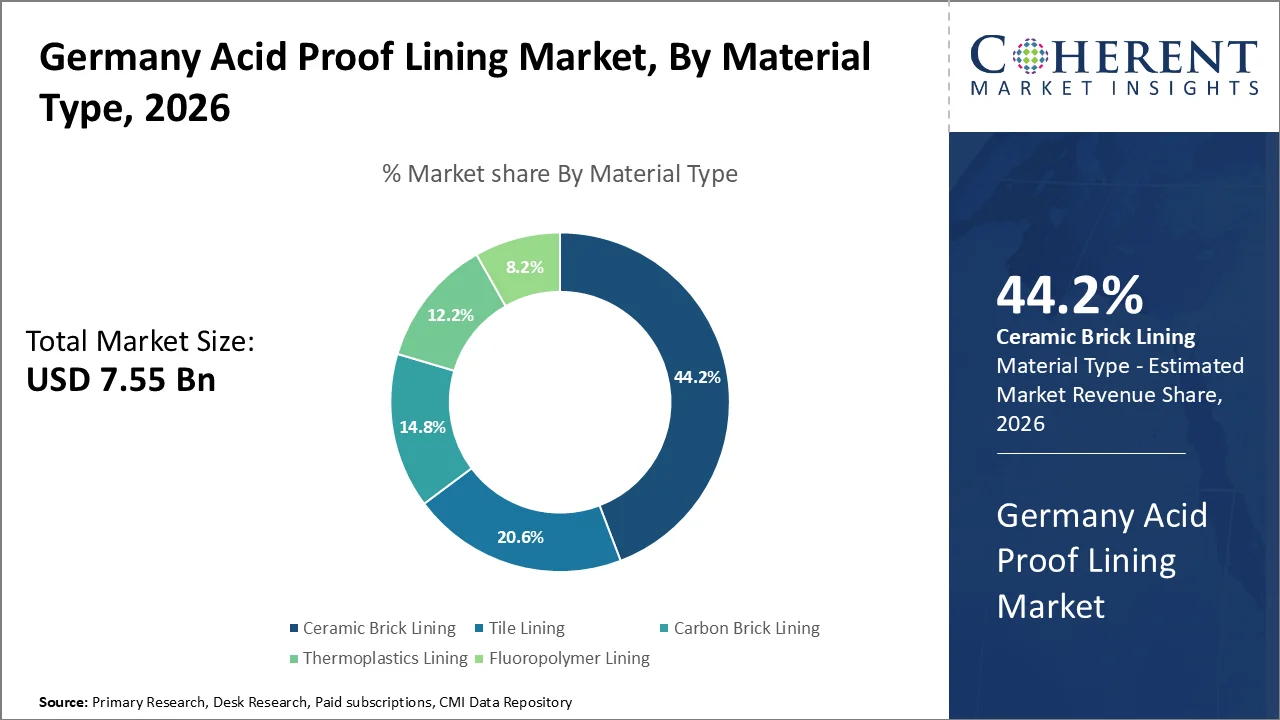
- The ceramic brick lining is expected to hold the largest Germany Acid Proof Lining Market share by 2026, accounting for 44.2%. The growth of the segment will be attributed to its strong resistance to high acids, temperature, abrasion, and long exposure to chemicals, along with wide application in tanks, process vessels, floors, and metal processing plants. In 2024, Germany manufactured 37.2 million tonnes of crude steel, indicating its significant metallurgy and continuous demand for corrosion-resistant systems.
- The chemicals segment is set to lead the Germany Acid Proof Lining market with an estimated 31.6% share in 2026. The segment’s growth is owing to the extensive application of acid-resistant linings in chemical reactors, storage tanks, pipelines, processing floors, drainage systems, and effluent-treatment units exposed to aggressive acids, alkalis, and solvents. Germany’s chemical and pharmaceutical industry generated EUR 240 Bn in sales and employed more than 560,000 people in 2024, demonstrating the large industrial base supporting demand for corrosion-resistant infrastructure.
Market Drivers
Wastewater Infrastructure Modernization is Accelerating Demand for Acid-Proof Linings in Germany
Germany’s ongoing investment in wastewater collection, treatment, and industrial water-management infrastructure is a major driver of the acid-proof lining market. Wastewater facilities frequently handle acidic effluents, treatment chemicals, hydrogen sulphide, sulphuric acid, and other corrosive substances that can damage concrete tanks, drainage channels, sumps, pipelines, and processing floors. Ceramic bricks, acid-resistant tiles, thermoplastic membranes, and resin-based linings are therefore increasingly used to extend infrastructure life and reduce maintenance requirements.
Germany Trade & Invest reported that the German water supply and wastewater disposal sector generated EUR 23.6 billion in turnover in 2025, making it the largest market of its kind in Europe. The country is also accelerating investments in industrial water reuse, greywater recycling, rainwater management, and climate-resilient wastewater systems.
In July 2024, the European Investment Bank signed financing for Hamburg’s sustainable wastewater investment programme. The programme has an estimated total cost of EUR 696 million and covers the replacement, expansion, and rehabilitation of sewer networks, pumping stations, and wastewater-treatment facilities during 2024–2027.
Stricter Industrial-Emission Regulations are Increasing Corrosion-Protection Requirements
Tightening environmental and industrial-safety regulations are encouraging chemical, petrochemical, metallurgy, power-generation, waste-treatment, and pharmaceutical facilities to upgrade containment and pollution-control infrastructure. The acid-resistant linings can assist the industries to avoid chemical leaks, protect surfaces, avoid contamination possibilities, and stay compliant within their reactors, storage tanks, scrubbers, drainage systems, effluent treatment facilities, and secondary containment facilities.
The EU Industrial and Livestock Farming Emission Directive was amended and took effect on August 4, 2024. The directive covers around 37,000 big industrial plants in the European Union, and introduces more stringent rules regarding emissions, efficiency, control of hazardous chemicals, and permitting of the environment.
Current Events and Their Impact on the Germany Acid Proof Lining Market
Current Event | Description and its Impact |
Germany Advances National Implementation of the Revised Industrial Emissions Directive (2026) |
|
EU Introduces Stricter Surface-Water and Groundwater Pollution Rules (2026) |
|
- Current Industry Events of 2026
- Market Size Estimation
- Regional Breakdown
- Competitive Landscape
- Customer Intelligence
- Segmental Analysis
- Pricing Analysis
- Key Market Drivers, Challenges & Future Trends
- Customized Insights Section
Segmental Insights
Why is Ceramic Brick Lining Acquiring the Largest Share?
On the basis of material type, the ceramic brick lining segment is projected to account for the largest Germany Acid Proof Lining market share of 44.2% in 2026. The segment’s growth is owing to its high chemical resistance, mechanical strength, abrasion resistance, thermal stability, and suitability for protecting concrete and steel structures exposed to concentrated acids, solvents, wastewater, and fluctuating operating temperatures.
Recent technical developments are strengthening the use of multilayer ceramic brick systems. In January 2026, Germany-based Steuler-KCH introduced updated technical specifications for its DIBt-approved OXYDUR VEL SR PROTECT 2 system, which combines a chemically resistant, crack-bridging laminate with 15–115 mm acid-resistant ceramic bricks, tiles, or porcelain stoneware. The system’s sealing layer can bridge cracks of up to 0.4 mm and provides flexural and tensile strengths of 140 MPa and 60 MPa, respectively.
Chemicals Hold the Largest Market Share
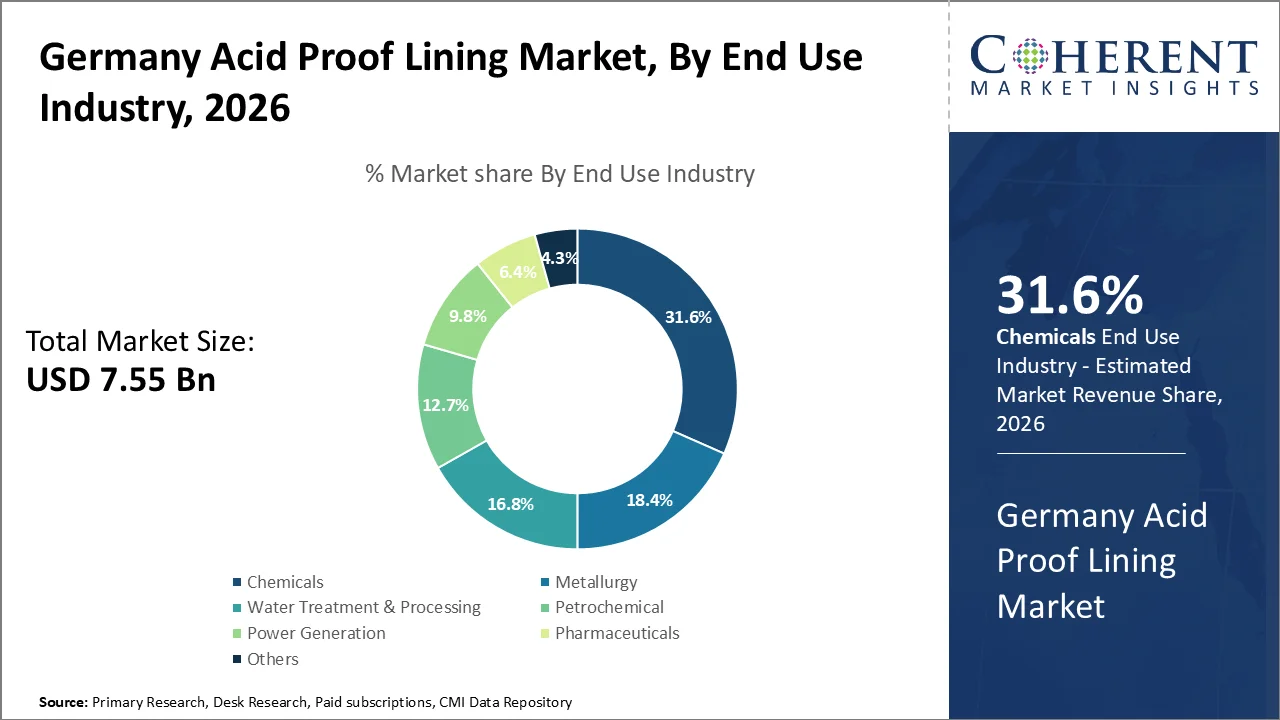
On the basis of end-use industry, the chemicals segment is projected to lead the Germany Acid Proof Lining market with an estimated 31.6% share in 2026. The segment’s growth is owing to the extensive use of acids, alkalis, solvents, and other aggressive media in reactors, process vessels, storage tanks, pipelines, scrubbers, production floors, wastewater channels, and secondary-containment systems.
The German chemical and pharmaceutical industry generated EUR 50.9 billion in revenue during the first quarter of 2026, representing a 2.1% increase from the preceding quarter.
In April 2026, BASF officially launched two newly built world-scale production plants for menthol and linalool at its Ludwigshafen Verbund site in Germany. Commercial production began during April 2026, supported by an investment in the triple-digit million-euro range and the creation of 60 new jobs.
Germany Acid Proof Lining Market Trends
- Increased utilization of lithium-ion battery recycling leads to an increased need for chemical resistant lining systems at places like battery dismantling areas, metal recovery sections, tanks, floors, drainage, and secondary containment facilities. In June 2025, BASF started up its Schwarzheide black mass recycling facility, which can handle up to 15,000 tons of end-of-life batteries and production scrap per year, which is equal to about 40,000 electric vehicle batteries.
- The increasing use of chemical recycling technology has led to the emergence of new uses for acid-resistant linings in catalytic reactors, pyrolysis reactors, feedstock tanks, drainage facilities, and chemical containment facilities. The MoReTec plant from LyondellBasell at Wesseling, Germany, has been built with a capacity of 50,000 metric tons of recycled capacity per year and is capable of recycling plastic packaging waste from over 1.2 million Germans. The project has been chosen for a EUR 40 million Innovation Fund grant from the European Union.
- The expansion of semiconductor manufacturing is strengthening demand for high-purity, chemical-resistant floors, drains, tanks, ducts, and wastewater-handling systems. Semiconductor fabrication involves acids, solvents, etching chemicals, and ultrapure-water processes that require reliable protection against chemical leakage and surface degradation. The European Semiconductor Manufacturing Company is developing an advanced fab in Dresden with investment exceeding EUR 10 billion, planned production capacity of 480,000 wafers annually, and approximately 2,000 direct high-technology jobs.
Who are the Major Companies in Germany Acid Proof Lining Industry
Some of the major key players in Germany Acid Proof Lining Market are Steuler-Kch GmbH, AGRU Kunststofftechnik GmbH, Simona AG, Nittel GmbH & Co. KG, Christen & Laudon, Hurner-Funken GmbH, SKO Saureschutz und Kunststoffbau GmbH, GBT-BUCOLIT GmbH, Knapper Oberflächentechnik GmbH, and A-SPT Protective Solutions GmbH & Co. KG.
Key News
- In February 2025, Jasmino Corporation announced the acquisition of GBT-BUCOLIT GmbH and HAW Linings. GBT-BUCOLIT specialises in heavy-duty corrosion-protection coatings, plastic linings, equipment engineering, fabrication, on-site installation, and maintenance services.
- In May 2026, HUrner Luft- und Umwelttechnik GmbH, formerly associated with the Hurner-Funken name, presented a plastic air-handling unit with an integrated scrubber, heat-recovery system, energy-efficient EC fan, and sound enclosure at SurfaceTechnology Germany in Stuttgar.
Market Report Scope
Germany Acid Proof Lining Market Report Coverage
| Report Coverage | Details | ||
|---|---|---|---|
| Base Year: | 2025 | Market Size in 2026: | USD 7.55 Bn |
| Historical Data for: | 2020 To 2024 | Forecast Period: | 2026 To 2033 |
| Forecast Period 2026 to 2033 CAGR: | 6.0% | 2033 Value Projection: | USD 11.35 Bn |
| Segments covered: |
| ||
| Companies covered: | Steuler-Kch GmbH, AGRU Kunststofftechnik GmbH, Simona AG, Nittel GmbH & Co. KG, Christen & Laudon, Hurner-Funken GmbH, SKO Säureschutz und Kunststoffbau GmbH, GBT-BUCOLIT GmbH, Knapper Oberflächentechnik GmbH, and A-SPT Protective Solutions GmbH & Co. KG. | ||
| Growth Drivers: |
| ||
| Restraints & Challenges: |
| ||
Analyst Opinion
- The Germany Acid Proof Lining market is increasingly becoming a compliance- and risk-management-driven market rather than being dependent only on new industrial construction. In 2024, Germany had 1,542 cases of accidents involving water-hazardous materials, where around 6.5 million liters of pollutants were spilled out. The ongoing threat of spillage is one reason why there is continuous demand for chemical-resistant flooring, tanks, pits, drainage systems, and containment liners.
- The market is expected to remain largely maintenance- and refurbishment-oriented, as lining systems require periodic inspection, joint repair, relining, and replacement throughout the operating life of chemical and industrial assets. The country’s industrial production grew 0.9% on a monthly basis in May 2026, and production for energy-intensive industries increased 3.2% in March through May 2026, when compared to the previous quarter. Greater use of facilities that rely on chemicals exposes these plants to acid, solvents, thermal stress, and abrasion, favoring demand for linings.
- Analysts expect suppliers offering approved multilayer systems, technical installation, inspection, and lifecycle maintenance to outperform material-only vendors. EU environmental-protection investment reached an estimated EUR 79 billion in 2025, representing a 37% increase compared with 2014. This broader investment trend is likely to favour German providers of ceramic brick, thermoplastic, fluoropolymer, resin, and combined lining systems that meet strict chemical-containment and environmental-performance requirements.
Speak to the analyst
Want personalized insights?
Take the findings above to one of our principal consultants, or have the report rebuilt around the segments, geographies and competitors you actually track.
Market Segmentation
- By Material Type (Revenue, USD Bn, 2021-2033)
- Ceramic Brick Lining
- Carbon Brick Lining
- Tile Lining
- Thermoplastics Lining
- Fluoropolymer Lining
- By End Use Industry (Revenue, USD Bn, 2021-2033)
- Power Generation
- Chemicals
- Pharmaceuticals
- Petrochemical
- Metallurgy
- Steel Manufacturing
- Aluminum Manufacturing
- Others
- Water Treatment & Processing
- Sewage and Waste Water
- Process Water
- Others
Sources
Primary Research Interviews
- Acid-proof lining manufacturers and system suppliers
- Industrial corrosion-protection specialists
- Ceramic brick, tile, thermoplastic, and fluoropolymer material experts
- Project engineers and plant-maintenance managers
- Chemical and petrochemical facility procurement managers
- Wastewater-treatment and industrial water-management professionals
- Metallurgy, power-generation, pharmaceutical, and battery-recycling experts
- Installation contractors, applicators, and inspection specialists
- Key opinion leaders in industrial coatings, linings, and chemical containment
Databases
- German Federal Statistical Office (Destatis)
- Eurostat
- World Bank
- Organisation for Economic Co-operation and Development (OECD)
- Germany Trade & Invest (GTAI)
- European Investment Bank (EIB)
- European Chemicals Agency (ECHA)
- European Environment Agency (EEA)
- German Environment Agency (Umweltbundesamt)
- German Institute for Building Technology (DIBt)
Magazines
- Chemical Engineering
- Chemical Processing
- European Coatings Journal
- World Pipelines
- Water & Wastewater International
- Process Worldwide
- Chemie Technik
- Materials Performance
Journals
- Progress in Organic Coatings
- Corrosion Science
- Construction and Building Materials
- Surface and Coatings Technology
- Journal of Coatings Technology and Research
- Materials and Corrosion
- International Journal of Corrosion
- Journal of Environmental Chemical Engineering
Newspapers and Business Publications
- Handelsblatt
- Financial Times
- Reuters
- Frankfurter Allgemeine Zeitung
- Die Welt
- Chemical Week
- ICIS Chemical Business
- European Chemical News
Associations
- German Chemical Industry Association (VCI)
- German Steel Association (WV Stahl)
- European Federation of Corrosion (EFC)
- Association for Materials Protection and Performance (AMPP)
- European Chemical Industry Council (Cefic)
- German Association for Water, Wastewater and Waste (DWA)
- DECHEMA Society for Chemical Engineering and Biotechnology
- European Industrial Insulation Foundation
- European Federation of Chemical Engineering
- International Concrete Repair Institute
Public-Domain Sources
- Company annual reports and investor presentations
- Company product catalogues and technical datasheets
- DIBt approvals and construction-product certifications
- EU industrial-emissions and water-protection regulations
- German federal and state environmental-policy publications
- Publicly available industrial-project announcements
- Wastewater infrastructure and chemical-plant investment reports
- Patent databases such as WIPO, EPO, USPTO, and Google Patents
- Trade-fair announcements from ACHEMA, IFAT, and SurfaceTechnology Germany
- Company press releases covering product launches, acquisitions, and facility expansions
Proprietary Elements
- CMI Data Analytics Tool
- Proprietary CMI Existing Repository of Information for the Last 10 Years
Get access to 250+ pages report
Every segment, forecast, competitor profile and data table behind the analysis above — available for instant download.
- ESOMAR Member
- ISO 9001:2015 Certified
- D-U-N-S Registered
- GDPR & CCPA Compliant
Missing comfort of reading report in your local language? Find your preferred language:
Transform your Strategy with Exclusive Trending Reports
Frequently Asked Questions
The Germany Acid Proof Lining market is expected to reach USD 11.35 Bn by 2033, compared with USD 7.55 Bn in 2026.
Major players include Steuler-Kch GmbH, AGRU Kunststofftechnik GmbH, Simona AG, Nittel GmbH & Co. KG, Christen & Laudon, Hurner-Funken GmbH, SKO Säureschutz und Kunststoffbau GmbH, GBT-BÜCOLIT GmbH, Knapper Oberflächentechnik GmbH, and A-SPT Protective Solutions GmbH & Co. KG.
High initial material and installation costs, the requirement for skilled and certified installers, complex surface preparation, installation-related production downtime, and the risk of cracking or delamination are key factors hampering market growth.
Increasing demand for corrosion protection in chemical and petrochemical facilities, modernization of wastewater-treatment infrastructure, stricter environmental regulations, and rising maintenance of aging industrial assets are driving market growth.
The Germany Acid Proof Lining market is anticipated to grow at a CAGR of 6.0% between 2026 and 2033.
The ceramic brick lining segment is projected to dominate the market with an estimated 44.2% share in 2026, supported by its chemical resistance, mechanical strength, abrasion resistance, and thermal stability.
The chemicals segment is projected to lead the market with an estimated 31.6% share in 2026, owing to the extensive use of acid-proof linings in reactors, tanks, pipelines, scrubbers, floors, and containment systems.