

Natural Biomaterials Market Size and Forecast: 2026-2033
The Natural Biomaterials Market is anticipated to grow at a CAGR of 4.8% with USD 86.7 Bn in 2026 and is expected to reach USD 103.3 Bn in 2033. The Natural Biomaterials Market is driven by rising demand for sustainable and biodegradable materials, increasing healthcare applications, and growing environmental awareness.
Key Takeaways:
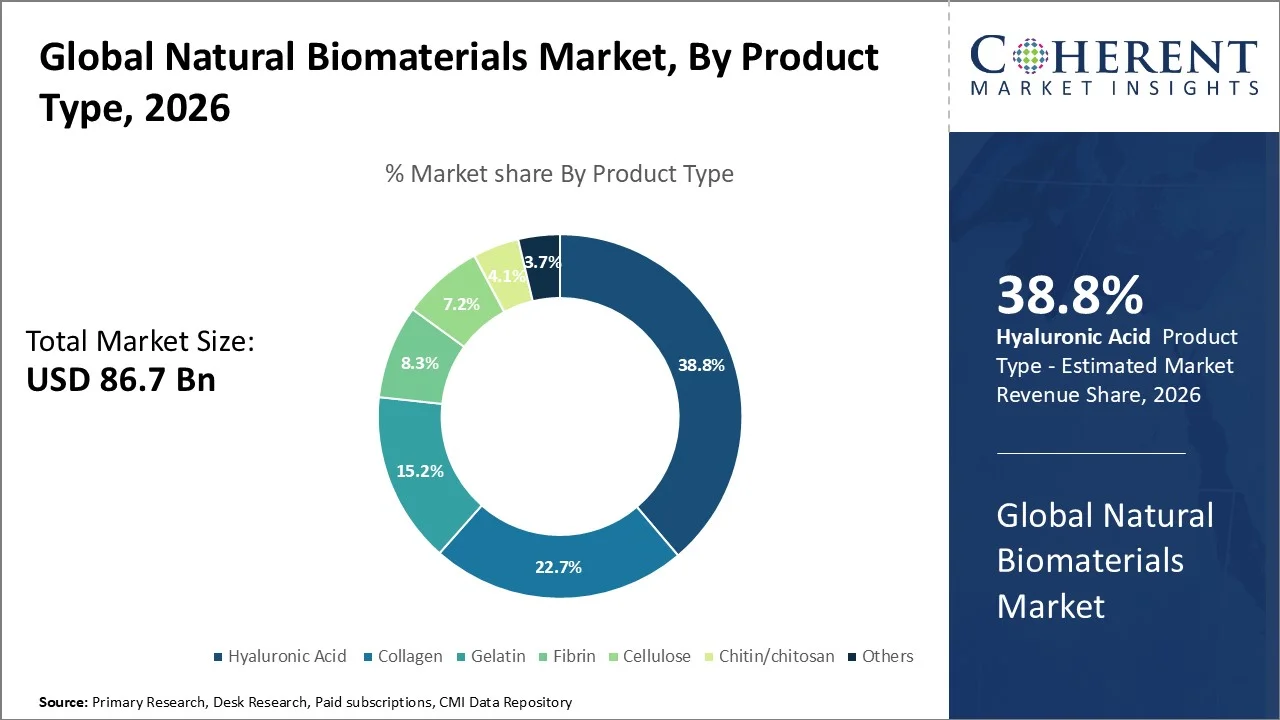
- Hyaluronic Acid holds the largest market share of 38.8% in 2026 owing to the rising demand for minimally invasive aesthetic procedures.
Hyaluronic acid is widely used across medical and cosmetic applications, with over 4.6 million aesthetic procedures performed using HA-based biomaterials in 2024 alone. - Cardiovascular acquired the prominent market share of 34.3% in 2026 owing to its growing demand for biocompatible vascular grafts and implants. Natural biomaterials are heavily used in regenerative medicine and cardiovascular implants, with over 72% of regenerative grafts incorporating materials such as collagen, fibrin, and hyaluronic acid.
- Asia Pacific is expected to acquire the dominant share of 41.2% in 2026 owing to the growing burden of chronic diseases. According to PubMed Central, around 21% of elderly individuals in India have at least one chronic condition.
Current Events and Their Impact on the Natural Biomaterials Market
Current Event | Description and its Impact |
EU Packaging and Packaging Waste Regulation (PPWR) – 2025 Update |
|
EU Single-Use Plastics Directive Enforcement Expansion |
|
Segmental Insights
- Current Industry Events of 2026
- Market Size Estimation
- Regional Breakdown
- Competitive Landscape
- Customer Intelligence
- Segmental Analysis
- Pricing Analysis
- Key Market Drivers, Challenges & Future Trends
- Customized Insights Section
Why is Hyaluronic Acid Acquiring the Largest Market Share?
Hyaluronic Acid holds the largest market share of 38.8% in 2026 owing to the shift toward microbial fermentation production. Rising demand for minimally invasive aesthetic procedures drives the use of hyaluronic acid in the natural biomaterials market, while expanding applications in regenerative medicine and a growing preference for biocompatible and biodegradable materials further accelerate its adoption. Industries actively use it across dermatology, orthopedics, ophthalmology, and wound care to support growth.
This dominance is supported by strong clinical and commercial adoption, globally, over 4 million hyaluronic acid–based dermal filler procedures are performed annually, making it one of the most widely used biomaterials in aesthetic medicine. In orthopedics, more than 10 million viscosupplementation injections are administered each year worldwide for osteoarthritis treatment, highlighting its therapeutic importance. Additionally, in ophthalmology, hyaluronic acid is used in over 90% of cataract surgeries as a viscoelastic agent, demonstrating its critical role in surgical procedures.
An aging population further fuels demand, as over 1 billion people globally were aged 60+ in 2023, increasing the prevalence of osteoarthritis and skin aging conditions that require HA-based treatments. Technological advancements, including cross-linked formulations and microbial fermentation, are also enhancing scalability, over 90% of commercially produced hyaluronic acid is now derived from microbial fermentation, improving purity, safety, and large-scale production efficiency.
For instance, in September 2025, Allergan Aesthetics, an AbbVie company, has launched the “Naturally You with Injectable Hyaluronic Acid Fillers” campaign to provide clear, factual education about HA injectable fillers. The initiative corrects misinformation and improves understanding while highlighting the safe, natural-looking results achievable with hyaluronic acid injectables.
Cardiovascular holds the Largest Market Share
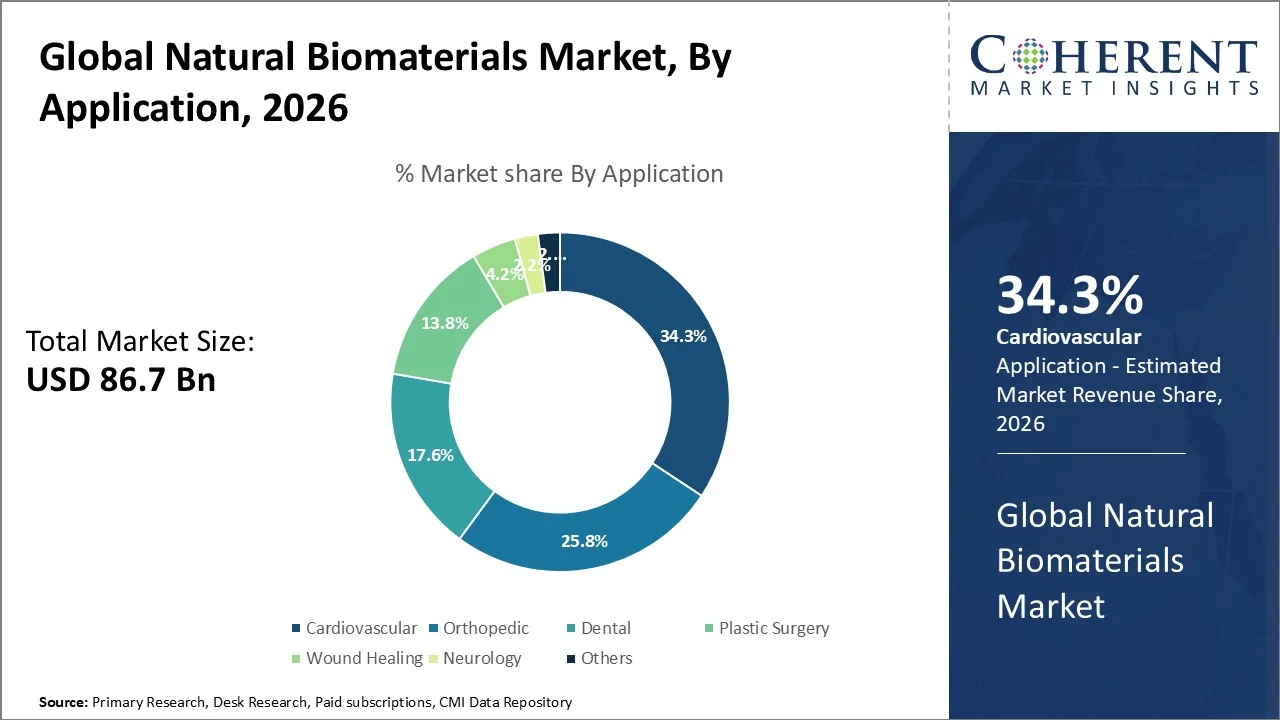 Cardiovascular acquired the prominent market share of 34.3% in 2026. The rising prevalence of cardiovascular diseases increases demand for natural biomaterials in vascular grafts, heart valves, and cardiac repair solutions. Healthcare providers prefer biocompatible and bioresorbable materials to minimize complications and improve patient outcomes. Advancements in minimally invasive procedures and tissue engineering drive adoption in cardiac care. An aging population and better healthcare access boost surgical volumes, while continuous research and innovation improve the performance and reliability of natural biomaterials in cardiovascular applications.
Natural Biomaterials Market Trends
- Rising demand for minimally invasive procedures such as MIGS and microincisional surgeries improves safety and shortens recovery time, increasing the adoption of natural biomaterials in ophthalmic applications. Globally, over 28 million cataract surgeries are performed each year, with a growing shift toward minimally invasive techniques, directly increasing the use of biomaterials such as hyaluronic acid–based viscoelastics and collagen scaffolds.
- Growing use of personalized eye surgeries with customized intraocular lenses and ocular implants enhances visual outcomes and patient satisfaction, supporting demand for advanced biomaterials. More than 4 million intraocular lenses (IOLs) are implanted annually in the United States alone, with increasing adoption of premium and customized lenses that rely on biocompatible materials to improve outcomes.
Regional Insights
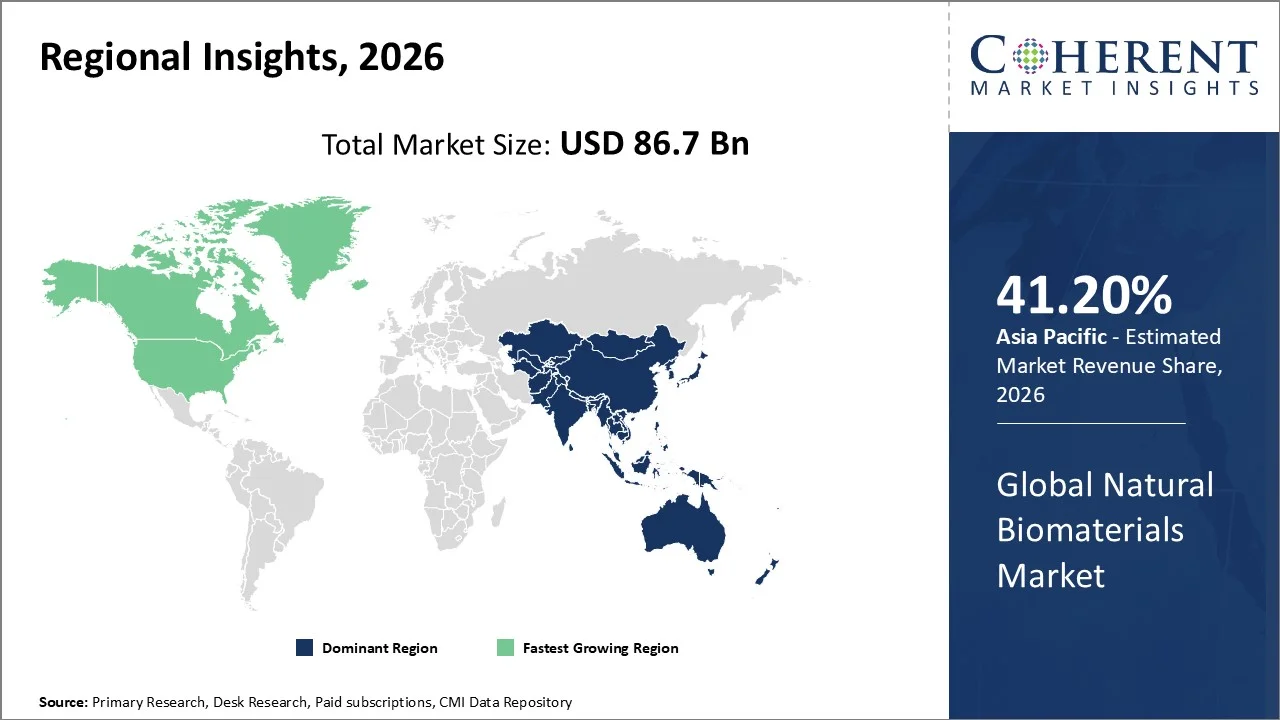
Asia Pacific dominates owing to expanding regenerative medicine & tissue engineering
Asia Pacific is expected to acquire the dominant share of 41.2% in 2026. The Asia Pacific region drives growth in the natural biomaterials market through rapid expansion of healthcare infrastructure and increased healthcare spending. Its large population and rising prevalence of chronic diseases boost demand for implants, tissue repair, and regenerative therapies. An aging population and higher surgical volumes further strengthen market expansion. Governments improve healthcare access and promote medical tourism, while technological advancements and growing local manufacturing enhance the availability and affordability of natural biomaterials. For instance, in April 2025, Covation Biomaterials LLC (“CovationBio®”), a biomaterials company with advanced expertise in bio-based materials, introduced, CovationBio bioPTMEG. This advanced, sustainable polytetramethylene ether glycol (PTMEG) delivers high performance while significantly reducing environmental impact.
North America Natural Biomaterials Market Trends
Advanced healthcare infrastructure and high healthcare spending drive the natural biomaterials market in North America. Healthcare providers increase demand for biocompatible materials across orthopedics, cardiovascular care, and wound management. Growing adoption of minimally invasive procedures and regenerative medicine accelerates usage. An aging population and rising prevalence of chronic diseases boost surgical interventions. Ongoing research, technological innovation, and the strong presence of leading biomaterial companies strengthen the market, while favorable reimbursement policies expand access to advanced biomaterial-based treatments. For instance, in September 2025, IFF, a global leader in flavors, fragrances, and biosciences, announced the first large-scale commercial application of its Designed Enzymatic Biomaterials (DEB) platform. A major CPG company has launched a laundry detergent using this technology, improving cleaning and fabric softness while replacing non-biodegradable ingredients with biodegradable biomaterials.
Japan Natural Biomaterials Market Trends
Japan drives the natural biomaterials market through its advanced healthcare system and strong focus on medical innovation. A rapidly aging population significantly increases demand for biomaterials across orthopedics, cardiovascular care, and regenerative medicine. Notably, Japan has the world’s oldest population, with 29.3% of its population aged 65 and above (around 36.25 million people in 2024), and this is projected to reach nearly 40% by 2060, creating sustained demand for age-related treatments and biomaterial-based solutions.
United States Natural Biomaterials Market Trends
Advanced healthcare infrastructure and strong investment in medical innovation drive the natural biomaterials market in the United States. Healthcare providers create high demand for biocompatible materials in orthopedics, cardiovascular treatments, wound care, and regenerative medicine. They widely adopt minimally invasive procedures and advanced surgical technologies, which further increase usage. An aging population and rising prevalence of chronic diseases raise treatment needs. Leading biomaterials companies maintain a strong presence, while ongoing research and favorable reimbursement policies support market expansion and improve accessibility.
Who are the Major Companies in Natural Biomaterials Industry
Some of the major key players in Natural Biomaterials are BASF SE, Biomet, Inc., Invibio Ltd., Mimetis Biomaterials, Royal DSM, Corbion N.V., Botiss Biomaterials GmbH, and Medtronic, Inc.
Key News
- In September 2025, IFF announced the first commercial-scale deployment of its Designed Enzymatic Biomaterials (DEB) platform.
Market Report Scope
Natural Biomaterials Market Report Coverage
| Report Coverage | Details | ||
|---|---|---|---|
| Base Year: | 2025 | Market Size in 2026: | USD 86.7 Bn |
| Historical Data for: | 2020 To 2024 | Forecast Period: | 2026 To 2033 |
| Forecast Period 2026 to 2033 CAGR: | 4.8% | 2033 Value Projection: | USD 103.3 Bn |
| Geographies covered: |
| ||
| Segments covered: |
| ||
| Companies covered: | BASF SE, Biomet, Inc., Invibio Ltd., Mimetis Biomaterials, Royal DSM, Corbion N.V., Botiss Biomaterials GmbH, and Medtronic, Inc. | ||
Analyst Opinion
- The natural biomaterials market is being driven more by clinical necessity than by innovation cycles alone. For example, over 1.7 billion people globally are affected by musculoskeletal conditions, and many of these cases require biomaterial-based interventions such as bone graft substitutes, collagen scaffolds, and tissue repair matrices, showing that demand is structurally embedded in disease burden rather than optional adoption.
- Cardiovascular applications remain one of the most material-intensive segments, with cardiovascular diseases causing an estimated 17.9 million deaths annually worldwide. In clinical practice, biologically derived materials such as collagen-based vascular grafts and decellularized heart valves are increasingly used, especially in pediatric and high-risk patients where synthetic materials often fail due to thrombosis or rejection risks.
- Wound care represents a persistent and expanding use case for natural biomaterials, particularly in chronic conditions. Around 6.7 million people in the United States alone suffer from chronic wounds, and advanced biomaterials like alginate, chitosan, and collagen dressings are widely adopted due to their proven ability to accelerate healing and reduce infection rates compared to conventional dressings.
- Regenerative medicine is also pushing material innovation into real clinical usage rather than experimental stages. Clinical studies in cartilage repair show that hyaluronic acid and collagen-based scaffolds significantly improve tissue regeneration outcomes, with some procedures demonstrating improved functional recovery within months compared to traditional surgical repair methods, reinforcing biomaterials as essential rather than optional in modern therapeutic protocols.
Speak to the analyst
Want personalized insights?
Take the findings above to one of our principal consultants, or have the report rebuilt around the segments, geographies and competitors you actually track.
Market Segmentation
- By Product Type (Revenue, USD Bn, 2021-2033)
- Hyaluronic Acid
- Collagen
- Gelatin
- Fibrin
- Cellulose
- Chitin/chitosan
- Others
- By Application (Revenue, USD Bn, 2021-2033)
- Cardiovascular
- Orthopedic
- Dental
- Plastic Surgery
- Wound Healing
- Neurology
- Neurological Disorders/Central Nervous Systems
- Tissue Engineering
- Ophthalmology
- Others
- By Region (Revenue, USD Bn, 2021-2033)
- North America
- U.S.
- Canada
- Latin America
- Brazil
- Mexico
- Argentina
- Rest of Latin America
- Europe
- Germany
- U.K.
- France
- Italy
- Spain
- Russia
- Rest of Europe
- Asia Pacific
- China
- India
- Japan
- Australia
- South Korea
- ASEAN
- Rest of Asia Pacific
- Middle East
- GCC
- Israel
- Rest of Middle East
- Africa
- South Africa
- Central Africa
- North Africa
- North America
- Key Players
- BASF SE
- Biomet, Inc.
- Invibio Ltd.
- Mimetis Biomaterials
- Royal DSM
- Corbion N.V.
- Botiss Biomaterials GmbH
- Medtronic, Inc.
Sources
Primary Research Interviews
- Academic researchers in biomaterials and tissue engineering
- R&D heads of biomedical device manufacturers
- Product development managers in biopolymer and biomaterial companies
- Clinical researchers working on regenerative medicine applications
- Hospital procurement and biomedical engineering departments
Databases
- PubMed Central (NIH database for biomedical literature)
- ScienceDirect (Elsevier journals collection)
- IEEE Xplore Digital Library (bioengineering and materials research)
- SpringerLink (materials science and biomedical engineering studies)
- Wiley Online Library (biomaterials and life sciences publications)
Magazines
- Biomaterials Science & Engineering focused trade magazines
- Materials Today (biomaterials and nanomaterials sections)
- Scientific American (life sciences and materials innovations)
- Nature Biotechnology feature articles
- Advanced Materials industry insights section
Journals
- Biomaterials
- Acta Biomaterialia
- Journal of Biomedical Materials Research
- Advanced Healthcare Materials
- Materials Science and Engineering:
Newspapers
- The Hindu (science and health innovation coverage)
- The Economic Times (healthcare technology updates)
- The Times of India (medical innovation and biotech news)
- Financial Express (biomedical industry developments)
- Business Standard (life sciences sector coverage)
Associations
- Indian Society for Biomaterials
- International Union of Societies for Biomaterials Science and Engineering (IUSBSE)
- Society for Biomaterials (USA-based scientific body)
- Regenerative Medicine Foundation networks
- Biotechnology Industry Research Assistance Council (BIRAC)
Public Domain Sources
- World Health Organization (WHO) reports on biomaterials in healthcare
- Government of India Ministry of Health & Family Welfare publications
- U.S. National Institutes of Health (NIH) public research data
- European Medicines Agency (EMA) scientific opinions and guidelines
- World Bank health infrastructure and medical innovation datasets
Proprietary Elements
- CMI Data Analytics Tool
- Proprietary CMI Existing Repository of information for last 10 years
Get access to 250+ pages report
Every segment, forecast, competitor profile and data table behind the analysis above — available for instant download.
- ESOMAR Member
- ISO 9001:2015 Certified
- D-U-N-S Registered
- GDPR & CCPA Compliant
Missing comfort of reading report in your local language? Find your preferred language:
Transform your Strategy with Exclusive Trending Reports
Frequently Asked Questions
Global natural biomaterials market was valued at around USD 86.7 Bn in 2026.
Rising prevalence of conditions such as osteoarthritis, rheumatoid arthritis, and sports injuries one of the major factors that is expected to propel growth of the market over the forecast period.
Various development in the gene therapy and medicine industries are some of the main trends in market.
Lack of reimbursement policies and inadequate supply of natural tissues are estimated to restrain the market.
Major players operating in the market include BASF SE, Biomet, Inc., Invibio Ltd., Mimetis Biomaterials, Royal DSM, Corbion N.V., Botiss Biomaterials GmbH, and Medtronic, Inc.
The market is estimated to grow at around 4.8% CAGR in the forecast period.