

India & Middle East Ceramic Membrane Market Size and Share Analysis - 2026 to 2033
The India & Middle east ceramic membrane market is estimated to be valued at USD 1,385.7 Mn in 2026 and expected to reach USD 2,740.1 Mn by 2033, witnessing a CAGR of 10.20% over the forecast period 2026-2033.
Key Takeaways
- Based on Material, the alumina segment is expected to hold 37.2% share of the market in 2026.
- Based on Technology, the ultrafiltration segment is expected to lead the market with 47.8% share in 2026.
- Based on Application, the water & wastewater treatment segment is projected to account for 52.6% share in 2026.
Market Overview
Ceramic membranes are a type of artificial membranes and are used in membrane operations for liquid filtration. They can be used where aggressive media are present by contrast with polymeric membranes. Material types of ceramic membrane include alumina, zirconium oxide, titania, and silicon carbide.
Current Events and their Impacts on the India & Middle East Ceramic Membrane Market
Current Event | Description and its Impact |
India's Industrial Pollution Control Regulations |
|
Technological Advancements in Membrane Manufacturing |
|
Can ceramic membranes solve wastewater challenges across India and the GCC?
India
- Namami Gange pilot projects: Ceramic ultrafiltration (UF) membranes tested for river water purification and municipal wastewater reuse.
- Industrial wastewater treatment: Textile and pharmaceutical clusters in Gujarat and Maharashtra are adopting silicon carbide ceramic membranes for high-strength effluents.
- Food & beverage sector: Breweries and dairies are piloting ceramic MF for clarification and reuse, supported by CPCB discharge compliance.
Middle East
- Saudi Arabia – CERAFILTEC MBRs: Large-scale ceramic membrane bioreactors deployed for municipal wastewater reuse, achieving >90% recovery rates.
- UAE desalination pretreatment: Hybrid systems (ceramic UF + RO) integrated into desalination plants to reduce fouling and extend RO lifespan.
- Partnership projects: Osmoflo and CERAFILTEC expanding ceramic UF adoption in GCC, focusing on industrial cooling and tertiary reuse.
- Current Industry Events of 2026
- Market Size Estimation
- Regional Breakdown
- Competitive Landscape
- Customer Intelligence
- Segmental Analysis
- Pricing Analysis
- Key Market Drivers, Challenges & Future Trends
- Customized Insights Section
Segmental Insights
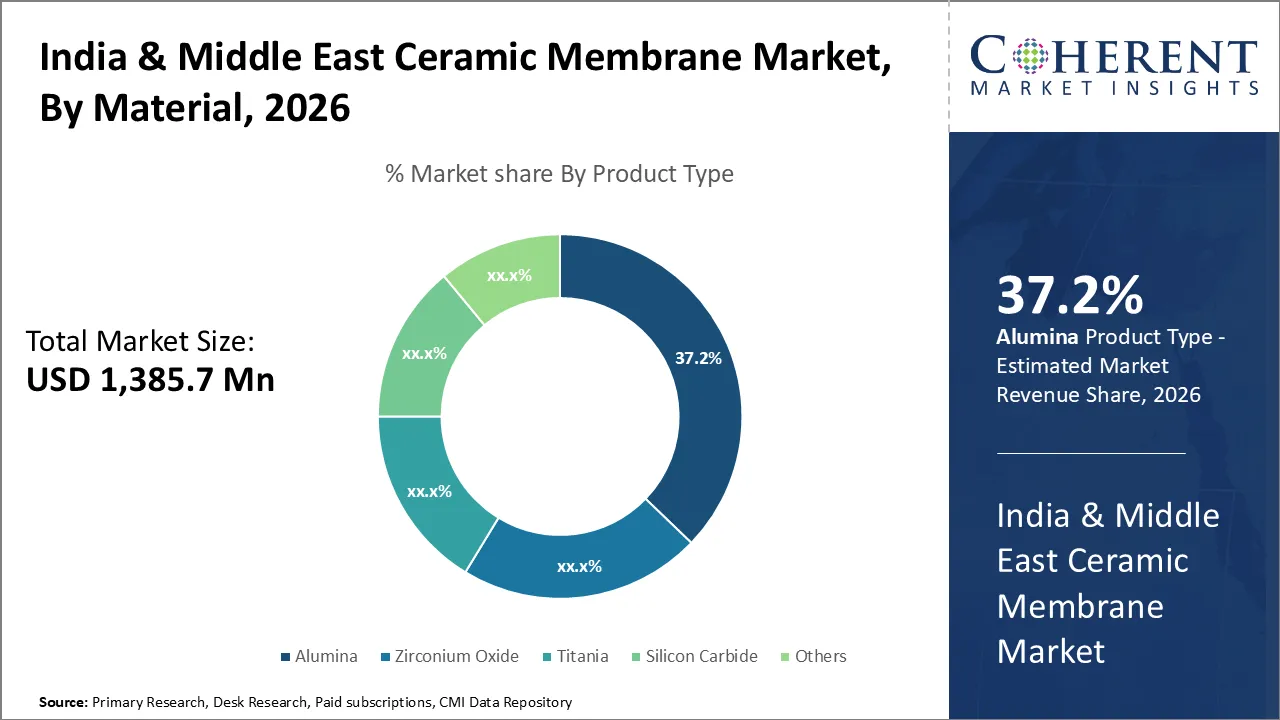
India & Middle East Ceramic Membrane Market Insights, By Material Type: Alumina membranes dominate for their affordability, durability, and broad industrial adaptability
In terms of material type, the alumina segment is expected to hold 37.2% share of the market in 2026, due to their affordability, strength, and resistant to chemicals. They are used in many fields since they work well in filtration processes. They are still the best choice over more expensive options like silicon carbide because they have various application, like cleaning water, processing food, and making chemicals.
For example, QUA Group makes CeraQ ceramic membranes at its factory in Pune, India, in October 2025. These alumina membranes are made in the area and then sent around the world to clean up industrial water and wastewater. The Pune site is a key hub that supports global deployment in industries like textiles, food, oil and gas, and petrochemicals.
Is ultrafiltration driving ceramic membrane growth in India and Middle East?
The ultrafiltration segment is expected to have the largest share of the market in 2026, with 47.8%, owing to its excellency is removing suspended solids, bacteria, and macromolecules. It is extensively being used to treat municipal water, make food and beverages, and make pharmaceuticals. It is widely used because it strikes the right balance between being cost-effective and high-performing.
Does water scarcity and infrastructure investment boost ceramic membrane demand?
In terms of application, the water & wastewater treatment segment is projected to account for 52.6% share in 2026, caused by India's growing cities and the Middle East's severe lack of water. Governments and businesses heavily investing into desalination plants, recycling systems, and city infrastructure. Ceramic membranes are essential for long-term water management solutions because they are strong and last a long time.
Market Report Scope
India & Middle East Ceramic Membrane Market Report Coverage
| Report Coverage | Details | ||
|---|---|---|---|
| Base Year: | 2025 | Market Size in 2026: | USD 1,385.7 Mn |
| Historical Data for: | 2020 To 2024 | Forecast Period: | 2026 To 2033 |
| Forecast Period 2026 to 2033 CAGR: | 10.20% | 2033 Value Projection: | USD 2,740.1 Mn |
| Geographies covered: |
| ||
| Segments covered: |
| ||
| Companies covered: | Pall Corporation, Osmotech Membranes Pvt. Ltd., Hyflux Ltd., Jiangsu Jiuwu Hi-Tech Co. Ltd., CTI-Orelis, Saint-Gobain S.A., Aastropure Systems Pvt. Ltd., H & R Johnson (India), Aquabrane Water Technologies Pvt. Ltd., Aquatech International LLC, and Novasep | ||
| Growth Drivers: |
| ||
| Restraints & Challenges: |
| ||
India & Middle East Ceramic Membrane Market Driver
Water Scarcity & Treatment Needs
Rapid urbanization, population growth, and dry climates are making water problems worse in India and the Middle East. In India, cities that are expanding demand to treat wastewater. In the Middle East, desalination is a big part of getting fresh water.
An increasing number of individuals are using ceramic membranes to make sure that water purification is sustainable. This rising reliance directly boosts India & Middle East ceramic membrane market demand, as businesses and governments seek out long-term ways to keep water safe and use it again.
Industrial Growth
The oil and gas and petrochemical industries in the Middle East, along with India's rapidly growing manufacturing base, are driving the need for strong separation technologies. Ceramic membranes are better than polymeric alternatives at withstanding chemicals, staying stable at high temperatures, and lasting a long time.
In light of these qualities, they are needed to handle difficult industrial tasks. As industries grow, the India & Meddle East ceramic membrane market share is likely to grow. Ceramic membranes account for a larger part of the filtration and separation market in many different fields.
India & Middle East Ceramic Membrane Market Opportunity
Food & Beverage Industry Growth
The food and drink industry in India and the GCC countries is growing quickly, driven by rising consumer demand for processed foods, dairy products, and drinks. Ceramic membranes are used in things like separating milk proteins, clarifying beer, and filtering juice because they can handle harsh conditions and keep cleaning cycles consistent, which keeps the quality of the product.
This trend is likely to have a considerable impact on the India & Middle East ceramic membrane market forecast, showing that large-scale food processing operations have an immense amount of room to grow.
India & Middle East Ceramic Membrane Market Trends
- Shift Toward Sustainable Solutions
Ceramic membranes are growing more popular due to their last longer, are more resistant to chemicals, and are more durable than polymeric membranes.
- Improvements in technology
New ideas in hybrid systems and nanostructured membranes are making things work better and cost less to run.
- Government Initiatives
Policies that support clean water infrastructure and stricter environmental rules are accelerate market growth.
- Regional Collaboration
Partnerships between global tech companies and local businesses are making supply chains stronger and making countries less dependent on imports.
Analyst Opinion (Expert Opinion)
- The India and Middle East ceramic membrane market value has grown substantially since earlier baseline figures, as there is growing demand for advanced filtration solutions in important industrial and municipal settings. Ceramic membranes are being used continually in areas like food and drink, chemical processing, pharmaceuticals, and water and wastewater treatment, reflecting broader investments in infrastructure and environmental rules in India and the Gulf Cooperation Council (GCC) economies that put a premium on separation technologies that are both high-performance and long-lasting. Improved materials like alumina, zirconium oxide, and silicon carbide membranes help performance in tough working conditions, making them more popular in industrial filtration and process purification settings in these areas.
- In India, the need for efficient filtration systems has grown due to rapid industrialization and stricter discharge rules. This has led to a greater use of ceramic membranes in areas like wastewater management and process water purification. In the Middle East, the lack of water and efforts to desalinate it have been major drivers of demand. Membrane systems are key to making water reuse and process efficiency better. In this fast-changing market, both global and domestic manufacturers are competing in the region. They are focusing on product development, strategic partnerships, and expanding their distribution networks to take advantage of new opportunities.
Speak to the analyst
Want personalized insights?
Take the findings above to one of our principal consultants, or have the report rebuilt around the segments, geographies and competitors you actually track.
Recent Developments
- In September 2025, At the Global Water Expo 2025 in Riyadh, CERAFILTEC, a world leader in ceramic membrane technology, showcased its products. The company addresses its advanced ceramic flat membranes solve significant issues in water treatment, which shows the importance of Saudi Arabia in developing this technology.
Market Segmentation
- By Material Type
- Alumina
- Zirconium Oxide
- Titania
- Silicon Carbide
- Others
- By Technology
- Ultrafiltration
- Microfiltration
- Nanofiltration
- Others
- By Application
- Water & Wastewater Treatment
- Food & Beverages
- Chemical & Petrochemical
- Metalworking
- Pharmaceuticals
- Biotechnology
- Pulp & Paper
- Others
- By Region
- India
- Middle East
- GCC
- Israel
- Rest of Middle East
- Key Players
- Pall Corporation
- Osmotech Membranes Pvt. Ltd.
- Hyflux Ltd.
- Jiangsu Jiuwu Hi-Tech Co. Ltd.
- CTI-Orelis
- Saint-Gobain S.A.
- Aastropure Systems Pvt. Ltd.
- H & R Johnson (India)
- Aquabrane Water Technologies Pvt. Ltd.
- Aquatech International LLC
- Novasep
Sources
Primary Research Interviews
- Ceramic Membrane Manufacturers (India & Middle East)
- Membrane Module / Housing & Skid Integrators
- Industrial Water & Wastewater Treatment EPCs
- Oil & Gas / Refinery Utilities & Produced-Water Engineers
- Chemical & Petrochemical Process Engineers (Separation/Recovery)
- Food & Beverage Process & QA Engineers (Filtration/CIP)
- Pharmaceutical & Biotech Process Engineers (Sterile Filtration)
- Power & Energy Plant Water Specialists (Cooling/Boiler/RO Pretreatment)
- Desalination Plant Operators & Consultants (UF/MF Pretreatment)
- Minerals & Metals Process Engineers (Slurry Filtration)
- Others
Databases
- Bloomberg Terminal
- IHS Markit
- Import/Export Trade Databases (e.g., UN Comtrade, ITC Trade Map)
- Company Registries & Financial Filings (e.g., MCA India, local GCC registries)
- Others
Magazines
- Water & Wastewater International
- Water Technology Magazine
- Filtration + Separation
- Chemical Engineering Magazine
- Hydrocarbon Processing
- Power Engineering International
- Others
Journals
- Journal of Membrane Science
- Separation and Purification Technology
- Desalination
- Water Research
- Chemical Engineering Journal
- Journal of Water Process Engineering
- Ceramics International
- Others
Newspapers
- The Economic Times (India)
- Gulf News / Khaleej Times (Middle East)
- Reuters
- Bloomberg News
- Financial Times
- The Wall Street Journal
- Others
Associations
- International Water Association (IWA)
- Water Environment Federation (WEF)
- IDA (International Desalination Association)
- Indian Water Works Association (IWWA)
- GCC Water / Utilities Industry Bodies (regional associations & forums)
- Others
Public Domain Sources
- Central Pollution Control Board (CPCB), India
- Ministry of Jal Shakti (India) & Jal Jeevan Mission / AMRUT program sources
- National Mission for Clean Ganga (NMCG)
- Central Electricity Authority (CEA), India (power/water use references)
- MEWA / Water Authorities & National Utilities (UAE, KSA, Oman, Qatar, etc.)
- World Bank Open Data
- UNIDO / UNEP industrial water publications
- International Energy Agency (IEA) (industrial energy-water linkages)
- Others
Proprietary Elements
- CMI Data Analytics Tool
- Proprietary CMI Existing Repository of Information for the Last 8 Years
Get access to 250+ pages report
Every segment, forecast, competitor profile and data table behind the analysis above — available for instant download.
- ESOMAR Member
- ISO 9001:2015 Certified
- D-U-N-S Registered
- GDPR & CCPA Compliant
Missing comfort of reading report in your local language? Find your preferred language:
Transform your Strategy with Exclusive Trending Reports
Frequently Asked Questions
The global India & Middle East Ceramic Membrane Market size was valued at USD 1,385.7 Mn in 2026 and is expected to reach USD 2,740.1 Mn in 2033.
Water scarcity & treatment needs and industrial growth is expected to drive the market growth during the forecast period.
High initial costs and limited local manufacturing this is expected to hamper the market growth of ceramic membrane over the forecast period.
Major players operating in the market include Pall Corporation, Osmotech Membranes Pvt. Ltd., Hyflux Ltd., Jiangsu Jiuwu Hi-Tech Co. Ltd., CTI-Orelis, Saint-Gobain S.A., Aastropure Systems Pvt. Ltd., H & R Johnson (India), Aquabrane Water Technologies Pvt. Ltd., Aquatech International LLC, and Novasep.