

Nvh Materials Market Size and Forecast — 2026 - 2033
The Global NVH Materials Market size is estimated to be valued at USD 10.2 billion in 2026 and is expected to reach USD 17.5 billion by 2033, exhibiting a compound annual growth rate (CAGR) of 8.2% from 2026 to 2033.
Overview
NVH Materials refers to materials engineered to control Noise, Vibration, and Harshness (NVH) in products such as vehicles, machinery, and industrial equipment. These materials are designed to absorb sound, damp vibrations, and reduce unwanted noise to improve comfort, performance, and durability. Common NVH materials include acoustic foams, rubber isolators, damping sheets, mass-loaded vinyl, and specialized composites. They are widely used in automotive interiors, engine compartments, appliances, and building systems. By minimizing vibration transfer and airborne noise, NVH materials enhance user experience, meet regulatory standards, and contribute to overall product quality and reliability across transportation and industrial applications.
Key Takeaways
The polyurethane-based material segment holds a commanding market share of 48%, driven by its versatility, wide applications, and cost-effectiveness.
Composite materials are rapidly gaining adoption due to their multifunctional properties, contributing to emerging market growth.
Automotive applications dominate the NVH materials market, accounting for 62% of the share, supported by continuous innovation and regulatory efforts for quieter vehicle designs.
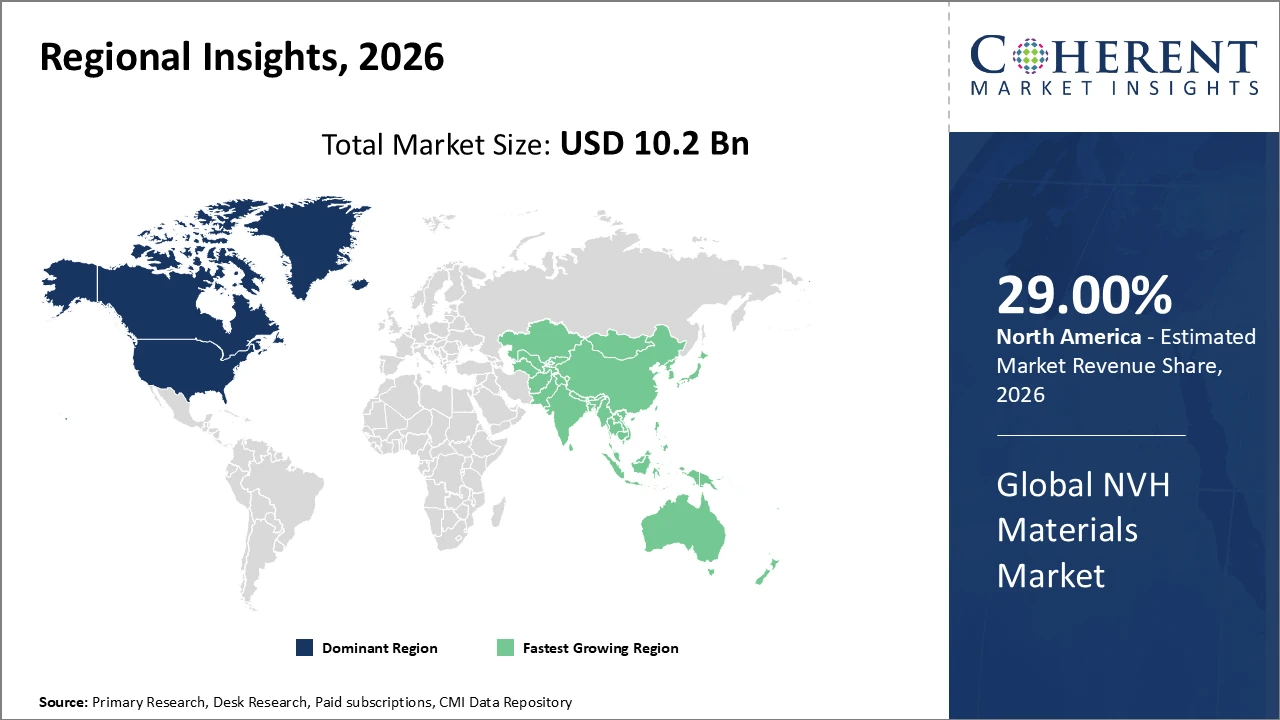
North America maintains the largest regional market share, attributed to advanced automotive and aerospace industries and strong industrial infrastructure.
Asia Pacific is the fastest-growing market, experiencing impressive CAGR growth driven by industrial modernization and supportive government policies.
These insights help stakeholders align strategies for growth, product development, and market expansion.
Nvh Materials Market Segmentation Analysis
Nvh Materials Market Insights, By End-User Industry
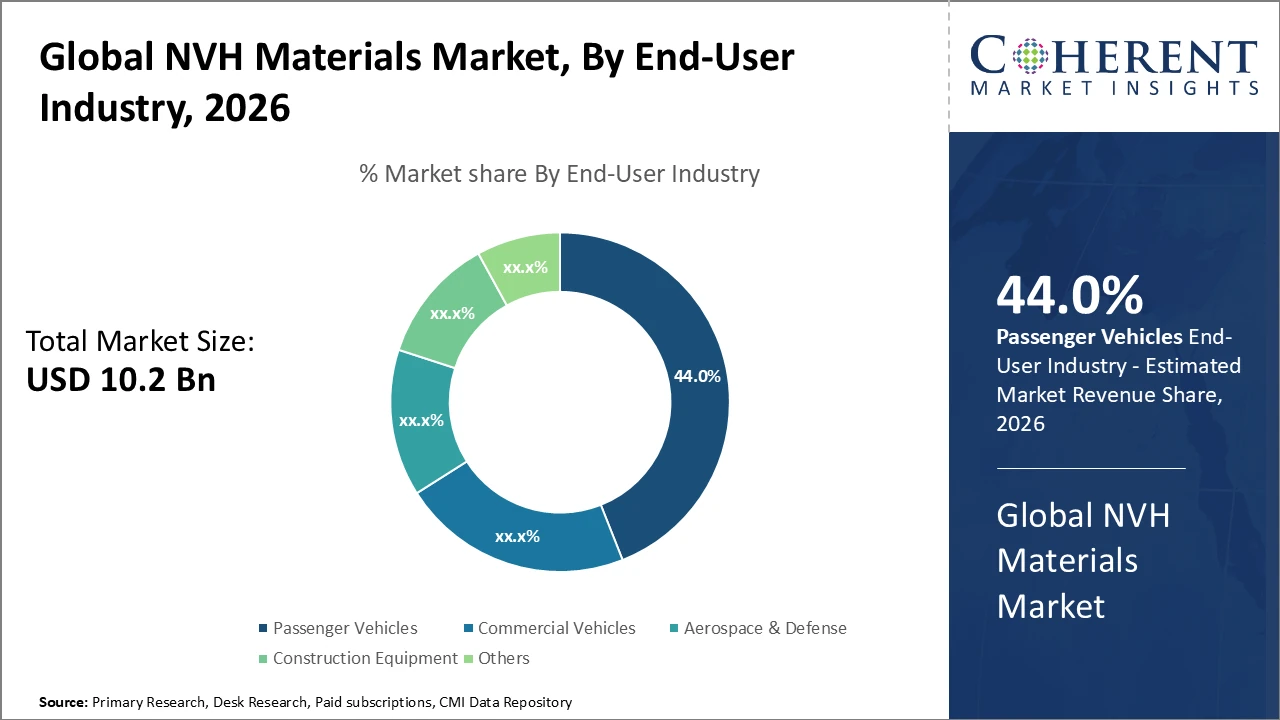
Passenger vehicles lead the NVH materials market with a 44% share, driven by growing urban mobility solutions, rising automotive comfort expectations, and increased deployment of electric vehicles. Commercial vehicles represent a significant segment, focusing on noise and vibration reduction to meet safety and environmental regulations. The aerospace and defense sector is the fastest-growing subsegment, adopting advanced multifunctional NVH materials to enhance performance and comply with stringent standards. Construction equipment relies on durable NVH materials to minimize harsh operational vibrations, while other sectors, including railways and marine applications, are gradually integrating customized NVH solutions to capitalize on expanding market opportunities.
Nvh Materials Market Insights, By Material Type
Polyurethane-based NVH materials dominate the market with a 48% share, driven by their versatility, cost-effectiveness, and adaptability across automotive and aerospace applications. Their lightweight nature and high damping capacity make them especially suitable for electric vehicle manufacturing, where weight reduction and noise control are critical. Composite materials, recognized for multifunctional properties and the growing trend toward bio-based variants, represent the fastest-growing subsegment, increasingly adopted in aerospace and premium vehicles. Rubber-based NVH materials maintain steady demand due to traditional acoustic and thermal insulation capabilities, while foam-based materials are widely used for cushioning in construction equipment. Other innovative nano-engineered polymers are emerging, poised for future growth.
Nvh Materials Market Insights, By Application
The automotive segment holds a dominant 62% share in the NVH materials market, driven by aggressive vehicle electrification and innovations aimed at enhancing passenger comfort. Within automotive, electric vehicles are key contributors to demand, leveraging specialized polyurethane and composite materials to meet stringent noise, vibration, and harshness requirements. Aerospace applications represent the fastest-growing subsegment, fueled by rising air traffic and stricter safety and noise regulations that necessitate advanced lightweight NVH solutions. Railways continue to employ foam-based and rubber materials for vibration damping in infrastructure projects, while industrial equipment increasingly uses polymer-based NVH materials to comply with operational noise regulations. Other niche markets, such as marine applications, are gradually adopting NVH materials.
Nvh Materials Market Trends
Market trends in the NVH materials market emphasize sustainability and lightweight solutions, driven by the growing electrification of vehicles.
Increased use of bio-composite materials in European automotive manufacturing in 2025 highlights the focus on materials that reduce noise while minimizing vehicle weight.
Adoption of nano- and micro-fiber reinforced polymers is enhancing sound absorption efficiency, with wider integration by automotive OEMs starting in 2024.
North America dominates the market with around 38% industry share, supported by strong automotive and aerospace sectors, strict environmental regulations, and robust R&D ecosystems.
Asia Pacific is the fastest-growing regional market, with a CAGR exceeding 9%, fueled by manufacturing expansion in China and India, supportive government policies, and increasing foreign investments.
Trade dynamics in Asia Pacific have accelerated the spread of advanced NVH material technologies, driving sustained regional revenue growth.
Nvh Materials Market Insights, By Geography
North America Nvh Materials Market Analysis and Trends
In North America, the NVH materials market is dominated by well-established automotive manufacturing hubs that integrate advanced NVH solutions to meet stringent federal noise and emission standards. The U.S. accounted the prominent market revenue in 2025, driven by increasing adoption of lightweight and sustainable materials. Investments in electric vehicle factories by leading automakers have further boosted demand, prompting the development of specialized NVH materials designed to address EV-specific acoustic challenges. Strong R&D capabilities, regulatory compliance, and focus on passenger comfort continue to reinforce North America’s leading position in the global NVH materials market.
Asia Pacific Nvh Materials Market Analysis and Trends
Asia Pacific is the fastest-growing region in the NVH materials market, driven primarily by the rapid expansion of automotive and aerospace sectors in China and India. Rapid urbanization, coupled with government incentives promoting cleaner, quieter vehicles and improved industrial noise control, is fueling demand. The region has experienced a CAGR exceeding 9%, well above the global average, supported by evolving industrial standards and increasing production capacities. Domestic manufacturers are increasingly adopting innovative NVH composites, while rising export activities are expanding market reach. Together, these factors are strengthening regional market dynamics and positioning Asia Pacific as a key growth hub in the global NVH materials industry.
Nvh Materials Market Outlook for Key Countries
USA Nvh Materials Market Analysis and Trends
The United States NVH materials market is strongly shaped by its mature automotive and aerospace industries. In 2025, demand for polyurethane and composite NVH materials rose by 12%, driven by government regulations targeting noise reduction and the expanding electric vehicle sector. Leading companies such as Freudenberg and BASF have set up innovation centers in the U.S., enabling the rapid development and deployment of advanced, lightweight NVH solutions. Collaborations between automotive OEMs and NVH suppliers for EV platforms have further strengthened localized R&D and manufacturing capabilities, boosting market revenue, improving product offerings, and reinforcing the country’s dominant position in the regional NVH materials market.
Germany Nvh Materials Market Analysis and Trends
The Germany NVH materials market is shaped by its advanced automotive and aerospace industries, emphasizing sustainability, lightweight design, and high-performance acoustic solutions. Growing demand for electric and hybrid vehicles is driving adoption of polyurethane, composite, and bio-based NVH materials to meet stringent noise and vibration standards. In 2025, manufacturers increased R&D investments in multifunctional and environmentally friendly NVH products, supporting innovations in passenger comfort and vehicle efficiency. The market also benefits from regulatory frameworks promoting reduced noise emissions and eco-friendly materials. Overall, Germany’s NVH materials sector reflects a balance of technological innovation, regulatory compliance, and sustainable product development trends.
Analyst Opinion
The global rise in electric vehicle (EV) production is a key demand-side driver for the NVH materials market. In 2025, over 14 million EVs were produced, representing nearly 10% of total automotive output, increasing the need for lightweight NVH solutions tailored to EVs’ unique acoustic profiles and accelerating material innovation cycles.
Supply chain optimization among raw material suppliers led to a 7% reduction in polyurethane-based NVH material production costs in 2024, enabling wider adoption among mid-tier vehicle manufacturers and expanding market penetration in cost-sensitive emerging economies, positively impacting overall revenue.
Advancements in multifunctional materials combining NVH and thermal insulation properties were notable in 2026, with bio-based composites gaining traction. Demand in aerospace applications rose by 15%, driven by strict weight and safety regulations, highlighting micro-indicators that boost specialized segment growth.
Export volumes of acoustic insulation products increased by 12% in 2025, with Europe serving as a major exporter to Asia Pacific. This export growth reflects strong cross-regional trade dynamics supporting sustained expansion in NVH materials’ global market share.
- Current Industry Events of 2026
- Market Size Estimation
- Regional Breakdown
- Competitive Landscape
- Customer Intelligence
- Segmental Analysis
- Pricing Analysis
- Key Market Drivers, Challenges & Future Trends
- Customized Insights Section
Market Scope
| Report Coverage | Details | ||
|---|---|---|---|
| Base Year: | 2025 | Market Size in 2026: | USD 10.2 billion |
| Historical Data for: | 2020 To 2024 | Forecast Period: | 2026 To 2033 |
| Forecast Period 2026 to 2033 CAGR: | 8.2% | 2033 Value Projection: | USD 17.5 billion |
| Geographies covered: |
| ||
| Segments covered: |
| ||
| Companies covered: | BASF SE, 3M Company, Covestro AG, Dow Inc., Lanxess AG, Huntsman Corporation, Zotefoams plc, JSR Corporation, Toray Industries Inc., Owens Corning Incorporated | ||
| Growth Drivers: |
| ||
Nvh Materials Market Growth Factors
The rapid adoption of electric and hybrid vehicles is a key growth driver for the NVH materials market, creating demand for lighter yet highly efficient solutions to manage the quieter operation profiles of these vehicles. Global regulatory frameworks aimed at reducing noise pollution are further accelerating demand for innovative NVH materials certified by authorities such as the EPA and the European Environment Agency. The increasing use of synthetic and bio-composite materials, driven by sustainability trends, is supporting market expansion. Additionally, industrial automation and modernization of machinery in Asia Pacific are generating new requirements for high-performance NVH materials, enhancing market opportunities and overall business growth.
Nvh Materials Market Development
In October 2025, Genesis, the luxury division of Hyundai Motor Group, launched the 2026 Genesis GV70 in Korea. The updated midsize SUV features improved NVH (Noise, Vibration, and Harshness) performance, revised option packages, and design refinements based on customer feedback. Enhanced NVH engineering delivers a quieter, smoother ride, with added underbody sound-absorbing materials and an engine support damper in the 2.5 Turbo variant to reduce cabin vibration.
Key Players
Leading Companies of the Market
Huntsman Corporation
BASF SE
3M Company
Covestro AG
Dow Inc.
JSR Corporation
Toray Industries, Inc.
Owens Corning Incorporated
Zotefoams plc
Lanxess AG
Several market companies have undertaken strategic initiatives to strengthen their position in the NVH materials market. In 2025, Freudenberg invested in advanced bio-based NVH materials that reduced product weight by 10% while enhancing acoustic performance, leading to successful collaborations with multiple premium automotive brands. Similarly, in early 2026, BASF launched a new line of polyurethane systems specifically designed for electric vehicle applications, achieving a 20% increase in market share within that subsegment. These companies continue to leverage intensified R&D efforts and localization strategies to efficiently address growing regional demand and drive overall market growth.
Nvh Materials Market Future Outlook
The NVH materials market is expected to experience robust growth in the coming years, driven by the expanding adoption of electric and hybrid vehicles that require lightweight, high-performance acoustic solutions. Increasing regulatory focus on noise reduction and sustainability is encouraging the development of eco-friendly and bio-based NVH materials. Advances in multifunctional composites, nano- and micro-fiber reinforced polymers, and thermal-insulating NVH solutions are opening new application areas across automotive, aerospace, and industrial equipment sectors. Regions such as Asia Pacific are projected to lead growth due to industrial expansion and supportive policies, while North America and Europe continue to focus on innovation and regulatory compliance.
Nvh Materials Market Historical Analysis
The NVH materials market has demonstrated steady growth over the past decade, primarily driven by the automotive and aerospace sectors’ focus on passenger comfort and regulatory compliance for noise reduction. Historically, polyurethane, rubber, and foam-based materials dominated due to their effectiveness in vibration damping and acoustic insulation. Early adoption of lightweight composites emerged in premium and electric vehicles, while industrial applications gradually incorporated NVH solutions for machinery noise control. Regional manufacturing hubs in North America, Europe, and Asia Pacific supported market expansion through strong production capabilities and R&D investments. These historical trends laid the foundation for the current emphasis on multifunctional, sustainable, and high-performance NVH materials.
Sources
Primary Research Interviews:
NVH materials and specialty polymer manufacturers
Automotive and aerospace OEMs
Tire and rubber component producers
Industrial machinery and construction equipment manufacturers
Magazines:
Chemical & Engineering News
Materials World
Coatings World
Rubber & Plastics News
Journals:
Journal of Materials Science
Industrial & Engineering Chemistry Research
Journal of Applied Polymer Science
Journal of Coatings Technology and Research
Minerals Engineering
Newspapers:
Financial Times – Industrial Materials & Manufacturing
The Wall Street Journal – Automotive & Chemicals
Reuters – Specialty Materials & Industrial Components
Bloomberg – Automotive Supply Chains & Innovation
Associations:
International Zinc Association (IZA)
European Chemicals Industry Council (Cefic)
American Chemistry Council (ACC) – Inorganic Pigments Panel
International Lead and Zinc Study Group (ILZSG)
Global Zinc Network (GZN)
Get access to 250+ pages report
Every segment, forecast, competitor profile and data table behind the analysis above — available for instant download.
- ESOMAR Member
- ISO 9001:2015 Certified
- D-U-N-S Registered
- GDPR & CCPA Compliant
Missing comfort of reading report in your local language? Find your preferred language:
Transform your Strategy with Exclusive Trending Reports
Frequently Asked Questions
The market companies leading the NVH Materials Market include Covestro AG, BASF SE, and 3M Company, among others known for their innovation in bio-based and polyurethane NVH materials.
The NVH Materials Market size is forecasted to rise from USD 10.2 billion in 2026 to USD 17.5 billion by 2033, exhibiting a CAGR of 8.2% driven by automotive and aerospace demand.
The automotive segment has the largest market share and growth opportunity, especially in electric vehicle applications which require advanced noise and vibration materials.
Trends will evolve toward multifunctional, sustainable, and nano-engineered NVH materials, with a focus on reducing vehicle weight and enhancing acoustic performance.
The landscape is marked by high R&D intensity and strategic collaborations. Key challenges include raw material price volatility and the need to meet rigorous environmental standards.
Leading market players emphasize innovation partnerships, regional production localization, and tailoring products for EV and aerospace industry specific needs to gain competitive advantage.