

Phosphor Screen Scanner Market Size and Forecast — 2026 - 2033
The Global Phosphor Screen Scanner Market size is estimated to be valued at USD 875 million in 2026 and is expected to reach USD 1430 million by 2033, exhibiting a compound annual growth rate (CAGR) of 7.2% from 2026 to 2033.
Overview
A phosphor screen scanner is a digital imaging device used mainly in medical and dental radiography to read images captured on photostimulable phosphor (PSP) plates. Instead of traditional film, the PSP plate stores X-ray energy when exposed. The scanner uses a laser to stimulate the plate, releasing the stored energy as light, which is then converted into a digital image. This image can be viewed, enhanced, stored, and shared electronically. Phosphor screen scanners are widely used in computed radiography (CR) systems because they provide high image quality, reduce radiation exposure, and eliminate the need for chemical film processing.
Key Takeaways
The Flatbed Phosphor Screen Scanner segment dominates the product type market, holding 48% share due to its precision and broad applicability, while handheld scanners are the fastest-growing subsegment because of portability and ease of use.
Medical imaging leads the application segment, driven by healthcare digitization and rising demand for chronic disease diagnosis, contributing the highest revenue globally.
North America holds the largest regional market share, led by the U.S., supported by advanced healthcare infrastructure and substantial investment, while Asia Pacific is the fastest-growing region due to expanding industrial applications and government incentives.
Regulatory support and increasing adoption in research institutes create growth opportunities across Europe and LATAM, sustaining steady regional market dynamics.
Phosphor Screen Scanner Market Segmentation Analysis
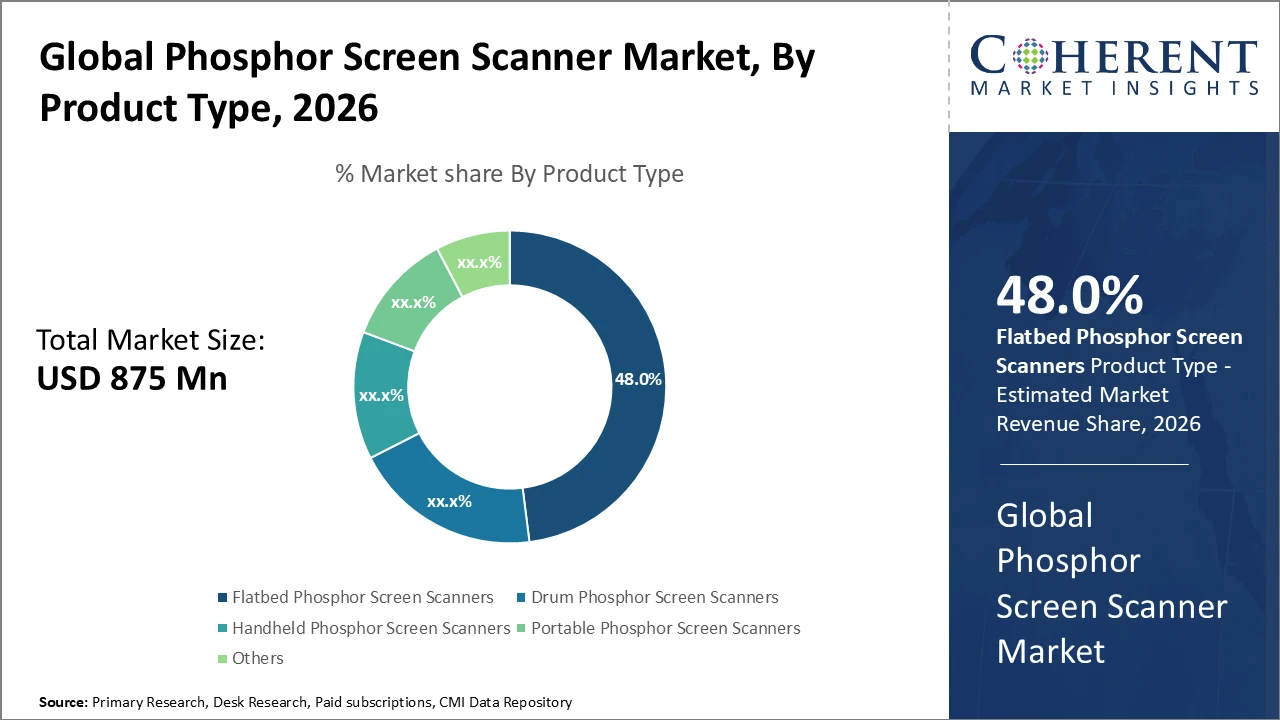
Phosphor Screen Scanner Market Insights, By Product Type
Flatbed Phosphor Screen Scanners dominate the market due to their high precision, consistent output quality, and widespread use across medical and industrial applications. They offer superior scanning resolution, making them ideal for detailed diagnostics and quality control in healthcare facilities and manufacturing plants. Handheld Phosphor Screen Scanners represent the fastest-growing subsegment, driven by rising demand for portability and versatile field use, particularly in security inspections and onsite evaluations. Drum scanners remain important for high-resolution industrial imaging but expand more slowly due to higher costs and limited applicability. Portable scanners serve remote medical diagnostics and mobile security needs, while other specialized scanner types address customized applications, supporting steady niche growth.
Phosphor Screen Scanner Market Insights, By Application
Medical imaging leads the market, driven by rising demand for digital diagnostics and the global expansion of healthcare infrastructure. Technological advancements enhancing scan clarity and speed further support this segment, enabling timely and accurate patient care. Industrial inspection is the fastest-growing application, fueled by strict safety standards and increasing adoption in aerospace, automotive, and electronics manufacturing. Scientific research maintains steady growth, focusing on advanced imaging for materials science and biological studies. Security screening is gaining prominence due to heightened public safety and border security concerns, utilizing phosphor screen scanners for real-time, high-resolution imaging, while other applications include art restoration and environmental monitoring.
Phosphor Screen Scanner mixture Market Insights, By End-User
Hospitals and clinics hold the largest market share, driven by rising healthcare spending and the integration of digital phosphor screen scanners into diagnostic workflows. Research institutes represent the fastest-growing subsegment, as academic and private centers intensify their focus on non-invasive imaging for advances in medical and material sciences. Manufacturing plants use phosphor screen scanners for non-destructive testing and quality assurance, with adoption increasing in emerging economies. Security agencies are gradually investing in advanced scanners to enhance operational efficiency, while the Others segment, including cultural heritage conservation and veterinary medicine, experiences steady growth due to specialized, niche demand.
Phosphor Screen Scanner Market Trends
The phosphor screen scanner market has experienced rapid technological advancements, with AI and machine learning integration improving image processing efficiency and accuracy. In 2025, AI-enabled scanners reduced technician workload by 20% in several U.S. healthcare institutions.
Sustainability trends have prompted innovation in phosphor material composition, leading to the launch of eco-friendly scanners by European manufacturers in 2025, generating new revenue streams and aiding regulatory compliance.
Hybrid imaging systems combining phosphor screen scanners with other modalities are gaining traction, driven by industrial demand for multi-functional and cost-effective solutions.
Aerospace and automotive industries have widely adopted hybrid systems to enhance imaging capabilities and operational efficiency.
The convergence of AI, sustainability, and hybrid technologies is shaping the future of market growth and innovation globally.
Phosphor Screen Scanner Market Insights, By Geography
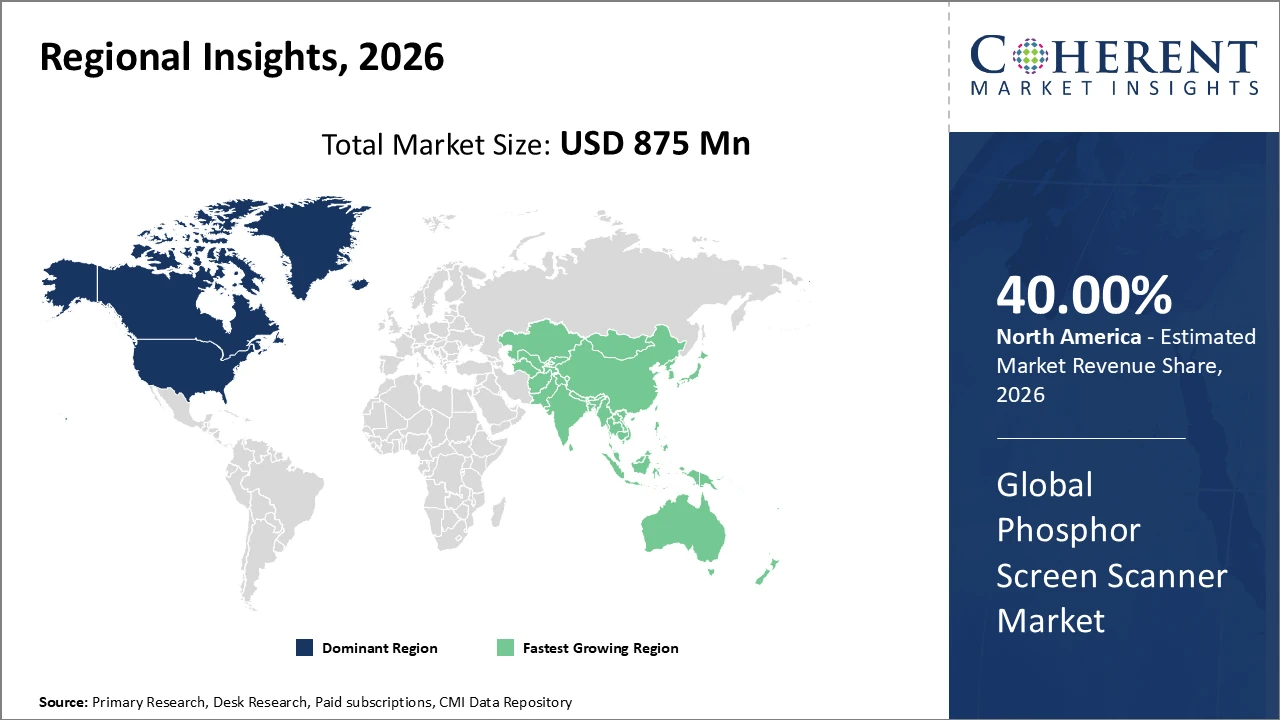
North America Phosphor Screen Scanner Market Analysis and Trends
In North America, the phosphor screen scanner market is dominated by advanced R&D facilities, a strong presence of key players such as Carestream Health, and significant investments in healthcare infrastructure. The U.S. accounted major market share in 2025, reflecting rapid adoption of digital imaging technologies in medical diagnostics. The region benefits from a robust industrial sector, with growing applications in aerospace, electronics, and quality control driving demand. High awareness of imaging efficiency, government initiatives promoting healthcare modernization, and early adoption of AI-enabled and hybrid imaging systems further consolidate North America’s leadership in the global phosphor screen scanner market.
Asia Pacific Phosphor Screen Scanner Market Analysis and Trends
Asia Pacific demonstrates the fastest growth in the phosphor screen scanner market, with a CAGR of around 9.1%, driven by expanding healthcare infrastructure, rising industrial modernization, and increasing investments in imaging technologies across countries such as China, India, and Japan. Government incentives promoting domestic manufacturing and technological adoption have bolstered market expansion, while growing awareness of advanced diagnostic tools supports demand in hospitals and clinics. Key market players are establishing local production facilities and forming strategic collaborations with regional partners to enhance accessibility and reduce costs. These efforts, combined with rising industrial and medical imaging applications, continue to accelerate the region’s market penetration and revenue growth.
Phosphor Screen Scanner Market Outlook for Key Countries
USA Phosphor Screen Scanner Market Analysis and Trends
The U.S. phosphor screen scanner market is a key global contributor, driven by rapid adoption of advanced imaging technologies in hospitals and research institutes. In 2025, more than 50% of new scanner installations were motivated by enhanced features, including AI integration, faster processing, and improved phosphor materials. Leading companies such as Carestream Health and Fujifilm introduced high-throughput scanners offering superior image resolution and operational efficiency, reinforcing the country’s position as an innovation hub. Strong healthcare infrastructure, investment in digital diagnostics, and growing demand for precise medical and industrial imaging continue to sustain robust market growth in the U.S.
Germany Phosphor Screen Scanner Market Analysis and Trends
The German phosphor screen scanner market is driven by advanced healthcare infrastructure, strong research capabilities, and increasing adoption of digital imaging technologies. Hospitals and diagnostic centers are modernizing workflows with high-resolution scanners, while research institutes invest in AI-enabled and hybrid imaging systems for medical and material science applications. Industrial applications, particularly in manufacturing quality control and non-destructive testing, further support market demand. Government initiatives promoting healthcare digitization and environmental compliance encourage the use of eco-friendly phosphor materials. Technological innovations, combined with strategic collaborations among local and international players, position Germany as a key regional market with steady growth and high adoption rates.
Analyst Opinion
Supply-side indicators such as increased production capacities and optimized manufacturing processes have positively impacted market dynamics; in 2025, higher output from key phosphor screen manufacturing hubs led to a 15% reduction in unit production costs, influencing pricing and revenue streams.
On the demand side, diversified applications across healthcare and industrial sectors have driven import volumes upward, with the medical imaging segment recording a 35% increase in phosphor screen scanner imports in 2024, reflecting broader adoption trends.
Pricing strategies remain key, with a 5% year-over-year improvement enabling wider accessibility of scanners in emerging markets like India and Southeast Asia.
Nano-scale advancements in phosphor materials have improved image resolution by 12% between 2023 and 2025, supporting new product development and driving market growth.
- Current Industry Events of 2026
- Market Size Estimation
- Regional Breakdown
- Competitive Landscape
- Customer Intelligence
- Segmental Analysis
- Pricing Analysis
- Key Market Drivers, Challenges & Future Trends
- Customized Insights Section
Market Scope
| Report Coverage | Details | ||
|---|---|---|---|
| Base Year: | 2025 | Market Size in 2026: | USD 875 million |
| Historical Data for: | 2020 To 2024 | Forecast Period: | 2026 To 2033 |
| Forecast Period 2026 to 2033 CAGR: | 7.2% | 2033 Value Projection: | USD 1430 million |
| Geographies covered: |
| ||
| Segments covered: |
| ||
| Companies covered: | Carestream Health, Konica Minolta, Inc., Philips Healthcare, Landauer, Inc., Hologic, Inc., Scintacor Limited, Varian Medical Systems, PerkinElmer, Inc., Fujifilm Holdings Corporation, Shimadzu Corporation | ||
| Growth Drivers: |
| ||
Phosphor Screen Scanner Market Growth Factors
The surge in demand for high-precision diagnostic imaging in healthcare serves as a primary growth driver for the phosphor screen scanner market. Rising prevalence of chronic diseases has prompted medical facilities to upgrade to digital phosphor screen scanners, with new installations increasing by 22% in 2025. Industrial applications, particularly in non-destructive testing, also boost market revenue, supported by strict safety regulations and quality standards—for instance, U.S. aerospace manufacturing saw a 17% rise in scanner usage in 2024. Technological improvements in phosphor materials have enhanced resolution and throughput, reducing scanner turnaround time by 14%, while growing R&D investments in Asia Pacific, especially in India and China, further expand market growth and emerging opportunities.
Phosphor Screen Scanner Market Development
In 2025, Carestream Health introduced a new line of AI-enabled flatbed phosphor screen scanners, enhancing image processing speed and diagnostic accuracy, which led to a 20% increase in adoption across U.S. hospitals and research institutes.
Key Players
Leading Companies of the Market
Carestream Health
Konica Minolta, Inc.
Philips Healthcare
Landauer Inc.
Hologic, Inc.
Scintacor Limited
Varian Medical Systems
PerkinElmer, Inc.
Shimadzu Corporation
Fujifilm Holdings Corporation
Prominent market players have pursued aggressive growth strategies including mergers, acquisitions, and portfolio expansions. In 2025, Fujifilm’s acquisition of a leading phosphor screen technology firm boosted its global market share by 10%. Likewise, Konica Minolta’s strategic R&D investment in 2024 enhanced product sensitivity, enabling the company to expand its presence significantly across North American and Asian markets. These initiatives have strengthened technological capabilities, improved scanner performance, and increased adoption across healthcare, industrial, and research applications, reinforcing their competitive positioning and driving overall growth in the global phosphor screen scanner market.
Phosphor Screen Scanner Market Future Outlook
The global phosphor screen scanner market is poised for sustained growth, driven by increasing adoption in healthcare, industrial inspection, and research applications. Advances in AI integration, hybrid imaging systems, and high-resolution phosphor materials are expected to enhance diagnostic accuracy and operational efficiency. Emerging markets in Asia Pacific, particularly India, China, and Southeast Asia, offer significant growth potential due to expanding healthcare infrastructure and industrial modernization initiatives. Sustainability trends, including eco-friendly phosphor materials, and growing investments in R&D will further support innovation and product diversification. Overall, technological evolution and regional expansion are set to drive robust market growth through 2033.
Phosphor Screen Scanner Market Historical Analysis
The phosphor screen scanner market has experienced steady growth over the past decade, driven initially by healthcare digitization and industrial imaging needs. From 2016 to 2023, increasing demand for high-resolution medical diagnostics and non-destructive testing in aerospace, automotive, and electronics sectors spurred market expansion. Technological advancements, including improved phosphor materials and integration of digital processing systems, enhanced scanner performance and reliability. The rise of research-focused applications in universities and private institutes further supported market adoption. Additionally, regulatory support for medical imaging modernization and industrial safety standards contributed to consistent revenue growth, laying a strong foundation for current and future market developments.
Sources
Primary Research Interviews:
Hospitals, clinics, and diagnostic centers
Industrial inspection and non-destructive testing facilities
Research institutes and academic laboratories
R&D managers and process engineers in imaging technology and electronics sectors
Magazines:
Medical Imaging International
Imaging Technology News
Diagnostic Imaging Magazine
Healthcare Technology Today
Journals:
Journal of Medical Imaging
Progress in Biomedical Optics
International Journal of Imaging Systems and Technology
Journal of Digital Imaging
Newspapers:
The New York Times – Healthcare & Technology
Financial Times – Medical Equipment & Innovation
The Guardian – Science & Industrial Technology
Reuters – Healthcare & Imaging
Associations:
Radiological Society of North America (RSNA)
European Society of Radiology (ESR)
Society for Imaging Informatics in Medicine (SIIM)
International Society for Optics and Photonics (SPIE)
Get access to 250+ pages report
Every segment, forecast, competitor profile and data table behind the analysis above — available for instant download.
- ESOMAR Member
- ISO 9001:2015 Certified
- D-U-N-S Registered
- GDPR & CCPA Compliant
Missing comfort of reading report in your local language? Find your preferred language:
Transform your Strategy with Exclusive Trending Reports
Frequently Asked Questions
Key market players include Carestream Health, Fujifilm Holdings Corporation, and Konica Minolta, Inc., which consistently drive innovation and command significant market share.
The market is projected to grow from USD 875 million in 2026 to USD 1430 million by 2033 with a CAGR of 7.2%, reflecting robust expansion driven by healthcare and industrial demand.
The medical imaging sector offers the largest growth opportunity due to rising healthcare digitization and the prevalence of chronic and age-related diseases globally.
Market development will see enhanced integration of AI, hybrid scanner systems, and sustainable material innovations transforming scanner capabilities and market penetration rates.
The market is competitive with emphasis on technological innovation and pricing strategies; challenges include high manufacturing costs and regulatory compliance.
Strategies include mergers and acquisitions, strategic partnerships, regional expansions, and focused R&D investments to enhance technology and product portfolios.