

Building Integrated Photovoltaics Market Size and Share Analysis-2026 to 2033
Global building integrated photovoltaics market is estimated to be valued at USD 39.00 Bn in 2026 and is expected to reach USD 123.61 Bn by 2033, exhibiting a compound annual growth rate (CAGR) of 17.9% from 2026 to 2033.
Key Takeaways
- By Technology, the thin-film solar cells segment is projected to dominate the global building integrated photovoltaics market with a 40.2% share in 2026.
- By Application, the residential buildings segment is anticipated to hold the highest market share of 41.3% in 2026.
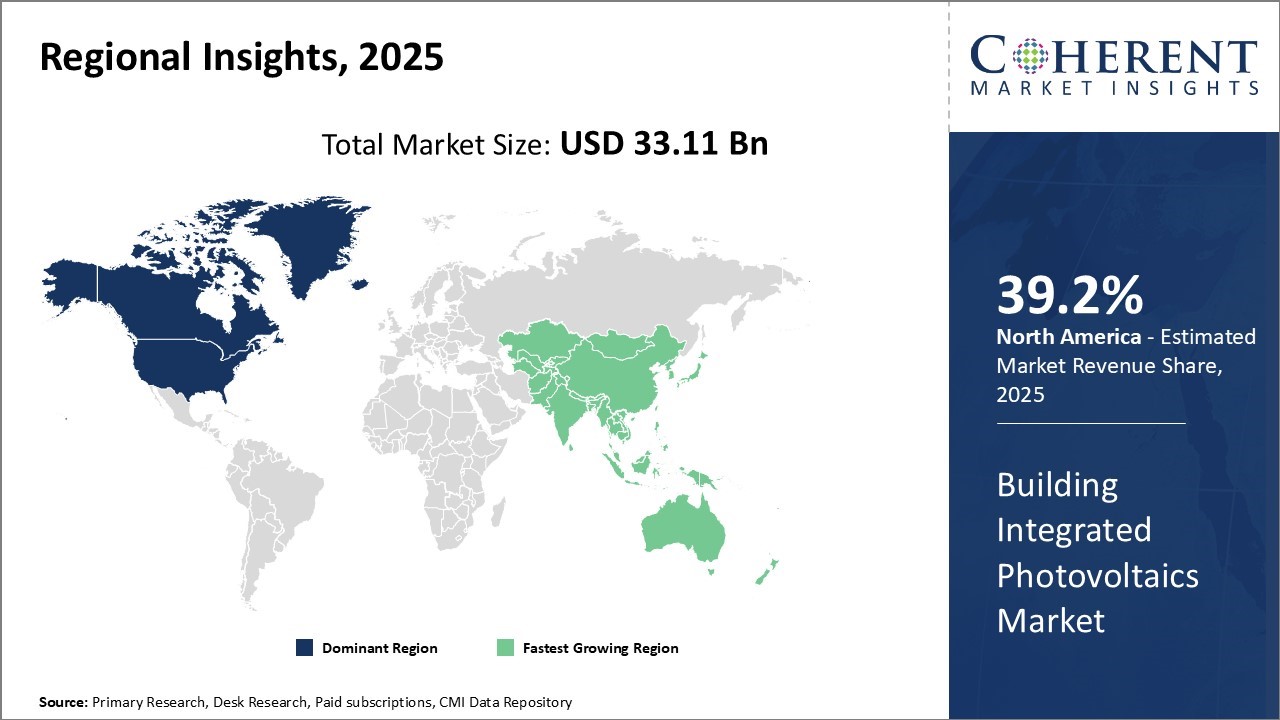
- By Region, North America is expected to lead the global BIPV market with a projected share of 39.2% in 2026.
Market Overview
The global Building Integrated Photovoltaics (BIPV) Market is witnessing robust growth, driven by increasing emphasis on sustainable construction and renewable energy integration. Thin-film solar cells dominate the technology segment due to their flexibility and cost-efficiency. Residential buildings lead in application as homeowners seek energy independence and green solutions.
Current Events and its Impact on the Building Integrated Photovoltaics Market
Current Event | Description and its impact |
Technological Advancements in Solar Integration |
|
Shifting Sustainability Priorities in Construction |
|
Green Building Certifications and Mandates |
|
Emergence of New Technologies in the Building Integrated Photovoltaics (BIPV) Market
The BIPV market is witnessing rapid technological innovation, enhancing both performance and architectural appeal. One of the most significant advancements is in thin-film photovoltaic technology, which offers greater flexibility, lighter weight, and improved integration into non-traditional surfaces like curved facades and glass windows. Semi-transparent solar panels are also gaining momentum, enabling power generation without obstructing natural light—ideal for skylights, atriums, and curtain walls.
Additionally, perovskite solar cells are emerging as a transformative innovation, offering higher efficiency, lower production costs, and compatibility with diverse building materials. Smart BIPV systems, integrated with IoT and energy management platforms, are also being developed to optimize energy use and provide real-time performance monitoring.
3D printing, prefabrication techniques, and nano-coating technologies further enhance durability, aesthetics, and ease of installation. Together, these innovations are driving down costs, improving energy efficiency, and expanding BIPV’s appeal across residential, commercial, and industrial construction.
- Current Industry Events of 2026
- Market Size Estimation
- Regional Breakdown
- Competitive Landscape
- Customer Intelligence
- Segmental Analysis
- Pricing Analysis
- Key Market Drivers, Challenges & Future Trends
- Customized Insights Section
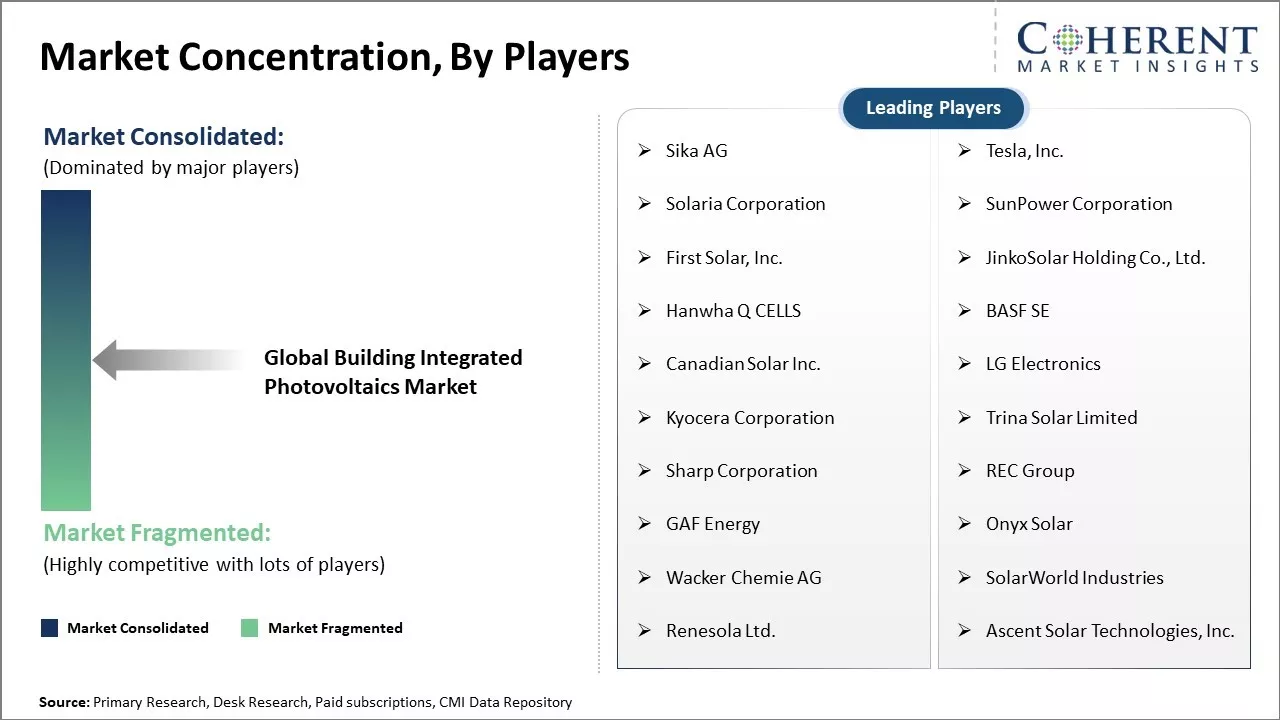
Market Concentration and Competitive Landscape
Building Integrated Photovoltaic Market Trends
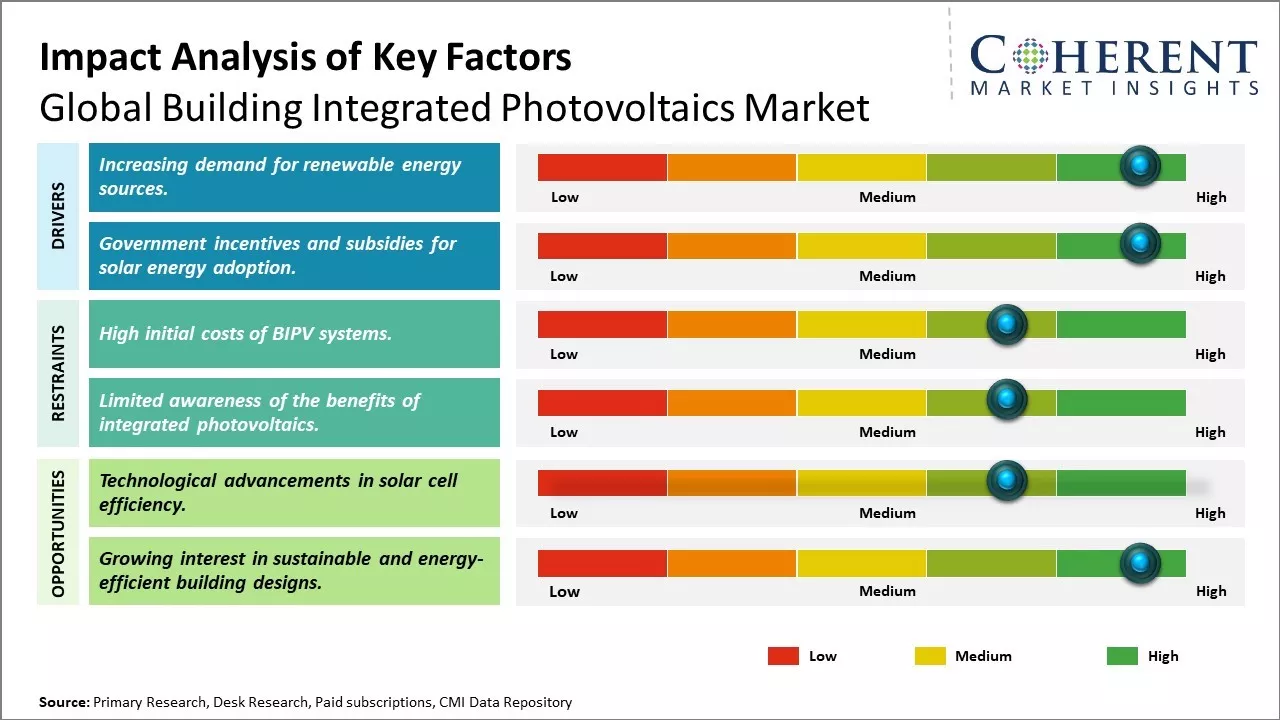
- Increasing demand for renewable energy sources
Growing environmental concerns around the world have prompted many countries as well as the public to shift towards cleaner and greener sources of energy like solar. There has been increase in energy demands of the global population due to economic growth and rising standards of living.
According to data from World Meters in 2025, global population is growing at an approximate rate of 0.91% per year. This growth rate translates to an annual increase of about 73 million people. This steady rise in population highlights the ongoing demographic changes and the need for effective planning in areas such as resource management, infrastructure, healthcare, and food security to accommodate the growing number of individuals worldwide.
Synthetic fuels which have traditionally met majority of the global energy needs are leading to various environmental issues like climate change when burned. This has boosted need for countries and companies to move towards sustainable energy alternatives.
Solar energy provides several advantages as compared to traditional fossil fuels as it is abundant, universally available and completely clean. However, the large-scale adoption of solar power was hindered in the past due to high upfront capital costs of installation. Building integrated photovoltaic or BIPV offers a promising solution to this issue by allowing the solar panels to become an integral part of the building infrastructure.
With BIPV, solar panels can be installed as the exterior component of a new building like roof or walls during construction itself. This eliminates additional costs and effort of setting up solar panels as a separate exercise after building is ready. As a result, BIPV solutions have become increasingly cost competitive compared to tradition solar power projects and find more takers.
- Government incentives and subsidies for solar energy adoption
Most governments around the world recognize the strategic and environmental importance of replacing fossil fuels with renewable sources like solar and wind over the long run. However, setting up large scale solar projects is expensive due to high installation and initial equipment costs. To incentivize greater adoption of solar among building owners as well as overcome the high upfront costs, many administrations offer vital subsidies and tax incentives. These measures have played a key role in boosting the solar photovoltaic market globally in past decade.
When it comes to building integrated photovoltaic systems, governments provide attractive subsidy schemes to encourage higher utilization of this innovative technology. Newly constructed buildings which opt for BIPV solutions as an integral part of their design may qualify for additional subsidies over roof top solar panels. This helps reduce the price difference between normal construction and installing BIPV systems for builders.
Various nations also allow accelerated depreciation on BIPV systems to lower the tax burden and returns on investment further. Some local authorities have instituted renewable purchase mandates which make it mandatory for new large buildings to source a certain percentage of power needs from on-site BIPV or pay penalties.
In May 29, 2025, pv magazine reported that Denmark’s largest energy community is under construction, featuring over 30,000 m² of solar rooftops combining both PV and BIPV technologies. Danish specialist Solartag is supplying pitched-roof BIPV modules alongside flat-roof systems to support this 4 MW project.
Opportunities In the Building Integrated Photovoltaic Market
- Technological advancements in solar cell efficiency
Global building integrated photovoltaics market can witness growth opportunities due to continued technological advancements that can improve the efficiency and performance of solar cells. Higher efficiency photovoltaic materials and components used in BIPV modules translate directly to more electricity generated per unit area. This enhances the overall value proposition for building owners.
Ongoing research into new thin film technologies, multifunction cells as well as organic and perovskite cells holds promise to significantly boost efficiency ratings in the near future. Advancements are also being made through new nanoparticle formulations, enhanced light trapping mechanisms and cell interconnection designs.
As efficiency levels increase steadily, the energy and cost savings from BIPV will rise accordingly, strengthening the business case for investments. This will accelerate market expansion rates globally as the technology becomes increasingly competitive against traditional construction materials and electricity rates.
Segmental Insights
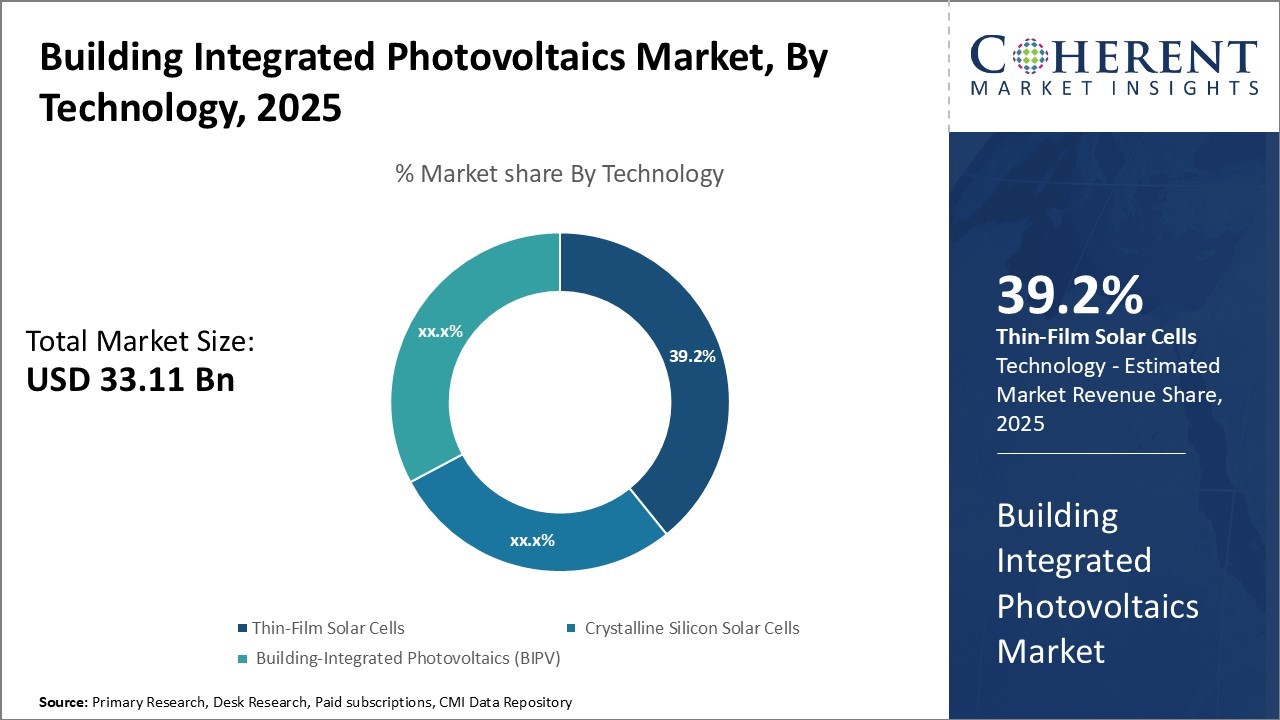
Building Integrated Photovoltaic Market Insights, By Technology
The thin-film solar cells segment is projected to lead the global building integrated photovoltaics market with a 40.2% share in 2026. This dominance is driven by their lightweight design, flexibility, and cost-efficiency, making them well-suited for integration into diverse building elements such as façades, windows, and rooftops.
Thin-film technologies require less material and offer aesthetic versatility, enabling architects and developers to meet both energy and design objectives. Their ease of installation and compatibility with modern construction trends continue to drive adoption across new and retrofitted buildings globally.
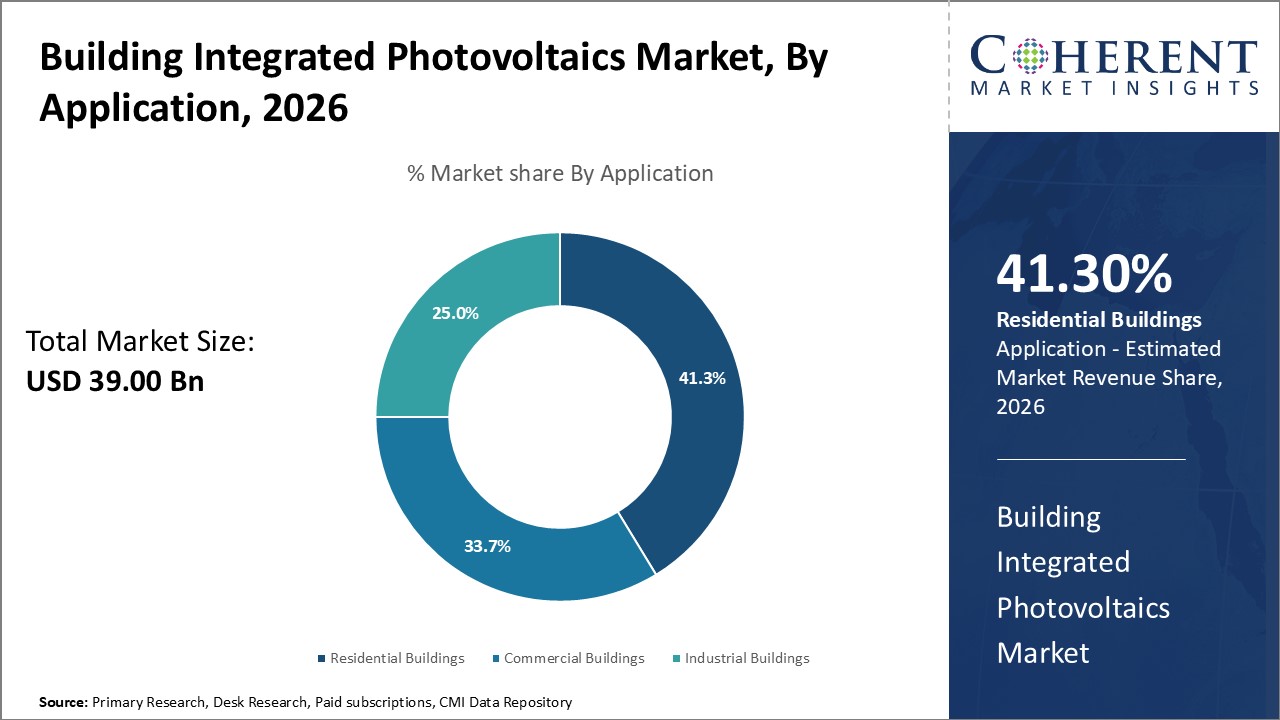
Building Integrated Photovoltaic Market Insights, By Application
The residential buildings segment is anticipated to account for the largest share of 41.3% in 2026. Increasing demand for energy self-sufficiency, rising electricity prices, and government-backed incentives for solar installations are key growth drivers.
Regional Insights
North America BIPV Market Trends and Analysis
North America is expected to lead the global BIPV market with a projected share of 39.2% in 2026. This dominance is driven by strong regulatory frameworks, widespread adoption of green building codes, and generous tax incentives for solar integration in construction.
The U.S. and Canada are actively investing in sustainable infrastructure, with growing emphasis on net-zero energy buildings. High awareness of climate change, combined with increasing residential and commercial adoption of renewable energy technologies, positions North America as the most mature and influential BIPV market globally.
Europe BIPV Market Trends and Analysis
Europe is poised to maintain a significant share in the global BIPV market, supported by ambitious climate policies, carbon neutrality targets, and progressive energy regulations. Countries like Germany, France, and the Netherlands are spearheading innovation in solar-integrated architecture, backed by strong subsidies and widespread adoption of Nearly Zero-Energy Building (NZEB) standards.
The region’s focus on energy efficiency and sustainability in urban development, coupled with robust R&D initiatives and architectural advancements, continues to drive demand for BIPV technologies across new and renovated structures.
Building Integrated Photovoltaic Market Dominating Countries
United States and Canada
The United States is a key leader in the global BIPV market, significantly contributing to North America's projected 39.2% market share in 2026. This dominance is driven by strong government support through tax credits and green building mandates such as LEED and the Inflation Reduction Act.
The U.S. construction sector is increasingly integrating solar solutions into new residential and commercial buildings, while states like California and New York lead in implementing net-zero energy targets. Major players and startups are also investing heavily in architectural solar technologies, supporting rapid market innovation and deployment.
Canada plays a supportive role in the North American BIPV landscape with its ambitious clean energy goals and commitment to sustainable building practices. Government initiatives like the Canada Greener Homes Grant and building code updates are incentivizing the integration of photovoltaics into homes and public infrastructure.
The country’s colder climate and focus on energy efficiency further reinforce the adoption of solar-integrated roofing, façades, and curtain wall systems, especially in urban redevelopment projects.
Market Report Scope
Building Integrated Photovoltaics Market Report Coverage
| Report Coverage | Details | ||
|---|---|---|---|
| Base Year: | 2025 | Market Size in 2026: | USD 39.00 Bn |
| Historical Data for: | 2020 To 2024 | Forecast Period: | 2026 To 2033 |
| Forecast Period 2026 to 2033 CAGR: | 17.9% | 2033 Value Projection: | USD 123.61 Bn |
| Geographies covered: |
| ||
| Segments covered: |
| ||
| Companies covered: | Sika AG, Tesla, Inc., Solaria Corporation, SunPower Corporation, First Solar, Inc., JinkoSolar Holding Co., Ltd., Hanwha Q CELLS, BASF SE, Canadian Solar Inc., LG Electronics, Kyocera Corporation, Trina Solar Limited, Sharp Corporation, REC Group, GAF Energy, Onyx Solar, Wacker Chemie AG, SolarWorld Industries, Renesola Ltd., and Ascent Solar Technologies, Inc. | ||
| Growth Drivers: |
| ||
| Restraints & Challenges: |
| ||
Analyst Viewpoint – Building Integrated Photovoltaics Market
- Analysts hold a highly optimistic outlook for the global building integrated photovoltaics (BIPV) market, viewing it as a pivotal solution in the transition toward sustainable and energy-efficient buildings. The growing demand for decentralized renewable energy, coupled with stringent green building regulations and carbon neutrality goals, is reinforcing long-term market potential.
- Experts emphasize that the integration of thin-film solar technologies, semi-transparent modules, and perovskite materials is expanding the design versatility and efficiency of BIPV systems. These innovations, alongside smart energy management solutions and AI-driven monitoring, are improving performance, aesthetics, and return on investment.
- Regionally, North America leads the market due to supportive policy frameworks and tax incentives, while Asia Pacific is experiencing the fastest growth, driven by rapid urbanization, government subsidies, and rising adoption in residential and commercial construction. Analysts anticipate that technological advancement, regulatory alignment, and falling component costs will sustain robust global BIPV market expansion over the coming years.
Building Integrated Photovoltaics Market: Key Development
- In March, 2025, the "Building‑Integrated Photovoltaics: A Technical Guidebook", released by IEA‑PVPS Task 15, provides comprehensive guidance on BIPV design, performance, and integration strategies for architects and engineers. This publication helps address technical adoption barriers and supports harmonized design practices, accelerating market implementation and boosting confidence among building professionals.
- In April, 2025, GoodWe introduced three flagship BIPV products—Luxa solar pergola, Havera solar canopy, and Vela solar carport—featuring smart light control, modular design, and high-efficiency solar modules. These consumer-focused and aesthetically appealing products boost market visibility, drive end-user interest, and strengthen the commercial pathway for residential and EV-supporting BIPV systems.
- In March 2025, Tokyo’s municipal government approved an ordinance requiring solar panel installation on all new detached houses from April 2025 onwards. This policy significantly catalyzes residential BIPV adoption in Japan, setting a model that could spread nationally and across Asia Pacific, boosting integration levels of rooftop solar into standard home builds.
- In December, 2024, IEA‑PVPS released a report advocating unified testing and certification protocols for BIPV systems to streamline regulatory compliance and market entry. This push for standardization is expected to lower entry barriers, reduce product variability, and catalyse broader international adoption of BIPV.
- In October 2024, Trina Solar’s BIPV unit introduced solar tiles, industrial walls, PV noise barriers, and colored PV glass—all with high-efficiency TOPCon technology—targeting public infrastructure and industrial applications. This product rollout highlights diversification of BIPV into a wider range of structural uses, signalling innovation in commercial and industrial market segments.
Market Segmentation
- By Technology Insights (Revenue, USD Bn, 2021 - 2033)
- Thin-Film Solar Cells
- Crystalline Silicon Solar Cells
- Building-Integrated Photovoltaics (BIPV)
- By Application Insights (Revenue, USD Bn, 2021 - 2033)
- Residential Buildings
- Commercial Buildings
- Industrial Buildings
- Regional Insights (Revenue, USD Bn, 2021 - 2033)
- North America
- U.S.
- Canada
- Latin America
- Brazil
- Argentina
- Mexico
- Rest of Latin America
- Europe
- Germany
- U.K.
- Spain
- France
- Italy
- Russia
- Rest of Europe
- Asia Pacific
- China
- India
- Japan
- Australia
- South Korea
- ASEAN
- Rest of Asia Pacific
- Middle East
- GCC Countries
- Israel
- Rest of Middle East
- Africa
- South Africa
- North Africa
- Central Africa
- Key Players Insights
- Sika AG
- Tesla, Inc.
- Solaria Corporation
- SunPower Corporation
- First Solar, Inc.
- JinkoSolar Holding Co., Ltd.
- Hanwha Q CELLS
- BASF SE
- Canadian Solar Inc.
- LG Electronics
- Kyocera Corporation
- Trina Solar Limited
- Sharp Corporation
- REC Group
- GAF Energy
- Onyx Solar
- Wacker Chemie AG
- SolarWorld Industries
- Renesola Ltd.
- Ascent Solar Technologies, Inc.
Sources
The Stakeholders Consulted
- Building material manufacturers and facade system suppliers
- Solar PV panel and thin-film technology providers
- Architects, civil engineers, and green building consultants
- Renewable energy system integrators and EPC contractors
- Regulatory authorities and sustainable construction agencies
- Research institutions focused on renewable energy, BIPV, and smart cities
- Real estate developers and infrastructure investment firms
- Public infrastructure and smart grid project managers
- Urban planning and energy efficiency consultants
Databases Opened
- International Energy Agency (IEA) – Renewable Energy & PVPS Task 15 Data
- U.S. Department of Energy (DOE) – Solar Energy Technologies Office
- International Renewable Energy Agency (IRENA) – Global Solar and BIPV Statistics
- Ministry of New and Renewable Energy (MNRE), India – Solar Rooftop & Building Programs
- World Bank Open Data – Energy Access and Green Infrastructure Metrics
- ScienceDirect, SpringerLink – BIPV Technology, Material Science, and Green Construction Papers
Magazines & Trade Publications
- PV Magazine
- Solar Power World
- Renewable Energy World
- Green Building & Design (GB&D)
- Smart Energy International
- Architecture + Design India
- CleanTechnica – Solar & Buildings Section
Scientific and Industry Journals
- Renewable & Sustainable Energy Reviews
- Solar Energy Materials & Solar Cells
- Journal of Building Engineering
- Energy Reports
- Journal of Cleaner Production
Newspapers & Media Outlets
- Bloomberg – Energy Transition & Solar Sector
- Reuters – Clean Energy and Real Estate Sections
- The Wall Street Journal – Energy Innovation & Construction
- The Economic Times – Renewable Energy & Urban Development
- Business Standard – Solar Technology & Infrastructure Updates
Associations and Regulatory Bodies
- International Energy Agency – PVPS Task 15 (BIPV)
- Bureau of Energy Efficiency (BEE), India
- Solar Energy Industries Association (SEIA), U.S.
- National Renewable Energy Laboratory (NREL), U.S.
- European Commission – Energy & Green Deal Division
- Indian Green Building Council (IGBC)
- Building Research Establishment (BRE), U.K
Public Domain Sources
- U.S. Energy Information Administration (EIA) – Solar and Building Data
- European Commission – BIPV & Zero-Energy Buildings Reports
- World Bank – Renewable Energy Integration Reports
- International Renewable Energy Agency (IRENA) – BIPV Policy and Technology Briefs
- UN Habitat – Sustainable Urbanization and Building Efficiency Programs
Proprietary Research Elements
- CMI Data Analytics Tool
- Proprietary CMI Repository of Market Data (covering past 8 years)
- CMI Expert Interviews and Transcripts
(Focused on building-integrated photovoltaics, urban energy use, and smart infrastructure trends)
Get access to 250+ pages report
Every segment, forecast, competitor profile and data table behind the analysis above — available for instant download.
- ESOMAR Member
- ISO 9001:2015 Certified
- D-U-N-S Registered
- GDPR & CCPA Compliant
Missing comfort of reading report in your local language? Find your preferred language:
Transform your Strategy with Exclusive Trending Reports
Frequently Asked Questions
The Building Integrated Photovoltaics Market size is estimated to be valued at USD 39.00 Bn in 2026, and is expected to reach USD 123.61 Bn by 2033.
The CAGR of the global Market is projected to be 17.9% from 2026 to 2033.
Increasing demand for renewable energy sources and government incentives and subsidies for solar energy adoption are the major factors driving the growth of global market.
High initial costs of BIPV systems and limited awareness of the benefits of integrated photovoltaics are the major factors hampering the growth of global market.
In terms of technology, thin-film solar cells segment is estimated to dominate the market in 2026.
Sika AG, Tesla, Inc., Solaria Corporation, SunPower Corporation, First Solar, Inc., JinkoSolar Holding Co., Ltd., Hanwha Q CELLS, BASF SE, Canadian Solar Inc., LG Electronics, Kyocera Corporation, Trina Solar Limited, Sharp Corporation, REC Group, GAF Energy, Onyx Solar, Wacker Chemie AG, SolarWorld Industries, Renesola Ltd., and Ascent Solar Technologies, Inc. are the major players.
North America is expected to lead the global market.