

Amino Acid Analyzer Market Size and Forecast – 2026 to 2033
The Amino Acid Analyzer Market is estimated to be valued at USD 24.78 Bn in 2026 and is expected to reach USD 71.1 Bn by 2033, exhibiting a compound annual growth rate (CAGR) of 19.6% from 2026 to 2033.
Key Takeaways
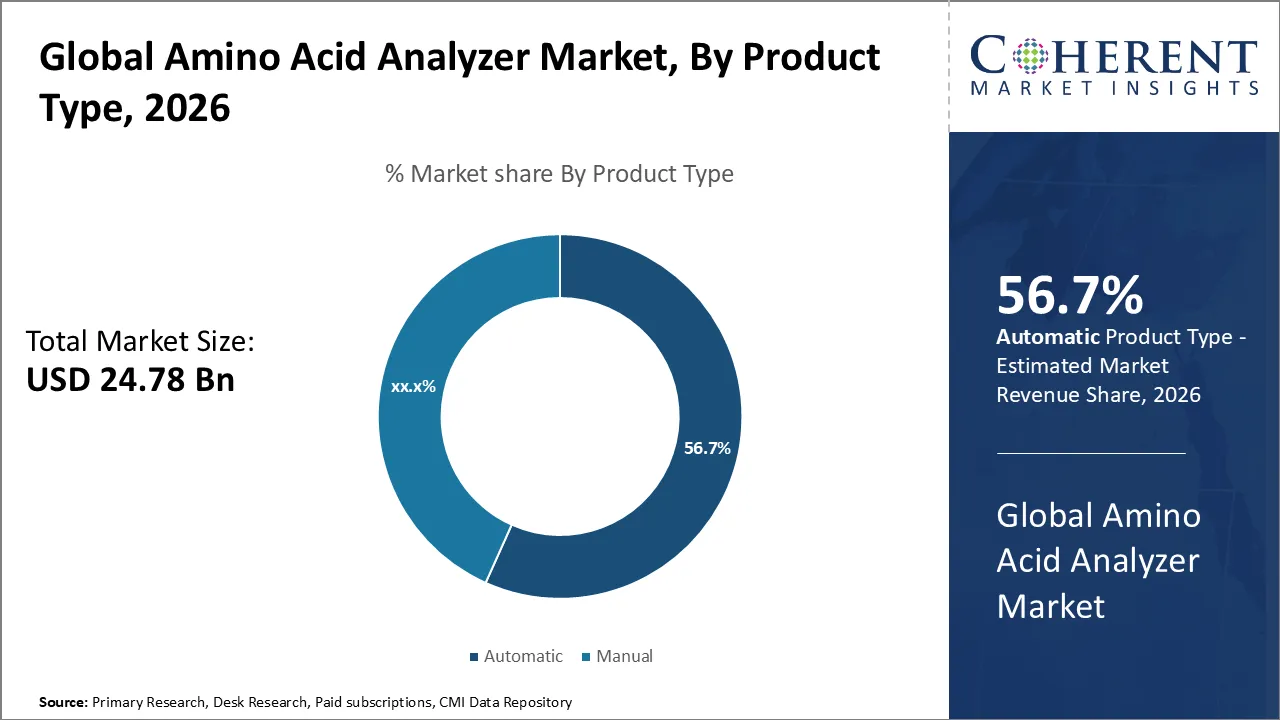
- By Product Type, Automatic hold the largest market share of 56.7% in 2026 owing to the growing demand for automation in laboratories.
- By Application, Identification expected to hold largest market share of 51.3% in 2026 owing to the growing need for protein and peptide characterization.
- By End User, Biopharmaceutical Industries acquired the prominent market share of 34.4% in 2026 owing to its expansion of biopharmaceutical R&D & pipeline growth.
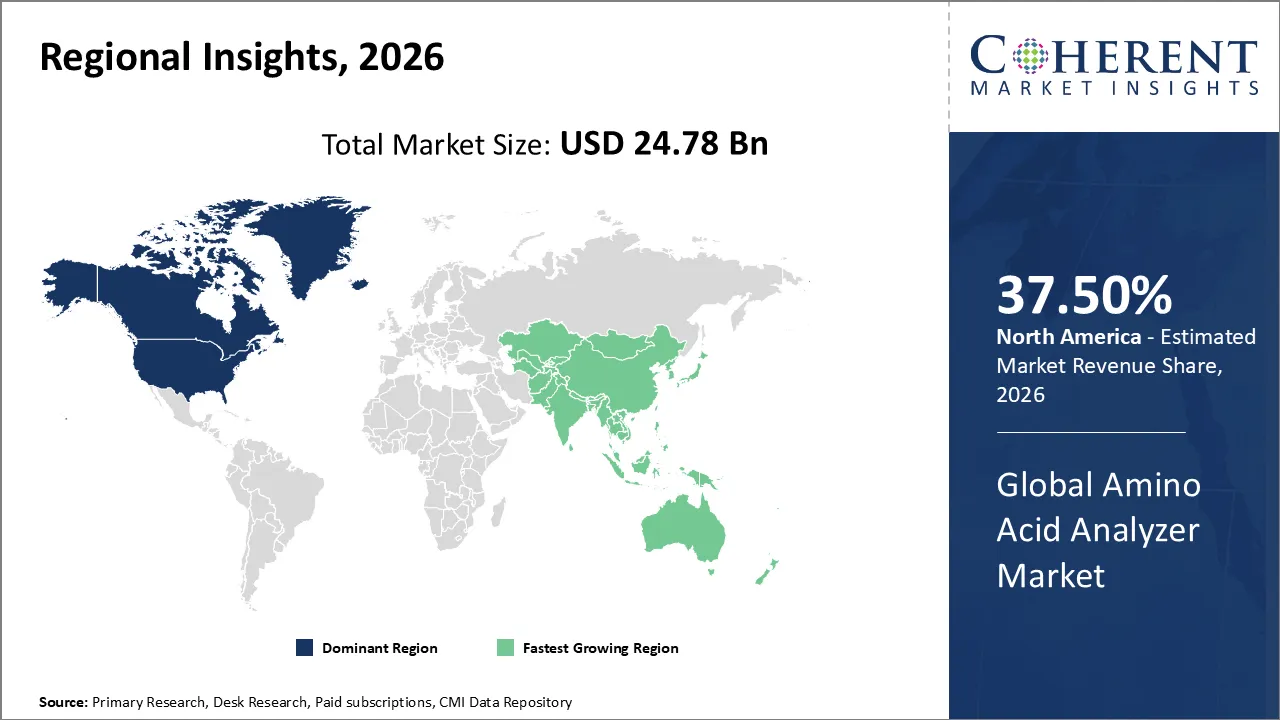
- By Region, North America dominates the overall market with an estimated share of 37.5% in 2026 advanced healthcare & research infrastructure.
Market Overview
Rising demand for accurate amino acid analysis drives the Amino Acid Analyzer Market across pharmaceuticals, biotechnology, food testing, and clinical diagnostics. Laboratories use these analyzers for protein characterization, quality control, diagnosing metabolic disorders, and nutritional analysis. Ongoing technological advancements, including automation, advanced detection techniques, and higher throughput, improve efficiency and precision. Expanding biopharmaceutical research, tightening regulatory standards, and increasing applications in proteomics and personalized medicine further propel global market growth.
Current Events and Its Impact on the Amino Acid Analyzer Market
Current Events | Description and its impact |
Geopolitical and Regulatory Developments |
|
Technological Advancements and Innovation |
|
Scientific Research and Healthcare Trends |
|
Segmental Insights
- Current Industry Events of 2026
- Market Size Estimation
- Regional Breakdown
- Competitive Landscape
- Customer Intelligence
- Segmental Analysis
- Pricing Analysis
- Key Market Drivers, Challenges & Future Trends
- Customized Insights Section
Amino Acid Analyzer Market Insights, By Product Type: Automatic contribute the highest share of the market owing to its rising food & nutritional testing needs.
Automatic hold the largest market share of 56.7% in 2026. The growing need for efficient laboratory workflows and reliable analytical outcomes drives the automatic segment of the Amino Acid Analyzer Market. Automatic analyzers limit manual handling, reduce the risk of human error, and accelerate sample processing, which suits high-throughput testing environments. Pharmaceutical quality control units, biopharmaceutical production facilities, and advanced research laboratories increasingly adopt these systems. Moreover, laboratories actively shift from manual and semi-automatic instruments to meet higher standards for data accuracy, regulatory compliance, and overall operational efficiency.
Amino Acid Analyzer Market Insights, By Application: Identification contributes the highest share of the market owing to its clinical diagnostics & disease biomarker discovery.
Identification expected to hold largest market share of 51.3% in 2026. Increasing demand for precise detection and profiling of amino acids in complex biological and chemical samples drives the identification segment of the Amino Acid Analyzer Market. Research organizations and biopharmaceutical companies actively use identification functions for protein structure studies, peptide mapping, and biomarker exploration. Greater focus on disease diagnosis, screening of metabolic disorders, and verification of food and nutritional products further boosts demand. Moreover, improvements in analytical sensitivity and separation techniques enhance the importance of amino acid identification across a wide range of applications. For instance, in December 2025, Quantum-Si has launched the Version 3 Library Preparation Kit and new data analysis tools, advancing its single-molecule protein analysis technology.
Amino Acid Analyzer Market Insights, By End User: Biopharmaceutical Industries contribute the highest share of the market owing to its outsourcing to CROS & analytical services.
Biopharmaceutical Industries acquired the prominent market share of 34.4% in 2026. The biopharmaceutical industry actively drives demand for amino acid analyzers as companies develop biologics, peptide-based drugs, and vaccines that require precise protein characterization. These analyzers ensure quality control, maintain batch consistency, and help meet regulatory standards throughout drug development and production. Expanding research in proteomics, personalized medicine, and therapeutic protein optimization further boosts their adoption. Additionally, the growth of biomanufacturing facilities and outsourcing to contract research organizations increases reliance on high-throughput, accurate amino acid analysis, making these instruments indispensable in biopharmaceutical operations. For instance, Pfanstiehl has introduced high-purity, low-endotoxin, low-metal L-Histidine and L-Histidine Hydrochloride Monohydrate, setting a new quality benchmark for amino acids.
Regional Insights
North America Amino Acid Analyzer Market Trends
North America dominates the overall market with an estimated share of 37.5% in 2026. Strong research activity, advanced healthcare infrastructure, and substantial investment in pharmaceuticals and biotechnology drive the Amino Acid Analyzer Market in North America. Laboratories increasingly implement automated, high-performance analyzers to advance clinical diagnostics, biopharmaceutical development, and food testing. The region’s focus on regulatory compliance, personalized medicine, and protein research actively boosts demand. Moreover, ongoing technological innovations and the strategic presence of key industry players strengthen market competition and expand the use of amino acid analyzers across a wide range of scientific and industrial applications. For instance, in August 2025, Lupin Limited has launched an authorized generic of Ravicti (Glycerol Phenylbutyrate) Oral Liquid, 1.1g/mL, in the U.S. for managing urea cycle disorder patients unresponsive to diet or amino acid therapy alone.
Asia Pacific Amino Acid Analyzer Market Trends
Rising investment in biotechnology and healthcare drives the adoption of advanced amino acid analyzers across research, clinical, and industrial laboratories in the Asia Pacific. China, India, and Japan actively lead regional demand as pharmaceutical development, food safety testing, and agricultural diagnostics grow. Laboratories increasingly use efficient analyzers to perform protein research, quality testing, and metabolic profiling. Rapid industrialization, increasing healthcare awareness among the middle class, and the expansion of food processing industries further accelerate the market’s growth across diverse regional applications.
India Amino Acid Analyzer Market Trends
In India, growth in life sciences and quality testing drives the Amino Acid Analyzer Market, as laboratories increasingly invest in analytical equipment to support pharmaceutical, food safety, and agricultural applications. Contract research organizations and healthcare facilities actively use amino acid analysis for drug development and clinical diagnostics. Rising health awareness and growing demand for nutritional products encourage adoption in functional food and supplement testing. Additionally, government initiatives supporting biotech infrastructure and local manufacturing actively boost market presence and adoption across the country. For instance, Danone India has launched its global brand Neocate, a hypoallergenic amino acid-based formula, for managing cow’s milk allergy in infants and young children.
United States Amino Acid Analyzer Market Trends
In the United States, advanced healthcare, pharmaceutical, and biotech research actively drives strong demand for precise amino acid analyzers. Laboratories increasingly implement high-performance systems to conduct clinical diagnostics, drug development, and food safety testing, while adhering to strict regulatory standards and quality assurance protocols. Academic and industry collaborations actively promote innovation in amino acid profiling and protein research. Furthermore, laboratories adopt automated technologies and focus on metabolic studies, further expanding the use of amino acid analyzers across diverse scientific and industrial applications.
End-user Feedback and Unmet Needs in the Amino Acid Analyzer Market
- Need for Faster Analysis: End-users report that traditional amino acid analyzers can be time-consuming, especially in high-throughput labs. They seek instruments that combine speed with accuracy to streamline workflows. Faster analysis would reduce bottlenecks in clinical diagnostics, pharmaceutical testing, and research laboratories, improving overall efficiency without compromising data quality.
- Desire for Greater Automation: Many laboratories express the need for fully automated systems that minimize manual intervention. Automation reduces human error, enhances reproducibility, and allows staff to focus on interpretation rather than routine processing. Users want intuitive systems with automated sample handling, derivatization, and data processing features for smoother lab operations.
- Demand for High Sensitivity and Accuracy: End-users emphasize the need for analyzers capable of detecting low-concentration amino acids with high precision. Improved sensitivity is critical for proteomics, biomarker discovery, and metabolic profiling, where even minor deviations can impact results. Users expect reliable, reproducible data across diverse sample types.
Amino Acid Analyzer Market Trend
Shift Toward Automation
Laboratories increasingly adopt automated amino acid analyzers to streamline workflows, reduce manual errors, and increase throughput. Automation allows high-volume testing across clinical, pharmaceutical, and food laboratories, providing faster, more reproducible results. Advanced systems now integrate automated sample preparation, derivatization, and data analysis, enabling researchers to focus on interpretation rather than routine processes, improving operational efficiency and productivity across multiple end-use sectors.
Growing Adoption in Biopharmaceutical Research
The rise of biologics, peptide therapeutics, and protein-based drugs drives amino acid analyzer usage in the biopharmaceutical sector. Companies rely on these instruments for protein characterization, batch consistency checks, and regulatory compliance. Increasing research in proteomics and personalized medicine further boosts demand, as accurate amino acid profiling is essential for drug development, stability studies, and optimizing therapeutic efficacy.
Market Report Scope
Amino Acid Analyzer Market Report Coverage
| Report Coverage | Details | ||
|---|---|---|---|
| Base Year: | 2025 | Market Size in 2026: | USD 24.78 Bn |
| Historical Data for: | 2020 To 2024 | Forecast Period: | 2026 To 2033 |
| Forecast Period 2026 to 2033 CAGR: | 19.6% | 2033 Value Projection: | USD 71.1 Bn |
| Geographies covered: |
| ||
| Segments covered: |
| ||
| Companies covered: | Hitachi High-Technologies, Dionex (Thermo Fisher), MembraPure GmbH, Biochrom, Beckman Coulter, HACH, Horiba, Agilent, Shimadzu, Jeol, Young Lin, Zef Scientific, and Phenomenex. | ||
| Growth Drivers: |
| ||
| Restraints & Challenges: |
| ||
Amino Acid Analyzer Market News
- In July 2024, Nirrin Technologies has launched the Atlas™ system, using tunable laser spectroscopy™ to quantify excipients and high-concentration proteins in bioprocessing in just one minute.
Analyst Opinion (Expert Opinion)
- The Amino Acid Analyzer market is exhibiting a discernible shift from traditional, semi‑automatic instrumentation toward automated, high‑throughput platforms as quality control in biopharmaceutical production intensifies; over 60% of laboratories globally adopted automated analyzers in 2024, and biopharma facilities alone accounted for 38% of all usage, underscoring how precision and speed are now non‑negotiable operational imperatives rather than optional enhancements.
- Despite this momentum, the scarcity of technically skilled operators and rising consumable costs are constraining broader deployment, with roughly a quarter of labs reporting recruitment challenges for technically competent staff and nearly a third flagging consumables as a significant cost burden.
- In parallel, adoption patterns reflect evolving analytical demands beyond pharma, as food testing laboratories now conduct more than 22 million amino acid analyses for nutritional profiling and compliance with stricter labeling norms, demonstrating diversification of demand drivers and opening new avenues for instrument innovation and application expansion.
Speak to the analyst
Want personalized insights?
Take the findings above to one of our principal consultants, or have the report rebuilt around the segments, geographies and competitors you actually track.
Market Segmentation
- By Product Type
- Manual
- Automatic
- By Application
- Quantification
- Identification
- By End User
- Biopharmaceutical Industries
- Research Organizations
- Food and Beverage Industry
- By Regional Insights
- North America
- U.S.
- Canada
- Latin America
- Brazil
- Argentina
- Mexico
- Rest of Latin America
- Europe
- Germany
- U.K.
- Spain
- France
- Italy
- Russia
- Rest of Europe
- Asia Pacific
- China
- India
- Japan
- Australia
- South Korea
- ASEAN
- Rest of Asia Pacific
- Middle East
- GCC Countries
- Israel
- Rest of Middle East
- Africa
- South Africa
- North Africa
- Central Africa
- North America
- Key Players Insights
- Hitachi High-Technologies
- Dionex (Thermo Fisher)
- MembraPure GmbH
- Biochrom
- Beckman Coulter
- HACH
- Horiba
- Agilent
- Shimadzu
- Jeol
- Young Lin
- Zef Scientific
- Phenomenex
Sources
Primary Research interviews
- Laboratory managers and technical staff in biopharmaceutical and clinical labs
- R&D scientists in pharmaceutical and biotechnology companies
- Quality control and regulatory compliance officers
- Food testing laboratory professionals
- Academic researchers specializing in proteomics and metabolomics
Databases
- PubChem
- Protein Data Bank (PDB)
- NCBI (National Center for Biotechnology Information)
- ClinicalTrials.gov
- FDA and EMA regulatory databases
Magazines
- The Scientist
- Lab Manager
- Genetic Engineering & Biotechnology News
- BioPharm International
Journals
- Journal of Proteome Research
- Analytical Biochemistry
- Journal of Chromatography B
- Amino Acids
- Clinical Chemistry
Newspapers
- The New York Times – Health Section
- The Guardian – Science Section
- The Times of India – Science & Health Section
Associations
- American Chemical Society (ACS)
- American Society for Biochemistry and Molecular Biology (ASBMB)
- International Society for Amino Acid Research (ISAAR)
- Association of Clinical Research Organizations (ACRO)
Public Domain sources
- U.S. National Library of Medicine (NLM)
- World Health Organization (WHO) reports
- Food and Agriculture Organization (FAO) publications
- Government health and food safety portals (CDC, USDA)
Proprietary Elements
- CMI Data Analytics Tool
- Proprietary CMI Existing Repository of information for last 8 years
Get access to 250+ pages report
Every segment, forecast, competitor profile and data table behind the analysis above — available for instant download.
- ESOMAR Member
- ISO 9001:2015 Certified
- D-U-N-S Registered
- GDPR & CCPA Compliant
Missing comfort of reading report in your local language? Find your preferred language:
Transform your Strategy with Exclusive Trending Reports
Frequently Asked Questions
The Amino Acid Analyzer Market is estimated to be valued at USD 24.78 Bn in 2026 and is expected to reach USD 71.1 Bn by 2033.
The CAGR of the Amino Acid Analyzer Market is projected to be 19.6% from 2026 to 2033.
Key end-users include biopharmaceutical companies, clinical diagnostic laboratories, food and nutrition testing labs, research institutions, and contract research organizations (CROs).
Recent advancements include automation, high-throughput capabilities, improved sensitivity, integration with LC-MS systems, and AI-assisted data analysis.
High initial costs, ongoing consumable expenses, complex operation, and limited skilled personnel are the primary challenges.