

Clinical Diagnostic Market Size and Forecast – 2026 to 2033
The Clinical Diagnostic Market is anticipated to grow at a CAGR of 8.5% with USD 86.8 Bn in 2026 and is expected to reach USD 123.8 Bn in 2033. Healthcare providers increasingly demand early and accurate disease detection, while companies advance molecular diagnostic technologies and expand personalized medicine solutions.
Key Takeaways
- Complete Blood Count hold the largest market share of 38.7% in 2026 owing to its rising prevalence of chronic and blood-related diseases. Blood-related diseases (hematologic conditions) and cardiovascular diseases, which are closely linked, represent a significant global health burden. Key statistics include 900,000+ U.S. annual blood clot cases, 100,000+ U.S. sickle cell disease cases, and 1.62 Bn people affected by anemia globally. Globally, Cardiovascular Diseases (CVDs) cause an estimated 19.8 million deaths annually. paraphrase this make it precise
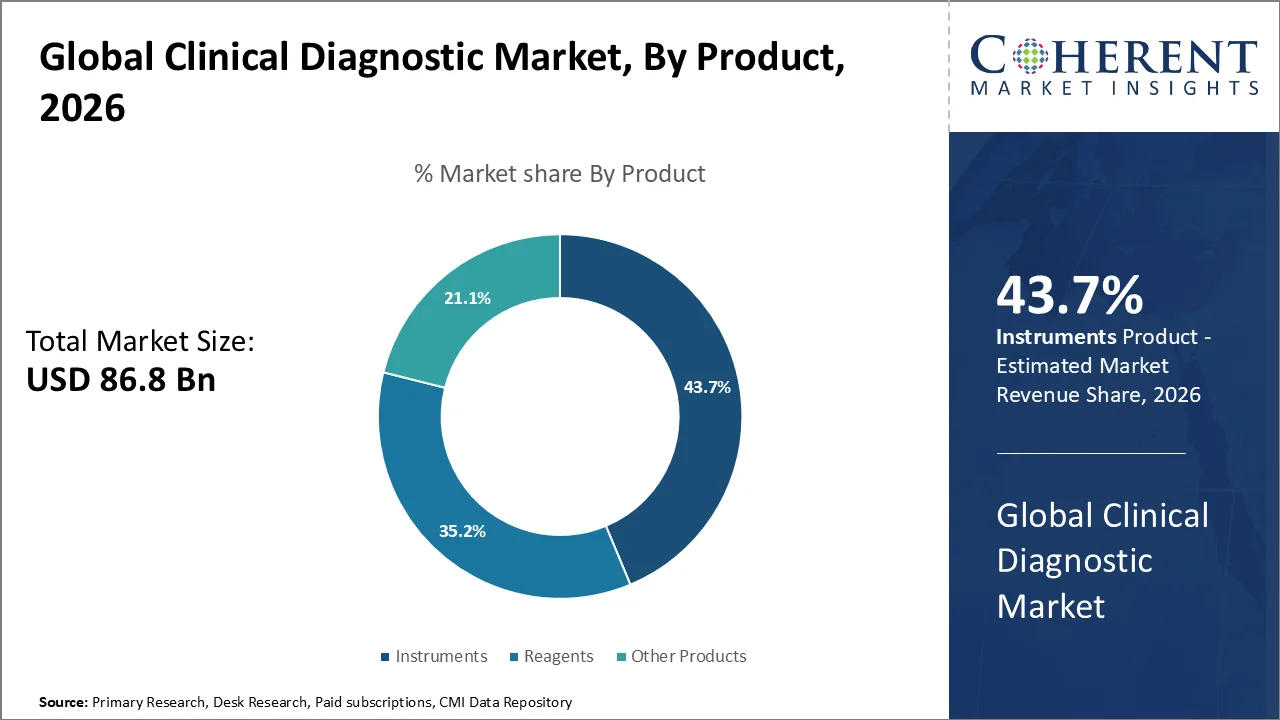
- Instruments expected to hold largest market share of 43.7% in 2026 owing to the increasing demand for automated diagnostic systems.
- Hospital Laboratory acquired the prominent market share of 39.6% in 2026 owing to its increasing patient admissions and diagnostic testing volumes. In 2023–24, there were 12.6 million hospital admissions, equivalent to 421 hospitalizations per 1,000 people.
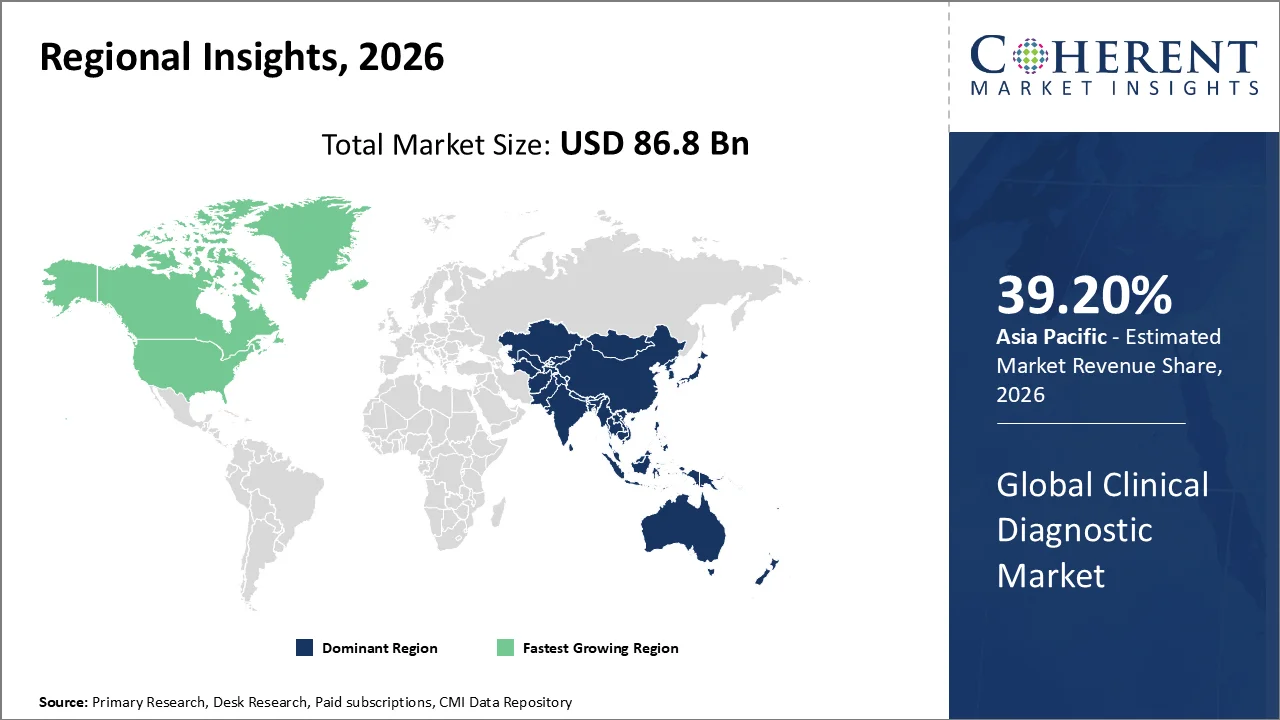
- By Region, Asia Pacific is expected to acquire the dominant share of 39.2% in 2026 owing to the rising prevalence of chronic and infectious diseases.
Current Events and Their Impact on the Clinical Diagnostic Market
Current Event | Description and its Impact |
FDA Crackdown and Legal Reversal on Laboratory Developed Tests (LDTs) – U.S. |
|
EU AI Act and IVDR Enforcement in Diagnostics |
|
Segmental Insights
- Current Industry Events of 2026
- Market Size Estimation
- Regional Breakdown
- Competitive Landscape
- Customer Intelligence
- Segmental Analysis
- Pricing Analysis
- Key Market Drivers, Challenges & Future Trends
- Customized Insights Section
Instruments expected to hold largest market share
Instruments expected to hold largest market share of 43.7% in 2026. Rising demand for accurate and rapid disease diagnosis across healthcare settings drives the instruments segment in the clinical diagnostic market. Growing cases of chronic and infectious diseases increase the need for advanced diagnostic instruments. Manufacturers and healthcare providers continuously adopt technological advancements to improve automation, precision, and laboratory efficiency. Expanding healthcare infrastructure and diagnostic laboratories, along with wider use of point-of-care testing, further boost demand. Increasing emphasis on early disease detection and personalized medicine also accelerates the adoption of sophisticated diagnostic instruments globally. For instance, Transasia Bio-Medicals Ltd. provides clinical diagnostic solutions across biochemistry, hematology, molecular diagnostics, microbiology, immunology, coagulation, and urine analysis, offering a broad portfolio of high-quality diagnostic products and services.
Which End User segment dominates the market?
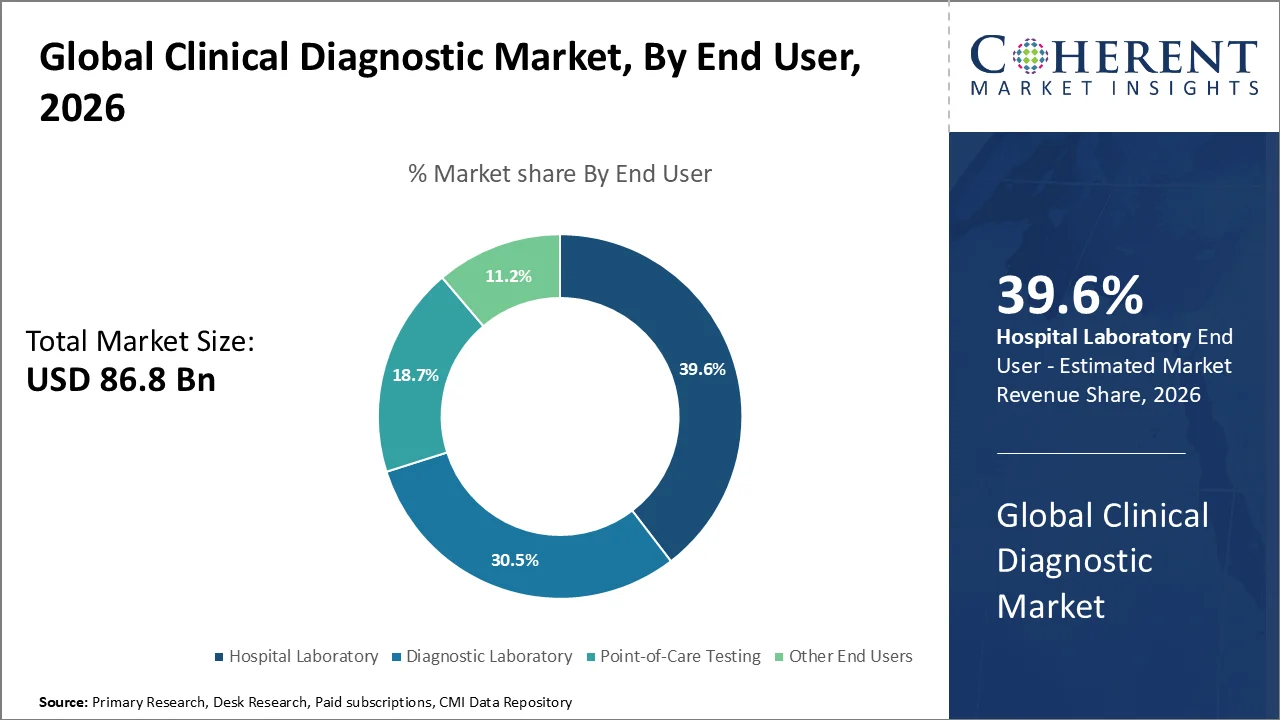
Hospital laboratories accounted for a significant 39.6% share of the clinical diagnostic market in 2026. This segment is driven by rising patient admissions and the growing burden of chronic and infectious diseases that require routine and advanced diagnostic testing. According to the World Health Organization, chronic diseases account for nearly 74% of global deaths annually, while cardiovascular diseases alone cause approximately 19.8 million deaths worldwide each year. Additionally, diabetes affects over 830 million people globally, significantly increasing the demand for continuous laboratory testing and disease monitoring. Hospitals are increasingly investing in advanced laboratory infrastructure to improve diagnostic accuracy and reduce turnaround time.
Why is Complete Blood Count Acquiring the Largest Market Share?
Complete Blood Count (CBC) held the largest market share of 38.7% in 2026. The growth of the CBC clinical diagnostic market is driven by the rising prevalence of blood disorders, infections, and chronic diseases, increasing the need for routine blood monitoring for accurate diagnosis and treatment. Globally, anemia affects nearly 1.62 billion people, while more than 900,000 blood clot cases and over 100,000 sickle cell disease cases are reported annually in the U.S. alone. In addition, chronic diseases account for approximately 74% of global deaths each year, significantly increasing demand for regular hematological testing and patient monitoring. Healthcare providers are increasingly adopting automated hematology analyzers to improve testing speed, precision, and laboratory efficiency. Expanding healthcare infrastructure, growing preventive health check-ups, and rising demand for early disease detection continue to support market growth.
Clinical Diagnostic Market Trends
- Rising demand for early and accurate disease detection is increasing the adoption of advanced clinical diagnostic solutions across hospitals and laboratories, improving patient outcomes and treatment decisions. More than 70% of clinical decisions are estimated to rely on laboratory diagnostic results, highlighting the critical role of diagnostics in modern healthcare.
- Expanding adoption of point-of-care testing (POCT) enables rapid diagnostic results in emergency and remote care settings, improving accessibility and timely clinical intervention. The increasing use of rapid infectious disease testing and glucose monitoring devices is driving POCT adoption, particularly as over 537 million adults globally live with diabetes and require continuous monitoring.
Regional Insights
Asia Pacific dominates owing to growing population
Asia Pacific is expected to acquire the dominant share of 39.20% in 2026. Rising cases of chronic and infectious diseases drive demand for early and accurate testing in the Asia Pacific clinical diagnostic market. Expanding healthcare infrastructure and growing hospital networks across emerging economies improve access to diagnostic services. Increasing awareness of preventive healthcare encourages wider adoption of early disease detection. Technological advancements in automated analyzers, molecular diagnostics, and point-of-care testing enhance efficiency and speed. Higher healthcare spending, along with government efforts to strengthen laboratory systems, continues to support sustained market growth across the region. For instance, Agilus Diagnostics has installed the Illumina NovaSeq X at its Mumbai reference laboratory, expanding India’s large-scale next-generation sequencing (NGS) capabilities.
North America Clinical Diagnostic Market Trends
The North American clinical diagnostic market is expanding as chronic and lifestyle-related diseases become more common, increasing the need for early disease detection and advanced testing solutions. Healthcare providers are rapidly adopting new diagnostic technologies, supported by strong healthcare systems, broad insurance access, and ongoing innovation in molecular testing and automation. Precision medicine, point-of-care testing, and preventive healthcare initiatives are further driving adoption across the region. At the same time, stronger focus on infectious disease monitoring and supportive regulatory policies are enabling laboratories and healthcare organizations to enhance and expand their diagnostic capabilities.
China Clinical Diagnostic Market Trends
China’s clinical diagnostic market continues to grow steadily as rising chronic and infectious diseases and an aging population drive demand for early and accurate diagnosis. Healthcare providers increasingly adopt molecular diagnostics, automated systems, and digital laboratory technologies. Government reforms reshape procurement and pricing, while local manufacturers expand production capacity. Laboratories actively use reagents, point-of-care testing, and AI-powered diagnostic tools to improve workflow efficiency. Global and domestic companies collaborate to introduce innovative solutions and broaden access to advanced diagnostic services across both urban hospitals and regional healthcare facilities.
United States Clinical Diagnostic Market Trends
Rising chronic diseases, an aging population, and stronger focus on early disease detection continue to drive the United States clinical diagnostic market forward. Chronic diseases account for approximately 90% of the nation’s annual healthcare expenditure, while nearly 6 in 10 U.S. adults live with at least one chronic condition. In addition, cardiovascular diseases cause around 700,000 deaths annually in the country, significantly increasing demand for routine and advanced diagnostic testing. Healthcare providers are actively adopting molecular diagnostics, genomics, and AI-based testing tools to improve the accuracy and speed of results. Hospitals and laboratories are increasingly implementing automated and high-throughput systems, while outpatient centers continue expanding point-of-care testing to improve accessibility. The growing elderly population is also contributing to market growth, with adults aged 65 and older projected to exceed 80 million by 2040 in the U.S.
Who are the Major Companies in Clinical Diagnostic Industry
Some of the major key players in Clinical Diagnostic are Thermo Fisher Scientific, F. Hoffmann-La Roche AG, Qiagen N.V, Hologic Inc., Siemens Healthineers AG, BioMerieux SA, Abbott Laboratories, Bio-Rad Laboratories Inc., Becton, Dickinson and Company, and Danaher Corporation (Beckman Coulter, Inc.), among others.
Key News
- In February 2026, ACIST Medical Systems, Inc. has launched the ACIST Pro Diagnostic System in selected European markets to improve precision, safety, and efficiency in image-guided cardiovascular procedures.
Market Report Scope
Clinical Diagnostic Market Report Coverage
| Report Coverage | Details | ||
|---|---|---|---|
| Base Year: | 2025 | Market Size in 2026: | USD 86.8 Bn |
| Historical Data for: | 2020 To 2024 | Forecast Period: | 2026 To 2033 |
| Forecast Period 2026 to 2033 CAGR: | 8.5% | 2033 Value Projection: | USD 123.8 Bn |
| Geographies covered: |
| ||
| Segments covered: |
| ||
| Companies covered: | Thermo Fisher Scientific, F. Hoffmann-La Roche AG, Qiagen N.V, Hologic Inc., Siemens Healthineers AG, BioMerieux SA, Abbott Laboratories, Bio-Rad Laboratories Inc., Becton, Dickinson and Company, and Danaher Corporation (Beckman Coulter, Inc.), among others. | ||
Analyst Opinion
- Clinical diagnostics is not expanding due to incremental innovation alone—it is being structurally forced upward by disease prevalence and delayed diagnosis. In the U.S. alone, more than 129 million people live with at least one major chronic disease, creating continuous and unavoidable demand for diagnostic testing across oncology, cardiometabolic, and infectious disease segments.
- The scale of testing demand is already industrial. The U.S. performs over 14 billion laboratory tests annually, meaning diagnostics has effectively become a frontline healthcare function rather than a supporting one. This volume is driven largely by routine monitoring of diabetes, cardiovascular risk, and cancer screening rather than episodic illness.
- Molecular diagnostics is no longer niche—it is becoming standard of care in oncology decision-making. For example, over 80% of new cancer drugs now require companion diagnostic testing for treatment selection, directly embedding diagnostics into therapy pathways and making test adoption clinically non-optional rather than discretionary.
- AI-enabled and automated diagnostic systems are gaining real traction because workforce constraints are severe, not theoretical. The U.S. faces a projected shortfall of tens of thousands of laboratory professionals, pushing hospitals like Mayo Clinic and Cleveland Clinic to scale automated analyzers and digital pathology platforms to maintain turnaround times and diagnostic accuracy under rising sample loads.
Speak to the analyst
Want personalized insights?
Take the findings above to one of our principal consultants, or have the report rebuilt around the segments, geographies and competitors you actually track.
Market Segmentation
- By Test (Revenue, USD Bn, 2021-2033)
- Lipid Panel
- Liver Panel
- Renal Panel
- Complete Blood Count
- Electrolyte Testing
- Infectious Disease Testing
- Other Tests
- By Product (Revenue, USD Bn, 2021-2033)
- Instruments
- Reagents
- Other Products
- By End User (Revenue, USD Bn, 2021-2033)
- Hospital Laboratory
- Diagnostic Laboratory
- Point-of-Care Testing
- Other End Users
- By Region (Revenue, USD Bn, 2021-2033)
- North America
- U.S.
- Canada
- Latin America
- Brazil
- Mexico
- Argentina
- Rest of Latin America
- Europe
- Germany
- U.K.
- France
- Italy
- Spain
- Russia
- Rest of Europe
- Asia Pacific
- China
- India
- Japan
- Australia
- South Korea
- ASEAN
- Rest of Asia Pacific
- Middle East
- GCC
- Israel
- Rest of Middle East
- Africa
- South Africa
- Central Africa
- North Africa
- North America
Sources
Primary Research interviews
- Interviews with clinical laboratory directors and pathologists
- Discussions with hospital procurement managers and diagnostic center owners
- Inputs from medical device distributors and diagnostic equipment suppliers
- Consultations with healthcare professionals involved in diagnostic decision-making
- Feedback from technicians and lab analysts working in clinical diagnostics
Databases
- World Health Organization (WHO) Global Health Observatory
- World Bank Health Nutrition and Population Statistics
- National health ministry databases and public health dashboards
- PubMed Central biomedical database
- Medline/PubMed indexed clinical research database
- ClinicalTrials.gov registry
Magazines
- The Lancet Infectious Diseases (industry insights section)
- Nature Medicine features and reports
- Scientific American (health and diagnostics coverage)
- Modern Healthcare (diagnostics and hospital tech updates)
- Medical Device + Diagnostic Industry (MD+DI) magazine
Journals
- Journal of Clinical Microbiology
- Clinical Chemistry journal
- The American Journal of Clinical Pathology
- Diagnostics (MDPI journal)
- Laboratory Medicine journal
- BMJ (British Medical Journal) research articles
Newspapers
- The New York Times (health section)
- The Guardian (healthcare coverage)
- Financial Times (healthcare and life sciences reporting)
- The Hindu (health and science section)
- The Times of India (health news coverage)
Associations
- American Association for Clinical Chemistry (AACC)
- College of American Pathologists (CAP)
- World Association of Societies of Pathology and Laboratory Medicine
- Indian Association of Medical Microbiologists (IAMM)
- Clinical and Laboratory Standards Institute (CLSI)
- International Federation of Clinical Chemistry and Laboratory Medicine (IFCC)
Public Domain sources
- Government health ministry reports and annual health statistics
- WHO technical reports and disease burden publications
- CDC (Centers for Disease Control and Prevention) surveillance data
- OECD health statistics portal
- Open-access biomedical research repositories
- National disease registries and epidemiological datasets
Proprietary Elements
- CMI Data Analytics Tool
- Proprietary CMI Existing Repository of information for last 10 years
Get access to 250+ pages report
Every segment, forecast, competitor profile and data table behind the analysis above — available for instant download.
- ESOMAR Member
- ISO 9001:2015 Certified
- D-U-N-S Registered
- GDPR & CCPA Compliant
Missing comfort of reading report in your local language? Find your preferred language:
Transform your Strategy with Exclusive Trending Reports
Frequently Asked Questions
The Clinical Diagnostic Market is anticipated to grow at a CAGR of 8.5% with USD 86.8 Bn in 2026 and is expected to reach USD 123.8 Bn in 2033.
Growing burden of infectious and chronic diseases and increase in use of clinical diagnostic around the world is fueling the market.
The Complete Blood Count segment is the leading test segment in the market.
Affordability for high-end molecular diagnostics and limitations associated with reimbursement scenario are major factors restraining the market.
Major players operating in the market are Thermo Fisher Scientific, F. Hoffmann-La Roche AG, Qiagen N.V, Hologic Inc., Siemens Healthineers AG, BioMerieux SA, Abbott Laboratories, Bio-Rad Laboratories Inc., Becton, Dickinson and Company, and Danaher Corporation (Beckman Coulter, Inc.), among others.