

Data Center Virtualization Market Size and Share Analysis - 2026 To 2033
The Data Center Virtualization Market size is expected to reach a CAGR of 15.1%, rising from its current value of USD 8.78 Bn to an approximate value of USD 23.56 Bn by 2033. The key drivers behind the market growth include the rise in use of cloud computing, high demand for scalable and cost-effective data centers infrastructure, increasing volumes of enterprise data, and the requirement of higher server efficiency. Data center virtualization refers to consolidating physical servers, storage, network, and computing capabilities into virtual environments that can be managed via software, thereby reducing the cost of hardware, enabling efficient workload management, faster applications deployment, and hybrid/multi-cloud operation. According to Synergy Research Group, the global spend on cloud infrastructure services by enterprises stood at USD 98.8 Bn in Q2 2025, registering a year-over-year growth of 25%, while the public IaaS/PaaS revenues rose by 27%.
Key Takeaways
- The IT & Telecommunication segment is anticipated to gain maximum traction in the Data Center Virtualization Market with around 28.6% market share in 2026. This is attributed to the fast growth in cloud computing, higher internet traffic, adoption of virtualized network functions, development of 5G infrastructure, and increasing need for scalable computing and networking resources. As per the report by TeleGeography on State of the Network 2025, the global international internet bandwidth grew at 22% in 2024 to 1,479 Tbps, posting a 25% CAGR from 2020 to 2024.
- The large enterprises segment is set to lead the market with an estimated 64.0% share in 2026. The segment’s growth is attributed to the existing server infrastructure, large application workloads, increased budgets for IT modernization, and increasing usage of hybrid cloud management, disaster recovery, workload migration, and software-defined infrastructure. In a 2025 survey conducted by Red Hat on 1,010 IT managers and virtualization professionals within large enterprises, 71% reported virtualizing more than 50% of their IT infrastructure, and 84% used server virtualization.
- The North America region is likely to dominate the Data Center Virtualization Market with an estimated 41.0% share in 2026. The region’s growth is owing to the presence of major cloud and virtualization technology providers, extensive hyperscale data-center capacity, rapid adoption of hybrid-cloud infrastructure, rising AI computing workloads, and sustained enterprise investment in software-defined data centers. According to Synergy Research Group, the U.S. accounted for 55% of global hyperscale data-center operational capacity in Q3 2025, while the number of hyperscale facilities worldwide reached 1,297.
Market Drivers
Hybrid and Multi-Cloud Expansion Is Accelerating the Data Center Virtualization Market
The Data Center Virtualization Market is expanding as enterprises increasingly operate applications across private data centers, public clouds and edge environments. Virtualization enables organizations to move workloads between these environments, centrally manage computing resources and maintain consistent infrastructure without remaining dependent on a single physical platform.
The 2025 Red Hat State of Virtualization survey, storage and network virtualization were used by 84%, 81% and 77% of organizations, respectively. The increasing need to manage virtual machines, containers and cloud-native applications through unified infrastructure platforms is therefore supporting demand for data center virtualization solutions.
Rising Cloud Costs Are Driving Infrastructure Consolidation and Resource Optimization
Data Center Virtualization Market is getting driven by cost optimization as businesses are trying to lower down the number of unused hardware, minimize their cloud spend and optimize computing resources. With the help of virtualization, it becomes possible for multiple workloads to operate within a single physical resource set up.
Based on the Flexera 2025 State of the Cloud Report, 84% of those polled felt that the management of cloud spend was the most prevalent problem with cloud computing, but at the same time, cloud spending was predicted to rise by 28% in the next year. In addition, cloud budgeting was overstepping the allocated amount by 17%.
Current Events and Their Impact on the Data Center Virtualization Market
Current Event | Description and its Impact |
U.S. Government Accelerates Federal Permitting for AI Data Centers (July 2025) |
|
EU Advances Mandatory Data-Center Energy Reporting and Rating Scheme (2026) |
|
- Current Industry Events of 2026
- Market Size Estimation
- Regional Breakdown
- Competitive Landscape
- Customer Intelligence
- Segmental Analysis
- Pricing Analysis
- Key Market Drivers, Challenges & Future Trends
- Customized Insights Section
Segmental Insights
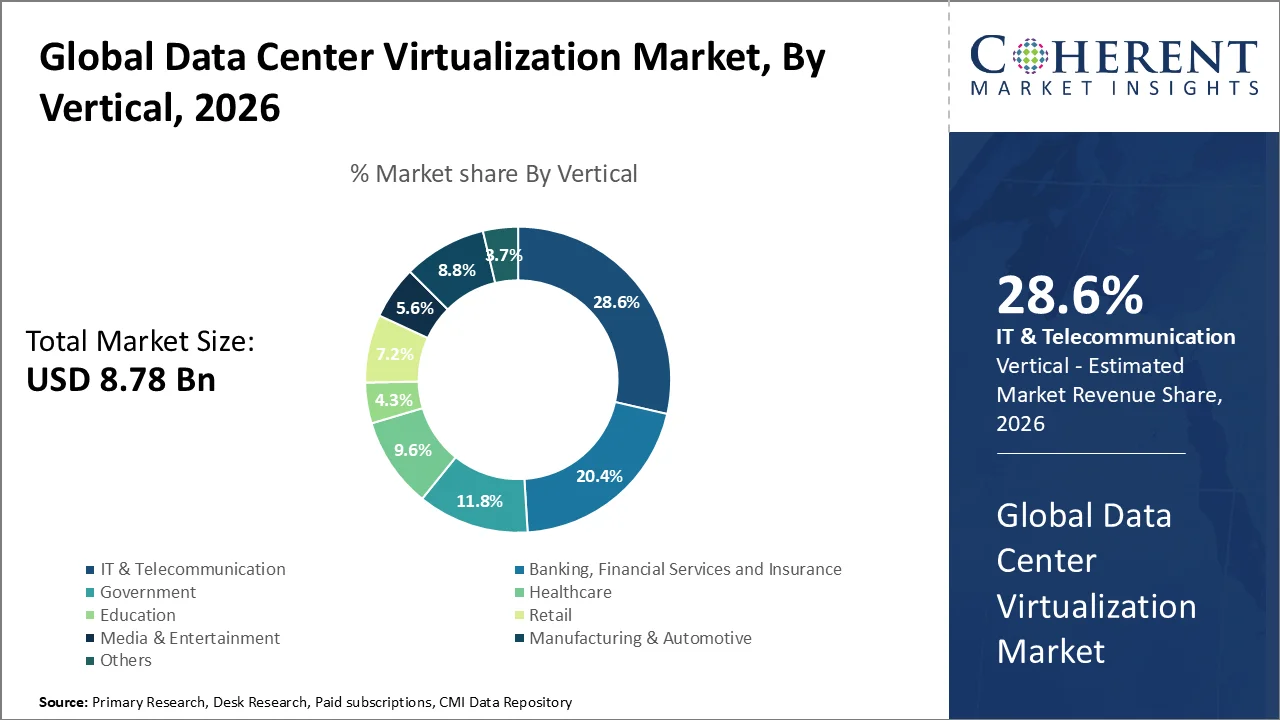
Why Is IT & Telecommunication Acquiring the Largest Share?
On the basis of vertical, the IT & Telecommunication segment is projected to account for the largest Data Center Virtualization Market share of 28.6% in 2026. The segment’s growth is owing to the rapid expansion of 5G networks, cloud-based telecom services, virtual network functions, network slicing and software-defined infrastructure. Telecom operators use virtualization to deploy network functions on shared computing infrastructure, automate resource allocation and manage increasing data traffic without continuously expanding dedicated physical hardware.
According to the Ericsson Mobility Report, global mobile data traffic reached approximately 146 exabytes per month in 2025, while 5G carried 48% of total mobile data traffic. More than 90 communication service providers had launched or soft-launched 5G Standalone networks, and Ericsson identified 118 network-slicing use cases across 56 service providers.
In June 2026, Nokia and Amazon Web Services expanded their collaboration to run Nokia’s Autonomous Network Fabric on AWS, enabling telecommunication operators to manage orchestration, network assurance, inventory and AI-driven operations through cloud infrastructure.
Large Enterprises Hold the Largest Market Share
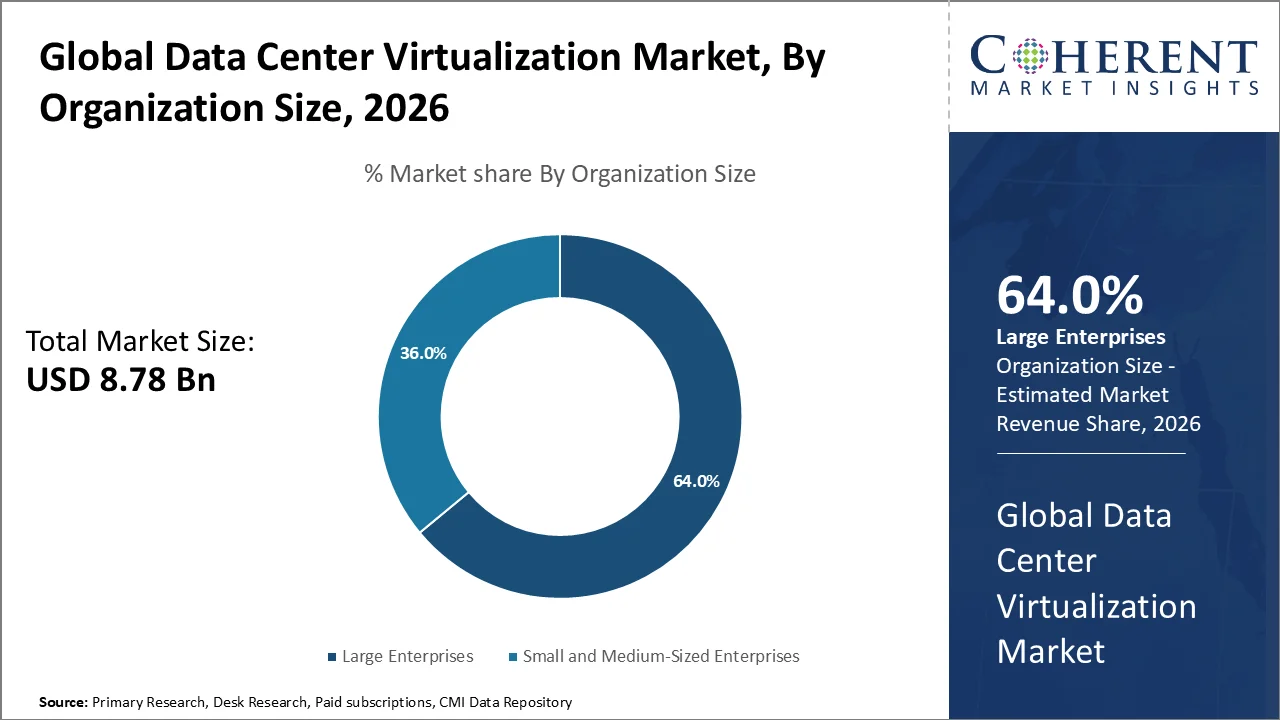
On the basis of organization size, the large enterprises segment is projected to lead the Data Center Virtualization Market with a major 64.0% share in 2026. The segment’s growth is owing to the presence of extensive data-center infrastructure, large application and database workloads, higher technology budgets and greater demand for disaster recovery, workload mobility, security and centralized infrastructure management. Large enterprises are increasingly replacing fragmented legacy virtualization environments with hybrid-cloud platforms that can manage virtual machines, containers, private clouds and AI workloads through a unified operating model.
In February 2026, an HPE survey of nearly 400 global enterprise IT decision-makers found that more than two-thirds of enterprises planned material changes to their virtualization strategies within the following two years, while only 5% considered themselves fully prepared for the transition.
Data Center Virtualization Market Trends
- The continued adoption of hybrid and multicloud infrastructure is increasing demand for virtualization platforms that can centrally manage workloads across private data centers, colocation facilities and public clouds. Flexera’s 2026 State of the Cloud Report found that 73% of organizations use hybrid cloud environments and 88% follow a multicloud strategy. Uptime Institute also reported that 45% of enterprise IT workloads remained within corporate data centers in 2025, highlighting the need for workload portability between on-premises and off-premises infrastructure.
- Rising licensing costs, vendor lock-in concerns and complex management requirements are encouraging enterprises to diversify their hypervisor environments. Red Hat’s State of Virtualization research found that 70% of surveyed organizations had recently moved, or were moving, virtual machine workloads to an additional or alternative hypervisor. Licensing costs were identified as a major concern by 31% of respondents, while 28% cited management complexity and vendor lock-in, supporting demand for alternative and open virtualization platforms.
- The convergence of virtual machines and containers is becoming an important infrastructure-modernization trend. Organizations are increasingly seeking a common platform for managing traditional VM-based applications alongside Kubernetes-based workloads. CNCF’s 2025 Annual Cloud Native Survey showed that 82% of container users operated Kubernetes in production, compared with 66% in 2023, while Red Hat reported that 39% of organizations plan to unify virtualized and containerized workloads on a single platform.
Regional Insights
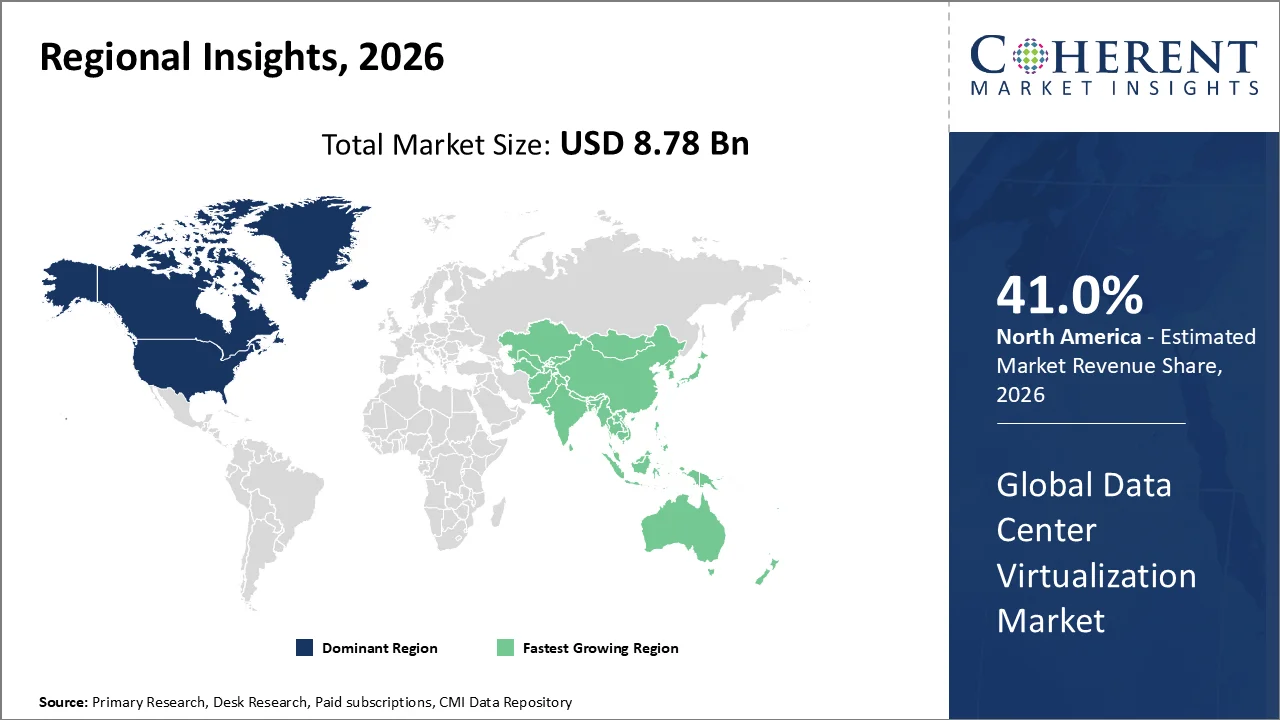
North America Dominates Owing to Its Large Data-Center Base and Advanced Cloud Infrastructure
The North America region is projected to account for the largest Data Center Virtualization Market share of 41.0% in 2026, representing approximately USD 3.60 billion. The region’s leadership is owing to the concentration of major cloud and virtualization providers, extensive enterprise data-center infrastructure, rapid adoption of hybrid-cloud environments, and increasing deployment of AI and high-performance computing workloads.
According to the U.S. Department of Energy, data centers consumed approximately 176 TWh of electricity in 2023, equivalent to 4.4% of total U.S. electricity consumption. Data-center electricity use is projected to reach between 325 TWh and 580 TWh by 2028, accounting for approximately 6.7% to 12.0% of total U.S. electricity demand. This rapid capacity expansion is increasing the need for server consolidation, automated workload allocation and energy-efficient virtual infrastructure.
In May 2026, California-based Broadcom announced VMware Cloud Foundation 9.1, an AI- and Kubernetes-native private-cloud platform supporting AMD, Intel and NVIDIA computing infrastructure.
Asia Pacific Data Center Virtualization Market Trends
Asia Pacific is expected to be the fastest-growing region in the Data Center Virtualization Market during 2026–2033, with an estimated CAGR of approximately 17.3%. Regional growth is owing to expanding cloud regions, rapid hyperscale investment, increasing data-localization requirements, rising enterprise digitalization and the development of AI-ready data centers across India, China, Japan, Southeast Asia, South Korea and Australia.
According to Cushman & Wakefield, Asia Pacific’s data-center development pipeline increased by 7,103 MW during the first half of 2026, reaching approximately 26,455 MW. The pipeline included 4,764 MW under construction and 21,691 MW in planning, while approximately 1,372 MW of new operational capacity was delivered during the period. Despite the additional supply, regional data-center vacancy declined from 10.9% to 10.3%, indicating continued absorption of new capacity.
In July 2026, Amazon Web Services launched Amazon Elastic VMware Service in the Asia Pacific (Seoul) Region. The service enables South Korean enterprises to run VMware Cloud Foundation directly within their Amazon Virtual Private Cloud on EC2 bare-metal infrastructure.
Federal AI Infrastructure Expansion and Secure Cloud Modernization Are Accelerating the Data Center Virtualization Market in the United States
The U.S. Data Center Virtualization Market is witnessing strong growth owing to the rapid development of AI-ready data centers, increasing migration of enterprise workloads to hybrid-cloud environments, and rising demand for secure and flexible computing infrastructure. Organizations are deploying server, storage and network virtualization to share high-cost computing resources, improve hardware utilization and manage conventional, cloud-native and AI workloads through centralized platforms.
In April 2025, the U.S. Department of Energy identified 16 federal sites with existing energy and infrastructure advantages for potential AI data-center development. The initiative is designed to support public-private partnerships and accelerate the construction of data centers alongside new energy-generation capacity.
National Computing-Power Interconnection and AI Infrastructure Expansion Are Strengthening the China Data Center Virtualization Market
The China Data Center Virtualization Market is expected to record strong growth owing to the country’s rapidly expanding computing infrastructure, large-scale cloud adoption, national data-center coordination programs and increasing deployment of AI computing clusters. Virtualization is becoming important for consolidating heterogeneous computing resources, improving data-center utilization and distributing workloads between eastern demand centres and western computing hubs.
According to the Digital China Development Report 2025, published in June 2026, China had more than 13.73 million standard data-center racks in operation at the end of 2025. The country had also developed 42 computing clusters containing at least 10,000 AI accelerators each, while intelligent computing capacity reached approximately 1.59 million PFLOPS based on FP16 performance, ranking second globally. This infrastructure expansion is increasing the requirement for virtualized workload allocation, GPU sharing, automated resource scheduling and software-defined data-center management.
Who are the Major Companies in Data Center Virtualization Industry
Some of the major key players in Data Center Virtualization Market are Amazon Web Services, AT&T, Cisco Systems, Citrix Systems, Fujitsu, HCL Technologies, Hewlett Packard Enterprise, Huawei, International Business Machines Corporation, Microsoft, Radiant Communications, VMware.
Key News
- In October 2025, AT&T introduced AT&T Express Waves, providing private 100G and 400G wavelength connectivity between major U.S. metropolitan areas, with eligible long-haul services activated within 24 hours.
- In February 2025, Cisco announced the N9300 Series Smart Switches, integrating AMD Pensando data-processing units and Cisco Silicon One technology. The switches can host networking and security services directly within the data-center network, supporting software-defined and virtualized infrastructure for AI workloads.
Market Report Scope
Data Center Virtualization Market Report Coverage
| Report Coverage | Details | ||
|---|---|---|---|
| Base Year: | 2025 | Market Size in 2026: | USD 8.78 Bn |
| Historical Data for: | 2020 To 2024 | Forecast Period: | 2026 To 2033 |
| Forecast Period 2026 to 2033 CAGR: | 15.1% | 2033 Value Projection: | USD 23.56 Bn |
| Geographies covered: |
| ||
| Segments covered: |
| ||
| Companies covered: | Amazon Web Services, AT&T, Cisco Systems, Citrix Systems, Fujitsu, HCL Technologies, Hewlett Packard Enterprise, Huawei, International Business Machines Corporation, Microsoft, Radiant Communications, VMware | ||
| Growth Drivers: |
| ||
| Restraints & Challenges: |
| ||
Analyst Opinion
- The Data Center Virtualization Market is shifting from basic server consolidation toward the unified management of private cloud, public cloud and AI infrastructure. Global enterprise spending on cloud infrastructure services reached USD 128.6 billion in Q1 2026, increasing by 35% year over year, while public IaaS and PaaS revenues expanded by 38%. This rapid growth is strengthening demand for virtualization platforms that support workload mobility, automated provisioning and centralized resource management.
- The convergence of virtual machines and containers is becoming a major competitive direction in the market. The CNCF 2025 Annual Cloud Native Survey found that 82% of container users run Kubernetes in production, while 66% of organizations hosting generative AI use Kubernetes to manage some or all inference workloads. This indicates that future data-center virtualization platforms will increasingly need to manage virtual machines, containers and AI workloads through a common infrastructure layer.
- AI adoption is creating a strong infrastructure-modernization opportunity, but integration with legacy systems remains a major barrier. Nutanix’s 2025 Enterprise Cloud Index found that 98% of surveyed organizations experienced challenges scaling generative AI from development to production, while 54% identified integration with existing IT infrastructure as the leading challenge. This is expected to increase demand for interoperable virtualization platforms, migration services, GPU-resource management and hybrid-cloud orchestration.
Speak to the analyst
Want personalized insights?
Take the findings above to one of our principal consultants, or have the report rebuilt around the segments, geographies and competitors you actually track.
Market Segmentation
- By Vertical (Revenue, USD Bn, 2021-2033)
- IT & Telecommunication
- Banking, Financial, Service and Insurance
- Government
- Healthcare
- Education
- Retail
- Media & Entertainment
- Manufacturing & Automotive
- Others
- By Organization Size (Revenue, USD Bn, 2021-2033)
- Small and Medium-Sized Enterprises
- Large Enterprises
- By Region (Revenue, USD Bn, 2021-2033)
- North America
- U.S.
- Canada
- Latin America
- Brazil
- Mexico
- Argentina
- Rest of Latin America
- Europe
- Germany
- U.K.
- France
- Italy
- Spain
- Russia
- Rest of Europe
- Asia Pacific
- China
- India
- Japan
- Australia
- South Korea
- ASEAN
- Rest of Asia Pacific
- Middle East
- GCC
- Israel
- Rest of Middle East
- Africa
- South Africa
- Central Africa
- North Africa
- North America
Sources
Primary Research Interviews
- Data center operators and infrastructure managers
- Cloud architects and virtualization engineers
- Chief information officers and IT infrastructure heads
- Server, storage, and networking solution providers
- Managed cloud and colocation service providers
- Telecommunication network virtualization experts
- Enterprise procurement and technology decision-makers
- Cybersecurity, disaster recovery, and business continuity specialists
Databases
- World Bank
- Organisation for Economic Co-operation and Development
- U.S. Energy Information Administration
- U.S. Department of Energy
- Eurostat
- International Telecommunication Union
- National Institute of Standards and Technology
- European Commission Digital Strategy Database
- UNCTAD Digital Economy Database
- U.S. Securities and Exchange Commission EDGAR
Paid Databases
- Factiva
- EMIS
- Orbis
- Dun & Bradstreet
- PitchBook
- Panjiva
- S&P Capital IQ
- Moody’s Analytics
Magazines and Industry Publications
- Data Center Dynamics
- Data Center Knowledge
- Network World
- CIO Magazine
- InformationWeek
- Computer Weekly
- Enterprise Networking Planet
- Capacity Media
Journals
- IEEE Transactions on Cloud Computing
- IEEE Transactions on Network and Service Management
- Future Generation Computer Systems
- Journal of Cloud Computing
- Computer Networks
- ACM Computing Surveys
- International Journal of Network Management
- Cluster Computing
Newspapers and Business Publications
- The Wall Street Journal
- Financial Times
- Reuters
- Bloomberg
- The New York Times
- The Economic Times
- Nikkei Asia
- South China Morning Post
Associations and Industry Bodies
- Uptime Institute
- Cloud Native Computing Foundation
- Open Compute Project Foundation
- Storage Networking Industry Association
- Distributed Management Task Force
- Internet Engineering Task Force
- Telecommunications Industry Association
- European Data Centre Association
- Data Center Coalition
- International Data Center Authority
Public Domain Sources
- Company annual reports and investor presentations
- Cloud and virtualization product documentation
- Government digital infrastructure and data-center policies
- Data-center energy consumption and efficiency reports
- Patent databases such as WIPO, USPTO, and Google Patents
- University research publications and technical papers
- Public procurement and government tender databases
- Regulatory publications covering cybersecurity and data sovereignty
- Company press releases, product launches, and partnership announcements
- Open-source virtualization and cloud platform documentation
Company Sources
- Amazon Web Services
- Microsoft
- Broadcom and VMware
- Hewlett Packard Enterprise
- IBM
- Cisco Systems
- Huawei
- Fujitsu
- Red Hat
- Nutanix
- Citrix
- HCLTech
Proprietary Elements
- CMI Data Analytics Tool
- Proprietary CMI repository covering the previous 10 years
Get access to 250+ pages report
Every segment, forecast, competitor profile and data table behind the analysis above — available for instant download.
- ESOMAR Member
- ISO 9001:2015 Certified
- D-U-N-S Registered
- GDPR & CCPA Compliant
Missing comfort of reading report in your local language? Find your preferred language:
Transform your Strategy with Exclusive Trending Reports
Frequently Asked Questions
The Data Center Virtualization Market is expected to reach approximately USD 23.56 Bn by 2033, increasing from USD 8.78 Bn in 2026.
Major players operating in the global Data Center Virtualization Market include Amazon Web Services, AT&T, Cisco Systems, Citrix Systems, Fujitsu, HCL Technologies, Hewlett Packard Enterprise, Huawei, International Business Machines Corporation, Microsoft, Radiant Communications, and VMware.
High initial investment and migration costs, complex integration with legacy infrastructure, cybersecurity concerns, vendor lock-in, licensing expenses, virtual-machine sprawl, and shortages of skilled virtualization professionals are the major factors hampering market growth.
The increasing adoption of hybrid and multi-cloud infrastructure, rising demand for server consolidation, expansion of AI-ready data centers, growing enterprise data volumes, and the need for scalable and cost-efficient computing resources are driving market growth.
The Data Center Virtualization Market is anticipated to grow at a CAGR of approximately 15.1% during 2026–2033.
North America is expected to dominate the global Data Center Virtualization Market with an estimated 41.0% share in 2026, supported by its extensive hyperscale data-center capacity, advanced cloud infrastructure, and strong presence of major virtualization technology providers.
Asia Pacific is expected to be the fastest-growing region during 2026–2033, with an estimated CAGR of approximately 17.3%. Growth is supported by expanding cloud regions, data-localization requirements, enterprise digitalization, and AI-ready data-center investments.