

Global Telecom Cloud Market Size and Forecast – 2026 To 2033
The global telecom cloud market is expected to grow from USD 47 Bn in 2026 to USD 169 Bn by 2033, registering a compound annual growth rate (CAGR) of 14% from 2026 to 2033. The global telecom cloud market is driven by the growing demand for edge computing across telecom operators. On June 24, 2026, Telefónica completed deployment across Spain of 17 edge computing nodes, an advanced network that accelerates the country’s digital transformation and strengthens technological sovereignty by providing more and better services to businesses and government agencies nationwide.
Key Takeaways of the Global Telecom Cloud Market
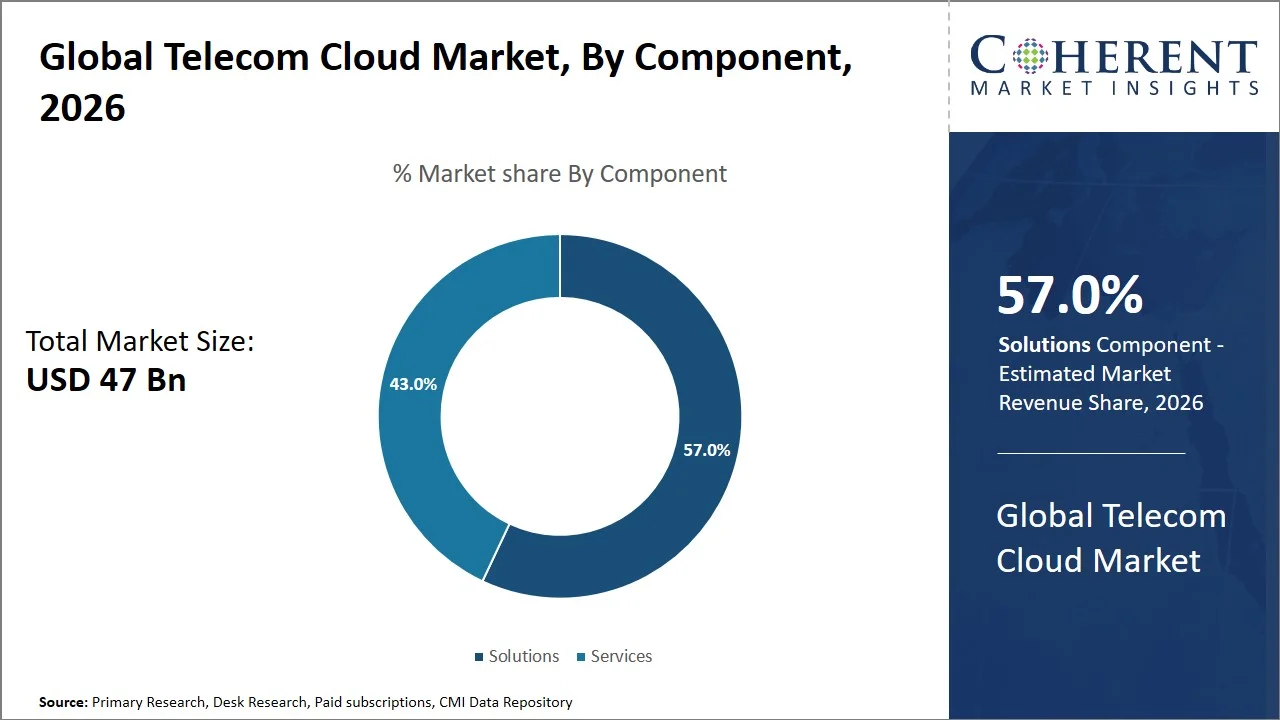
- The solutions segment is expected to account for 57.0 % of the global telecom cloud market share in 2026. Expansion of AI-driven network automation and orchestration is driving the growth of the segment. On March 5, 2025, Mavenir and e& UAE, the telecom arm of a global technology group, e&, announced a collaboration to advance e& UAE’s future of cloud-native converged packet core networks across 4G and 5G.
- The public cloud segment is estimated to capture 44.0 % of the market share in 2026. Rising telecom investments in multi cloud environments is majorly driving the growth of the segment. On November 4, 2025, Deutsche Telekom and a global AI infrastructure company, NVIDIA celebrated the first major milestone for the world’s first industrial AI cloud, one of Europe’s largest AI infrastructures, in the presence of high-ranking representatives from politics, business and science.
- The infrastructure as a service segment is estimated to capture 53.0 % of the market share in 2026. Expansion of open RAN deployments using cloud native architecture is driving the growth of the segment. On February 23, 2026, Tune Talk, one of Malaysia’s most recognized mobile brands, has completed its evolution into a fully independent, cloud-native mobile network operator (MNO) through a strategic partnership with Mavenir, the network software provider building AI‑driven mobile infrastructure.
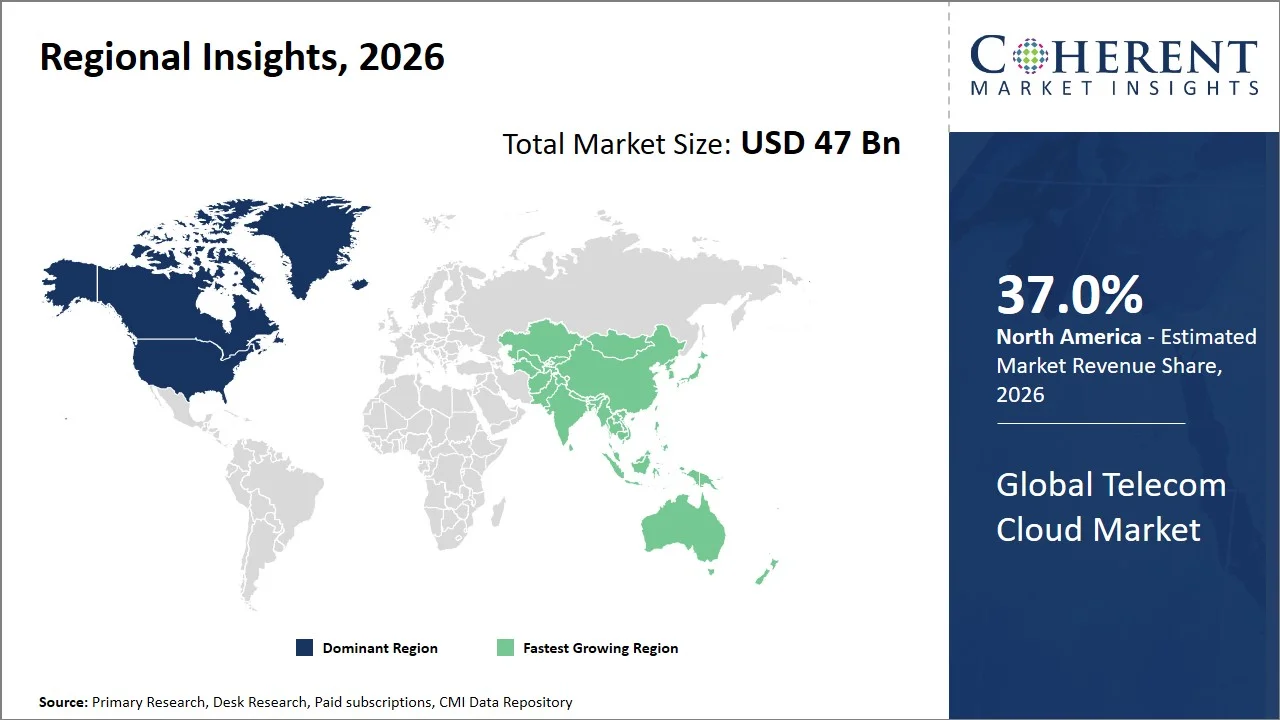
- North America is expected to dominate the telecom cloud market in 2026 with a market share of 37.0 %. Increasing adoption of telecom cloud for IoT connectivity services in North America is driving the growth of the regional market. On September 11, 2025, Gigs, the operating system for mobile services, and AT&T, the largest network in North America, joined forces to transform how phone plans are delivered to hundreds of millions of U.S. consumers.
- Asia Pacific is expected to account for 30.0 % of the market share in 2026 and is projected to record the fastest growth over the forecast period. Rising demand for edge cloud services supporting low latency applications across Asia Pacific is driving the growth of the regional market. On March 11, 2025, Airtel announced an agreement with SpaceX to bring Starlink’s high-speed internet services to its customers in India. This is the first agreement to be signed in India, which is subject to SpaceX receiving its own authorizations to sell Starlink in India.
- Cloud Native 5G Core Network Transformation: Telecom operators are quickly replacing monolithic network architectures with cloud native 5G cores built on top of containerized microservices and Kubernetes-based platforms to improve network scalability, service agility, and automated lifecycle management. This enables the faster deployment of new digital services and lower operational complexity.
- Expansion of Edge Cloud for Ultra Low Latency Services: Telecom operators are deploying distributed edge cloud infrastructure closer to end users to support latency sensitive applications such as autonomous vehicles, industrial automation, immersive AR and VR, cloud gaming, and smart city services, creating new revenue opportunities beyond traditional connectivity offerings.
Segmental Insights
Why Does the Solutions Segment Dominate the Global Telecom Cloud Market?
The solutions segment is expected to account for 57.0% of the global telecom cloud market share in 2026. Solutions are highly preferred in the worldwide telecom cloud market as they enable operators to combine networks operations, automation platforms and cloud-native services through flexible and scalable architectures. Telecom operators are increasingly packaging orchestration, virtualization, security, analytics and managed cloud capabilities as solutions offer ease in complicated network transformations and reduce deployment issues. These integrated solutions allow operators to speed 5G rollouts, address edge computing requirements and increase operational efficiency without having to resort to fragmented technology from different suppliers. On February 4, 2025, AT&T announced that it is extending its voice core relationship with Nokia in a multi-year expansion deal that will support the U.S. operator in delivering on its vision of securely providing customer-focused networks and automation that drive new services, faster deployment times, and operational efficiencies.
- Current Industry Events of 2026
- Market Size Estimation
- Regional Breakdown
- Competitive Landscape
- Customer Intelligence
- Segmental Analysis
- Pricing Analysis
- Key Market Drivers, Challenges & Future Trends
- Customized Insights Section
Why is Public Cloud the Most Preferred Deployment Type?
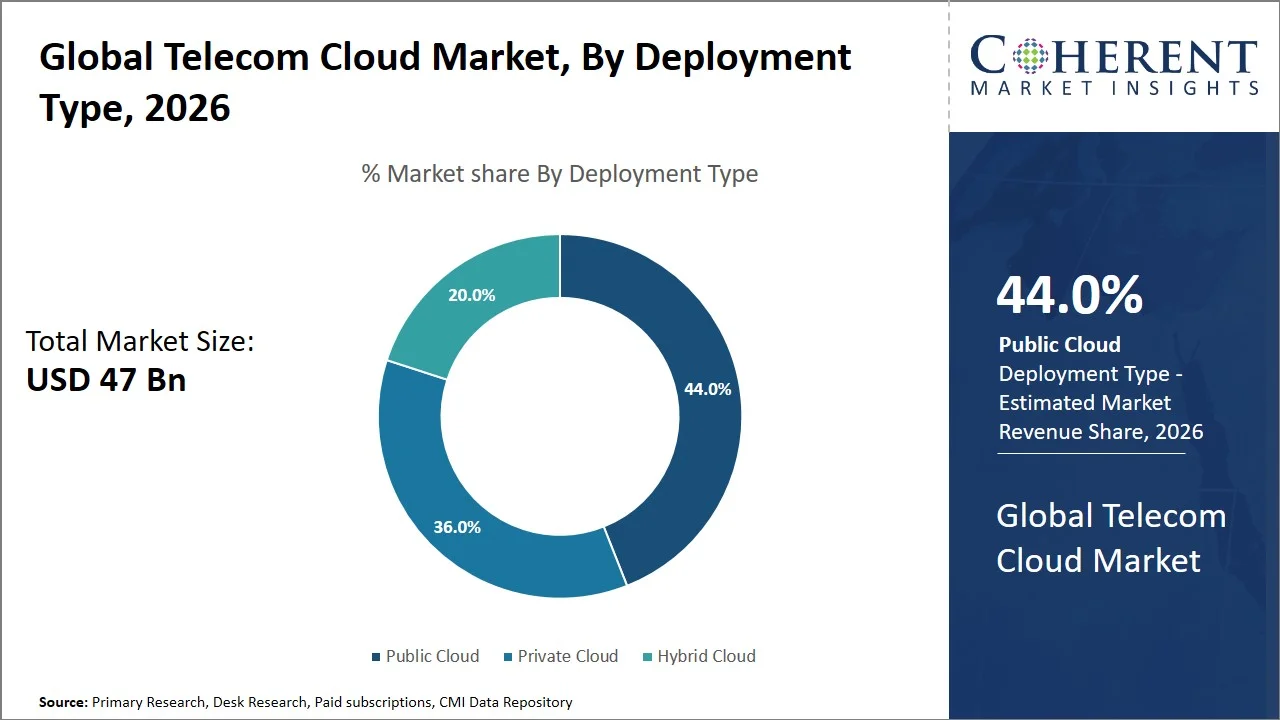
The public cloud segment is expected to account for 44.0% of the global telecom cloud market share in 2026. The public cloud has become the deployment type of choice since it allows telecom operators to quickly scale computing, storage and network resources without having to make a significant upfront investment in physical infrastructure. As the demand for 5G services, edge applications, artificial intelligence workloads and digital customer experiences grows, public cloud platforms offer the ability to deploy new services fast while optimizing resource usage across geographically scattered networks. This scalability, together with ongoing access to sophisticated cloud-native tools and infrastructure around the globe, enables telecom operators to speed innovation and improve service delivery, all while retaining operational efficiency. On July 15, 2026, Poste Italiane and TIM announced that they would work together to develop a national distributed cloud platform, leveraging TIM’s telecommunications infrastructure and Poste Italiane’s nationwide locations to increase public cloud capacity, edge computing resources and cloud-native digital services for companies and public-sector organizations.
Infrastructure as a Service Dominates the Global Telecom Cloud Market
The infrastructure as a service segment is expected to account for 53.0% of the global telecom cloud market share in 2026. Infrastructure as a Service (IaaS) is extensively used, as it gives telecom operators highly scalable computing, storage and networking resources to facilitate the quick deployment of cloud-native network functions and digital services. Telecom companies are progressively virtualizing essential infrastructure of their networks to manage surging data traffic, expand 5G and edge computing applications without the cost and complexity of maintaining large onsite hardware installations. Infrastructure as a service is one of the key cornerstones of today’s telecom network transformation, providing the flexibility to provision infrastructure on demand, optimize resource usage, and serve large-scale workloads across numerous locations. On December 10, 2024, Terrestar and Mavenir successfully demonstrated NB-IoT connectivity via non-terrestrial satellite networks. The companies used Mavenir’s cloud-native infrastructure platform to offer telecom services over scalable virtualized infrastructure for satellite-enabled IoT applications.
Currents Events and their Impact
Current Events | Description and its Impact |
European Union - Gigabit Infrastructure Act |
|
United States - FCC AWS-3 Spectrum and 5G Fund Implementation |
|
Global Telecom Cloud Market Dynamics
Market Drivers
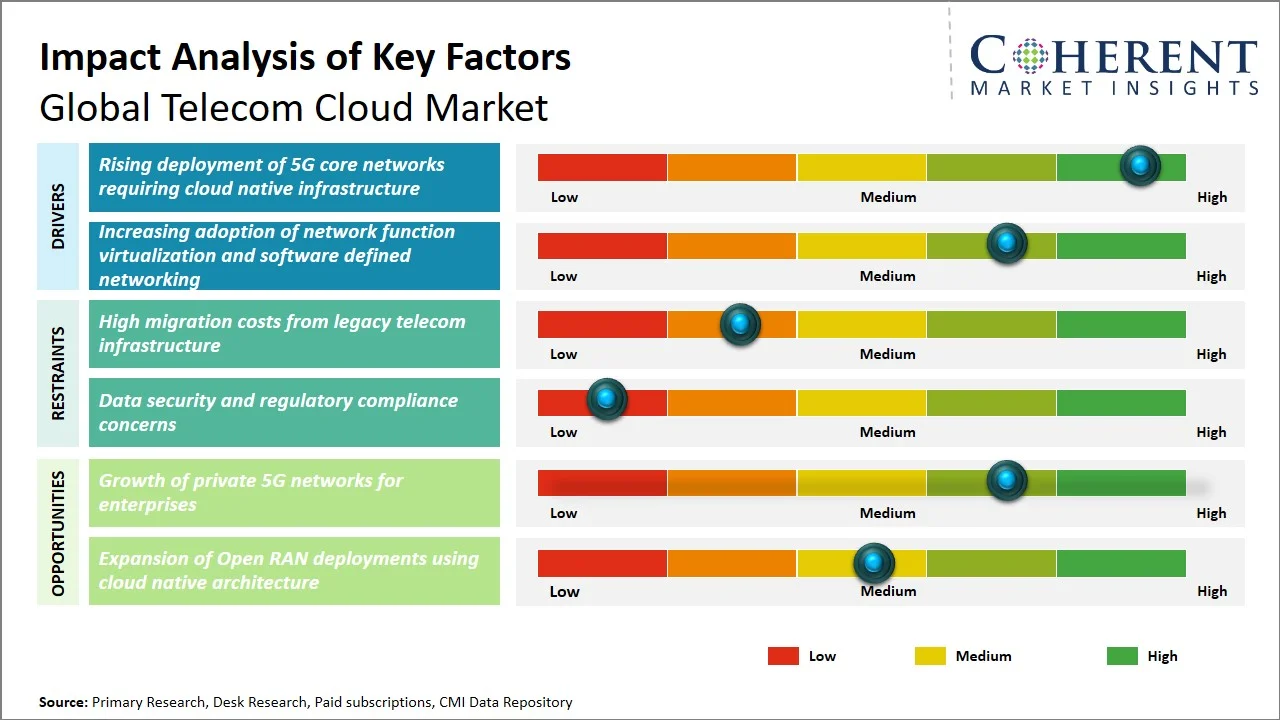
- Rising deployment of 5G core networks requiring cloud native infrastructure: Telecom operators are aggressively rolling out standalone 5G core networks built on cloud-native designs to boost scalability, network automation, and service flexibility. Unlike traditional hardware-based networks, cloud-native 5G cores use containerized network functions, microservices and Kubernetes-based orchestration, enabling operators to deploy new services faster, lower operational complexity, and enable network slicing, edge computing and ultra-low-latency applications. This shift is leading to major investment in telecom cloud platforms that are capable of handling distributed and highly virtualized network infrastructures. On November 5, 2025, Nokia announced an expansion of its partnership with SoftBank Corp. through a new deal to supply advanced 4G and 5G radio access equipment in Japan. The agreement encompasses the modernization of existing network infrastructure and the expansion of 5G standalone coverage using Nokia's cutting-edge AirScale portfolio.
- Increasing adoption of network function virtualization and software defined networking: Telecom service providers are increasingly adopting network function virtualization (NFV) and software defined networking (SDN) to replace proprietary hardware with software-based network functions operating on cloud infrastructure. This solution allows centralized control of the network, dynamic resource allocation, faster service provisioning and reduced infrastructure cost and enhancing the flexibility of the network. Operators are modernizing older networks to accommodate 5G, enterprise connectivity and multi-cloud operations, accelerating demand for advanced telecom cloud solutions as NFV and SDN continue to be adopted. On February 26, 2025, Bell Canada successfully completed Open RAN field trials of Cohere Technologies’ Universal Spectrum Multiplier (USM) software. The study, conducted on Bell Canada’s commercial 5G Standalone network, demonstrated software-based capacity gains that didn’t require changes to current radios or antennas.
Emerging Trends
- Growing Adoption of AI Driven Autonomous Network Operations: Telecom cloud environments are incorporating artificial intelligence and machine learning to automate network planning, predictive maintenance, fault detection, traffic optimization and energy management. This allows communication service providers to improve network performance while reducing operational costs and improving customer experience.
- Rise of Multi Cloud and Open RAN Ecosystems: Telecom operators are increasingly adopting multi cloud strategies, combined with Open RAN architectures, to reduce vendor dependency, increase infrastructure flexibility, accelerate network innovation, and enable seamless interoperability between cloud platforms and network equipment from multiple technology providers.
Regional Insights
Why is North America a Strong Market for Telecom Cloud?
North America is expected to account for a market share of 37.0% in 2026. North America continues to dominate in telecom cloud adoption due to ambitious cloud-native network transformation initiatives by top operators such as AT&T, Verizon, T-Mobile US, Bell Canada and Rogers Communications. AT&T has expanded its cloud-based 5G core and Open RAN efforts with partnerships with Microsoft Azure and Ericsson, and Verizon continues to roll out virtualized network functions and edge cloud infrastructure with Amazon Web Services (AWS) and NVIDIA to support AI-enabled telecom services. T-Mobile US boasts one of the largest independent 5G core networks, built on a cloud-native architecture created with Nokia and Cisco, while Bell Canada is working with Google Cloud to modernize network analytics and customer operations. Hyperscalers such as AWS, Google Cloud, Microsoft Azure and Oracle cloud technology continue to grow telecom-specific cloud platforms and distributed edge technology, further bolstering regional telecom cloud expenditures.
Why Does the Asia Pacific Telecom Cloud Market Exhibit High Growth?
Asia Pacific is projected to account for 30.0% of the global telecom cloud market and is expected to register the fastest growth. Asia Pacific is the fastest growing telecom cloud industry driven by the quick commercialization of 5G standalone networks, Open RAN deployments and massive digital infrastructure projects. Major operators including NTT DOCOMO, SoftBank, KDDI, China Mobile, China Telecom, China Unicom, SK Telecom, KT Corporation, Reliance Jio, Bharti Airtel, Singtel and Telstra are introducing cloud-native core networks and virtualized network operations. Rakuten Symphony continues to deploy its cloud-native telecom platform across the region and is joined by Samsung Networks, Nokia, Ericsson and Mavenir, providing cloud-based radio and core network solutions. Countries in the region are also investing in edge computing facilities that combine telecom cloud platforms with artificial intelligence, industrial automation, and enterprise connection services.
Global Telecom Cloud Market Outlook for Key Countries
Why is the U.S. Emerging as a Major Hub in the Telecom Cloud Market?
The U.S. is at the vanguard of telecom cloud innovation, with AT&T, Verizon and T-Mobile US widely deploying cloud-native 5G infrastructure. Verizon has broadened its Private 5G with AWS offerings to manufacturing and logistics customers, and AT&T has advanced its cloud-based network automation strategy with partnerships with Microsoft Azure and Ericsson. T-Mobile US has rolled out a countrywide independent 5G core based on cloud-native technology from Cisco and Nokia, enabling it to support sophisticated network slicing and edge computing capabilities. Oracle Communications, Juniper Networks, VMware by Broadcom, Red Hat and Dell Technologies are also providing virtualization, orchestration and cloud management systems to assist nationwide telecom modernization.
Is China the Next Growth Engine for the Telecom Cloud Market?
China Mobile, China Telecom and China Unicom have together invested in building one of the world’s most advanced telecom cloud ecosystems. These operators keep developing cloud-native 5G core networks with technology from Huawei, ZTE and Inspur and integrate artificial intelligence into network operations and service management. Huawei’s cloud-native core platform is supporting large-scale independent 5G deployments across many provinces, while ZTE continues to provide virtualized network infrastructure for enterprise and public sector connectivity. Chinese cloud providers such as Alibaba Cloud and Tencent Cloud are rapidly cooperating with telecom operators to offer edge cloud services that power smart manufacturing, autonomous shipping and industrial internet applications.
Germany Telecom Cloud Market Analysis and Trends
The telecom cloud market in Germany is driven by the need for enhanced industrial connections and statewide 5G upgrade. Deutsche Telekom continues to build its cloud-native core network employing solutions from Nokia, Ericsson and Google Cloud, while Vodafone Germany has expedited implementation of Open RAN and virtualized network operations. 1&1 is deploying Europe’s first large-scale cloud native Open RAN mobile network powered by technology from Rakuten Symphony and Mavenir, marking a major step towards software-defined telecom infrastructure. The automotive, industrial automation and manufacturing sectors in Germany are demanding enterprise solutions, which continues to push telecom carriers to offer edge cloud systems supporting low-latency industrial applications.
South Korea Telecom Cloud Market Analysis and Trends
SK Telecom, KT Corporation and LG Uplus have been constantly innovating to lead telecom cloud deployment in South Korea. SK Telecom has expanded its AI-integrated cloud-native network operations and deployed sophisticated edge cloud infrastructure for autonomous mobility and smart manufacturing applications. KT Corporation is also further developing its cloud-based 5G core capabilities and enterprise private network services. LG Uplus has also included virtualized network infrastructure for media streaming, cloud gaming and industrial connection. Major domestic IT businesses such as Samsung Networks and Samsung SDS have led the supply of cloud-native telecom platforms, virtualized radio networks and AI-powered network management solutions.
Japan Telecom Cloud Market Analysis and Trends
Japan’s telecom cloud market is characterized by the early adoption of cloud-native mobile networks and widespread Open RAN deployment. NTT DOCOMO further upgrades its nationwide network using cloud-native core technologies and AI-based network automation developed jointly with Nokia, NEC and Fujitsu. Rakuten Mobile runs one of the world’s most advanced fully virtualized cloud-native mobile networks, and Rakuten Symphony offers telecom cloud software and Open RAN platforms to operators globally. SoftBank will build distributed edge cloud infrastructure for enterprise digital transformation and KDDI will continue providing cloud-native network services with Google Cloud to power low latency applications, linked mobility and industrial digitalization.
Global Telecom Cloud Market - Software Defined Networking Implementation Trends
Region | SDN Implementation | Primary Adoption Drivers |
North America | 79% | 5G Standalone deployment AI network automation hyperscale cloud partnerships |
Europe | 71% | Open RAN initiatives telecom virtualization EU digital infrastructure |
Asia Pacific | 68% | Rapid 5G rollout edge computing smart manufacturing |
Middle East | 56% | Smart city investments national digital transformation |
Latin America | 49% | Telecom modernization cloud migration programs |
Africa | 38% | Broadband expansion mobile network modernization |
How is the Growth of Private 5G Networks for Enterprises Creating New Growth Opportunities in the Telecom Cloud Market?
The fast adoption of private 5G networks across manufacturing plants, logistics hubs, airports, ports, energy facilities and large enterprise campuses is creating huge growth opportunities for the telecom cloud market as these networks are highly dependent on cloud-native cores, virtualized network functions, edge computing platforms and central orchestration systems. Enterprises want dedicated, secure, low-latency connectivity that can be adapted to unique operational needs. Telecom operators and cloud providers are addressing this with private 5G as a managed service delivered through cloud platforms. Verizon, AT&T, NTT DOCOMO, Deutsche Telekom, Vodafone and SK Telecom are scaling private 5G solutions for enterprises that include cloud management, network analytics, AI-driven automation and edge computing capabilities.
On February 28, 2024, Tech Mahindra and Pegatron announced the signing of a Memorandum of Understanding (MoU) at Mobile World Congress (MWC) 2024. The two organizations will develop private 5G solutions for global enterprises. The partnership between the organizations will explore mutually beneficial opportunities in the fast-growing private 5G space, positioning it as a catalyst for business growth.
Market Players, Key Development, and Competitive Landscape
Key Developments
- On March 24, 2025, Nokia announced the launch of Broadband Easy, a digital platform and set of services that help operators streamline and accelerate the process of deploying fiber. The digital platform gives operators full visibility and control of the entire fiber rollout process, while advanced automation and AI models help ensure design, installations, and budget of the project are optimized.
- On February 26, 2025, Mavenir announced that it has strengthened its long-term partnership with Telefónica and its global operating companies, with the signing of a new five-year contract which will see O2 Telefónica Germany transition from Mavenir’s virtualized IMS (vIMS) to Cloud-Native IMS solution. The multi-year contract extension covers both fixed and mobile IMS networks serving O2 Telefónica Germany’s entire subscriber base.
Competitive Landscape
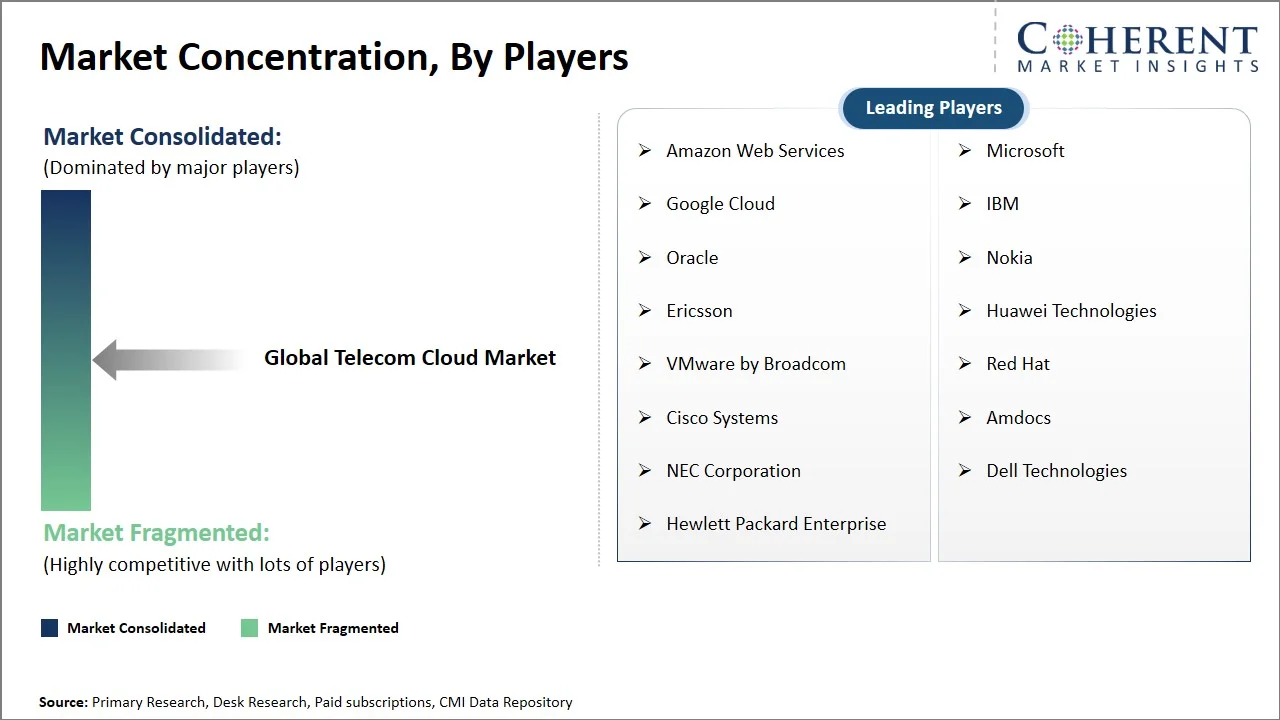
The global telecom cloud market is characterized by the presence of leading players such as Microsoft, Amazon Web Services (AWS), Google Cloud, Oracle, Ericsson, Nokia, Huawei, Cisco, VMware by Broadcom, Red Hat, Mavenir, NEC, Fujitsu, Samsung Networks, and Rakuten Symphony, each pursuing distinct cloud-native network strategies to enhance scalability, automation, interoperability, and next-generation telecom infrastructure capabilities. Microsoft focuses on carrier-grade cloud infrastructure with Azure Operator Nexus and agreements with AT&T and key global operators to enable cloud-native 5G cores. AWS is also growing its AWS Telco Network Builder, AWS Outposts, and AWS Wavelength to support edge telecom workloads, while Google Cloud is focusing on AI-powered network operations through partnerships with Deutsche Telekom, KDDI and Bell Canada. Oracle bolsters its position with Oracle Communications Cloud Native Core and distributed cloud deployments for telecom operators.
Market Report Scope
Telecom Cloud Market Report Coverage
| Report Coverage | Details | ||
|---|---|---|---|
| Base Year: | 2025 | Market Size in 2026: | USD 47 Bn |
| Historical Data for: | 2020 To 2024 | Forecast Period: | 2026 To 2033 |
| Forecast Period 2026 to 2033 CAGR: | 14% | 2033 Value Projection: | USD 169 Bn |
| Geographies covered: |
| ||
| Segments covered: |
| ||
| Companies covered: | Amazon Web Services, Microsoft, Google Cloud, IBM, Oracle, Nokia, Ericsson, Huawei Technologies, VMware by Broadcom, Red Hat, Cisco Systems, Amdocs, NEC Corporation, Dell Technologies, and Hewlett Packard Enterprise | ||
| Growth Drivers: |
| ||
| Restraints & Challenges: |
| ||
Analyst Opinion (Expert Opinion)
- Telecom cloud market competition is increasingly being shaped by advanced software orchestration capabilities rather than traditional network equipment offerings. Competitive differentiation is shifting from proprietary hardware performance toward cloud-native platforms, automation frameworks, network intelligence, and the ability to efficiently manage complex digital network environments. Cloud-native core maturity, Open RAN interoperability, AI-enabled network automation, Kubernetes-based lifecycle management, and the ability to operate distributed edge cloud environments across multiple public cloud providers are all becoming key differentiators for competitiveness.
- There is also a slow shift to hyperscaler-led telecom transformation, where cloud providers are shifting away from being technology providers to being long-term strategic infrastructure partners. Cloud platforms that are specific to telecom such as Azure Operator Nexus, AWS Telco Network Builder, Oracle Communications Cloud Native Core and Google Distributed Cloud are gaining prominence. Vendors who offer integrated AI operations, sovereign cloud support and multi-cloud portability are likely to have a competitive edge over those who have built their businesses around traditional network hardware.
- The telecom cloud market is likely to transition to a highly dispersed cloud architecture, with telecom core networks, radio access functions, edge computing resources, and corporate applications operating as a single cloud platform. AI-native network management, autonomous service orchestration, network APIs, cloud-based 6G readiness, and sovereign telecom cloud deployments are expected to define future competition. Collaborations between hyperscalers, telecom operators, semiconductor companies, and Open RAN software providers are expected to redefine network ownership models and accelerate the transition to full software-defined telecommunications infrastructure.
Speak to the analyst
Want personalized insights?
Take the findings above to one of our principal consultants, or have the report rebuilt around the segments, geographies and competitors you actually track.
Market Segmentation
- Component Insights (Revenue, USD Billion, 2021 - 2033)
- Solutions
- Services
- Deployment Type Insights (Revenue, USD Billion, 2021 - 2033)
- Public Cloud
- Private Cloud
- Hybrid Cloud
- Service Model Insights (Revenue, USD Billion, 2021 - 2033)
- Infrastructure as a Service
- Platform as a Service
- Software as a Service
- Application Insights (Revenue, USD Billion, 2021 - 2033)
- Billing and Provisioning
- Customer Management
- Traffic Management
- Network Management
- Data Analytics
- Unified Communications
- Regional Insights (Revenue, USD Billion, 2021 - 2033)
- North America
- U.S.
- Canada
- Latin America
- Brazil
- Argentina
- Mexico
- Rest of Latin America
- Europe
- Germany
- U.K.
- Spain
- France
- Italy
- Russia
- Rest of Europe
- Asia Pacific
- China
- India
- Japan
- Australia
- South Korea
- ASEAN
- Rest of Asia Pacific
- Middle East
- GCC Countries
- Israel
- Rest of Middle East
- Africa
- South Africa
- North Africa
- Central Africa
- North America
- Key Players Insights
- Amazon Web Services
- Microsoft
- Google Cloud
- IBM
- Oracle
- Nokia
- Ericsson
- Huawei Technologies
- VMware by Broadcom
- Red Hat
- Cisco Systems
- Amdocs
- NEC Corporation
- Dell Technologies
- Hewlett Packard Enterprise
Sources
Primary Research Interviews
- Telecom Cloud Solution Providers
- Network Infrastructure Specialists
- Cloud Service Providers & Integrators
- Enterprise Telecom Decision Makers
Magazines
- Telecom Asia Magazines
- IEEE Spectrum (Telecom & Cloud Edition)
- Cloud Computing Magazine
- Light Reading Magazine
Journals
- Journal of Cloud Computing (Springer)
- IEEE Transactions on Cloud Computing
- International Journal of Network Management (Wiley)
Associations
- GSMA (Global System for Mobile Communications Association)
- TM Forum (TeleManagement Forum)
- Cloud Native Computing Foundation (CNCF)
- International Telecommunication Union (ITU)
Public Domain Sources
- U.S. Federal Communications Commission (FCC) Reports
- European Telecommunications Standards Institute (ETSI) Publications
- World Economic Forum (WEF) Digital Infrastructure Reports
- OECD Broadband & Telecom Statistics Portal
Proprietary Elements
- CMI Data Analytics Tool
- Proprietary CMI Existing Repository of Information for the Last 10 Years
Get access to 250+ pages report
Every segment, forecast, competitor profile and data table behind the analysis above — available for instant download.
- ESOMAR Member
- ISO 9001:2015 Certified
- D-U-N-S Registered
- GDPR & CCPA Compliant
Missing comfort of reading report in your local language? Find your preferred language:
Transform your Strategy with Exclusive Trending Reports
Frequently Asked Questions
The global telecom cloud market is expected to stand at USD 47 Bn in 2026 and is expected to reach USD 169 Bn by 2033.
The CAGR of the global telecom cloud market is projected to be 14% from 2026 to 2033.
Network function virtualization replaces dedicated telecom hardware with software-based network functions running on cloud platforms.
Edge computing enables low-latency processing by bringing cloud resources closer to end users and connected devices.
Rising deployment of 5G core networks requiring cloud native infrastructure and increasing adoption of network function virtualization and software defined networking are the major factors driving the growth of the global telecom cloud market.
High migration costs from legacy telecom infrastructure and data security and regulatory compliance concerns are the major factors hampering the growth of the global telecom cloud market.
In terms of component, the solutions segment is estimated to dominate the market revenue share in 2026.